
microRNA: the tiny brakes on our genes
Nobel Prize in Physiology or Medicine, 2024: Victor Ambros and Gary Ruvkun

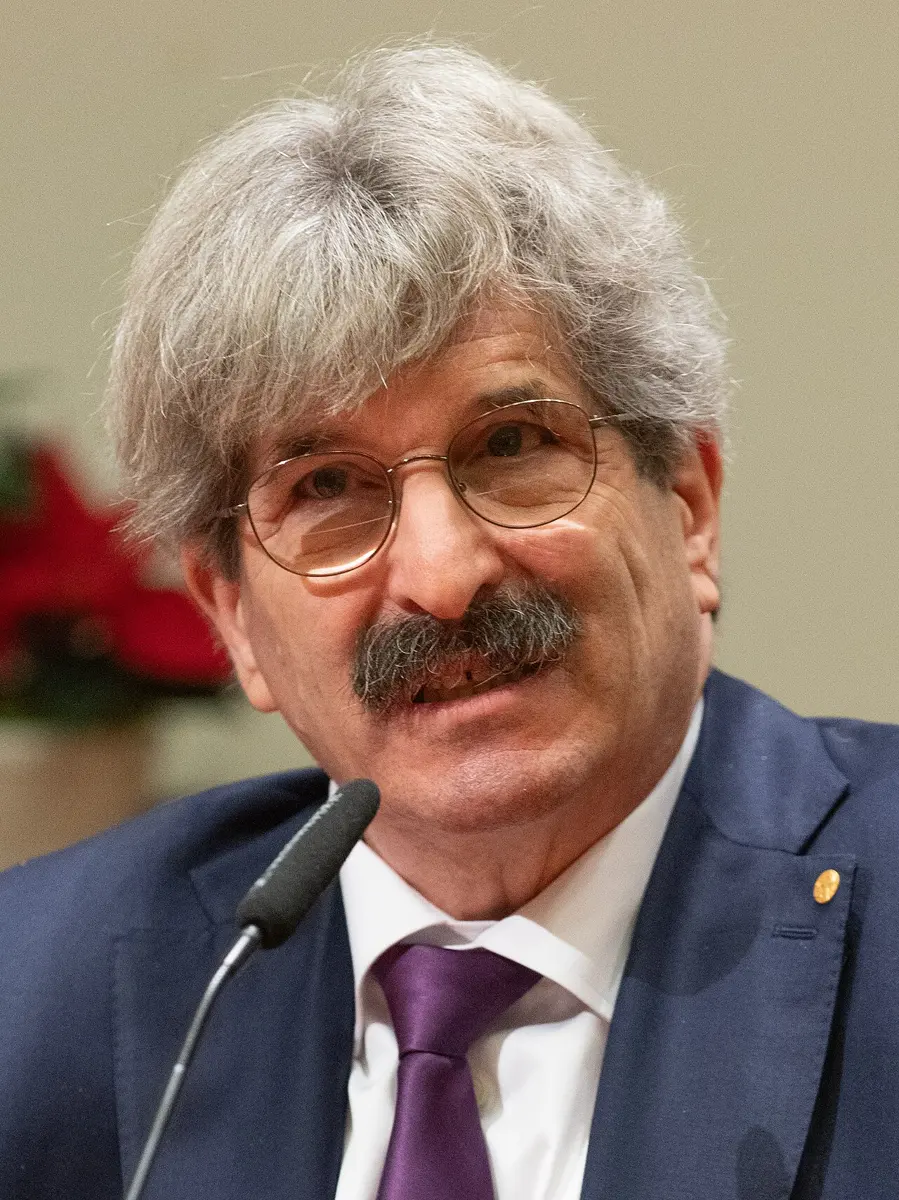
Victor Ambros
born 1953 in the United States
He grew up on a small dairy farm in Vermont, one of eight children, and spent forty years studying one tiny worm.
Photo: Arthur Petron, CC BY-SA 4.0
Gary Ruvkun
born 1952 in the United States
A geneticist who first studied bacteria, then switched to worms after hearing about them while traveling through Europe.
Photo: John Sears, CC BY-SA 4.0
A cell in your eye and a cell in your stomach look nothing alike and do completely different jobs. Yet both carry exactly the same DNA, the same set of about 20,000 genes. So how does each cell know which genes to use?
For a long time scientists thought they knew most of the answer. Then, in 1993, two scientists studying a worm smaller than a grain of rice found a new kind of switch that nobody had imagined: a tiny piece of RNA that tells a gene to quieten down. In 2024 the Nobel Prize in Physiology or Medicine went to Victor Ambros and Gary Ruvkun for discovering microRNA.
The problem: same genes, different cells
You began as a single cell. That cell divided again and again, and every new cell got a copy of the same DNA Grade 10: Mitosis. Today your body is made of trillions of cells of hundreds of kinds: nerve cells, muscle cells, skin cells, blood cells.
Think of your DNA as a big recipe book, and each gene as one recipe. Every cell in your body has the whole book, but a muscle cell cooks only the muscle recipes, and a nerve cell only the nerve ones. Turning the right genes on and off, in the right cell at the right time, is called gene regulation (Same DNA, different cells).
Gene regulation also matters from day to day. A cell has to adjust when you eat, sleep, catch a cold or grow. When it goes wrong, the result can be serious diseases such as cancer or diabetes.
How a gene makes a protein
Most genes are recipes for proteins, the molecules that do most of the work in a cell. A gene is used in two steps (How does a gene make a protein?):
- Copying. In the nucleus, the cell copies the gene into a working copy, a molecule of messenger RNA (mRNA) Grade 10: RNA. Like DNA, RNA is written in a code of four “letters”, called bases; in RNA they are A, U, G and C.
- Building. The mRNA travels out to a ribosome, the cell’s protein-building machine Grade 8: Ribosomes. The ribosome reads the letters and joins amino acids in that order to make the protein.
In the 1960s scientists found proteins called transcription factors that sit on the DNA and decide which genes are copied into mRNA at all. Thousands of them were found. By the 1980s many scientists thought the main rules of gene regulation were known: a gene is controlled at the copying step.
Your nerve cells and your muscle cells contain the same genes. Why are they so different?
Pick an answer to see why.
A worm that grows up on time
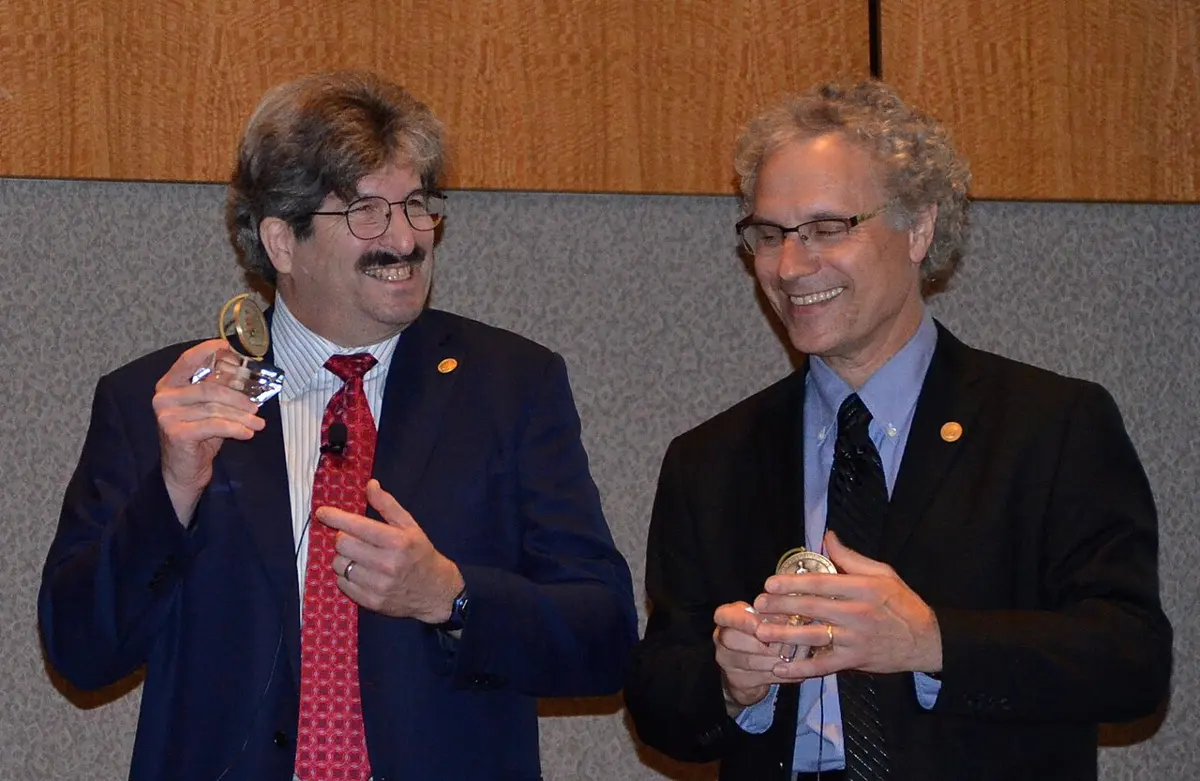
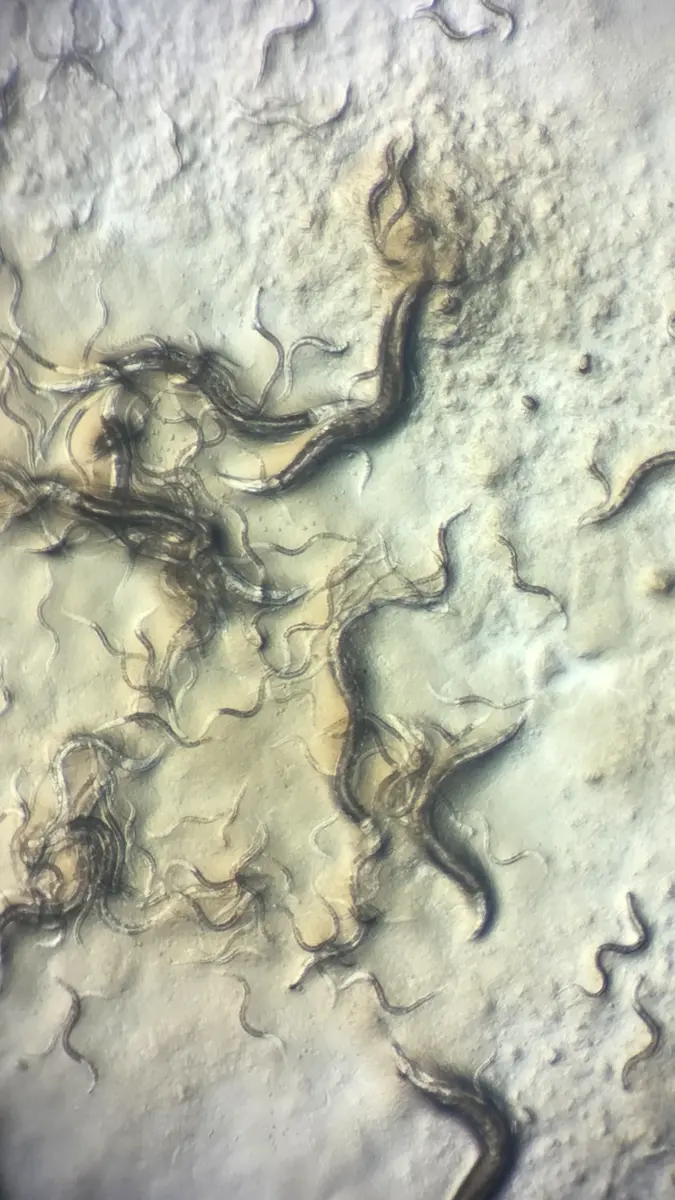
Ambros and Ruvkun found their answer in a worm called Caenorhabditis elegans (C. elegans for short). It is a roundworm, a relative of the Ascaris that a school worm tablet gets rid of Grade 10: Nemathelminthes. But C. elegans is harmless: it lives in soil and rotting fruit and eats bacteria.
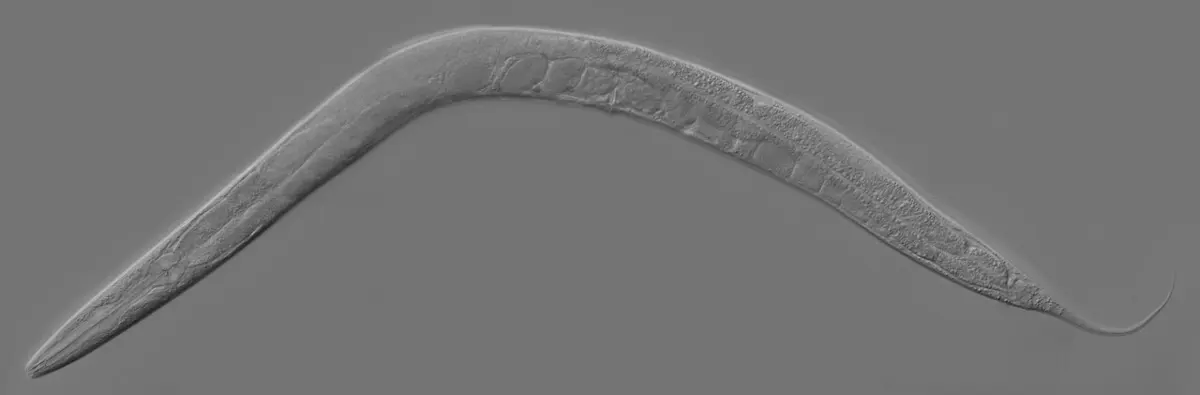
Biologists love this worm. It is about 1 millimeter long and see-through. An adult has only about a thousand body cells, yet it has nerves, muscles, a gut and skin like bigger animals. And it grows fast: from egg to adult takes about three days. On the way it passes through four larval stages, called L1, L2, L3 and L4, a little like a student passing through four classes. In each stage, particular cells divide and become particular things, always at the right time.
In the 1980s Ambros and Ruvkun were young scientists in the laboratory of Robert Horvitz in Boston (he won the Nobel Prize himself in 2002). They studied mutant worms, worms with a damaged gene, whose cells got the timing wrong:
- In worms with a broken gene called lin-4, cells kept repeating what they do in the first stage, L1, again and again. The worms never grew the adult parts. They could not even lay their eggs, which hatched inside them.
- In worms with a broken gene called lin-14, it was the other way round. The cells skipped the L1 program and jumped ahead to later stages too early.
Ambros had shown that the two genes worked against each other: lin-4 switches lin-14 off. The lin-14 gene makes the LIN-14 protein. When there is a lot of it, the cells do “L1 things”. At the end of L1 its amount must fall, so that the worm can move on to L2. But how did lin-4 bring it down?
Why it was hard
In the 1980s, finding the actual DNA of a gene was slow, hard work. Scientists only knew a gene was “somewhere on this chromosome” because damaging it changed the worm. They had to search along the chromosome piece by piece. Ambros and Ruvkun worked for years to find lin-14.
And everybody expected the answer to be a protein. A gene makes a protein: that was the rule. So when lin-4 seemed to make no protein at all, the first thought was that something was wrong with the experiment.
What they did, step by step
By the mid-1980s both men had their own laboratories in Boston: Ambros at Harvard University, and Ruvkun at Massachusetts General Hospital and Harvard Medical School. Ambros worked on lin-4, Ruvkun on lin-14.
Ambros: a gene with no protein
- Finding the gene. With Rosalind Lee and Rhonda Feinbaum, Ambros narrowed lin-4 down to a small piece of DNA, 693 letters long. Putting just this piece into a mutant worm made it normal again, so the gene was there.
- No protein. They looked for the protein it made, and found none. Even when they changed the DNA so that any protein would come out garbled, the gene still worked. So lin-4 didn’t need a protein at all.
- 1991: tiny RNAs. They found what the gene did make: two very short pieces of RNA, 61 and 22 letters long. An ordinary mRNA is often more than a thousand letters long. This RNA was tiny, and it was not a recipe for anything.
Ruvkun: the problem was in the tail
- The same mRNA, more protein. Ruvkun measured both the lin-14 mRNA and the LIN-14 protein. In worms where lin-4 could not work, there was 4 to 7 times more protein, but just as much mRNA. So the gene was being copied normally. The control came later, at the building step. That was new: genes were thought to be controlled at the copying step.
- A “tail” that matters. An mRNA has a part at its end that the ribosome never reads, called the tail here (scientists call it the 3′ untranslated region). Ruvkun found that mutant worms with a piece of this tail missing made too much LIN-14. Cutting the tail down step by step, his team found a stretch of just 124 letters that was enough to switch protein making off at the right time.
1992: the two halves fit
On the evening of 11 June 1992, Ambros and Ruvkun compared their results. Ambros had the letters of the tiny lin-4 RNA. Ruvkun had the letters of the lin-14 tail. They saw at once that parts of the tiny RNA matched several places in the tail, the way the two strands of DNA match: A pairs with U, and G pairs with C.
So the idea was this. The tiny lin-4 RNA sticks to the tail of the lin-14 mRNA, and that stops the ribosomes making LIN-14 protein. More experiments in both laboratories showed that this was right. They published their results side by side in the journal Cell in 1993: a new kind of gene, whose product was not a protein but a tiny RNA that switches another gene down.
Ruvkun found that worms without working lin-4 had the same amount of lin-14 mRNA but much more LIN-14 protein. What did that tell him?
Pick an answer to see why.
How microRNA works
The lin-4 RNA was the first microRNA: “micro” because it is tiny, about 22 letters long. Thousands more are now known. They all work in a similar way.
- A microRNA gene is copied into RNA that folds back on itself, like a hairpin.
- The cell trims it, in two cuts, down to about 22 letters, and loads it into a protein that carries it around the cell.
- The microRNA finds an mRNA whose tail has letters that match a short stretch of its own, especially about seven letters near its front end.
- It sticks there. Then fewer proteins are made from that mRNA, and the mRNA is broken down sooner.
A microRNA is not an on–off switch; it is more like a brake or a volume knob. It turns a gene down, often only partly. And because it needs only a short match, one microRNA can turn down hundreds of different genes, and one gene can be turned down by many microRNAs. Together they fine-tune whole groups of genes at once.
At the 2024 prize ceremony, the speaker compared your genes to the musicians of a large orchestra. Transcription factors are like conductors who tell musicians to play louder or softer. MicroRNAs are a different kind of conductor: they only ever say, “You there, play softer! You, take a break!”
Why can one kind of microRNA control hundreds of different genes?
Pick an answer to see why.
Seven years of silence, then let-7
The 1993 papers met with what the Nobel committee called “almost deafening silence”. Most scientists thought lin-4 was an oddity of worms. When they searched for its letters in other animals, they found it only in close worm relatives.
That changed in 2000. Ruvkun’s team found a second microRNA in the worm, made by a gene called let-7. It too controlled the worm’s timing. But this time, when they searched other animals, the same microRNA, with the same letters, turned up in fruit flies, zebrafish and humans. A brake that has stayed the same for hundreds of millions of years must be important.
Suddenly, laboratories everywhere went looking. In 2001 three groups, including Ambros’s, reported dozens more. Today more than a thousand microRNA genes are known in humans, and microRNAs are found in all many-celled animals and in plants. They began to multiply in animals’ genes about 600 million years ago, around the time animals with many kinds of cells appeared.
In your life today
- Your own body. Your microRNAs are at work in almost every cell right now. Scientists estimate that more than half of all human genes are controlled by at least one microRNA. Mice and fish whose cells cannot make microRNAs die before they are born.
- Diseases. When microRNAs go wrong, the body suffers. A change of one letter in a microRNA called miR-96 causes a kind of hearing loss that runs in families, and changes in others cause eye and bone disorders. Children with a faulty copy of DICER1, the gene for one of the cutting proteins, are more likely to get certain tumors. Many cancers have too much or too little of particular microRNAs.
- Plants and viruses. Plants use the same machinery to cut up the RNA of viruses that attack them. Rice, potatoes and other crops defend themselves this way.
- A family of discoveries. The same cell machinery is behind RNA interference, a way to switch off any chosen gene with small pieces of RNA, which won the 2006 prize. It is now used in research laboratories every day, and in a few medicines.
What came next
- Testing for disease. MicroRNAs leak from cells into the blood, and a tumor can leave a pattern of microRNAs there. Scientists are working on blood tests that read these patterns to find cancer early.
- Medicines. If a disease has too much of one microRNA, a medicine could block it; if too little, a medicine could replace it. Several such medicines have been tested on patients. When the prize was given, in 2024, none had yet been approved for general use.
- An open question. Humans have more than a thousand microRNAs, and each may turn down hundreds of genes. For most of them, nobody yet knows exactly which genes they control, or what happens when they are missing. Working out the whole network is a job for the coming decades.
In your science books
- Grade 8: the cell and its parts, including the ribosomes that build proteins.
- Grade 9: evidence for evolution, and why features shared by many animals point to a common ancestor.
- Grade 10: roundworms (Nemathelminthes), mitosis, DNA and RNA.
- Going further: How does a gene make a protein? and How does one cell become a whole person?
Learn more
- The Nobel Prize’s own explanation: the press release, the presentation speech and, for more detail, the scientific background (nobelprize.org).
- The laureates’ Nobel lectures: Ambros and Ruvkun.
The official reason
The prize was given “for the discovery of microRNA and its role in post-transcriptional gene regulation.”