
How nerve cells talk and memories are kept
Nobel Prize in Physiology or Medicine, 2000: Arvid Carlsson, Paul Greengard, and Eric Kandel
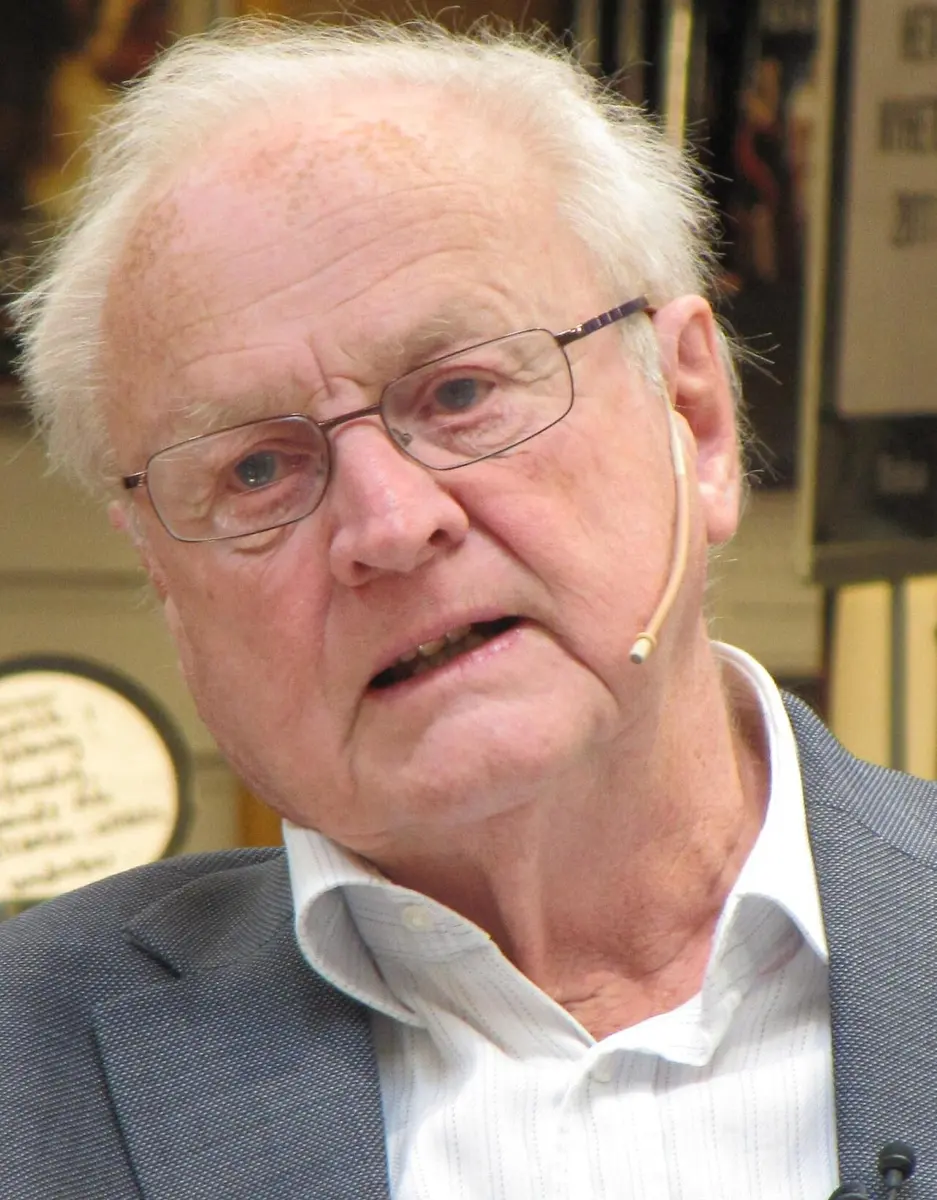
Arvid Carlsson
1923–2018, born in Uppsala, Sweden
A Swedish doctor who showed that a chemical everyone thought unimportant controls how we move.
Photo: Vogler, CC BY-SA 3.0
-
Paul Greengard
1925–2019, born in New York, USA
He worked out, step by step, what happens inside a nerve cell after a message arrives. He gave his prize money to set up a prize for women scientists, named after his mother, who died when he was born.
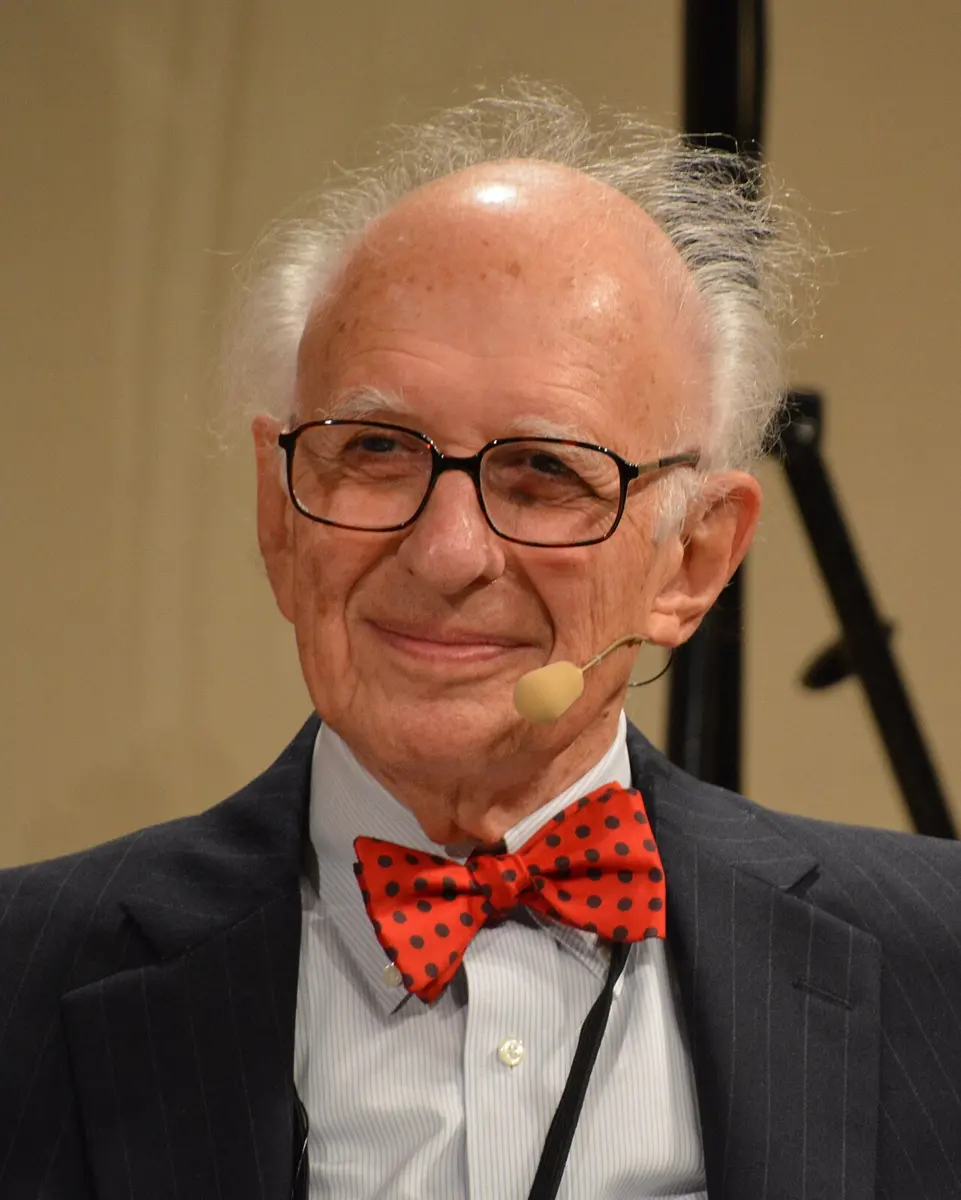
Eric Kandel
born 1929 in Vienna, Austria
He escaped from Vienna with his family in 1939, at the age of nine, trained to be a psychiatrist, and then spent most of his working life studying memory in a sea slug.
Photo: Bengt Oberger, CC BY-SA 4.0
Think of your phone number, or the way to your school, or the taste of sel roti. You remember them because something changed inside your brain when you first learned them. And when you pick up a glass of water, your hand moves smoothly, without shaking, because nerve cells in your brain are sending each other the right messages at the right time.
Your brain has about 100 billion nerve cells, and each one passes messages to thousands of others. The Nobel Prize in Physiology or Medicine 2000 went to three scientists who found out how some of these messages work: Arvid Carlsson, Paul Greengard and Eric Kandel. Their work gave us the main medicine for Parkinson’s disease, and it showed, for the first time, what a memory is made of inside a cell.
The problem: a gap between nerve cells
A nerve cell, or neuron, carries a message along its length as a tiny electrical signal, a nerve impulse Grade 9: Neuron or nerve cell. But at the end of a neuron, the message must jump to the next cell, and there is a gap: a very narrow space called a synapse. Electricity cannot jump this gap. Instead, the first cell lets out a chemical, called a transmitter (or neurotransmitter), which drifts across the gap and passes the message on.
By the 1950s, scientists knew a few transmitters. One was noradrenaline, which nerves use to speed up the heart. Cells make noradrenaline from another chemical, dopamine. So almost everyone thought dopamine was just a step on the way: something the cell made and quickly turned into noradrenaline, with no job of its own.
Meanwhile, doctors had no idea what caused Parkinson’s disease. It mostly affects older people. Their hands shake, their muscles become stiff, and they move more and more slowly, until walking and even smiling become hard. There was no good treatment.
And nobody knew what happens in the brain when we learn something. Is a memory kept in one special cell? In a loop of electricity going round and round? Nobody could tell.
Why can’t a nerve impulse simply jump from one nerve cell to the next?
Pick an answer to see why.
Fast messages and slow messages
Some transmitters work in about a thousandth of a second. They open tiny gates in the next cell at once, and the message rushes on. This fast kind of message lets you speak, move and feel.
The three laureates studied a slow kind. Here the transmitter (dopamine, noradrenaline, serotonin and some others) does not just open a gate. It sets off a chain of chemical changes inside the receiving cell, and the effect lasts from seconds to hours. Slow messages set how alert you are and your mood, and they can turn the fast messages up or down.
Why it was hard
- The amounts are tiny. A brain holds only a few millionths of a gram of dopamine in each gram of tissue. In the 1950s there was no way to measure so little.
- You can’t watch a synapse. The gap is about twenty millionths of a millimeter wide, far too small for an ordinary microscope, and it is deep inside a living brain.
- The brain is too big. With 100 billion cells, each joined to thousands of others, finding the cells that store one memory is like finding a few grains of rice in all the rice of Nepal.
What they did, step by step
Carlsson: the rabbits that could not move
Arvid Carlsson was a young doctor working on medicines in Lund, in Sweden.
- 1957, the key experiment. He gave animals (in the best-known experiments, rabbits) a medicine called reserpine. Reserpine comes from the root of a plant, sarpagandha (Rauvolfia serpentina), which grows in the foothills of Nepal and India. It empties nerve cells of several transmitters. The animals became floppy and almost stopped moving. Then Carlsson gave them L-DOPA, the chemical that the body turns into dopamine. The animals got up and moved normally again. A chemical that the body turns into a different transmitter, serotonin, did not help.
- Late 1950s, measuring dopamine. Carlsson found a sensitive way to measure dopamine, even in very small amounts. It showed that L-DOPA had brought the dopamine in the animals’ brains back to normal.
- Where dopamine is. Carlsson’s team found that dopamine is not spread evenly through the brain. It is packed into a few deep regions, the basal ganglia, which control movement, and it is in different places from noradrenaline. So dopamine must be a transmitter in its own right.
- The link to Parkinson’s. Carlsson saw that animals given reserpine looked very like people with Parkinson’s disease: stiff, slow and still. Perhaps those patients were short of dopamine?

Other scientists took the next steps. In 1960, Oleh Hornykiewicz and Herbert Ehringer, in Vienna, measured the brains of people who had died with Parkinson’s disease, and found very little dopamine in the basal ganglia. In the 1960s doctors gave L-DOPA to patients, and in 1967 George Cotzias in New York showed that large doses, taken as tablets and built up slowly, worked well. Patients who could hardly walk could walk again.
Carlsson also showed that the medicines for schizophrenia, a serious mental illness, work by blocking dopamine’s receptors, and he helped to develop a new kind of medicine for depression.
Greengard: the message inside the cell
By the late 1960s, it was clear that dopamine, noradrenaline and serotonin were transmitters. But what did they actually do to the receiving cell? Paul Greengard, first at Yale University and then at Rockefeller University in New York, spent thirty years working it out.
- A second messenger. Dopamine never enters the receiving cell. It fits into a receptor, a protein on the cell’s surface, like a key in a lock. The receptor then makes a small molecule inside the cell, cyclic AMP (cAMP). Cyclic AMP carries the message on, so it is called a second messenger (the transmitter is the first).
- A switch made of phosphate. Cyclic AMP switches on an enzyme, protein kinase A. A kinase sticks phosphate groups (a phosphorus atom with oxygen atoms around it) onto other proteins. This is called phosphorylation. A protein with a phosphate stuck on it changes shape, and so it works differently. Taking the phosphate off changes it back. It is like a light switch that the cell can flip on and off.
- Gates that change. Among the proteins that get a phosphate are ion channels: tiny gates in the cell’s skin that let charged particles in and out. Change the gates, and the cell becomes easier or harder to set off. This is how a slow message changes the fast ones.
- A conductor. Greengard found a protein, called DARPP-32, that dopamine and several other transmitters act on. Like the conductor of a band, it tells many other proteins when to work.
What does a protein kinase do?
Pick an answer to see why.
Kandel: memory in a sea slug
Eric Kandel wanted to know how memory works. A human brain was far too complicated, so he did what scientists often do: he looked for the simplest animal that can still learn.
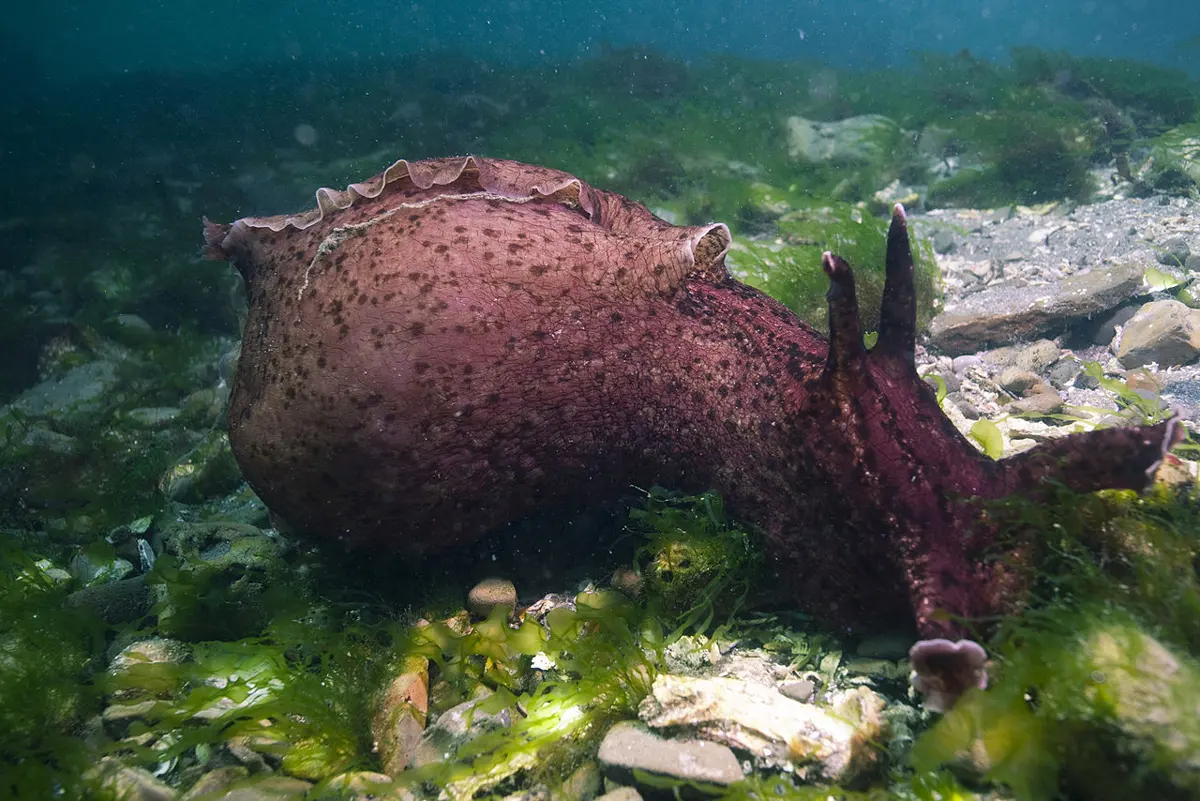
- 1962, choosing the animal. Kandel went to Paris to work with Ladislav Tauc on a large sea slug called Aplysia, or sea hare. It has only about 20,000 nerve cells, and many of them are so big that the same cell can be found and recognized in every animal.
- A simple reflex. On its back, Aplysia has a soft gill, which it uses to breathe. Touch the skin nearby and the slug pulls its gill in to protect it: a reflex, like pulling your hand back from a hot pan Grade 9: Reflex action. Kandel and his team showed that this reflex can learn. Touch it gently again and again, and it reacts less and less (it gets used to the touch). Give the tail a sharp shock first, and the next touch makes the gill pull in much harder: the slug “remembers” the danger.
- The 1970s, memory is at the synapse. Kandel’s team traced the nerve cells of the reflex, one by one. Learning did not change which cells were joined. It changed how strongly the synapse between the touch cell and the gill cell passed its message.
- Short-term memory. After one shock, the slug remembered for minutes to hours. The shock made the touch cell put a phosphate on its channel proteins, Greengard’s switch, so that each touch released more transmitter.
- Long-term memory. When the shocks were repeated, with breaks in between, the memory lasted for days or weeks. Now the signal (cyclic AMP and protein kinase A) went all the way to the cell’s nucleus. There it switched on genes, the cell made new proteins, and the touch cell grew new nerve endings: more synapses onto the gill cell. When the team stopped the cell from making new proteins, long-term memory failed, but short-term memory still worked.
- The 1990s, mice. Kandel showed that the same kinds of change happen when mice learn. Our memory, too, is kept in our synapses.
How a memory is kept
Put Kandel’s steps together, and a memory looks like this.
- A short-term memory is a change in the proteins already at the synapse. It is quick to make and quick to fade.
- A long-term memory is a change in the shape of the cell: new synapses grow. It needs new proteins, takes longer to make, and lasts.
- Repetition with breaks is what turns a short-term memory into a long-term one, in a sea slug and, as far as we know, in you.
In Kandel’s experiments, what was needed for a long-term memory but not for a short-term one?
Pick an answer to see why.
In your life today
- Parkinson’s disease. L-DOPA (called levodopa) is still the most important medicine for Parkinson’s disease, more than fifty years later. It is usually taken with a second medicine, carbidopa, which stops the L-DOPA from being turned into dopamine in the blood before it reaches the brain. Millions of people take it.
- Mental illness. Many medicines for schizophrenia block dopamine receptors, as Carlsson showed, and common medicines for depression act on serotonin, another slow transmitter.
- Addiction. Drugs such as cocaine, amphetamine and heroin act on these same slow-message pathways, especially dopamine. That is part of why they are so hard to stop.
- Studying. Every time you revise a lesson after a few days’ break, you are using the rule Kandel’s slugs showed: spaced repetition builds long-term memory.
What came next
- Memory in people. Scientists have since found many of the genes and proteins that Kandel’s slugs use in mice and humans too. One is a switch in the nucleus, called CREB, that turns on the genes for long-term memory.
- Parkinson’s, still not cured. Levodopa replaces the missing dopamine, but it does not stop the dopamine-making cells from dying, and after some years it works less well. Doctors now also use deep brain stimulation, thin wires placed in the brain that send small electrical pulses. Why the cells die in the first place is still not fully known.
- The open question. A slug’s memory of a shock lives in a few synapses. But where in your brain is your memory of your first day at school, with its sounds, faces and feelings, and how does your brain find it again? Nobody knows yet.
In your science books
- Grade 9: nervous tissue and the neuron, the human nervous system and the brain, reflex action, and how nerves and hormones work together.
- Going Further (Grades 6–8): messages along nerves and two kinds of memory.
- More Nobel Prizes: how nerve endings release their transmitter on time.
Learn more
- The Nobel Prize’s own short explanation: Speed read: Mind reading, and the press release with its diagrams (nobelprize.org).
- The three laureates’ Nobel lectures: Carlsson, Greengard and Kandel.
The official reason
The prize was given “for their discoveries concerning signal transduction in the nervous system.”