
G-proteins: your cells’ relay switches
Nobel Prize in Physiology or Medicine, 1994: Alfred G. Gilman and Martin Rodbell
-
Alfred G. Gilman
1941–2015, born in New Haven, USA
His father wrote a famous medical textbook the year he was born, and gave him its co-author’s name as his middle name.
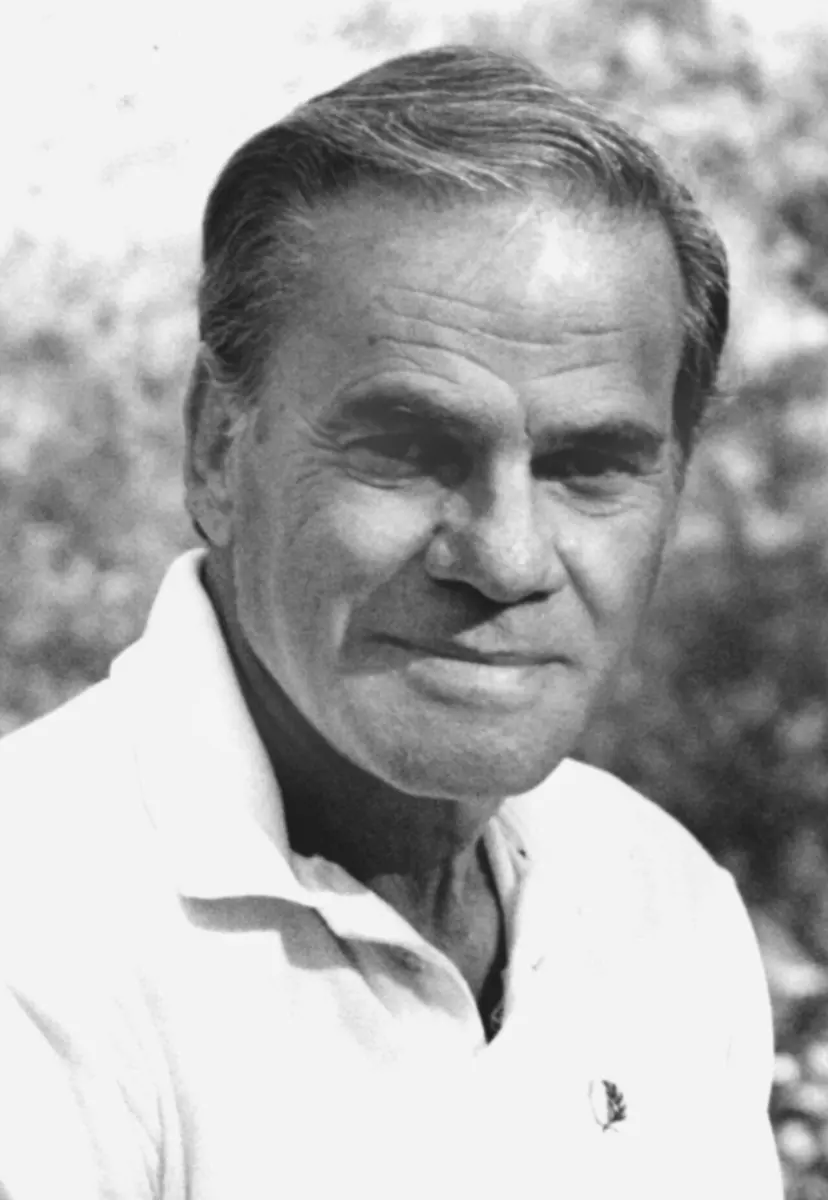
Martin Rodbell
1925–1998, born in Baltimore, USA
A navy radio operator in the Second World War who loved French books, and found the first clue to the switch in an impure bottle of chemical.
Photo: NIH, courtesy of Andrew M. Rodbell, Public domain
You are walking to school and a dog rushes at you, barking. Before you have even decided to run, your heart is pounding, your breathing is fast, and your muscles are ready. A gland above each kidney has poured a hormone, adrenaline, into your blood. In seconds it reaches your heart, your liver and your muscles, and each of them changes what it is doing.
But adrenaline never goes inside those cells. It only touches their outer skin. So how does the message get in? The answer is a family of tiny switches inside the cell, called G-proteins. In 1994 the Nobel Prize in Physiology or Medicine went to the two Americans who found them: Martin Rodbell and Alfred Gilman.
The problem: a message at the door
Your body is made of thousands of billions of cells, and they must work together. They talk to each other with chemicals. Hormones are chemical messengers made by glands and carried by the blood Grade 9: Endocrine glands: adrenaline for danger, insulin and glucagon from the pancreas to control the sugar in your blood Grade 9: Pancreas.
Every cell is wrapped in a thin cell membrane, made mostly of fats Grade 8: The covering of the cell. Many hormones can’t pass through it. They stop at the outside, like a visitor at a closed gate.
By the 1960s, scientists knew part of the answer. The American scientist Earl Sutherland (Nobel Prize 1971) had shown that when a hormone like adrenaline arrives at the outside of a cell, a new chemical messenger appears inside it. He called the hormone the first messenger, and the chemical inside, cyclic AMP, the second messenger. Cyclic AMP then tells the cell what to do: in the liver, for example, to break down stored food and send sugar into the blood.
So the message changed hands somewhere in the membrane. But how? What was in there, and how did it work?
How a cell listens
Scientists knew two of the parts:
- The receptor. Sitting in the membrane, with one end outside, is a protein shaped to fit just one kind of hormone, the way a lock fits one key. Liver cells have receptors for glucagon; heart cells have receptors for adrenaline. A cell only “hears” the hormones it has receptors for.
- The amplifier. On the inside of the membrane is an enzyme (a protein that speeds up a reaction) that makes cyclic AMP. Once switched on, it makes molecule after molecule, so a weak signal outside becomes a strong one inside.
Most scientists assumed that the receptor simply switched the amplifier on directly. That turned out to be wrong.
Adrenaline makes your heart beat faster, but it never enters the heart cells. How does its message get inside?
Pick an answer to see why.
Why it was hard
- Tiny amounts. The proteins that carry the message are rare. A cell has only a little of each.
- Fragile. They live in the oily membrane. Take them out of it with a soap-like chemical (a detergent), and most of them fall apart and stop working.
- All mixed up. A membrane holds hundreds of different proteins. Picking out the one that matters is like finding one particular grain of rice in a sack.
- Hidden by impurities. Some of the chemicals used in the experiments were not as pure as their labels said. That nearly hid the most important clue, and then, by luck, revealed it.
What they did, step by step
Rodbell: three parts and a strange fuel (1969–1971)
Martin Rodbell worked at the National Institutes of Health (NIH), the United States’ government medical research center near Washington.
- Cells without their insides. Rodbell had found a way to take fat cells out of fat tissue and then remove their insides, leaving empty membranes he called “ghosts”. These ghosts still answered hormones by making cyclic AMP. Later his team used membranes from rat liver, which answer the hormone glucagon.
- A puzzle. His team made glucagon slightly radioactive so they could measure how much stuck to the membranes. It stuck slowly, and wouldn’t wash off. That made no sense: the liver answers glucagon within seconds. But when they added ATP (the cell’s energy chemical, needed by the amplifier), glucagon came on and off in seconds.
- The impure bottle. As a student, Rodbell had once been misled by a chemical that wasn’t pure. He remembered the lesson: never trust the label. He tested chemicals similar to ATP and found that the real cause was GTP (guanosine triphosphate), a close cousin of ATP, which was present as an impurity in the bottle of ATP. GTP worked at amounts a hundred to a thousand times smaller than ATP.
- GTP is needed. Then they tested the amplifier using a form of ATP that couldn’t carry any GTP in with it. Now glucagon could not switch on the amplifier, unless GTP was added too.
Rodbell, who liked to compare cells to computers, concluded in 1971 that there must be three parts, not two: a discriminator (the receptor, which picks out the hormone), an amplifier (which makes cyclic AMP), and between them a transducer, a go-between that passes the message on and needs GTP to work. But he did not know what the transducer was.
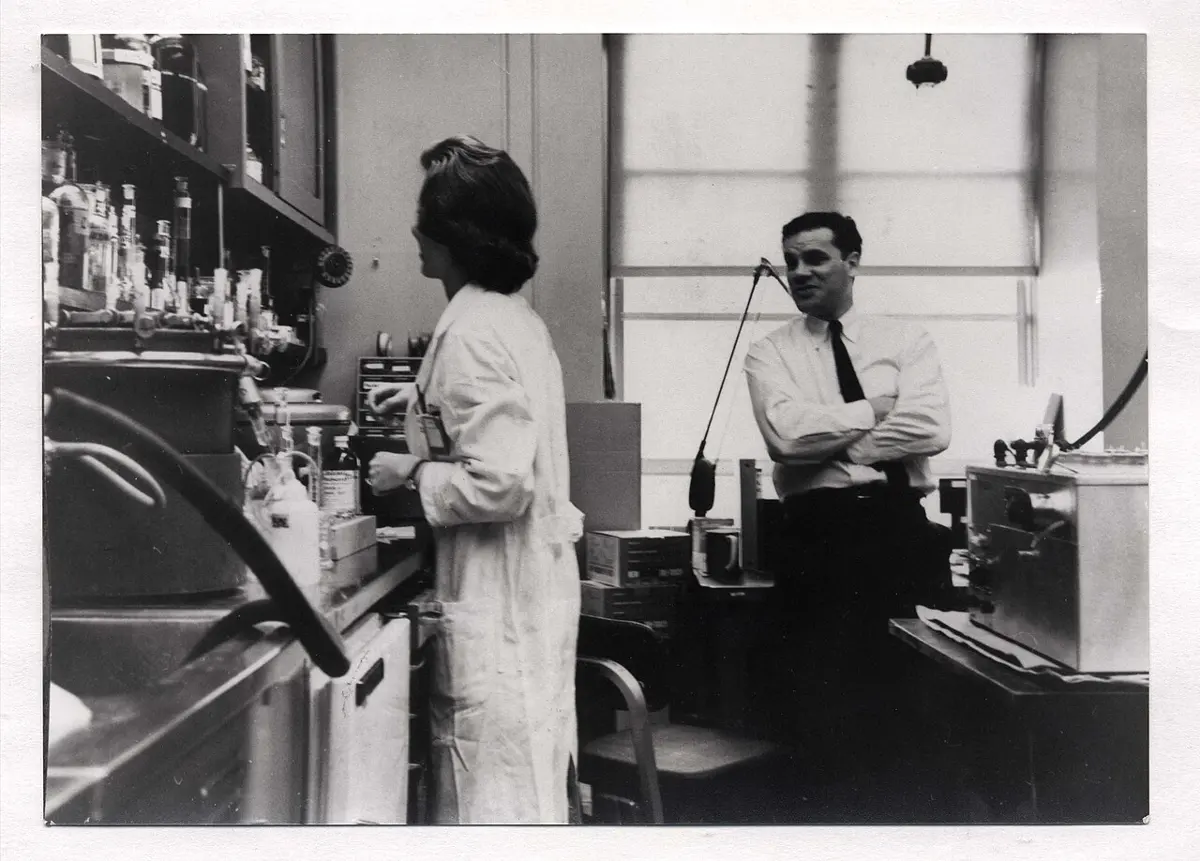
Gilman: finding the switch (1975–1980)
Alfred Gilman, at the University of Virginia, set out to find Rodbell’s transducer. He used a clever kind of help: cells that were broken.
- Broken cells. Gilman’s laboratory grew a kind of blood cancer cell from mice (lymphoma cells; nobelprize.org’s press release calls them leukemia cells). Cyclic AMP kills these cells, so scientists had picked out mutant cells that survived: cells that could not make cyclic AMP when a hormone arrived. One mutant, called cyc⁻, seemed to be missing the amplifier. Gilman’s lab found another that had a normal receptor and a normal amplifier, yet still did nothing when a hormone arrived. Something between them was missing.
- Fixing a broken cell. In 1975 a young scientist, Elliott Ross, joined the lab. He took the proteins out of normal cell membranes with detergent and mixed them into membranes of the cyc⁻ mutant. Now the mutant membranes answered an adrenaline-like hormone by making cyclic AMP. It looked as if he had given them back their missing amplifier.
- The surprise. As a check, Ross first destroyed the amplifier in his extract by warming it. The mixture still worked. So the mutant had an amplifier all along. What the extract was giving it was a third protein, which survived the warming, and which needed GTP. This was Rodbell’s transducer.
- Pure at last. It took years of patient work, by Paul Sternweis and John Northup in Gilman’s lab, to purify this rare protein. By 1980 they had it pure. It was named a G-protein, because it binds GTP (G stands for guanine). Put back into the broken membranes, it brought back the whole response.
How the switch works
A G-protein sits on the inside of the cell membrane, next to the receptor. It works like a switch with a built-in timer:
- Off. At rest, the G-protein holds a molecule of GDP (GTP with one phosphate fewer). It does nothing.
- A hormone arrives. The hormone fits its receptor outside. The receptor changes shape and makes the G-protein let go of its GDP and take a GTP instead.
- On. With GTP on board, the G-protein is switched on. Part of it breaks away and slides along the membrane to the amplifier, which starts making cyclic AMP, many molecules of it, which carry the message through the cell.
- The timer. After a short time, the G-protein itself breaks the GTP down to GDP. It switches off, and goes back to wait for the next signal.
The timer matters. A message that never switched off would be like a doorbell stuck down: the cell would keep answering long after the visitor had gone. The person who presented the prize compared a G-protein to a timed switch that lets the signal through “just long enough”.
There are many kinds of G-protein, made of three parts each of which comes in several forms, and in all some hundred combinations. Different ones carry different messages: some switch amplifiers on, some switch them off, and some open or close tiny gates in the membrane. They are at work in your eyes when light falls on the retina, in your nose when you smell food cooking, and on your tongue when you taste something sweet or bitter.
What switches a G-protein off again after a hormone has switched it on?
Pick an answer to see why.
In your life today
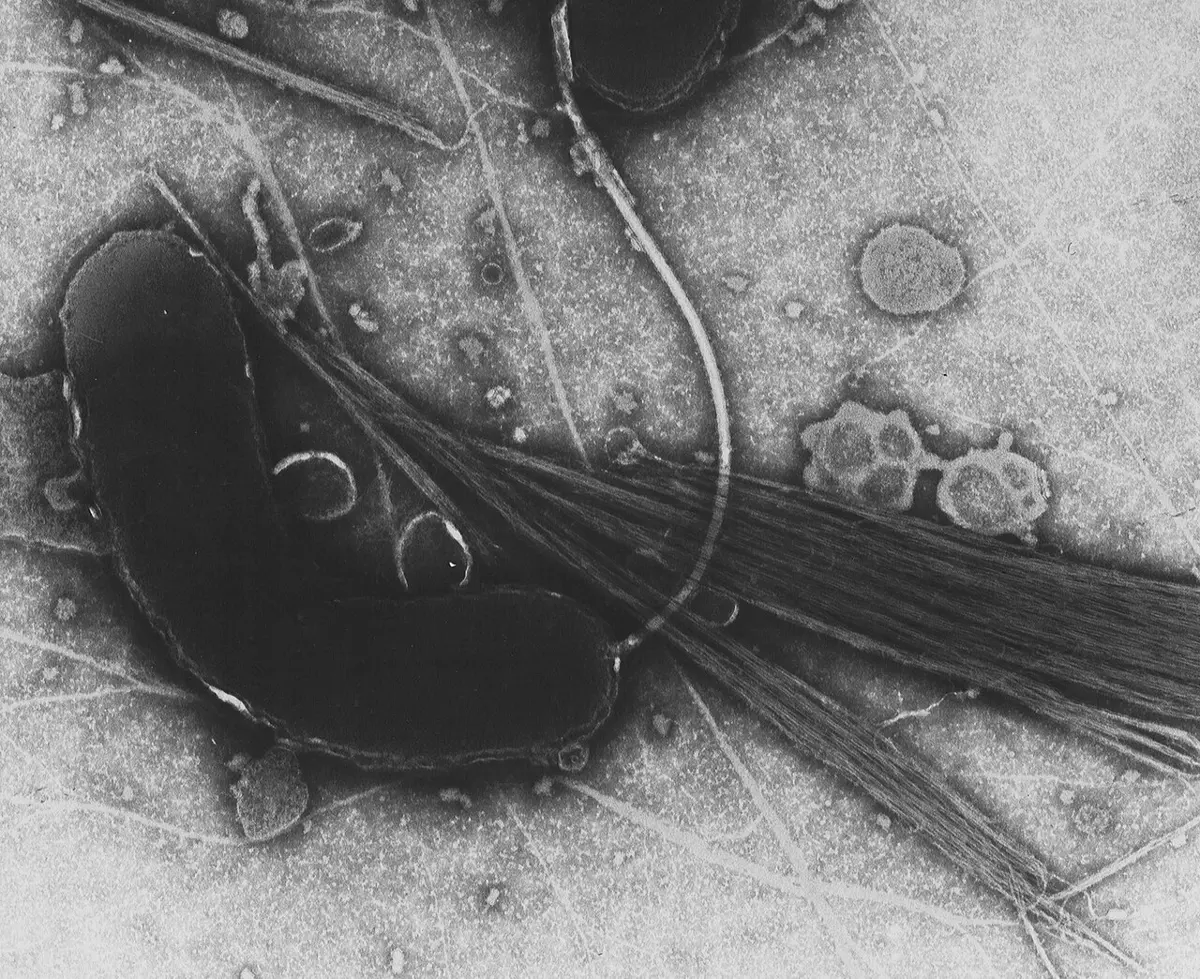
- Cholera. Cholera is caused by a bacterium in dirty water. In Nepal it breaks out in the monsoon, when drinking water is easily polluted. The bacteria make a poison, cholera toxin, that gets into the cells lining the gut and changes one G-protein so that it can’t switch off. The press release called it a traffic light stuck on green. The amplifier makes cyclic AMP non-stop, and the gut cells pour out salt and water. The patient has severe watery diarrhea and can lose dangerous amounts of water within hours.
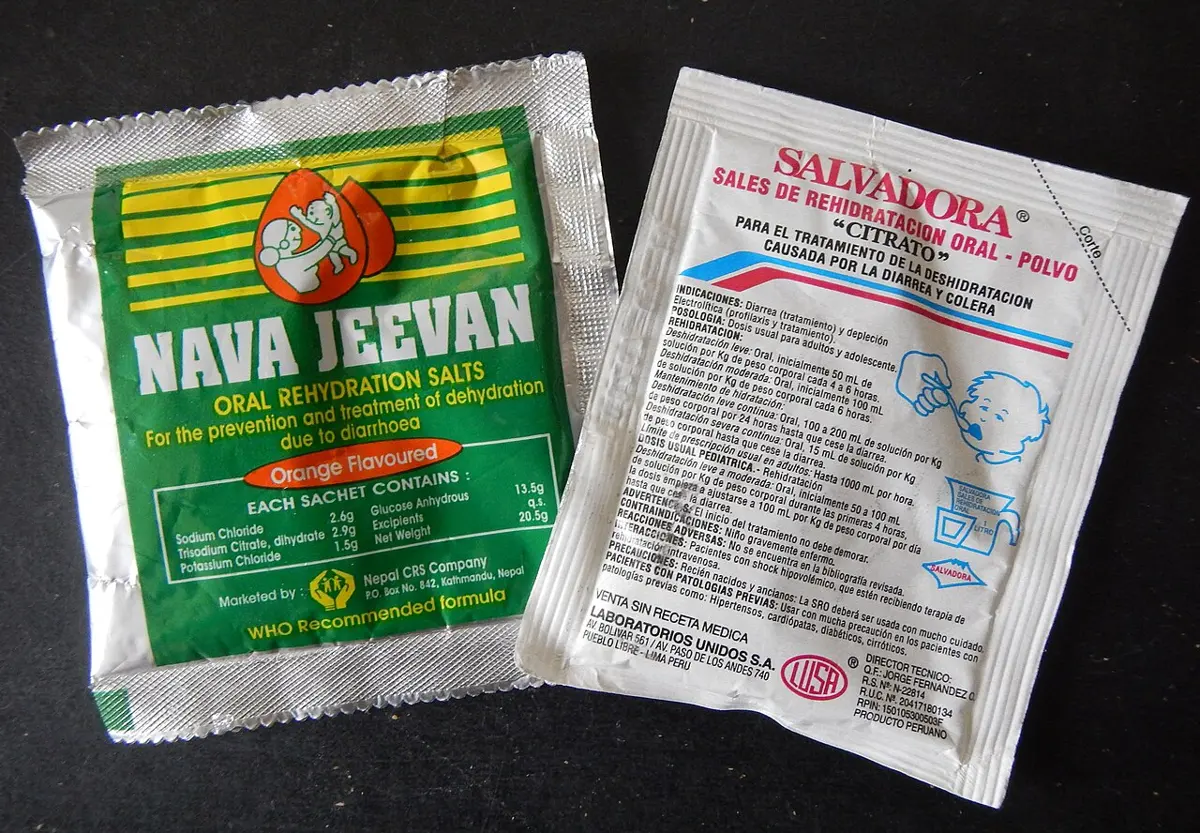
- ORS saves lives. The gut can still take in salt if it comes together with sugar, by a different route that cholera toxin does not block. That is why oral rehydration solution (ORS), a measured mix of salt and sugar in clean water, keeps people with cholera and other diarrhea alive. ORS packets made in Nepal are sold in pharmacies and handed out at health posts.
- Whooping cough. The bacterium of whooping cough makes a poison that does the opposite: it jams some G-proteins off. Nepal’s children are vaccinated against whooping cough in their first months, with the DPT vaccine.
- Medicines. Many medicines work by fitting the receptors that pass messages to G-proteins: medicines for high blood pressure, asthma, allergies, stomach ulcers and pain. Estimates of how many range from about a third of all medicines to about half, depending on how they are counted.
What came next
- The receptors. The receptors that pass messages to G-proteins are a huge family: about 800 kinds in humans, each a protein chain that weaves seven times through the membrane. How they work earned another Nobel Prize, in Chemistry in 2012 (the full story). Our sense of smell uses about 400 of them (Medicine 2004).
- Seeing the switch. In 2011 scientists worked out the shape, atom by atom, of a receptor caught in the act of switching on its G-protein.
- The open question. For many of these receptors, scientists still don’t know which chemical messenger they answer, or what job they do. Each one found could lead to a new medicine.
In your science books
- Grade 9: endocrine glands, the functions of hormones, the adrenal glands (adrenaline) and the pancreas (insulin and glucagon).
- Grade 8: the covering of the cell, the cell membrane, and bacteria.
- Going further: proteins do the work, and your body’s detectors.
Learn more
- The Nobel Assembly’s press release, which explains the discovery with pictures, and the presentation speech (nobelprize.org).
- The Nobel lectures: Gilman and Rodbell.
The official reason
The prize was given “for their discovery of G-proteins and the role of these proteins in signal transduction in cells.”