
Every Dashain, villages across Nepal build a ping: four tall bamboo poles, crossed in pairs and lashed together high up, with a rope seat hanging from them. Watch a child on one. Pushed hard, she flies high; pushed gently, she swings low; yet the high swings and the low swings take nearly the same time. Her heavier uncle on the same ping keeps the same beat as she does. And on the bus home, as it swings round a bend on the hill road, everyone slides towards the outside of the bend, though nothing pushed them that way. Behind the bus, a truck stacked high with sacks leans on the same bend, and the driver slows right down, because a load that high could tip the whole truck over.
These are all questions about force. Why does a swing keep time, and what decides how fast it swings? What force keeps anything moving in a circle, from a stone on a string to the Moon? How strong is the Earth’s pull far out in space, and how fast must a rocket go to escape it for good? And why does a tall load make a truck easy to tip? This unit answers each one, with the numbers.

11.1 Simple pendulum
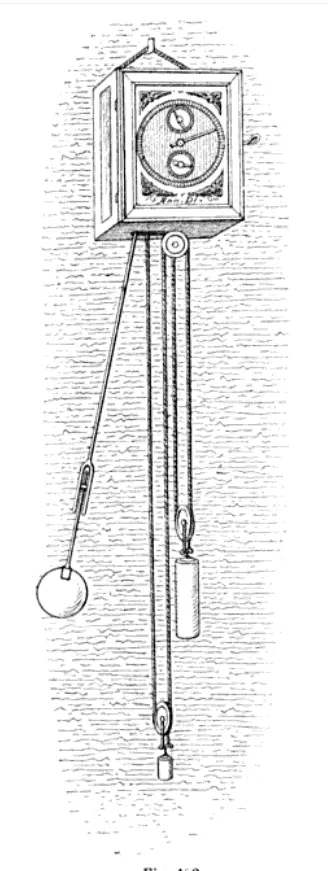
Hang a key from a thread, pull it a little to one side and let go. It swings back through the lowest point, up the other side, and back again, over and over, slowly dying away. A ping, a temple bell’s clapper, a chandelier in a draft and the pendulum of an old wall clock all do the same. The simplest version of all of them is the one physicists study.
Description
A simple pendulum is a small, heavy body (the bob) hung from a fixed point by a light, inextensible thread, so that it can swing freely to and fro in a vertical plane.
A perfect simple pendulum would have all its mass at one point, a thread with no mass that never stretches, and no air or friction to slow it down. No real pendulum is perfect, but a small metal ball on a long cotton thread comes very close: the ball is far heavier than the thread, so the thread’s mass hardly matters, and a heavy ball loses its swing to the air only slowly.
The words used to describe a pendulum:
- Point of suspension (S): the fixed point the thread hangs from. It must not move, or the pendulum loses energy to its support; that is why the thread is pinched in a split cork, not just tied round a rod.
- Bob: the heavy body at the end of the thread, usually a small metal sphere.
- Effective length (l): the distance from the point of suspension to the center of the bob: the length of the thread plus the radius of the bob. This is the length that decides how the pendulum swings, and the one used in every formula.
- Mean position (O): the position where the bob hangs at rest, straight below S. It is also called the equilibrium position.
- Extreme positions (A and B): the farthest points the bob reaches on either side, where it stops for an instant before turning back.
- Amplitude: the greatest distance of the bob from its mean position, OA or OB, measured along its path; often given as the angle θ between the thread and the vertical at the extreme position.
- Oscillation: one complete to-and-fro swing: from O to A, back through O to B, and back to O (or from A to B and back to A).
- Time period (T): the time taken for one complete oscillation, in seconds.
- Frequency (f): the number of complete oscillations in one second, in hertz (Hz). Since one oscillation takes T seconds, .
A pendulum’s thread is 95 cm long and its bob has a diameter of 4 cm. What is its effective length?
Pick an answer to see why.
Why a pendulum swings
At the mean position, the thread pulls the bob straight up with a force equal to its weight, which pulls it straight down: the two balance and the bob can hang there at rest. Pull it aside to an angle θ and let go, and they no longer balance.
Split the bob’s weight mg into two parts, as you split vectors into parts in Grade 9 Optional Science. Along the thread, the part mg cos θ is balanced by the pull of the thread (its tension). At right angles to the thread, along the bob’s path, the part mg sin θ has nothing to balance it, so it pulls the bob back towards the mean position. A force like this, always pulling a body back towards its mean position, is called a restoring force.
The bob speeds up as it falls back, so it arrives at O moving at its fastest. There the restoring force is zero, but the bob doesn’t stop: it keeps going (its inertia) and climbs up the other side, where the restoring force now pulls it back, slows it, stops it at B, and sends it back again.
In energy terms, the bob keeps trading one kind of energy for the other. At an extreme position it is highest and still for an instant: all its energy is potential energy. At the mean position it is lowest and fastest: all kinetic energy. In between, it has some of each. A little energy is lost to the air and the support at every swing, so the amplitude slowly shrinks and a real pendulum, left alone, stops in the end. A clock gives its pendulum a tiny push every swing to make up the loss.
The time period of a simple pendulum
For small swings (an amplitude of up to about 10°), the time period of a simple pendulum is
where l is the effective length (in m) and g is the acceleration due to gravity (in m/s²) at the place. Look at what is in the formula, and what is not:
- the length l is in it: a longer pendulum swings more slowly;
- g is in it: where gravity is weaker, the pendulum swings more slowly;
- the mass of the bob is not: a heavy bob and a light one of the same length keep the same time;
- the amplitude is not: a small swing and a slightly bigger one take the same time.
These four facts are stated as the laws of the simple pendulum:
- Law of isochronism: for small amplitudes, the time period doesn’t depend on the amplitude. (Isochronous means “taking equal times”.)
- Law of mass: the time period doesn’t depend on the mass (or the material) of the bob.
- Law of length: the time period is directly proportional to the square root of the effective length, .
- Law of acceleration: the time period is inversely proportional to the square root of the acceleration due to gravity, .
Why doesn’t the mass matter? A heavier bob is pulled back by a bigger restoring force, mg sin θ, but it is also harder to speed up, by exactly the same factor. The two cancel, just as they do when a heavy and a light stone fall together.
The law of isochronism holds only for small swings. For a big swing the period is a little longer than the formula gives: about 0.05 % longer at 5°, 0.4 % at 15°, 1.7 % at 30°. That is why a pendulum clock’s swing is kept to a few degrees, and why, in the lab, the bob is pulled aside only a little.
Two pendulums have the same length. One has a 500 g iron bob, the other a 50 g wooden bob. Both swing through small angles. Their time periods are:
Pick an answer to see why.
To make a pendulum’s time period twice as long, its effective length must be made:
Pick an answer to see why.
11.2 Periodic motion
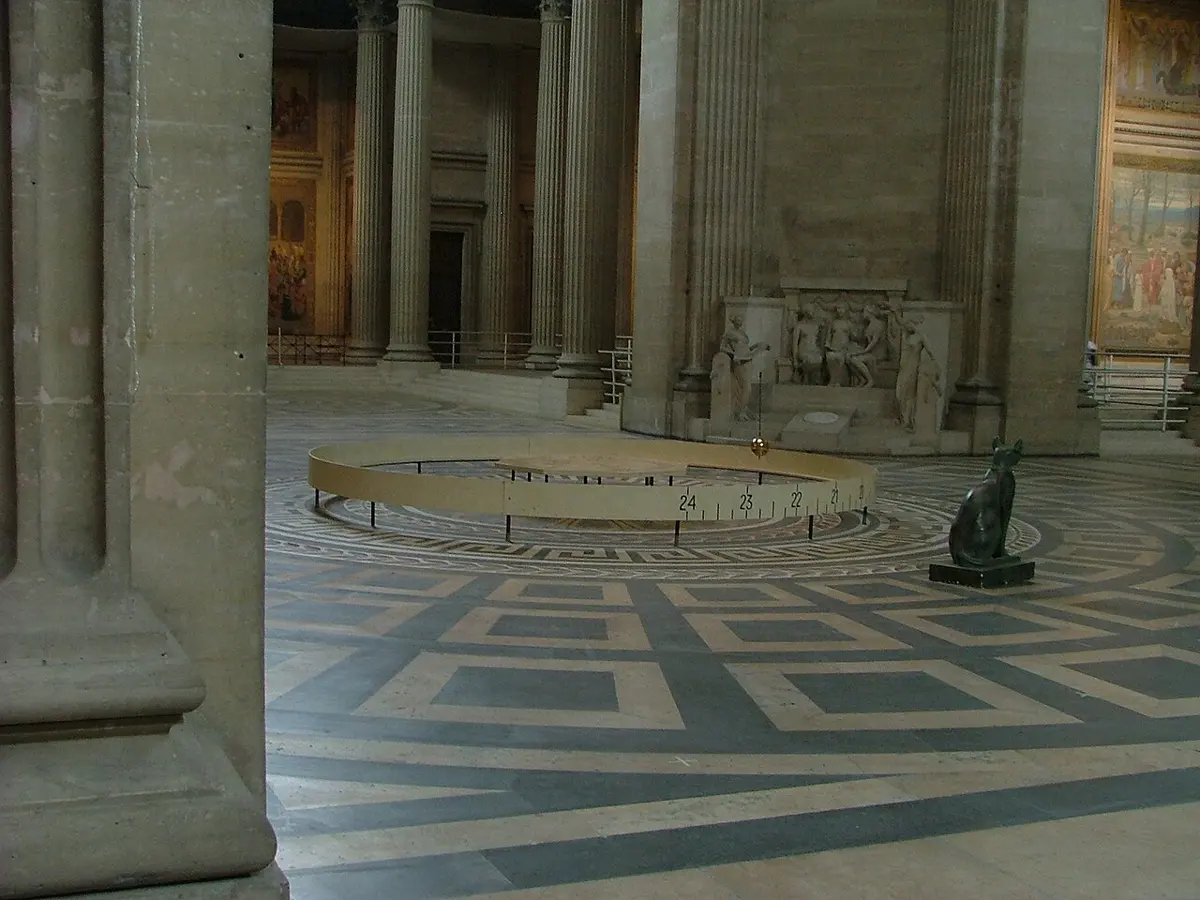
The pendulum repeats its motion over and over, each time in the same time. So does much else around you: the second hand of a clock comes back to 12 every minute, the Earth turns once a day, the Moon goes through its phases in about 29.5 days, and your heart beats about 72 times a minute.
Periodic motion is a motion that repeats itself again and again after equal intervals of time. The time taken for one repetition is the time period (T), and the number of repetitions in a second is the frequency (f), in hertz:
| Periodic motion | Its time period |
|---|---|
| a seconds pendulum | 2 s |
| the second hand of a clock | 60 s |
| the hour hand of a clock | 12 hours |
| the Earth spinning on its axis | 1 day (24 hours) |
| the Earth going round the Sun | about 365¼ days |
| the Moon going round the Earth (new moon to new moon) | about 29.5 days |
| a resting heartbeat (72 beats a minute) | about 0.83 s |
| a tuning fork of frequency 256 Hz | 1/256 s ≈ 0.0039 s |
| the blade of a ceiling fan at full speed | about 0.2 s |
Oscillatory motion
Some periodic motions are to-and-fro about a mean position: a pendulum, a child on a ping, a mass bouncing on a spring, a guitar string, the needle of a sewing machine, a tree branch in the wind after a bird takes off. These are called oscillatory or vibratory motions. (When the to and fro is fast and small, like a guitar string’s, we usually call it a vibration.)
Every oscillatory motion is periodic, but not every periodic motion is oscillatory. The hands of a clock and the Earth going round the Sun repeat themselves in equal times, but they go round and round, never to and fro about a mean position: they are periodic but not oscillatory.
A motion that doesn’t repeat itself in equal times is non-periodic: a ball bouncing lower and lower with shorter and shorter bounces, a bus in the city traffic, a falling leaf, a footballer running about the field.
Which of these is periodic but not oscillatory?
Pick an answer to see why.
A pendulum makes 30 complete oscillations in 45 s. Its frequency is:
Pick an answer to see why.
11.3 Circular motion
In Bhaktapur’s Potters’ Square, a potter spins a heavy wheel with a stick, and while it turns, every bit of clay on it goes round and round the same center. The tip of a ceiling fan’s blade, a seat on a giant wheel at a mela, the Moon round the Earth and a satellite round the Earth all do the same thing: they move along a circle.
Circular motion is the motion of a body along a circular path. When the body covers equal distances along the circle in equal times, its speed stays the same, and the motion is called uniform circular motion.

A body going once round a circle of radius r covers the circumference, 2πr. If one round takes the time period T, its speed is
Speed stays the same, velocity doesn’t
In uniform circular motion the speed is constant, but the velocity is not. Velocity is a vector: it has a direction, and in circular motion the direction changes at every moment. At each point the body moves along the tangent to the circle there, at right angles to the radius. Go a quarter of the way round and the direction has turned through 90°.
You can see the tangent whenever something lets go of a spinning object. Water flies off a wet umbrella spun round, along the tangents, not straight outwards. Mud flies off a bicycle’s tyre the same way, which is why bicycles have mudguards. Sparks from a grinding wheel are red-hot specks of metal torn off the rim, and they fly off along the tangent at the point where they leave it.

A change in velocity is an acceleration, so a body in uniform circular motion is always accelerating, even though its speed doesn’t change. Which way? Subtract the velocities, as you subtracted vectors in Grade 9: take a stone going round anticlockwise, moving east (3 units) at the bottom of the circle, and a quarter turn later moving north (3 units) at the right-hand side. The change in velocity is the new velocity minus the old one.
A − B is the change in velocity: it points up and to the left, towards the center of the circle from the point halfway between the two. Take the two velocities closer and closer together, and their difference points straight at the center.
So the acceleration of a body in uniform circular motion points towards the center of the circle, all the time. It is called centripetal acceleration (from Latin, “center-seeking”). Its size is
(Going Further 9–12 proves it with Pythagoras’ theorem: Going round in a circle needs a pull.)
Examples of circular motion
- a potter’s wheel and a grinding wheel, every point of which moves in a circle;
- the tips of the blades of a ceiling fan, and of the hands of a clock;
- a seat on a giant wheel or a merry-go-round at a mela;
- a stone whirled round on a string;
- a car or a motorbike going round a roundabout or a bend;
- the Moon round the Earth, and satellites round the Earth (their orbits are very nearly circles);
- the Earth round the Sun (very nearly a circle; the planets’ orbits are ellipses, close to circles);
- the electron round the nucleus in Bohr’s model of the atom Grade 9: Bohr’s atomic model.
A stone is whirled in a circle at a steady speed. Which statement is true?
Pick an answer to see why.
A wet umbrella is spun round. The drops of water fly off:
Pick an answer to see why.
11.4 Centripetal force
Newton’s first law says a moving body goes on in a straight line at a steady speed unless a force acts on it. A body moving in a circle doesn’t go straight on: its direction keeps turning towards the center. So some force must be pulling it towards the center all the time.
Definition
Centripetal force is the force that acts on a body moving in a circle, directed towards the center of the circle, which keeps it moving in the circle.
By Newton’s second law, F = ma, a body of mass m moving at speed v in a circle of radius r, whose acceleration is v²/r towards the center, needs a force
towards the center. The centripetal force is bigger:
- for a heavier body (F ∝ m),
- for a faster body, and much bigger: doubling the speed makes it four times as big (F ∝ v²),
- for a sharper turn, a smaller circle (F ∝ 1/r).
Since , the force can also be written in terms of the time for one round: .
The centripetal force is not a new kind of force. It is the name for the job of pulling inwards, and in each case some real force does that job:
| Body moving in a circle | The force that pulls it to the center |
|---|---|
| a stone whirled on a string | the tension (pull) of the string |
| a car or a bus going round a bend | friction between the tyres and the road |
| the Moon round the Earth, a satellite round the Earth | the Earth’s gravitational pull |
| the Earth and the planets round the Sun | the Sun’s gravitational pull |
| the electron round the nucleus (Bohr’s model) | the electric attraction between them |
| clothes in a spinning washing machine drum | the push of the drum’s wall |
| a rider on a giant wheel or a merry-go-round | the push of the seat and the pull of its supports |
Demonstration of centripetal force
Daily-life applications
- Banked roads and tracks. On a flat road, only friction turns a vehicle, and on a wet road friction may not be enough. So the roads of hill highways, the curves of racing tracks and railway lines on a bend are banked: the outer edge is raised above the inner one. The road then pushes on the tyres at a slant, partly inwards, and that inward part helps provide the centripetal force.
- A cyclist leaning into a bend. A cyclist or a motorcyclist leans inwards on a turn. The road then pushes up and inwards on the tyres, and the inward push gives the centripetal force (the faster or sharper the turn, the more they must lean).
- Speed limits on bends. Since F = mv²/r, a sharp bend at high speed needs a very large force. Signs before sharp bends on Nepal’s hill roads ask drivers to slow down: half the speed needs only a quarter of the force.
- Spin dryers and washing machines. The drum spins very fast and pushes the clothes round in a circle. The water in the clothes isn’t held in so firmly; it goes straight on, out through the holes in the drum, and the clothes are left almost dry.
- Cream separators and centrifuges. Milk spun very fast separates: the heavier, watery milk goes to the outside, the lighter cream stays nearer the center and is drawn off. In a hospital laboratory, a centrifuge spins tubes of blood so that the heavier blood cells pack at the bottom of each tube, and the clear plasma can be tested.
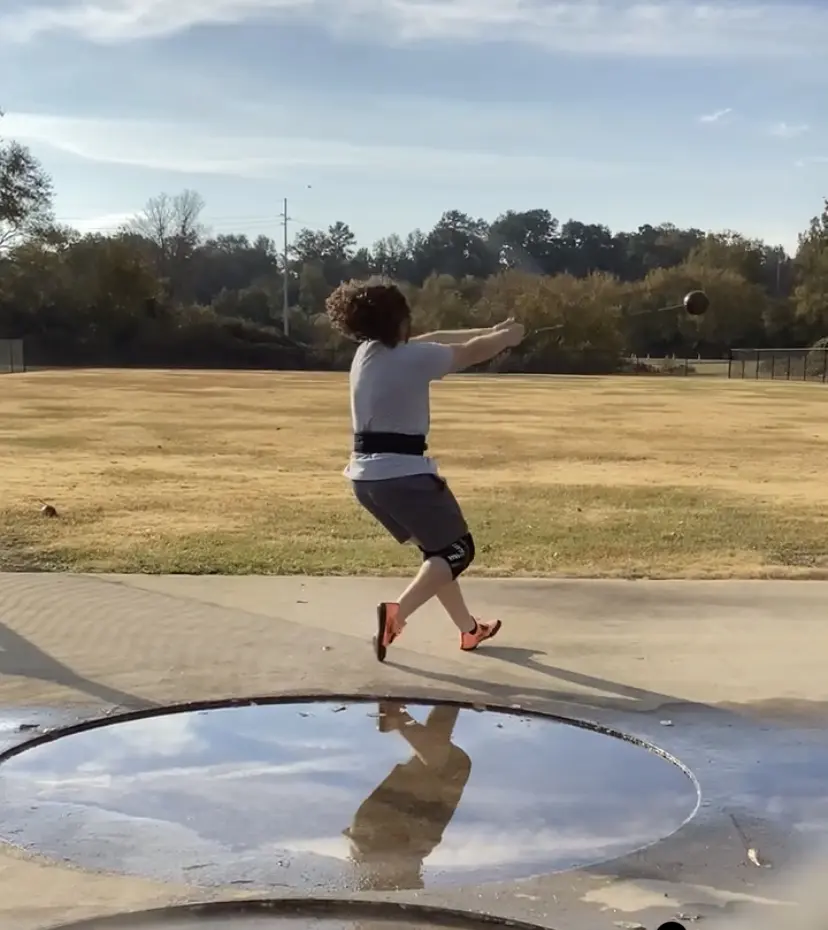
- The hammer throw. An athlete swings a heavy ball on a wire round and round, pulling it inwards with all her strength, then lets go: the ball flies off along the tangent.
- The Moon and satellites. The Earth’s gravity is the centripetal force that keeps the Moon and every satellite on its orbit; without it, they would fly off in straight lines (Going Further 9–12: Gravity does the pulling).
A car goes round a bend at twice its earlier speed. The centripetal force needed is:
Pick an answer to see why.
What provides the centripetal force for the Moon going round the Earth?
Pick an answer to see why.
Why are roads banked on sharp bends?
Pick an answer to see why.
11.5 Gravitational field intensity
Introduction
A magnet pulls a pin from a distance, without touching it; the space round the magnet where it can do that is its magnetic field. Gravity works the same way. The Earth pulls the Moon, a satellite and a falling mango without touching any of them. The space round any mass in which another mass feels a gravitational force is called its gravitational field. Every mass has one, but only a very large mass like the Earth, the Moon or the Sun has a field strong enough to notice.
A field is drawn with gravitational field lines, which show the direction in which a mass placed there would be pulled. Round the Earth they point straight in towards its center from every side. Where the lines are closer together, near the surface, the field is stronger; farther out they spread apart, and the field is weaker.
Gravitational field intensity
How strong is a field at a point? Place a mass there and measure the force on it. A 2 kg mass feels twice the force of a 1 kg mass at the same point, so the fair measure is the force on each kilogram.
The gravitational field intensity at a point is the gravitational force acting on a unit mass (1 kg) placed at that point:
Its SI unit is the newton per kilogram (N/kg). It is a vector, pointing the way a mass there would be pulled: towards the body making the field.
For the Earth, a mass m at a distance r from its center feels a force (Newton’s law of gravitation, Grade 10 Science), where M is the Earth’s mass. So
This is exactly the formula for g, the acceleration due to gravity Grade 10: Calculating g. The gravitational field intensity at a point is equal to the acceleration due to gravity there. At the Earth’s surface it is 9.8 N/kg: every kilogram is pulled down with 9.8 N, and that pull, acting alone, accelerates it at 9.8 m/s². The two units are the same thing: 1 N/kg = 1 (kg m/s²)/kg = 1 m/s².
Since E = GM/r², the field gets weaker with distance as 1/r²: at twice the distance from the center, a quarter of the strength; at three times, a ninth.
| Place | Distance from the Earth’s center | Field intensity |
|---|---|---|
| sea level | 6,371 km (R) | 9.81 N/kg |
| the top of Sagarmatha (8,849 m) | 6,380 km | 9.78 N/kg |
| the Space Station (400 km up) | 6,771 km | 8.69 N/kg |
| 1,000 km up | 7,371 km | 7.33 N/kg |
| 2R from the center (6,371 km up) | 12,742 km | 2.45 N/kg |
| geostationary satellites (35,786 km up) | 42,157 km | 0.224 N/kg |
| the Moon’s distance | 384,400 km | 0.0027 N/kg |
(Here and below, G = 6.67 × 10⁻¹¹ N m²/kg², the Earth’s mass M = 5.97 × 10²⁴ kg and its radius R = 6,371 km, so GM = 3.98 × 10¹⁴ N m²/kg.)
The SI unit of gravitational field intensity is:
Pick an answer to see why.
At what distance from the Earth’s center is its field intensity one ninth of its value at the surface?
Pick an answer to see why.
11.6 Gravitational potential of the Earth
Concept
Lift a bag of rice onto a shelf and you do work against gravity; the work is stored in the bag as gravitational potential energy, given back as it falls (Going Further 9–12: Gravitational potential energy). Near the ground you work it out as mgh, from any level you choose. But g gets weaker far from the Earth, so mgh is no use for a rocket going thousands of kilometers up. We need a measure of the energy of a position in the Earth’s field that works at any distance, and a zero that everyone agrees on.
The natural zero is infinity: a point so far away that the Earth’s pull there is nothing at all. Bring a mass from there towards the Earth and gravity pulls it in; the field does work on it, and its potential energy falls. So its potential energy everywhere near the Earth is less than zero: negative. To take it back out to infinity, you would have to do work on it to make up the difference.
Definition
The gravitational potential at a point is the work done in bringing a unit mass (1 kg) from infinity to that point. (Equally: it is the potential energy of 1 kg placed at that point.)
Its SI unit is the joule per kilogram (J/kg). Unlike field intensity, potential is a scalar: it is energy per kilogram, with no direction.
At a distance r from the center of the Earth (mass M), the gravitational potential is
The minus sign says the field, not you, does the work as the mass comes in: the potential is zero at infinity and becomes more and more negative closer to the Earth. A mass m placed at that point has potential energy U = mV = −GMm/r.
At the Earth’s surface, r = R:
about −62.5 million joules per kilogram (−62.5 MJ/kg). Since g = GM/R², this can also be written V = −gR at the surface.
Potential and potential energy
Going from a point of potential V₁ to a point of potential V₂, a mass m gains potential energy m(V₂ − V₁): that is the work needed to lift it.
Escape velocity
Throw a stone up and it comes back. Throw it faster and it goes higher before it comes back. Is there a speed at which it would never come back?
There is. As the stone rises, the Earth’s pull slows it down, but the pull also gets weaker as it goes, so it slows less and less. If the stone starts fast enough, its speed never quite runs out: it keeps going, slower and slower, forever. Escape velocity is the smallest speed with which a body must be thrown up from the surface of a planet so that it escapes the planet’s gravitational field and never returns (ignoring the air). From the Earth’s surface it is about 11.2 km/s (Grade 10 Science, Future of the universe, where the rocket’s graph shows it).
Its relation to gravitational potential. Escaping means climbing from the surface, where the potential energy is mV = −GMm/R, all the way to infinity, where it is zero. So the body needs to gain GMm/R of potential energy, and the only energy it has is the kinetic energy it was thrown with. Just escaping, it arrives at infinity with nothing to spare:
The mass m cancels, so
and, since the potential at the surface is V = −GM/R,
The kinetic energy each kilogram needs to escape equals the depth of the potential well it starts in: the deeper the potential (the more negative V), the greater the escape velocity. For the Earth:
Three things to notice:
- The body’s mass is not in it. A dust grain and a spacecraft need the same 11.2 km/s.
- The direction doesn’t matter (as long as the path doesn’t hit the planet): it is an energy, not a direction, that must be supplied.
- It depends only on the planet: its mass and radius.
| Body | Escape velocity from its surface |
|---|---|
| the Moon | 2.38 km/s |
| Mars | 5.03 km/s |
| the Earth | 11.2 km/s |
| Jupiter | 59.5 km/s |
| the Sun | 618 km/s |
The gravitational potential at the Earth’s surface is negative because:
Pick an answer to see why.
A planet has the same radius as the Earth but four times its mass. Its escape velocity is:
Pick an answer to see why.
11.7 Center of gravity
Meaning
Balance a meter stick on one finger. There is just one place where it balances, the 50 cm mark, and there the stick behaves as if all its weight were pulling down at that single point. Every tiny piece of the stick is pulled down by gravity, but together their pulls act exactly as one force, the stick’s weight, acting at that point.
The center of gravity (CG, often marked G) of a body is the point through which the whole weight of the body acts, in whatever position the body is placed.
A body supported at its center of gravity balances in any position, because its weight then passes through the support and has no moment about it (Grade 9 Optional Science: Principle of moments).
The center of gravity is not always inside the body. The CG of a ring or a bangle is at the center of the circle, in empty space; so is the CG of a boomerang, between its arms. For a uniform body of a regular shape, the CG is at its geometric center:
| Body (uniform) | Its center of gravity |
|---|---|
| a rod, a meter stick, a pencil | its midpoint |
| a rectangle or a square sheet | where its diagonals cross |
| a triangular sheet | where its medians cross, a third of the way up from each side |
| a circular disc or a ring | its center |
| a sphere, a solid or hollow ball | its center |
| a cylinder | the midpoint of its axis |
| a solid cone | on its axis, a quarter of its height above the base |
A body whose mass isn’t spread evenly, like a cricket bat, a hammer or a loaded truck, has its CG nearer the heavier part: a hammer’s CG is close to its head.
Finding the center of gravity of simple objects
For a long, thin object like a pencil, a ruler or a meter stick, find the CG by balancing it. For a flat sheet of any shape, hang it freely: a body hanging freely from a point always comes to rest with its CG straight below that point, because only then does its weight have no moment about the point of suspension.
Relationship with stability
A book lying flat on a table is hard to knock over. Stand it up on its end and a small push tips it. Try to balance it on one corner and it falls by itself. What decides how easily a body topples is where its center of gravity is.
Tilt a body a little, and one of three things happens when you let go:
- Stable equilibrium: it falls back to where it was. A tilt raises its CG, so gravity pulls it back down. A cone standing on its base, a book lying flat, a chair on its four legs.
- Unstable equilibrium: it falls over, away from where it was. A tilt lowers its CG, so gravity pulls it farther. A cone balanced on its tip, a pencil standing on its point, a stick balanced upright on a finger.
- Neutral equilibrium: it stays where it is put. A tilt (here, a roll) leaves its CG at the same height, so gravity neither pulls it back nor farther. A ball on a level floor, a cone or a cylinder lying on its side.
When does a body topple? Draw a line straight down from its center of gravity. While that line falls inside the base the body stands on, its weight turns it back onto its base: it is stable. Once the body is tilted so far that the line falls outside the base, its weight turns it the other way, over the edge, and it topples.
So a body is more stable, harder to topple, when:
- its center of gravity is low, so it must be tilted farther before the line from G passes the edge of the base;
- its base is wide, which also means it must be tilted farther.
For a box of base width b with its CG at height h above the middle of its base, the line from G reaches the edge when it is tilted to an angle θ with . The lower h and the wider b, the bigger the angle it can stand.
Stability in daily life:
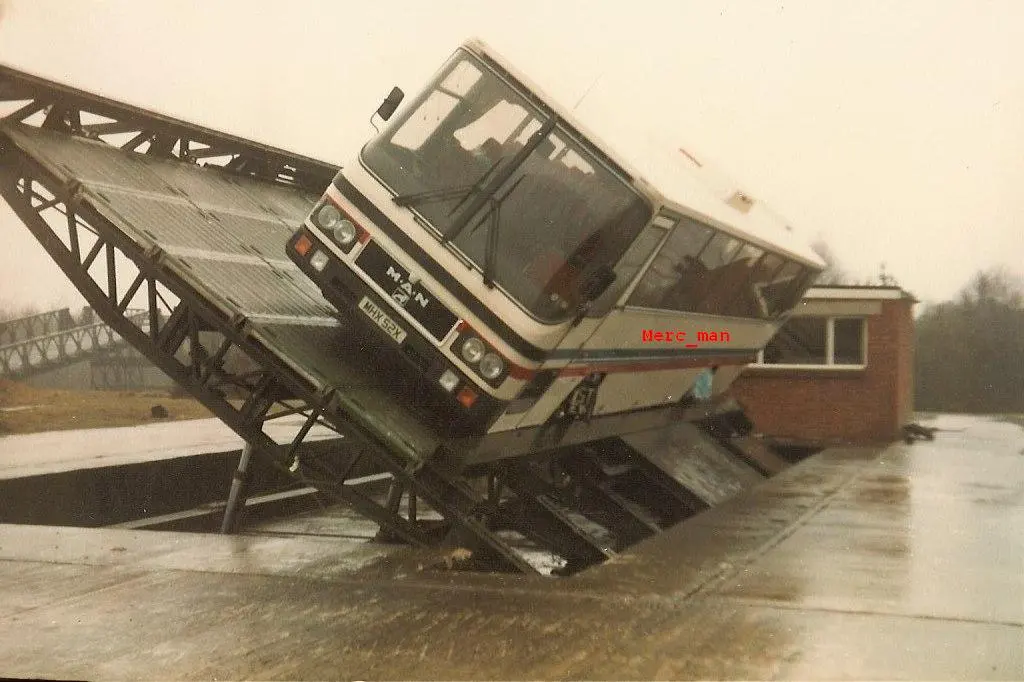
- Loads on buses and trucks. Heavy luggage on the roof of a bus, or sacks stacked high on a truck, raise the CG and make the vehicle easier to overturn on a bend or a sideways slope. Heavy loads should go low, in the luggage hold, and light ones on top.
- Racing cars are built low and wide: a low CG and a wide base.
- A table lamp, a pressure cooker, a gas cylinder have heavy, wide bases.
- Carrying a load. A porter with a doko on his back leans forward, and someone carrying a heavy bucket in one hand leans to the other side: each keeps the CG of body and load over the feet, inside the base. Standing with the feet apart widens the base; that is how you stand in a moving bus.
- Toys that won’t lie down. A tumbler doll has a heavy, rounded base: tip it, and its very low CG is raised, so it rocks back upright.
- A ship carries heavy ballast low in its hull, to keep its CG low.

A truck is loaded with sacks of cement. It is most stable if the sacks are:
Pick an answer to see why.
A ball resting on a level floor is in:
Pick an answer to see why.
A body topples when:
Pick an answer to see why.
Exercise
1. Choose the correct option
a. The time period of a simple pendulum does not depend on:
Pick an answer to see why.
b. Which of these is an oscillatory motion?
Pick an answer to see why.
c. In uniform circular motion, the quantity that stays constant is the body’s:
Pick an answer to see why.
d. A body of mass m moves in a circle of radius r at speed v. If both v and r are doubled, the centripetal force becomes:
Pick an answer to see why.
e. The gravitational field intensity at the Earth’s surface is numerically equal to:
Pick an answer to see why.
f. The escape velocity from the Earth is about:
Pick an answer to see why.
g. A cone resting on its tip is in:
Pick an answer to see why.
2. Give reasons
A pendulum clock loses time in summer.
Hint
Answer
Passengers in a bus going round a bend lean outwards.
Hint
Answer
The roads on sharp bends of a hill highway are banked.
Hint
Answer
The escape velocity of a rocket is the same as that of a small stone.
Hint
Answer
A double-decker bus is more likely to overturn when its upper deck is full and its lower deck empty.
Hint
Answer
The gravitational potential at any point near the Earth is negative.
Hint
Answer
3. Differentiate between
Periodic motion and oscillatory motion
Hint
Answer
Gravitational field intensity and gravitational potential
Hint
Answer
Stable equilibrium and unstable equilibrium
Hint
Answer
Centripetal force and centrifugal force
Hint
Answer
4. Answer the following questions
What is a simple pendulum? Define effective length, amplitude and time period of a simple pendulum.
Hint
Answer
State the laws of a simple pendulum.
Hint
Answer
Why does a simple pendulum, pulled aside and released, keep swinging to and fro? Explain with a diagram showing the forces on the bob at an extreme position.
Hint
Answer
What is periodic motion? Give four examples, and say which of them are also oscillatory.
Hint
Answer
What is uniform circular motion? Why is it called an accelerated motion though its speed is constant?
Hint
Answer
What is centripetal force? Write its formula. Describe a simple way to demonstrate it, and give three examples of its use in daily life.
Hint
Answer
Define gravitational field intensity. Show that it is equal to the acceleration due to gravity.
Hint
Answer
What is gravitational potential? What is escape velocity? Derive the relation between the escape velocity and the gravitational potential at the Earth’s surface.
Hint
Answer
What is the center of gravity of a body? Describe how you would find the center of gravity of an irregular sheet of cardboard.
Hint
Answer
How is the stability of a body related to its center of gravity and its base? Explain why racing cars are made low and wide, and why loads should not be piled high on the roof of a bus.
Hint
Answer
Think: a pendulum clock keeps correct time in Biratnagar, on the plains. Will it run fast or slow in Kathmandu (about 1,300 m higher), and on the Moon? Explain.
Hint
Answer
5. Numerical problems
Find the time period and frequency of a simple pendulum of effective length 2.5 m. (g = 9.8 m/s²)
Hint
Answer
A simple pendulum makes 50 complete oscillations in 100 s at a place where g = 9.8 m/s². Find its effective length.
Hint
Answer
In a school lab, Rajan finds that a pendulum of effective length 0.60 m makes 20 oscillations in 31.2 s. Find the value of g in the lab.
Hint
Answer
A pendulum has a time period of 2 s on the Earth (g = 9.8 m/s²). What would its time period be on a planet where g = 2.45 m/s²?
Hint
Answer
The blades of a ceiling fan of radius 0.60 m turn 300 times a minute. Find the time period of the motion and the speed of the tip of a blade.
Hint
Answer
A stone of mass 0.5 kg tied to a 1.0 m string is whirled in a horizontal circle, making 2 rounds a second. Find its speed and the tension in the string. (Leave out gravity.)
Hint
Answer
A motorbike and its rider, of total mass 200 kg, go round a bend of radius 40 m. The greatest friction force the road can give the tyres is 1,800 N. What is the greatest speed at which they can take the bend without skidding?
Hint
Answer
The radius of the Earth is 6,400 km and g at its surface is 9.8 m/s². Find the gravitational field intensity (i) at a height of 3,200 km above the surface, and (ii) at a height of 6,400 km.
Hint
Answer
The mass of Mars is 6.4 × 10²³ kg and its radius 3,400 km. Find (i) the gravitational field intensity at its surface, (ii) the gravitational potential at its surface, and (iii) the escape velocity from Mars. (G = 6.67 × 10⁻¹¹ N m²/kg²)
Hint
Answer
The gravitational potential at the surface of a planet is −8.0 × 10⁶ J/kg. What is the escape velocity from it? What minimum kinetic energy must a 500 kg probe have to escape from its surface?
Hint
Answer
A uniform meter stick of mass 120 g carries a 30 g mass at its 90 cm mark. Find the position of the center of gravity of the stick and the mass together.
Hint
Answer
A wooden cupboard 0.50 m deep and 1.8 m tall stands on a floor. Its center of gravity is at its middle. (i) Through what angle can it be tipped forward on its front edge before it falls? (ii) Heavy books are put on its bottom shelf, lowering its CG to 0.60 m above the floor. Through what angle can it now be tipped?
Hint
Answer
Printable PDFs
- The unit as a book (A5) 41 pages Answers as an A4 booklet, 11 sheets
- Study notes 3 pages
- Worksheet 5 pages Answer key
- Harder practice questions 3 pages Answer key
Practice every question in the book, and keep track of the ones you miss →
Found a mistake? Please tell us.