
Drop a tennis ball on the floor of your school’s verandah and watch it. It bounces back, but not as high as you dropped it. The next bounce is lower, and the next lower still. After a few seconds it rattles to a stop and lies still.
In Grade 9 you learned that energy can neither be created nor destroyed, only changed from one form to another Grade 9: Principle of conservation of energy. The ball started with energy, because you lifted it. Now it has none that you can see. So where did the energy go?
Squash players know part of the answer. Before a match they hit the ball dozens of times against the wall, to warm it up: a cold squash ball hardly bounces at all. The energy of every hit is going into the ball, and the ball is getting warmer. This topic shows you how to count energy in joules, kinetic, gravitational and thermal, and how to follow every joule of the bouncing ball until you find where it went.
Energy you can count
In Grade 9 you met work: when a force moves something, work = force × distance moved, measured in joules (J). One joule is about the work you do lifting a 100 g apple (a weight of about 1 N) up by 1 m. Work is how energy moves from one thing to another: when you lift the apple, energy goes from you into the apple and the Earth. In a machine, the input work is the energy you put in, and the output work is the energy the machine passes on Grade 9: Efficiency.
So energy is something you can count, like money in a bank account. It moves from one account to another, and changes from one kind to another, but if you add up every account, the total never changes. To check that, you need a way to count each kind. Physicists sort all the kinds into two big families:
- Energy of motion, called kinetic energy: a moving bus, a flying cricket ball, the jiggling molecules of hot tea.
- Energy of position, called potential energy: a ball held up high, a stretched catapult band, the electrons and atoms in a molecule of petrol. It is energy stored because things that push or pull on each other are held at a distance from each other.
In Grade 6 you met these two as kinetic energy and potential energy. Now you will put numbers on them.
A 1 kg bag of rice is lifted from the floor onto a shelf 1.5 m high. About how much work is done? (A 1 kg mass weighs about 9.8 N.)
Pick an answer to see why.
Kinetic energy: the energy of motion
How much energy does a moving thing have? Find out how much work it takes to get it moving.
Push a trolley of mass m, starting from rest, with a steady force F along a smooth, level floor. You learned in Grade 9 that the force gives it an acceleration a = F ÷ m Grade 9: Newton’s second law, and that after it has moved a distance s its velocity v is given by v² = u² + 2as, with u = 0 Grade 9: Equations of linear motion. Put them together:
The acceleration cancels out. However hard or gently you push, the work it takes to bring a mass m up to a speed v is always the same. That work is now stored in the trolley’s motion, and it comes out again when the trolley is stopped: it can squash a box, or heat the brakes. So the kinetic energy (KE) of a body of mass m moving at speed v is
with m in kg and v in m/s, giving joules.
Look at what the formula says. Kinetic energy is in proportion to the mass: a loaded truck has twice the kinetic energy of the same truck empty, at the same speed, if the load weighs as much as the truck. But it goes with the square of the speed: at twice the speed, a bus has four times the kinetic energy, and its brakes have four times as much energy to get rid of. That is why a crash at 80 km/h is so much worse than one at 40 km/h.
A car’s speed goes up from 30 km/h to 90 km/h. Its kinetic energy becomes
Pick an answer to see why.
Gravitational potential energy: the energy of height
Now lift something. To raise a mass m steadily, you must push up with a force equal to its weight, mg Grade 10: Weight. Lifted through a height h, the work you do is force × distance:
That work isn’t lost. Let go, and the falling mass gives it back as speed. While it is held up, the energy is stored, as gravitational potential energy (GPE):
with m in kg, g = 9.8 m/s² and h in meters, giving joules.
Two things to notice. First, h is the height above a level you choose: the floor, the table, the ground outside. What matters in every calculation is how much the GPE changes, and the change is the same whichever level you call zero. Second, the energy isn’t really “in” the ball. It belongs to the ball and the Earth together: it is stored because they pull on each other and have been pulled apart. Physicists say it is stored in the gravitational field between them (you met fields in Why Is Gravity So Weak?). A ball far out in space, with nothing to fall towards, would have no gravitational potential energy to give.
A ball on a table is 1 m above the floor and 4 m above the ground outside the window. Its GPE is
Pick an answer to see why.
Swapping one for the other
Drop a ball. As it falls, it loses height and gains speed: gravitational potential energy is turning into kinetic energy. Is the swap exact?
You can check with the equation you used for falling bodies in Grade 10 Grade 10: Equations of motion for free fall. A body dropped from rest (u = 0) that has fallen a height h has v² = 2gh. Multiply both sides by ½m:
Kinetic energy gained = gravitational potential energy lost, exactly. While nothing but gravity acts, GPE + KE stays the same all the way down. Here is the swap, worked out for the tennis ball dropped from 2.54 m that you will meet again below (mass 58 g, so its GPE at the top is 0.058 × 9.8 × 2.54 = 1.44 J):
| Height (m) | Speed (m/s) | GPE (J) | KE (J) | GPE + KE (J) |
|---|---|---|---|---|
| 2.54 (let go) | 0 | 1.44 | 0 | 1.44 |
| 1.91 | 3.53 | 1.08 | 0.36 | 1.44 |
| 1.27 | 4.99 | 0.72 | 0.72 | 1.44 |
| 0.64 | 6.11 | 0.36 | 1.08 | 1.44 |
| 0 (hits the floor) | 7.06 | 0 | 1.44 | 1.44 |
This is the principle of conservation of energy put to work: if you know how the energy changes in one part of a system, you can work out the change in another part, without knowing anything about the forces or the path. Energy gives you a short cut.
Two stones, one of 1 kg and one of 5 kg, are dropped together from a bridge 20 m high. Ignoring air, which is true when they reach the water?
Pick an answer to see why.
Where the energy goes in a bounce
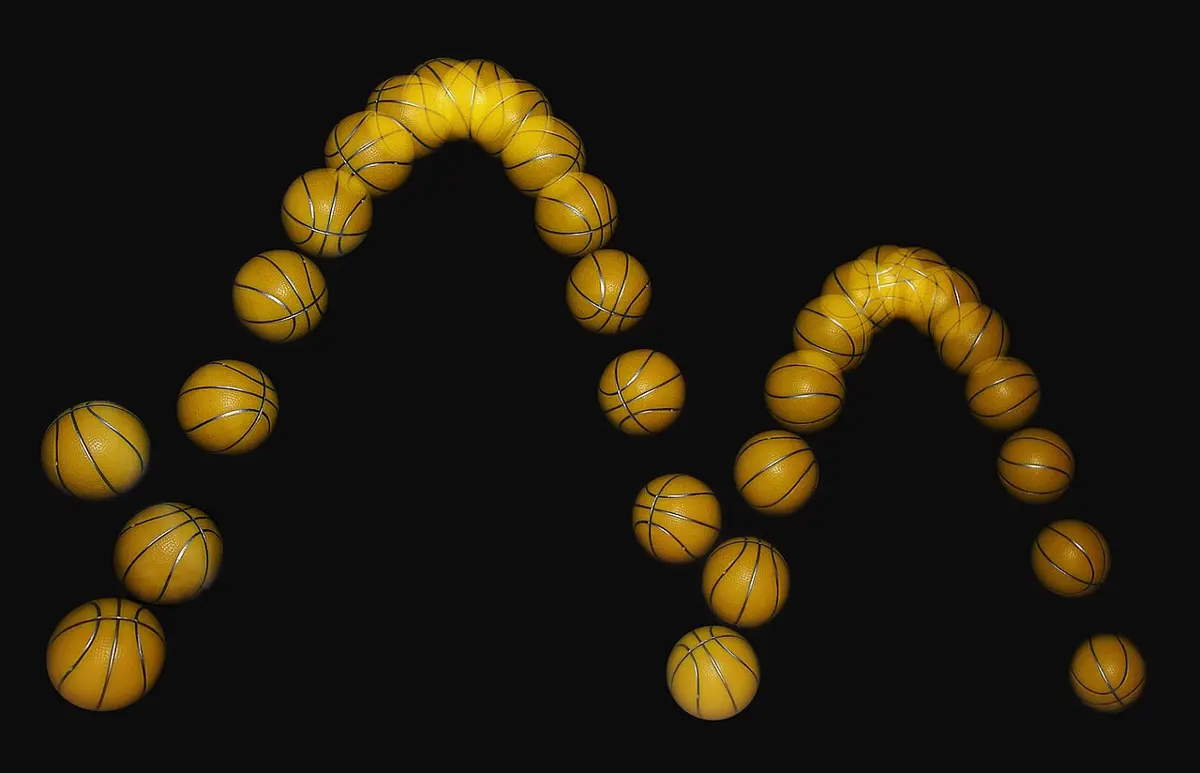
Now watch the bounce itself. A tennis ball hits the floor at 7 m/s. In a few thousandths of a second it is squashed flat on one side, stops, and springs back up.
At the moment it is squashed most, the ball isn’t moving at all. Its kinetic energy is now stored in the squashed rubber and the squeezed air inside, the way energy is stored in a stretched catapult band. This is elastic potential energy, and you met the idea behind it in Grade 9: an elastic body that is deformed has a restoring force that pushes it back Grade 9: Elasticity and plasticity. As the ball springs back, the elastic energy turns back into kinetic energy, and the ball leaves the floor.
But not all of it. As the rubber squashes and springs back, its long, tangled molecules slide and rub past one another, and the floor shakes a little. That rubbing turns part of the energy into thermal energy: the ball and the floor get very slightly warmer. A very little goes off as the sound of the bounce, and that too ends up as thermal energy in the air. So the ball leaves the floor slower than it arrived, and rises less high.
How much is lost? Sports’ governing bodies test their balls by exactly this experiment. Each ball must be dropped from a fixed height onto a hard surface and bounce back to a height inside a fixed range:
| Ball | Mass | Dropped from | Must bounce back to | Middle of range ÷ drop |
|---|---|---|---|---|
| Tennis ball (ITF) | 56.0–59.4 g | 254 cm, onto concrete | 135–147 cm | 141 ÷ 254 = 56% |
| Football (FIFA Quality) | 410–450 g | 200 cm, onto a steel plate | 125–155 cm | 140 ÷ 200 = 70% |
| Table tennis ball (ITTF) | 2.7 g | 30.5 cm, onto a steel block | 24–26 cm | 25 ÷ 30.5 = 82% |
Because GPE = mgh, the ratio of the bounce height to the drop height is the fraction of the energy that the ball keeps in each bounce: the bounce’s efficiency, in Grade 9’s words (output ÷ input). A tennis ball keeps about 56% of its energy and turns about 44% into thermal energy. (A little is also lost to air resistance on the way down and up, but over a fall of 2.5 m that is small.)
A ball is dropped from 2.0 m and bounces to 1.5 m. What fraction of its energy became thermal energy in the bounce?
Pick an answer to see why.
Every kind of energy is motion or position
Where is the thermal energy, really? Zoom in on the ball.
The ball is made of countless molecules. Before the bounce, they were all moving downwards together at 7 m/s: that shared, orderly motion is the ball’s kinetic energy. After the bounce, the ball as a whole is moving more slowly. The missing energy hasn’t vanished: it is now spread among the molecules as random motion, each jiggling a tiny bit faster than before, in every direction. In Grade 10 you learned that the total kinetic energy of the molecules is a body’s thermal energy, and that temperature measures their average kinetic energy Grade 10: Thermal energy, heat and temperature. So the ball’s energy is still energy of motion. It has only gone from the motion of the whole ball to the motion of its separate molecules.
There is a little more to thermal energy than that. In a solid or a liquid, molecules pull and push on their neighbors, like balls joined by springs. As they jiggle, they keep stretching and squeezing those springs, so part of a body’s thermal energy is the energy of position of its molecules. That is where the energy goes when ice melts: the molecules are pulled out of their fixed places, against the pull of their neighbors, and their energy of position goes up while the temperature stays at 0 °C (more in Why Does Salt Melt at 801 °C but Ice at 0 °C?).
Follow any kind of energy far enough down and you find the same two families again:
- Elastic energy in a squashed ball or a stretched catapult band is the energy of position of its atoms, pushed together or pulled apart against the electric forces that hold them in place.
- Chemical energy in petrol, food or a battery is energy of position too: of electrons and atoms, held in the arrangement of the molecules. A reaction that rearranges them can release it (Why Do Some Reactions Get Hot?).
- Electrical energy stored between two charged metal plates, one positive and one negative, is energy of position as well. The plates pull on each other; to pull them farther apart you must do work, and that work is stored in the electric field between them, just as the work of lifting a ball is stored in the gravitational field between the ball and the Earth.
- Sound is the motion of air molecules, squeezed together and spread apart as the wave passes: motion and position, back and forth.
So the answer to the question in the title is: the energy of the bouncing ball goes into the motion of molecules, in the ball, the floor and the air. It is all still there; it has just been spread so thinly among so many molecules that you can’t see it, and the temperature rise is too small to feel.
(Light is the one kind that doesn’t fit neatly into either family: it is energy carried by electric and magnetic fields themselves, traveling through space.)
A moving bus brakes to a stop. At the level of molecules, what has happened to its kinetic energy?
Pick an answer to see why.
Proving that heat is energy
Building an energy model
To follow energy through any change, scientists build an energy model: a set of accounts that must balance. You can do it in four steps.
- Choose the system: the things you will keep the accounts for (the ball, the Earth and the floor; a bicycle, its rider and the Earth).
- List its energy stores: kinetic, gravitational, elastic, thermal, chemical.
- List the energy flowing in or out: work done by something outside (a push, your legs on the pedals), heat flowing in or out, sound or light leaving.
- Balance the accounts: the total change in the stores = energy in − energy out. If you know all the changes but one, the last one is the difference.
Each term means something real. A Δ (“change in”) is the final amount minus the starting amount, so it is negative when a store goes down: when the ball falls, ΔGPE is negative and ΔKE is positive, and they add up to zero.
Questions
A stone falls from a cliff. Halfway down (ignoring air), its kinetic energy is
Pick an answer to see why.
A ball dropped on a hard floor bounces back to 60% of its drop height each time. After two bounces, what share of its starting energy does it still have as GPE at the top?
Pick an answer to see why.
A 1,200 kg car is moving at 20 m/s. a. Find its kinetic energy. b. It brakes to a stop. If all its kinetic energy goes into its four brake discs, each of mass 5 kg and made of iron (s = 460 J/(kg °C)), by how much does each disc warm up?
Answer
- a.KE = ½mv² = ½ × 1,200 × 20² = 240,000 J.
- b.Each disc gets a quarter: 60,000 J. Δθ = Q ÷ (ms) = 60,000 ÷ (5 × 460) = 26 °C. (In a real car the front brakes do more of the work and some heat goes into the air and the pads, but a hard stop really does warm the discs by tens of degrees. Brakes are machines for turning kinetic energy into thermal energy.)
A pole vaulter of mass 60 kg runs at 9.0 m/s and clears a bar. a. Find her kinetic energy as she runs. b. If all of it became gravitational potential energy, how high could her center of mass rise? c. Real vaulters lift their center of mass a little more than that. Where can the extra energy come from?
Answer
- a.KE = ½ × 60 × 9.0² = 2,430 J.
- b.mgh = 2,430 J, so h = 2,430 ÷ (60 × 9.8) = 4.1 m. (Notice the mass cancels: h = v² ÷ 2g = 81 ÷ 19.6.)
- c.From her own muscles, energy flowing into the system: she pushes up with her arms on the pole as she rises. The bent pole stores energy as elastic energy and gives it back; its job is to turn her forward kinetic energy into height. (Some is also lost as thermal energy in the pole and her body, so her muscles have to make that up too.)
Using the idea of molecules, explain what happens to the energy of a moving football when it rolls across a grass field and stops. Is energy conserved?
Answer
At the start, all the molecules of the football are moving forward together: this shared motion is the ball’s kinetic energy. As it rolls, the grass bends and the ball squashes a little at the bottom, again and again; rubbing in the grass and the ball’s rubber, and the air pushed aside, pass the energy to the molecules of the grass, the ball and the air. They end up jiggling slightly faster, in random directions: thermal energy. The ball’s orderly motion has become the disorderly motion of many molecules. Yes: energy is conserved. The total is the same; only its form has changed, from kinetic energy of the ball to thermal energy of the surroundings.
A 0.50 kg ball is dropped from 4.0 m and bounces back to 3.0 m. Make an energy model of the bounce: a. choose the system, b. find the energy in each store at the start, just before it hits the floor, and at the top of the bounce, and c. find the energy that became thermal energy. d. How fast was it going just before it hit the floor, and just after it left it?
Answer
- a.The ball, the Earth and the floor (and the air around them). Nothing outside does work on them, so no energy flows in.
- b.At the start: GPE = 0.50 × 9.8 × 4.0 = 19.6 J, KE = 0. Just before it hits: GPE = 0, KE = 19.6 J. At the top of the bounce: GPE = 0.50 × 9.8 × 3.0 = 14.7 J, KE = 0.
- c.19.6 − 14.7 = 4.9 J became thermal energy (and a little sound), 25% of the start.
- d.Before: ½ × 0.50 × v² = 19.6, so v = √78.4 = 8.9 m/s. After: ½ × 0.50 × v² = 14.7, so v = √58.8 = 7.7 m/s.
A hydropower plant uses water that falls 100 m through a pipe. a. How much gravitational potential energy does 1 kg of water release? b. If 1,000 kg of water flows through every second and the plant is 85% efficient, what is its power output? c. What happens to the other 15%?
Answer
- a.GPE = mgh = 1 × 9.8 × 100 = 980 J.
- b.Every second, 1,000 kg releases 1,000 × 980 = 980,000 J. 85% of it is 833,000 J per second, so the power is 833,000 W, about 0.83 MW.
- c.It becomes thermal energy: friction in the pipe and the turbine’s bearings, swirling water, heating in the generator’s wires, and sound. (How Much Electricity Can a Small Stream Make? goes further with this.)
Climbing from Bhaktapur (1,401 m) to Nagarkot (2,175 m), a 50 kg student gains gravitational potential energy. a. How much? b. Muscles turn only about a quarter of the food energy they use into work; the rest becomes thermal energy. How much food energy does the climb take, at least? c. A plate of cooked rice (about 300 g) gives about 1.6 MJ of food energy. How many plates is that?
Answer
- a.GPE = mgh = 50 × 9.8 × 774 = 379,000 J (379 kJ).
- b.379 kJ is a quarter of the energy used, so the food energy is 4 × 379 = 1,520 kJ (about 1.5 MJ). The other three-quarters warms the body, which is why you get hot climbing.
- c.About one plate, just for the climbing, on top of what the body uses anyway.
Where to go next
- Why Does Heat Never Flow from Cold to Hot? The ball’s energy spreads out into thermal energy, and never gathers itself back to bounce the ball higher. Why energy spreads one way, and why no engine is perfect.
- How Much Electricity Can a Small Stream Make? Gravitational potential energy at work: measure a stream’s drop and flow, work out its power, and build a turbine.
- How Do Magnets Push Without Touching? More on the energy stored in fields, electric and magnetic.