
A bus has a flat tyre on the Araniko Highway. The driver fits a lug wrench onto a nut and pulls, but the nut won’t move. So he slips a length of iron pipe over the end of the wrench, pulls again, and the nut turns at once. He didn’t pull any harder; he only pulled farther from the nut. Down in Pokhara, a boatman on Phewa Lake steps from his boat onto the shore, and the boat slides backward away from the bank, though nobody pushed it.
Both happen because of rules about force that are older than any bus. A force can make a thing turn, and how well it turns depends on where the force acts as much as on how big it is. A force changes a body’s motion, and when two bodies push on each other, the motion one gains the other loses. This unit is about those rules: how to add forces and other quantities that have a direction, how to read a journey from a velocity–time graph, how forces turn things, and how momentum is passed from one body to another.

11.1 Vector and scalar quantities
Your friend phones from Bhaktapur Durbar Square and says, “Walk 3 km and you will find me.” Can you find her? Not yet. Three kilometers north takes you toward Nagarkot’s road, three kilometers west toward Thimi. To find her you need to know which way as well as how far.
Anything we can measure in physics is a physical quantity: length, mass, time, speed, force and so on. Every physical quantity has a magnitude, its size, written as a number with a unit (3 km, 50 kg, 20 s). Some quantities need nothing more. Others make sense only with a direction as well.
A scalar quantity is a physical quantity that has magnitude only. Mass, time, temperature, volume and speed are scalars: “50 kg”, “20 s” or “30 °C” says everything there is to say.
A vector quantity is a physical quantity that has both magnitude and direction, and that adds by the rules of vector addition below. Displacement, velocity, acceleration and force are vectors: “3 km to the north”, “20 m/s toward Pokhara”, “a force of 50 N downward”.
| Scalar quantities | Vector quantities |
|---|---|
| distance (5 km) | displacement (5 km to the east) |
| speed (60 km/h) | velocity (60 km/h toward the south) |
| mass (60 kg) | weight (600 N, downward) |
| time, temperature, volume, density | acceleration (9.8 m/s², downward) |
| work, energy, power | force (20 N to the left) |
| pressure, electric current, charge | momentum (section 11.4) |
Distance and displacement show the difference well. A bus goes from Kathmandu to Pokhara and back, about 200 km each way. The distance it covers is 400 km, a scalar. Its displacement, the straight-line change in its position with a direction, is zero: it ended where it started.
Representing a vector
A vector is drawn as an arrow. The arrow points in the vector’s direction, and its length shows its magnitude, drawn to a chosen scale. With a scale of 1 cm = 10 N, a force of 40 N to the east is an arrow 4 cm long pointing east. The end the arrow starts from is its tail, the pointed end its head.
In print, a vector is written in bold, F, or with a small arrow over its letter, ; its magnitude alone is written in ordinary type, F, or as .
Two vectors are equal when they have the same magnitude and the same direction, wherever they are drawn. The negative of a vector, −A, has the same magnitude as A but points the opposite way.
Which of these is a vector quantity?
Pick an answer to see why.
Addition of vectors
Scalars add like ordinary numbers: 2 kg of rice and 3 kg of rice make 5 kg, always. Vectors don’t. Walk 4 km east and then 3 km north, and you have walked 7 km, but you are only 5 km from where you started. The single vector that has the same effect as two or more vectors together is called their resultant.
Vectors along one line
When two vectors act in the same direction, the resultant is their sum, in that direction. Two porters pushing a cart forward with 40 N and 30 N give it a resultant push of 70 N forward.
When two vectors act in opposite directions, the resultant is their difference, in the direction of the larger one. In a tug of war, if one team pulls with 1,500 N to the left and the other with 1,350 N to the right, the resultant is 150 N to the left, and the rope moves left.
The triangle law
When the vectors are at an angle, draw them head to tail.
Triangle law of vector addition: if two vectors are represented in magnitude and direction by the two sides of a triangle taken in order (the tail of the second at the head of the first), their resultant is represented in magnitude and direction by the third side, drawn from the tail of the first to the head of the second.
Walk 4 km east from A to B, then 3 km north from B to C. The two walks are the sides AB and BC, head to tail; your resultant displacement is AC, from where you started to where you ended.
The parallelogram law
The same rule can be drawn with both vectors starting from one point, as two forces pulling on the same object do.
Parallelogram law of vector addition: if two vectors acting at a point are represented in magnitude and direction by the two adjacent sides of a parallelogram drawn from that point, their resultant is represented in magnitude and direction by the diagonal of the parallelogram from the same point.
The two laws always give the same answer: the far side of the parallelogram is the second vector moved to the head of the first, so the triangle is just half of the parallelogram.
Two vectors at right angles
When the two vectors are perpendicular, the triangle is a right-angled triangle, and the resultant can be calculated by Pythagoras’ theorem instead of being measured on a drawing:
where is the angle the resultant makes with A.
Two vectors at any angle
At any other angle, draw the vectors to scale, head to tail, and measure the resultant with a ruler and its direction with a protractor. This is the graphical method, and it works for any number of vectors: draw them all head to tail, and the resultant runs from the first tail to the last head.
The widget shows a rule worth remembering: the resultant of two vectors is largest when they point the same way (R = A + B) and smallest when they point opposite ways (R = A − B, if A is the larger). At every other angle it lies between the two.
Two forces of 6 N and 4 N act on a box. Which of these can not be their resultant, whatever the angle between them?
Pick an answer to see why.
A boat is steered straight across a river at 3 m/s while the river flows at 4 m/s. What is the boat’s speed relative to the bank?
Pick an answer to see why.
Subtraction of vectors
To subtract a vector, add its negative:
Turn B round so it points the opposite way, then add it to A by the triangle law, as in the third drawing of Figure 11.2.
Vector subtraction is how we find a change in a vector, such as a change in velocity: change in velocity = final velocity − initial velocity. On a line, this is just a matter of signs. A ball hits a wall at 8 m/s and bounces straight back at 6 m/s. Taking “away from the wall” as positive, its velocity changes from −8 m/s to +6 m/s, so the change is 6 − (−8) = 14 m/s away from the wall, not 2 m/s. That change is what the wall’s push produced, and you will need it in 11.4.
A ball moving at 5 m/s hits a wall head-on and bounces straight back at 5 m/s. What is the change in its velocity?
Pick an answer to see why.
11.2 Velocity–time graph
A velocity–time graph tells the whole story of a journey in a straight line: when the body sped up, how quickly, when it cruised, when it braked, and how far it went. You met its shapes in Grade 9 Science: a flat line is uniform velocity, a straight sloping line is uniform acceleration, and a curve is changing acceleration. This section is about drawing one from measurements and reading numbers from it.
Plotting a velocity–time graph
To draw a velocity–time graph from a table of readings:
- Put time on the x-axis (across) and velocity on the y-axis (up), because time is the quantity we choose and velocity the one we measure.
- Choose a scale for each axis that makes the graph fill most of the paper, with easy steps: 1 cm for 5 s, 1 cm for 2 m/s, never awkward steps such as 1 cm for 3 s.
- Label each axis with the quantity and its unit, “time (s)” and “velocity (m/s)”, and number the big squares.
- Plot each reading as a small cross or dot.
- Join the points. Where the velocity changes steadily, the points lie on straight lines; join them with a ruler. Where it doesn’t, draw a smooth curve through them.
Acceleration from the slope
Acceleration is the rate of change of velocity, and on a velocity–time graph that is the slope of the line. Pick two points on a straight part, and :
- A line sloping up has a positive slope: the body is speeding up.
- A flat line has zero slope: no acceleration, uniform velocity.
- A line sloping down has a negative slope: the body is slowing down, a retardation (deceleration).
- The steeper the line, the greater the acceleration.
On a curved line the slope is different at every point, and its slope at one moment is the slope of the straight line that just touches the curve there, its tangent.
Distance from the area
The area under a velocity–time graph, between the line and the time axis, is the distance traveled (strictly, the displacement). Why? A bus moving at a steady 10 m/s for 5 s travels 10 × 5 = 50 m, and on its graph that is a rectangle 10 high and 5 wide, of area 50. Velocity × time is distance, and height × width is area.
Break the area into shapes you can work out:
| Shape under the line | When it appears | Area |
|---|---|---|
| rectangle | uniform velocity | width × height |
| triangle | uniform acceleration from rest, or to rest | × base × height |
| trapezium | uniform acceleration between two velocities | × (sum of the parallel sides) × width |
In working out an area, read the time in seconds and the velocity in m/s from the axes, so that the area comes out in meters.
Average velocity from the graph
Average velocity is the total displacement divided by the total time taken:
So find the whole area first, then divide by the time on the graph’s last point.
On a velocity–time graph, a straight line falls from 20 m/s at 0 s to 0 m/s at 4 s. What distance does the body travel?
Pick an answer to see why.
The equations of motion from the graph
The three equations of motion you used in Grade 9 Science can all be read from one velocity–time graph. Take a body moving with uniform acceleration : its velocity is at time 0 and at time , and it travels a distance . Its graph is a straight line from to .
1. From the slope: the acceleration is the slope of the line,
2. From the area: the area under the line is a trapezium with parallel sides and and width , so
Or split it into a rectangle of height and a triangle on top, whose height is :
3. Without the time: from (i), . Put this into (ii):
When the velocity turns negative
Throw a ball straight up at 20 m/s. Gravity slows it by about 10 m/s every second (taking g ≈ 10 m/s² to keep the numbers simple), so it stops at the top after 2 s and falls back, reaching your hand after 4 s, moving down at 20 m/s. Taking upward as positive, its graph is one straight line from +20 m/s down to −20 m/s, crossing the time axis at 2 s.
The area above the axis (0 to 2 s) is m: the ball rose 20 m. The area below the axis (2 to 4 s) is also 20 m, but counted negative: it came down 20 m. So its displacement is 20 − 20 = 0 (it is back in your hand), while the distance it traveled is 20 + 20 = 40 m. An area below the time axis is a displacement in the negative direction.
A body’s velocity–time graph is a straight line parallel to the time axis, at 8 m/s, from 0 to 5 s. Which statement is correct?
Pick an answer to see why.
11.3 Turning effect of force
Push a door near its hinges and it hardly moves; push it at the handle with the same force and it swings open easily. A force can do more than push a thing along: it can turn it about a fixed point or line, the pivot (or fulcrum, or axis of rotation). The door turns about its hinges, a wrench (the spanner, as many in Nepal call it) about the nut, a see-saw about its middle, a steering wheel about its column.
Moment of a force
The turning effect of a force is called its moment (or torque).
The moment of a force about a point is the product of the force and the perpendicular distance from the point to the line of action of the force:
The line of action of a force is the straight line along which it acts, through the point where it is applied. The distance must be measured from the pivot at right angles to that line.
The SI unit of moment is the newton meter (N m): a force of 1 N acting 1 m from the pivot, at right angles, has a moment of 1 N m.
A moment turns a body either clockwise or anticlockwise, and the direction matters as much as the size: two equal moments in opposite directions cancel. So a moment is described by its size and its sense of turning.
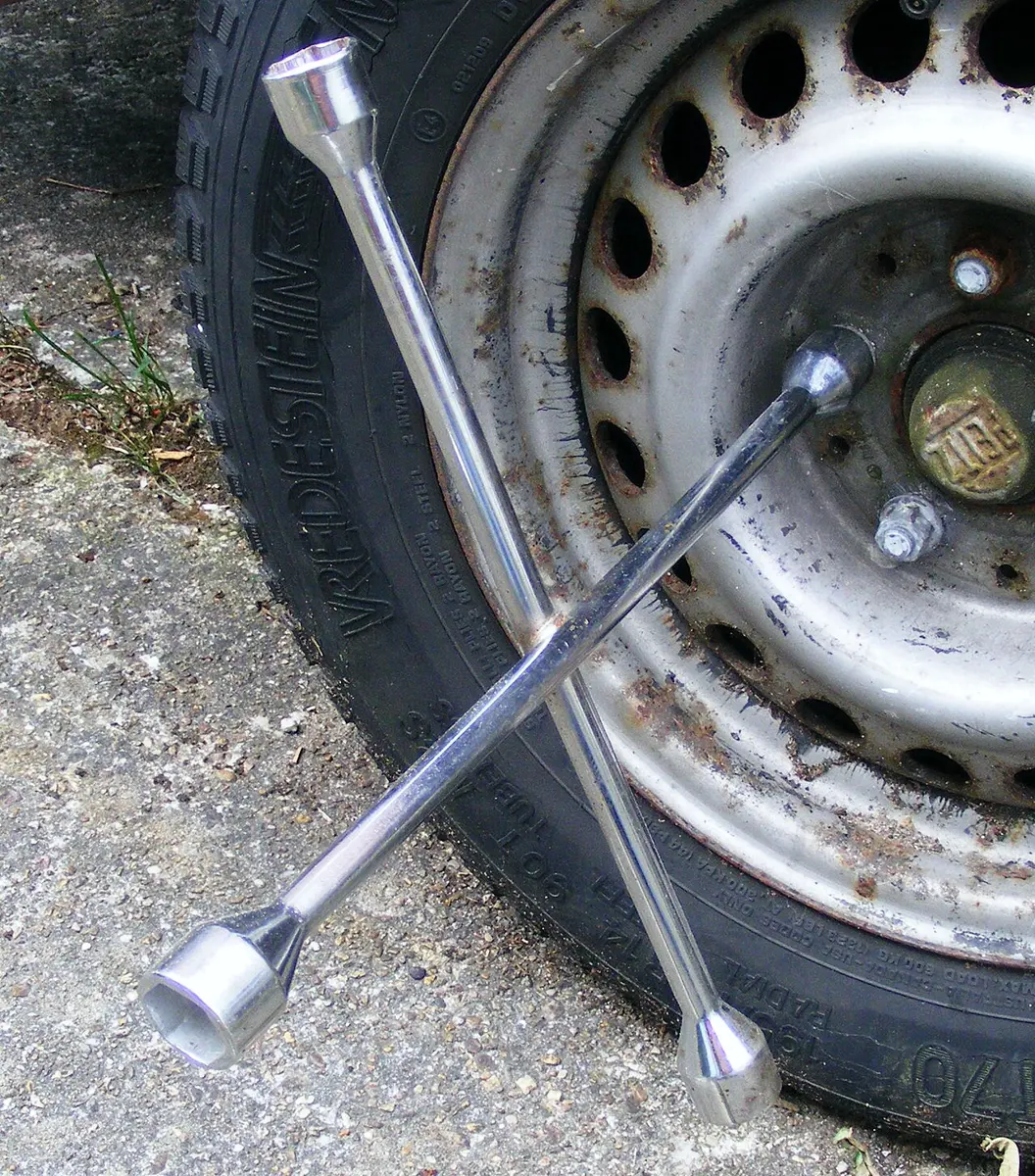
The moment of a force can be made bigger in two ways: a bigger force, or a bigger perpendicular distance. The second is usually easier, which is why the bus driver’s pipe worked. That is the whole secret of a wrench.
Wrench after File:Wrench.svg, public domain, via Wikimedia Commons
Moments around us
- Door handles are fixed on the edge farthest from the hinges, for the largest perpendicular distance.
- Wrenches and lug wrenches have long handles, and a stuck nut is loosened with a longer one (or a pipe over the handle).
- A hand pump at a tube well has a long handle: a small push at its end gives a large moment about the pivot, enough to lift the column of water.
- Tin snips and garden shears for cutting thick wire or branches have long handles and short blades.
- A wheelbarrow carries its load close to the wheel (the pivot) and is lifted at the far ends of its handles.
- A bottle opener grips the cap close to the pivot and is pushed at its far end.
- Turning a bicycle’s pedal is easiest with the crank horizontal, when the push of your foot is farthest (at right angles) from the axle; with the crank straight down, your push passes through the axle and has no moment at all.

Principle of moments
When a body is balanced and doesn’t turn, the moments that try to turn it one way exactly cancel those that try to turn it the other way. In Grade 8 you met this as the principle of the lever (effort × effort distance = load × load distance). In terms of moments:
Principle of moments: when a body is in equilibrium, the sum of the clockwise moments about any point is equal to the sum of the anticlockwise moments about the same point.
A force of 20 N acts at right angles to a wrench, 0.25 m from the nut. What is its moment?
Pick an answer to see why.
Why is it hard to open a door by pushing near its hinges?
Pick an answer to see why.
Couple
Turn a steering wheel and you use two hands: one pushes up on one side of the wheel while the other pulls down on the opposite side. Open a tap, turn a key, unscrew a bottle cap, and your fingers do the same: they push in opposite directions on opposite sides.
A couple is a pair of equal and opposite parallel forces whose lines of action are not the same.
The two forces of a couple add up to zero, so they don’t move the body from its place; they only turn it. That is the difference from a single force: one push on the edge of a book lying on a table makes it slide as well as turn, but a couple, one finger pushing on each opposite corner, spins it where it lies.
The moment of a couple is one of the forces multiplied by the perpendicular distance between their lines of action, called the arm of the couple:
Why? Take moments about the middle point between the forces. Each force is from it, and both turn the body the same way, so the total is . Take moments about any other point and the answer is the same: about one hand on the wheel, that hand’s force has no moment and the other’s is . A couple has the same moment about every point.
Couples in daily life
- turning a steering wheel, or the handlebar of a bicycle with both hands;
- opening or closing a water tap, and turning a key in a lock;
- unscrewing the lid of a jar or a bottle cap;
- turning a screwdriver, with the fingers pushing opposite ways on its handle;
- winding a watch or a clock;
- a lug wrench turned with both hands;
- the forces of the Earth’s magnetic field on the two poles of a compass needle, which turn it to point north (Unit 14);
- the forces on the two sides of the coil in an electric motor, which keep it spinning.
| Moment of a force | Couple |
|---|---|
| The turning effect of one force about a pivot. | Two equal, opposite, parallel forces not in the same line. |
| Moment = force × perpendicular distance from the pivot. | Moment = one force × the perpendicular distance between the two forces. |
| Its size depends on the point it is taken about. | Its moment is the same about every point. |
| A single force can also move the body along (the pivot holds it). | The forces add up to zero: it only turns the body. |
| Example: opening a door, a wrench on a nut. | Example: a steering wheel, a tap, a key in a lock. |
Which of these is turned by a couple?
Pick an answer to see why.
Each hand turns a steering wheel 40 cm across with a force of 15 N, in opposite directions. What is the moment of the couple?
Pick an answer to see why.
11.4 Linear momentum
A bicycle rolling at 5 m/s is easy to stop with your hand on its carrier. A loaded truck rolling at the same 5 m/s would crush anyone who tried. A cricket ball tossed gently is easy to catch; the same ball from a fast bowler stings your hands. How hard a moving body is to stop depends on both its mass and its velocity. Physics puts the two together in one quantity.
Definition
The linear momentum of a body is the product of its mass and its velocity:
where is the momentum, the mass in kilograms and the velocity in meters per second. The SI unit of momentum is the kilogram meter per second (kg m/s).
Momentum is a vector, with the same direction as the velocity. On a straight road, choose one direction as positive; a body moving the other way then has a negative velocity and a negative momentum. “Linear” means momentum along a line, to tell it apart from the momentum of a spinning body. A body at rest has no momentum at all, however heavy it is.
A parked truck of mass 5,000 kg and a 60 kg runner moving at 5 m/s: which has more momentum?
Pick an answer to see why.
Momentum and force: Newton’s second law
A force acting on a body changes its velocity, and so changes its momentum. Suppose a force acts on a body of mass for a time , and changes its velocity from to .
Initial momentum = ; final momentum = .
Change in momentum = .
Rate of change of momentum = .
Newton found that the rate at which a body’s momentum changes is directly proportional to the force on it. This is Newton’s second law of motion, in the form he gave it:
Newton’s second law of motion: the rate of change of momentum of a body is directly proportional to the force applied on it, and takes place in the direction of the force.
So
But is the acceleration , so , or . The newton is defined as the force that gives 1 kg an acceleration of 1 m/s², which makes :
The second form says more: a force is needed to change a body’s momentum, and the bigger the force, the faster the momentum changes. Its units agree, too: 1 N = 1 kg m/s², so N × s = kg m/s.
Multiply both sides by : . The force × the time it acts is called the impulse, and it equals the change in momentum. The same change in momentum can come from a big force for a short time or a small force for a long time.
Longer stops, smaller forces
The rule explains many things we do without thinking:
- A fielder draws her hands back while catching a fast ball, to make the stop last longer.
- A high jumper lands on a thick foam mattress, and a long jumper in sand, so they stop over a longer time.
- We bend our knees when we jump down from a wall.
- Glass and eggs are packed in straw, paper or foam, so a knock stops them gently.
- A motorcycle helmet’s foam and a car’s airbags and crumple zones make a crash last a few hundredths of a second longer, which cuts the force on the head many times.
Why does a fielder draw her hands back while catching a fast cricket ball?
Pick an answer to see why.
Conservation of linear momentum
When two bodies collide, or push each other apart, each one’s momentum changes. But what one gains, the other loses.
The law of conservation of linear momentum: when no external force acts on a system of bodies, the total momentum of the system stays the same.
A system is the group of bodies we are looking at. The forces they exert on one another are internal forces; a push or pull from anything outside the group is an external force.
Proving the law from Newton’s laws
Take two balls, A of mass moving at and B of mass moving at , in the same direction, with A behind and faster (). A catches up with B and hits it. They touch for a short time , and then move on with velocities and .
During the collision, A pushes B forward with a force , and by Newton’s third law B pushes A backward with an equal and opposite force, . The two forces last exactly as long, since they act only while the balls touch.
By Newton’s second law, each force equals the rate of change of the momentum of the ball it acts on:
Since ,
Multiply both sides by and rearrange:
The left side is the total momentum before the collision, and the right side the total momentum after it. The total momentum before equals the total momentum after, which is the law of conservation of linear momentum. It holds whether the balls bounce apart, stick together or break, as long as no outside force (such as friction from the ground) acts while they push on each other.
Daily-life uses of the law
Recoil of a gun
Before a gun is fired, the gun and the bullet are at rest: their total momentum is zero. The exploding powder pushes the bullet forward and the gun backward with equal forces for the same time. Afterward the total momentum must still be zero, so the gun’s backward momentum equals the bullet’s forward momentum:
The gun moves backward, and this backward kick is called its recoil. It is much slower than the bullet, because it is much heavier. A shooter holds the gun tight against the shoulder, so that the recoil moves the gun and the shooter’s body together, a much larger mass, more slowly.
Stepping out of a boat
The boatman on Phewa Lake and his boat were at rest, with zero total momentum. When he steps forward onto the bank, his feet push the boat backward. He gains forward momentum, so the boat must gain an equal backward momentum, and it slides away from the bank. Step out of a light boat carelessly, and you can end up in the water, as the boat moves away under your back foot.
Rockets and jets
A rocket burns fuel in a chamber and pushes the hot gas out of its nozzle at a very high speed, more than 2 km/s. The gas carries momentum backward; the rocket gains an equal momentum forward. It doesn’t need air to push against, which is why rockets work in space. Jet planes work the same way, throwing a stream of air and burnt fuel backward, and so does a balloon let go with its neck open.

Other examples of the same law: a garden or fire hose pushes back on the hands that hold it as water rushes out; a swimmer pushes water backward to move forward; when you walk, your feet push the Earth backward and you move forward (the Earth moves too, but its mass is so great that its velocity is far too small to notice); an astronaut floating outside a space station can move by throwing something away from her.
A gun fires a bullet forward. Why does the gun move backward?
Pick an answer to see why.
A trolley of mass 1 kg moving at 4 m/s hits an identical trolley at rest, and they stick together. What is their velocity afterward?
Pick an answer to see why.
Exercise
1. Choose the correct option
a. Which group contains only vector quantities?
Pick an answer to see why.
b. Two forces of 5 N and 12 N act at right angles on a body. Their resultant is:
Pick an answer to see why.
c. The slope of a velocity–time graph gives:
Pick an answer to see why.
d. The SI unit of the moment of a force is:
Pick an answer to see why.
e. A couple acting on a body:
Pick an answer to see why.
f. The rate of change of momentum of a body is equal to:
Pick an answer to see why.
g. The momentum of a 2 kg ball moving at 3 m/s is:
Pick an answer to see why.
2. Give reasons
Distance is a scalar quantity but displacement is a vector quantity.
Hint
Answer
The handle of a door is fixed far from its hinges.
Hint
Answer
A long wrench loosens a tight nut more easily than a short one.
Hint
Answer
A cricket player draws her hands back while catching a fast ball.
Hint
Answer
A gun moves backward when a bullet is fired from it.
Hint
Answer
A boat moves away from the bank when a person steps out of it onto the bank.
Hint
Answer
The area under a velocity–time graph gives the distance traveled.
Hint
Answer
3. Differentiate between
Scalar quantity and vector quantity
Hint
Answer
Moment of a force and couple
Hint
Answer
Uniform velocity and uniform acceleration on a velocity–time graph
Hint
Answer
4. Answer the following questions
What is a resultant vector? State the triangle law and the parallelogram law of vector addition.
Hint
Answer
How can you subtract one vector from another? A ball moving at 6 m/s toward a wall bounces back at 6 m/s. Explain why its velocity has changed even though its speed hasn’t, and find the change.
Hint
Answer
How are the acceleration, the distance traveled and the average velocity found from a velocity–time graph?
Hint
Answer
Derive and from a velocity–time graph.
Hint
Answer
Define the moment of a force. On what two things does it depend? Give two daily-life examples where we use a long arm to get a large moment.
Hint
Answer
State the principle of moments. A meter stick is pivoted at its middle. A 3 N weight hangs 20 cm to the left of the pivot. Where must a 2 N weight hang to balance it?
Hint
Answer
What is a couple? Show that the moment of a couple is one of the forces multiplied by the perpendicular distance between them. Give four examples of couples from daily life.
Hint
Answer
Define linear momentum. Show that Newton’s second law of motion leads to F = ma.
Hint
Answer
State the law of conservation of linear momentum, and prove it for two colliding bodies.
Hint
Answer
How does a rocket move forward in space, where there is no air to push against?
Hint
Answer
5. Numerical problems
Two forces of 6 N and 8 N act on a body at right angles to each other. Find the magnitude and direction of their resultant.
Hint
Answer
Find the resultant of the same two forces (6 N and 8 N) when they act: (i) in the same direction; (ii) in opposite directions.
Hint
Answer
An aircraft heads north at 240 km/h through still air. A wind starts to blow toward the east at 70 km/h. Find the aircraft’s resultant velocity over the ground.
Hint
Answer
A car starts from rest and speeds up uniformly to 20 m/s in 8 s. It moves at 20 m/s for 12 s, then stops uniformly in 4 s. Draw its velocity–time graph and find: (i) its acceleration in the first 8 s; (ii) its retardation in the last 4 s; (iii) the total distance traveled; (iv) its average velocity.
Hint
Answer
A cyclist’s velocity falls uniformly from 10 m/s to 4 m/s in 3 s as she climbs a hill. Find her retardation and the distance she covers in those 3 s from the velocity–time graph.
Hint
Answer
The table gives the velocity of a toy car every 2 seconds. Plot its velocity–time graph and find the distance it travels in 10 s and its average velocity.
| Time (s) | 0 | 2 | 4 | 6 | 8 | 10 |
|---|---|---|---|---|---|---|
| Velocity (m/s) | 0 | 1 | 2 | 3 | 3 | 3 |
Hint
Answer
A force of 40 N is applied at right angles to a wrench, 25 cm from the center of a nut. Find the moment of the force. What force would give the same moment at 10 cm?
Hint
Answer
Sonam, of mass 40 kg, sits 2 m from the pivot of a see-saw. How far from the pivot must Rabina, of mass 32 kg, sit on the other side to balance it?
Hint
Answer
The fingers turning a tap push on its handle with two equal and opposite forces of 25 N, 8 cm apart. Find the moment of the couple.
Hint
Answer
A car of mass 1,500 kg moving at 72 km/h is brought to rest in 4 s. Find the change in its momentum and the average braking force.
Hint
Answer
A toy spring cannon of mass 0.8 kg fires a 20 g ball at 12 m/s. Find the velocity of the cannon’s recoil.
Hint
Answer
Bishal, of mass 60 kg, runs at 4 m/s and jumps onto a trolley of mass 40 kg at rest. Find the velocity of Bishal and the trolley together.
Hint
Answer
A 2 kg trolley moving at 3 m/s collides head-on with a 1 kg trolley moving at 2 m/s in the opposite direction. They stick together. Find their common velocity.
Hint
Answer
Think: An astronaut of mass 100 kg (with her suit) is floating at rest 10 m from her space station, and her safety line has come loose. She throws a 2 kg tool away from the station at 5 m/s. How fast does she move toward the station, and how long does she take to reach it? Why would throwing nothing and “swimming” with her arms not help?
Hint
Answer
Printable PDFs
- The unit as a book (A5) 33 pages Answers as an A4 booklet, 9 sheets
- Study notes 3 pages
- Worksheet 5 pages Answer key
- Harder practice questions 3 pages Answer key
Practice every question in the book, and keep track of the ones you miss →
Found a mistake? Please tell us.