
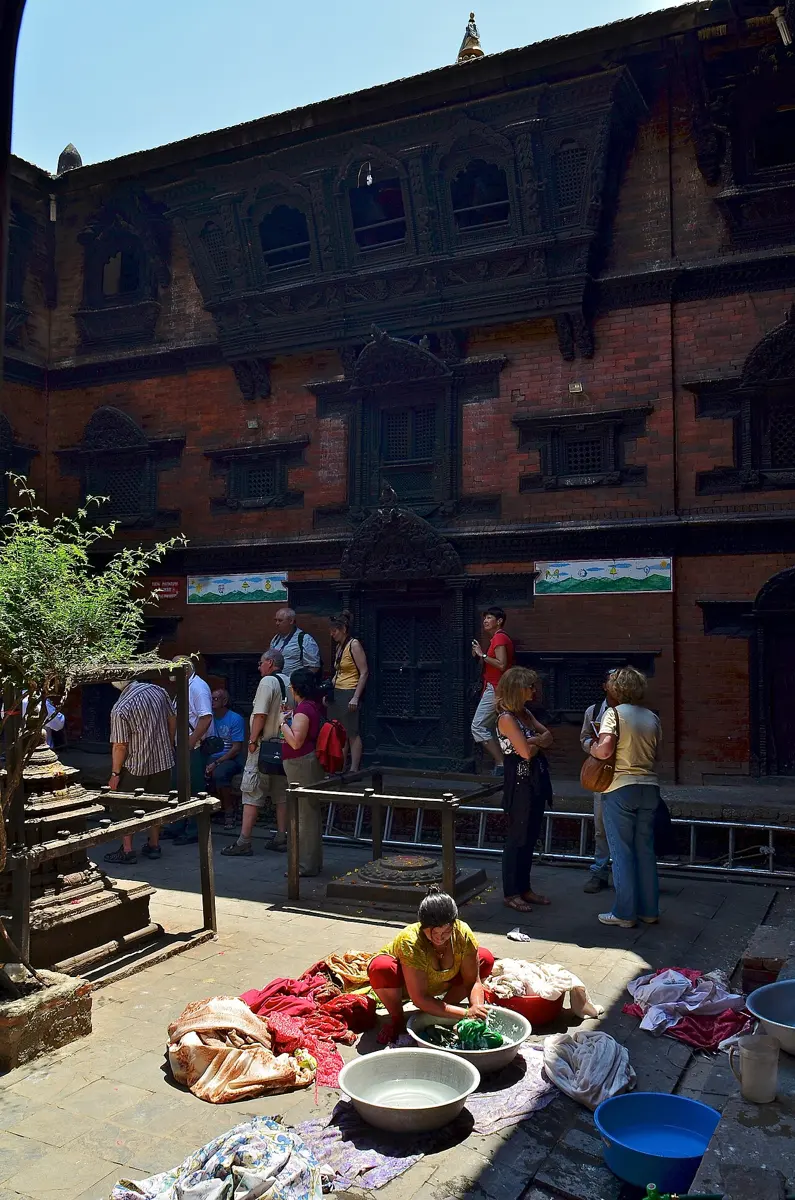
On a sunny winter morning in Bhaktapur, the rooftops fill with washing. By noon the clothes are dry, though the air never got anywhere near the 100 °C at which water boils. Where did the water go, and why do the clothes on a breezy roof dry before the ones in a sheltered courtyard?
The same morning, the steel rails of a railway in the Terai are a few millimeters shorter than they will be by mid-afternoon. A kettle’s steam can scald a hand far worse than a splash of the boiling water it came from. And a lump of ice dropped into a glass of juice cools it much better than the same mass of ice-cold water would. All four are about what heat does to matter when it isn’t simply making it hotter: it lets molecules escape, it pushes them apart, and it breaks them free of each other. This unit is about those three things, and about the one equation that keeps track of every joule.
12.1 Evaporation
Put a spoonful of water in a steel plate and leave it on a windowsill. After a few hours the plate is dry. The water hasn’t soaked into anything and hasn’t boiled; it has gone into the air as an invisible gas, water vapor. This is evaporation.
Evaporation is the change of a liquid into its vapor from its surface, at any temperature below its boiling point.
Water evaporates from a puddle at 15 °C, from wet clothes at 25 °C and from your skin at 34 °C. Spirit, petrol and nail-polish remover evaporate even faster. In every case the vapor leaves only from the surface, the boundary between the liquid and the air.
Why a liquid can evaporate below its boiling point
The molecules of a liquid are close together and pull on each other, which is what holds the liquid together. They are also always moving, sliding past each other and colliding millions of millions of times a second. In those collisions some molecules gain speed and others lose it, so at any moment the molecules have a whole range of speeds: most are near the average, a few are slow, and a few are very fast. The temperature tells us only the average kinetic energy of the molecules.
Now think of a molecule right at the surface. Its neighbors are all below it and beside it, and they pull it back down. If it happens to be one of the very fast ones, and happens to be moving upward, it can break free of that pull and fly off into the air. That is evaporation, one molecule at a time.
The cooling effect of evaporation
Here is the important part. The molecules that escape are the fastest ones. Take the fastest out of any group, and the average speed of those left behind goes down. A lower average kinetic energy means a lower temperature. So:
Evaporation cools the liquid that is left behind, and anything the liquid touches.
Once the liquid is cooler than its surroundings, heat flows into it from them: from the air, from the plate, from your skin. That heat keeps the evaporation going, and the surroundings cool too. Every kilogram of water that evaporates carries away a lot of energy: about 2,400,000 J at the temperature of your skin (more than the 2,260,000 J needed at 100 °C: in cooler water the molecules have less energy of their own, so each needs more to break free). You will meet this energy again in 12.3 as latent heat.
A drop of spirit on your hand feels colder than a drop of water at the same temperature. Why?
Pick an answer to see why.
The cooling effect around us
Sweating. When you are hot, your skin releases sweat, and as it evaporates it takes heat from your body. Heavy work in hot weather can make a person sweat a liter an hour; evaporating that much carries away about 2.4 million joules, more than 650 joules every second, several times what the body makes at rest. Sweat that drips off without evaporating cools you hardly at all, which is why a hot, humid day feels so much worse than a hot, dry one.
Dogs and buffaloes. A dog can’t sweat much, so it pants: air rushing over its wet tongue and mouth evaporates water from them. A buffalo wallows in mud and water on a hot afternoon, and the water evaporating from its skin cools it.
A wet cloth on the forehead. A cloth soaked in water and laid on the forehead of someone with a high fever cools them by evaporation, as well as by the water warming up.
The matka. Water seeps through the unglazed clay of a pot and evaporates from its outside, so the water inside stays cooler than the room. It works best in a dry, airy place.
Cooling the courtyard. Sprinkling water on a hot floor or a courtyard on a summer afternoon cools it, and a breeze blowing over wet ground feels cool. An evaporative (“desert”) cooler blows air through wet pads for the same reason.
Under a tree. Leaves lose water through their pores (transpiration), and its evaporation keeps a tree’s shade cooler than the shade of a tin roof.
Factors affecting the rate of evaporation
Why does washing dry in an hour on some days and stay damp all day on others? The rate of evaporation (how much liquid evaporates each minute) depends on six things. Each one comes straight from the picture of fast molecules escaping from the surface.
1. Temperature of the liquid. At a higher temperature the molecules move faster on average, so many more of them are fast enough to escape. Into the same dry air, water at 40 °C evaporates about six times as fast as water at 10 °C. That is why clothes dry faster in the sun.
2. Surface area. Molecules escape only from the surface, so the bigger the surface, the more escape each second. Tea in a saucer cools faster than tea in a cup; wet clothes spread out dry faster than clothes left in a heap; farmers spread paddy and chilies in a thin layer on mats to dry them.
3. Humidity of the air. The vapor in the air is made of molecules moving at random too, and some of them hit the liquid’s surface and are caught again. In dry air few come back; in humid air (air already holding a lot of water vapor) almost as many come back as leave, so the liquid evaporates slowly. When the air holds all the vapor it can at that temperature (100% humidity), water evaporates no faster than vapor comes back, and wet things don’t dry at all. Clothes dry slowly in the monsoon, quickly in the dry days of Mangsir.
4. Movement of the air (wind). In still air, the molecules that escape gather just above the surface, and many fall back in. A breeze sweeps them away and brings drier air, so evaporation goes faster. That is why we fan a hot face and why clothes dry fastest on a windy day.
5. Nature of the liquid. Liquids whose molecules pull on each other more weakly lose them more easily. Spirit, petrol, acetone and ether evaporate quickly (they are called volatile liquids); water evaporates more slowly; mustard oil hardly evaporates at all.
6. Air pressure. The lower the pressure of the air above the liquid, the more easily its molecules escape. Evaporation is faster high in the mountains, where the air pressure is low, as long as it isn’t too cold.
The times in the widget are a model’s estimates, not measurements: they come from a formula engineers use for water evaporating from a surface, with the towel’s wet area guessed, and a real towel slows down as its last water dries, so take them as rough guides to which way each change works and by how much. The towel hangs in the shade, so, just like the wet thermometer, it cools as it dries, until the heat flowing in from the air pays for the evaporation: look at its temperature. In the sun it would be warmer and dry faster, but every factor works the same way.
Which of these would make wet clothes dry more slowly?
Pick an answer to see why.
Evaporation and boiling
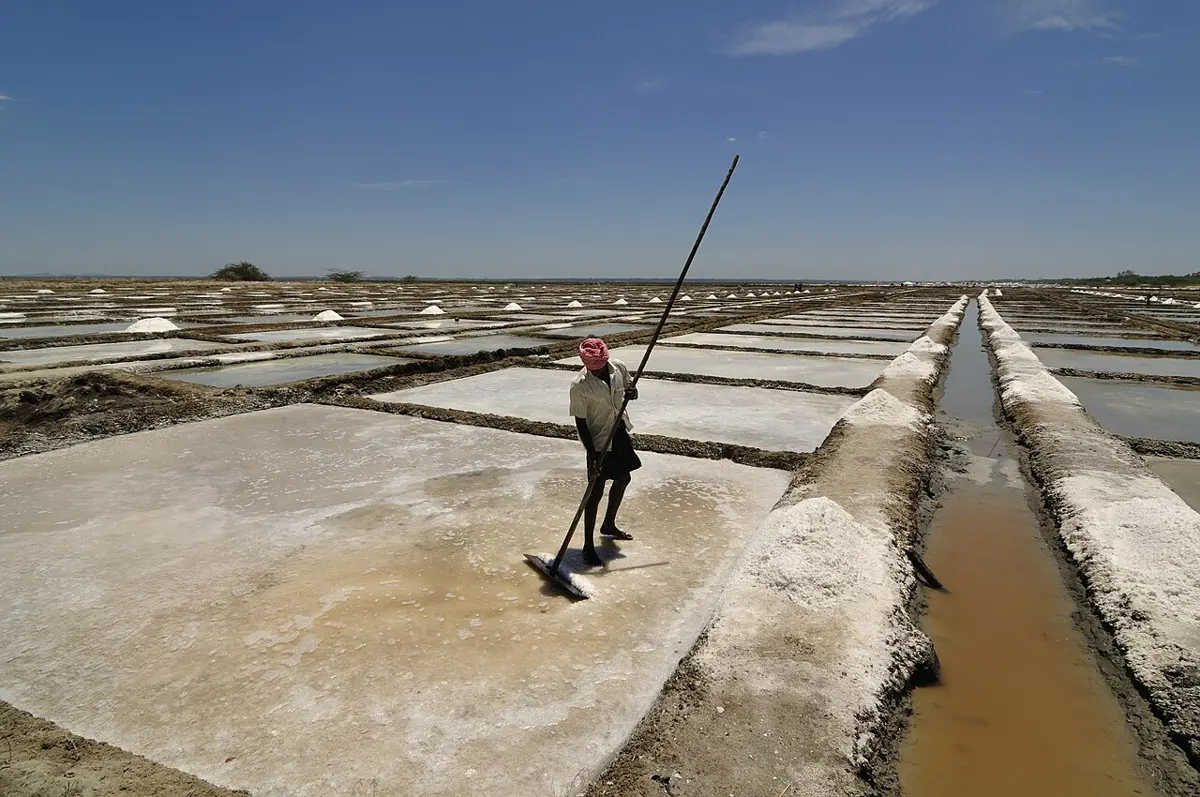
Evaporation and boiling both turn a liquid into vapor, but they are not the same process. When water is heated in a pan, it evaporates from its surface all the time, faster as it gets hotter. At its boiling point (100 °C at sea level, about 95 °C in Bhaktapur, where the air pressure is lower) something new happens: the molecules inside the liquid are energetic enough to form bubbles of vapor whose pressure can push back the air pressure on the water. Bubbles form all through the liquid, mostly where it is heated, rise and burst. That is boiling.
Boiling is the rapid change of a liquid into vapor, with bubbles forming all through it, at a fixed temperature (its boiling point) for a given pressure.
While water boils, its temperature stays at the boiling point however strongly it is heated: the extra heat only makes it boil away faster.
| Evaporation | Boiling |
|---|---|
| Takes place only at the surface of the liquid. | Takes place all through the liquid, with bubbles. |
| Happens at any temperature. | Happens only at the boiling point (for a given pressure). |
| Slow and quiet. | Fast and vigorous. |
| Cools the liquid left behind. | The temperature stays at the boiling point while heat is supplied. |
| The heat comes from the liquid itself and its surroundings. | Needs heat supplied from outside, such as a flame. |
| Faster with a larger surface, wind and dry air. | Doesn’t depend on surface area, wind or humidity. |
Which statement is true of evaporation but not of boiling?
Pick an answer to see why.
12.2 Thermal expansion
When things are heated they usually get bigger, and when they cool they shrink. This is thermal expansion (and contraction). Grade 10 Science showed it with the ball and ring, and showed water’s strange exception between 0 °C and 4 °C. Here we look at why it happens and at the different kinds of expansion.
Thermal expansion is the increase in the size of a substance when it is heated.
Expansion explained by the motion of molecules
In a solid, the molecules (or atoms) are held in fixed places by the forces between them, like balls joined to their neighbors by springs. They don’t stay still: they vibrate about their places. When the solid is heated, they vibrate harder, with bigger swings.
Why should bigger swings make the solid bigger? Because the “springs” between molecules are lopsided. Pushing two molecules closer together than their usual spacing is very hard: they repel each other strongly as soon as they are squeezed. Pulling them apart is much easier: the attraction weakens gradually as they separate. So when a molecule swings harder, it can’t go much closer to its neighbor, but it goes a good deal farther away. On average it sits a little farther from its neighbors than before. Every pair of neighbors gets a little farther apart, and the whole solid grows.
In a liquid, the molecules are close together but free to slide past each other. Heated, they move faster and jostle each other harder, and the liquid takes up more room. The forces holding a liquid together are weaker than in a solid, so a liquid expands more than a solid for the same warming.
In a gas, the molecules are far apart and fly about freely. Heated at a steady pressure, they move faster and hit the walls harder and more often, so the gas spreads into a bigger space (Charles’s law, from Grade 9 Optional Science). Gases expand far more than liquids, and liquids more than solids: warmed by the same amount, air expands about 15 times as much as water and about 100 times as much as steel.
Linear, superficial and cubical expansion
A heated solid grows in every direction at once. But often only one or two of its dimensions matter, so we name three kinds of expansion.
Linear expansion is the increase in the length of a solid when it is heated. It matters for long, thin things: rails, wires, rods, pipes, bridges, the metal strips in a thermostat.
Superficial expansion (also called areal expansion) is the increase in the area of a solid when it is heated. It matters for flat things: metal sheets and roofs, floor tiles, glass panes, a metal lid on a jar.
Cubical expansion (also called volume expansion) is the increase in the volume of a substance when it is heated. It matters for solid blocks, and it is the only kind of expansion a liquid or a gas can have, since they have no shape of their own.
All three are the same thing seen three ways: a heated solid grows in length, in breadth and in height. A plate that grows by 1% in length and 1% in breadth grows by about 2% in area; a block that grows by 1% each way grows by about 3% in volume.
A steel ring has a hole in the middle. When the ring is heated, the hole:
Pick an answer to see why.
Which kind of expansion can a liquid have?
Pick an answer to see why.
Impacts of thermal expansion in daily life
Thermal expansion is small, but the forces behind it are enormous. A steel rail heated by 40 °C, if held so it can’t grow, pushes on whatever holds it with about 100 million newtons for every square meter of its cross-section, about the weight of a small car on every square centimeter. So engineers either leave room for expansion, or put it to work.
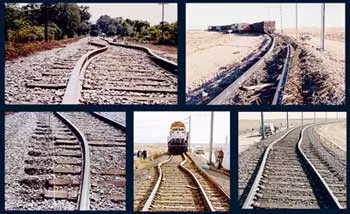
Railway tracks. Short rails are laid with small gaps between their ends. Modern long rails are welded into one piece kilometers long and fastened down very firmly to heavy sleepers, so they can’t grow; special expansion joints, where two rail ends slide past each other at a slant, are put in where the long rail meets the track beyond. When the heat is more than the track was built for, the rails can buckle sideways, a dangerous sun kink.
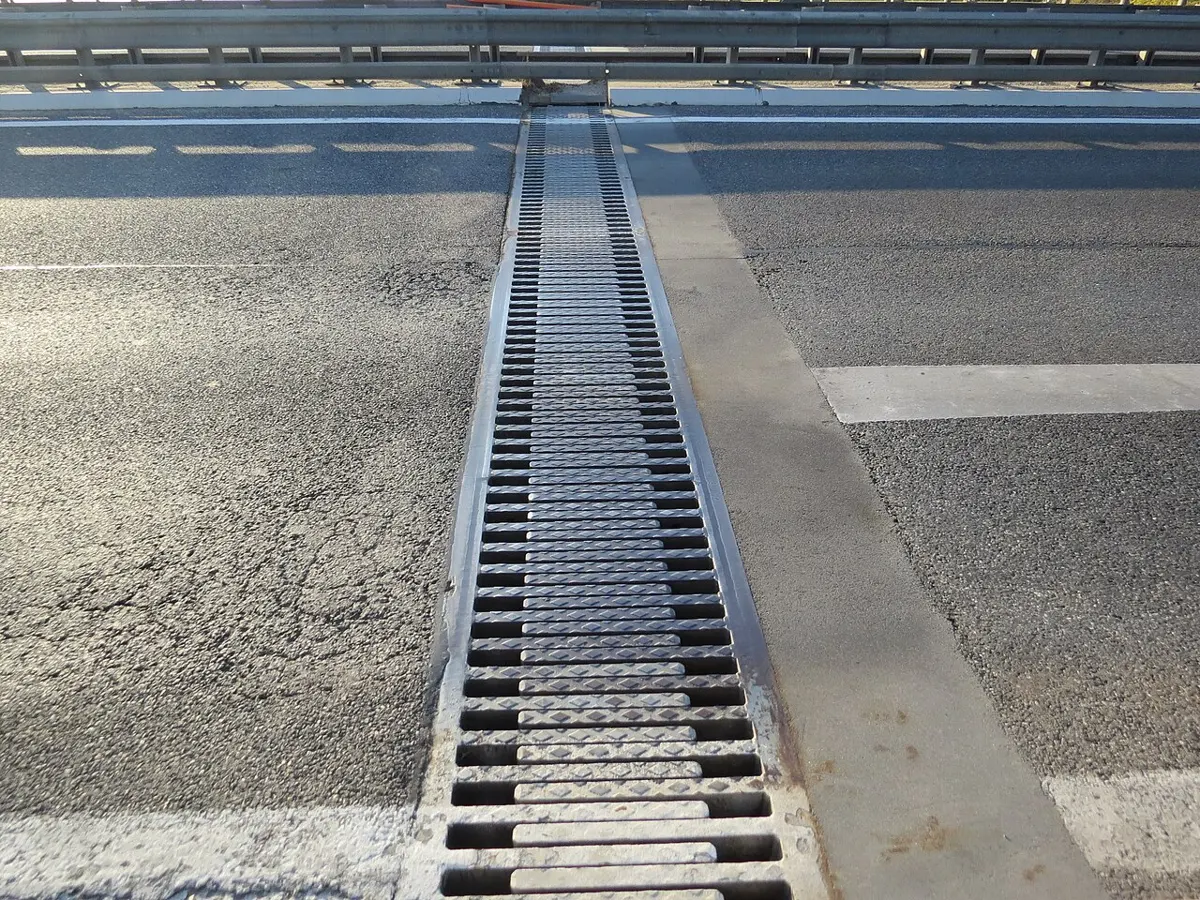
Bridges and flyovers. A 1 km steel or concrete bridge grows by roughly 12 mm for each 1 °C it warms: about half a meter between a cold winter night and a hot summer afternoon in the Terai. So a long bridge rests on rollers at one end, and has expansion joints across the road: interlocking steel teeth, or steel beams with rubber seals between them, whose gaps open in winter and close in summer.
Concrete roads and floors are laid in slabs with thin gaps between them, filled with a soft, tar-like material that is squeezed when the slabs expand.
Electric and telephone wires are hung with a little sag. In winter they contract and pull tighter; if they were hung tight in summer, they would snap in the cold. In summer they sag more.
Glass. Hot tea poured into a thick, cold glass can crack it: the inside expands before the outside warms up. Glass for cooking and laboratory flasks (borosilicate glass) expands only about a third as much, so it survives sudden heating.
Fitting things tightly. A blacksmith fits the iron tyre onto a wooden bullock-cart wheel while the tyre is red hot and slightly too big; as it cools it shrinks and grips the wheel tightly. Metal rims, gears and bearings are shrink-fitted onto shafts in the same way.
Dental fillings. Dentists choose filling materials that expand as nearly as possible like the tooth around them: a filling that grew and shrank much more than the tooth with every hot tea and ice cream would open a gap at its edge.
Liquids. A petrol tank or a bottle filled to the brim in the cool morning overflows or bursts in the hot afternoon, because the liquid expands more than its container. Bottles and tanks are always left with a little space at the top.
Gases. A tyre or a football left in the hot sun gets harder, and an over-pumped one can burst: the air inside expands and its pressure rises.
Thermometers work by expansion: the liquid in the bulb expands more than the glass and rises up the narrow tube.
The bimetallic strip
Two strips of different metals, such as brass and iron, riveted or welded together face to face along their whole length, make a bimetallic strip. Brass expands about one and a half times as much as iron for the same warming. When the strip is heated, the brass gets longer than the iron, but the two are joined, so the strip bends, with the brass on the outside of the curve. When it cools, it straightens again. (Cooled below the temperature at which it is straight, it bends the other way.)
That movement can switch a circuit on and off, and bimetallic strips do just that in many things you use:
- Thermostats in electric irons, water heaters (geysers), rice cookers and room heaters: when the right temperature is reached, the strip bends away from its contact and switches the heater off; as it cools it touches again and switches it back on. Turning the iron’s knob moves the contact, which sets the temperature.
- Fire alarms: heat from a fire bends the strip until it touches a contact and completes the alarm’s circuit.
- Circuit breakers (MCBs): too large a current heats a bimetallic strip, which bends and trips the switch.
- Flashing lights: in older indicator lamps and Christmas-light flashers, a strip heated by the current bends, breaks the circuit, cools, and closes it again, over and over.
- Dial thermometers: a long bimetallic strip wound into a coil turns a pointer as the temperature changes (oven and meat thermometers).
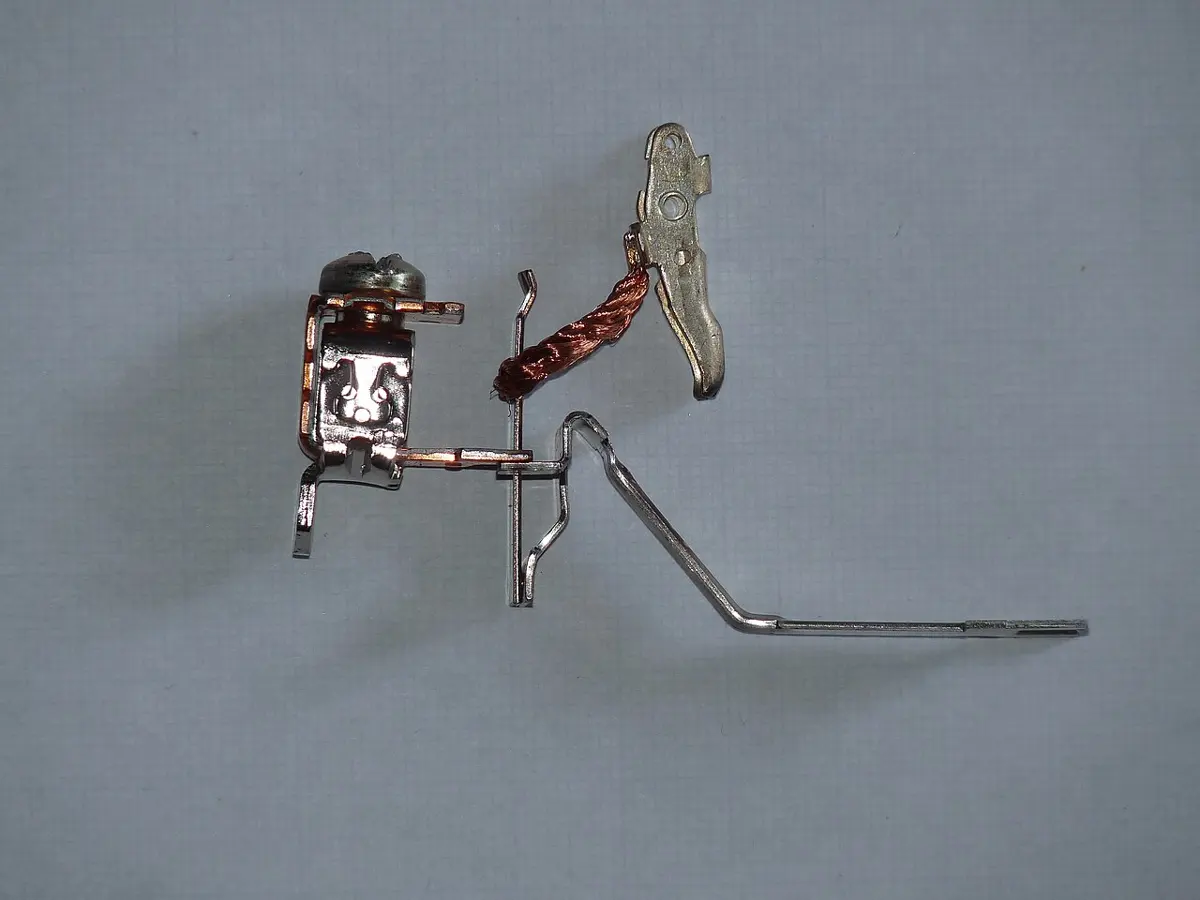
A bimetallic strip is made of brass and iron, and brass expands more than iron. When the strip is heated, it:
Pick an answer to see why.
12.3 Latent heat
Put a pan of crushed ice on a steady flame with a thermometer in it. The temperature rises to 0 °C and then stops, while the ice melts, even though the flame keeps giving heat. Only when the last of the ice has melted does the temperature rise again. At 100 °C it stops a second time, while the water boils away. The heat going in during those flat stretches doesn’t show on the thermometer. The Scottish chemist Joseph Black, who studied it around 1761, called it latent (hidden) heat.
Latent heat is the heat absorbed or given out by a substance while it changes its state (solid to liquid, liquid to gas, or back), at a constant temperature.
The heat needed to melt a solid at its melting point is its latent heat of fusion; the heat needed to turn a liquid into vapor at its boiling point is its latent heat of vaporization. The same heat comes out again when the change goes the other way: water gives out its latent heat of fusion as it freezes, and steam gives out its latent heat of vaporization as it condenses.
Specific latent heat
The more ice there is, the more heat it takes to melt it: twice the mass, twice the heat. So the latent heat is proportional to the mass that changes state:
The constant is the specific latent heat of the substance. Put = 1 kg and :
The specific latent heat of fusion of a substance is the heat needed to change 1 kg of it from solid to liquid at its melting point, without any change in temperature. For ice, it is 336,000 J/kg (3.36 × 10⁵ J/kg).
The specific latent heat of vaporization of a substance is the heat needed to change 1 kg of it from liquid to vapor at its boiling point, without any change in temperature. For water, it is 2,260,000 J/kg (2.26 × 10⁶ J/kg).
The SI unit of specific latent heat is the joule per kilogram (J/kg). There is no °C in it, because the temperature doesn’t change while the state does.
| Substance | Melting point (°C) | Latent heat of fusion (J/kg) | Boiling point (°C) | Latent heat of vaporization (J/kg) |
|---|---|---|---|---|
| water | 0 | 336,000 | 100 | 2,260,000 |
| ethyl alcohol | −114 | 104,000 | 78 | 854,000 |
| lead | 327 | 23,000 | 1,749 | 866,000 |
| aluminium | 660 | 397,000 | 2,519 | 10,500,000 |
| iron | 1,538 | 247,000 | 2,861 | 6,090,000 |
So melting 1 kg of ice at 0 °C takes 336,000 J, as much as warming that kilogram of water from 0 °C to 80 °C. And boiling away 1 kg of water at 100 °C takes 2,260,000 J, more than five times what it took to warm it from 0 °C all the way to 100 °C.
Latent heat explained by the kinetic molecular theory
The molecules of a substance have two kinds of energy. Because they move, they have kinetic energy; the temperature measures its average. Because they attract each other, they also have potential energy, which depends on how far apart they are, just as a stone lifted off the ground has potential energy because the Earth pulls it.
Below the melting point, heat makes the molecules of the solid vibrate faster: their kinetic energy rises, so the temperature rises.
At the melting point, the molecules are vibrating so hard that a little more energy lets them break out of their fixed places. Now all the heat goes into pulling the molecules free of the forces holding them in place: it raises their potential energy, not their kinetic energy. Their average speed doesn’t change, so the temperature doesn’t change, until every molecule is free and the solid has all melted. The molecules of water at 0 °C have the same kinetic energy as those of ice at 0 °C, but more potential energy.
At the boiling point, the same thing happens again, more strongly. Each molecule must be pulled completely away from its neighbors, to fly off on its own in the gas, and the vapor must also push back the air above the liquid to make room for itself. All the heat goes into that, and the temperature stays the same until the liquid has all boiled away.
Why the latent heat of vaporization is so much larger. When ice melts, each molecule only loosens its hold: in the water it still touches its neighbors and is still pulled by them. When water boils, each molecule must break away from all its neighbors entirely, and the vapor, about 1,600 times the volume of the water, must push the atmosphere back. So for water the latent heat of vaporization is about 6.7 times the latent heat of fusion. (Of the 2,260,000 J for each kilogram, about 170,000 J goes into pushing back the atmosphere: some books call it the external latent heat, and the rest, for pulling the molecules apart, the internal latent heat.)
When the change goes backward, the molecules come together again, their potential energy falls, and the same energy comes out as heat. That is why water freezing at 0 °C keeps giving out heat without its temperature falling, and why steam condensing on your skin gives out so much heat.
The ice is in a cylinder under a free piston, so it stays at the air pressure at sea level (water boils at 100 °C) and the steam can be heated further, and no heat is lost. The heater gives 1,000 J every second, so the length of a flat part, in seconds, measures the latent heat. Melting took 168 s: J for 0.5 kg, so J/kg. The sloping parts have different slopes too: the ice and the steam warm about twice as fast as the water, because their specific heat capacities (2,100 and about 2,040 J/(kg °C)) are about half of water’s 4,200.
While ice melts at 0 °C, the heat it takes in:
Pick an answer to see why.
Why is the latent heat of vaporization of water much larger than its latent heat of fusion?
Pick an answer to see why.
Latent heat around us
Steam burns are worse than boiling-water burns. A gram of steam at 100 °C that condenses on your skin gives out 2,260 J as it turns to water, before the water even starts to cool. (Example 3 below works out how much worse.)
Ice cools better than ice-cold water. Every kilogram of ice at 0 °C takes in 336,000 J just to melt, before it starts to warm up. Water at 0 °C has no such store. That is why ice keeps fish fresh in a market and a cold drink cold.
Snow and glaciers melt slowly. On the first warm day of spring, the snow on the hills doesn’t vanish in an afternoon, because every kilogram needs 336,000 J to melt. Rivers fed by Himalayan snow rise steadily through spring and summer, not in a single flood.
Lakes freeze slowly. As the water of a lake like Gosaikunda freezes in winter, every kilogram gives out 336,000 J, which slows the cooling of the water below.
Protecting crops from frost. On frosty nights, fruit growers in some countries spray their trees with water. As the water freezes on the buds it gives out its latent heat, which holds the buds at about 0 °C instead of letting them fall to a few degrees below, the temperature that would kill them.
Refrigerators work by evaporation: a liquid evaporates in the pipes inside the freezer, taking its latent heat from the food; a pump then squeezes the vapor back into a liquid outside, in the coils at the back, where it gives that heat out to the room. That is why the back of a refrigerator is warm.
Sweat and the matka cool by the latent heat of vaporization, as you saw in 12.1.
12.4 Heat equation
Mix hot water with cold, drop ice into juice, or blow steam into water, and heat flows from the hotter to the colder until both reach the same temperature. If no heat escapes to the surroundings, no energy is lost or made on the way, so
This is the heat equation, also called the principle of calorimetry or the principle of mixtures:
Heat equation: when a hot body and a cold body are in contact in a closed, insulated system, the heat lost by the hot body is equal to the heat gained by the cold body, until both reach the same temperature.
It is the law of conservation of energy, applied to heat. To use it, we write each side using the two formulas we have:
- for a change of temperature, (the heat for a body of mass and specific heat capacity );
- for a change of state, .
Some books give the name “heat equation” to itself, and Grade 10 Science calls “heat lost = heat gained” the principle of calorimetry. In an exam, state the principle in words, write and , and you have covered both.
The calorimeter
Heat measurements are made in a calorimeter: a small vessel of copper or aluminium (metals, so they quickly reach the same temperature as what is inside), with a lid, a stirrer and a thermometer, standing on a cork or felt pad inside a larger insulated container. The pad, the air gap and the lid stop heat leaking in or out, so “heat lost = heat gained” holds. The calorimeter itself is warmed or cooled with its contents, so in careful work it goes on the right side of the equation too, with its own mass and specific heat capacity (Example 8).
Solving problems with the heat equation
- List each substance with its mass, specific heat capacity, starting temperature, and any latent heat.
- Decide which substances lose heat (start hot) and which gain heat (start cold), and call the final temperature .
- Write the heat lost and the heat gained, using (the fall or rise in temperature) and for any change of state. Each change of temperature is written as the larger temperature minus the smaller, so every term is positive.
- Put heat lost = heat gained and solve for the unknown.
- Check: the final temperature must lie between the starting temperatures.
In a mixing problem, your answer for the final temperature of hot water mixed with cold water comes out higher than the hot water’s starting temperature. What does it mean?
Pick an answer to see why.
Exercise
1. Choose the correct option
a. Evaporation takes place:
Pick an answer to see why.
b. Which of these does not increase the rate of evaporation of water?
Pick an answer to see why.
c. The SI unit of specific latent heat is:
Pick an answer to see why.
d. While a pure solid is melting, its temperature:
Pick an answer to see why.
e. When a bimetallic strip of brass and iron is heated, it bends because:
Pick an answer to see why.
f. The increase in the area of a metal sheet on heating is called:
Pick an answer to see why.
g. How much heat is needed to boil away 0.5 kg of water already at 100 °C? (L = 2,260,000 J/kg)
Pick an answer to see why.
h. The heat equation says that, in an insulated system:
Pick an answer to see why.
2. Give reasons
A wet cloth on the forehead brings down a high fever.
Hint
Answer
Small gaps are left between the rails of a railway track.
Hint
Answer
Ice at 0 °C cools a drink better than the same mass of water at 0 °C.
Hint
Answer
Clothes dry faster on a windy day than on a still day.
Hint
Answer
A burn from steam at 100 °C is more severe than one from boiling water at 100 °C.
Hint
Answer
Electric wires are hung with some sag between the poles.
Hint
Answer
The temperature of water does not rise while it is boiling, though it is still being heated.
Hint
Answer
3. Differentiate between
Evaporation and boiling
Hint
Answer
Linear, superficial and cubical expansion
Hint
Answer
Latent heat of fusion and latent heat of vaporization
Hint
Answer
Specific heat capacity and specific latent heat
Hint
Answer
4. Answer the following questions
What is evaporation? Explain, using the kinetic theory of matter, why evaporation causes cooling.
Hint
Answer
Describe the factors that affect the rate of evaporation, with an example of each.
Hint
Answer
Explain thermal expansion of a solid in terms of the motion of its molecules.
Hint
Answer
Write four impacts of thermal expansion in daily life, and how each is dealt with or used.
Hint
Answer
Define latent heat. Explain, using the kinetic molecular theory, why the temperature of melting ice stays at 0 °C while it is heated.
Hint
Answer
Why is the latent heat of vaporization of water greater than its latent heat of fusion?
Hint
Answer
State the heat equation. Write the formulas used with it for a change of temperature and a change of state.
Hint
Answer
Sketch the graph of temperature against time when ice at −20 °C is heated steadily until it becomes steam at 120 °C. Label each part and say what is happening in it.
Hint
Answer
How is a bimetallic strip used in the thermostat of an electric iron?
Hint
Answer
5. Numerical problems
How much heat is needed to melt 500 g of ice at 0 °C? (L = 336,000 J/kg)
Hint
Answer
How much heat is needed to change 2 kg of water at 100 °C into steam at 100 °C? (L = 2,260,000 J/kg)
Hint
Answer
Find the heat needed to change 0.5 kg of ice at −5 °C into water at 0 °C. (s of ice = 2,100 J/(kg °C); L = 336,000 J/kg)
Hint
Answer
How much heat does it take to turn 100 g of water at 20 °C into steam at 100 °C? (s of water = 4,200 J/(kg °C); L = 2,260,000 J/kg)
Hint
Answer
Find the heat needed to change 1 kg of ice at −10 °C into steam at 100 °C. What share of it is used in boiling?
Hint
Answer
A 500 W heater is put in a large block of ice at 0 °C. How long does it take to melt 1 kg of the ice, if all its heat goes into the ice?
Hint
Answer
Rizwan adds 40 g of ice at 0 °C to 200 g of water at 25 °C. Find the final temperature, assuming all the ice melts and no heat is lost.
Hint
Answer
How much steam at 100 °C must be passed into 500 g of water at 20 °C to warm it to 80 °C?
Hint
Answer
A copper calorimeter of mass 200 g contains 300 g of water at 30 °C. 50 g of ice at 0 °C is added. Find the final temperature once all the ice has melted. (s of copper = 385 J/(kg °C))
Hint
Answer
In an experiment, a 1,500 W kettle kept boiling for 10 minutes boils away 0.39 kg of water. Find the latent heat of vaporization from these readings. Why is your answer larger than 2,260,000 J/kg?
Hint
Answer
Think: 50 g of ice at 0 °C cools 250 g of juice at 30 °C to about 11.7 °C (Example 5). Find the final temperature if 50 g of water at 0 °C is used instead, and explain the difference.
Hint
Answer
Printable PDFs
- The unit as a book (A5) 29 pages Answers as an A4 booklet, 8 sheets
- Study notes 2 pages
- Worksheet 5 pages Answer key
- Harder practice questions 2 pages Answer key
Practice every question in the book, and keep track of the ones you miss →
Found a mistake? Please tell us.