
Nobody has ever seen inside an atom. An atom is so small that a single grain of salt holds several billion billion of them, and no light microscope will ever show one. Yet we know that an atom is almost entirely empty space, that its mass sits in a speck at its center tens of thousands of times smaller across than the atom, and that the electrons around it can only have certain energies, like a ladder whose rungs are fixed.
How do we know all this about something we can’t see? The same way you can tell what is inside a closed box without opening it: by shaking it, tipping it, firing things at it and seeing what comes out. Over about 130 years, from John Dalton in 1803 to James Chadwick in 1932, scientists did exactly that to atoms. This unit follows their experiments, one picture of the atom at a time, and ends with the numbers that tell one atom from another: atomic number, mass number, atomic mass, isotopes, isobars and isotones.
6.1 Dalton’s atomic theory
The idea of atoms is old. Around 400 BCE the Greek thinker Democritus argued that if you cut something in half again and again, you must at last reach a piece that can’t be cut: an atomos, Greek for “uncuttable”. In India, the Vaisheshika school of philosophy described tiny, eternal particles called परमाणु (paramanu). But these were ideas, not experiments. Nobody could test them.
That changed at the end of the 1700s, when chemists began to weigh carefully what went into a reaction and what came out. Two laws came out of their measurements:
- The law of conservation of mass (Antoine Lavoisier, 1789): in a chemical reaction, the total mass of the products equals the total mass of the reactants. Matter is neither made nor lost.
- The law of constant proportions (Joseph Proust, 1797): a compound always contains the same elements in the same proportion by mass. Pure water, from a Himalayan spring or a laboratory, is always 8 g of oxygen for every 1 g of hydrogen.
The English schoolteacher John Dalton (1766–1844) asked what matter must be like to obey these laws. He first presented his answer in 1803 and published it in full in A New System of Chemical Philosophy in 1808. It is called Dalton’s atomic theory.
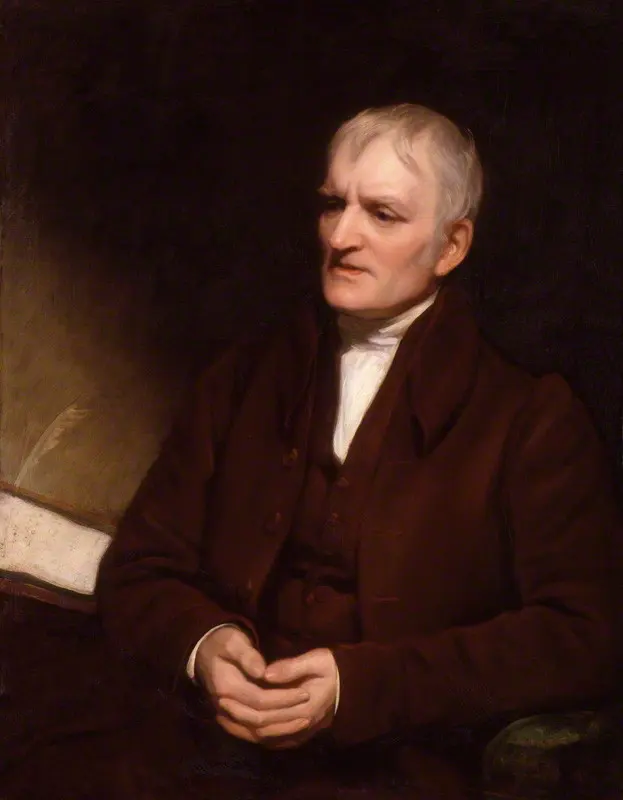
Postulates of Dalton’s atomic theory
- All matter is made up of tiny indivisible particles called atoms, and the atom is the smallest unit of an element.
- Atoms of the same element are alike in mass and in their chemical and physical properties, and atoms of different elements are different.
- Atoms combine with each other in simple whole-number ratios (1 : 1, 1 : 2, 2 : 3…) to form molecules.
- In chemical reactions, atoms keep their identity: they are only rearranged into new combinations, and are neither created nor destroyed.
Each postulate explained something that had been measured. If atoms are never created or destroyed (postulate 4), and a reaction only rearranges them, the total mass can’t change: that is conservation of mass. If every water molecule is the same group of atoms, each atom with its own fixed mass (postulates 2 and 3), every sample of water must have the same proportion by mass: that is constant proportions. Dalton also predicted a new law that he then checked himself, the law of multiple proportions: when two elements form more than one compound, the masses of one that combine with a fixed mass of the other are in a simple whole-number ratio.
Which postulate of Dalton’s atomic theory explains the law of conservation of mass?
Pick an answer to see why.
Modifications of Dalton’s atomic theory
Dalton’s theory was a huge step: for the first time, chemistry could be explained by particles with definite masses. But experiments over the next hundred years showed that some of its postulates are not quite right. Here is each postulate with what we know now.
| Dalton’s postulate | What we know now |
|---|---|
| 1.Atoms are indivisible, the smallest unit of an element. | Atoms are made of smaller particles: electrons, protons and neutrons (6.2). But the atom is still the smallest particle that takes part in a chemical reaction: only its outer electrons are shared or passed on, and its nucleus is untouched. |
| 2.Atoms of one element are alike in mass; atoms of different elements are different. | Atoms of one element can have different masses: isotopes, such as chlorine-35 and chlorine-37 (6.5). Atoms of different elements can have the same mass number: isobars, such as argon-40 and calcium-40. What really makes elements different is the number of protons. |
| 3.Atoms combine in simple whole-number ratios. | Many compounds, especially carbon compounds, have large, far from simple ratios: table sugar is C₁₂H₂₂O₁₁, and a single starch molecule has thousands of atoms. |
| 4.Atoms keep their identity, never created or destroyed. | True in chemical reactions. In nuclear reactions, atoms of one element change into atoms of another (transmutation), and a little mass turns into energy. |
So the modified theory says: an atom is the smallest particle of an element that takes part in a chemical reaction; it is made of electrons, protons and neutrons; its identity is set by its number of protons; and atoms of one element may differ in mass.
The existence of isotopes shows that which postulate of Dalton’s theory needs modifying?
Pick an answer to see why.
6.2 Subatomic particles
Introduction
The particles an atom is made of are called subatomic particles. There are three of them in every atom except ordinary hydrogen, which has no neutron: the electron, the proton and the neutron. Each was found by an experiment, and each experiment changed the picture of the atom.
The electron: cathode rays
In the 1870s, scientists found that a glass tube with most of its air pumped out glows when a high voltage is put across two metal plates sealed into its ends. The plate joined to the negative terminal is the cathode, the one joined to the positive terminal the anode. At a very low pressure (about 0.01 mmHg) and some thousands of volts, the glass at the far end from the cathode glows green, and an object placed in the tube casts a sharp shadow on the glow. Something was streaming from the cathode in straight lines. It was called cathode rays.
In 1897, at the Cavendish Laboratory in Cambridge, J. J. Thomson bent cathode rays with both an electric field and a magnetic field, and measured how much each bent them. The rays bent toward the positive plate, so they were negatively charged particles. From the bending he worked out the ratio of their charge to their mass, : more than a thousand times larger than for the lightest ion known, hydrogen’s (today’s value is 1.76 × 10¹¹ C/kg). And he got the same whatever gas was in the tube and whatever metal the cathode was made of. So these particles were far lighter than any atom, and they were part of every atom. They were later called electrons.
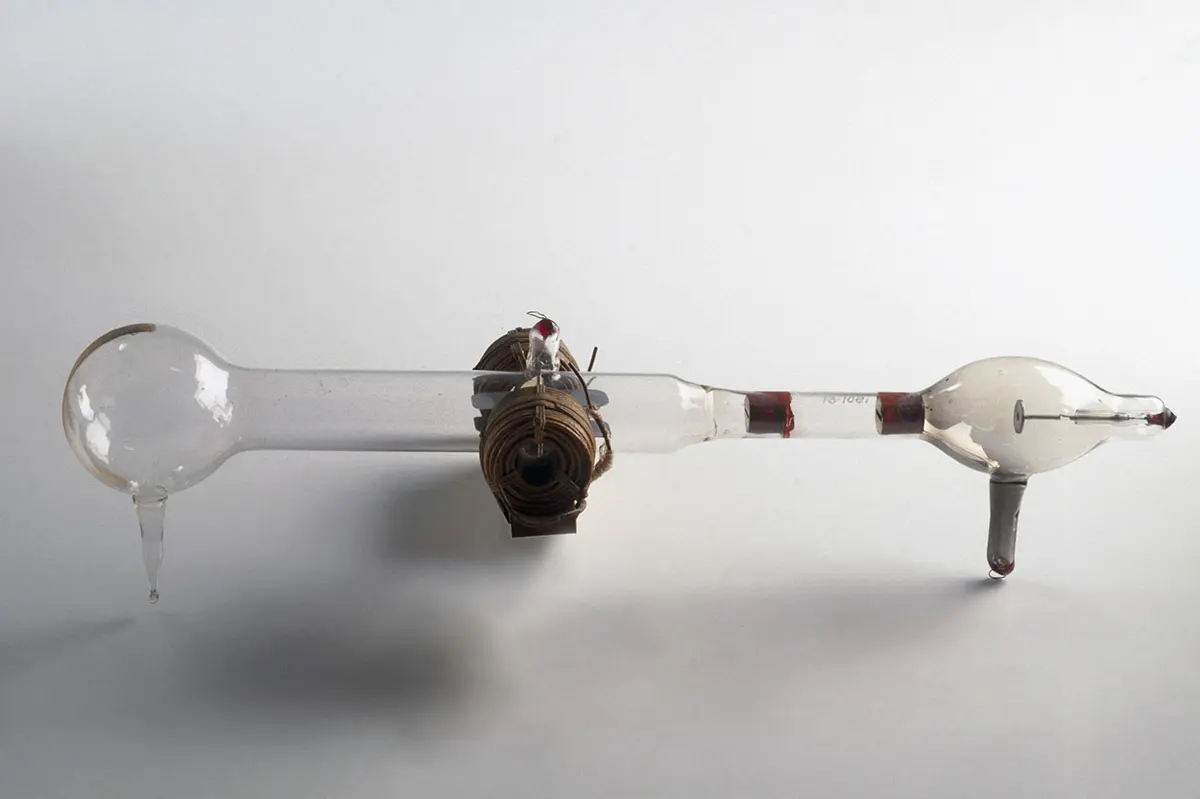
Properties of cathode rays:
- They travel in straight lines from the cathode: an object in their path casts a sharp shadow.
- They are deflected toward the positive plate of an electric field, and by a magnetic field, so they carry negative charge.
- They make glass, and substances such as zinc sulphide, glow (fluorescence) where they strike.
- They can heat a thin metal foil they fall on, and pass through very thin foils.
- They produce X-rays where they hit a metal target (Wilhelm Röntgen, 1895).
- Their nature doesn’t depend on the gas in the tube or the metal of the cathode.
The charge on one electron was measured by the American physicist Robert Millikan from 1909, by watching tiny charged oil drops float between two charged plates (today’s value is = 1.602 × 10⁻¹⁹ C). Together with Thomson’s , that gave the electron’s mass: today’s value is 9.109 × 10⁻³¹ kg, about 1/1836 of a hydrogen atom’s.
Since every atom is electrically neutral, an atom with negative electrons must also hold an equal amount of positive charge. Thomson pictured the atom in 1904 as a ball of positive charge with the electrons stuck in it, like the seeds in a watermelon (in England, the plums in a Christmas pudding, so it is called the plum pudding model). In 6.3 you will see how that picture was tested, and failed.
The proton: canal rays
In 1886 the German physicist Eugen Goldstein used a discharge tube whose cathode had holes (canals) in it, and found rays streaming backward through the holes, away from the anode. These canal rays (or anode rays) bent the opposite way to cathode rays: they were positively charged. Unlike cathode rays, their depended on the gas in the tube, because they are the atoms of that gas with electrons knocked off. The lightest, with the largest , came from hydrogen: a hydrogen atom with its one electron removed.
In 1919 Ernest Rutherford fired alpha particles into nitrogen and found hydrogen nuclei coming out: they were inside the nitrogen nucleus too. In 1920 he proposed calling the hydrogen nucleus, the building block of positive charge in every nucleus, the proton.
The neutron
Protons alone couldn’t account for the mass of atoms. A helium atom has 2 protons but about 4 times the mass of a hydrogen atom. Rutherford guessed in 1920 that the nucleus must also hold neutral particles. In 1932 James Chadwick, in Cambridge, fired alpha particles at beryllium. It gave off a radiation with no charge that knocked protons out of paraffin wax at high speed. From how hard it hit, he showed it was a stream of neutral particles with about the mass of a proton: the neutron. Chadwick was awarded the Nobel Prize in Physics in 1935.
What did Thomson’s finding that cathode rays have the same in every gas show?
Pick an answer to see why.
Properties of subatomic particles
| Property | Electron | Proton | Neutron |
|---|---|---|---|
| Symbol | e⁻ | p⁺ | n⁰ |
| Discovered by | J. J. Thomson, 1897 | E. Goldstein (canal rays), 1886; named by Rutherford, 1920 | J. Chadwick, 1932 |
| Where in the atom | around the nucleus | in the nucleus | in the nucleus |
| Charge (C) | −1.602 × 10⁻¹⁹ | +1.602 × 10⁻¹⁹ | 0 |
| Relative charge | −1 | +1 | 0 |
| Mass (kg) | 9.109 × 10⁻³¹ | 1.6726 × 10⁻²⁷ | 1.6749 × 10⁻²⁷ |
| Mass (u) | 0.000549 | 1.00728 | 1.00866 |
| Relative mass | 1/1836 (taken as 0) | 1 | 1 (a little more than a proton) |
The unit u is the unified atomic mass unit (also written amu): one-twelfth of the mass of one carbon-12 atom, 1.6605 × 10⁻²⁷ kg (6.5).
Three things to notice in the table:
- The proton’s and electron’s charges are exactly equal and opposite, so an atom with as many electrons as protons is neutral.
- The proton and neutron have almost the same mass, the neutron about 0.14% heavier.
- The electron is so light that almost all the mass of an atom is in its nucleus: 1,836 electrons would be needed to match one proton.
6.3 Rutherford’s atomic model
The gold foil experiment
Ernest Rutherford (1871–1937), born in New Zealand, was working in Manchester on alpha particles: fast, positively charged particles shot out by radioactive elements such as radium. (An alpha particle is a helium nucleus, 2 protons and 2 neutrons, with a charge of +2; you will meet it again in Unit 12, Radioactivity.) In 1909 he asked his assistant Hans Geiger and a 20-year-old student, Ernest Marsden, to fire alpha particles at a very thin metal foil and see whether any bounced back.
The setup:
- A radioactive source in a lead box with a narrow opening sent out a thin beam of alpha particles.
- The beam fell on a very thin foil of gold, less than a micrometer thick: Geiger gave one foil’s thickness as 0.000086 mm, only about 300 atoms.
- Around the foil, a screen coated with zinc sulphide gave a tiny flash of light wherever an alpha particle struck it. The flashes were counted, in a darkened room, through a microscope that could be moved round the foil to any angle.
- Everything was inside an evacuated box, so that air didn’t stop the alpha particles.
If Thomson’s plum pudding model were right, the alpha particles should all pass through with hardly any deflection: the positive charge is spread thinly over the whole atom, so its push on a passing alpha particle is weak, and the light electrons can’t turn a particle more than 7,000 times heavier than themselves.
What they saw:
- Most of the alpha particles passed straight through the foil, undeflected.
- Some were deflected through small angles.
- A very few were deflected through large angles, and some bounced almost straight back. With a platinum plate, Geiger and Marsden found that about 1 in 8,000 of the alpha particles striking it bounced back off it.
Rutherford remembered it in a lecture in 1936: “It was almost as incredible as if you fired a 15-inch shell at a piece of tissue paper and it came back and hit you.” Something in the foil was small, very heavy and strongly charged. He worked out the explanation and published it in 1911.
Rutherford’s conclusions from the three observations:
| Observation | Conclusion |
|---|---|
| Most alpha particles pass straight through. | Most of the atom is empty space. |
| A few are deflected through large angles. | The positive charge is not spread out but packed into a tiny region that repels the alpha particles strongly. |
| Very few bounce back. | That region, the nucleus, is extremely small (only a direct near-hit bounces back) and very heavy (an alpha particle bounces off it as a ball off a wall, not the other way round). |
Postulates of Rutherford’s atomic model
- An atom has a very small, dense, positively charged center called the nucleus.
- All the positive charge and almost all the mass of the atom are in the nucleus.
- The nucleus is extremely small compared with the atom: its radius is about 10⁻¹⁵ m to 10⁻¹⁴ m, while the atom’s is about 10⁻¹⁰ m, so the atom is tens of thousands of times wider than its nucleus.
- The electrons revolve round the nucleus in circular paths called orbits, as planets go round the Sun. This is why it is also called the planetary model. The electrostatic attraction between the nucleus and an electron provides the force that keeps it in its orbit.
- The number of electrons equals the number of units of positive charge on the nucleus, so the atom as a whole is neutral.
- Most of the atom is empty space.
Limitations of Rutherford’s atomic model
- It can’t explain why atoms are stable. By the laws of electricity and magnetism, a charged particle moving in a circle is always accelerating and must give out energy as light. An orbiting electron should lose energy all the time and spiral into the nucleus, in about a hundred-billionth of a second (for hydrogen, 1.6 × 10⁻¹¹ s). Every atom would collapse. But atoms are stable: they last for billions of years.
- It can’t explain the line spectra of atoms. A spiraling electron would give out light of every color, smeared out. But heated hydrogen gives out light of only a few sharp colors (its line spectrum).
- It says nothing about how the electrons are arranged round the nucleus.
Which observation of the gold foil experiment shows that most of an atom is empty space?
Pick an answer to see why.
Why does an orbiting electron in Rutherford’s model fall into the nucleus?
Pick an answer to see why.
6.4 Bohr’s atomic model
In 1913 the Danish physicist Niels Bohr (1885–1962), who had worked with Rutherford in Manchester, kept Rutherford’s nucleus but gave the electrons new rules. He took an idea from the newest physics of the time: that energy comes in fixed packets, quanta, as Max Planck and Albert Einstein had shown for light.
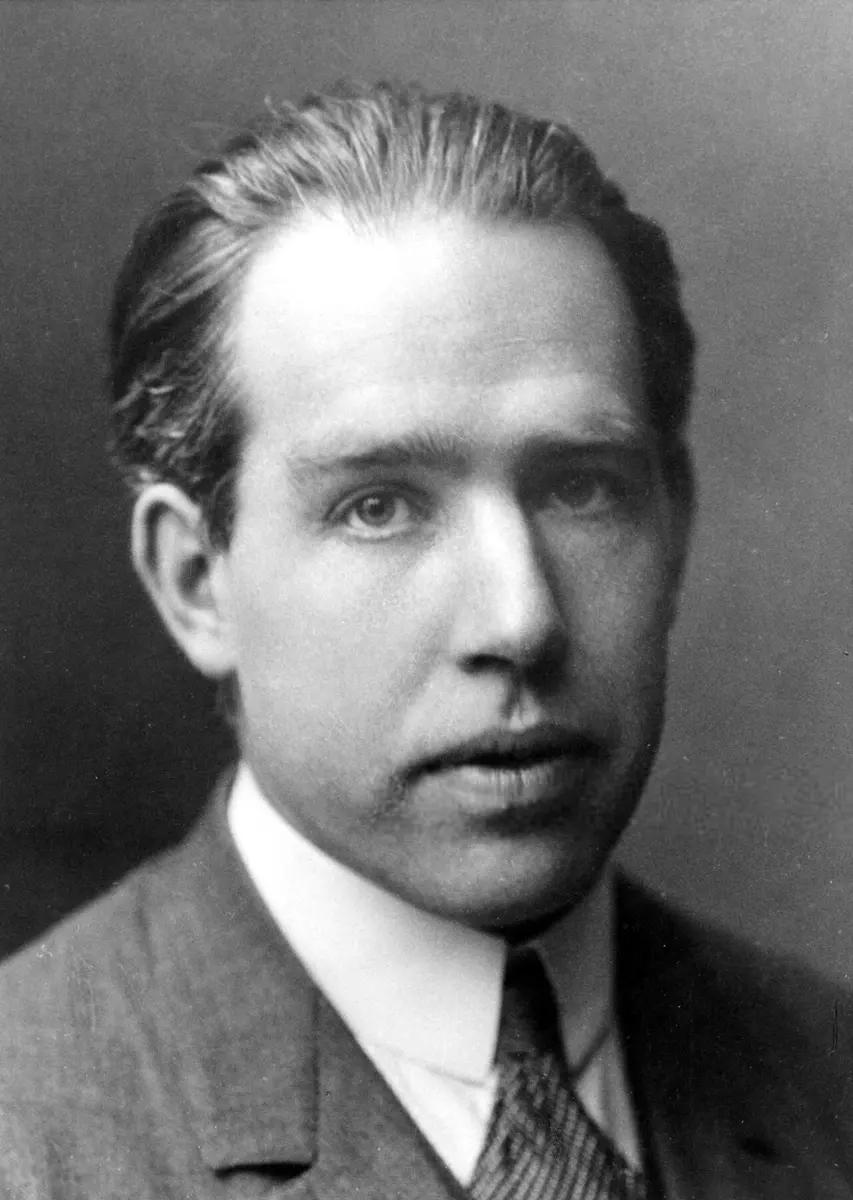
Postulates of Bohr’s atomic model
- Electrons revolve round the nucleus only in certain fixed circular orbits, called stationary orbits, energy levels or shells. They are numbered n = 1, 2, 3, 4… outward from the nucleus, or named K, L, M, N….
- While an electron stays in one of these orbits, it does not give out energy. (This is the rule that saves the atom from collapsing.)
- Each orbit has a fixed energy. The energy is lowest in the innermost orbit, K, and increases outward:
- Only those orbits are allowed in which the electron’s angular momentum is a whole-number multiple of : , where = 1, 2, 3… is the orbit’s number (the principal quantum number).
- An electron gives out or takes in energy only when it jumps from one orbit to another: .
In postulate 4, is the electron’s mass, its speed, the orbit’s radius and Planck’s constant (6.626 × 10⁻³⁴ J s). In postulate 5, an electron jumping inward, from a higher energy to a lower , gives out the difference as one packet of light of frequency ; to jump outward, it must take in exactly that much. A bigger jump gives more energy and a higher frequency: violet instead of red.
The energy levels of hydrogen
For the hydrogen atom, Bohr’s rules give each orbit a radius and an energy. The radius grows as : the second orbit is 4 times as wide as the first (0.053 nm), the third 9 times. The energy is
where 1 electronvolt (eV) = 1.602 × 10⁻¹⁹ J is the energy an electron gains crossing 1 volt. The energy is negative because the electron is bound: it would take energy to pull it away to zero, outside the atom.
Bohr’s orbits also gave the rule you used in Grade 8 and 9 for filling shells: each shell holds at most 2n² electrons (K 2, L 8, M 18, N 32), and electrons fill the lower-energy shells first. This arrangement of electrons in shells is sometimes called the Bohr–Bury scheme.
Merits and limitations of Bohr’s model
Merits:
- It explains why atoms are stable: an electron in a stationary orbit doesn’t radiate.
- It explains the line spectrum of hydrogen, and calculates the wavelengths of its lines.
- It calculates the size of the hydrogen atom and the energy needed to remove its electron (13.6 eV), both matching experiments.
- It gives the idea of electron shells, from which the 2n² rule and electronic configurations came.
Limitations:
- It works only for hydrogen and other atoms or ions with one electron (He⁺, Li²⁺). For atoms with two or more electrons, its numbers come out wrong.
- It can’t explain why some spectral lines, looked at closely, are pairs of lines, or why lines split in a magnetic field.
- It pictures the electron as a tiny ball on a fixed circular track. Since 1926 we know an electron has no definite path: we can only say where it is likely to be, an electron cloud (an orbital).
According to Bohr, when does an electron give out energy?
Pick an answer to see why.
6.5 Concept of atomic number, atomic mass, isotopes, isobars and isotones
Atomic number and mass number
The atomic number (Z) of an element is the number of protons in the nucleus of its atom. In a neutral atom it is also the number of electrons.
The atomic number is what makes an element that element. Every atom with 6 protons is carbon; give it a seventh and it is nitrogen. Elements in the modern periodic table are arranged in order of atomic number.
The mass number (A) of an atom is the total number of protons and neutrons in its nucleus. Protons and neutrons together are called nucleons.
where is the number of neutrons. An atom is written with its mass number at the top left of its symbol and its atomic number at the bottom left:
or simply by name and mass number: sodium-23, chlorine-35, Na-23.
Atomic mass
Atoms are far too light to weigh in grams: a carbon atom has a mass of about 2 × 10⁻²³ g. So chemists compare their masses with a standard atom instead. Since 1961 the standard has been the carbon-12 atom, given a mass of exactly 12 u.
The atomic mass unit (amu, or u) is one-twelfth of the mass of one carbon-12 atom: 1 u = 1.6605 × 10⁻²⁷ kg.
The relative atomic mass (or atomic mass, or atomic weight) of an element is the average mass of its atoms compared with one-twelfth of the mass of a carbon-12 atom:
As a ratio of two masses it has no unit, but it is the same number as the atom’s mass in u. Oxygen’s atomic mass is 16.00: an oxygen atom is, on average, 16 times as heavy as one-twelfth of a carbon-12 atom.
Mass number and atomic mass are not the same thing. The mass number counts particles, so it is always a whole number. The atomic mass is a measured mass, and it is almost never a whole number: the mass of a chlorine-35 atom is 34.969 u, not 35, because protons and neutrons don’t weigh exactly 1 u each, and a little of their mass goes into binding the nucleus. And an element’s atomic mass is an average over its isotopes, which brings us to them.
Isotopes
Isotopes are atoms of the same element that have the same atomic number but different mass numbers. They have the same number of protons and electrons but different numbers of neutrons.
Hydrogen has three isotopes, the only ones with names of their own:
| Isotope | Symbol | Protons | Neutrons | Electrons |
|---|---|---|---|---|
| protium (ordinary hydrogen) | 1 | 0 | 1 | |
| deuterium (heavy hydrogen) | or D | 1 | 1 | 1 |
| tritium | or T | 1 | 2 | 1 |
More examples: carbon-12, carbon-13 and carbon-14 (6 protons with 6, 7 and 8 neutrons); chlorine-35 and chlorine-37 (17 protons with 18 and 20 neutrons); uranium-235 and uranium-238 (92 protons with 143 and 146 neutrons).
Properties of isotopes:
- They have the same chemical properties, because chemistry depends on the electrons, and isotopes have the same number of electrons with the same arrangement. Water made with deuterium, D₂O (heavy water), still puts out fires and dissolves salt.
- They have slightly different physical properties that depend on mass: density, melting and boiling points, and how fast they diffuse (heavy water boils at 101.4 °C and is about 11% denser than ordinary water).
- Some isotopes are stable; others are radioactive, their nuclei breaking down over time (carbon-14, tritium, uranium-235).
- They have the same place in the periodic table, which is where the name comes from: Greek isos, “same”, and topos, “place”.
Uses of isotopes:
- Carbon-14 dates old wood, bone and cloth up to about 50,000 years old (radiocarbon dating), from how much of it is left.
- Cobalt-60 gives out gamma rays used to kill cancer cells and to sterilize medical equipment.
- Iodine-131 is used to find and treat diseases of the thyroid gland, which collects iodine.
- Uranium-235 is the fuel of nuclear power stations: only 0.7% of natural uranium.
- Deuterium, as heavy water, slows down neutrons in some nuclear reactors.
Average atomic mass
Most elements are a mixture of isotopes, always in very nearly the same proportions wherever the element is found. Chlorine is about 75.76% chlorine-35 and 24.24% chlorine-37, whether it comes from sea salt or a rock. The element’s atomic mass is the average mass of its atoms, weighted by how common each isotope is:
Two atoms have 17 protons each; one has 18 neutrons and the other 20. They are:
Pick an answer to see why.
Isobars
Isobars are atoms of different elements that have the same mass number but different atomic numbers. They have the same total number of nucleons, made up of different numbers of protons and neutrons. (Greek baros, “weight”: the same weight.)
| Isobar | Protons | Neutrons | Mass number |
|---|---|---|---|
| 18 | 22 | 40 | |
| 19 | 21 | 40 | |
| 20 | 20 | 40 |
Carbon-14 and nitrogen-14 are isobars too. Being different elements, isobars have different chemical properties: argon is an unreactive gas, potassium a soft metal that bursts into flame in water, calcium a metal in bones and limestone. Their masses are nearly, but not exactly, equal.
Isotones
Isotones are atoms of different elements that have the same number of neutrons but different numbers of protons, so different atomic numbers and different mass numbers.
| Isotone | Protons | Neutrons | Mass number |
|---|---|---|---|
| 6 | 8 | 14 | |
| 7 | 8 | 15 | |
| 8 | 8 | 16 |
Other isotones: sodium-23 and magnesium-24 (12 neutrons each); potassium-39 and calcium-40 (20 each).
A memory aid: isotopes have the same number of protons, isotones the same number of neutrons, and isobars the same mass number.
To find which group a pair belongs to, compare Z, N and A in turn:
| Atomic number, Z | Neutrons, N | Mass number, A | Same element? | |
|---|---|---|---|---|
| Isotopes | same | different | different | yes |
| Isobars | different | different | same | no |
| Isotones | different | same | different | no |
Which pair are isotones?
Pick an answer to see why.
Exercise
1. Choose the correct option
a. Which part of Dalton’s atomic theory is still accepted without change?
Pick an answer to see why.
b. The particle discovered by James Chadwick in 1932 is the:
Pick an answer to see why.
c. In the gold foil experiment, the fact that a very few alpha particles bounced back showed that:
Pick an answer to see why.
d. According to Bohr, the angular momentum of an electron in an allowed orbit is:
Pick an answer to see why.
e. and are:
Pick an answer to see why.
2. Give reasons
An atom is electrically neutral.
Hint
Answer
Almost all the mass of an atom is in its nucleus.
Hint
Answer
Isotopes of an element have the same chemical properties.
Hint
Answer
3. Differentiate between
Atomic number and mass number
Hint
Answer
Rutherford’s atomic model and Bohr’s atomic model
Hint
Answer
4. Answer the following questions
Write the main postulates of Dalton’s atomic theory. How has each of the following been modified: (i) atoms are indivisible, (ii) atoms of an element are identical in mass?
Hint
Answer
How was the electron discovered? Write any four properties of cathode rays.
Hint
Answer
Describe Rutherford’s alpha-ray scattering experiment, with a labeled diagram. Write its observations and conclusions.
Hint
Answer
Write the postulates of Bohr’s atomic model. Give one merit and one limitation.
Hint
Answer
What are isotopes? Write their properties and any three uses.
Hint
Answer
5. Numerical problems
Find the numbers of protons, neutrons and electrons in (i) , (ii) , (iii) and (iv) .
Hint
Answer
An atom has 15 protons and 16 neutrons. Find its atomic number and mass number, write its symbol with them, and name the element.
Hint
Answer
Boron is 19.9% boron-10 (mass 10.013 u) and 80.1% boron-11 (mass 11.009 u). Find the average atomic mass of boron.
Hint
Answer
Copper has an atomic mass of 63.55 and two isotopes, copper-63 (mass 62.93 u) and copper-65 (mass 64.93 u). Find the percentage of each.
Hint
Answer
Think: A student says, “Since potassium-40 and calcium-40 have the same mass number, they must behave the same way in reactions.” Explain the mistake.
Hint
Answer
Printable PDFs
- The unit as a book (A5) 26 pages Answers as an A4 booklet, 7 sheets
- Study notes 2 pages
- Worksheet 5 pages Answer key
- Harder practice questions 2 pages Answer key
Practice every question in the book, and keep track of the ones you miss →
Found a mistake? Please tell us.