
Stand at the Ratna Park end of Kathmandu early in the morning and you may hear something odd for a crowded bus stop: almost nothing. The three-wheelers called Safa Tempos pull away with a hum instead of a roar. They have no engine and no fuel tank. Under the seats are rows of heavy batteries, and every night the same batteries are plugged in and charged again, to run the tempo all the next day. They can do this for years. The small cells in a torch can’t: once they run down, they are thrown away.
What is different inside a battery that can be charged again? And when a mechanic checks that battery, the meter he uses is, deep inside, the same kind of instrument as the one on a school lab bench, turned into whatever meter he needs by one resistor. This unit is about both, and about the materials that make magnets and the tiny pieces of silicon that run every phone.

14.1 Magnetic materials
Hold a strong magnet near a steel spoon, a copper coin, a piece of aluminium foil and a plastic ruler. Only the spoon jumps to it. Yet with a strong enough magnet, it turns out that every substance is affected a little: some are pulled very weakly, some are pushed away very weakly. How strongly a substance is pulled depends on what its atoms and molecules are like inside.
Molecular magnetism
Electrons moving inside an atom, and spinning, are tiny currents, and every current makes a magnetic field. In most atoms the electrons come in pairs whose fields cancel exactly. In some atoms, though, one or more electrons are unpaired, and their fields don’t cancel: each atom (or molecule) is then a tiny magnet, with its own north and south pole. This is called molecular magnetism. Whether these tiny magnets line up with each other decides what kind of magnetic material a substance is.
Paramagnetic materials
In a paramagnetic material, each atom or molecule is a tiny magnet, but the magnets don’t act on each other enough to line up. The heat of the material keeps knocking them about, so they point in every direction at random and cancel out.
Put the material in a magnetic field and the field turns the tiny magnets a little towards its own direction. Only a little: heat keeps scattering them. At room temperature, even in a very strong field, only about two in every thousand more point along the field than against it. So the material becomes a very weak magnet pointing the same way as the field, and it is pulled weakly towards the stronger part of a magnetic field. Take the field away, and the heat scatters them again: the material keeps no magnetism at all.
Paramagnetic materials are substances that are weakly attracted by a magnet and become weakly magnetized in the direction of the field, losing it as soon as the field is removed. Examples: aluminium, platinum, sodium, manganese, oxygen (liquid oxygen clings between the poles of a strong magnet) and compounds such as copper sulphate.
Heat matters: the colder a paramagnetic material, the less its tiny magnets are scattered, and the more strongly it is magnetized by the same field.
Ferromagnetic materials
In iron, cobalt and nickel something else happens. The tiny atomic magnets act on their neighbors so strongly that they line up with each other by themselves, even with no field around. They do it in regions called domains. In each domain, all the atomic magnets point the same way, so a domain is a strong little magnet. Domains are small, often less than a tenth of a millimeter across, but even a domain 0.01 mm across holds about a hundred million million (10¹⁴) atoms.
In an unmagnetized iron nail, the domains point in different directions and cancel, so the nail as a whole is not a magnet. Put it in a magnetic field and the domains turn to the field one after another (the domains already pointing along the field also grow at the expense of the others). Because whole domains turn, not single atoms against the heat, the nail becomes a strong magnet. In the same field, iron is magnetized at least tens of thousands of times more than aluminium, and in a weak field millions of times more.
Ferromagnetic materials are substances that are strongly attracted by a magnet and can be strongly magnetized, because their atomic magnets line up in domains. Examples: iron, cobalt, nickel, gadolinium, and alloys such as steel and alnico (aluminium, nickel and cobalt with iron).
Ferromagnetic materials come in two kinds. In soft magnetic materials, like soft iron, the domains turn easily and turn back as easily when the field is removed: almost no magnetism is left. They are used where a magnet must switch on and off, in the cores of electromagnets, transformers and the galvanometer below. In hard magnetic materials, like steel and alnico, the domains are hard to turn, but once turned they stay. They make permanent magnets.
| Paramagnetic materials | Ferromagnetic materials |
|---|---|
| Weakly attracted by a magnet. | Strongly attracted by a magnet. |
| Atomic magnets point at random; a field lines up only a tiny share of them. | Atomic magnets are lined up in domains; a field turns whole domains. |
| No domains. | Have domains. |
| Lose all their magnetism when the field is removed. | Hard ones keep their magnetism and can be made into permanent magnets. |
| Examples: aluminium, platinum, sodium, oxygen. | Examples: iron, cobalt, nickel, steel. |
Why is a piece of iron pulled far more strongly by a magnet than a piece of aluminium of the same size?
Pick an answer to see why.
14.2 Secondary cell
A cell changes chemical energy into electrical energy. It has two electrodes (plates of different materials) in an electrolyte (a liquid or paste that conducts by ions). Several cells joined together make a battery, though in everyday speech a single cell is often called a battery too.
The dry cell in a torch, a remote control or a clock is a primary cell: the chemicals inside react to give a current, and once they are used up the reaction can’t be reversed. The cell is dead and must be thrown away (or, better, recycled). A secondary cell can be used again and again: when it runs down, a current from a charger is passed through it the other way, which drives its chemical reaction backwards and makes the original chemicals again.
A secondary cell is a cell in which electrical energy is stored as chemical energy, and which can be recharged by passing a current through it in the opposite direction. Because it stores energy and gives it back, a secondary cell is also called a storage cell or an accumulator.
Types of secondary cells
| Cell | Electrodes and electrolyte | Voltage per cell | Where it is used |
|---|---|---|---|
| Lead-acid cell | lead dioxide and lead in dilute sulphuric acid | about 2 V | cars, motorbikes, Safa Tempos, inverters, solar lights |
| Nickel–cadmium (NiCd) cell | nickel oxide hydroxide and cadmium in potassium hydroxide | 1.2 V | older cordless tools, emergency lights |
| Nickel–metal hydride (NiMH) cell | nickel oxide hydroxide and a metal alloy holding hydrogen, in potassium hydroxide | 1.2 V | rechargeable AA and AAA cells, hybrid cars |
| Lithium-ion cell | a lithium metal oxide and graphite, in a lithium salt dissolved in an organic liquid | about 3.6–3.7 V | phones, laptops, electric cars and scooters |
The lithium-ion cell, light and able to store a lot of energy, is why phones and electric cars became possible; its inventors won the 2019 Nobel Prize in Chemistry. The oldest, invented by Gaston Planté in France in 1859, is the lead-acid cell. It is heavy, but it is cheap, reliable and can give a very large current for a moment, which is what a car’s starter motor needs. That is why it is still the battery under the hood of nearly every car, and in most homes in Nepal that keep an inverter for power cuts.
Structure of a lead-acid cell
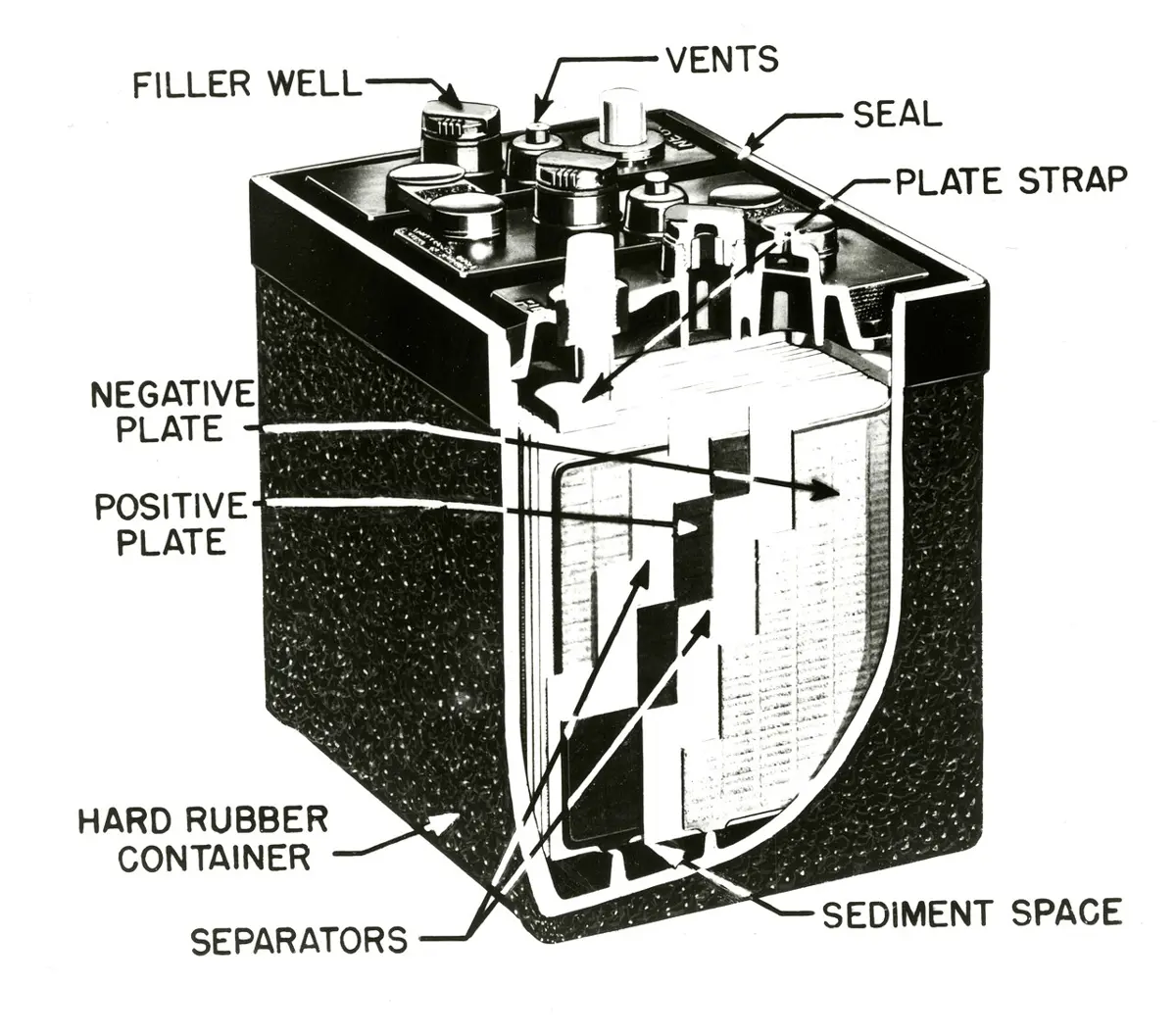
A lead-acid cell has:
- a strong case of plastic (in old batteries, hard rubber or glass) that the acid can’t attack;
- a positive plate of lead dioxide, PbO₂, a chocolate-brown paste pressed into a grid of lead alloy;
- a negative plate of spongy lead, Pb, gray and full of tiny holes, so that the acid reaches as much of it as possible;
- the electrolyte, dilute sulphuric acid, H₂SO₄, of density about 1.28 g/cm³ when the cell is fully charged;
- separators, thin porous sheets that keep the plates from touching but let the acid through;
- a vent cap, which lets out the gases made while charging.
To give a large current, a real cell has several positive plates and several negative plates, joined in parallel and taking turns, which gives a large area of plate. A cell gives about 2 V (2.1 V when fully charged), however big it is: its size decides how much charge it can store, not its voltage. A 12 V car battery is six cells joined in series in one case: 6 × 2 V = 12 V.
Chemical processes during discharging and charging
Discharging (the cell lighting a lamp or starting a car). At the negative plate, the lead gives up electrons and joins with sulphate ions from the acid to make lead sulphate:
The electrons flow through the outside circuit (the lamp) to the positive plate. There, the lead dioxide takes them up and also turns into lead sulphate:
Adding the two:
As the cell discharges, both plates slowly turn into white lead sulphate, the sulphuric acid is used up, and water is made. So the acid becomes more dilute and its density falls, from about 1.28 g/cm³ when full to about 1.12 g/cm³ when nearly empty. The voltage falls a little too.
Charging. A charger is connected with its positive terminal to the positive plate and its negative terminal to the negative plate. Its higher voltage pushes a current through the cell the opposite way, and every reaction runs backwards:
Lead dioxide forms again on the positive plate, spongy lead on the negative plate, and sulphuric acid in the liquid, so its density rises back to about 1.28 g/cm³. The electrical energy from the charger is stored again as chemical energy.
Near the end of charging, when most of the lead sulphate is used up, the current starts to split the water in the acid instead (electrolysis, which Grade 9 Optional Science covers in Unit 8): hydrogen bubbles off at the negative plate and oxygen at the positive plate. The cell is said to be gassing, and it is a sign that it is fully charged.
Uses of secondary cells
Secondary cells are used wherever energy has to be stored and taken out again many times: to start vehicles and run their lights; in electric vehicles from Safa Tempos to electric cars and scooters; in inverters, which keep lights and fans running in homes, shops and hospitals during power cuts; to store the day’s solar energy for the night in solar home systems and street lamps; in phones, laptops, cameras and torches; and in telephone towers and computer centers that must never lose power.
Advantages of secondary cells over primary cells
| Primary cell | Secondary cell |
|---|---|
| Can’t be recharged; thrown away once used. | Can be recharged hundreds or thousands of times. |
| Its chemical reaction can’t be reversed. | Its chemical reaction is reversed by a current passed the other way. |
| Costs less to buy, but more over time, as new cells are bought again and again. | Costs more to buy, but much less over its life. |
| Gives a small current. | Can give a large current (a car battery gives over 100 A for a moment to the starter motor). |
| Its internal resistance is fairly high. | Its internal resistance is very low. |
| Creates a lot of waste. | Creates far less waste for the same energy. |
| Light and handy, needs no charger: good for clocks, remotes and emergency kits. | Needs a charger and electricity to recharge. |
While a lead-acid cell is being used to light a lamp, the density of its acid:
Pick an answer to see why.
14.3 Use of ammeter and voltmeter
An ammeter measures the current through a part of a circuit, in amperes. A voltmeter measures the potential difference between two points, in volts. Using them right depends on where they go.
The ammeter is connected in series with the part whose current is measured: the circuit is broken where the current is wanted and the ammeter put in the gap, so all the current flows through it. To avoid changing the current it measures, an ammeter must have a very low resistance (an ideal one would have none).
The voltmeter is connected in parallel, its two terminals touching the two ends of the part. The circuit isn’t broken. To avoid taking current away from the part it is across, a voltmeter must have a very high resistance (an ideal one would take no current at all). A good digital voltmeter has a resistance of about 10 million ohms.
When using either meter:
- connect its positive terminal (marked + or colored red) to the side of the circuit nearer the cell’s positive terminal, or the pointer is pushed backwards;
- start on the highest range and switch down until the reading is large on the scale, for the most accurate reading without overloading the meter;
- read the scale looking straight at the pointer, from directly in front (a mirror strip under the scale of a good meter helps: the pointer should hide its own reflection).
What goes wrong if they are swapped? An ammeter connected in parallel across a lamp offers the current an easy path round the lamp: a very large current flows through the ammeter, which can burn it out (and the cell runs down fast). A voltmeter connected in series lets almost no current through: the lamp doesn’t light, and the voltmeter reads nearly the whole voltage of the cell.
14.4 Galvanometer
In Grade 10 Science, a galvanometer is used to detect the tiny current made when a magnet was pushed into a coil. A galvanometer is a very sensitive instrument that detects a small current and shows its direction; its pointer rests at zero in the middle of the scale and swings to one side or the other. It is also the heart of every pointer-type ammeter and voltmeter.
Structure of a moving-coil galvanometer
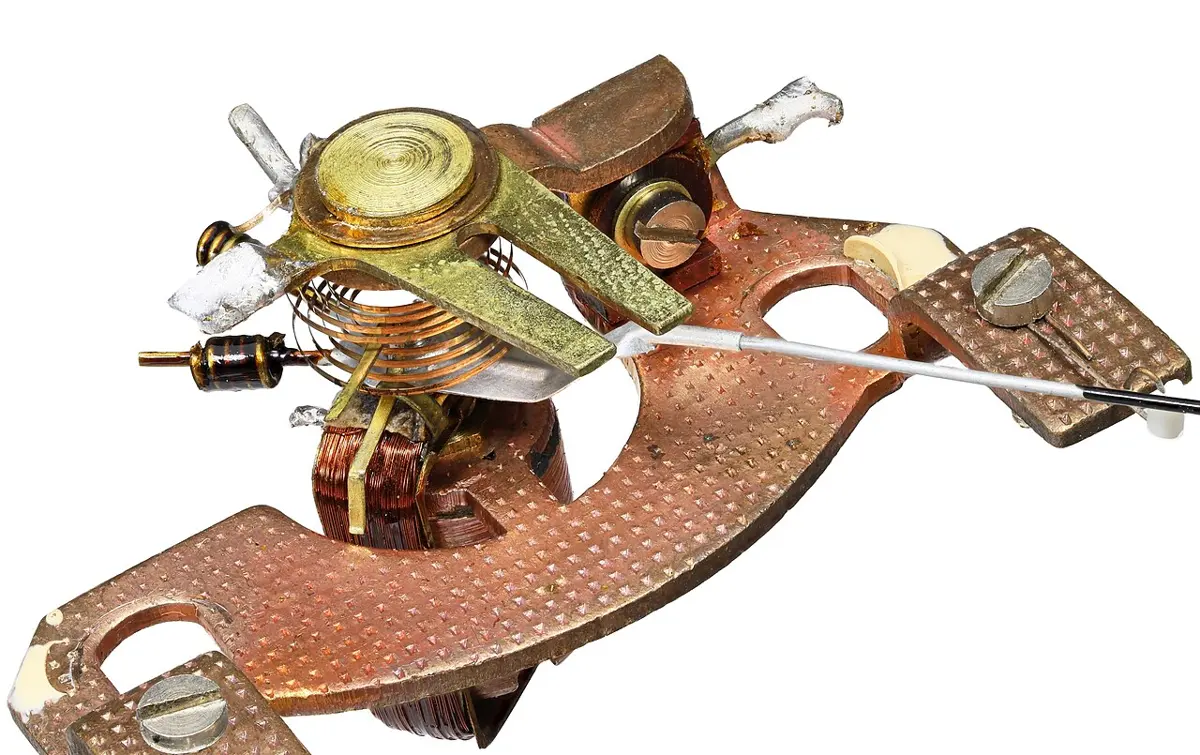
A moving-coil galvanometer has:
- a coil of many turns of very fine insulated copper wire, wound on a light rectangular aluminium frame, which can turn about an axle;
- a strong permanent magnet (a horseshoe magnet) whose pole pieces are curved to fit round the coil;
- a fixed soft-iron cylinder (the core) inside the coil, which makes the field in the gaps stronger and points it along the radius, towards the core’s center, wherever the coil turns;
- two fine hairsprings of phosphor bronze at the axle, which hold the coil at zero, resist its turning, and lead the current in and out of the coil;
- a light pointer fixed to the coil, moving over a scale.
How it works
When a current flows through the coil, its two sides carry the current in opposite directions in the magnet’s field. By the motor effect, one side is pushed one way and the other side the other way (left-hand rule), so the coil turns. As it turns, it twists the hairsprings, which push back harder the more they are twisted. The coil stops where the springs’ push balances the turning effect of the current.
The bigger the current, the stronger the turning effect, so the further the coil turns before the springs balance it: the deflection is proportional to the current. The radial field from the curved poles and the soft-iron core makes the turning effect the same at every angle, so the scale’s marks are evenly spaced. Reverse the current and the coil turns the other way. When the current stops, the springs bring the pointer back to zero.
A galvanometer is sensitive: a typical school one gives its full deflection for a current of a few milliamperes or less, and its coil has a resistance of tens of ohms. Two numbers describe it: its resistance, , and the current for full-scale deflection, .
Converting a galvanometer into an ammeter
To measure a current larger than , most of it must go round the galvanometer instead of through it. So a low resistance, called a shunt (), is connected in parallel with the galvanometer. At full scale, flows through the coil and the rest, , through the shunt.
The galvanometer and the shunt are in parallel, so the potential difference across them is the same:
where is the largest current the ammeter is to read. The scale is then marked again so that full deflection reads . The whole ammeter (coil and shunt in parallel) has a resistance smaller than : very small, as an ammeter needs.
Converting a galvanometer into a voltmeter
To measure a potential difference larger than , the current through the coil must be kept small. So a high resistance, called a multiplier (), is connected in series with the galvanometer. At full scale, the voltage to be measured drives just through the coil and the multiplier together:
The scale is marked again to read volts. The whole voltmeter has a resistance of : large, as a voltmeter needs.
A galvanometer is to be made into a voltmeter. What must be connected, and how?
Pick an answer to see why.
14.5 Semiconductor, diode and transistor
Semiconductors
Some materials, like copper and aluminium, are good conductors; others, like glass, rubber and plastic, are insulators. A semiconductor is a material whose ability to conduct electricity lies between those of conductors and insulators. The most important are the elements silicon and germanium; compounds such as gallium arsenide and gallium nitride (used in LEDs) are semiconductors too.
A piece of pure silicon conducts poorly, about a hundred billion times worse than copper, because nearly all of its electrons are held in the bonds between its atoms. Three things change that:
- Heat. Warming a semiconductor shakes some electrons free, so it conducts better as it gets hotter. A metal does the opposite: its resistance rises with temperature.
- Light, in the same way, frees electrons: a light-dependent resistor (LDR) and a solar cell use this.
- Doping: adding a tiny amount of another element, a few atoms in every million, makes silicon conduct more than a thousand times better. Adding phosphorus or arsenic (five outer electrons, one more than silicon’s four) gives spare electrons that can move: an n-type semiconductor (n for negative). Adding boron or gallium (three outer electrons) leaves gaps where an electron is missing, called holes, which move like positive charges as neighboring electrons hop into them: a p-type semiconductor (p for positive).
The diode
A diode is made by joining a p-type and an n-type semiconductor in one piece of silicon: a p–n junction. It has two terminals, and it lets current through in one direction only. Its symbol is an arrow (the triangle) pointing the way the conventional current can go, against a bar. On a real diode, a band printed round one end marks the bar’s side, the cathode (n side); the other end is the anode (p side).
Forward bias. When the p side is joined to the positive terminal of a supply, the holes in the p side and the electrons in the n side are both pushed towards the junction. They meet and cross it, and a current flows. A silicon diode needs about 0.7 V across it to start conducting (germanium about 0.3 V); above that, current flows easily.
Reverse bias. When the p side is joined to the negative terminal, the holes and electrons are both pulled away from the junction. The thin layer at the junction with no free charges, the depletion layer, becomes wider, and practically no current flows. The diode acts like an open switch. (Too large a reverse voltage breaks the diode down, so every diode has a largest reverse voltage it is rated for.)
Uses of diodes.
- Rectifiers. A diode in an a.c. circuit lets through only the halves of each wave that drive it forward: half-wave rectification, shown in the widget with an a.c. supply. Four diodes arranged in a bridge use both halves. Every phone charger, laptop adapter and TV turns the mains a.c. into d.c. this way.
- Light-emitting diodes (LEDs). In a diode made of materials like gallium nitride, electrons crossing the junction give out their energy as light. LEDs light homes, streets, phone screens and traffic lights for a fraction of the electricity of a filament bulb (the blue LED, which made white LED light possible, won the 2014 Nobel Prize in Physics).
- Solar cells are large p–n junctions working the other way: light makes a current.
- Protection: a diode in the power lead of a device stops it being damaged if a battery is put in the wrong way round.
The transistor
A transistor is a sandwich of three layers of semiconductor: n–p–n (an npn transistor) or p–n–p (a pnp transistor). Its three terminals are the emitter (E), the thin middle layer, called the base (B), and the collector (C). In the symbol, the arrow on the emitter points out for npn and in for pnp, the way the conventional current flows.
The key idea: a small current into the base controls a much larger current from the collector to the emitter. With no base current, the transistor is off and almost no collector current flows. A small base current (it needs about 0.7 V between base and emitter, like a diode) lets a collector current flow that is typically about 100 times bigger. A change of 0.05 mA in the base current, for example, changes the collector current by about 5 mA.
This makes a transistor two things:
- a switch, with no moving parts, turning a large current on and off by a tiny one, millions or billions of times a second; and
- an amplifier, in which a small, changing current (the weak signal from a microphone, or a radio’s antenna) controls a large current that changes in exactly the same way, a stronger copy that can drive a loudspeaker.
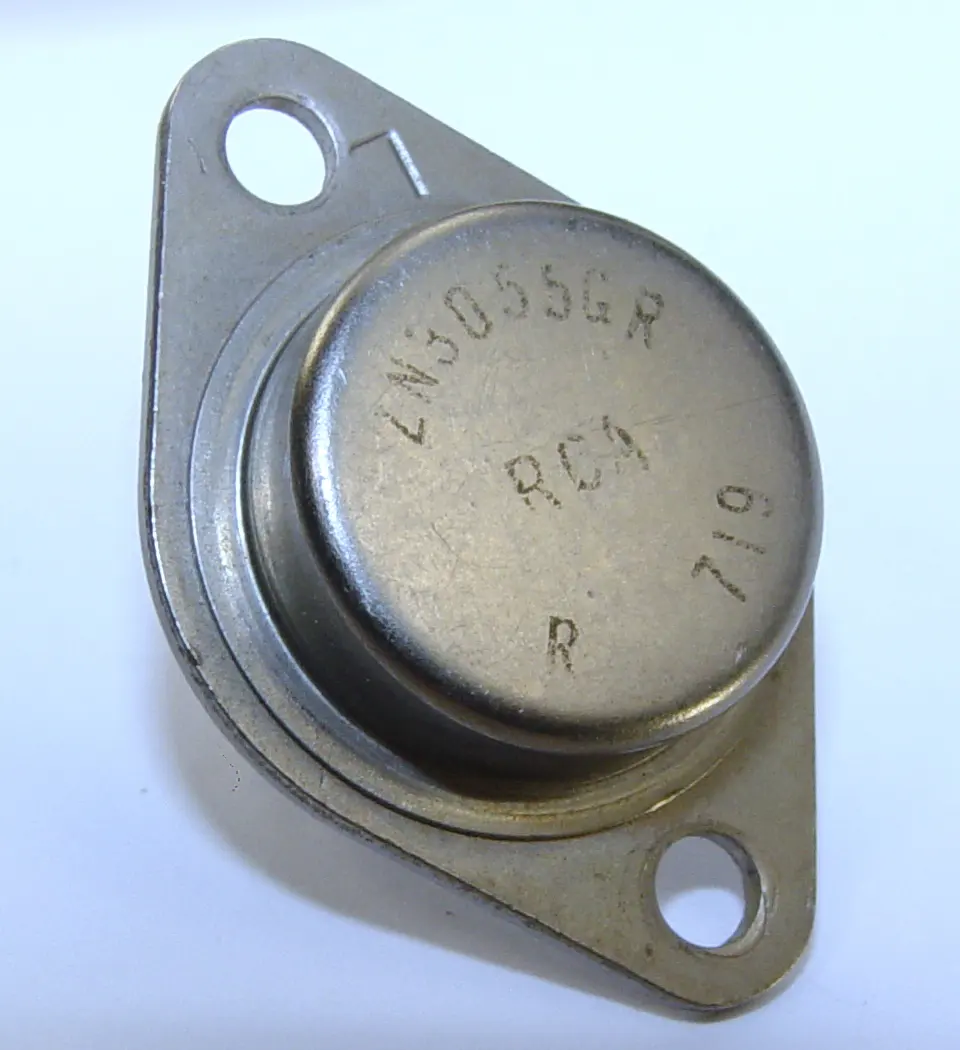
Uses of transistors in daily life. As switches: in every computer and phone chip; in automatic street lights and night lights; in fire and burglar alarms; in an inverter, switching the battery’s d.c. on and off many times a second to make a.c. As amplifiers: in radios, hearing aids, microphones and loudspeakers, and every audio system.
In an automatic night light like Figure 14.6, why does the lamp come on when it gets dark?
Pick an answer to see why.
Exercise
1. Choose the correct option
a. Which of these is a ferromagnetic material?
Pick an answer to see why.
b. When a paramagnetic material is taken out of a magnetic field, it:
Pick an answer to see why.
c. The electrolyte in a lead-acid cell is:
Pick an answer to see why.
d. When a lead-acid cell is fully discharged, its plates are mostly:
Pick an answer to see why.
e. A galvanometer is converted into an ammeter by connecting:
Pick an answer to see why.
f. The soft-iron core in a moving-coil galvanometer is used to:
Pick an answer to see why.
g. A p-type semiconductor is made by adding to pure silicon a small amount of:
Pick an answer to see why.
h. Which device turns an alternating current into a direct current?
Pick an answer to see why.
2. Give reasons
A ferromagnetic material is attracted far more strongly than a paramagnetic material.
Hint
Answer
A lead-acid battery is called a storage battery.
Hint
Answer
A lead-acid battery should be charged in an open, airy place away from flames.
Hint
Answer
An ammeter should have a very low resistance and a voltmeter a very high one.
Hint
Answer
The pointer of a galvanometer swings both ways from a zero in the middle of its scale.
Hint
Answer
3. Differentiate between
Primary cell and secondary cell
Hint
Answer
Ammeter and voltmeter
Hint
Answer
p-type and n-type semiconductors
Hint
Answer
4. Answer the following questions
What is molecular magnetism? Draw the arrangement of the atomic magnets in a paramagnetic and a ferromagnetic material, with no field and in a strong field.
Hint
Answer
Describe the structure of a lead-acid cell with a labeled diagram.
Hint
Answer
Write the chemical reactions at each plate of a lead-acid cell while it is discharging. What happens to them during charging?
Hint
Answer
Explain the structure and working of a moving-coil galvanometer.
Hint
Answer
What is a diode? Explain forward and reverse bias, and give two uses of diodes.
Hint
Answer
What is a transistor? How can it be used as a switch and as an amplifier?
Hint
Answer
Think: in the night light of Figure 14.6, what would happen if the LDR and the 10 kΩ resistor were swapped, so that the LDR was between +6 V and the base?
Hint
Answer
5. Numerical problems
A galvanometer of resistance 100 Ω gives full-scale deflection for a current of 1 mA. (i) What potential difference across it gives full-scale deflection? (ii) What shunt makes it an ammeter of range 0–1 A? (iii) What resistance in series makes it a voltmeter of range 0–5 V?
Hint
Answer
A galvanometer of resistance 50 Ω gives full-scale deflection for 10 mA. Find the shunt needed to make it an ammeter of range 0–2 A, and the resistance of the whole ammeter.
Hint
Answer
The same galvanometer (50 Ω, 10 mA) is to read up to 20 V. What resistance must be connected, and how? What is the resistance of the voltmeter?
Hint
Answer
A galvanometer of resistance 40 Ω gives full-scale deflection for 2 mA. A shunt of 0.04 Ω is connected across it. What is the largest current the ammeter can now read?
Hint
Answer
A galvanometer of resistance 20 Ω gives full-scale deflection for 5 mA. A resistance of 980 Ω is connected in series with it. What is the range of the voltmeter made?
Hint
Answer
A galvanometer giving full-scale deflection for 25 mA needs a shunt of 0.25 Ω to read up to 5 A. Find the resistance of the galvanometer.
Hint
Answer
A car battery has six lead-acid cells in series, each of 2.1 V when fully charged. Its capacity is 60 Ah. (i) What is its voltage? (ii) For about how long could it keep two headlights lit, if together they take 9 A?
Hint
Answer
A shop in Bhaktapur keeps four 10 W LED lights and a 60 W fan running during power cuts, on an inverter with a 12 V battery. The longest power cut is 3 hours. Ignoring losses in the inverter, find (i) the energy needed, in watt-hours, (ii) the charge needed, in ampere-hours, and (iii) the smallest battery capacity if no more than half of its charge is to be used.
Hint
Answer
A silicon diode and a 1 kΩ resistor are joined in series to a 9 V battery. Find the current when the diode is forward biased. What is the current, and the p.d. across the diode, when it is reversed?
Hint
Answer
A red LED works with 2 V across it and a current of 20 mA. What resistance must be put in series with it to run it from a 5 V phone charger?
Hint
Answer
In a transistor, the collector current is 100 times the base current. (i) What collector current flows for a base current of 0.04 mA? (ii) What base current is needed to switch on a lamp that takes 0.15 A?
Hint
Answer
Printable PDFs
- The unit as a book (A5) 24 pages Answers as an A4 booklet, 6 sheets
- Study notes 2 pages
- Worksheet 5 pages Answer key
- Harder practice questions 2 pages Answer key
Practice every question in the book, and keep track of the ones you miss →
Found a mistake? Please tell us.