
Split a shaligram from the Kali Gandaki and you hold a sea animal that died about 150 million years ago. Dig under the Maya Devi Temple in Lumbini, as archaeologists did in 2011–2013, and you find charcoal from a wooden shrine built about 2,600 years ago. Neither came with a date written on it. Yet scientists give both their ages with confidence, and can say that one is more than fifty thousand times older than the other. How?
This unit is about reading time: the ages of rocks and fossils, the kinds of fossils Nepal holds and what they tell us, and the radioactive clock inside every living thing, carbon-14. Then it turns from the Earth’s past to the sky above it: the planetarium, a room that can show you the sky of any night, from any place, and the story of how people, in less than a century, sent machines and then themselves into space.

15.1 Geochronology
Meaning of geochronology
Geochronology is the science of finding the ages of rocks, fossils, sediments and the events of the Earth’s history, and the order in which they happened. The word joins three Greek words: gē, the Earth, chronos, time, and logos, study. A geologist asks two kinds of question about a rock, and geochronology answers both.
- Which is older? Finding the order of events without numbers is relative dating: “this layer formed before that one”, “this fault is younger than the rocks it breaks”.
- How old, in years? Finding an age in years is absolute dating (or numerical dating): “this lava cooled 1.2 million years ago”.
Relative dating came first, and still sorts most of the Earth’s history; absolute dating, which became possible only after radioactivity was discovered in 1896, put the numbers on it.
Relative dating
Look at the cut face of a hillside where a road has been blasted through layers of rock. A few simple rules, worked out from the 1660s on, let you read it like a history book.
a. Superposition. In a pile of sedimentary layers that hasn’t been turned over, each layer is younger than the one below it and older than the one above. The bottom of the pile was laid down first.
b. Original horizontality. Sediment settles in flat layers. Layers found tilted or folded were bent after they formed, as the Himalaya’s were.
c. Cross-cutting. A fault, or a vein of once-molten rock, that cuts through layers is younger than the layers it cuts. You can’t break something that isn’t there yet.
d. Faunal succession. Living things have changed through time, so each layer holds its own set of fossils, in the same order everywhere. Rocks far apart holding the same fossils formed at the same time. A fossil that is common, found widely and lived for only a short span is especially useful for this: an index fossil. Ammonites, which changed quickly and swam in every ocean, are some of the best.
Going Further 6–8 works through all four rules with real cliffs, and lets you build and read a cliff yourself: How Do Rocks Tell Time?
A road cut shows three flat layers: sandstone at the bottom, shale in the middle, limestone at the top. A crack filled with dark igneous rock runs up through all three. Which formed last?
Pick an answer to see why.
Absolute dating: radioactive clocks
In Grade 9 Optional Science you met radioactivity: unstable nuclei break down by themselves, giving out alpha or beta particles and gamma rays, and turn into nuclei of other elements: Types of nuclear radiations. The unstable nucleus is called the parent and the one it turns into the daughter.
No one can say when one particular nucleus will decay. But in a sample of billions, a fixed share decays in any stretch of time, so the number left falls in a steady way. The time it takes for half of the parent nuclei in a sample to decay is its half-life. After one half-life, ½ of the parent is left; after two, half of that, ¼; after three, ⅛; and so on:
where is the time passed, the half-life and the number of half-lives. Nothing changes a half-life: not heat, not pressure, not chemical reactions, because decay happens inside the nucleus, where none of those reach. That makes a radioactive substance a clock that has kept the same time since the rock formed. Measure how much parent is left (or how much daughter has built up), and you can work out how many half-lives have passed.
Each clock suits a different stretch of time, as each kind of watch does:
| Parent → daughter | Half-life | Dates |
|---|---|---|
| uranium-238 → lead-206 | 4,470 million years | the oldest rocks, meteorites, the age of the Earth |
| potassium-40 → argon-40 | 1,250 million years | volcanic rocks, from about 100,000 years old upwards |
| carbon-14 → nitrogen-14 | 5,730 years | wood, bone, cloth and other once-living things, up to about 50,000 years |
A clock is useful while there is enough parent left to measure and enough daughter made to see. Carbon-14 is too fast for rocks millions of years old: nothing would be left. Uranium-238 is too slow for a few thousand years: almost no lead would have formed. Going Further 9–12 shows how the uranium clock in tiny zircon crystals gave the Earth its age, 4.54 billion years: How Old Is the Earth?
Radioactivity is not the only absolute clock. Trees in places with a cold or dry season grow one ring a year, and counting the rings of living and old wood (dendrochronology) goes back more than 12,000 years. Some lakes lay down one pale and one dark layer of mud each year (varves), and the ice of Greenland and Antarctica holds yearly layers of snow, counted back tens of thousands of years.
The geological time scale
With relative dating to put the layers in order and radioactive clocks to put years on them, geologists have built one calendar of the Earth’s history, the geological time scale. You met its eras in Grade 8. Its units, from longest to shortest, are:
- eons: the Hadean, Archean, Proterozoic (together called the Precambrian) and the Phanerozoic, “visible life”, the last 539 million years;
- eras: the Phanerozoic’s three, the Paleozoic (“old life”), Mesozoic (“middle life”) and Cenozoic (“new life”);
- periods: the eras’ chapters, most named after places where their rocks were first studied (the Cambrian after Cambria, the old name of Wales; the Jurassic after the Jura mountains);
- epochs: the periods’ paragraphs, used mostly for the Cenozoic (the Miocene, the Pleistocene, the Holocene).
The boundaries are drawn where the fossils change sharply, often at a mass extinction. The numbers are fixed by radioactive dating of volcanic ash beds near each boundary; the International Commission on Stratigraphy publishes the official chart, and adjusts a date when better measurements come in.
| Era | Period (million years ago) | Life | In Nepal’s rocks |
|---|---|---|---|
| Cenozoic | Quaternary (2.6 – now) | Ice ages; humans | the Kathmandu Valley’s lake clays; the Terai’s gravels |
| Neogene (23 – 2.6) | grasslands spread; apes, elephants, horses | the Siwalik (Chure) hills and their fossils | |
| Paleogene (66 – 23) | mammals spread after the dinosaurs | India meets Asia, about 50 million years ago | |
| Mesozoic | Cretaceous (145 – 66) | flowering plants; the last dinosaurs | sea-floor rocks of the Tethys Himalaya |
| Jurassic (201 – 145) | dinosaurs; ammonites everywhere | the shaligrams’ black shales, Mustang | |
| Triassic (252 – 201) | first dinosaurs and mammals | Tethys limestones, Manang and Dolpa | |
| Paleozoic | Permian (299 – 252) | ends with the Great Dying | |
| Carboniferous (359 – 299) | coal forests | ||
| Devonian (419 – 359) | fish; first forests | ||
| Silurian (444 – 419) | plants on land | ||
| Ordovician (485 – 444) | trilobites, sea lilies | the limestone at the top of Sagarmatha | |
| Cambrian (539 – 485) | most animal groups appear | ||
| Precambrian | (4,540 – 539) | single cells, then the first many-celled life | the oldest rocks of the Lesser Himalaya |
To see the whole of it as a story, scroll through the site’s Deep Time timeline, from the Big Bang to the end of the last Ice Age, with the eons, eras and periods as a ruler down its side; and to watch the continents move through those periods, with the rocks under Kathmandu followed from the far south, open Our World’s Earth Through Time.
Why are the boundaries between periods placed where they are?
Pick an answer to see why.
Importance of geochronology
a. Reading the Earth’s story in order, and its speed. Dates turn a pile of rocks into a history: when the Tethys Sea closed, when India met Asia, how fast the Himalaya rose and the Chure filled with sediment.
b. The history of life. The ages of fossil-bearing rocks tell when each group of living things appeared and died out, and how fast evolution worked. Without them there would be no geological time scale.
c. Finding resources. Coal, oil and gas, and many ores formed in rocks of particular ages and settings. Knowing a rock’s age tells geologists whether it is worth searching. Most of the world’s coal formed in the swamp forests of the Carboniferous and Permian periods.
d. Earthquakes and other hazards. Dating the layers broken by a fault tells how often it moves. In trenches dug across the Main Frontal Thrust in the eastern Terai, radiocarbon dates of charcoal in the broken layers showed that the great earthquakes of 1934 and 1255 both broke the ground surface, 679 years apart. (The 1255 earthquake is remembered in the chronicles of the Kathmandu Valley, which say King Abhaya Malla died in it.) Knowing how often a fault breaks helps decide how strongly to build.
e. Climate of the past. Dated layers of lake mud, ice and cave stone record past temperatures and rainfall, and show how fast climate has changed before: the background against which today’s warming is measured.
f. History and archaeology. The same clocks date human remains and objects, as you will see in 15.3.
15.2 Fossils
Definition
A fossil is the remains or trace of a living thing of the distant past, preserved in rock. The word comes from the Latin fossilis, “dug up”. A fossil can be a bone, a tooth, a shell, a leaf, a tree trunk turned to stone, the print of a shell, or a footprint, a burrow or droppings left by an animal. By custom, remains younger than about 10,000 years (the end of the last Ice Age) aren’t called fossils. The study of fossils is paleontology.
Process of formation
Most living things never become fossils. A dead animal on land is eaten by scavengers, rotted by bacteria and fungi, and broken by the weather; within a few years nothing is left. A fossil forms only when everything goes right:
- the living thing has hard parts, shells, bones, teeth or wood, which last longer than flesh;
- it is buried quickly, in mud, sand or volcanic ash, away from scavengers and from the oxygen that decay needs. That is why most fossils are of things that lived in or near water, where mud settles all the time;
- the rock that forms around it is left undisturbed: not melted, not crushed, not worn away, for millions of years.
The Kali Gandaki’s ammonites went through every stage, shown in Figure 15.2.
Step by step:
a. Death and burial. The living thing dies and is covered quickly by sediment.
b. Decay of the soft parts. Flesh, skin and leaves usually rot away; hard parts are left.
c. Hardening of the sediment. More layers pile on top. Their weight presses the water out of the layers below, and minerals carried by the water cement the grains together: mud becomes shale, sand becomes sandstone. This is lithification.
d. Mineralization. Water seeping through the rock carries dissolved minerals (silica, calcite, iron compounds) into the tiny spaces of a bone, shell or wood and leaves them there, or dissolves the original material and puts minerals in its place, grain by grain. The thing turns to stone but keeps its shape, sometimes down to its cells.
e. Uplift and exposure. Movements of the Earth lift the rock, and erosion wears away the rock above until the fossil appears at the surface, where someone finds it.
Kinds of fossils
How a living thing is preserved gives different kinds of fossil, drawn in Figure 15.3.
a. Petrified (mineralized) fossils. Bone, shell or wood whose spaces have been filled, or whose substance has been replaced, by minerals, as described above. Petrified wood shows every ring of the tree in stone. Most dinosaur bones and the Siwalik’s fossil teeth are of this kind.
b. Molds. A shell or bone buried in mud may later dissolve away completely, leaving a hollow in the rock of exactly its shape: a mold.
c. Casts. If minerals or sediment later fill the mold, they make a stone copy of the original: a cast. A mold is like the hollow of a jelly mold, the cast like the jelly.
d. Carbon films. Leaves, ferns, insects and soft-bodied animals pressed flat in fine mud lose their water and gases until only a thin black film of carbon is left, showing every vein.
e. Trace fossils. Not the living thing but something it did: footprints, trails, burrows, tooth marks, nests, eggs, and coprolites (fossil droppings). Trace fossils show how animals moved and behaved.
f. Unaltered (original) remains. Rarely, the living thing itself survives almost unchanged: insects and spiders trapped in sticky tree resin that hardened into amber; woolly mammoths frozen in the ice and frozen ground of Siberia, with skin, hair and stomach contents; animals trapped in tar pits.
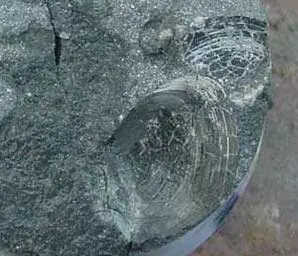
A geologist finds a rock with the clear shape of a snail shell inside it, but no shell material at all: just a hollow. What kind of fossil is it?
Pick an answer to see why.
Importance of fossils
a. The history of life. Fossils are the direct record of which living things lived when: the first cells, the first animals with shells, fish, the first land plants, the dinosaurs, our own ancestors. They are among the strongest evidence of evolution, showing how groups changed and which forms linked them, such as Archaeopteryx between reptiles and birds.
b. Dating and matching rocks. Index fossils give the relative age of a layer and match layers far apart: an ammonite species tells a geologist within a million years or so when its rock formed, anywhere in the world.
c. Past environments and climates. Corals tell of a warm, shallow, clear sea; fossil palm leaves of a warm climate; mammoths of cold. Sea fossils high on a mountain tell that the rock was once under the sea.
d. Moving continents. The same fossil plants and reptiles, such as the seed fern Glossopteris, are found in India, Africa, South America, Australia and Antarctica. They couldn’t have crossed oceans: the continents were once joined.
e. Resources. Coal is fossil plants; oil and gas formed from tiny plankton buried in mud. Limestone, used to make cement, is often made almost entirely of fossil shells. Index fossils guide the search for all of them.
f. Extinction and the future. Fossils show five great mass extinctions and how life recovered from each, a long view of how living things respond to rapid change, which today’s scientists use to understand our own effect on life.
Fossils found in Nepal and their significance
Nepal is rich in fossils, but they aren’t spread evenly: which fossils a belt holds depends on how its rocks were made. The Higher Himalaya’s rocks were cooked by heat and pressure so deeply that any fossils were destroyed, and much of the Lesser Himalaya’s too. The fossils lie in three places above all: the sea-floor rocks of the Tethys Himalaya in the north, the Siwalik (Chure) hills in the south, and the old lake beds of the Kathmandu Valley, as in Figure 15.5.
a. Sea fossils of the Tethys Himalaya
In the black shales of Mustang, along the Kali Gandaki around Jomsom and Muktinath, lie the ammonites of the shaligrams. Ammonites were mollusks, relatives of today’s squid and octopus, that lived in coiled, chambered shells and swam in every ocean from about 400 million years ago until they died out with the dinosaurs, 66 million years ago. The ones in the shaligrams are of the late Jurassic period, about 150 million years old. Their black shales formed as mud on the floor of the Tethys Sea; around many shells the mud hardened into round lumps much tougher than the shale, which is why they survive the river’s rolling. The same rocks across the Tethys Himalaya, in Manang, Dolpa and Mustang, hold other sea fossils: corals, brachiopods (two-shelled animals that aren’t clams), bivalves, sea lilies (crinoids) and tiny forams. At the very top of Sagarmatha (Mount Everest) is a limestone of the Ordovician period, about 450 million years old, with broken pieces of sea lilies and trilobites in it.
Significance: they show that the highest land on Earth was once the floor of a sea, the Tethys, that lay between India and Asia; they record how much the land has been lifted, thousands of meters; as index fossils they date the rocks of the Tethys Himalaya; and the shaligrams are worshipped as a form of Vishnu, which has made them known far beyond geology.
b. Vertebrate fossils of the Siwalik (Chure)
The Siwalik hills were built from the sand, gravel and mud that rivers carried out of the rising Himalaya, from about 13 million to about 1 million years ago. The rivers, swamps and forests along them were full of animals, and their bones and teeth were buried in the river sand. Teams of Nepali and foreign geologists have collected hundreds of them along the river sections of Dang and Deukhuri (the Tui Khola and the Surai Khola), the Tinau Khola near Butwal and the Rato Khola in Mahottari, among them:
- fish, crocodiles and gharials, and turtles, including a giant tortoise, Colossochelys atlas, with a shell nearly 2 m long;
- a hippopotamus (Hexaprotodon), pigs, deer, cattle and antelopes, and a short-necked relative of the giraffe;
- a three-toed horse (Hipparion) and rhinoceroses;
- elephants and their relatives: Stegodon, Elephas, and the strange Deinotherium, whose tusks curved down from its lower jaw;
- an ape: in the early 1980s, a team found a tooth of Sivapithecus in the Tinau Khola, in rock about 9 million years old. The first vertebrate fossils of Nepal’s Siwalik were reported from the Tui Khola, in Dang, in 1978.
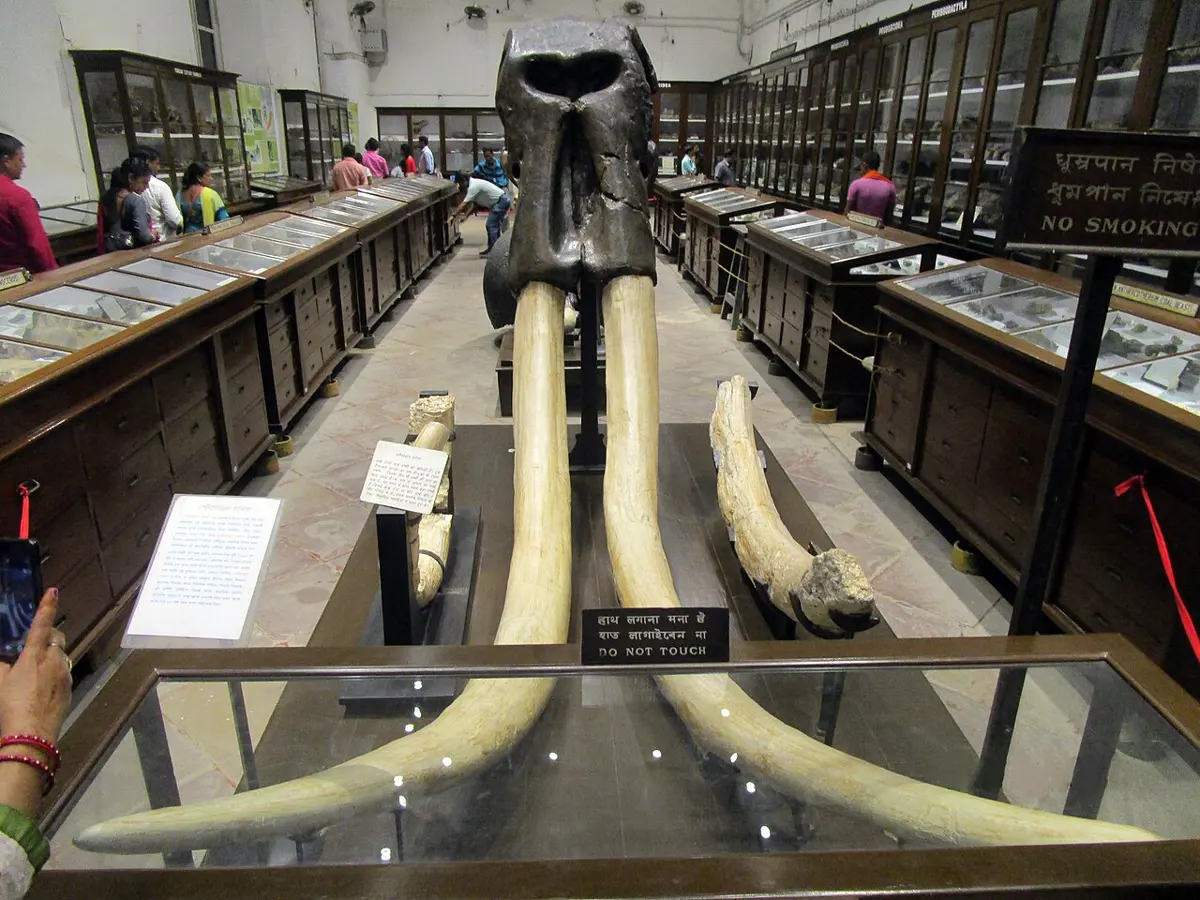
Significance: the animals show that a warm, wet land of rivers, swamps and forests lay at the foot of the young Himalaya; changes in the kinds of animals up the pile of rock (grazing animals replacing forest browsers) record the climate becoming drier and grasslands spreading; matched with the same fossils in the Siwaliks of India and Pakistan, they date the layers and so the rise of the mountains; and Sivapithecus is a link in the story of the great apes.
c. Fossils of the Kathmandu Valley
The Kathmandu Valley was a lake for much of the last few million years, and its oldest lake beds, the Lukundol Formation in the south of the valley, near Chapagaun, Lukundol and the Nakhu Khola, are a few million years old. In them geologists have found the lower jaw of a Stegodon (Stegodon ganesa, from the Nakhu Khola, described in 1973), many elephant teeth, and the remains of a hippopotamus, a crocodile, fish, deer, pigs and wild cattle. A tooth of an animal of the cattle family, reported in 2011, comes from Phaidhoka, east of Bhaktapur, on the way to Nala.
Significance: elephants, hippos and crocodiles live in warm places today. Their fossils in the valley show that its climate was then much warmer than now, with forests and a lake where Kathmandu, Lalitpur and Bhaktapur stand. The lake beds, dated by fossils, magnetism and radiocarbon, tell when the lake filled and drained.
d. Fossils of the Lesser Himalaya
The old rocks of the Lesser Himalaya, most of them more than 500 million years old and changed by heat and pressure, hold few fossils: mostly stromatolites, mounds built up in layers by blue-green bacteria in shallow seas, some of the oldest signs of life on Earth. Around Tansen in Palpa, younger rocks lie on top of them: the Gondwana rocks, about 300 million years old, with fossils of plants, and above them sea-shore rocks about 45 million years old that hold a crocodile’s tooth, the oldest backboned animal yet found in Nepal.
| Belt | Rocks | Fossils | Age | What they tell us |
|---|---|---|---|---|
| Tethys Himalaya | limestone, black shale | ammonites, brachiopods, corals, sea lilies, trilobites | about 450 to 66 million years | the Tethys Sea; the land lifted thousands of meters |
| Siwalik (Chure) | sandstone, mudstone | fish, crocodiles, turtles, hippos, elephants, horses, Sivapithecus | about 13 to 1 million years | rivers and forests at the foot of the young Himalaya; drying climate |
| Kathmandu Valley | lake clays and sands | Stegodon, elephants, hippo, crocodile, fish | a few million years | an old lake; a much warmer climate |
| Lesser Himalaya | old altered rocks; younger rocks at Tansen | stromatolites; Gondwana plants, a crocodile’s tooth | more than 500 million; about 300 and 45 million | early life; India once part of Gondwana |
Elephant and hippo fossils are found in the old lake beds of the Kathmandu Valley. What does this tell us?
Pick an answer to see why.
15.3 Carbon dating
Meaning of carbon dating
Carbon dating (or radiocarbon dating) is a way of finding how long ago a living thing died, from how much of the radioactive isotope carbon-14 is left in its remains. It works on anything that was once alive and still has some of its own carbon: wood and charcoal, bone, shell, hair, cloth, paper, seeds, peat.
It depends on three facts, shown in Figure 15.7.
Tree: W. Heubach (d. 1923) in O. Schmeil, Lehrbuch der Botanik (1911), No restrictions, via Wikimedia Commons
Katy Lawler, CC0, via PhyloPic
Cow skull: New International Encyclopedia (1905), public domain
a. Carbon-14 is made all the time in the air. Cosmic rays, very fast particles from space, smash into atoms high in the atmosphere and knock out neutrons. A neutron that hits a nitrogen-14 nucleus can turn it into carbon-14, giving out a proton:
The carbon-14 joins with oxygen to make carbon dioxide, which mixes through the whole atmosphere. For about every million million (10¹²) carbon atoms in the air, about one is carbon-14; the rest are the stable carbon-12 and carbon-13.
b. Every living thing takes it in. Plants take in carbon dioxide for photosynthesis, carbon-14 and all; animals eat plants, or animals that ate plants. So while it lives, every plant and animal keeps the same small share of carbon-14 as the air around it, topped up as fast as its carbon-14 decays.
c. At death, the topping up stops, and the clock starts. A dead plant or animal takes in no more carbon. Its carbon-14 decays by beta decay back into nitrogen-14, with a half-life of 5,730 years:
Its carbon-12 doesn’t change. So the share of carbon-14 in its carbon falls by half every 5,730 years. Measure that share, compare it with a living thing’s, and you know how long ago it died.
The amount left after a time follows the half-life rule of 15.1:
where is the carbon-14 the sample had when it died (the amount in the same mass of carbon from a living thing) and is what is left now. Laboratories measure it in one of two ways: by counting the beta particles the sample gives out each minute (its activity, which is in proportion to the carbon-14 left), or, since the 1980s, by counting the carbon-14 atoms themselves in a machine called an accelerator mass spectrometer, which needs only a few milligrams of carbon.
| Time since death | Half-lives | Carbon-14 left |
|---|---|---|
| 0 | 0 | 100% |
| 5,730 years | 1 | 50% |
| 11,460 years | 2 | 25% |
| 17,190 years | 3 | 12.5% |
| 22,920 years | 4 | 6.25% |
| 28,650 years | 5 | 3.1% |
| 51,570 years | 9 | 0.2% |
Reading the clock backwards
The CarbonClock above goes forwards: from an age to the share left. A laboratory works the other way: it measures the share left, and must find the age. The widget below gives you five real kinds of sample and the share of carbon-14 a laboratory would find in each. Move the age until the share matches.
Importance of carbon dating
a. Archaeology and history. Radiocarbon dates have put years on the human past all over the world. At Lumbini, charcoal and sand under the brick temples of the Maya Devi Temple, dated by radiocarbon and by another method, showed in 2013 that the first shrine there was a wooden one built in about the sixth century BC: the oldest Buddhist shrine yet found. In the caves of Mustang, radiocarbon dates show people were burying their dead in rock-cut caves from nearly 3,000 years ago; the remains in a cave at Samdzong are of the third to eighth centuries AD.
b. Earthquakes and landslides. As in 15.1, charcoal in the layers broken by a fault dates the earthquakes that broke them; wood buried by an old landslide or glacial-lake flood dates it, and tells how often such disasters come.
c. The last Ice Age and past climates. Wood, peat, shells and pollen in lake mud and glacier moraines show when the glaciers advanced and melted, and how climate changed, over the last 50,000 years.
d. Checking what is genuine. Dating can show whether an old-looking manuscript, painting on cloth or piece of wood is as old as claimed.
e. The life sciences. Nuclear bomb tests in 1950–1963 almost doubled the carbon-14 in the air, and it has been falling since. Measuring this “bomb carbon” in the body has shown how fast human cells are replaced, and in ivory, whether it came from an elephant killed before or after the ivory trade was banned.
Limits of carbon dating
a. Only once-living things. Rocks, metal and stone tools have no carbon from a living thing, so they can’t be carbon-dated. (A stone tool is dated by the charcoal or bone found with it.)
b. Only up to about 50,000 years. After about nine half-lives, less than 0.2% of the carbon-14 is left: too little to measure reliably, and the tiniest trace of modern carbon would spoil the result.
c. The air’s carbon-14 hasn’t been perfectly steady. The cosmic rays reaching the Earth have varied, and so has the share of carbon-14 in the air. Laboratories correct for this with a calibration curve, built from the radiocarbon ages of tree rings, corals and lake layers whose ages are known by counting. Burning coal and oil (which have no carbon-14) since about 1850, and the bomb tests since 1950, have changed the air again.
d. Contamination. Roots, groundwater and handling can add younger carbon; samples are carefully cleaned before they are measured.
Which of these could be dated by carbon-14?
Pick an answer to see why.
15.4 Planetarium
Meaning of a planetarium
A planetarium is a theater with a dome-shaped ceiling on which a projector shows the night sky: the stars, the Moon, the planets, the Milky Way, and their motions. The audience sits or lies back under the dome, and when the lights go down it seems to be under a real night sky. The word is also used for the projector itself, and for any machine or program that shows the sky and the movements of the bodies in it.
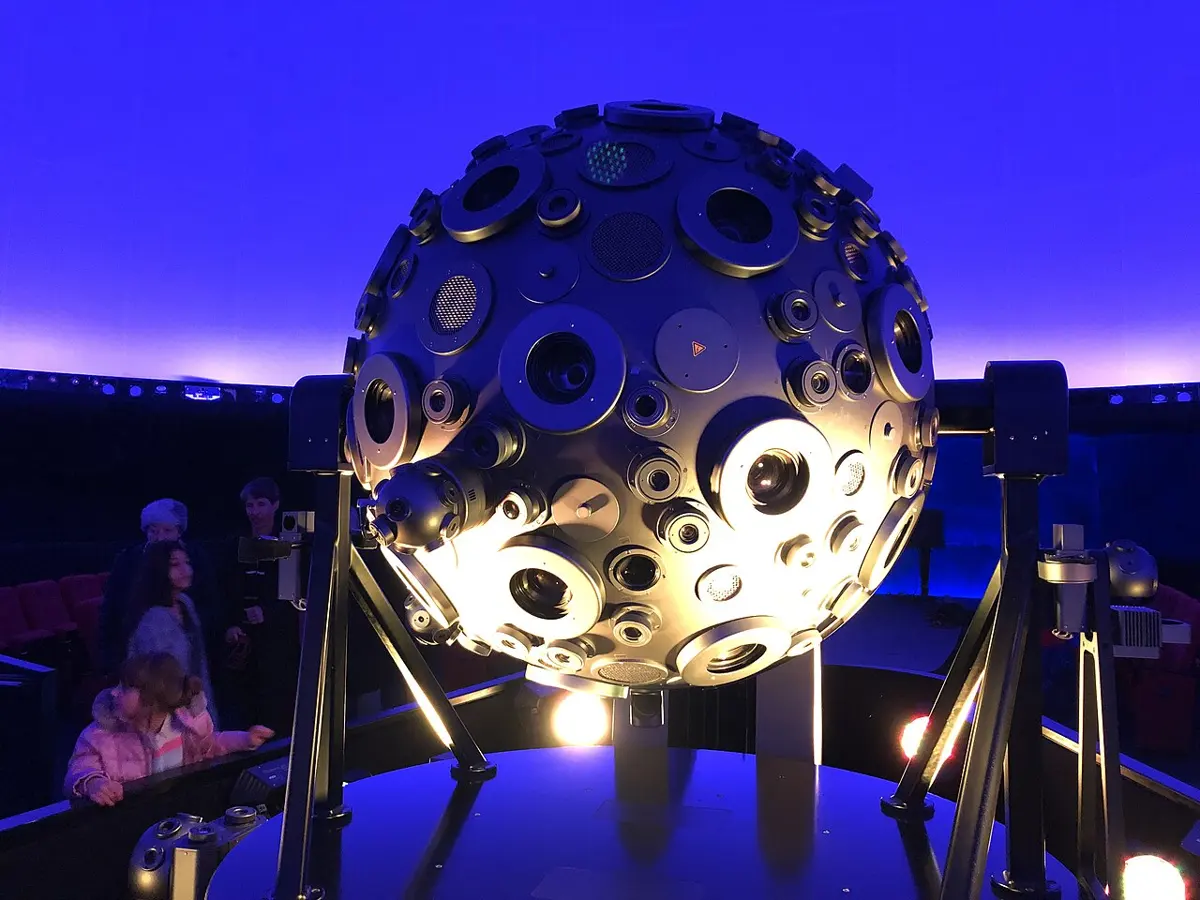
A traditional (optical) projector is a hollow ball, the star ball, with a bright lamp inside and thousands of tiny holes, one for each star; each hole lets out a thin beam that makes a sharp point of light on the dome. The brightest stars get small lenses of their own. Turning the ball turns the sky: once round for a day and a night, tipped to show the sky from another latitude. Separate small projectors on the frame show the Sun, the Moon and each planet, geared to move among the stars as they really do. Since the 1980s, more and more planetariums are digital: a computer draws the sky and one or more projectors with very wide lenses spread it over the whole dome, so the audience can also leave the Earth, fly to the planets, or out of the Milky Way. Domes range from about 3 m across, in portable inflatable ones that schools can borrow, to about 37 m, in St. Petersburg, Russia.
Uses of a planetarium
a. The sky at any time, in any weather. The real night sky needs a clear, dark night, which the monsoon, city lights and school hours rarely allow. A planetarium shows the stars in the daytime, in the rain, in the middle of a city.
b. Time made fast or slow. A whole night’s turning of the sky can be shown in a minute, so you can see the stars rise in the east and set in the west, and the stars near the pole star circle it. A year can pass in a few minutes, showing why the sky changes with the seasons, and why Mars sometimes seems to move backwards among the stars.
c. The sky from any place and any time. The same projector shows the sky from the North Pole, from the equator, or from Australia, where the Saptarishi can’t be seen; the sky over Lumbini when the Buddha was born; the sky of a future eclipse; or the slow drift of the pole, by which, thousands of years from now, Vega will be near the north celestial pole.
d. Teaching the sky. Teachers use it to show the constellations, the phases of the Moon, eclipses, the planets’ movements, how to find directions by the stars, and how the sky’s movements give us days, months, years and seasons.
e. Training. Sailors and pilots once learned to find their way by the stars in planetariums, and so did astronauts: those of NASA’s Mercury, Gemini and Apollo flights practiced picking out the navigation stars in a planetarium in North Carolina, in case they had to steer by them.
f. Exploring space. A digital planetarium can take the audience to the surface of Mars, through the rings of Saturn, or out to see the shape of the Milky Way, built from real data from spacecraft and telescopes.
g. Wonder, and science for everyone. Above all, planetariums bring astronomy to the public: school groups, families and visitors who would never look through a telescope come out asking questions.
Planetariums in Nepal, and on your screen
The government’s B.P. Koirala Memorial Planetarium, Observatory and Science Museum Development Board, in Kirtipur, Kathmandu, was set up to bring astronomy to the public. Its science museum opened in 2019, and a full-size planetarium theater is planned (as of 2026). Meanwhile, portable inflatable planetariums travel to schools, like the Kantipur Planetarium in Grade 8 Science: Galaxies.
And you can open a planetarium on any phone or computer. The site’s own Night Sky is one: it shows the sky above you tonight, or at any date and time you set, with the real horizon of a rooftop in Bhaktapur around you. Speed time up and watch the stars turn; jump to the sky of 500 BC. The Digital Telescope shows the same sky as it looks in radio waves, infrared, X-rays and gamma rays, with the great space telescopes’ photographs of each place.
Which of these can a planetarium do that the real night sky can’t?
Pick an answer to see why.
15.5 Chronology of space exploration
Space exploration is the study of space and the bodies in it by going there: by telescopes above the air, by robotic spacecraft, and by people. Space is usually taken to begin about 100 km above the ground, where the air is so thin that wings can’t hold anything up. To get there and stay, a craft needs a rocket, which pushes on nothing but its own exhaust (Newton’s third law), and enough speed: about 7.7 km/s sideways to circle the Earth a few hundred kilometers up, and 11.2 km/s, the escape velocity of Unit 11, to leave the Earth for good: Escape velocity.
Before the space age
For most of history, the sky could only be explored by eye, then by telescope, from 1609. The tool to leave the Earth came slowly. Gunpowder rockets were used in China by the 13th century, and the iron-cased rockets of Hyder Ali and Tipu Sultan of Mysore, in the 1780s, flew about 2 km. In 1903 the Russian schoolteacher Konstantin Tsiolkovsky worked out the rocket equation, which shows how a rocket’s final speed depends on its exhaust speed and how much of it is fuel, and argued that rockets burning liquid hydrogen and oxygen, built in stages, could reach space. In 1926 the American Robert Goddard launched the first liquid-fuel rocket; it flew for 2.5 seconds. The first object to reach space was a German V-2 war rocket, which rose about 175 km on 20 June 1944. After the war, the engineers who had built it worked for the United States and the Soviet Union, and the race to space began.
The space age, in order
Figure 15.10 shows the milestones; the story is in four stages.
a. The space race (1957–1975)
The Soviet Union (USSR) and the United States raced each other into space, each wanting to show what its science and its rockets could do.
- 4 October 1957: the USSR launched Sputnik 1, the first artificial satellite, a metal ball 58 cm across that circled the Earth every 96 minutes, beeping. The space age had begun.
- 3 November 1957: Sputnik 2 carried the first animal into orbit, the dog Laika. She didn’t survive the flight.
- 1 February 1958: Explorer 1, the first US satellite, discovered belts of fast charged particles trapped by the Earth’s magnetic field, the Van Allen belts. NASA was set up the same year.
- 1959: the USSR’s Luna 2 became the first craft to reach another world, crashing on the Moon, and Luna 3 photographed the Moon’s far side, which no one had ever seen.
- 12 April 1961: Yuri Gagarin (USSR) became the first person in space, circling the Earth once in Vostok 1, in 108 minutes.
- 16 June 1963: Valentina Tereshkova (USSR) became the first woman in space.
- 18 March 1965: Alexei Leonov (USSR) made the first spacewalk, floating outside his craft for 12 minutes.
- 3 February 1966: the USSR’s Luna 9 made the first soft landing on the Moon and sent back pictures from its surface.
- 24 December 1968: the crew of the US Apollo 8 became the first people to go round the Moon, and photographed the Earth rising over it.
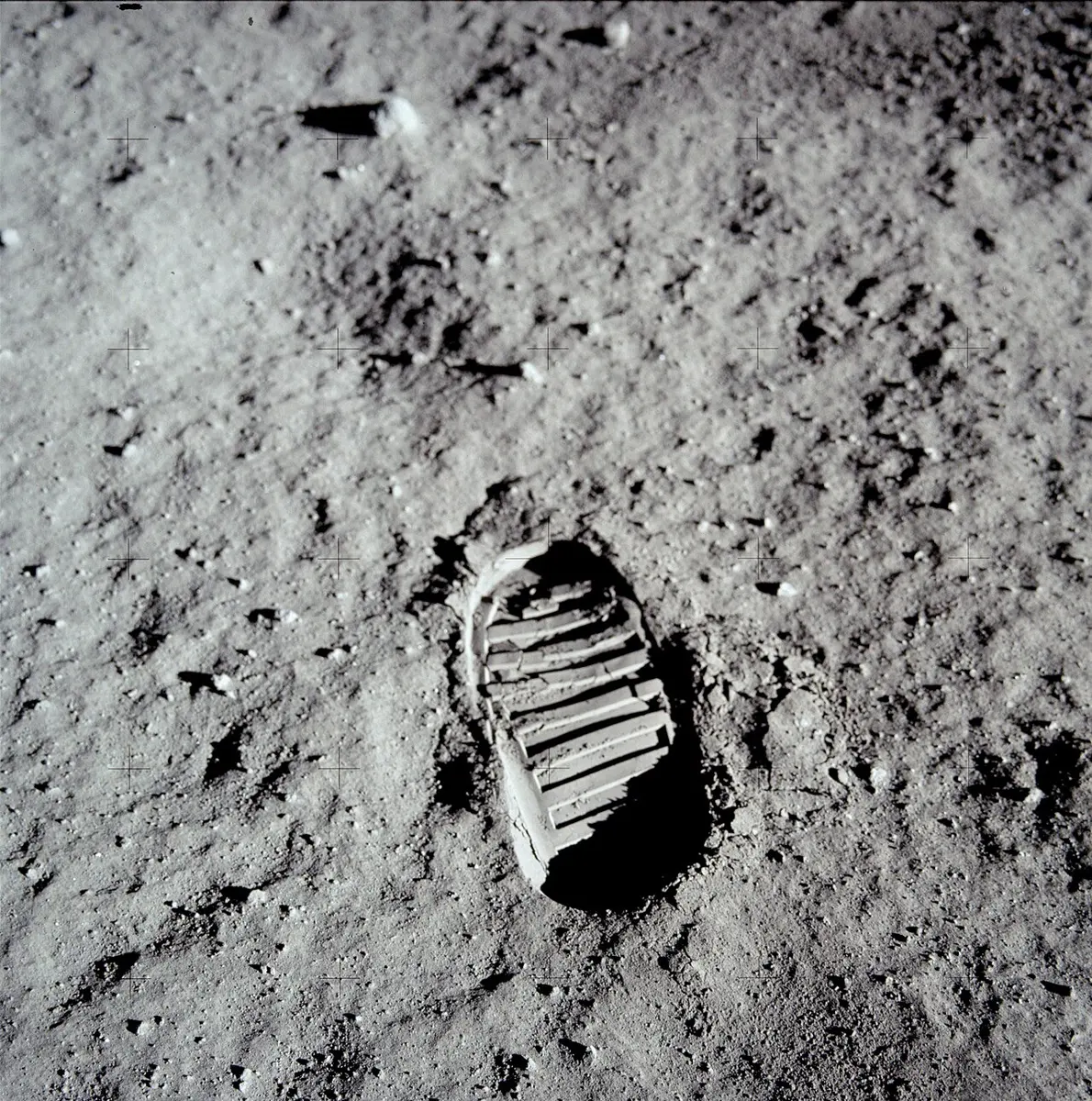
- 20 July 1969: Neil Armstrong and Buzz Aldrin of the US Apollo 11 became the first people to walk on the Moon, while Michael Collins circled above. Twelve people walked on the Moon between 1969 and 1972.
- 15 December 1970: the USSR’s Venera 7 landed on Venus, the first craft to land on another planet and send back data.
- 19 April 1971: the USSR launched Salyut 1, the first space station.
- July 1975: an American Apollo and a Soviet Soyuz craft docked in orbit and their crews shook hands, the end of the race.
b. Robots to the planets (from the 1970s)
- 1972–1973: the US Pioneer 10 was the first craft to cross the asteroid belt and to fly past Jupiter.
- 20 July 1976: the US Viking 1 made the first successful landing on Mars, and worked there for over six years.
- 1977: the US Voyager 1 and Voyager 2 set out; between them they flew past Jupiter, Saturn, Uranus and Neptune. In 2012 Voyager 1 became the first human-made object to leave the Sun’s bubble of solar wind and enter interstellar space.
- 4 July 1997: the US Mars Pathfinder landed, and its small rover Sojourner became the first to drive on Mars.
- 2015: the US New Horizons flew past Pluto and showed its mountains of ice.
c. Shuttles, stations and telescopes (from 1981)
- 12 April 1981: the first flight of the US Space Shuttle, a spacecraft that landed on a runway like a plane and flew again (135 flights until 2011).
- 1986: the USSR began building the space station Mir, which people lived in for years at a time.
- 24 April 1990: the Hubble Space Telescope was launched, above the blurring air; its photographs have shown the universe more sharply than any telescope on the ground, and helped measure its age.
- 2 November 2000: the first crew moved into the International Space Station (ISS), built by the United States, Russia, Europe, Japan and Canada. People have lived in space every day since.
d. Many nations, and Nepal (from 2003)
- 15 October 2003: China’s Shenzhou 5 carried Yang Liwei into orbit, making China the third country to send people into space by itself.
- 2008: India’s first Moon probe, Chandrayaan-1, found that water molecules are spread through the Moon’s soil.
- 24 September 2014: India’s Mangalyaan reached Mars orbit, the first Asian craft to do so, at its first attempt.
- 21 December 2015: a SpaceX Falcon 9 rocket’s first stage flew back and landed upright, so it could fly again. Reusable rockets have since made launches much cheaper.
- 3 January 2019: China’s Chang’e 4 made the first landing on the Moon’s far side.
- 2019: NepaliSat-1, Nepal’s first satellite, a cube 10 cm on each side built by two young Nepali engineers, Abhas Maskey and Hariram Shrestha, was launched in April and set loose from the ISS in June. It took photographs of Nepal from orbit.
- 2021: NASA’s Perseverance rover landed on Mars, and its small helicopter Ingenuity made the first powered flight on another planet. On 25 December the James Webb Space Telescope was launched; its first pictures, in July 2022, showed galaxies from the universe’s first few hundred million years.
- 26 September 2022: NASA’s DART crashed into a small asteroid moon on purpose and changed its orbit: the first test of protecting the Earth from an asteroid.
- 23 August 2023: India’s Chandrayaan-3 landed near the Moon’s south pole, making India the fourth country to land on the Moon.
- 2024: China’s Chang’e 6 brought back the first rock and soil from the Moon’s far side.
- April 2026: four astronauts of NASA’s Artemis II flew around the Moon, the first people to go there since 1972 (as of 2026).
Every milestone above, with its picture, is in the site’s Science timeline and, for the rockets, the Inventions timeline. To see where the International Space Station is right now, and when it next passes over Kathmandu, open Where Is the Space Station?; NASA’s own simulations of its spacecraft are on Explore with NASA.
Why explore space?
a. Knowledge. Space probes and telescopes have shown how the Solar System formed, what the planets are made of, how stars live and die, and how old the universe is.
b. Everyday services. Satellites give weather forecasts and warnings of storms and floods, telephone and television links, GPS positions for maps and phones, and pictures that track forests, glaciers, crops and disasters, in Nepal as everywhere.
c. Protecting the Earth. Satellites watch the climate, the ozone layer and the ice; DART tested how to turn aside a dangerous asteroid.
d. New technology. Work for space has given the world better solar cells, water filters, medical scanners, light strong materials and much of modern electronics.
e. Cooperation and inspiration. The International Space Station was built by countries that were once rivals. And a small satellite built by two Nepali engineers showed every student in Nepal that space is not only for other countries.
Which of these came first?
Pick an answer to see why.
Exercise
1. Choose the correct option
a. The study of the ages of rocks and of the events of the Earth’s history is called:
Pick an answer to see why.
b. In a pile of undisturbed sedimentary layers, the oldest layer is:
Pick an answer to see why.
c. Which of these is a trace fossil?
Pick an answer to see why.
d. Shaligrams found in the Kali Gandaki contain fossils of:
Pick an answer to see why.
e. Carbon-14 is formed in the atmosphere when neutrons from cosmic rays strike:
Pick an answer to see why.
f. The half-life of carbon-14 is about:
Pick an answer to see why.
g. The first artificial satellite, Sputnik 1, was launched in:
Pick an answer to see why.
h. The first person to walk on the Moon was:
Pick an answer to see why.
2. Give reasons
Most fossils are found in sedimentary rocks, not in igneous rocks.
Hint
Answer
Fossils of sea animals are found in the mountains of Mustang.
Hint
Answer
Ammonites are good index fossils.
Hint
Answer
Carbon dating can’t be used for objects older than about 50,000 years.
Hint
Answer
A planetarium is useful for teaching astronomy in Nepal’s cities.
Hint
Answer
3. Differentiate between
Relative dating and absolute dating
Hint
Answer
Mold and cast
Hint
Answer
Body fossil and trace fossil
Hint
Answer
Planetarium and observatory
Hint
Answer
4. Answer the following questions
What is geochronology? Write any four of its importances.
Hint
Answer
What is a fossil? Describe how a fossil is formed.
Hint
Answer
Describe the kinds of fossils with an example of each.
Hint
Answer
Name the main kinds of fossils found in Nepal, where they are found, and their significance.
Hint
Answer
What is carbon dating? How does it work, and what are its limits?
Hint
Answer
What is a planetarium? Write its uses.
Hint
Answer
Write a short chronology of space exploration, with at least eight milestones.
Hint
Answer
Higher ability: A geologist finds, in a Siwalik river bank, a layer of sandstone with a hippo’s tooth in it, and a few meters above it a layer of volcanic ash. Someone suggests carbon-dating the tooth. Explain why that won’t work, and suggest how the age of the tooth could be found.
Hint
Answer
5. Numerical problems
A radioactive substance has a half-life of 10 days. What fraction of it is left after 40 days?
Hint
Answer
The carbon-14 in a bone from a cave is one-sixteenth of that in a living animal’s bone. Find the age of the bone.
Hint
Answer
Carbon from a living plant gives 16 counts per minute per gram. A sample of old cloth gives 2 counts per minute per gram. Find the age of the cloth.
Hint
Answer
What percentage of its carbon-14 does a piece of bone keep after 28,650 years? After how many years would only about 0.2% be left?
Hint
Answer
A rock is 4,470 million years old. What fraction of the uranium-238 it had when it formed is left? (Half-life of uranium-238: 4,470 million years.) What fraction has turned into lead-206, and how many lead-206 atoms are there for each uranium-238 atom?
Hint
Answer
The Phanerozoic eon began about 539 million years ago, and the Earth is about 4,540 million years old. What percentage of the Earth’s history is the Phanerozoic? If all of the Earth’s history were squeezed into one 24-hour day, how many minutes before midnight would the Phanerozoic begin?
Hint
Answer
A lake lays down one pair of layers (one pale, one dark) every year. A core of its mud 3.6 m long contains pairs of layers each about 1.2 mm thick. About how many years does the core cover?
Hint
Answer
NepaliSat-1 circled the Earth about 400 km up, once every 92 minutes. About how many times did it go round the Earth in one day?
Hint
Answer
Printable PDFs
- The unit as a book (A5) 36 pages Answers as an A4 booklet, 9 sheets
- Study notes 3 pages
- Worksheet 5 pages Answer key
- Harder practice questions 2 pages Answer key
Practice every question in the book, and keep track of the ones you miss →
Found a mistake? Please tell us.