
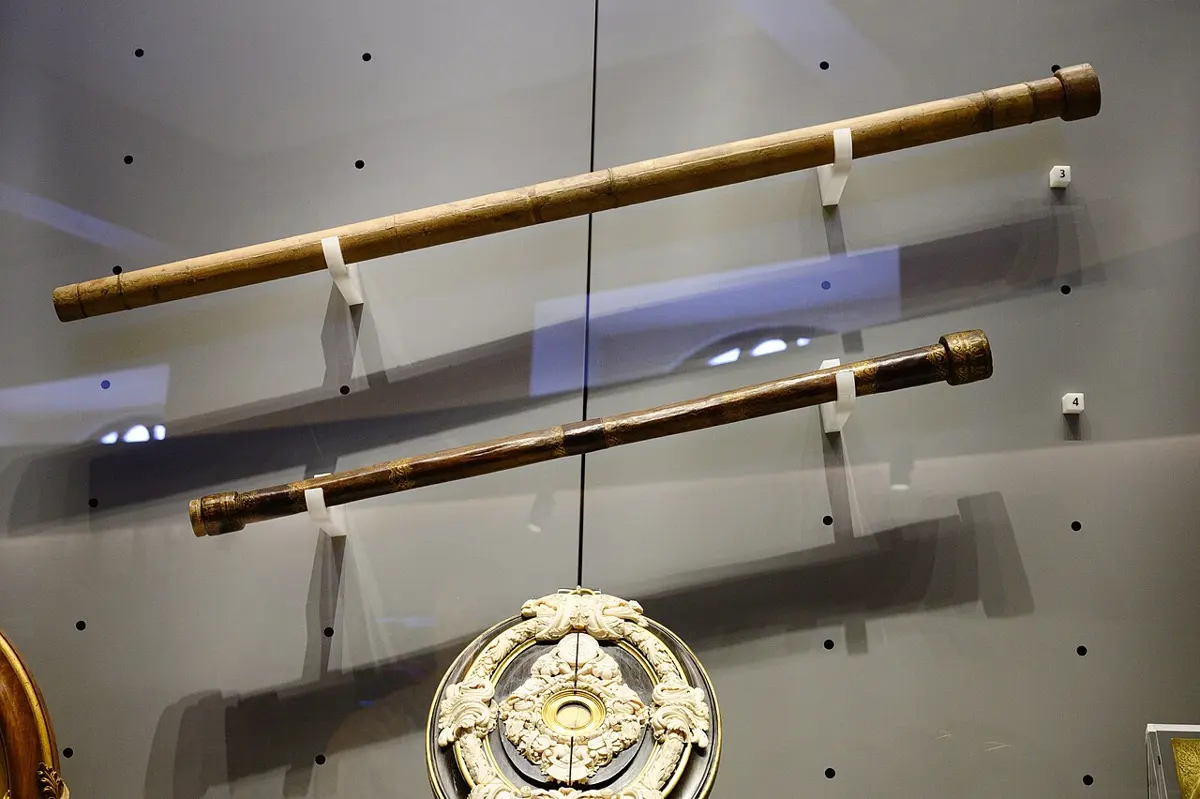
On the night of 7 January 1610, in Padua, Galileo Galilei pointed a tube about a meter long, with a piece of curved glass at each end, at the planet Jupiter. Beside it he saw three small “stars” in a straight line. The next night they had moved. Within a week he had found a fourth, and understood that they were going round Jupiter: moons, the first things ever seen to go round something other than the Earth. Half a century later, in London, Robert Hooke put a thin slice of cork under another tube of lenses and saw it was made of tiny boxes. He called them cells, the word every biology book has used since.
Both tubes worked on the same idea: two lenses, one after the other, each doing part of the work. This unit is about lenses with numbers: how far away an image forms, how big it is, how strong a lens is, and how two lenses in a tube become a compound microscope or an astronomical telescope.
13.1 Lens
A lens is a piece of transparent material, usually glass or plastic, with two surfaces, at least one of them curved (part of a sphere). Light passing through it is refracted at both surfaces, and because the surfaces are curved, different parts of a beam are bent by different amounts: the rays come together, or spread apart.
Types of lens
Lenses are of two kinds, told apart by their middle.
- A convex lens is thicker in the middle than at its edges. A convex lens of glass in air bends parallel rays together, to meet at a point, so it is also called a converging lens.
- A concave lens is thinner in the middle than at its edges. It bends parallel rays apart, so that they seem to spread from a point, and is also called a diverging lens.
Each kind comes in three shapes, named by its two faces (Figure 13.2). The face named first is the one with the weaker curve; “plano” means flat.
| Convex (converging) lenses | Concave (diverging) lenses |
|---|---|
| Biconvex: both faces bulge outwards. A hand lens. | Biconcave: both faces curve inwards. |
| Plano-convex: one face flat, one bulging. The condenser of a projector or a microscope. | Plano-concave: one face flat, one curving inwards. |
| Concavo-convex (a converging meniscus): curved like a crescent, the outer face more curved. Spectacles for long sight. | Convexo-concave (a diverging meniscus): crescent-shaped, the inner face more curved. Spectacles for short sight. |
Spectacle lenses are nearly always crescent-shaped (menisci), curved the same way as the eye, so that the view stays clear when the eye turns to look through the side of the lens.
The words used with lenses
Grade 10 Science explains these with drawings; here they are in one place, since every formula below uses them.
- The optical center (O) is the middle point of the lens. A ray through it goes straight on.
- The principal axis is the line through the optical center and the centers of curvature of the two faces.
- The principal focus (F) of a convex lens is the point on the axis where rays coming in parallel to the axis meet after the lens. For a concave lens, it is the point from which they seem to spread after the lens. A lens has a focus on each side, F₁ on the side the light comes from and F₂ on the other, at equal distances.
- The focal length (f) is the distance from the optical center to the principal focus.
- A real image is formed where rays really meet; it can be caught on a screen. A virtual image is where rays only seem to come from; it can only be seen by looking into the lens.
The three rays used to find an image are: a ray parallel to the axis, which passes through F₂ after a convex lens (or seems to come from F₁ after a concave lens); a ray through the optical center, which goes straight on; and a ray through F₁ (for a concave lens, heading for F₂), which leaves parallel to the axis. Any two of them find the image.
A lens is thinner at its middle than at its edges, with one face flat. What is it?
Pick an answer to see why.
Power of a lens
A thick, strongly curved convex lens brings parallel light to a focus close to itself; a thin, gently curved one focuses it far away. The shorter the focal length, the more strongly the lens bends light. This bending ability is measured by the lens’s power.
The power of a lens is the reciprocal of its focal length, measured in meters:
Its SI unit is the diopter (D): a lens of focal length 1 m has a power of 1 D. A convex lens has a positive focal length and a positive power; a concave lens has a negative focal length and a negative power. That is why an eye doctor’s prescription reads like “+2.5 D” (a converging lens, for long sight) or “−1.75 D” (a diverging lens, for short sight).
Lenses in contact
Put two thin lenses together, touching, and they act as one lens whose power is the sum of their powers:
This is why an optician testing your eyes slips one trial lens in front of another until you can read the chart: +1.00 D and +0.50 D together are +1.50 D. The eye works much the same way: the cornea (about +43 D) and the eye lens (about +20 D when relaxed) together give about +60 D (a little less than their sum, because they are a few millimeters apart, not touching), strong enough to focus light on the retina about 2 cm behind them.
Which lens bends light most strongly?
Pick an answer to see why.
Magnification
Look at a word through a hand lens held close to the page and it looks bigger; hold the lens at arm’s length to look at a window across the room, and the window’s image is small and upside down. How much bigger or smaller an image is than its object is given by the magnification.
The magnification (m) produced by a lens is the ratio of the height of the image to the height of the object:
It has no unit. An image with m = 3 is three times as tall as the object; m = 1, the same size; m = 0.5, half as tall.
Look again at Figure 13.3 below. The ray through the optical center goes straight, so the object and the image stand at the ends of two similar triangles that meet at O. Their heights are in the same ratio as their distances from the lens:
where u is the object’s distance from the lens and v the image’s. So the image is as many times bigger than the object as it is farther from the lens. Once v has a sign (in the lens formula, below), so does m: it comes out positive for a real, inverted image and negative for a virtual, upright one, and its size says how many times taller the image is.
The lens formula
Where will the image form? Ray diagrams answer this on paper. One short formula answers it with a calculator, for every position of the object and both kinds of lens.
The sign convention. In the formula, distances are measured from the optical center, and given a sign:
- the distances of real objects and real images are taken as positive;
- the distances of virtual images are taken as negative;
- the focal length of a convex lens is positive, and of a concave lens negative.
This is the “real is positive” convention, the one Nepal’s Grade 11 Physics book uses, and this series too.
The formula. The object distance u, the image distance v and the focal length f of a thin lens are related by the lens formula:
Where it comes from. In Figure 13.3, the object AB stands at a distance u = OA from a convex lens of focal length f = OF, and its real image A′B′ forms at v = OA′.
- Triangles ABO and A′B′O (blue) are similar: their angles at O are vertically opposite, and both have a right angle on the axis. So .
- Triangles OQF and A′B′F (amber) are similar too: their angles at F are vertically opposite, and both have a right angle on the axis. So .
- The ray from B reaches the lens parallel to the axis, so OQ = AB. The two left-hand sides are equal, so the right-hand sides are too:
Dividing every term by uvf:
The same formula, with the signs above, holds for virtual images and for concave lenses as well.
Reading the answer. Work out , then:
- v positive: a real image on the far side of the lens, inverted, which can be caught on a screen;
- v negative: a virtual image on the same side as the object, upright, seen only by looking through the lens;
- (the object exactly at F): the rays leave parallel, and the image is at infinity.
Then carries the same sign as v: positive for a real, inverted image, negative for a virtual, upright one.
Worked examples
Using , a student finds = −12 cm for a convex lens. What does the minus sign tell her?
Pick an answer to see why.
Where lenses are used
- Spectacles and contact lenses: concave lenses (negative power) for short sight, convex lenses (positive power) for long sight and for reading in old age (see Grade 10 Science, Defects of vision).
- Magnifying glasses, used by watchmakers, jewelers and anyone reading small print.
- Cameras and phone cameras, whose lenses form real, diminished images on the sensor; projectors, which form real, magnified images on a screen.
- Microscopes and telescopes, below; binoculars, which are two telescopes side by side with prisms inside to turn the image the right way up.
- Peepholes in doors (a concave lens gives a small, upright, wide view of the doorstep), and the condenser lenses of projectors and microscopes.
13.2 Optical instruments
An optical instrument is a device of lenses (or mirrors) that helps the eye see what it can’t see well on its own: things too small, or too far away. Two are named in the course: the compound microscope and the astronomical telescope. Both are built from two convex lenses, and in both the lens at the eye, the eyepiece, is used as a magnifying glass. So that is where to start.
What a magnifying glass does
To see the details of something small, you bring it close to your eye, because nearer things look bigger. But the eye can’t focus on anything closer than about 25 cm (the least distance of distinct vision, D, for a young adult; see Grade 10 Science, Far point and near point). Nearer than that, the object only gets blurred.
A convex lens held close to the eye solves this. With the object just inside its focus, it forms a virtual, upright, magnified image farther away, which the eye can focus on comfortably, as in the stamp example above. Used like this, a convex lens is called a magnifying glass or simple microscope. With the image formed at 25 cm, it makes the object look
times as large as it looks to the eye alone at 25 cm (with the eye close to the lens). A hand lens of focal length 5 cm gives times. With the object exactly at the focus, the image is at infinity, the eye looks at it relaxed, and the lens magnifies a little less, times: 5 times for this lens. The numbers marked on microscope eyepieces are worked out this way: a 10× eyepiece has f = 2.5 cm. To magnify more, the lens must have a shorter focal length, and so be smaller and more strongly curved. A single lens of focal length 1 cm would magnify 26 times, but it would be a tiny bead, hard to look through. Two lenses in a tube do far better.
Compound microscope
Function. A compound microscope is an optical instrument used to see very small objects, such as cells, bacteria and the parts of a leaf, magnified many times, by means of two convex lenses: one forms a real, magnified image of the object, and the other magnifies that image again.
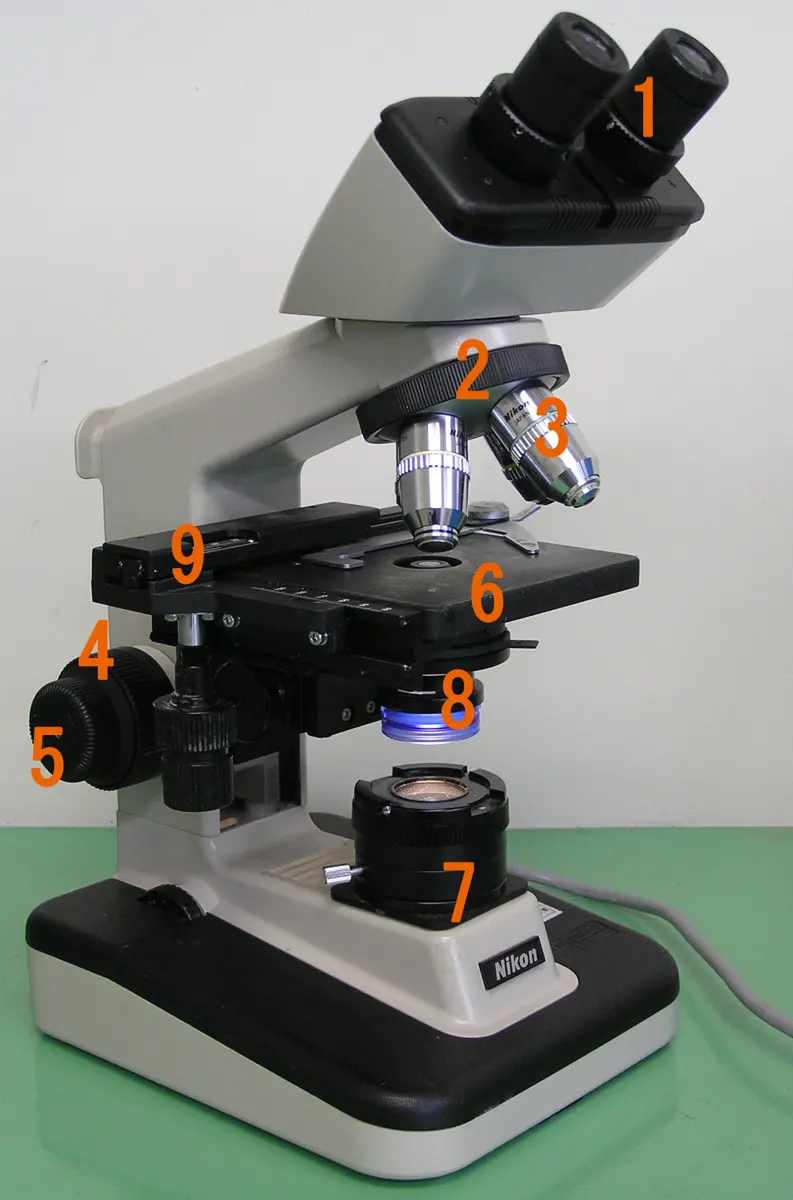
Basic structure. A compound microscope has:
- the objective lens, a convex lens of very short focal length (a few millimeters) and small size, close to the object. Most microscopes have three or four objectives (often marked 4×, 10×, 40× and 100×) on a turning nosepiece, to change the magnification;
- the eyepiece (or ocular), a convex lens of short focal length (a few centimeters, but longer than the objective’s), and larger, at the top of the tube, where you put your eye. A common one is marked 10×;
- the body tube, a metal tube that holds the two lenses at a fixed distance apart (about 16 cm in many school microscopes);
- the stage, a flat plate with a hole in the middle and clips, on which the slide with the object rests;
- a mirror or a lamp, with a condenser lens, below the stage, which sends light up through the object (most specimens are thin and lit from below);
- the coarse and fine adjustment knobs, which move the tube (or the stage) up and down to bring the image into focus;
- the arm and the heavy base, which hold it all steady.
How it forms an image. The object is placed just beyond the focus of the objective. The objective therefore forms a real, inverted and magnified image of it inside the tube (the case of an object between F and 2F). This first image falls just inside the focus of the eyepiece. The eyepiece then acts as a magnifying glass on it, forming a virtual, magnified final image, usually at the least distance of distinct vision, 25 cm from the eye, or for relaxed viewing, very far away. The final image is inverted compared with the object: move a slide to the left and its image moves to the right.
Magnifying power. Each lens magnifies in turn, so the whole microscope magnifies by the product (for instruments, magnifications are given as plain sizes, without signs):
where is the magnification by the objective, and the magnification by the eyepiece, which is when the final image is at the least distance of distinct vision. That is why the magnification of a school microscope is found by multiplying the numbers on its lenses: a 10× eyepiece with a 40× objective magnifies 400 times. (Strictly, what a microscope or a telescope increases is the angle the object fills at the eye, and its magnifying power is the ratio of two angles; for a microscope with its image at 25 cm, it works out to the same number, .)
In a compound microscope, where is the object placed?
Pick an answer to see why.
Astronomical telescope
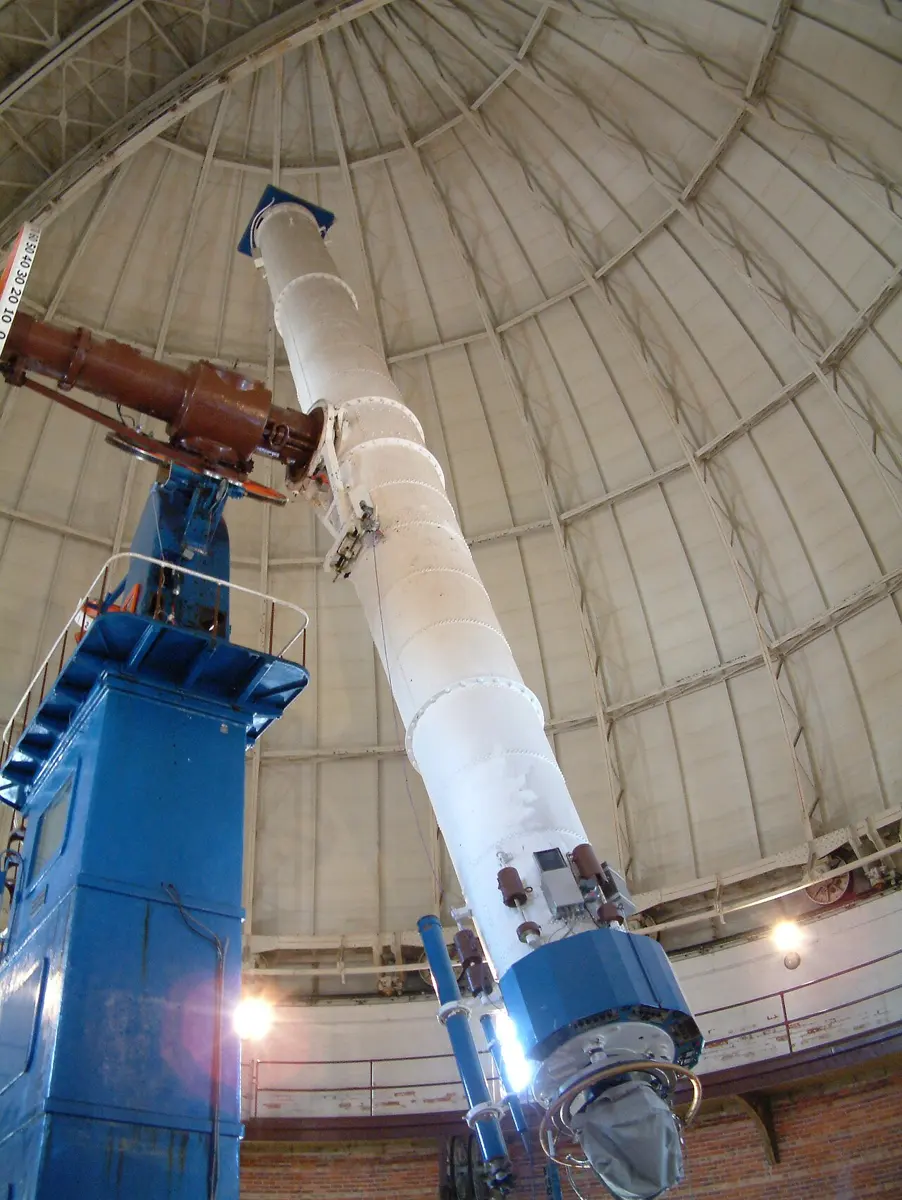
Function. An astronomical telescope is an optical instrument used to see distant objects, such as the Moon, planets and stars, magnified and in more detail, by means of two convex lenses: the objective forms a real image of the distant object, and the eyepiece magnifies that image.
A distant object can’t be brought closer, so a telescope makes it look bigger in another way: it increases the angle the object fills at the eye. The Moon fills an angle of only about half a degree in the sky; through a telescope that magnifies 50 times, it fills 25 degrees, and its craters can be seen.
Basic structure. An astronomical telescope has:
- the objective lens, a convex lens of long focal length and large size, facing the object. Its large size collects more light, so fainter things can be seen, and shows finer detail;
- the eyepiece, a convex lens of short focal length and small size, near the eye;
- the tube, which holds them on the same axis, usually made of two parts, one sliding inside the other, so that the distance between the lenses can be changed to focus.
How it forms an image. Light from a distant object arrives as parallel rays. The objective brings them together in its focal plane, forming a real, inverted and much diminished image of the object at its focus. The tube is adjusted so that this first image lies at the focus of the eyepiece (in normal adjustment). The eyepiece then acts as a magnifying glass: rays from each point of the first image leave it parallel again, so the eye sees a final image at infinity and can view it relaxed, as it looks at the sky. The final image is inverted compared with the object, and filling a much larger angle at the eye.
Magnifying power and length. In normal adjustment, the first image sits at both foci, so the distance between the lenses (the length of the telescope) is the sum of their focal lengths, and the magnifying power is the ratio of their focal lengths:
A long-focus objective and a short-focus eyepiece give a large magnification, which is why astronomical telescopes are long. To magnify more, put in an eyepiece of shorter focal length.
| Compound microscope | Astronomical telescope |
|---|---|
| Used to see very small objects close by. | Used to see very distant objects. |
| The objective has a very short focal length and small size. | The objective has a long focal length and large size. |
| The objective’s focal length is shorter than the eyepiece’s. | The objective’s focal length is longer than the eyepiece’s. |
| The object is just beyond the objective’s focus; the first image is real, inverted and magnified. | The object is very far away; the first image is real, inverted and diminished, at the objective’s focus. |
| The final image is usually at the least distance of distinct vision (25 cm). | In normal adjustment, the final image is at infinity. |
| The distance between the lenses is fixed; focusing moves the whole tube towards or away from the object. | Focusing changes the distance between the lenses; in normal adjustment it is . |
To make an astronomical telescope magnify more, you should use:
Pick an answer to see why.
Exercise
1. Choose the correct option
a. A lens that is thicker at the edges than in the middle is:
Pick an answer to see why.
b. The SI unit of the power of a lens is:
Pick an answer to see why.
c. The focal length of a lens of power −4 D is:
Pick an answer to see why.
d. An object placed 20 cm from a convex lens of focal length 10 cm forms an image:
Pick an answer to see why.
e. A convex lens gives a virtual image when the object is:
Pick an answer to see why.
f. In a compound microscope, the first image formed by the objective is:
Pick an answer to see why.
g. The length of an astronomical telescope in normal adjustment is:
Pick an answer to see why.
h. Two lenses of power +3 D and −1 D are placed in contact. The focal length of the combination is:
Pick an answer to see why.
2. Give reasons
A convex lens is called a converging lens.
Hint
Answer
The power of a concave lens is negative.
Hint
Answer
A magnifying glass must have a short focal length.
Hint
Answer
The objective of an astronomical telescope is made large.
Hint
Answer
The final image seen through an astronomical telescope is inverted.
Hint
Answer
The object in a compound microscope is placed just beyond the focus of the objective, and not inside it.
Hint
Answer
3. Differentiate between
Convex lens and concave lens
Hint
Answer
Magnification and power of a lens
Hint
Answer
Compound microscope and astronomical telescope
Hint
Answer
4. Answer the following questions
What is a lens? Name the types of convex and concave lenses, and draw their shapes.
Hint
Answer
Define power of a lens and its SI unit. Why do two lenses of the same shape but different curvature have different powers?
Hint
Answer
State the lens formula and the sign convention used with it. Derive it for a convex lens forming a real image.
Hint
Answer
Describe the basic structure and function of a compound microscope, with a labeled ray diagram.
Hint
Answer
Describe the basic structure and function of an astronomical telescope, with a labeled ray diagram for normal adjustment.
Hint
Answer
Think: you have three convex lenses, of focal lengths 2 cm, 5 cm and 50 cm. Which two would you use for a microscope, and which two for a telescope? Explain.
Hint
Answer
5. Numerical problems
Find the power of a convex lens of focal length 25 cm, and of a concave lens of focal length 20 cm.
Hint
Answer
An optician prescribes spectacles of power −1.5 D. Find the focal length of the lenses and say what kind they are.
Hint
Answer
An object is placed 30 cm from a convex lens of focal length 15 cm. Find the position and nature of the image and the magnification.
Hint
Answer
An object 3 cm tall is placed 8 cm from a convex lens of focal length 12 cm. Find the position, nature and height of the image.
Hint
Answer
An object is placed 60 cm from a concave lens of focal length 20 cm. Find the position, nature and magnification of the image.
Hint
Answer
A lens forms a sharp image of a bulb on a screen 40 cm behind it when the bulb is 40 cm in front of it. Find the focal length and power of the lens.
Hint
Answer
A lens of power +2.5 D forms a real image four times as tall as the object. Find the object and image distances.
Hint
Answer
Sanskriti uses a convex lens of focal length 12 cm as a magnifying glass, and sees a virtual image of an ant three times its size. How far is the ant from the lens?
Hint
Answer
A convex lens of focal length 25 cm and a concave lens of focal length 10 cm are placed in contact. Find the power and focal length of the combination. Is it converging or diverging?
Hint
Answer
A compound microscope has an objective that magnifies 8 times and an eyepiece of focal length 5 cm, with the final image at 25 cm. Find its magnifying power.
Hint
Answer
In a compound microscope, the objective has a focal length of 2 cm and an object is placed 2.5 cm from it. The eyepiece has a focal length of 5 cm and the final image is formed at the least distance of distinct vision (25 cm). Find the magnifying power and the distance between the two lenses.
Hint
Answer
An astronomical telescope has an objective of focal length 1.2 m and an eyepiece of focal length 4 cm. Find its magnifying power and length in normal adjustment.
Hint
Answer
Pemba builds a telescope 55 cm long in normal adjustment that magnifies 10 times. Find the focal lengths and powers of the two lenses.
Hint
Answer
Printable PDFs
- The unit as a book (A5) 26 pages Answers as an A4 booklet, 7 sheets
- Study notes 2 pages
- Worksheet 5 pages Answer key
- Harder practice questions 2 pages Answer key
Practice every question in the book, and keep track of the ones you miss →
Found a mistake? Please tell us.