
The universe is speeding up
Nobel Prize in Physics, 2011: Saul Perlmutter, Brian P. Schmidt, and Adam G. Riess
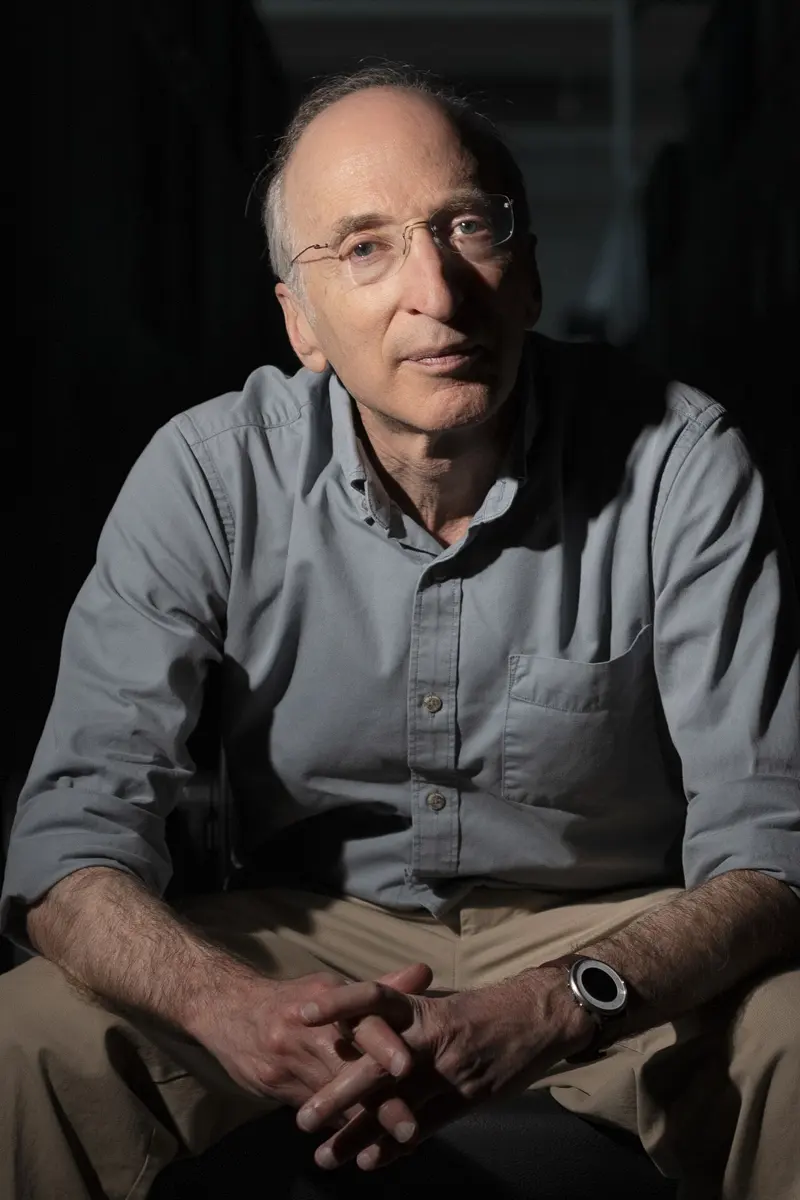
Saul Perlmutter
born 1959 in the USA
Started his team in 1988, when many astronomers thought finding distant exploding stars on time was impossible. He also teaches a popular course on how to think like a scientist.
Photo: Christopher Michel, CC BY-SA 4.0
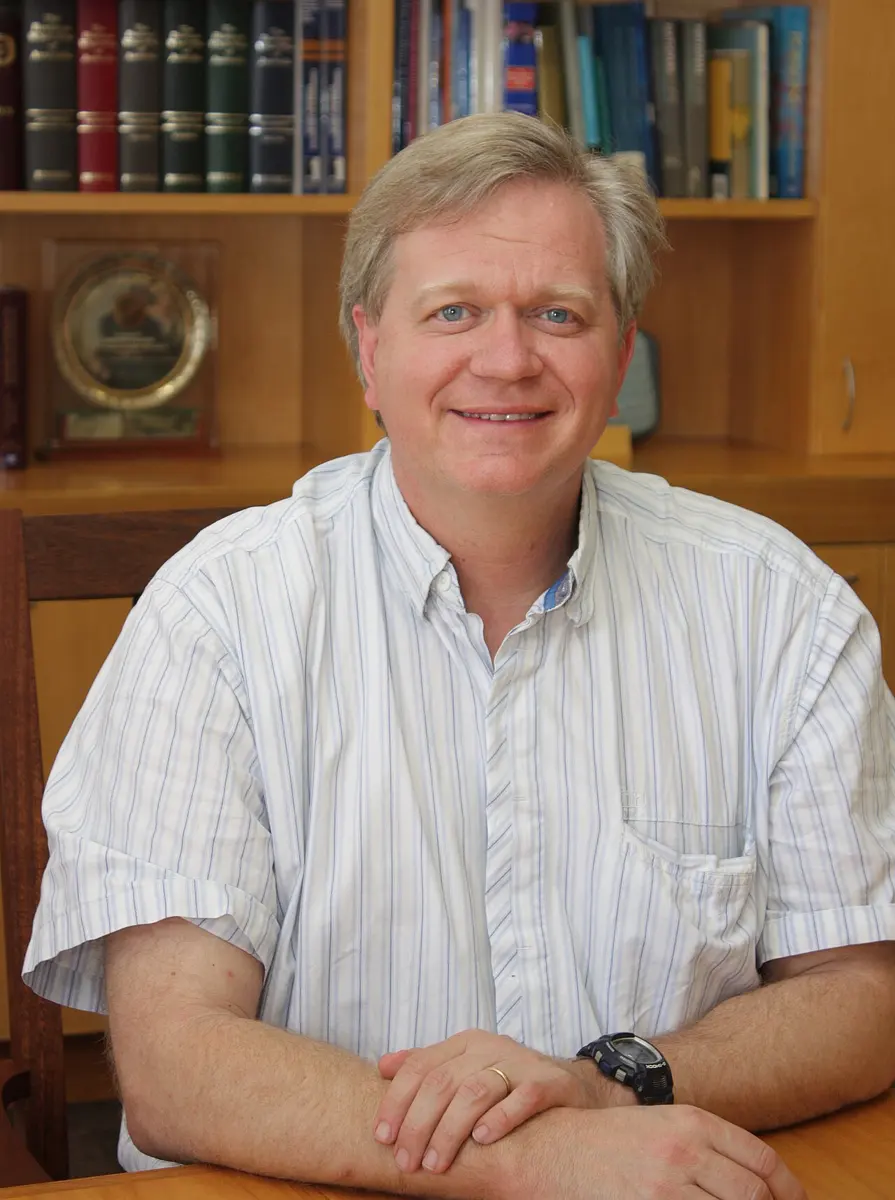
Brian P. Schmidt
born 1967 in the USA
Grew up in Montana and Alaska, and led the second team from Australia, where he still works. He grows grapes and makes wine on a small farm of his own.
Photo: Tim Wetherell, CC BY-SA 3.0
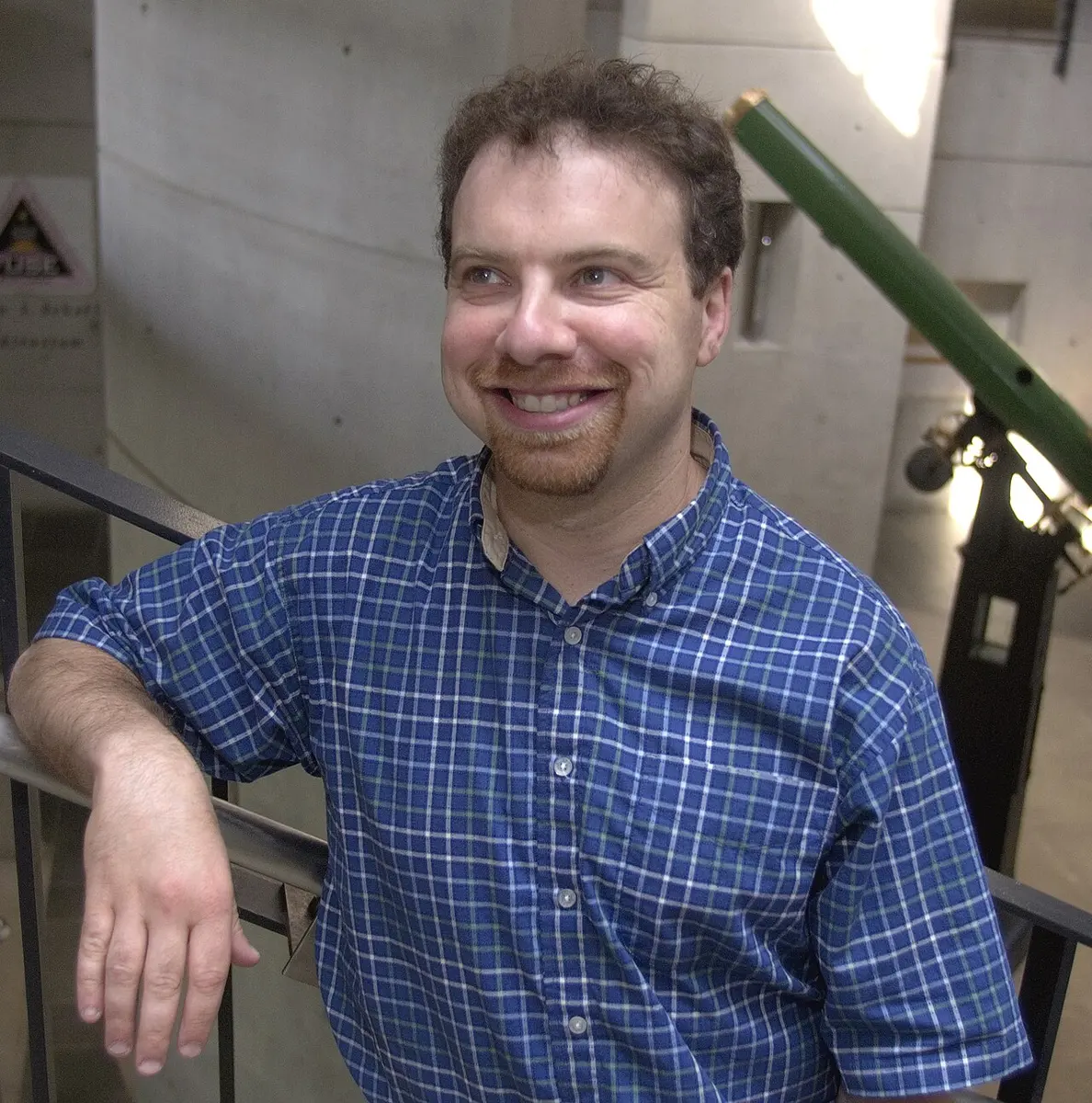
Adam G. Riess
born 1969 in the USA
Was still in his twenties when his calculations showed the surprise. He has spent the years since measuring how fast the universe grows today.
Photo: IMAGE: W. Kirk (Homewood Photographic Services–JHU), Public domain
Throw a ball straight up. It rises, but gravity pulls it back, so it slows down, stops, and falls. Throw it harder and it goes higher before it comes back. Now imagine you throw it, and instead of slowing down, it speeds up, faster and faster, until it disappears into the sky. You would think something very strange was pushing it.
In 1998 two teams of astronomers found that the whole universe is behaving like that ball. Since the Big Bang, the galaxies have been flying apart from one another. Everybody expected gravity to be slowing them down. The teams set out to measure how much. They found the opposite: the universe is growing faster and faster. In 2011 the Nobel Prize in Physics went to the leaders of the two teams.
The problem: how fast is the universe slowing down?
In the 1920s the American astronomer Edwin Hubble found that almost all galaxies are moving away from us, and that the farther away a galaxy is, the faster it is moving Grade 10: Hubble’s study. The universe is expanding: not galaxies flying out into empty space, but space itself stretching, carrying the galaxies apart, like raisins in a cake that rises in the oven. Run the film backwards, and everything was once squeezed together, in the Big Bang, about 14 billion years ago Grade 10: The Big Bang theory.
But every galaxy pulls on every other galaxy with gravity. So, just like the ball, the expansion should be slowing down. The question was: by how much? If there is enough matter in the universe, gravity would one day stop the expansion and pull everything back together in a Big Crunch. If there is too little, the universe would keep growing for ever, but more and more slowly Grade 10: Future of the universe. Measuring the slowing down would tell us the fate of the whole universe.
Before 1998, what did almost every astronomer expect about the expansion of the universe?
Pick an answer to see why.
How to measure it: looking back in time
Light takes time to travel. Light from the Sun is 8 minutes old when it reaches you. Light from a galaxy a billion light-years away (a light-year is the distance light travels in a year: Light-year) left it a billion years ago. So when astronomers look at very distant galaxies, they see the universe as it was long ago. By comparing near and far galaxies, they can see how the expansion has changed over time.
To do that, they need two measurements for each faraway object:
- How much its light has been stretched. While the light travels to us, space keeps stretching, and the light’s waves are stretched with it. Stretched light is redder, so this is called redshift. It tells you how much the universe has grown since the light set out (Light that has been stretched).
- How far away it is. This is the hard part.
Standard candles
Imagine a row of identical street lights along a straight road at night. The nearest looks bright, the far ones look dim. If you know they are all the same lamp, you can tell how far away each one is just from how dim it looks. A light twice as far away looks four times dimmer; three times as far, nine times dimmer. Astronomers call an object whose true brightness is known a standard candle.
For galaxies billions of light-years away, ordinary stars are far too faint to see one by one. The teams needed a standard candle bright enough to be seen across most of the universe.
Exploding stars
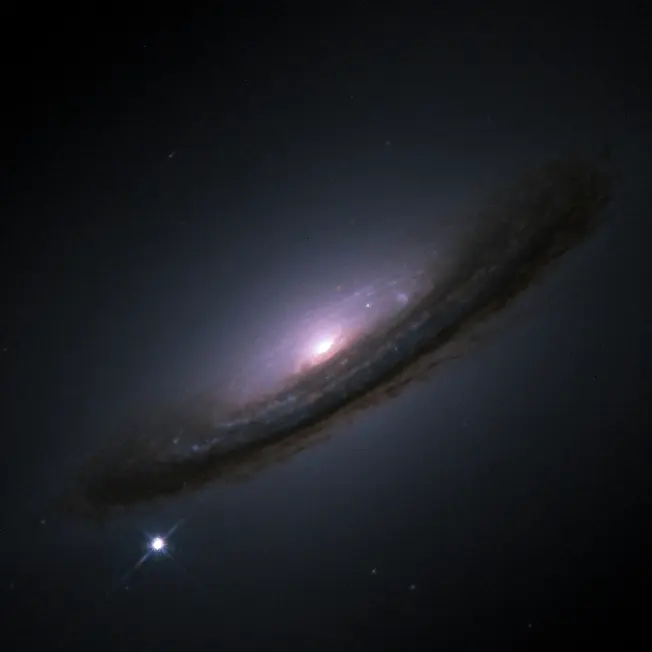
They used a kind of exploding star called a type Ia supernova (said “type one-A”). It starts with a white dwarf: the leftover core of an old star, as heavy as the Sun but only about as big as the Earth Grade 9: Death of a star. Our Sun will end as a white dwarf too, in billions of years.
Many stars live in pairs. If a white dwarf has a partner star close by, its strong gravity can pull gas off the partner. The white dwarf grows heavier. When it reaches about 1.4 times the mass of the Sun, it cannot hold itself up any longer: its carbon and oxygen start to fuse in a runaway nuclear explosion, and the whole star is blown apart in seconds. For a few weeks, a single type Ia supernova can shine as brightly as an entire galaxy of a hundred billion stars.
Because these explosions always happen at about the same mass, they all give out about the same amount of light. That makes them good standard candles. They are not perfect: the brightest ones fade more slowly, and the teams learned to use that to correct each one.
What makes a type Ia supernova useful for measuring distances?
Pick an answer to see why.
Why it was so hard
- They are rare. In a typical galaxy, only one or two supernovae explode in a thousand years. You can’t wait for one.
- They don’t last. A supernova is brightest for only a few weeks, then fades. To measure its brightness properly, you must catch it early and watch it for weeks.
- They can’t be booked. Big telescopes are booked months ahead. But nobody knows months ahead where a supernova will appear.
- They are faint and hidden. At billions of light-years, even a supernova is just a faint dot on top of the light of its own galaxy, and dust in space can dim it further.
What they did, step by step
Saul Perlmutter and the Supernova Cosmology Project (1988–1999)
- 1988. At the Lawrence Berkeley National Laboratory in California, Perlmutter and his colleagues started the Supernova Cosmology Project. For years, many people doubted they would ever find enough distant supernovae in time to measure them.
- Supernovae on schedule. The team found a trick. Using big electronic cameras (the CCD sensors that are also in your phone’s camera, honored with the Nobel Prize in 2009), they photographed thousands of distant galaxies just after a new moon, when the sky is darkest, and again about three weeks later, before the moonlight grew too bright. A computer compared the two pictures and looked for a new dot of light. Because each picture held thousands of galaxies, they could expect to find a batch of new supernovae each time, so they could book telescope time in advance to follow them up.
- Measuring. Each candidate was then watched with the world’s largest telescopes, including the Hubble Space Telescope, to check its type, measure its redshift, and follow how its light rose and faded.
- The result. In December 1998 they sent their paper on 42 distant supernovae for publication.
Brian Schmidt, Adam Riess and the High-z Supernova Search Team (1994–1998)
- 1994. Brian Schmidt, at the Mount Stromlo Observatory in Australia, started a second, competing team: the High-z Supernova Search Team (“z” is the letter astronomers use for redshift, so “high-z” means very distant). They used the same new methods.
- The analysis. Adam Riess, a young member of the team, did much of the work of turning the measurements into distances.
- The surprise. In late 1997 his calculations showed that the distant supernovae were fainter than they should be, even in a universe with very little matter to slow it down: on average they were about 10 to 15 per cent farther away than expected. The numbers made sense only if the expansion was speeding up. The team checked again and again for a mistake, and found none.
- 1998. They sent their paper, based on 16 distant supernovae and 34 nearby ones, for publication in May 1998.
Two teams, competing hard, using different supernovae and checking each other’s every step, had reached the same astonishing answer. That is what convinced other scientists.
How it works now: dark energy
Why are faint supernovae a sign of speeding up? If the expansion had been slowing down, the universe would have grown less, while a distant supernova’s light traveled to us, than if it had kept a steady pace. The supernova would be nearer, and so brighter. If the expansion has been speeding up, the universe grew more during the journey, the supernova is farther away, and it looks fainter. Fainter is what the teams saw.
What is pushing the universe apart? Nobody knows. Scientists call it dark energy: “dark” because we cannot see it, only its effect.
- It seems to be spread evenly through all of space, even empty space. As the universe grows, there is more space, so there is more dark energy, while matter just gets more spread out. For the first several billion years after the Big Bang, gravity won and the expansion slowed. About five or six billion years ago dark energy took over, and the expansion began to speed up.
- In 1917 Albert Einstein added an extra term to his equations of gravity, a kind of push from space itself, which he called the cosmological constant. He later called it a mistake. The simplest explanation of dark energy is exactly Einstein’s constant.
- Measurements since 1998, of the afterglow of the Big Bang and of maps of millions of galaxies, agree: today, about 68 per cent of the universe is dark energy, about 27 per cent is dark matter (unseen matter we know only from its gravity), and only about 5 per cent is the ordinary matter that stars, planets and people are made of Grade 10: What the universe is made of. (In 2011 the Nobel committee gave about 73 per cent; the numbers have been refined since.)
The distant supernovae looked fainter than expected. Why did that mean the expansion is speeding up?
Pick an answer to see why.
In your life today
- The fate of everything. If dark energy stays as it is, the universe will never collapse. It will expand faster and faster for ever, the galaxies will drift out of sight of one another, and the stars will slowly burn out: an ending in cold and dark, sometimes called the Big Freeze.
- Most of the universe is a mystery. Everything you have ever seen, touched or studied, every star, rock, tree and person, is only about one twentieth of what is out there.
- Your phone’s camera. The supernova hunters depended on CCD and similar electronic image sensors, and on powerful computers to compare thousands of pictures. The same kind of sensor is in every phone camera.
- Science can change its mind. In 1997 almost every astronomer “knew” the expansion was slowing. A year later the evidence said otherwise, and within a few years the whole field had changed its view. That is science working as it should.
What came next
- Checking from every side. The afterglow of the Big Bang, measured by satellites, and huge maps of galaxies have confirmed the speeding up in completely different ways.
- A new puzzle. Adam Riess went on to measure how fast the universe is expanding today, using nearby standard candles. His answer is about 8 per cent faster than the rate predicted from the afterglow of the Big Bang. Nobody yet knows whether this is a hidden error or a sign of new physics.
- Is dark energy changing? In 2024 and 2025 a giant survey of millions of galaxies called DESI found hints that dark energy may be getting weaker with time. If that is confirmed, the fate of the universe could change again. The hints are not yet strong enough to count as a discovery.
- The open question. What is dark energy? Is it Einstein’s constant, the energy of empty space itself, or something new? It may be the biggest unsolved problem in physics.
In your science books
- Grade 9: Death of a star and Nova, supernova, and what is left; Light-year.
- Grade 10: The Big Bang theory, Hubble’s study, Future of the universe (open, flat and closed universes) and What the universe is made of.
- Going further: How do we know the universe is expanding? and Why is gravity so weak?
Learn more
- The prize at nobelprize.org: The Nobel Prize in Physics 2011, with the popular information, “Written in the stars”.
- The laureates’ Nobel lectures: Saul Perlmutter, Brian Schmidt and Adam Riess.
The official reason
The prize was given “for the discovery of the accelerating expansion of the Universe through observations of distant supernovae.”