
The baby picture of the universe
Nobel Prize in Physics, 2006: John Mather and George Smoot

John Mather
born 1946 in Roanoke, Virginia, USA
He grew up on a dairy research farm in New Jersey. At NASA he led the whole COBE project, and later became the senior scientist of the James Webb Space Telescope.
Photo: Christopher Michel, CC BY 2.0

George Smoot
1945–2025, born in Yukon, Florida, USA
Before COBE he flew his instruments on balloons and on a spy plane. He was so careful that he offered his team two free plane tickets each for finding a mistake.
Photo: Michael Hoefner, CC BY 3.0
Stand outside on a clear night, away from the lights of the city, and look up. Between the stars the sky looks black. But it isn’t quite empty. Every part of it is giving off a very faint, very cold glow, far too faint for your eyes, in the form of microwaves. That glow has been traveling towards you for almost 14 billion years. It is the oldest light there is: the leftover heat of the Big Bang.
In 1989 NASA launched a satellite called COBE to measure this glow properly for the first time. Its results changed the study of the universe from clever guessing into an exact science. In 2006 the two scientists who led its main experiments, John Mather and George Smoot, won the Nobel Prize in Physics.
The problem: how did the universe begin?
In the 1950s scientists argued about two ideas.
- The Big Bang idea: the universe began very hot and very dense, and has been expanding and cooling ever since Grade 10: The Big Bang theory.
- The Steady State idea: the universe has always existed and always looked much the same.
In the 1940s, three physicists, Ralph Alpher, George Gamow and Robert Herman, worked out that if the Big Bang idea is right, the early heat should still be around, cooled to a few degrees above absolute zero (−273 °C, the coldest anything can be). It would fill the whole sky.
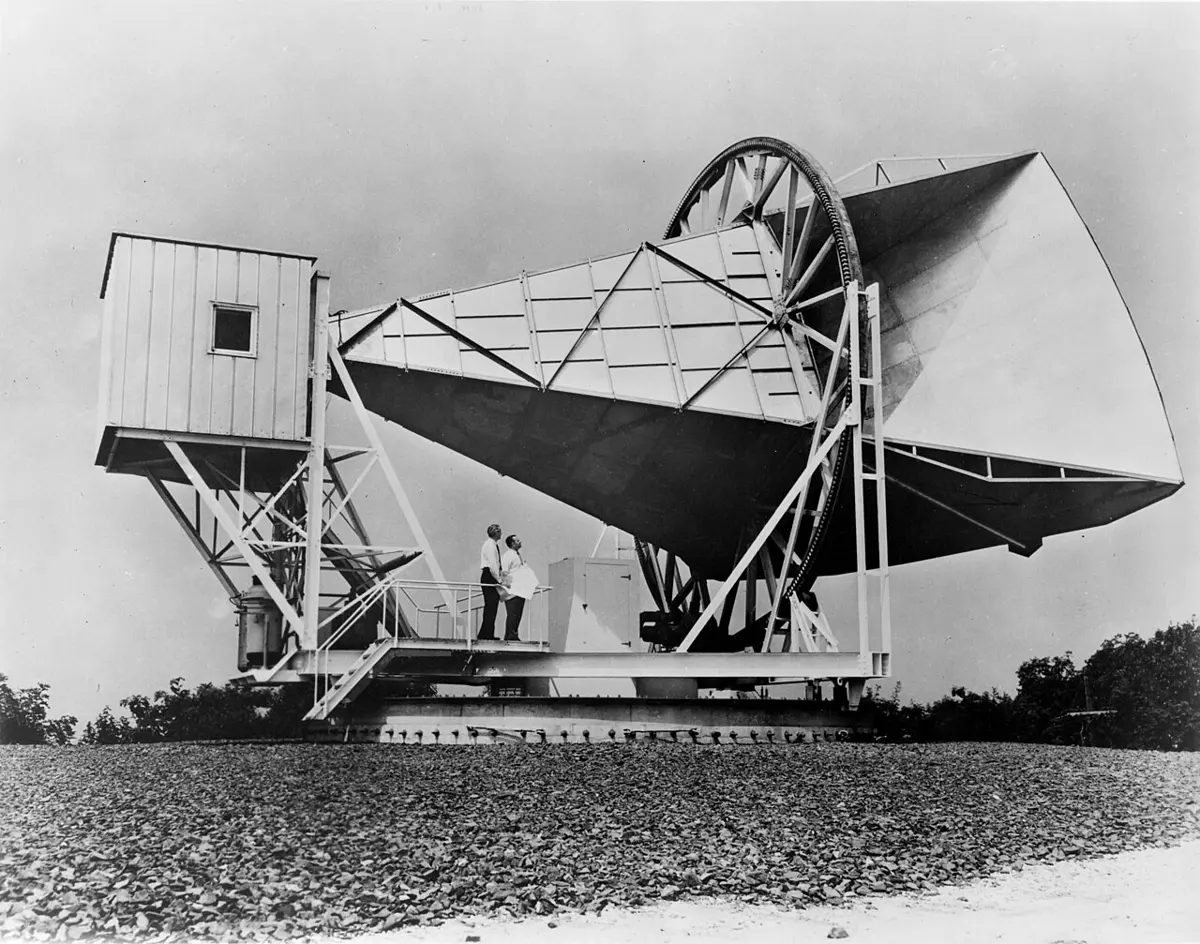
In 1964 two radio engineers in New Jersey, Arno Penzias and Robert Wilson, were testing a large horn-shaped antenna. They kept hearing a faint hiss that would not go away. They cleaned the antenna, even removed the droppings of the pigeons nesting inside, and the hiss was still there, coming equally from every direction. It was the leftover glow: the cosmic microwave background, or CMB. (Penzias and Wilson won the Nobel Prize in 1978.)
That was strong support for the Big Bang. But two big questions were left.
- Was it really the Big Bang’s glow? If it was, its colors had to follow one exact pattern, which you will meet below. Measurements from the ground could check only a small part of the pattern, because the air soaks up most of these wavelengths.
- Where did galaxies come from? The glow looked exactly the same in every direction. But if the early universe had been perfectly smooth, there would have been nothing for gravity to pull together, and no galaxies, stars or planets would have formed. There had to be tiny differences somewhere. Nobody could find them.
How it works: the glow of a hot thing
Think of the coil of an electric heater or a piece of iron in a blacksmith’s fire. As it gets hotter it first glows dull red, then orange, then yellow-white. Even before it glows, you can feel invisible infrared rays from it on your hand. Every object gives off this kind of radiation, and the hotter it is, the shorter the wavelength of most of its radiation. That is also why hot blue stars are hotter than red ones Grade 9: The color of a star.
For an ideal glowing object, which physicists call a blackbody, there is something more. If you measure how much radiation it gives off at each wavelength, you always get the same shape of curve: a steep rise, a peak, and a long tail. Only the temperature moves the peak. Know the temperature, and you can draw the whole curve; measure the curve, and you know the temperature. Max Planck worked out this shape in 1900.
Now, the Big Bang story. For its first 380,000 years or so, the universe was a hot fog of electrons, protons and light. Light could not travel far, because it kept bouncing off the free electrons, the way car headlights scatter in thick fog. As the universe expanded it cooled, and when it had cooled to nearly 3,000 °C, the electrons joined the protons to make atoms. Suddenly the fog cleared, and the light has traveled freely ever since.
At that moment the glow had the blackbody shape of a thing at nearly 3,000 °C: mostly red and infrared light. But while it traveled, space itself kept expanding, and the waves were stretched with it, about a thousand times. The shape of the curve stayed the same; it just slid to longer wavelengths. Today the glow has the shape of a blackbody at only 2.7 degrees above absolute zero (about −270 °C), and its waves are a millimeter or two long: microwaves Grade 9: Microwaves.
So the test was clear. If the CMB really is the Big Bang’s light, it must have the exact blackbody shape. Any other source, such as dust warmed by stars, would give a different shape.
How can scientists tell the temperature of something from its glow alone?
Pick an answer to see why.
Why it was hard
The air is in the way. Water vapor and oxygen in the air soak up most of the CMB’s wavelengths. Scientists carried instruments to mountain tops, on balloons and on rockets, but they could only ever see parts of the curve, for a few hours at a time.
The glow is cold, and everything else is warm. The CMB is at 2.7 degrees above absolute zero. The instrument itself, the Earth and the Sun are hundreds of degrees warmer, and they glow too. An instrument that measures the CMB’s exact curve must itself be cooled almost to absolute zero, or its own glow drowns the signal.
The ripples were tiny. At first scientists expected differences of about a thousandth of a degree between one part of the sky and another. While COBE was being built, calculations that included dark matter (matter that we cannot see, but whose gravity we can measure) showed that they could be even smaller: about a hundred-thousandth of a degree. Measuring that is like noticing that one part of a lake 100 meters deep is one millimeter deeper than another.
Other things look like ripples. Our own galaxy, the Milky Way, glows in microwaves. And the Earth is moving through the CMB, together with the Sun, so the sky ahead of us looks slightly warmer and the sky behind slightly cooler. George Smoot had measured that effect in 1976 with instruments on a high-flying U-2 spy plane. All of it had to be measured and taken away before any real ripples could show.
What they did, step by step
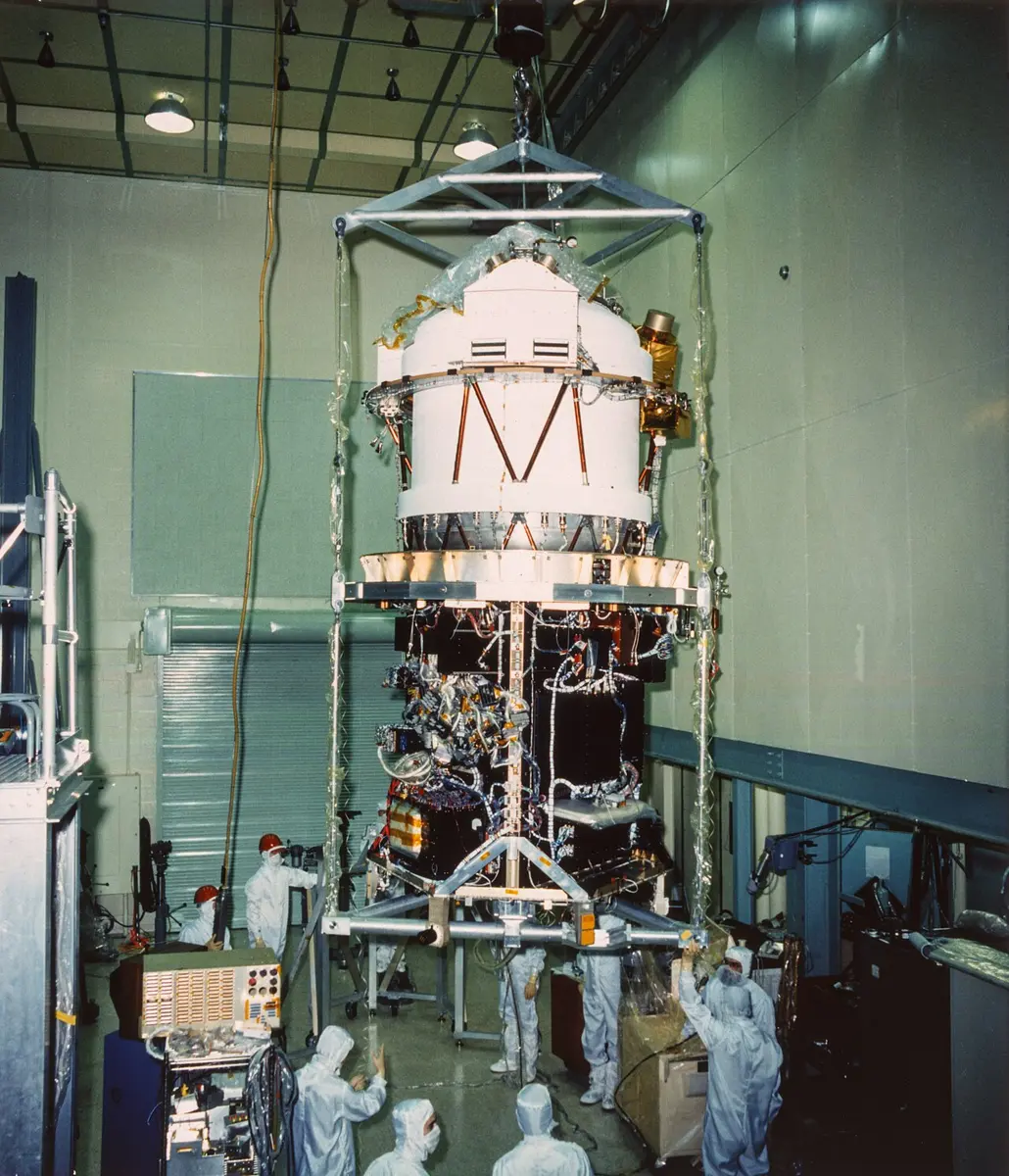
In 1974 NASA asked scientists for ideas for new satellites. Three teams proposed measuring the CMB from space, and in 1976 NASA told them to join together. The result was COBE, the Cosmic Background Explorer. More than 1,000 scientists, engineers and others worked on it, and John Mather coordinated the whole project.
COBE was first planned to ride into space on the Space Shuttle. Then, in January 1986, the shuttle Challenger exploded soon after launch, killing its seven crew, and shuttle flights stopped. The team had to redesign COBE to be much smaller and lighter, to fit on an ordinary Delta rocket. On 18 November 1989 it was launched from California into an orbit about 900 km high, passing over the North and South Poles.
Mather: the perfect curve
- The instrument. Mather was in charge of FIRAS, an instrument that compared the sky’s glow, wavelength by wavelength, with an artificial blackbody carried on board. It sat in a flask of liquid helium, at less than two degrees above absolute zero.
- Nine minutes. The first results came after just nine minutes of measurements. The CMB matched a perfect blackbody curve.
- January 1990. When Mather showed the curve to a meeting of astronomers, the hall gave it a standing ovation. The measurements fitted the curve so well that the dots were bigger than their errors. Later analysis put the temperature at 2.725 degrees above absolute zero.
- September 1990. The helium ran out, as planned, and FIRAS stopped. It had done its job: the CMB was the Big Bang’s glow, and the Steady State idea could not explain it.
Smoot: the ripples
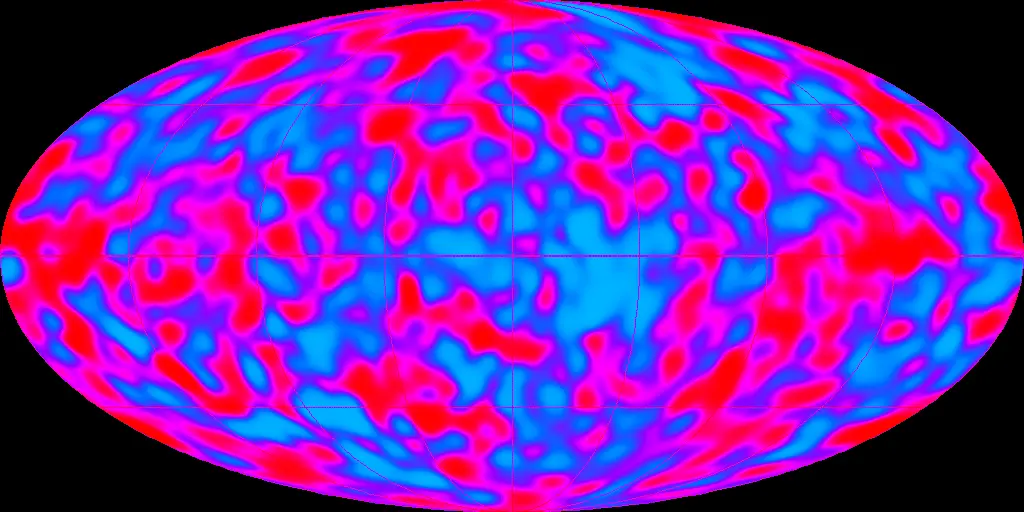
- The instrument. Smoot was in charge of the DMR, the Differential Microwave Radiometer. Rather than measure the temperature of one part of the sky, which is very hard to do exactly, it compared two. Pairs of horn-shaped antennas pointed at two parts of the sky 60° apart, and the instrument measured only the difference between them. COBE spun around and swept across the whole sky, so every part was compared with many others, again and again, for four years.
- Cleaning the map. The team took away the effect of the Earth’s motion and the glow of the Milky Way. Measuring at three different wavelengths helped: the Milky Way looks different at each one, but the CMB does not.
- Checking, and checking again. By late 1991 the ripples were showing in the data. Smoot insisted on secrecy until the team was sure. He offered two plane tickets to anywhere in the world to anyone who could prove a mistake. Nobody won them.
- April 1992. Smoot announced the result at a meeting in Washington: the CMB is warmer in some directions and cooler in others, by about one part in 100,000. The ripples matched hints already seen from the ground and from balloons. Stephen Hawking called it “the greatest discovery of the century, if not of all times”.
What made the DMR’s job so hard?
Pick an answer to see why.
What the ripples mean
The slightly warmer and cooler patches show where the early universe was very slightly more or less dense. Where there was a little more matter, gravity pulled in a little more, which made gravity there stronger still. Over hundreds of millions of years, the denser patches grew into clouds of gas, then the first stars and galaxies. The Milky Way, the Sun and the Earth all grew from ripples like these Grade 9: Galaxies.
Without the ripples there would be no structure at all: the universe would be a thin, even gas everywhere, with nothing to make stars, planets or people.
In your life today
- Knowing our universe’s age. The ripples measured by COBE, and much better by the satellites after it, give the age of the universe as about 13.8 billion years, as of 2026.
- What everything is made of. From the sizes of the ripples, scientists worked out that ordinary matter, the kind that makes up you, the Himalaya and the stars, is only about 5% of the universe. About 27% is dark matter, and about 68% is dark energy, which is making the expansion speed up. Both are still unexplained.
- Cooling to near absolute zero. Detectors that work only when very cold are now also used in some medical scanners and telescopes.
What came next
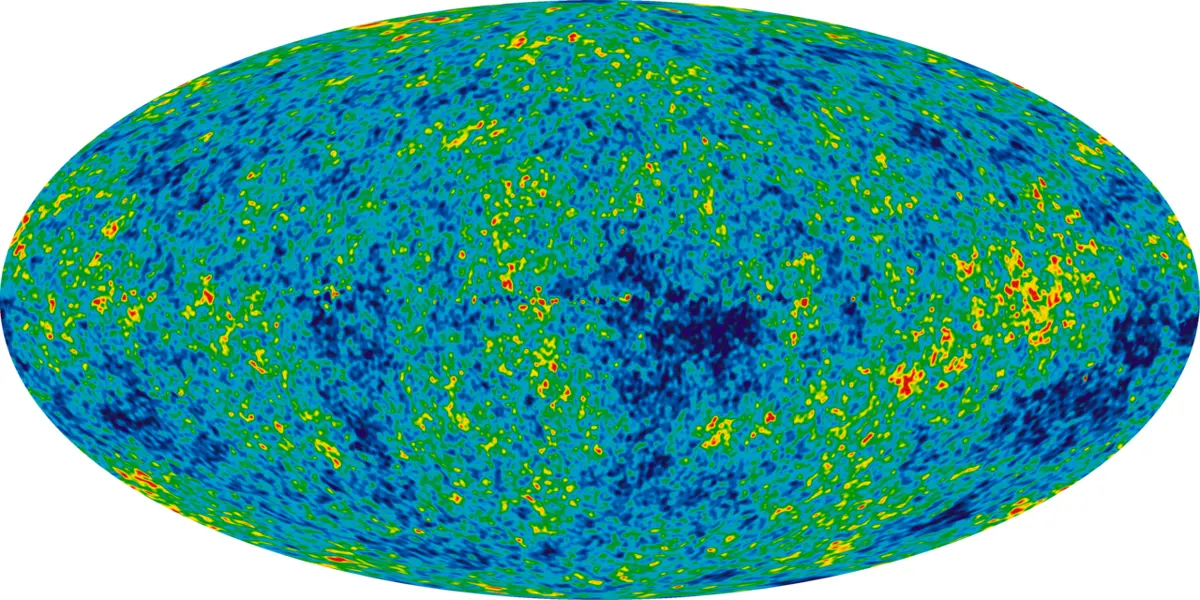
- Sharper pictures. COBE could only see patches of sky 7° across, about fourteen full Moons wide. NASA’s WMAP satellite (2001–2010) and Europe’s Planck satellite (2009–2013) mapped the same ripples in much finer detail.
- The James Webb Space Telescope. After COBE, John Mather became the senior project scientist of the James Webb Space Telescope, launched on 25 December 2021. It sees in infrared light, and looks at some of the first galaxies that grew from the ripples.
- The open questions. What is dark matter, and what is dark energy? And where did the ripples themselves come from? The leading idea is that in a tiny fraction of a second after the Big Bang, the universe swelled enormously fast (inflation), stretching tiny random jitters into the ripples COBE saw. Scientists are searching the CMB for faint patterns that would prove it.
In your science books
- Grade 8: the origin of the universe and the Big Bang theory and galaxies.
- Grade 9: how the universe began, the color of a star, the electromagnetic spectrum and microwaves.
- Grade 10: the Big Bang theory, the expanding balloon, Hubble’s study and the radiation thermometer, which reads a temperature from a glow.
- Going further: How do we know the universe is expanding? (the afterglow) and What are stars made of?
Learn more
- The Nobel Prize’s own explanation: From unexpected noise to precision science (nobelprize.org).
- The two laureates’ Nobel lectures: Mather and Smoot.
- NASA’s page on COBE and its results.
The official reason
The prize was given “for their discovery of the blackbody form and anisotropy of the cosmic microwave background radiation.”