
Quarks: free inside, trapped forever
Nobel Prize in Physics, 2004: David Gross, David Politzer, and Frank Wilczek
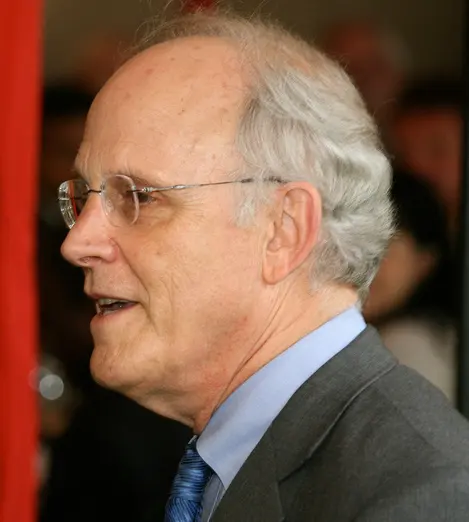
David Gross
born 1941 in the USA
A young professor at Princeton University who set out to prove that the strong force could not be explained this way, and found the opposite.
-
David Politzer
born 1949 in the USA
A graduate student at Harvard University, only 23 years old, who did the same calculation on his own and got the same answer. It was his first published paper.
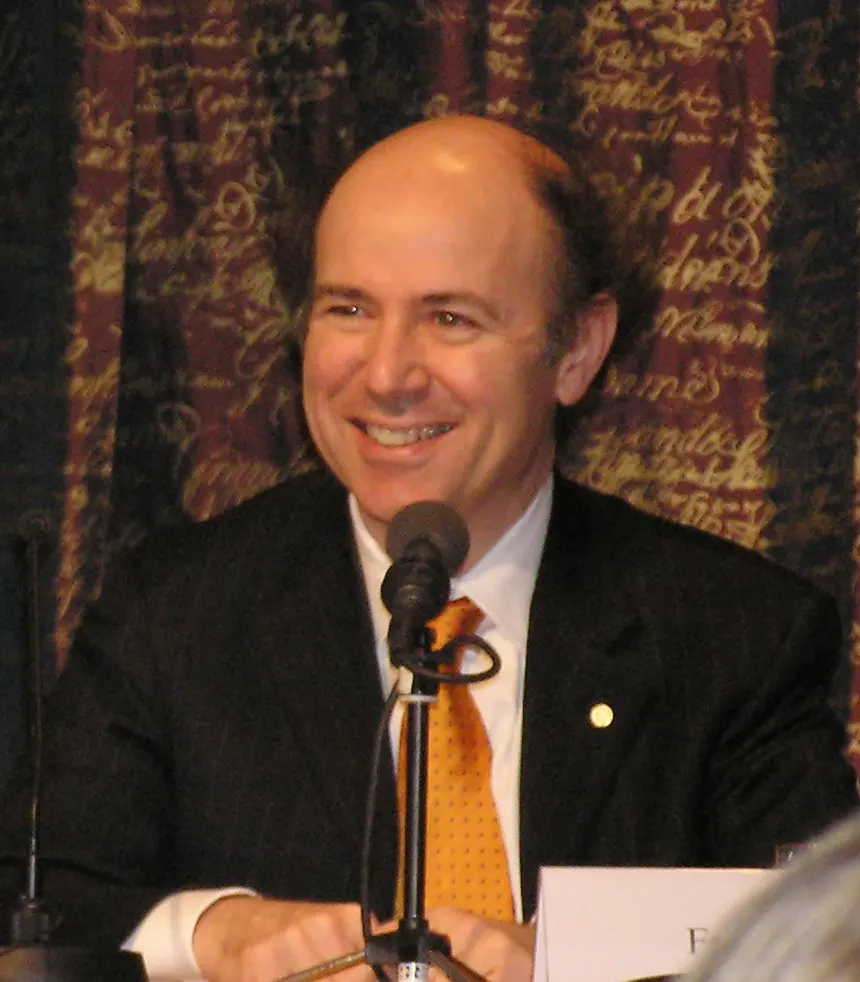
Frank Wilczek
born 1951 in the USA
Gross’s first graduate student. He was 21 when they made the discovery.
Photo: Betsy Devine, CC BY 2.5
Hold two magnets close together and they snap towards each other. Pull them apart and the pull gets weaker; a few centimeters away you hardly feel it. The pull between electric charges and the pull of gravity work the same way: the farther apart, the weaker.
Now imagine two balls joined by a rubber band. When they are close, the band is loose and they hardly pull on each other. Pull them apart and the band pulls back harder the more you stretch it.
Deep inside every atom there are particles that behave like the balls on a rubber band. In 1973 three young physicists worked out why. For this, David Gross, David Politzer and Frank Wilczek shared the 2004 Nobel Prize in Physics.
The problem: particles that would not come out
Inside the nucleus
Every atom has a tiny nucleus made of protons and neutrons, with electrons around it Grade 8: Structure of an atom. The protons all have a positive charge, and like charges repel. So why doesn’t the nucleus fly apart? Because a much stronger pull holds it together: the strong nuclear force Grade 9: Nuclear stability. It is one of the four basic forces of nature, with gravity, the electromagnetic force and the weak force.
In the 1960s physicists found that protons and neutrons are not the smallest pieces. Each is made of three even smaller particles called quarks. A proton has two up quarks and one down quark. The odd thing about quarks is their charge: an up quark has +⅔ of a proton’s charge and a down quark −⅓. Add up a proton’s three quarks, +⅔ +⅔ −⅓, and you get exactly +1.
Free inside, trapped forever
In 1968, at the Stanford Linear Accelerator in the USA, a machine 3.2 km long, physicists fired electrons at protons with enormous energy. Far more electrons than expected bounced off sharply, as if they had hit tiny hard grains inside the proton. Even stranger, those grains behaved as if they were free, as if nothing held them at all. (This experiment won the 1990 Nobel Prize in Physics.)

But nobody had ever seen a quark on its own. People smashed protons together as hard as they could, and searched ordinary matter for particles with a third of a proton’s charge. They found none. Quarks were free inside the proton, yet they could never get out. How could both be true?
What did the Stanford experiments of 1968 show?
Pick an answer to see why.
How forces between particles work
Messengers
In today’s physics, a force between two particles is carried by messenger particles that pass between them. The electromagnetic force is carried by photons, the particles of light. The strong force is carried by particles called gluons, from the word “glue”.
Color charge
To feel the electric force, a particle needs electric charge. To feel the strong force, it needs a different kind of charge, which physicists named color charge. It has nothing to do with real colors; it is just a name. Electric charge comes in one kind, which can be positive or negative. Color charge comes in three kinds, called red, green and blue.
The three quarks in a proton always have one of each color. Red, green and blue together are “neutral”, like the three colors of light that mix to give white. That is why a proton as a whole does not pull hard on things outside it.
The cloud around a charge
Here is the strangest part. Quantum physics says that empty space is never really empty. Pairs of particles keep popping up for a moment and vanishing again. Around an electron, these short-lived pairs line up so that they partly hide its charge, like a crowd of people standing round a famous person. From far away you see mostly the crowd; only by pushing close do you see the person in full.
So the electric force, seen very close up, is a little stronger than you would expect. This has been measured: at the LEP collider at CERN, near Geneva, the strength of the electric force came out about 7% higher in very hard collisions than in everyday ones.
Every theory of forces that physicists had worked out behaved this way: the force grew stronger close up. But the quarks at Stanford had shown the opposite: close up, the strong force was weak. A theory was needed in which the sign was reversed.
Why it was hard
By 1970 many physicists had begun to doubt that the methods used so successfully for the electric force could ever work for the strong force. One German physicist, Kurt Symanzik, saw that the only way out was a theory in which the force gets weaker close up, but he could not find one. Others published arguments that no such theory could exist. In the summer of 1972, the Dutch physicist Gerard ’t Hooft came very close to the answer, but did not follow it up.
There was one kind of theory left that nobody had checked properly. In it, the messengers themselves carry charge. The calculation for it was long and full of traps, and most people expected it to give the same answer as all the others.
What they did, step by step
Gross and Wilczek at Princeton
David Gross was a professor at Princeton University, in his early thirties. Frank Wilczek had arrived there to study mathematics, switched to physics, and in autumn 1972 began working with Gross as his first graduate student.
- The plan, 1972. Gross later said that he set out, “quite deliberately”, to prove that this whole kind of theory could not explain the strong force. Proving that no theory with the right sign existed was part of his plan.
- The last gap. With the help of another physicist, Sidney Coleman, Gross had shown that every theory of this kind except one gave the wrong sign. The one left was the kind where the messengers carry charge. Gross and Wilczek decided to calculate it.
- February 1973, a near miss. They kept making mistakes, and checked their working against each other. At one point a sign error made the theory come out wrong, as they had expected. As Gross sat down to write up the result, he caught the error. The sign was negative: the force got weaker close up.
Politzer at Harvard
David Politzer was a graduate student of Sidney Coleman at Harvard University. Coleman had asked him to study the same kind of theory, for a different reason, and Politzer went ahead with the same calculation on his own.
- Spring 1973, the same answer. He finished at almost the same time as Gross and Wilczek. The two teams compared their results, and they agreed.
- June 1973. The two papers were printed one after the other in the same issue of the journal Physical Review Letters.
Why the gluons make the difference
A photon has no electric charge, so photons do not pull on each other. But gluons carry color charge themselves. So the gluons around a quark do not just hide its color, as the crowd hides an electron’s charge. They spread it out, carrying some of it away into the space around.
So a quark seen from far away has its color spread over a large cloud, and pulls strongly. Seen very close, with most of the cloud outside, its color charge looks small and it pulls weakly. Quarks make the hiding kind of cloud too, but the gluons win as long as there are no more than 16 kinds of quark. There are 6.
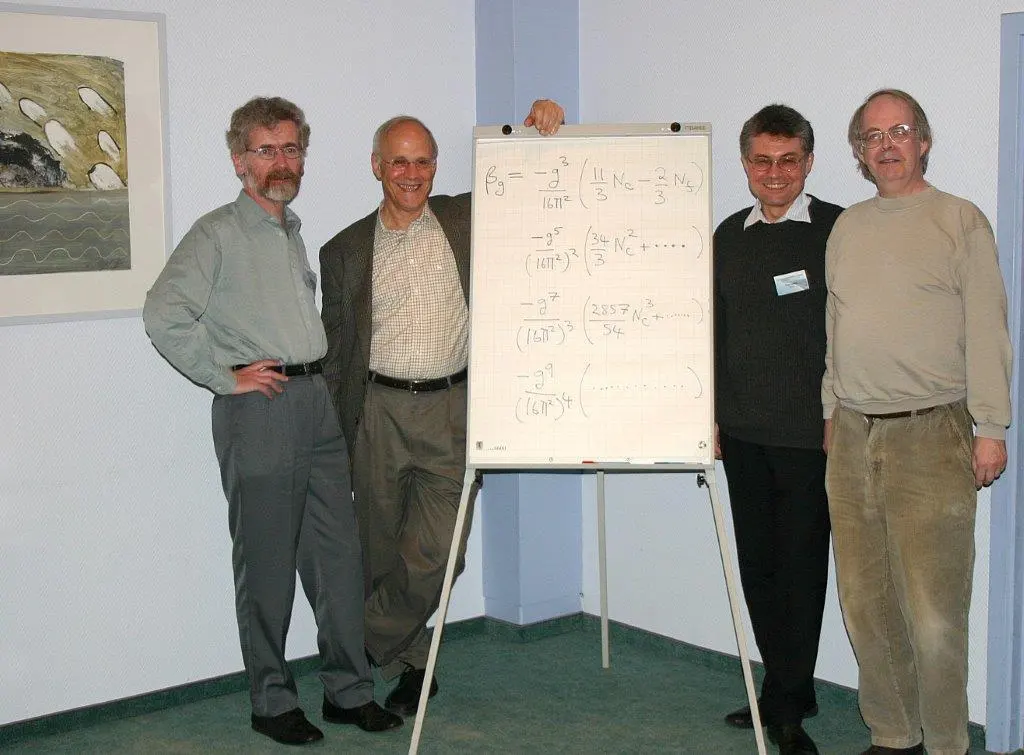
The number in the calculation that showed the sign was −11/3. At the prize ceremony, the physicist presenting the prize joked: “Seldom has a negative result had such a positive effect!”
Why does the strong force behave so differently from the electric force?
Pick an answer to see why.
How it works now
The result was named asymptotic freedom: the closer quarks come, the more nearly free they are. The new theory of the strong force was called quantum chromodynamics, or QCD (chroma is Greek for color).
The rubber band
Asymptotic freedom explains both halves of the puzzle at once.
- Close together, deep inside a proton, quarks hardly pull on each other. That is why the electrons at Stanford saw free grains.
- Pulled apart, the field of gluons between them is squeezed into a narrow tube, like a stretched band. Its pull does not fade with distance. It stays at roughly the weight of 15 tonnes, on a particle far smaller than an atom.
- Pulled harder, the band does not let go. Instead, the energy you put into stretching it becomes a new quark and a new antiquark, by Einstein’s (Mass into energy). You end up with two groups of quarks, never a single quark. Quarks are confined.
Measured from every side
The theory made predictions that could be tested, and they have been tested in great detail. The strength of the strong force has been measured in collisions of many different energies. A harder collision probes the quarks closer together, and every time, the force comes out weaker, just as QCD says.
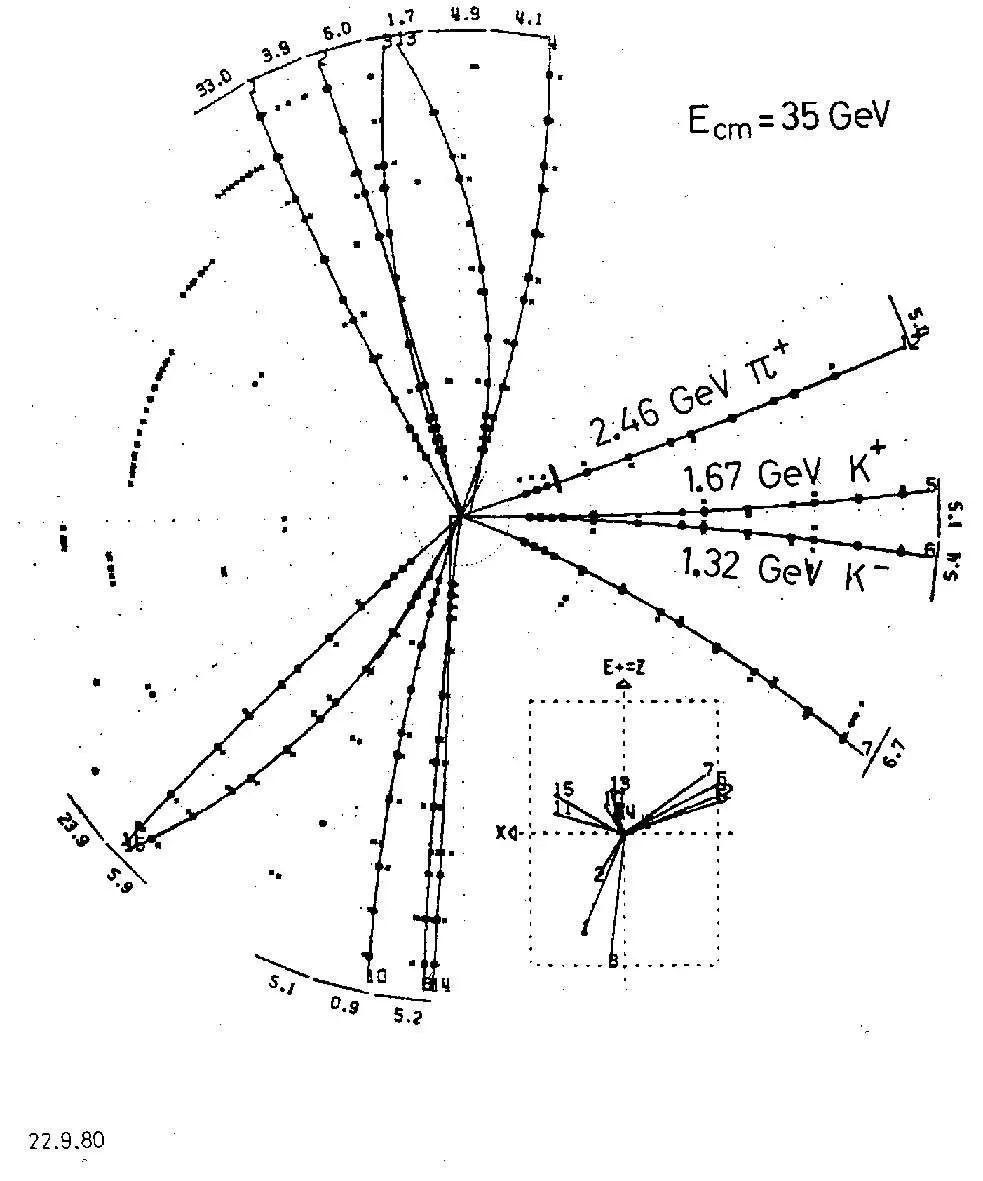
When an electron and its antiparticle crash together at high energy, a quark and an antiquark can fly out in opposite directions. Each one stretches its band until it snaps again and again, so what reaches the detector is two narrow jets of particles. QCD said that sometimes a quark should also throw off a gluon, which makes a third jet. In 1979 such three-jet events were seen at the DESY laboratory in Hamburg, Germany: the first direct sign of gluons.
In your life today
Asymptotic freedom is not inside any gadget. But it is inside you.
- Your weight. The three quarks in a proton together make up only about 1% of its mass. Almost all the rest comes from the energy of the quarks and gluons moving and pulling inside it, by . So nearly all the mass of your body, of a plate of dal bhat and of Mount Everest is energy of the strong force. (Physicists today put it at about 99%; the Nobel committee’s own explanation in 2004 said “about 80%”.)
- The Sun and nuclear power. The strong force, leaking out of protons and neutrons, holds every nucleus together. Its energy is what fusion in the Sun and fission in a nuclear power station set free Grade 9: Nuclear fusion.
- The biggest machines. At the Large Hadron Collider at CERN, protons are smashed together. Asymptotic freedom is what lets physicists calculate what the quarks inside them do, and so pick out new particles from the crowd. The Higgs particle, found there in 2012, was found with the help of QCD’s calculations.
What came next
- Quark soup. If quarks are close enough all the time, they should flow freely as a kind of hot soup, a quark–gluon plasma. That is what the whole universe was like for the first few millionths of a second after the Big Bang Grade 10: The Big Bang theory. Collisions of heavy nuclei at CERN and at Brookhaven, in the USA, have made tiny drops of it.
- One force? Because the strong force gets weaker at high energy while the others change too, their strengths come close together at enormous energies. Many physicists hope that all the forces are really one, which split apart as the universe cooled. Nobody yet knows, and gravity does not fit in at all (Gravity against electricity).
- An unsolved problem. QCD shows that quarks are confined, and computers confirm it, but nobody has yet proved it with exact mathematics. A closely related question is one of the seven “Millennium Prize Problems”; whoever solves it will receive one million US dollars.
In your science books
- Grade 8: the structure of an atom and the proton.
- Grade 9: nuclear stability, the force that holds a nucleus together, and nuclear fusion.
- Grade 10: Newton’s law of gravitation, a force that gets weaker with distance, and the Big Bang theory.
- Going further: Coulomb’s law and why gravity is so weak; what holds a nucleus together and how mass becomes energy.
Learn more
- The Nobel Prize’s own explanation: The Nobel Prize in Physics 2004, popular information (nobelprize.org).
- The laureates’ Nobel lectures: Gross, Politzer and Wilczek.
The official reason
The prize was given “for the discovery of asymptotic freedom in the theory of the strong interaction.”