
Quantum tunneling in a circuit you can hold
Nobel Prize in Physics, 2025: John Clarke, Michel H. Devoret, and John M. Martinis
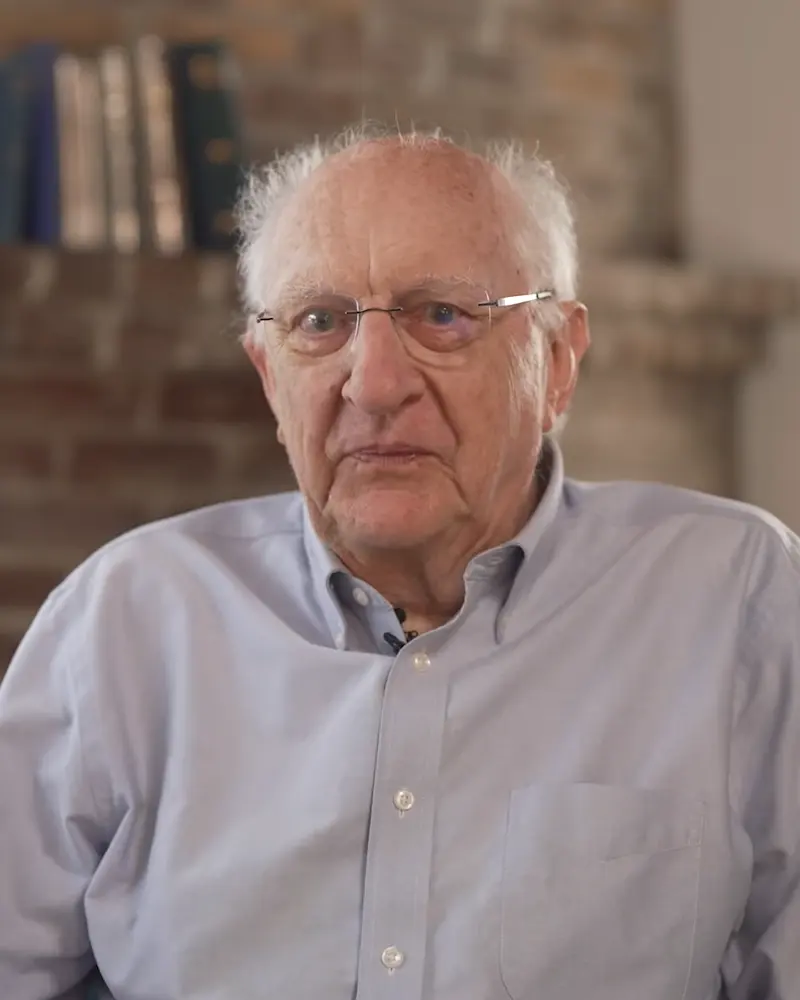
John Clarke
born 1942 in the United Kingdom
A professor at Berkeley who had spent years building the world’s most sensitive measuring devices from superconductors.
Photo: UC Berkeley, CC BY 4.0

Michel H. Devoret
born 1953 in France
A young physicist from France who came to work in Clarke’s laboratory, and went on to help build quantum computers.
Photo: Christian Ursilva from København, Danmark, CC BY-SA 4.0
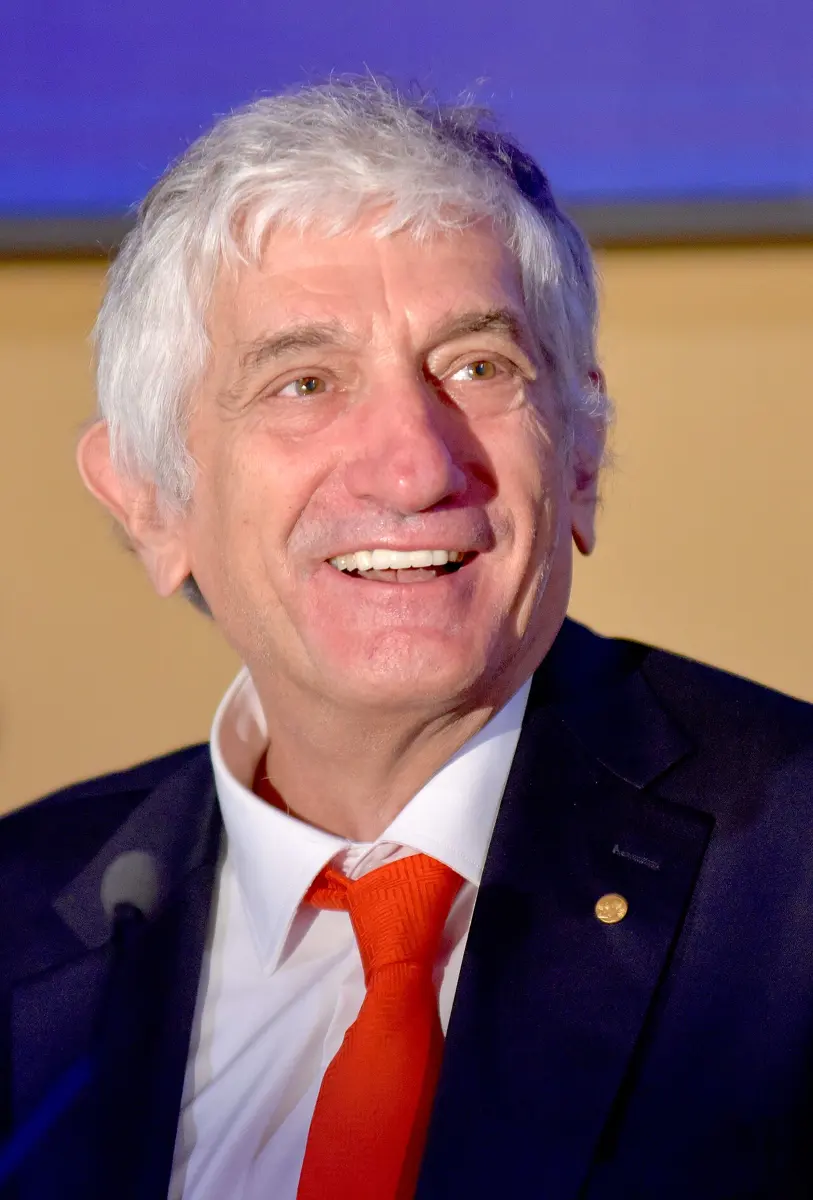
John M. Martinis
born 1958 in the United States
Clarke’s research student at the time. Thirty years later he led the team that built Google’s first quantum computer chip.
Photo: Karen Zhou, CC BY-SA 4.0
Throw a ball at the wall of your house. It bounces back. Throw it a thousand times, a million times: it always bounces back. It never appears on the other side of the wall.
For tiny particles, such as electrons, the rules are different. An electron thrown at a thin enough barrier usually bounces back, but sometimes it turns up on the other side, without breaking the barrier or jumping over it. This is called quantum tunneling.
Physicists had long thought that strange quantum effects like this belong only to the world of single tiny particles. In 1984 and 1985 three physicists in California showed that a whole electric circuit, on a chip about a centimeter across, could tunnel too. In 2025 the Nobel Prize in Physics went to John Clarke, Michel Devoret and John Martinis.
The problem: where do the quantum rules stop?
In the early 1900s scientists found that tiny things don’t follow the everyday rules of motion. They follow the rules of quantum physics. Two of those rules matter here.
- Energy comes in fixed steps. An electron in an atom can’t have just any energy. It can only sit in certain energy levels, like the rungs of a ladder: it can stand on one rung or the next, never in between Grade 9: Shells and their energy. To climb one rung it must take in exactly the right amount of energy, for example one packet of light, a photon, of the right size. We say its energy is quantized.
- Tunneling. A tiny particle trapped behind a barrier can sometimes get through it, even when it doesn’t have enough energy to climb over. Nobody can say when one particular particle will get through, only how likely it is in a given time.
Tunneling is not a laboratory trick. In 1928 the physicist George Gamow showed that it explains alpha decay: a heavy nucleus such as uranium holds its pieces in behind a kind of barrier, but now and then a small piece (an alpha particle) tunnels out (Alpha decay). The half-life of a radioactive element, the time it takes for half its atoms to decay, is a measure of how hard that tunneling is. Tunneling also lets the Sun shine: without it, the nuclei in the Sun’s core could not get close enough to join.
So why don’t balls tunnel through walls? A ball is made of an enormous number of atoms, all jiggling about separately. For the whole ball to tunnel, all of them would have to do it together, and the chance of that is so small that it would never happen in the whole age of the universe.
That raised a big question: how big can a thing be and still follow the quantum rules? In 1935 the physicist Erwin Schrödinger imagined a cat in a closed box whose life depended on one atom’s decay: by the quantum rules, until someone looks, the cat would be both alive and dead. He meant it to show how absurd the rules look when applied to big things. Could anyone ever see quantum behavior in something you could hold in your hand?
Why doesn’t a cricket ball ever tunnel through a wall?
Pick an answer to see why.
A big thing that moves as one: superconductors
The answer lay in superconductors. When you pass a current through a copper wire, the moving electrons bump into the metal’s atoms, and the wire resists the current and warms up Grade 9: Electric resistance. But some metals, cooled to just a few degrees above absolute zero (−273 °C, the coldest anything can be), suddenly lose all their resistance. A current set going in a ring of superconductor keeps flowing, with no battery, for as long as it stays cold.
In a superconductor the electrons join up in pairs, called Cooper pairs (after Leon Cooper, who shared the 1972 Nobel Prize for explaining this). And Cooper pairs do something ordinary electrons can’t: all of them move in step, as one. Think of the difference between a crowd in a busy bazaar, everyone pushing their own way, and a school band marching in perfect step: the whole band moves like one body. Physicists describe all the Cooper pairs in a piece of superconductor with one single quantum wave, as if they were one giant particle.
So a piece of superconductor might be a big thing that moves as one. If it could be trapped behind a barrier, maybe the whole thing would tunnel.
The Josephson junction
The barrier came from a discovery made in 1962 by a 22-year-old student in Cambridge, Brian Josephson (Nobel Prize 1973). Take two pieces of superconductor and separate them by a very thin layer of an insulator, a material that doesn’t conduct, only a few atoms thick. Josephson worked out that Cooper pairs can tunnel through this layer, so a current can flow across it with no voltage at all. This sandwich is called a Josephson junction.
What they did, step by step
John Clarke came to the University of California, Berkeley, in 1969, after his PhD at Cambridge. His team became experts in Josephson junctions: they used them to build SQUIDs, the most sensitive detectors of magnetism ever made. From 1978 the theorist Anthony Leggett (Nobel Prize 2003) suggested that superconducting circuits like these were the place to look for tunneling by a big object. Several laboratories tried. None could prove it.
By the mid-1980s Clarke’s group included Michel Devoret, who had come from Saclay near Paris as a young researcher, and John Martinis, a research student working towards his PhD.
- The trapped state. They fed a small current through the junction. As long as the current stays below a certain value, the Cooper pairs cross the junction with zero voltage. The whole circuit is like a ball resting in a dip: to get out, it would have to climb over a wall of energy. When it does get out, a voltage suddenly appears across the junction, and the meter shows it.
- How do you get out of a dip? In the everyday way, by being jiggled: heat makes things jiggle, and a big enough jiggle can kick the ball over the wall. The colder the circuit, the less it jiggles, so the longer it should stay trapped. Close to absolute zero, by the everyday rules, it should stay trapped almost forever.
- Waiting, thousands of times. Like a radioactive atom, the circuit escapes at a random moment. So they measured how long it stayed trapped again and again, thousands of times, and worked out the average, just as you measure a half-life.
- Silence. The hardest part was keeping out every disturbance. Even weak radio waves and microwaves leaking down the wires from the warm room could kick the circuit out of its dip and look just like tunneling. They built special filters for every wire, and measured every property of their circuit separately, so that the quantum theory could make an exact prediction with nothing guessed.
- 1985, tunneling. As they cooled the circuit, the escapes at first became rarer, as expected. But below a certain temperature they stopped getting rarer: the circuit kept escaping, as often as quantum theory predicted. It wasn’t being jiggled out. It was tunneling through the wall: billions of Cooper pairs, filling the whole circuit, getting out together.
- The ladder of energy. Then they shone microwaves, the same kind of waves that heat food in a microwave oven, onto the junction. If the trapped circuit followed the quantum rules, it could only take in energy in fixed steps, so only certain microwave frequencies would be absorbed. That is what they found. At just those frequencies, the circuit climbed to a higher rung of its energy ladder, and from there it tunneled out faster, exactly as a single atom would.
How did the team know the circuit was tunneling, and not just being shaken out of its dip by heat?
Pick an answer to see why.
From a strange result to a quantum computer
Ordinary computers store everything as bits, each a 0 or a 1 Grade 10: Binary numbers. A quantum bit, or qubit, uses the quantum rules: it can be in a mixture of 0 and 1 at the same time, and many qubits can be linked so that their states depend on each other. For some kinds of problems, a computer made of qubits could do in minutes what an ordinary computer could never finish.
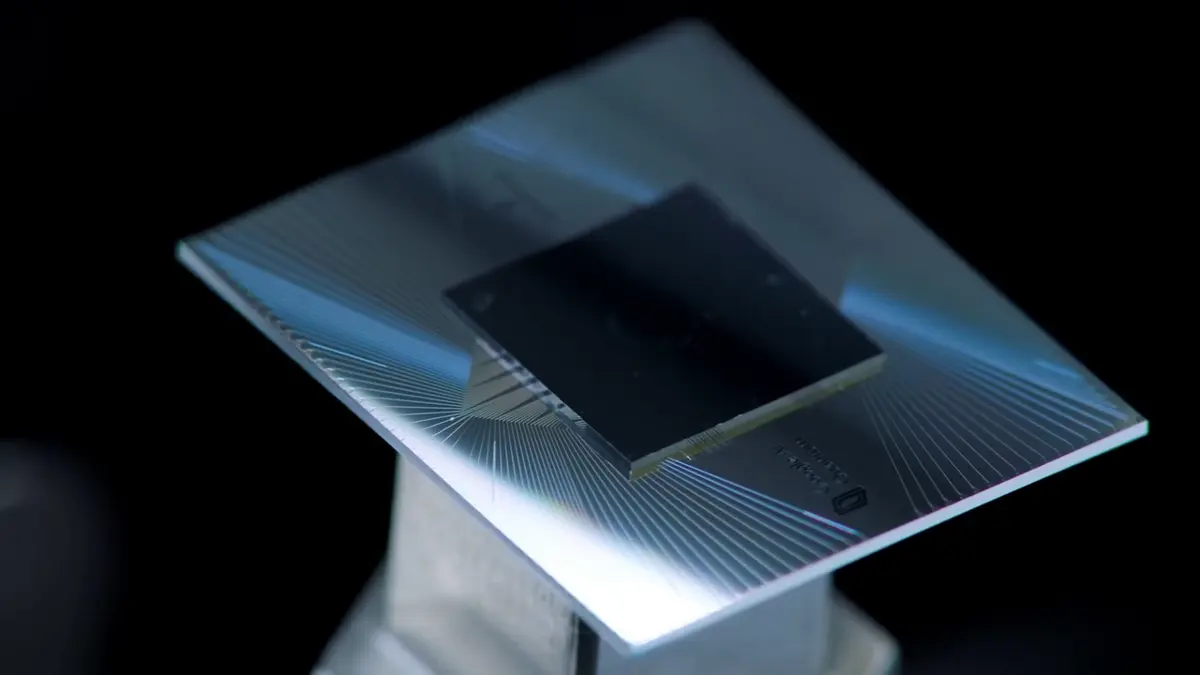
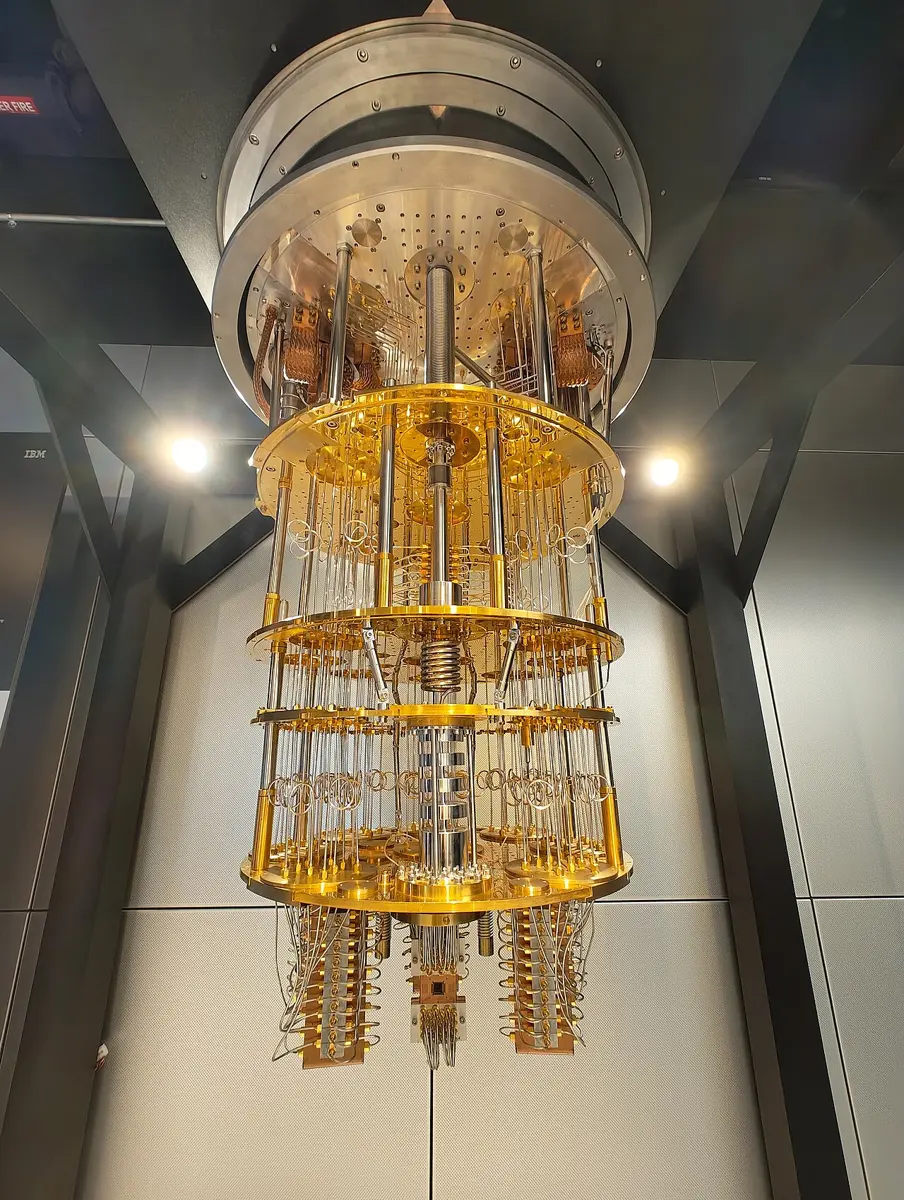
The circuit of 1985 was a natural qubit: its lowest rung can be the 0 and the next rung up the 1, and microwaves move it between them. Through the 1990s and 2000s many teams built better superconducting qubits. Devoret, at Yale University, helped invent ways to control them and read them out. Martinis built qubits at the University of California, Santa Barbara, and from 2014 led Google’s team building a quantum computer chip.
In your life today
As of October 2026, quantum computers are still experiments: they make too many mistakes for most useful work, and you can’t buy one. But the physics in this prize is already around you.
- Phones and pen drives. The memory in your phone and in a USB pen drive stores each bit by pushing electrons through a thin insulating layer, by tunneling. Every photo you save uses it.
- Measuring the brain. SQUIDs, built from Josephson junctions like Clarke’s, detect the tiny magnetic fields made by the brain’s electrical activity, hundreds of millions of times weaker than the Earth’s magnetism.
- The volt itself. The standard volt that every voltmeter is checked against is kept in national laboratories by chips with thousands of Josephson junctions in a row, because their voltage depends only on the microwave frequency and the fundamental constants of nature.
What came next
- Bigger and better quantum chips. Companies and universities around the world, including Google, where Devoret is chief scientist for quantum hardware, are building chips with more and more superconducting qubits. Their great enemy is the same one Clarke’s team fought in 1985: any tiny disturbance from outside ruins the quantum state. Correcting those errors is the main problem being worked on now.
- Other ways to build qubits. Superconducting circuits are only one way. Others use single atoms held by lasers, charged atoms (ions) in traps, or particles of light. Nobody knows yet which will win.
- How big can quantum be? The 1985 circuit was big for a quantum object, but still nothing like a cat. Physicists are now putting tiny vibrating crystals and other ever-larger objects into quantum states. Is there a size beyond which the quantum rules stop, or does it only get harder to protect them? This is one of the deepest open questions in physics.
In your science books
- Grade 9: shells and their energy, the energy ladder of an atom; electric resistance, which superconductors lose; the electromagnetic spectrum, where microwaves are.
- Grade 10: binary numbers, the bits that qubits go beyond.
- Going further: alpha decay, tunneling out of a nucleus; Einstein’s packets of light, the photons that fit the energy ladder.
Learn more
- The Nobel Prize’s own explanation: Quantum properties on a human scale (nobelprize.org), with the press release.
- The laureates’ Nobel lectures: Clarke, Devoret and Martinis.
The official reason
The prize was given “for the discovery of macroscopic quantum mechanical tunnelling and energy quantisation in an electric circuit.”