
The J/ψ particle and the charm quark
Nobel Prize in Physics, 1976: Burton Richter and Samuel Ting
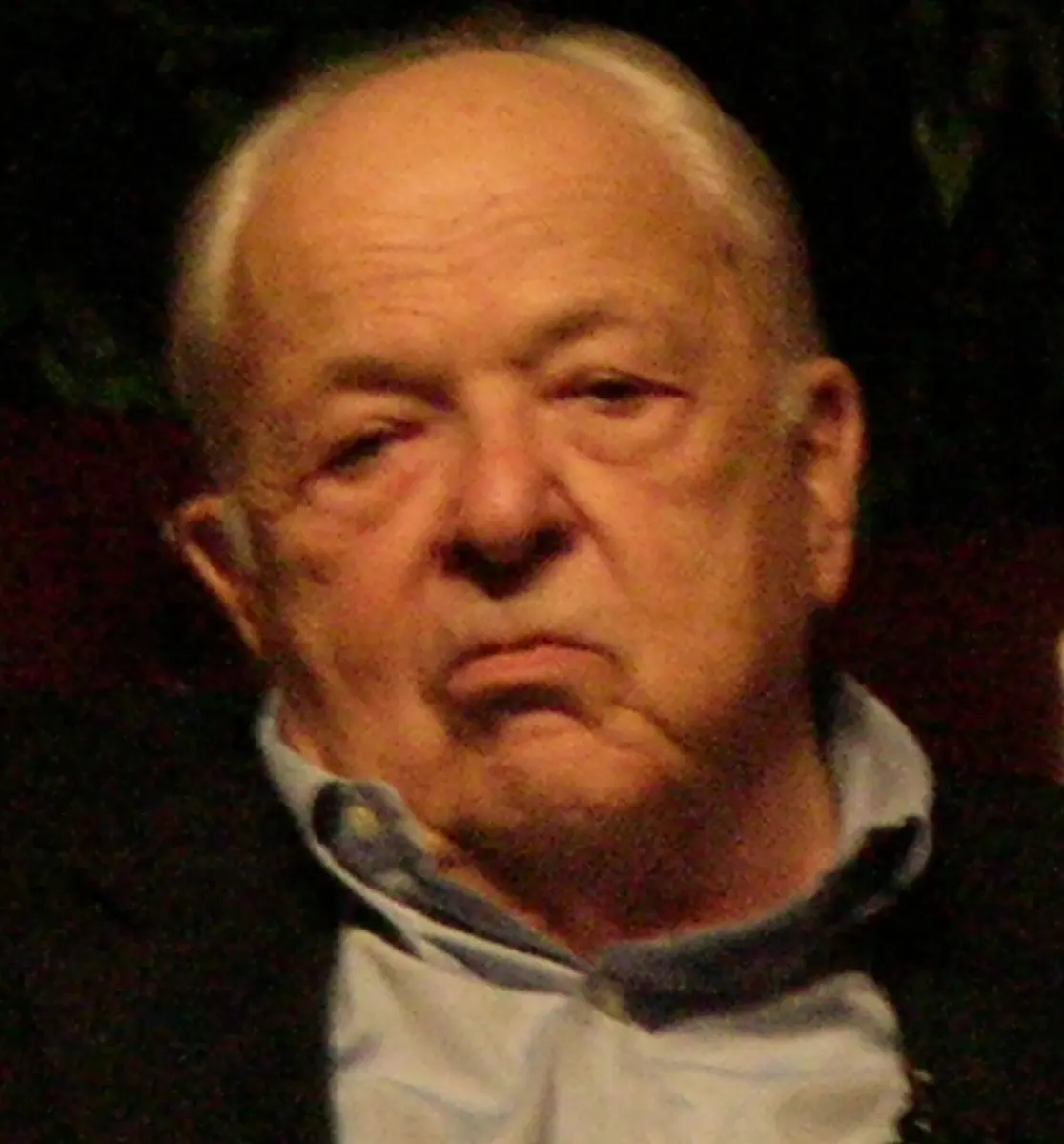
Burton Richter
1931–2018, born in New York, USA
He spent six years asking for money to build a new kind of machine, then found the particle in its first year and a half of experiments. Later he ran the whole Stanford laboratory.
Photo: BrokenSphere, CC BY-SA 3.0
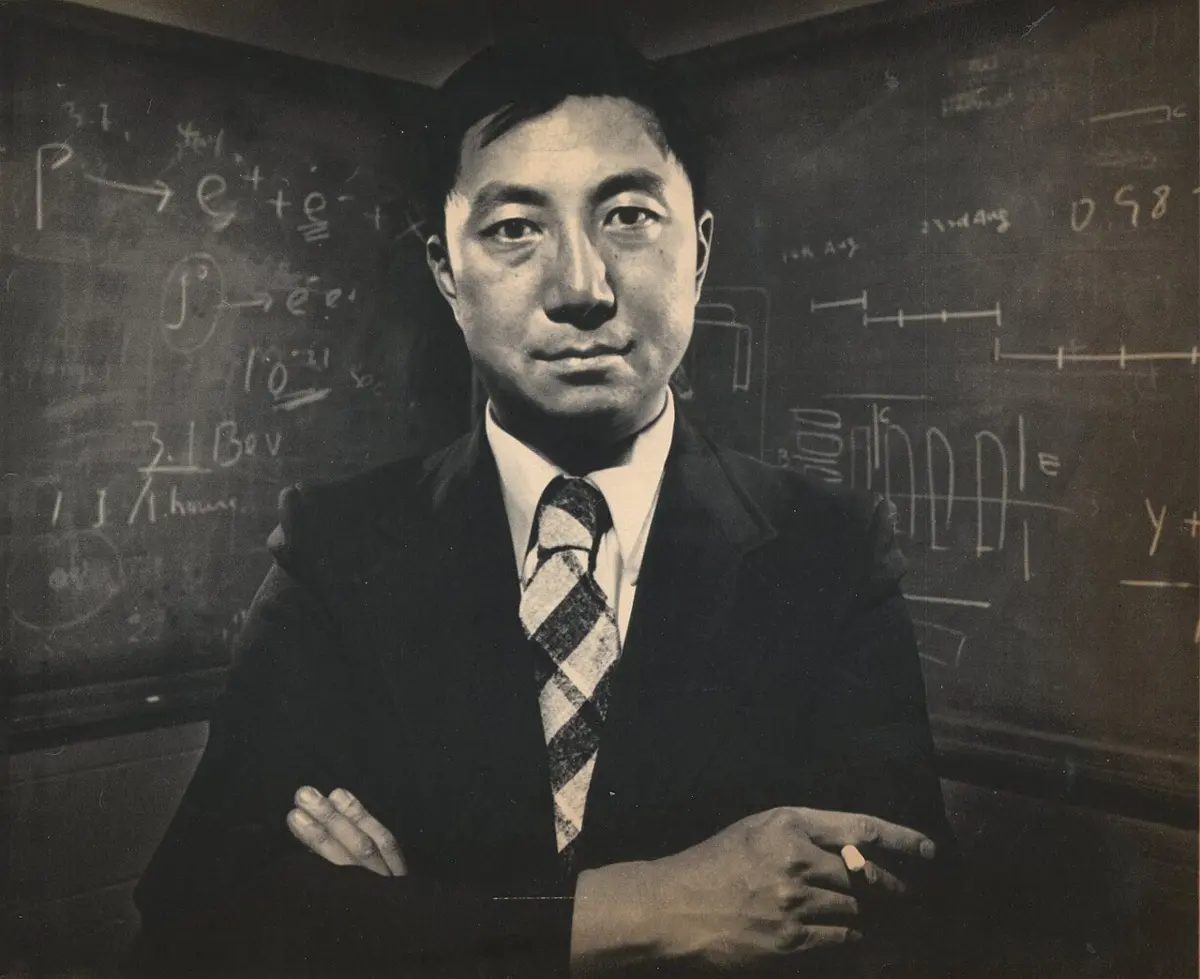
Samuel Ting
born 1936 in Ann Arbor, Michigan, USA
Born in the USA by accident while his parents were visiting, he grew up in China and Taiwan, and came back at 20 with 100 dollars and very little English.
Photo: Eddie Adams, Public domain
Your pencil, your phone and you are all made of atoms, and every atom is made of three kinds of particles: protons, neutrons and electrons. By the 1970s, physicists had found that protons and neutrons are themselves made of even smaller pieces, called quarks, and they thought three kinds of quark were enough to build everything.
Then, in one week of November 1974, two teams on opposite sides of the United States announced the same new particle. It was heavier than three protons, it lived a thousand times longer than it should have, and it fitted nowhere. It needed a fourth quark. Physicists still call that week the November Revolution. The 1976 Nobel Prize in Physics went to the two leaders, Burton Richter and Samuel Ting.
The problem: a zoo of particles
You know that an atom has a tiny nucleus of protons and neutrons, with electrons around it Grade 9: Structure of an atom. In the 1950s and 60s, physicists smashed particles together in big machines and found that many more kinds of particle could be made, for a moment, out of the energy of the crash. By the 1960s they had found more than a hundred. They called it the particle zoo.
In 1964 two physicists, Murray Gell-Mann and George Zweig, found a way to bring order to the zoo. Protons, neutrons and their many relatives, they said, are all made of a few smaller pieces, called quarks, in different combinations. Three kinds were enough:
- the up quark, with a charge of +⅔ (two-thirds of a proton’s charge);
- the down quark, with a charge of −⅓;
- the strange quark, also −⅓, found in some of the rarer particles.
A proton is two ups and a down (⅔ + ⅔ − ⅓ = +1). A neutron is one up and two downs (⅔ − ⅓ − ⅓ = 0).
A few theorists argued that there should be a fourth quark. In 1964 two of them even gave it a name: charm. In 1970 a stronger argument appeared: with a fourth quark, the theory explained why certain decays of particles that it otherwise predicted were never seen. But nobody had seen a sign of charm, and most physicists were not convinced.
A proton is made of two up quarks (charge +⅔ each) and one down quark (charge −⅓). What is its total charge?
Pick an answer to see why.
How to make a particle that isn’t there
How do you find a particle that doesn’t exist in ordinary matter? You make it, out of energy. Einstein’s E = mc² says that mass and energy are two forms of the same thing Grade 9: the mass–energy relation. Just as a little mass can be turned into a lot of energy in the Sun, a lot of energy, packed into a tiny space, can turn into the mass of new particles.
That is what a particle accelerator does. It uses electric fields to push particles to almost the speed of light, and magnets to steer them, then makes them crash. The heavier the particle you want, the more energy you need in the crash.
There is a special pair for this. Every particle has an antiparticle, of the same mass but opposite charge. The electron’s antiparticle is the positron. When an electron meets a positron, both disappear and all their energy is set free. That energy can then become new particles.
The new particles in the zoo do not last. Most heavy ones break up (decay) into lighter, familiar particles in an unimaginably short time, about a hundred-thousandth of a billionth of a billionth of a second. Physicists never see them directly. They see the pieces flying out, and work backwards.
Why it was hard
Both teams were looking for something they could not see, among enormous numbers of things they did not want.
- Ting’s problem was noise. His team fired protons at a target and looked for an electron and a positron coming out together, the pieces of a heavy particle. But each crash also sprays out a storm of other particles. For every pair they wanted there were many millions of unwanted particles. The Swedish Academy compared it to hearing a cricket chirping next to a jumbo jet taking off.
- Richter’s problem was the setting. In his machine, a new particle appears only when the energy of the collision is set exactly right. The machine could be set to more than a thousand different energies, and the new particle appeared at only one of them. Step past it, and you would never know it was there.
What they did, step by step
Samuel Ting: catching pairs at Brookhaven
Ting had spent years studying how electron–positron pairs are made, first in Hamburg, Germany, then from 1969 at the Massachusetts Institute of Technology (MIT). He believed there might be heavy particles that nobody had predicted, and he designed a detector to catch them.
- 1971–1974, building. Ting’s team set up their detector at the Brookhaven National Laboratory near New York, beside a proton accelerator about 200 meters across. Their detector was nearly 15 meters long: two “arms”, one to catch the electron and one to catch the positron, with magnets that bend each particle by an amount that depends on its energy.
- April 1974, a fright. When the beam was first switched on, the radiation in their control room was so high that a physicist would have got a whole year’s safe dose in a day. They were behind 10,000 tonnes of concrete blocks. After weeks of searching, a team member walking around with a Geiger counter found the leak: the top of the block that stops the beam had no shielding at all.
- The target. Protons with huge energy hit a target of thin plates of beryllium metal. From the directions and energies of each electron and positron caught in the two arms, the team could work out the mass of the particle they came from.
- End of August 1974, a peak. Most pairs came from all sorts of masses, but a great many came out at exactly one mass, about 3.3 times the mass of a proton. Something new was being made there.
- September–November, checking. Ting was famous for checking. They changed the magnets so the particles fell in different parts of the detector: the peak stayed at the same mass. Two separate groups analyzed the data with different computer programs, and got the same answer. They doubled the thickness of the target. Ting held back from announcing it for over two months. He called the particle J.
Burton Richter: a racetrack for electrons and positrons
Richter had a different idea. Instead of firing particles at a still target, why not make two beams crash head-on? Then none of the energy is wasted in pushing the target forward.
- 1963–1970, waiting for money. Richter, at the Stanford Linear Accelerator Center (SLAC) in California, designed a ring in which electrons and positrons would circle in opposite directions. He asked for the money in 1964 and kept asking for six years. In 1970 it came.
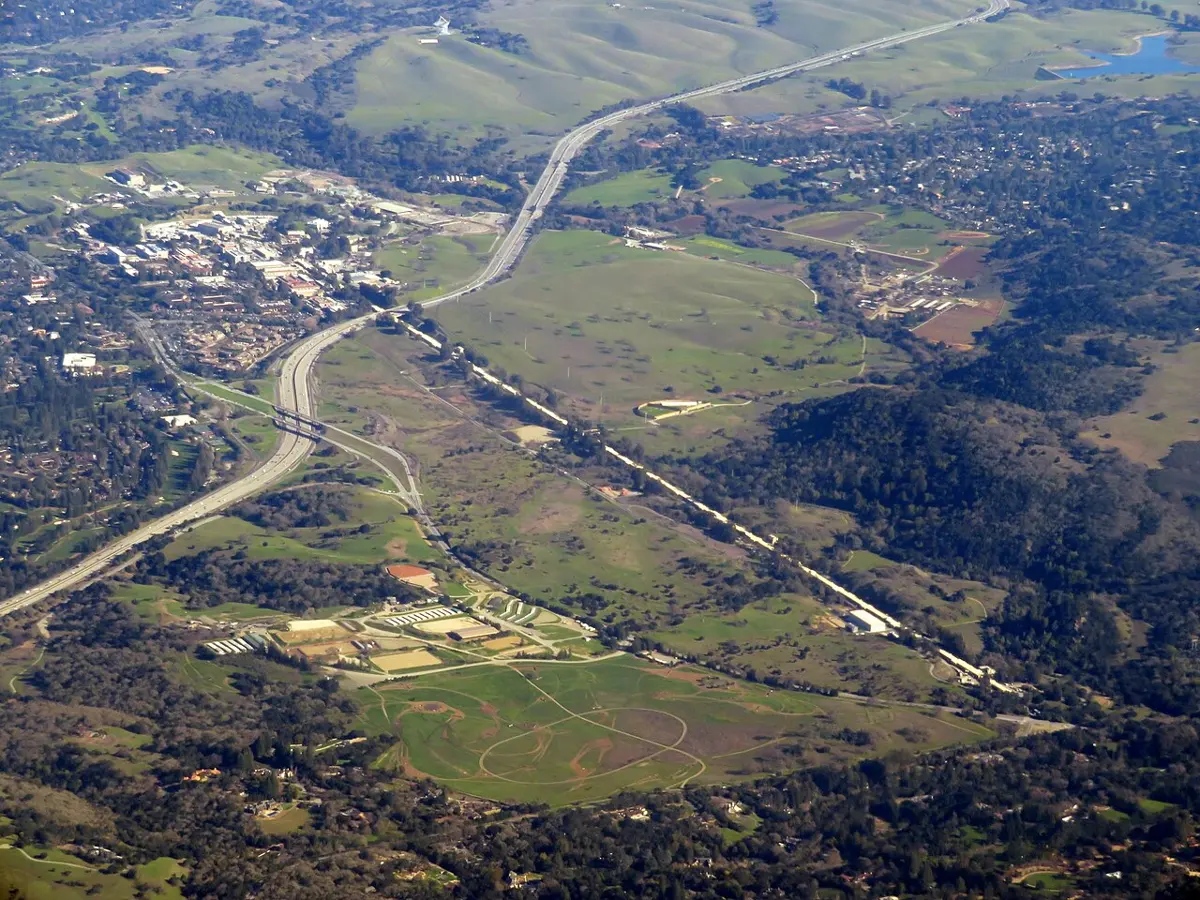
- 1972–1973, SPEAR. The ring, called SPEAR, was fed by SLAC’s 3-kilometer-long straight accelerator. Bunches of electrons and positrons went round and round, and crashed head-on inside a large detector, the Mark I, which Richter’s team from Stanford and Berkeley had built to catch particles flying out in every direction. Experiments began in 1973.
- The weekend of 9–10 November 1974. Some earlier measurements near one energy had looked odd, so the team went back to it and moved the energy up in very small steps. At one setting, the number of crashes producing showers of particles jumped about a hundred times, then fell again just above it. They called the particle ψ (psi, a Greek letter). It was the mass Ting had found.
The same particle, the same day
On Monday, 11 November 1974, Ting was at SLAC for a meeting. When he and Richter talked, each found that the other had the same particle. The two teams announced it that day, and their papers appeared together in the same issue of the journal Physical Review Letters. Within days a laboratory at Frascati, in Italy, tuned its own machine to the right energy and saw the particle too. Ten days later, Richter’s team found a second, heavier one, the ψ′.
The particle still has two names, J/ψ: both teams had found it on their own, and both names stuck.
How it works now: charm
Why was the J/ψ so strange? Two reasons.
- It was heavy: about 3.3 times the mass of a proton, heavier than any similar particle known.
- It lived too long. It decays after about 7 × 10⁻²¹ seconds. That sounds short, but it is about a thousand times longer than a particle like it should have lasted. The presentation speech compared it to finding a pyramid twice as heavy as the biggest one known, yet a thousand times narrower and taller.
Within weeks, theorists had the answer. The J/ψ is a charm quark joined to its antiparticle, a charm antiquark. Charm quarks are heavy, which is why the J/ψ is heavy. To decay into ordinary particles, the charm and anticharm must first destroy each other, and that turns out to be difficult, which is why it lives so long. It is a bit like a tiny atom with two heavy balls going round each other.
The final proof came in 1976. If charm quarks exist, there should also be particles with one charm quark joined to a lighter quark. Richter’s collaboration found them at SPEAR that year, at about the masses predicted. They are called D mesons.
The J/ψ is made of a charm quark and a charm antiquark. What is its electric charge?
Pick an answer to see why.
Why did Richter need to set the energy of his machine so exactly?
Pick an answer to see why.
In your life today
Nobody uses charm quarks to make anything. What changed your life is the machines and the knowledge.
- X-rays for medicine and materials. Particles going round a ring give off a very bright beam of X-rays. While SPEAR was being built, two Stanford scientists asked Richter to add a window to let those X-rays out. It became one of the first laboratories of its kind. Such “synchrotron light” is now used around the world to see the shapes of proteins and design new medicines.
- Accelerators in hospitals. Smaller electron accelerators treat cancer. B. P. Koirala Memorial Cancer Hospital in Bharatpur has several, aiming beams of X-rays made by fast electrons at tumors.
- Antimatter in scans. PET scans, used to find cancers, work by detecting the flash of energy when positrons, made by a medicine, meet electrons in the body: the same meeting that made the ψ in Richter’s ring.
What came next
- Six quarks. In 1975 Martin Perl, also working at SPEAR, found a heavy cousin of the electron, the tau (the 1995 prize). In 1977 a team at Fermilab found a fifth quark, bottom, in the same way the J/ψ was found: a heavy quark joined to its antiquark. The sixth, top, was found in 1995. Together with the electron and its cousins, they make the Standard Model, the list of the building blocks of all matter.
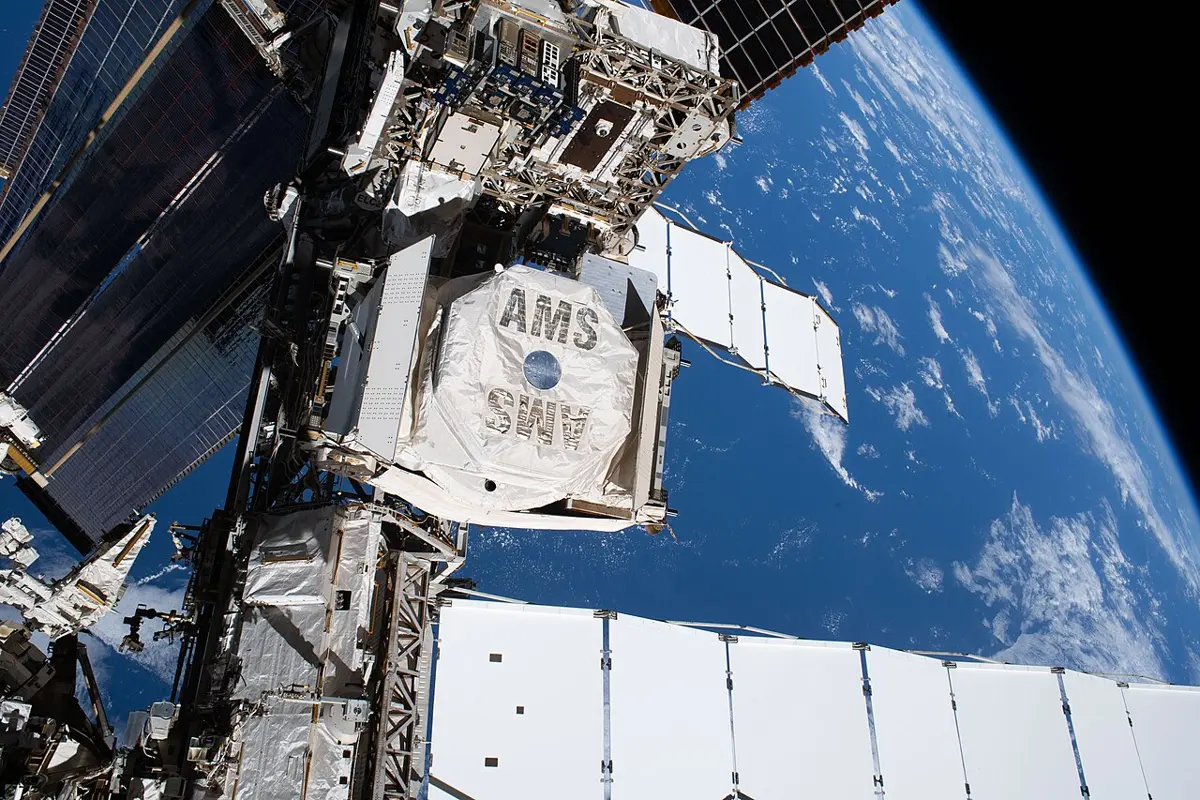
- Ting in space. Since 2011 a detector led by Ting, the Alpha Magnetic Spectrometer, has been fixed to the outside of the International Space Station, measuring billions of cosmic-ray particles. It is looking for traces of antimatter from space and of dark matter, the unseen matter whose gravity holds galaxies together.
- An open question. When the universe began, matter and antimatter should have been made in equal amounts and destroyed each other. Yet everything around us is matter. Why there was a little more matter than antimatter is still not known.
In your science books
- Grade 8: inside an atom: protons, neutrons and electrons.
- Grade 9: the structure of an atom, radioactivity and the mass–energy relation, E = mc².
- Grade 10: the magnetic effect of electric current (how magnets steer charged particles) and the Big Bang.
- Going further: mass into energy, in “What happens inside a nucleus when it decays?”
Learn more
- The Nobel Prize’s press release and presentation speech.
- The laureates’ Nobel lectures: Richter and Ting.
- Samuel Ting’s banquet speech, to students from developing countries.
The official reason
The prize was given “for their pioneering work in the discovery of a heavy elementary particle of a new kind.”