
HPV, cervical cancer and HIV
Nobel Prize in Physiology or Medicine, 2008: Harald zur Hausen, Françoise Barré-Sinoussi, and Luc Montagnier

Harald zur Hausen
1936–2023, born in Germany
When he first said that a wart virus could cause cancer, a conference full of experts received it coldly. He spent ten years proving it.
Photo: Kuebi = Armin Kuebelbeck, CC BY-SA 3.0

Françoise Barré-Sinoussi
born 1947 in France
She chose science over medicine because the course was shorter and cheaper for her family, and started at the Pasteur Institute as an unpaid volunteer.
Photo: MHM55, CC BY-SA 4.0

Luc Montagnier
1932–2022, born in France
The head of the virus laboratory at the Pasteur Institute in Paris, whose team found the AIDS virus within months of starting to look.
Photo: Danica Bijeljac, CC BY-SA 3.0 igo
You have probably had a vaccine against measles, a disease caused by a virus. But can a virus cause cancer? And can a virus attack the very cells that are meant to fight viruses?
The 2008 Nobel Prize in Physiology or Medicine was given for the discovery of two viruses that do these things. Half went to Harald zur Hausen, who showed that the human papilloma virus (HPV) causes cervical cancer. The other half went to Françoise Barré-Sinoussi and Luc Montagnier, who discovered the human immunodeficiency virus (HIV), the cause of AIDS. Because of them, there is now a vaccine that prevents a cancer, and medicines that let people with HIV live long lives.
The problem: two hidden killers
A cancer with no known cause
A virus is a tiny packet of genes in a coat of protein, far smaller than a bacterium Grade 8: Virus. It cannot grow or multiply on its own. It must get inside a living cell and make the cell build new copies of it.
Cervical cancer is a cancer of the cervix, the narrow opening at the bottom of the womb. In 2008 it was the second most common cancer in women in the world. Cancer happens when cells keep dividing when they should stop Grade 10: Mitosis. In the 1970s, most experts thought cervical cancer was caused by a common virus called herpes simplex, but nobody could prove it.
A new disease
In 1981, doctors in the United States reported young men falling ill with rare infections that a healthy body normally fights off easily. Their immune system, the body’s defense against germs, had failed. The disease was named AIDS, acquired immune deficiency syndrome. It also appeared in people who had received blood transfusions, in babies born to sick mothers, and in people with hemophilia, whose blood does not clot and who need treatments made from donated blood. That pointed to a germ carried in blood, small enough to pass through the filters used to clean blood products: very likely a virus. Nobody knew which.
What they did, step by step
Zur Hausen: fishing for a virus’s DNA
Some viruses join their genes into the DNA of the cell they infect. Once there, they can stay hidden for years, making no new viruses at all. Harald zur Hausen, a German doctor, reasoned that if a virus caused cervical cancer, its DNA should be inside every cancer cell, even if no virus could be seen.
- 1974, an unwelcome idea. At a meeting he reported that he had looked for herpes DNA in cervical cancers and found none. He suggested looking for papilloma viruses instead, the viruses that cause warts on the skin. The other scientists were not interested.
- Fishing with DNA. DNA is made of two strands that stick together only where their letters match: A with T, C with G Grade 10: DNA. So a single strand of a virus’s DNA can be used as bait: it sticks only to matching DNA in a sample, the way the hook side of Velcro sticks only to the loop side. Zur Hausen made bait from the DNA of wart viruses.
- Years of failure. The bait worked on warts but found nothing in cervical cancers. There are many types of papilloma virus, and the one in the cancers was different. He changed his method so that the bait could stick even to DNA that matched only roughly.
- 1983–84, HPV16 and HPV18. After about ten years he found a new type of HPV in cervical cancer cells, which he named HPV16, and the next year a second, HPV18. Together they turned up in about 70% of cervical cancers all over the world.
- How it causes cancer. His group showed that two genes of the virus, called E6 and E7, are always active in the cancer cells. A cell has brakes, proteins that stop it dividing when it shouldn’t, or make it destroy itself if something has gone wrong. The virus’s proteins switch these brakes off, so the infected cell keeps dividing.
He sent samples of HPV16 and HPV18 freely to any scientist who asked, and that is what made a vaccine possible.
Why did zur Hausen look for the virus’s DNA inside the cancer cells, instead of looking for whole viruses?
Pick an answer to see why.
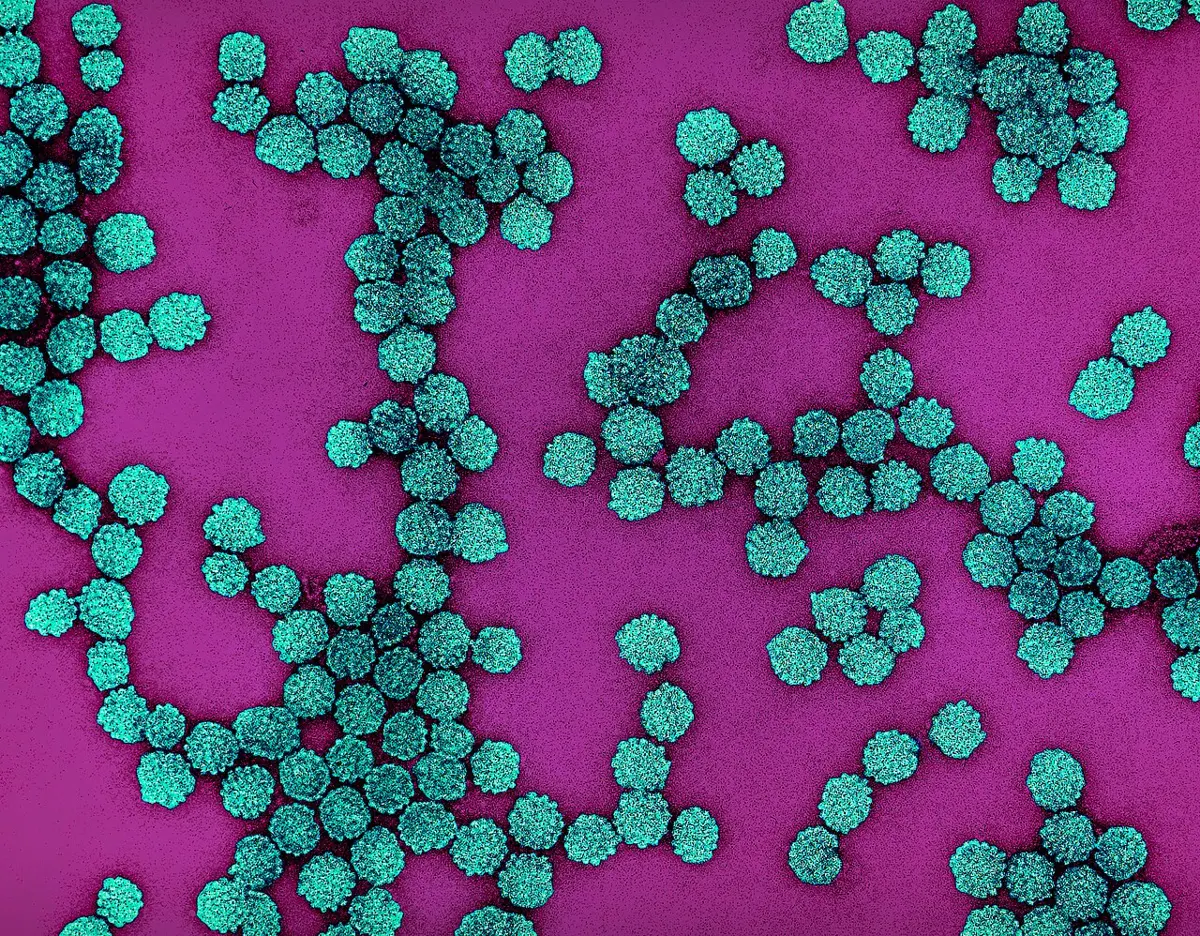
Barré-Sinoussi and Montagnier: catching HIV
At the Pasteur Institute in Paris, Luc Montagnier led a laboratory that studied retroviruses, and Françoise Barré-Sinoussi was an expert at detecting them. A retrovirus carries its genes as RNA, not DNA Grade 10: RNA. Inside a cell it uses a special enzyme, reverse transcriptase, to copy its RNA into DNA, the opposite of the usual direction. That enzyme is the retrovirus’s fingerprint.
- December 1982, a clever choice. Doctors in Paris asked them to look for a virus in AIDS patients. Patients in the late stage of AIDS had very few of the white blood cells the virus attacks. So the team chose a patient at an early stage, with swollen lymph nodes (small glands where white blood cells gather), and took a small sample of a lymph node, in January 1983.
- January 1983, the fingerprint. They grew the cells in dishes and tested the liquid every few days. In the second week, Barré-Sinoussi detected weak reverse transcriptase activity, which rose a few days later. A retrovirus was there.
- Saving the virus. Then the cells started dying, and the activity fell. The team added fresh white blood cells from a blood donor. These were infected in turn, and the virus kept growing. That was itself a clue: earlier human retroviruses made white blood cells grow out of control, but this one killed them.
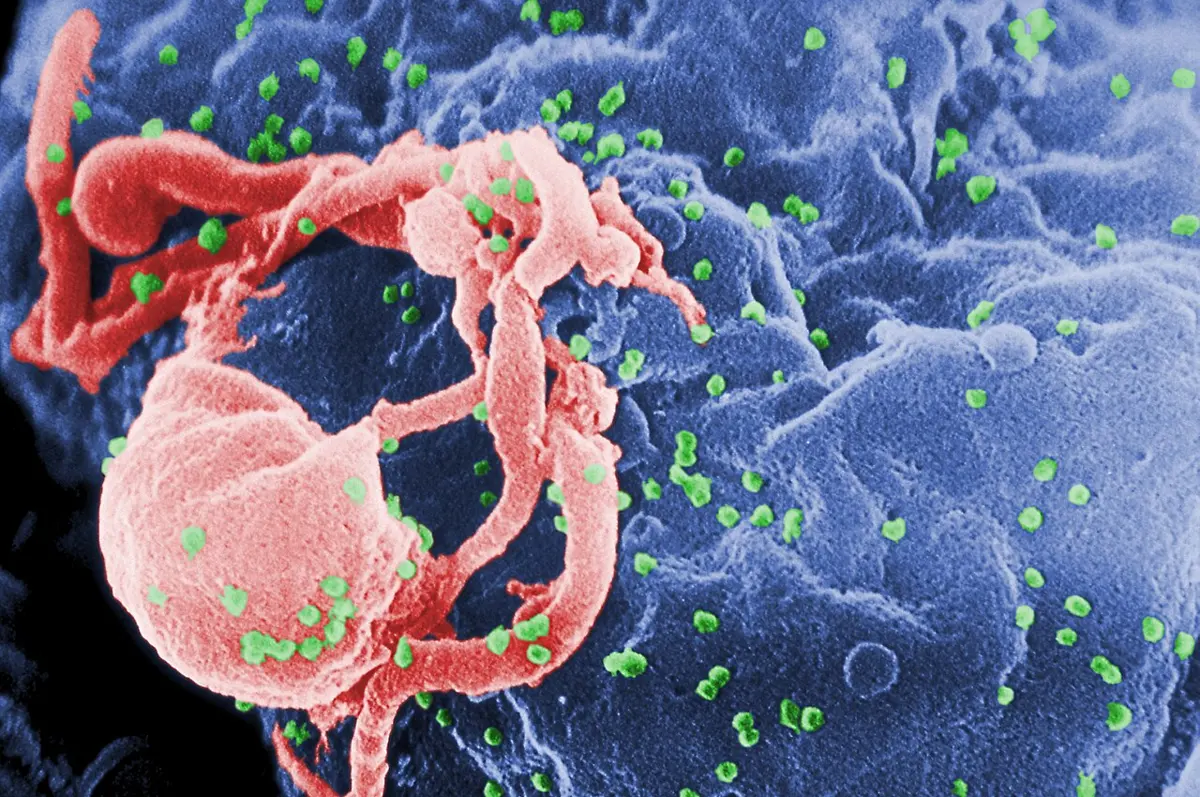
- Seeing it. With an electron microscope they photographed new virus particles budding off the infected cells. They published their discovery in the journal Science on 20 May 1983.
- 1983–84, more cases. They found the same virus in people from every group that was getting AIDS, and showed that it infects and kills T helper cells, the white blood cells that organize the immune system’s attack Grade 10: Blood corpuscles. In 1986 it was given the name it has today, HIV.
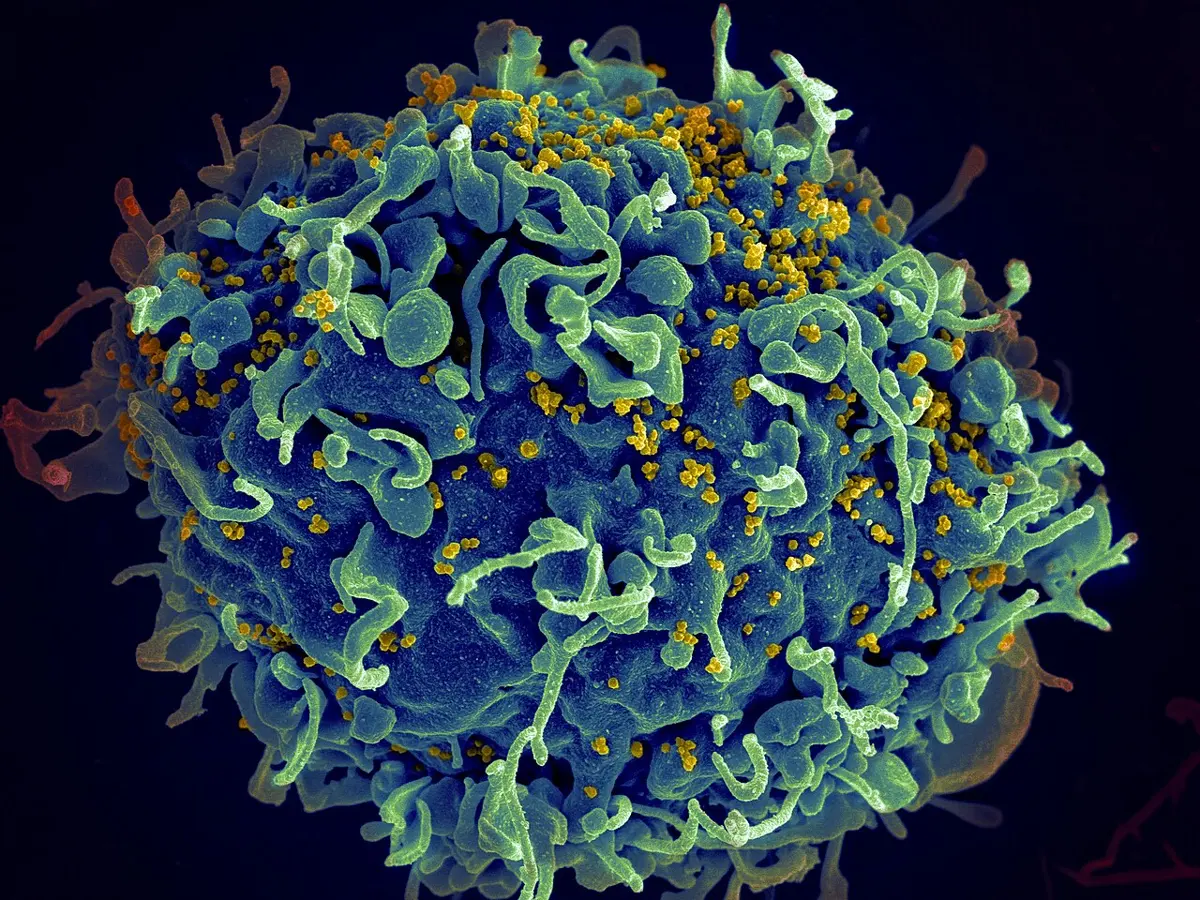
How the discoveries are used now
A vaccine that prevents a cancer
Zur Hausen’s work showed that cervical cancer starts with an infection. Infections can be prevented by vaccines. The first HPV vaccines were approved in 2006. They are made from the virus’s outer coat proteins only, assembled into empty shells that look like the virus but contain no genes, so they cannot cause infection. The body learns to recognize the coat and destroys real HPV before it can get into cells.
HPV spreads by close skin-to-skin contact during sex, and almost everyone who has sex catches it at some point. That is why the vaccine is given at age 9 to 14, well before anyone could be infected. Since 2022 the World Health Organization has said one dose is enough for this age.
Why is the HPV vaccine given to girls aged 9–14, and not to women at 40, when cervical cancer usually appears?
Pick an answer to see why.
Medicines for HIV
Knowing the virus meant scientists could test blood for it, so donated blood became safe again, and could read its genes and find its weak points. The first HIV medicine was approved in 1987. From 1996, doctors began to give three medicines together, each blocking a different step. The virus can quickly change and become resistant to one medicine, but it almost never manages all three at once (Why two drugs at once). A person with HIV who takes these medicines every day can now expect a nearly normal lifespan. The medicines cannot remove the DNA hidden in the cells, so they must be taken for life.
In your life today
- Nepal’s HPV vaccine. On 4 February 2025, World Cancer Day, Nepal began giving the HPV vaccine to schoolgirls in Grades 6–10 and to girls aged 10–14 who are not in school. According to the WHO, more than 1.46 million girls were vaccinated in the campaign, and it is now given every year to girls in Grade 6. Cervical cancer is one of the most common cancers among women in Nepal, so this will save many lives.
- Screening. The WHO advises women to be tested for cervical changes from about age 30. Changed cells found early can be treated simply, long before they become cancer.
- HIV worldwide. About 40.8 million people were living with HIV in 2024, and about 630,000 died of AIDS-related illnesses that year, far fewer than at the worst of the epidemic (UNAIDS, as of 2024). HIV spreads only through blood, sex and from mother to baby, never by touching, hugging, sharing food or mosquito bites. A mother with HIV who takes the medicines can almost always have a baby without HIV.
What came next
- Fewer cancers. In Sweden, women vaccinated against HPV before the age of 17 had about 88% fewer cervical cancers than women who were not. The WHO hopes cervical cancer can one day become rare in every country.
- Other cancers from viruses. About one cancer in eight in the world is started by an infection; HPV alone also causes some cancers of the throat and other parts of the body, in men too. Other viruses cause liver cancer, for which there is also a vaccine (hepatitis B).
- A cure for HIV? A handful of people have been cured of HIV, after bone-marrow transplants for cancer from donors whose cells HIV cannot enter. That is far too dangerous for ordinary use. Scientists are still searching for a way to clear the hidden DNA from the body, and for a vaccine against HIV, which changes so fast that every attempt so far has failed. These are open questions.
In your science books
- Grade 8: viruses and the effects of microorganisms.
- Grade 10: cell division (mitosis), DNA, RNA and white blood cells.
- Going Further (Grades 9–12): how a gene makes a protein, and why two drugs at once beat resistance.
Learn more
- The Nobel Prize’s own explanation: Two discoveries of viruses that cause serious diseases (nobelprize.org).
- The Nobel lectures: zur Hausen, Barré-Sinoussi and Montagnier.
The official reason
The prize was given “for his discovery of human papilloma viruses causing cervical cancer.”
The prize was given “for their discovery of human immunodeficiency virus.”