
Koch: catching the germ of tuberculosis
Nobel Prize in Physiology or Medicine, 1905: Robert Koch
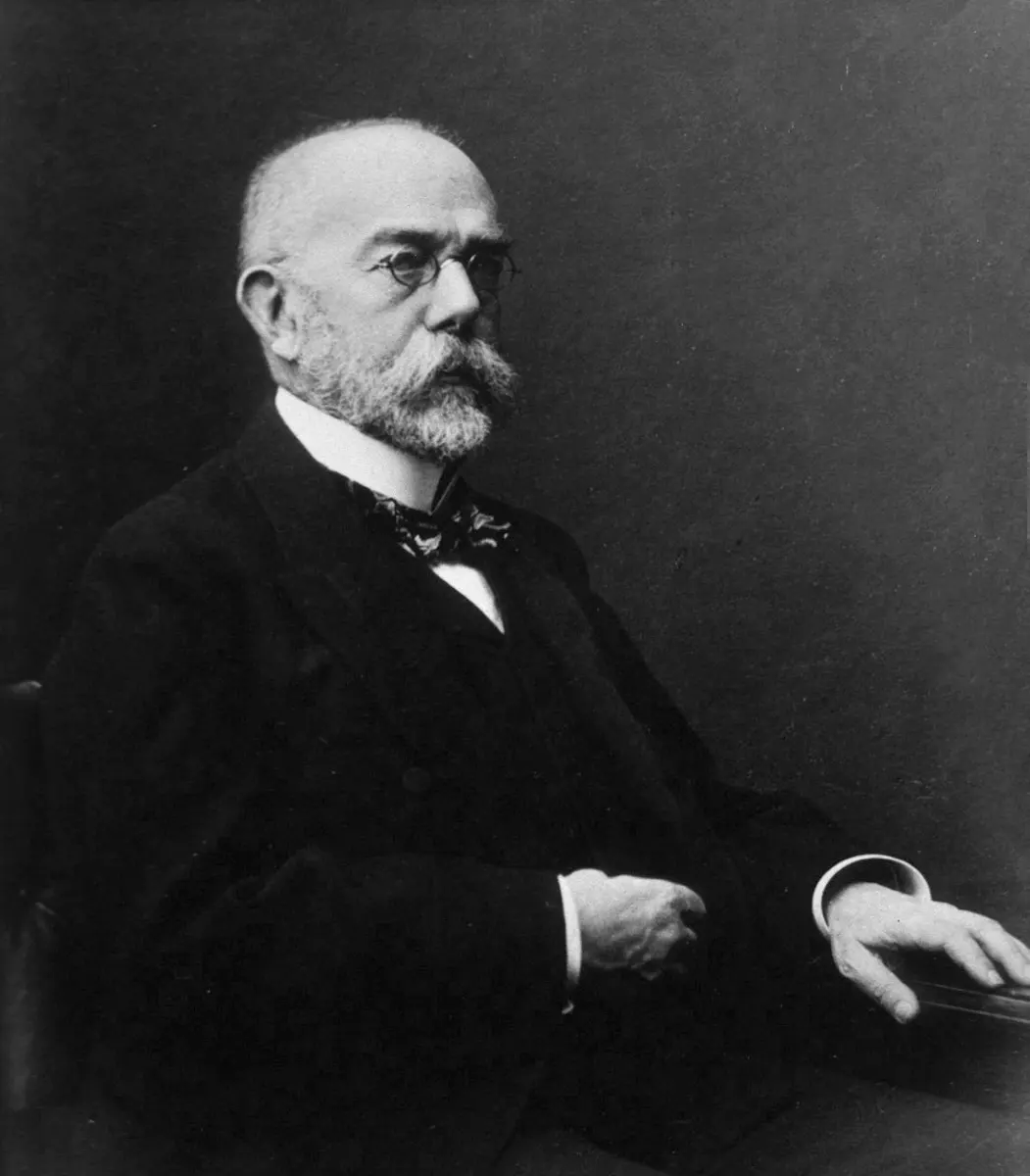
Robert Koch
1843–1910, born in Germany
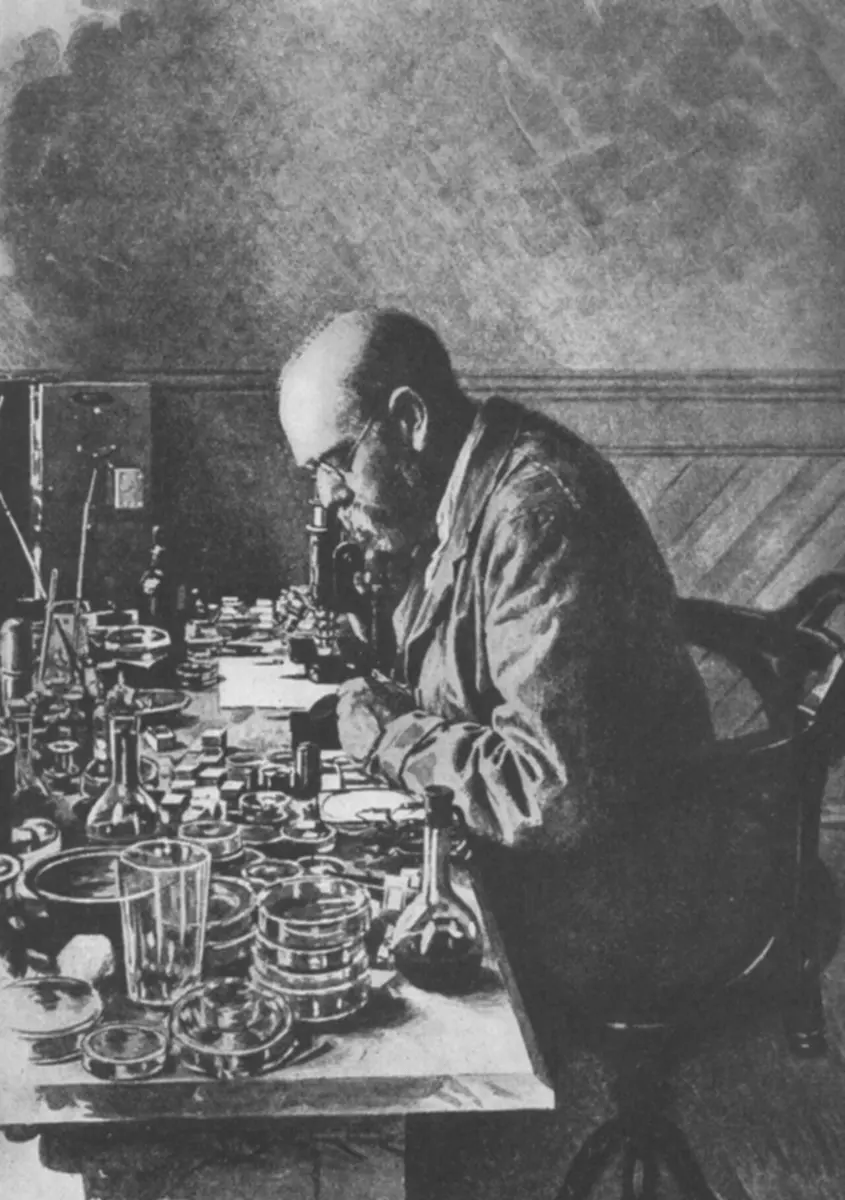
A country doctor who began his research in his own home, with a microscope his wife had given him.
Photo: Unknown author, Public domain
If a person in Nepal has a cough that goes on for more than two weeks, health workers say: get your sputum tested. Sputum is the thick mucus coughed up from deep in the chest. A laboratory spreads a little of it on a glass slide, stains it with dyes and looks at it under a microscope. They are looking for a germ that a German doctor, Robert Koch, first saw in 1882: the germ of tuberculosis, or TB.
In Koch’s time, TB killed more people than any other disease. He found its cause, showed how to prove it, and won the Nobel Prize in Physiology or Medicine in 1905.
The problem: a disease that killed one person in seven
TB usually attacks the lungs. A person with TB of the lungs coughs for weeks, then coughs up blood. They have fevers, sweat at night, and grow thinner and thinner. In English it used to be called consumption, because it seemed to eat people away.
In 1882 Koch wrote that one in seven of all human deaths was caused by TB, and among young adults, one in three or more. It was far worse than plague or cholera, the diseases people feared most.
Yet nobody knew what caused it. Many doctors thought it ran in families, or came from bad air, damp houses or poverty. Some experiments had shown that TB could be passed to animals, but other scientists disagreed, and nobody had found a germ.
How germs were thought of in the 1870s
The French chemist Louis Pasteur had shown that tiny living things, microbes, make wine go sour and meat rot Grade 8: Microorganism. Many scientists suspected that microbes also cause diseases. But it was very hard to prove.
- Everything is covered in bacteria. A sick person’s body has many kinds of bacteria in it. Which one, if any, causes the disease?
- Cause or result? If you find bacteria in a sick person, perhaps the disease came first and the bacteria just grew in the damaged body.
- They all look alike. Under the microscopes of the time, many bacteria (single-celled microbes, Bacteria) are just tiny rods or dots. Different scientists described different bacteria in the same disease.
Why TB was so hard
Even with good methods, the TB germ was especially hard to catch.
- It is tiny. Koch found it to be a thin rod, a quarter to a half as long as the width of a red blood cell: a few thousandths of a millimeter.
- It hides from dyes. Its outside is coated in a waxy layer, so the ordinary dyes that color other bacteria did not stick to it. Others had looked at TB under the microscope and seen nothing.
- It grows very slowly. Many common bacteria double every half an hour or so, and a dish of them is full of spots in a day. The TB germ divides only about once a day. It takes weeks before anything can be seen growing.
What he did, step by step
A doctor’s home laboratory: anthrax (1873–1876)
Koch was a country doctor in Wollstein, a small town then in Germany and now in Poland. Anthrax, a disease that killed sheep and cattle (and sometimes people), was common among the farm animals there. Other scientists had already seen rod-shaped bacteria in the blood of animals that died of it.
Koch had no laboratory, no library and no scientific colleagues. His laboratory was part of his family’s four-room flat. Between patients, he:
- took the rods from the spleens of dead animals and put them into mice with a thin sliver of wood: the mice died of anthrax. Mice given material from healthy animals did not;
- grew the rods for several generations outside any animal, in fluid from the eye of an ox, watching them under the microscope. He saw them form tough spores that can survive for years in the soil, then turn back into rods;
- showed that even rods grown for many generations outside an animal still caused anthrax.
In 1876 this was published. It was the first proof that one particular kind of bacterium causes one particular disease.
New tools (1877–1881)
Koch then invented much of what microbiologists still do.
- Stains and photographs. He dried bacteria on glass slides, colored them with dyes so they stood out, and photographed them through the microscope, so that others could see exactly what he saw.
- Solid food for bacteria. In a liquid, different bacteria mix together. Koch grew them on a solid surface, first a slice of boiled potato, later a jelly. Each single bacterium then grows into its own little heap, a colony, made only of its descendants: a pure culture. The jelly used today, agar, made from seaweed, was suggested to Koch’s team by Fanny Hesse, the wife of one of his assistants, who used it in her kitchen to set puddings. The round glass dish it is poured into was designed by another assistant, Julius Petri.
In 1880 Koch moved to Berlin to work for the government’s new health office, with a proper laboratory and assistants.
The TB germ (1881–1882)
Koch then turned to TB, working mostly on his own.
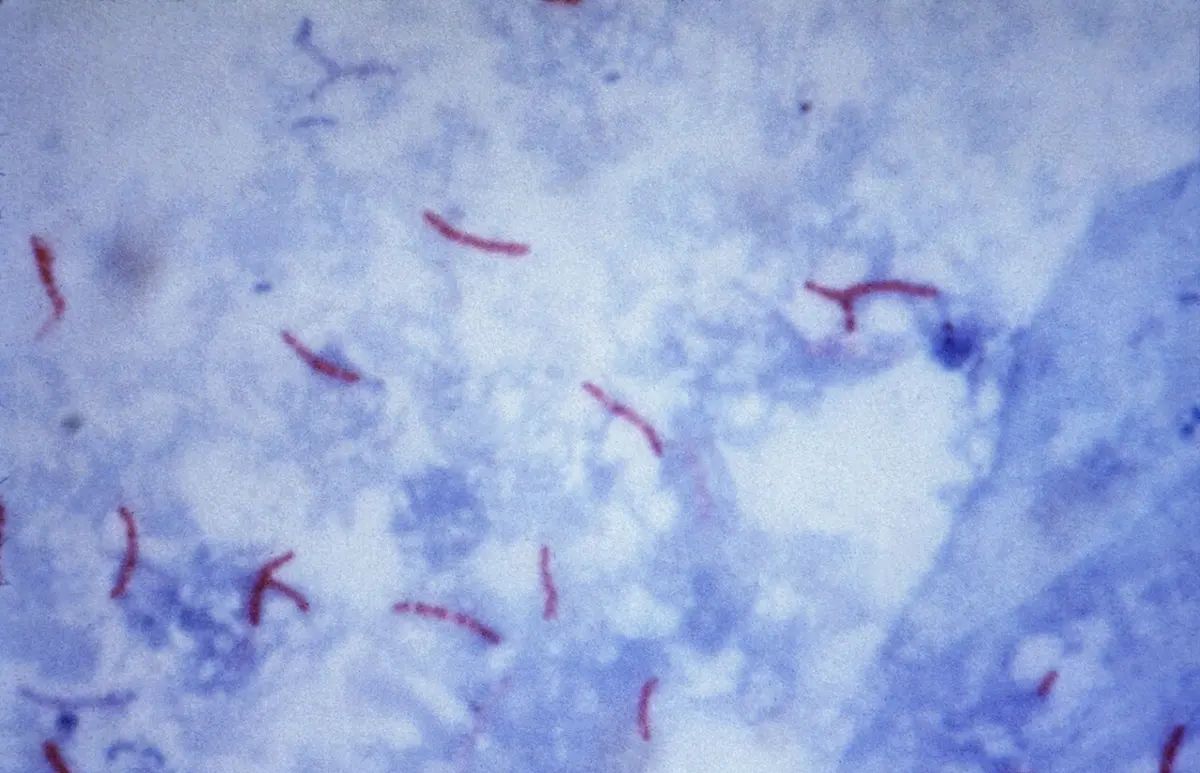
- Making it visible. He left the slides in a blue dye, methylene blue, with a little alkali added, for many hours. Then he stained them again with a brown dye. The brown dye washed the blue out of everything else, but not out of the waxy TB germs. Under the microscope, the body’s cells were brown and the germs were bright blue, “so striking”, he wrote, that even a few could be found with certainty.
- Finding it every time. He found the blue rods in every case of TB he examined, in people and in animals, in the lungs and in other organs. He did not find them in healthy tissue.
- Growing it pure. On ordinary jelly they would not grow. He used blood serum (the clear liquid part of blood), heated until it set like jelly, and kept the dishes at body temperature. After weeks of waiting, tiny colonies appeared. He grew them on, generation after generation, until no trace of the original sick tissue could be left.
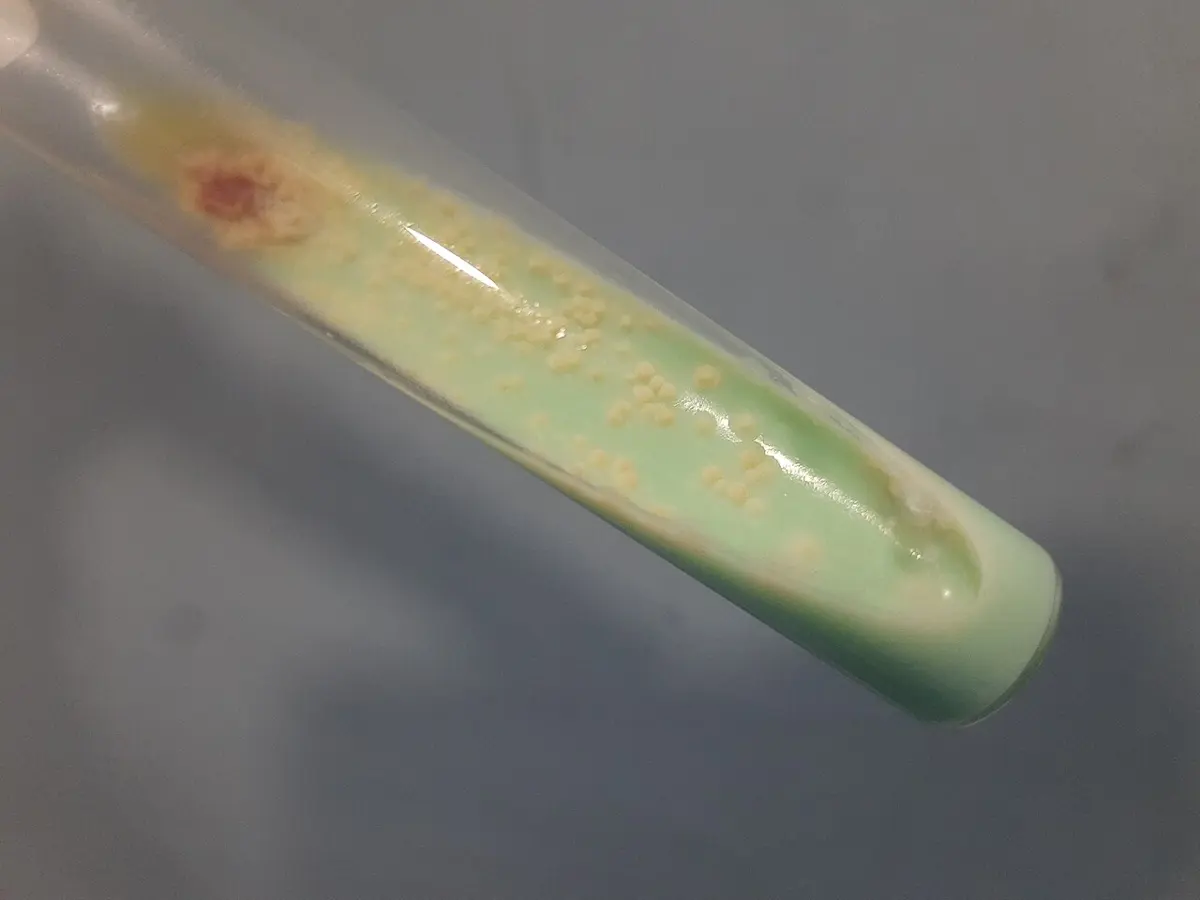
- Causing the disease. He put these pure germs into healthy guinea pigs and rabbits. They all got TB, and the same blue-stained rods were found in them.
On the evening of 24 March 1882, Koch read his paper to the Physiological Society in Berlin. He had brought his microscopes and slides, so that everyone could see the blue rods for themselves. World TB Day is held every year on 24 March, the date of this talk.
Why did Koch keep growing the TB germs on serum for generation after generation before putting them into healthy animals?
Pick an answer to see why.
Koch’s rules: how to prove a germ causes a disease
Koch’s way of working became a set of rules, now called Koch’s postulates. They are usually written as four steps:
- The germ is found in every case of the disease (and not in healthy bodies).
- The germ is taken from the sick body and grown on its own, as a pure culture.
- The pure germ, put into a healthy animal, causes the same disease.
- The same germ is found again in the newly sick animal.
Using these methods, Koch and his students found the germs of many more diseases. In 1883–1884 Koch himself, in Egypt and India, found the germ that causes cholera, and showed that it spreads through dirty drinking water.
The rules have limits, as we now know. Some people carry a germ without falling ill; some germs, like viruses, cannot be grown on jelly at all. But the idea behind them, that you must prove the cause and not just find it nearby, is still the heart of medical science.
Koch’s mistakes
Koch was a great scientist, and he also got things wrong.
- Tuberculin (1890). Koch announced that a liquid made from TB germs, tuberculin, could cure TB. Thousands of patients traveled to Berlin. It did not cure them, and some got worse. His reputation suffered. But tuberculin turned out to be useful in another way: injected into the skin, it makes a red bump in people who carry the TB germ. A skin test like this is still used today.
- TB from cattle (1901). Cattle get a kind of TB too. Koch rightly found that the cattle germ is different from the human one, but he went further and said it was almost harmless to people. That was wrong: cattle TB can pass to people, especially children, through raw milk. That is one reason milk should be boiled.
How TB works now
- The germ is a bacterium called Mycobacterium tuberculosis.
- It spreads through the air. When a person with TB of the lungs coughs, sneezes or even talks, they send out tiny droplets with germs in them, which someone else breathes in. Koch himself pointed out that crowded, dark, airless rooms make TB spread.
- Most people who breathe it in do not get ill. Their white blood cells surround the germs and wall them off Grade 10: White blood cells. About a quarter of all the people in the world carry sleeping TB germs like this. Some of them become ill later, especially if their body’s defenses get weak.
- TB is curable. The usual treatment is four medicines taken together, every day, for six months. It must be finished: stopping early, as soon as you feel better, lets the toughest germs survive and become drug-resistant.
A person with TB starts treatment and feels much better after two months. What should they do?
Pick an answer to see why.
In your life today
- TB is still here. In 2024, about 10.7 million people in the world fell ill with TB, and about 1.2 million died: still more than from any other single infection (WHO, as of 2025).
- TB in Nepal. Nepal’s first national TB survey, in 2018–2019, found about 117,000 people living with TB, many more than had been thought. In Nepal, TB tests and treatment are free at government health posts and hospitals.
- Know the signs. A cough for more than two weeks, fever, sweating at night, weight loss or coughing blood: get checked. Cover your mouth when you cough, and open the windows.
- BCG. Babies in Nepal get the BCG vaccine soon after birth. It protects young children against the most dangerous forms of TB.
- The test Koch made possible. Sputum is still stained and looked at under a microscope, using a stain improved from Koch’s; the germs show up red on blue. Many laboratories in Nepal now also use machines that find the germ’s DNA in two hours.
What came next
- A vaccine (1921). In France, Albert Calmette and Camille Guérin weakened a cattle TB germ over thirteen years of growing it, and made BCG, still the only TB vaccine in use.
- A cure (1943–1944). Streptomycin, the first medicine that killed the TB germ, was found in a soil microbe (Streptomycin). Soon several medicines were used together, which made a cure possible.
- Drug-resistant TB. Germs that survive the usual medicines are much harder to treat (What an antibiotic does).
- An open question: a better vaccine. BCG protects young children well but does not stop adults getting TB of the lungs, the kind that spreads. More than a hundred years after Koch, scientists are testing new vaccines in large trials. Can TB be ended?
In your science books
- Grade 8: Bacteria and the harmful effects of microorganisms, including diseases like TB.
- Grade 9: Kingdom Monera, the bacteria.
- Grade 10: White blood cells, the body’s defense.
- Going further: Why do antibiotics stop working?
Learn more
- The prize at nobelprize.org: The Nobel Prize in Physiology or Medicine 1905, with the presentation speech.
- Koch’s own Nobel lecture, “The current state of the struggle against tuberculosis”.
The official reason
The prize was given “for his investigations and discoveries in relation to tuberculosis.”