
Penicillin: the mold that cures
Nobel Prize in Physiology or Medicine, 1945: Alexander Fleming, Howard Florey, and Ernst Boris Chain
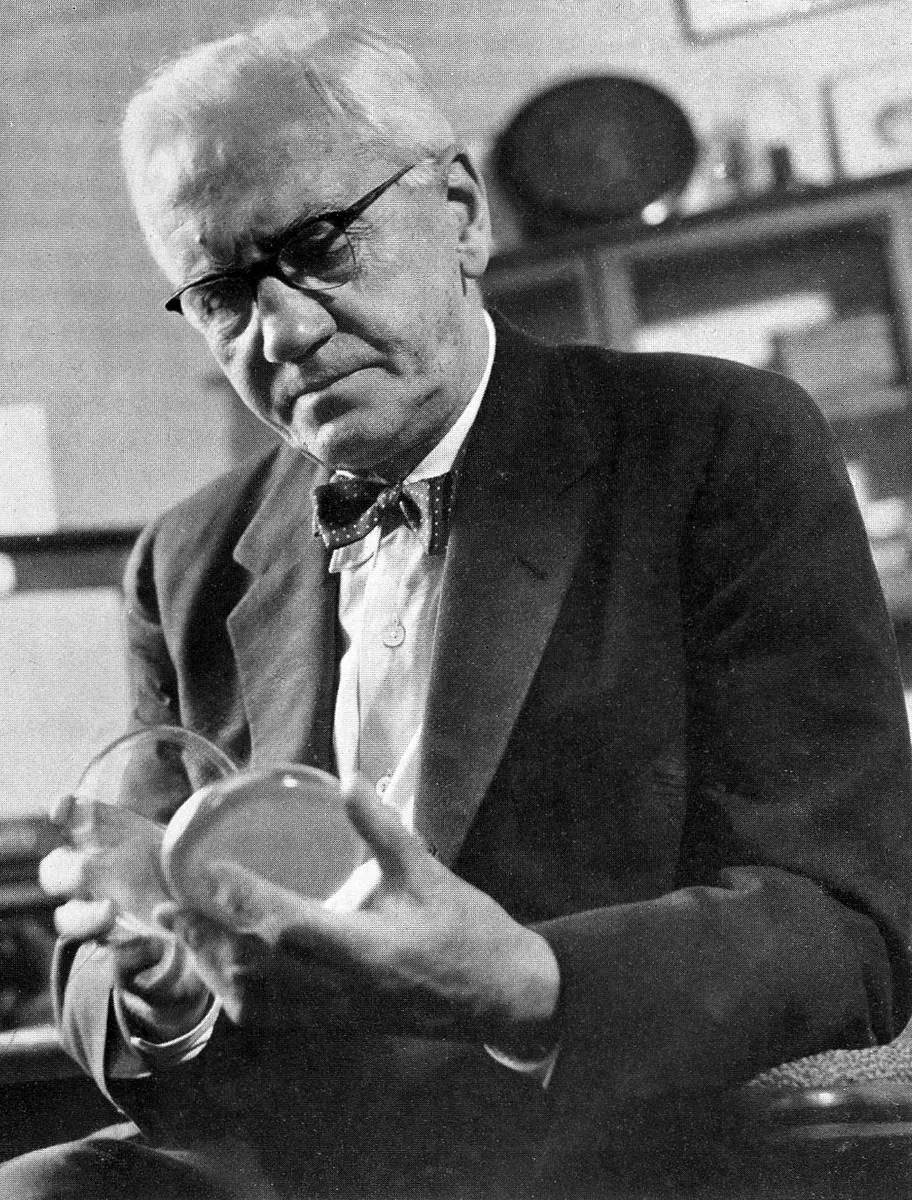
Alexander Fleming
1881–1955, born in Scotland
A farmer’s son who became a doctor and noticed what others might have thrown away.
Photo: Wellcome Collection, CC BY 4.0
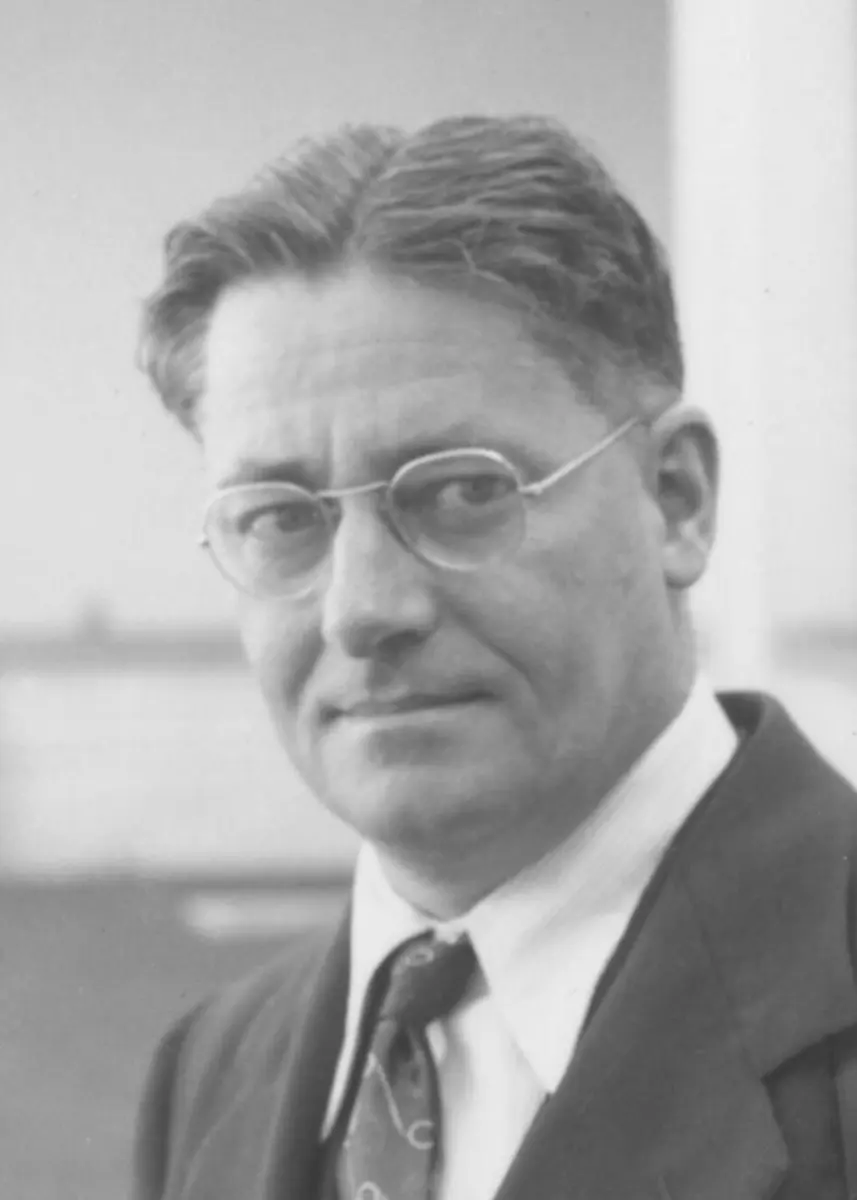
Howard Florey
1898–1968, born in Australia
Led the Oxford team that turned penicillin into a medicine.
Photo: Australian News and Information Bureau, Public domain
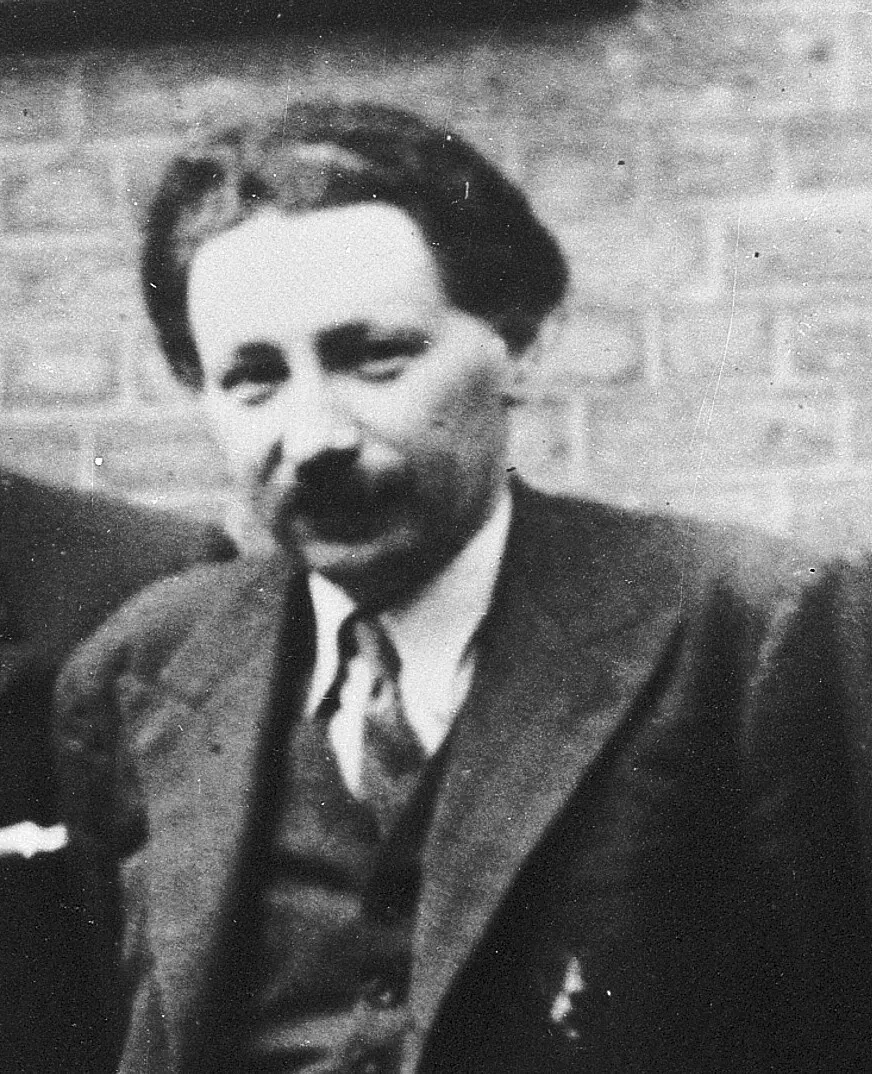
Ernst Boris Chain
1906–1979, born in Germany
A chemist who left Germany in 1933 when the Nazis came to power, and worked out how to get penicillin out of the mold.
Photo: Wellcome Collection, CC BY 4.0
Imagine cutting your knee on a rusty nail in 1930. The cut gets red, then swollen and hot, and then the redness spreads up your leg. Your doctor can clean the wound, but if the germs get into your blood, there is very little anyone can do.
Today, a doctor gives you a few days of tablets and the infection is gone. Those tablets are antibiotics, and the first was penicillin. In 1945 the Nobel Prize in Physiology or Medicine went to the man who found it and the two who made it into a medicine.
The problem: germs nobody could stop
By the 1920s, doctors knew that many diseases are caused by bacteria: tiny living things made of a single cell, far too small to see without a microscope Grade 8: Bacteria. Bacteria cause pneumonia (an infection of the lungs), many infections of wounds and blood, and fevers that often killed mothers after childbirth.
Doctors could kill bacteria outside the body with strong chemicals such as carbolic acid, but those chemicals also damage the body’s own cells. In the 1930s the first sulfa drugs helped against some infections, but not all of them. What was needed was a substance that kills bacteria and leaves human cells alone.
The discovery: a moldy dish (1928)
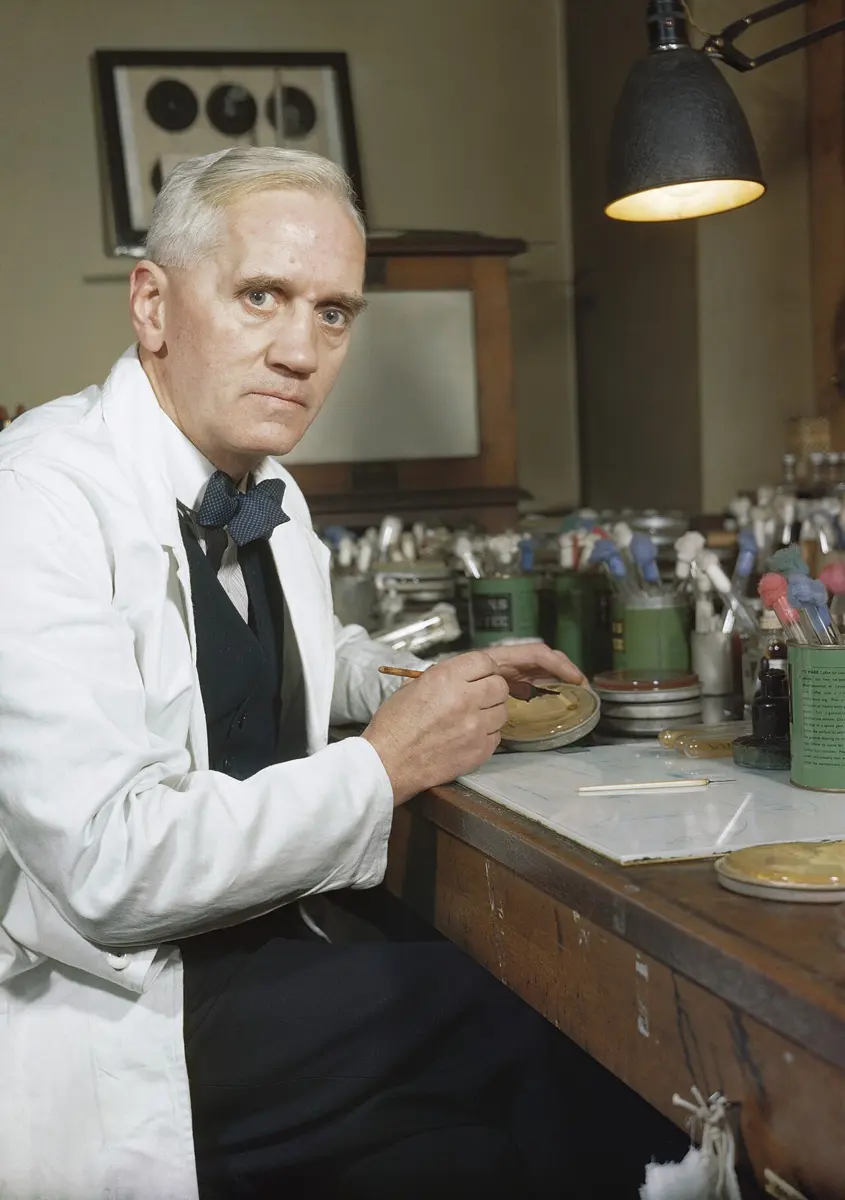
Alexander Fleming worked at St Mary’s Hospital in London. He studied Staphylococcus, round bacteria that cause boils and wound infections. He grew them on round, flat glass dishes of jelly called Petri dishes, where each bacterium multiplies into a little spot, a colony, big enough to see.
In September 1928 Fleming came back from a holiday and sorted through a pile of old dishes. On one of them a blob of mold had grown: a fungus, like the fluffy mold on old bread. All around the mold, the colonies of bacteria had died and turned see-through. Further away, they were growing normally.
Many scientists would have thrown the spoiled dish away. Fleming was curious: something coming out of the mold was killing the bacteria. He grew the mold in a broth and found that the liquid stopped staphylococci from growing even when it was diluted 500 to 800 times. The mold was a kind of Penicillium (today it is called Penicillium rubens), so he called the substance penicillin Grade 9: Kingdom Fungi.
He also showed that it did not harm white blood cells, and that it didn’t poison mice. He published all this in 1929.
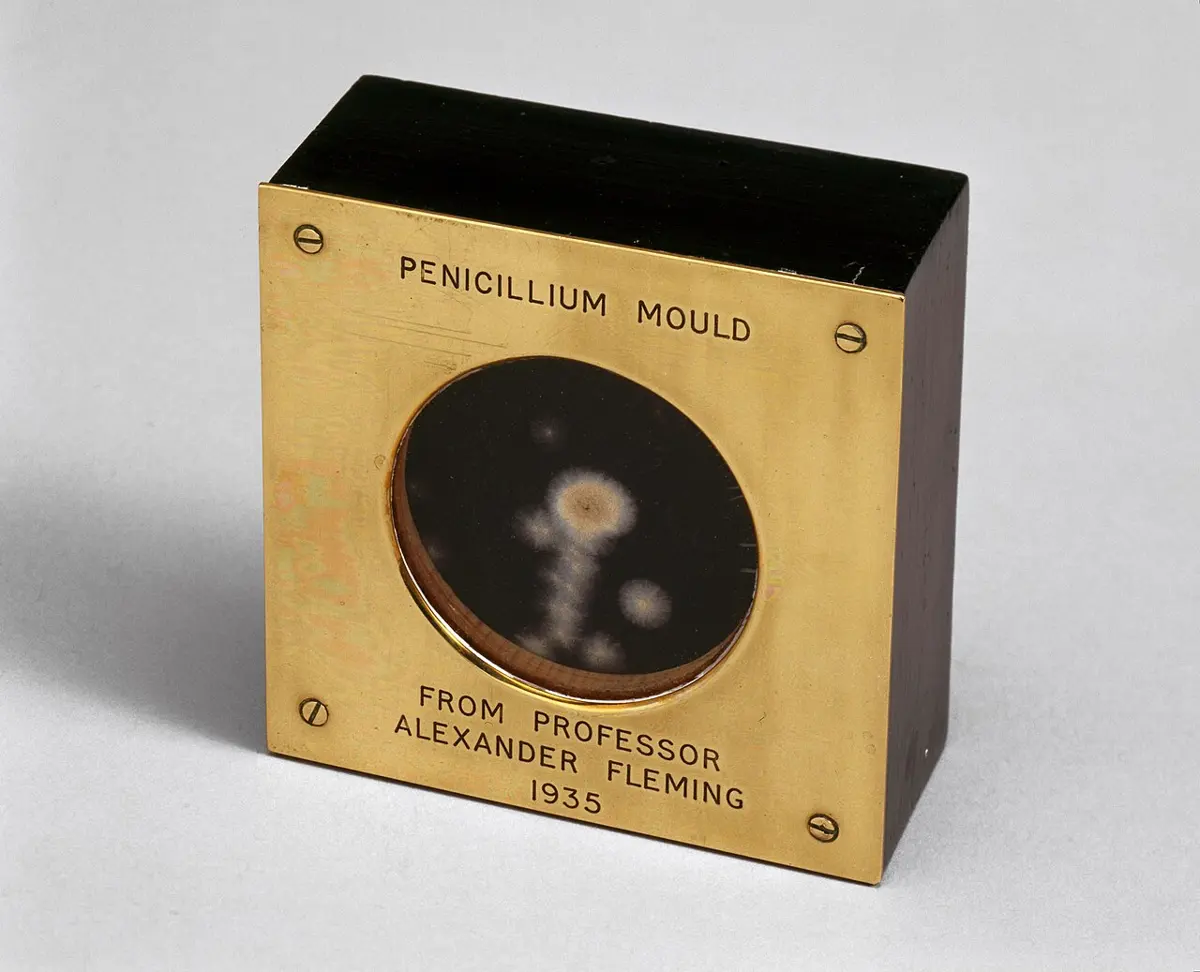
What made Fleming think the mold was making something that kills bacteria?
Pick an answer to see why.
Why it was so hard
Fleming had found penicillin, but he could not make a medicine from it.
- There was very little of it. The mold makes only a tiny amount, mixed into a lot of broth.
- It fell apart. Penicillin is fragile. When chemists tried to separate it from the broth and make it pure, it lost its power within days. Other chemists tried in the early 1930s and failed too.
- Nobody tested it in sick animals. Fleming used it on a few infected wounds, but without pure penicillin he could not show that it cured infections inside the body.
For about ten years, penicillin stayed an interesting fact in old journals.
What they did, step by step
Oxford: getting penicillin out of the mold (1938–1940)
At the University of Oxford, Howard Florey, an Australian, led a laboratory studying how the body fights germs. Ernst Chain, a chemist who had left Germany in 1933, worked with him. In 1938, searching old journals for substances made by microbes that kill other microbes, Chain came across Fleming’s paper, and they decided to try to purify penicillin.
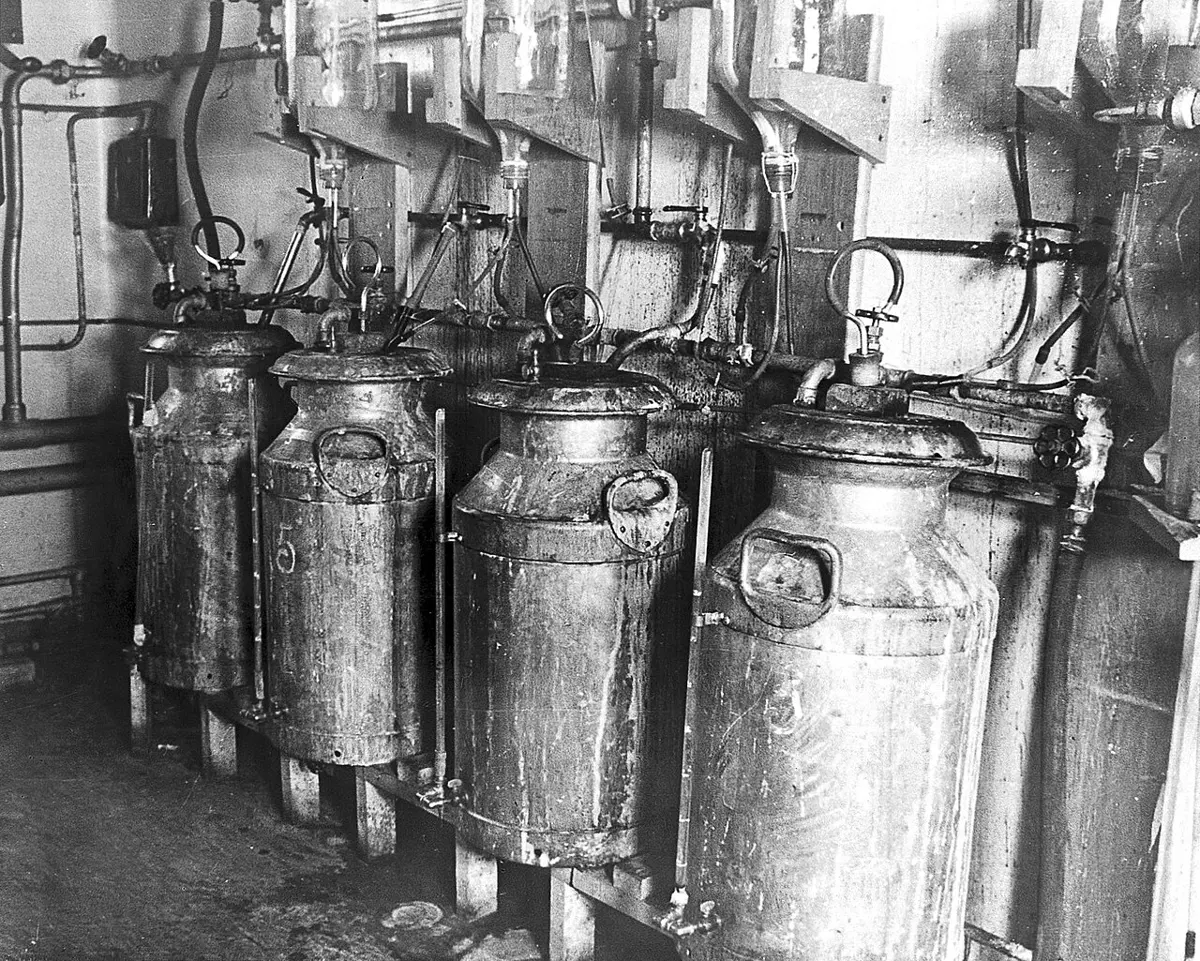
- Growing the mold. They needed huge amounts of broth, so the team grew the mold in anything flat they could find: bottles, tins, even hospital bedpans. Later, a team of young women, the “penicillin girls”, looked after hundreds of special pottery vessels.
- Getting it out. Chain and the biochemist Norman Heatley found a way to pull penicillin out of the broth and keep it from falling apart. Penicillin is an acid. When the broth was made a little acidic and shaken with a liquid that doesn’t mix with water (ether or amyl acetate), the penicillin moved into that liquid. Then it was moved back into water that was only slightly alkaline. All of this was done cold, because penicillin breaks down faster when warm. Heatley built much of the apparatus himself.
- Measuring it. Heatley also invented a simple way to measure how strong a batch was: put a drop in a little cup on a dish of bacteria, and measure the clear ring around it.
The mouse test (25 May 1940)
On 25 May 1940 the team gave eight mice a deadly dose of Streptococcus bacteria. Four of the mice were then given penicillin; the other four were not. By the next morning, the four untreated mice were dead. The four given penicillin were alive and well. They published the results in August 1940.
The first patient (1941)
On 12 February 1941 penicillin was given to a person for the first time: Albert Alexander, a policeman in Oxford who was dying of an infection that had spread from a sore on his face. Within a day he was much better. But there was so little penicillin that the team even collected it back from his urine to use again. After five days it ran out, the infection came back, and he died in March. Later patients, given enough penicillin, recovered.
Factories for a mold (1941–1944)
It was the middle of the Second World War, and British factories were busy. In 1941 Florey and Heatley flew to the United States. There, government and company scientists found ways to grow the mold in giant tanks, fed on corn steep liquor, a sticky waste from making cornflour. In 1943 a moldy cantaloupe melon from a market in Peoria, in the United States, gave a strain of Penicillium that made far more penicillin. By the end of the war, factories were making enough to treat millions of people.
How penicillin kills bacteria
A bacterium is surrounded by a strong cell wall, a mesh that holds it in shape, like the cane of a basket Grade 8: The covering of the cell. Inside, the cell is full of water and dissolved substances, which press outward. As a bacterium grows, it keeps opening the mesh and stitching in new pieces.
Penicillin blocks the enzyme (a protein that does a job in a cell) that stitches the new pieces in. The bacterium keeps growing, but the holes in its wall are never closed. The wall gets weaker and weaker, until the pressure inside bursts the cell.
Your cells have no cell wall, which is why penicillin is safe for you, and why it can’t do anything against viruses such as those that cause colds and flu: viruses have no wall either.
Why does penicillin kill bacteria but not your own cells?
Pick an answer to see why.
In your life today
- Antibiotics are everywhere in medicine. Penicillin and its relatives, such as amoxicillin, are still among the most used medicines in the world, for ear and throat infections, pneumonia and infected wounds. Operations, cancer treatment and the care of tiny newborn babies are all much safer because infections can be treated.
- Penicillin allergy. A few people are allergic to penicillin. If you are, tell every doctor and pharmacist who treats you.
- Antibiotics don’t cure colds. Colds and flu are caused by viruses, and antibiotics do nothing against them.
In Nepal, as in many countries, antibiotics are often sold without a doctor’s prescription, and many people stop taking them as soon as they feel better. Both help resistant bacteria to spread. So: take an antibiotic only when a doctor prescribes it, take the whole course, and never share it or save it for next time.
What came next
- More antibiotics. Penicillin’s success started a search through molds and soil bacteria for more. Streptomycin, the first drug that cured tuberculosis, was found in 1943 in the laboratory of Selman Waksman, who won the Nobel Prize in 1952.
- The shape of penicillin. In 1945 the chemist Dorothy Hodgkin worked out how the atoms of penicillin are arranged, using X-rays. Knowing its shape, chemists could make new penicillins in the laboratory. She won the Nobel Prize in Chemistry in 1964.
- The open problem: resistance. Bacteria keep evolving resistance, and few new antibiotics have been discovered for decades. Some infections no longer respond to most antibiotics. Why this happens, and what slows it down, is a whole topic of its own: Why do antibiotics stop working?
In your science books
- Grade 8: bacteria, the covering of the cell (cell wall and cell membrane), and the good and harmful effects of microorganisms.
- Grade 9: Kingdom Fungi, where Penicillium belongs, and Kingdom Monera, the bacteria.
- Going further: Why do antibiotics stop working?
Learn more
- The prize at nobelprize.org: The Nobel Prize in Physiology or Medicine 1945, with the presentation speech that tells the story.
- Fleming’s own Nobel lecture, with his warning about resistance.
The official reason
The prize was given “for the discovery of penicillin and its curative effect in various infectious diseases.”