
Predicting and designing proteins
Nobel Prize in Chemistry, 2024: David Baker, Demis Hassabis, and John Jumper
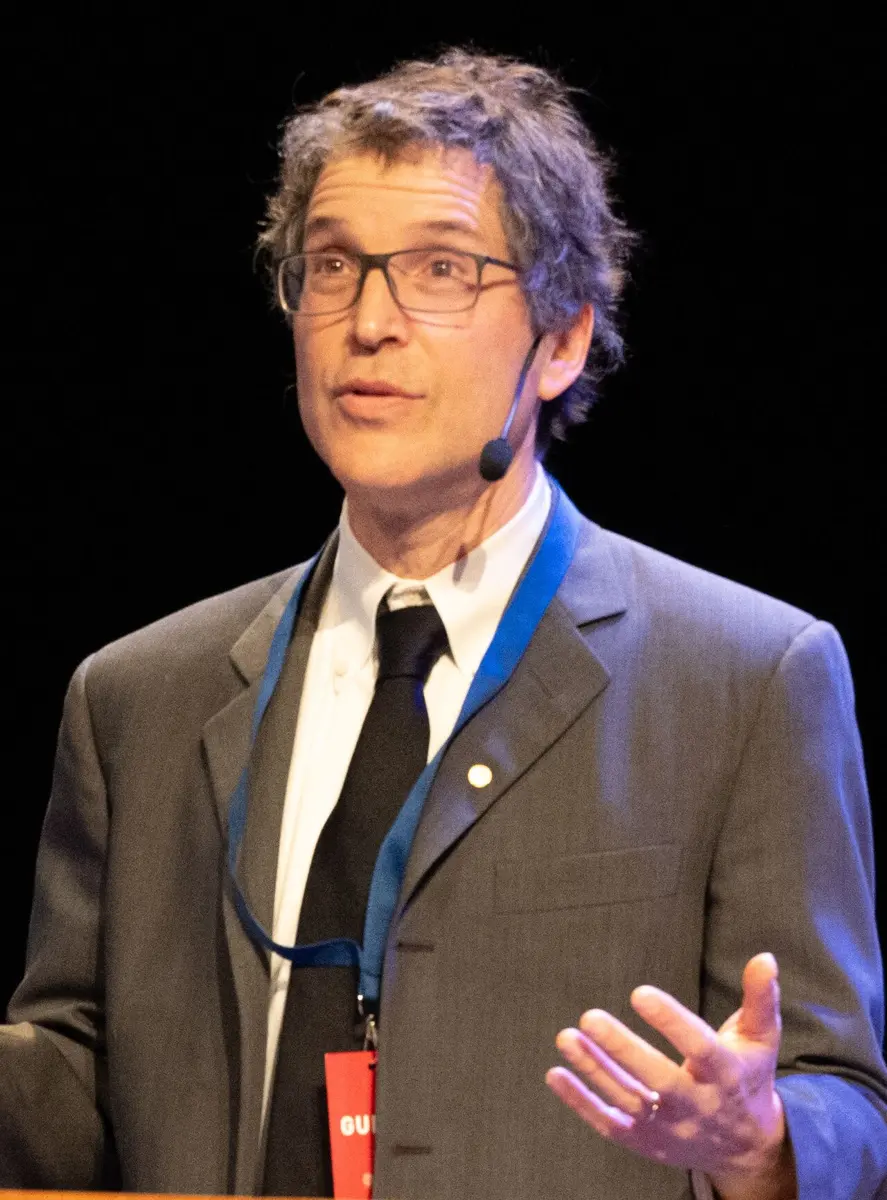
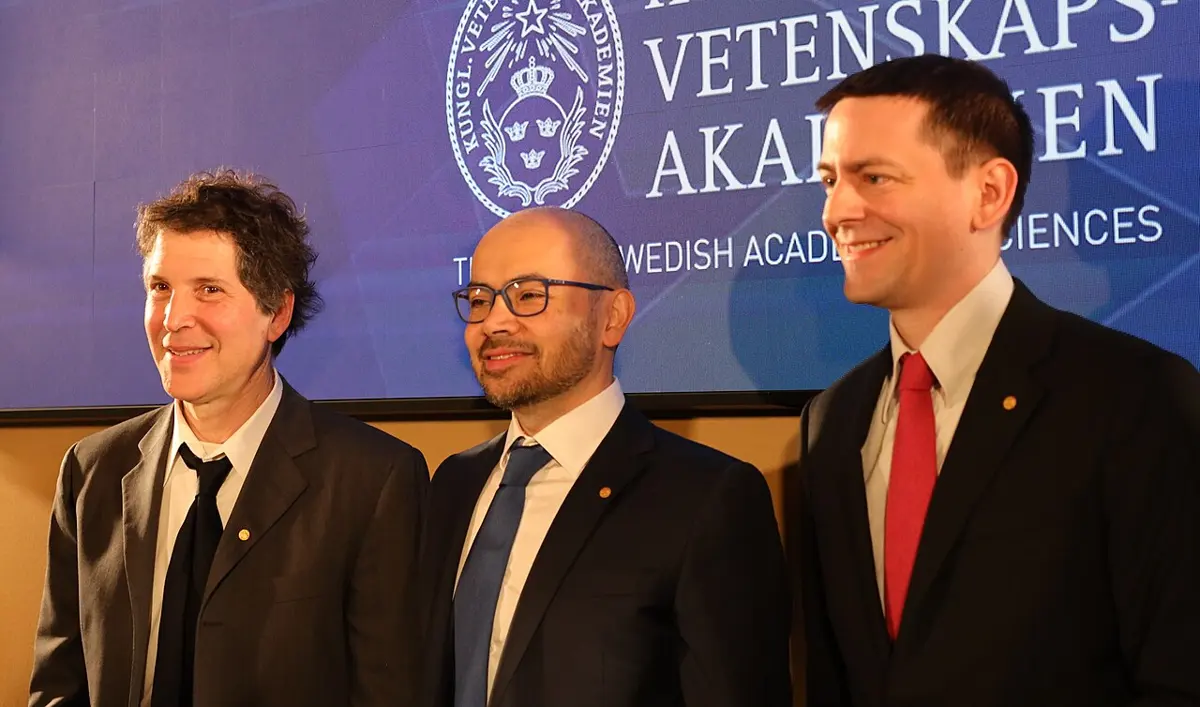
David Baker
born 1962 in the United States
He went to university to study philosophy, until a biology textbook changed his mind.
Photo: Arthur Petron, CC BY-SA 4.0
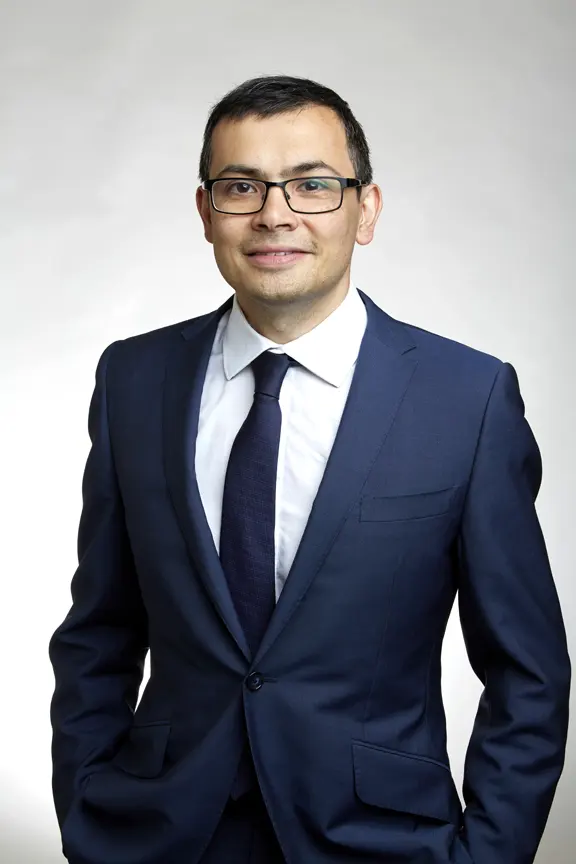
Demis Hassabis
born 1976 in the United Kingdom
A chess master at 13 and a video-game maker as a teenager, who founded a company to build thinking machines.
Photo: Duncan.Hull, CC BY-SA 4.0
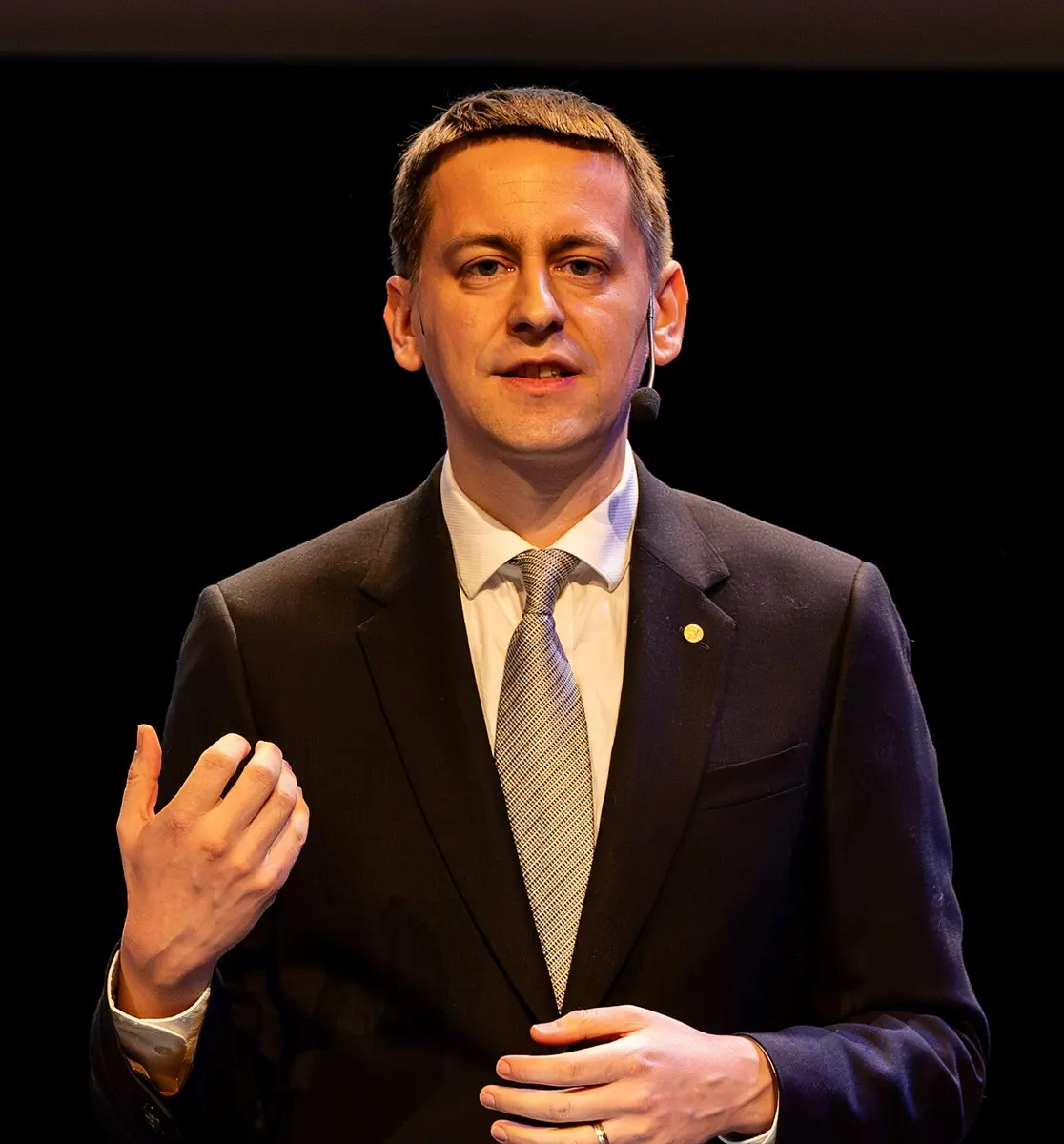
John Jumper
born 1985 in the United States
A young physicist who joined the AlphaFold team in 2017, fresh from his doctorate, and found the ideas that made it work.
Photo: Arthur Petron, CC BY-SA 4.0
Think of a woolen thread. Lying loose, it can do nothing. Knitted into a particular pattern, it becomes a sock, a cap or a glove, and each shape has its own use. Proteins are like that. They are long chains, and what each protein does depends on the shape its chain folds into.
For fifty years, finding a protein’s shape took months or years of hard work, and often failed. Today a computer program can predict it in minutes, and other programs can design proteins that nature never made. In 2024 the Nobel Prize in Chemistry went to the three people behind these two advances: one half to David Baker, for designing new proteins, and the other half to Demis Hassabis and John Jumper, for predicting the shapes of proteins.
The problem: a shape you can’t see
Almost everything in your body is done by proteins. Enzymes speed up the chemical reactions of life, such as digesting your dal bhat Grade 10: Catalyst. Hemoglobin carries oxygen in your blood. Antibodies catch germs. Keratin makes your hair and nails, and a buffalo’s horns.
Every protein is a chain built from amino acids. There are 20 kinds of amino acid, and a chain can have from a few dozen to several thousand of them, in any order. Your cells join them in the order written in a gene, on the ribosomes Grade 8: Ribosomes. Then the magic happens: the chain folds itself up into a particular three-dimensional shape. The shape is what lets the protein do its job, like a key that fits only one lock.
So to understand a protein, or to make a medicine that blocks it, you need to know its shape. But proteins are far too small to see with any ordinary microscope.
Why does a protein’s shape matter so much?
Pick an answer to see why.
The slow way: crystals and X-rays
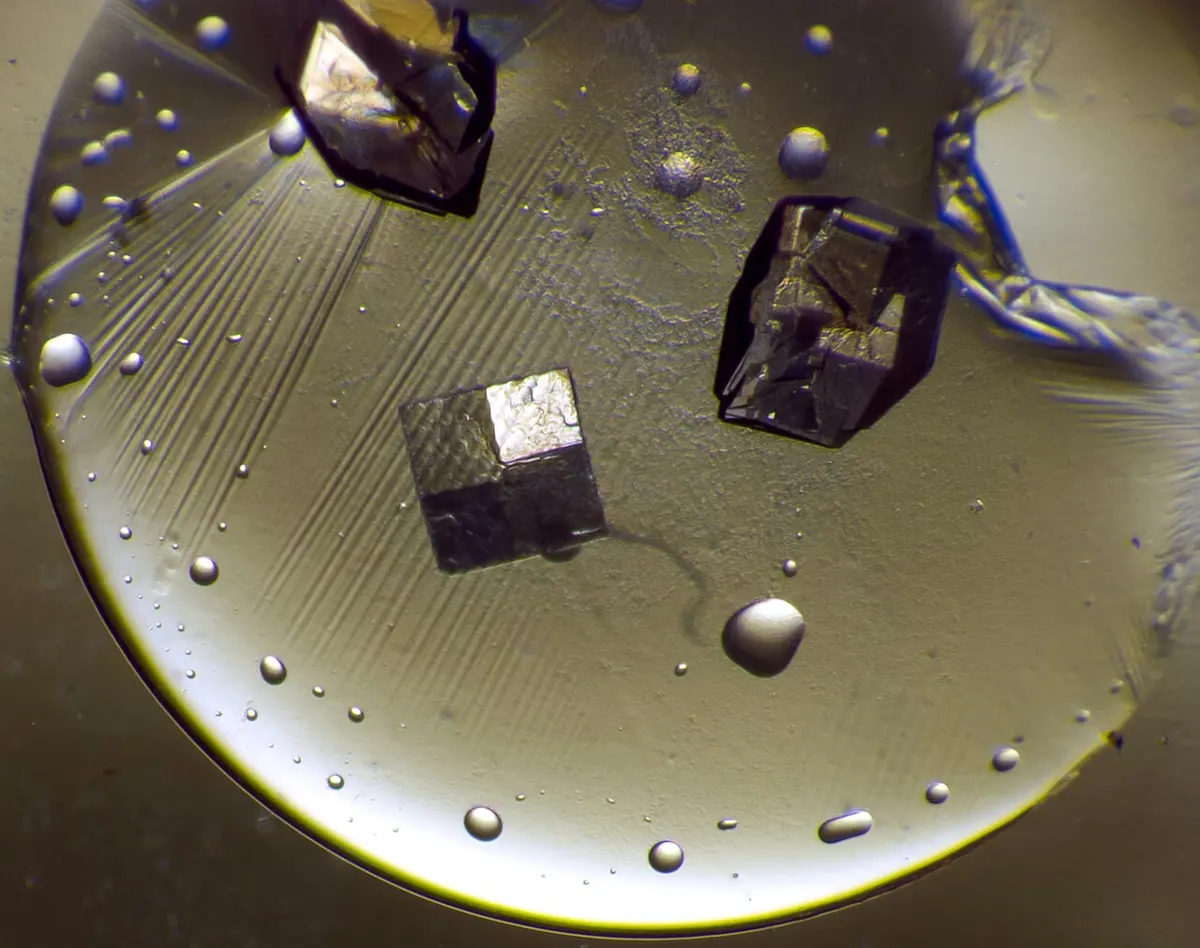
In the late 1950s, John Kendrew and Max Perutz in Cambridge, England, found the first shapes of proteins using X-ray crystallography. First you must make the protein form a crystal, with millions of copies lined up in a regular pattern. Then you shine X-rays through it. The X-rays bounce off the atoms into a pattern of spots, and from the pattern you can work out where every atom is. Kendrew and Perutz shared the Nobel Prize in Chemistry in 1962.
It works, but it is hard. Many proteins refuse to form crystals at all. Working out a single shape could take a scientist years. By the time AlphaFold arrived, scientists around the world had found the shapes of about 200,000 different proteins, a tiny part of the millions that exist.
Why predicting the shape was hard
In 1961 the American chemist Christian Anfinsen made a protein unfold, then let it fold up again. It came back to exactly the same shape every time. So the shape must be decided by the order of the amino acids alone. (He shared the Nobel Prize in Chemistry in 1972.) That raised a hope: if you know the order, you should be able to work out the shape, with no crystals at all.
But in 1969 Cyrus Levinthal pointed out a puzzle. Even a short chain of 100 amino acids could, in theory, fold into at least 10⁴⁷ different shapes. If the chain tried them one by one, it would take longer than the age of the universe to find the right one. Yet in a cell, a protein folds in a few thousandths of a second. The chain clearly doesn’t try every shape, and a computer can’t either.
In 1994 scientists started a competition called CASP. Every two years, the teams are given the amino acid order of proteins whose shapes have just been found but not yet published, and they try to predict the shapes. For more than twenty years, the predictions hardly got better.
What they did, step by step
Hassabis and Jumper: AlphaFold
Demis Hassabis learned chess at four and was a chess master at thirteen. As a teenager he wrote video games, then studied computers and, later, the brain. In 2010 he co-founded DeepMind, a company that builds artificial intelligence. Google bought it in 2014.
- 2016, a game. DeepMind’s program AlphaGo beat one of the world’s best players, Lee Sedol, at Go, an ancient board game with far more possible positions than chess. For Hassabis, games were practice. He wanted to use artificial intelligence on real problems in science.
- 2018, AlphaFold. DeepMind entered CASP with a program called AlphaFold, a neural network trained on the known protein shapes (Machines that learn). Before, the best predictions scored about 40%; AlphaFold reached almost 60%. It won, but a prediction needs about 90% to be truly useful, and the team got stuck.
- John Jumper. John Jumper had studied physics and then written computer programs that copy how proteins move. He joined DeepMind in 2017, just after his doctorate, with new ideas about building knowledge of proteins into the network. He and Hassabis led the team that rebuilt AlphaFold from the start.
- 2020, AlphaFold2. The new version used a newer kind of network, a transformer (the kind also inside today’s chatbots), and was trained on all the known protein shapes and orders. At CASP in 2020, its predictions were, for most proteins, almost as good as X-ray crystallography. The organizers declared the fifty-year-old problem solved.
How does it know? One clue comes from evolution. The same protein, in a human, a buffalo, a fish and a yeast, has mostly the same amino acids but some differences. If two amino acids touch each other in the folded protein, then when one of them changes over millions of years, the other usually changes too, so that they still fit. AlphaFold compares the same protein across many living things, finds such pairs, and learns which parts of the chain lie next to each other.
How did AlphaFold learn to predict protein shapes?
Pick an answer to see why.
Baker: building proteins that never existed
David Baker went to Harvard University to study philosophy and social science. In a biology course he met a famous textbook about the cell, and he changed direction. From 1993, at the University of Washington in Seattle, he studied how proteins fold.
- Late 1990s, Rosetta. Baker’s team wrote a program called Rosetta to predict protein shapes. It did well in CASP in 1998.
- The reverse idea. Then they turned it round. Instead of putting in an amino acid order and getting out a shape, why not put in a shape you want and get out an order that will fold into it? People had changed natural proteins before, but Baker wanted to build them from nothing. As he said: “If you want to build an aeroplane, you don’t start by modifying a bird.”
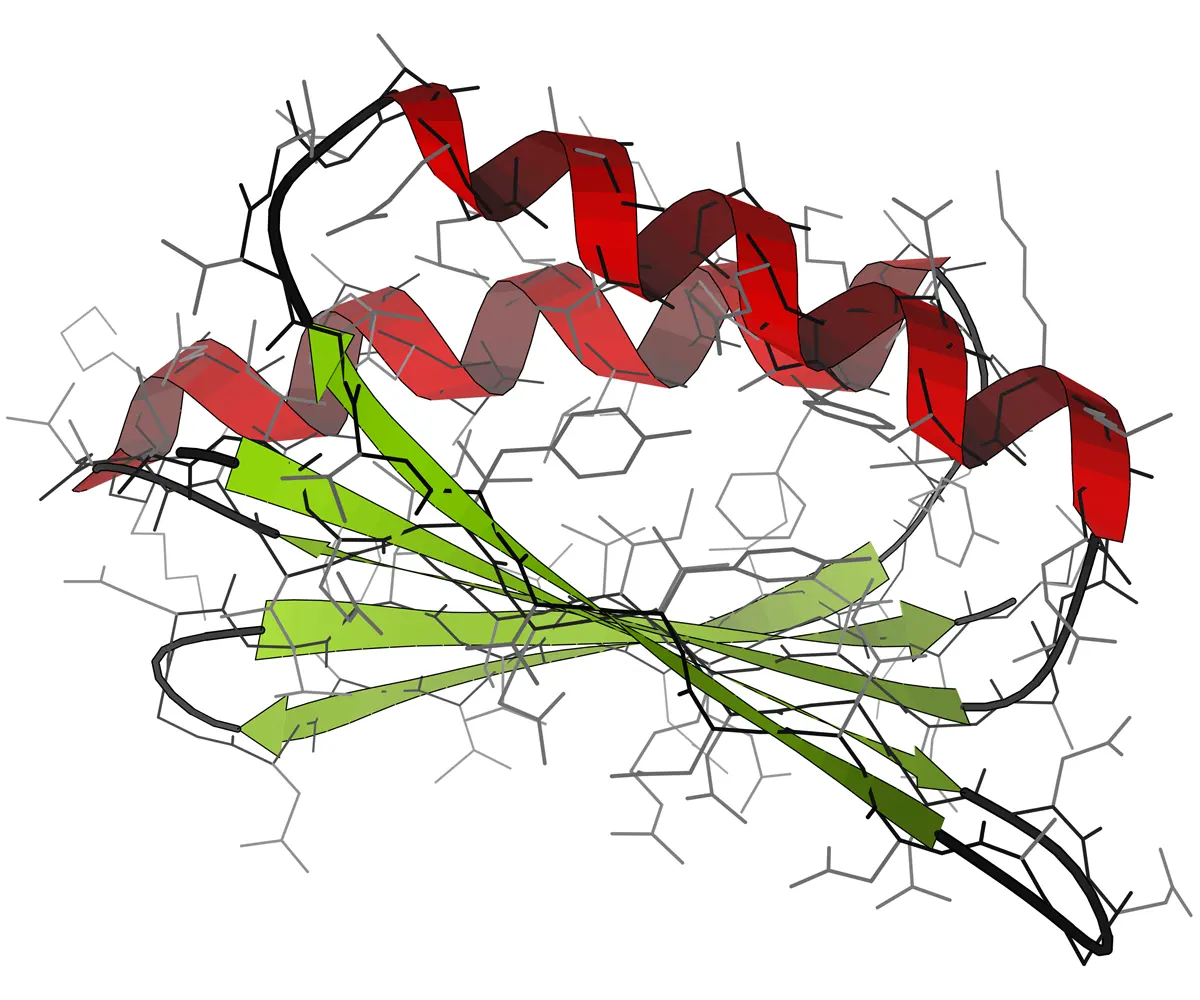
- 2003, Top7. His team drew a protein shape that is not found anywhere in nature. Rosetta worked out an order of 93 amino acids for it. They wrote the matching gene, put it into bacteria, and the bacteria made the protein. When its shape was measured with X-rays, it was almost exactly the shape they had drawn.
- Since then. Baker’s lab has designed thousands of new proteins. After AlphaFold2, he added the same kind of neural network to his own tools, and designing proteins became faster still.
How it works now
In 2021 DeepMind made AlphaFold free for anyone to use, and it has since put online the predicted shapes of almost all of the 200 million proteins known from living things. A shape that once took a scientist years now takes a few minutes. By October 2024, more than two million people in 190 countries had used it. AlphaFold also tells you how sure it is about each part of its prediction, so scientists know which parts to trust.
Baker’s approach is now used in laboratories all over the world. Scientists draw what they need, such as a protein that grabs one particular virus or poison, and the computer suggests orders of amino acids. They make the best ones in bacteria and test them.
In your life today
- Medicines. Many medicines work by fitting into a protein, like a wrong key jammed in a lock. Knowing the protein’s shape helps chemists design them. Companies and universities now use AlphaFold to search for new medicines.
- Vaccines. Baker’s group designed tiny protein balls that carry pieces of the coronavirus. A COVID-19 vaccine built this way, SKYCovione, was approved in South Korea in 2022.
- Snakebite. In Nepal, snakebite kills people every year, especially in the Terai during the monsoon, and cobras and kraits are among the most dangerous snakes. Today’s antivenom is made in the blood of horses that have been given small doses of venom (the idea behind the first Nobel Prize in Medicine), and it often works poorly against one of the main kinds of toxin in cobra venom. In 2025 Baker’s lab and a team in Denmark designed small proteins that block those toxins. They protected mice from deadly doses; they have not yet been tested in people.
- Understanding disease. Scientists use predicted shapes to study how bacteria resist antibiotics and how some microbes break down plastic.
What came next
- AlphaFold 3. In 2024 a new version came out that predicts not only single proteins but how proteins fit together with DNA, RNA and medicine molecules.
- Designer proteins everywhere. Proteins designed from scratch are being tested as vaccines, as medicines, as sensors that detect a single kind of molecule, and as enzymes for a cleaner chemical industry.
- The open question. AlphaFold predicts what shape a protein takes, but it doesn’t explain how the chain gets there, step by step, in a few thousandths of a second. And many proteins don’t hold one shape: they wobble, switch between shapes, or stay floppy until they meet a partner. Predicting that movement is the next big challenge.
In your science books
- Grade 8: ribosomes, where amino acids are joined into proteins.
- Grade 10: DNA and RNA, which carry the instructions for proteins; catalysts, and the enzymes that are life’s catalysts.
- Going further: proteins do the work and a chain that folds; molecules have shapes.
Learn more
- The Nobel Prize’s own explanation: They have revealed proteins’ secrets through computing and artificial intelligence (nobelprize.org).
- The laureates’ Nobel lectures: Baker, Hassabis and Jumper.
The official reason
The prize was given “for computational protein design.”
The prize was given “for protein structure prediction.”