
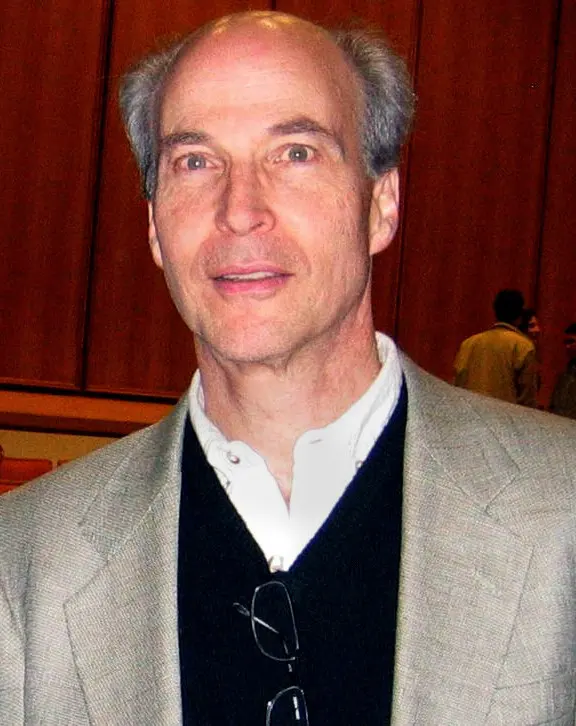
Roger Kornberg
born 1947 in St Louis, Missouri, USA
At the age of twelve he watched his father, Arthur Kornberg, receive the Nobel Prize in 1959 for finding how DNA is copied. Forty-seven years later he won one himself, for finding how DNA is read.
Photo: Dr Saptarshi, Public domain
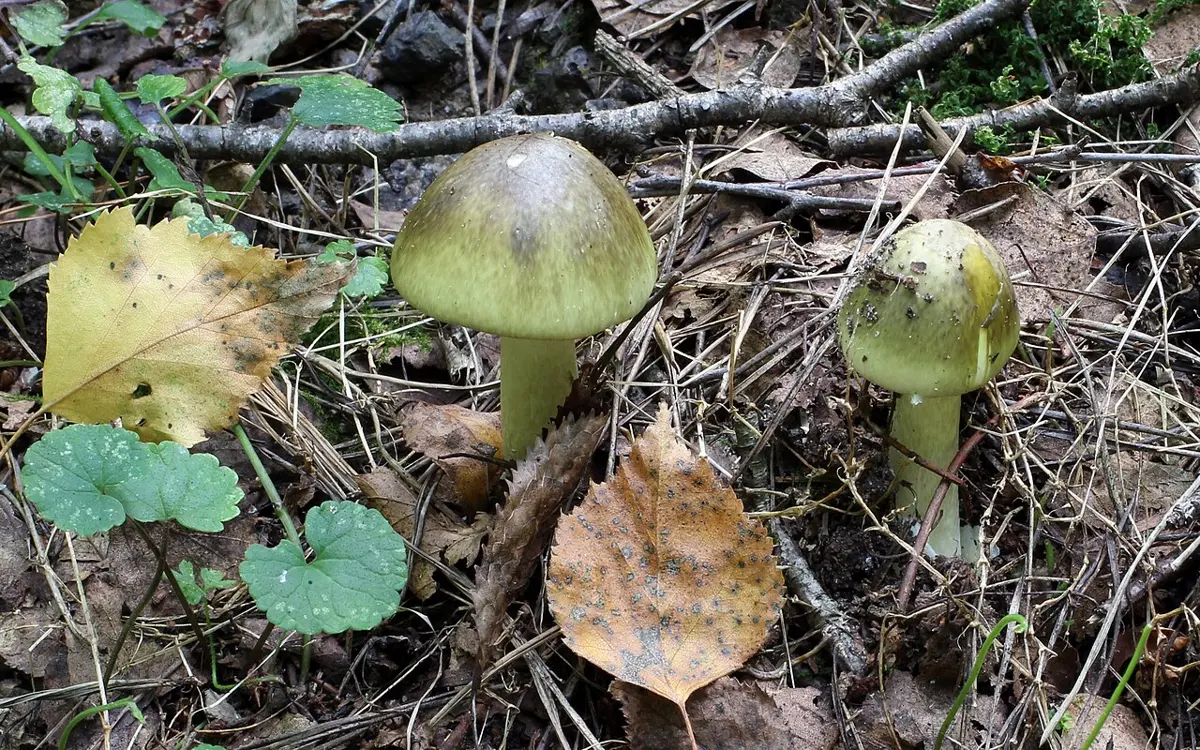
Almost every monsoon in Nepal, people die after eating wild mushrooms picked in the forest. Most of these deaths are caused by mushrooms such as the death cap. Its poison works in a strange, slow way. For hours after the meal the person feels fine. Then, over a few days, the liver and kidneys stop working.
The poison does not attack the liver directly. It jams one tiny machine found in every cell of the body: the machine that reads genes. Without it, a cell can no longer make new proteins, and slowly it dies. In 2006 the Nobel Prize in Chemistry went to Roger Kornberg, who was the first to make detailed pictures of this machine at work in cells like ours, so clear that single atoms can be seen.
The problem: a library you can’t take out
Your body is built and run by proteins: they make your muscles, carry oxygen in your blood, digest your food and fight germs. The recipe for each protein is a gene, a stretch of DNA Grade 10: DNA. Almost every cell has the full set: about 3 billion DNA “letters”, written in an alphabet of just four, A, T, G and C.
In cells like ours, the DNA stays locked away inside the nucleus Grade 8: The nucleus. But proteins are built outside it, on the ribosomes. So the cell does what you would do with a precious book that must not leave the library: it copies out just the recipe it needs. The copy is a molecule of messenger RNA (mRNA), which carries the recipe out of the nucleus Grade 10: RNA.
Copying DNA into RNA is called transcription. It goes on in every living cell, all the time, and it must be very accurate: the Nobel committee said that no more than about one mistake in 10,000 letters can be allowed.
It must also be controlled. A nerve cell and a liver cell have the same DNA, but they read different genes. That is why they look and work so differently.
By the 1960s scientists understood transcription in bacteria fairly well. But bacteria have no nucleus. In cells that do have one, called eukaryotic cells (those of fungi, plants and animals, including us), transcription turned out to be much more complicated, and nobody knew what the copying machine looked like or how it worked.
Why does the cell make an RNA copy of a gene, instead of using the DNA directly?
Pick an answer to see why.
How transcription works
The copying machine is an enzyme, a protein that makes a chemical reaction happen. It is called RNA polymerase. Our cells have three kinds; the one that copies the genes for proteins is RNA polymerase II (“two”).
- RNA polymerase sits on the DNA at the start of a gene and pulls the two strands of the double helix apart over a short stretch, making a bubble.
- One strand is used as the pattern. RNA building blocks, called nucleotides, float around in the nucleus. Each one can pair only with its partner on the DNA: G with C, C with G, T with A, and A with U (RNA has uracil in place of thymine).
- The polymerase joins each matching building block to the growing RNA chain, one at a time, then moves one step along the DNA.
- Behind it, the DNA zips up again, and the RNA copy peels away.
A stretch of the DNA pattern strand reads T A C G. Which RNA is made from it?
Pick an answer to see why.
Why it was hard
To see how a machine like this works, you need to know where every one of its atoms is. The way to do that is X-ray crystallography. You make a crystal of the molecule: billions of identical copies lined up in a regular pattern. You shine X-rays through it, and they scatter into a pattern of spots. From thousands of such spots a computer can work out the shape of the molecule, atom by atom.
RNA polymerase II made every step hard.
- It is huge. It is made of 12 protein chains fitted together. When Kornberg started, in the early 1980s, nobody had worked out the structure of anything that big and irregular.
- You need a lot of it, perfectly pure. Earlier work used cells from the livers of mammals, which are hard to grow in large amounts.
- It moves. A picture of the enzyme alone shows a machine at rest. To understand it, you want to catch it in the middle of copying, with its DNA and RNA in place. But in a test tube it copies in a flash and then lets go.
What he did, step by step
First, how DNA is packed
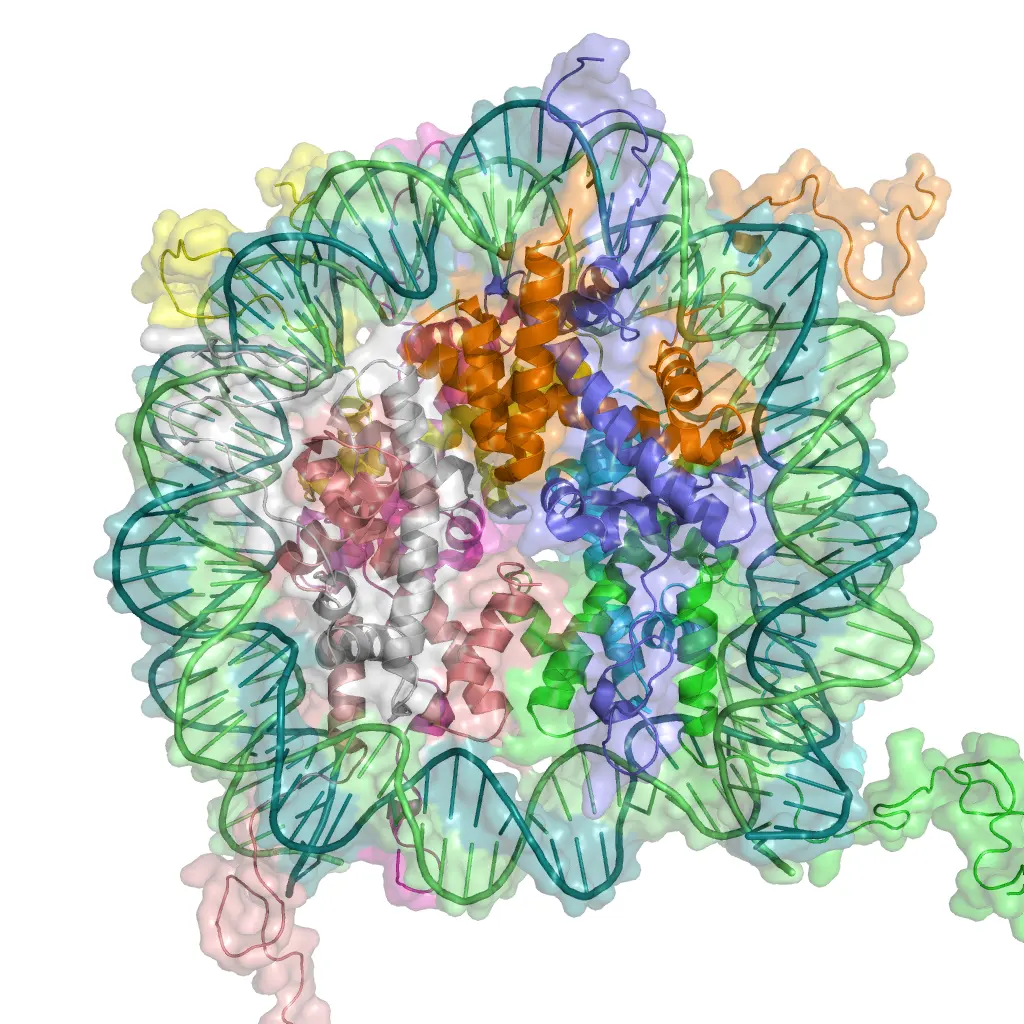
As a young scientist in Cambridge, England, Kornberg found in 1974 how the long DNA in our cells is packed: it is wound around tiny spools of proteins called histones, like thread on a reel. Each spool with its thread is called a nucleosome. This explained how two meters of DNA fit into a nucleus far smaller than a full stop. It also raised his next question: how does the copying machine read DNA that is wound up?
Then, the copying machine
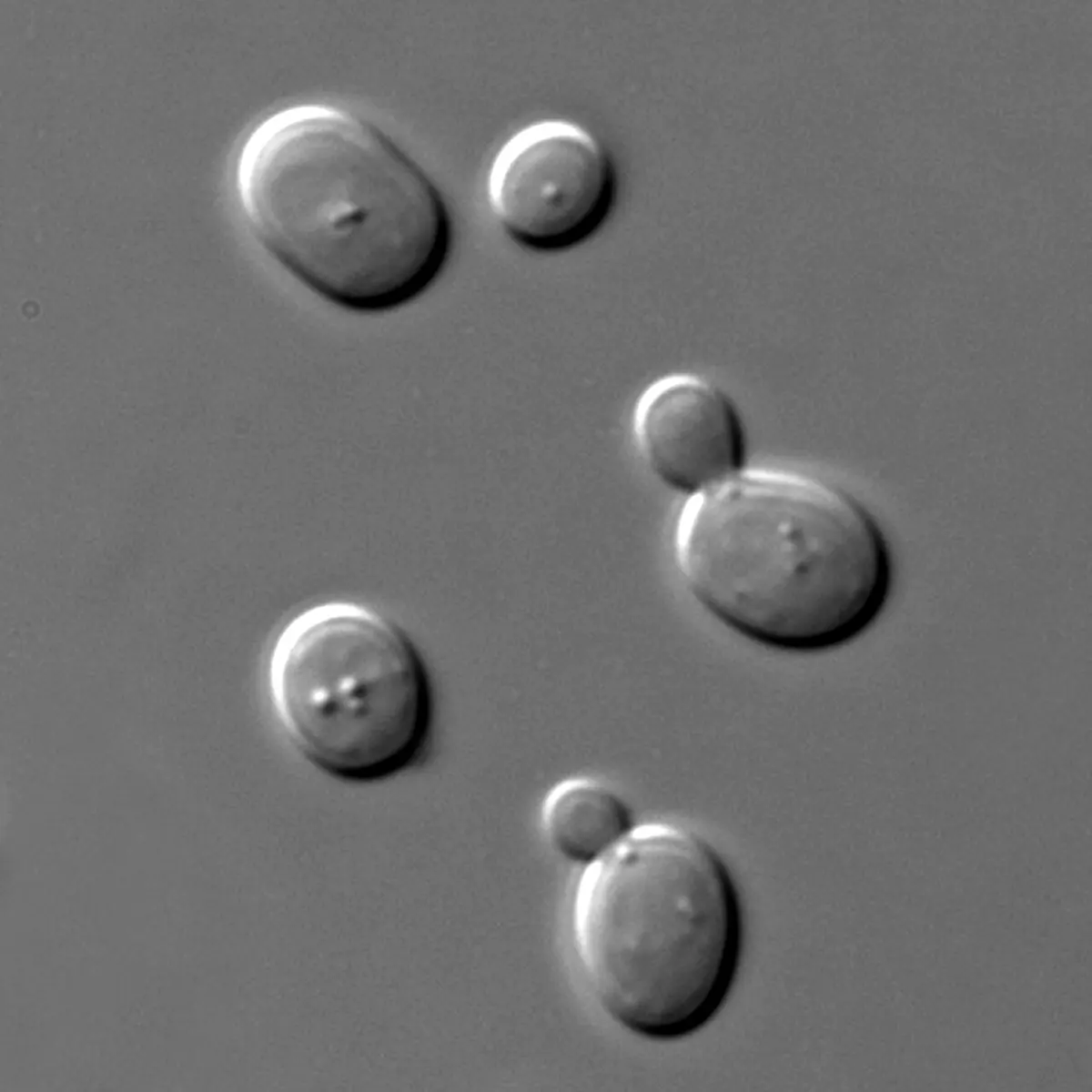
- 1978, a new choice. Back in the USA, at Stanford University, Kornberg decided to study transcription in ordinary baker’s yeast, the yeast that makes bread rise. Most scientists thought yeast was hopeless for this kind of work. But yeast is a eukaryote, like us, and it can be grown in huge amounts. His team spent about ten years getting yeast transcription to work in a test tube. One small change made a big difference: replacing the chloride in their solutions, which stopped the yeast enzyme, with acetate.
- 1990, the go-between. Proteins called activators switch genes on, but they could not talk to RNA polymerase directly. Kornberg’s team found a large group of about two dozen proteins that passes the message between them. They called it Mediator.
- The 1980s and 1990s, the crystals. Getting crystals of RNA polymerase II took nearly twenty years of trial and error, first flat sheets one molecule thick, which could be studied with an electron microscope, then proper three-dimensional crystals.
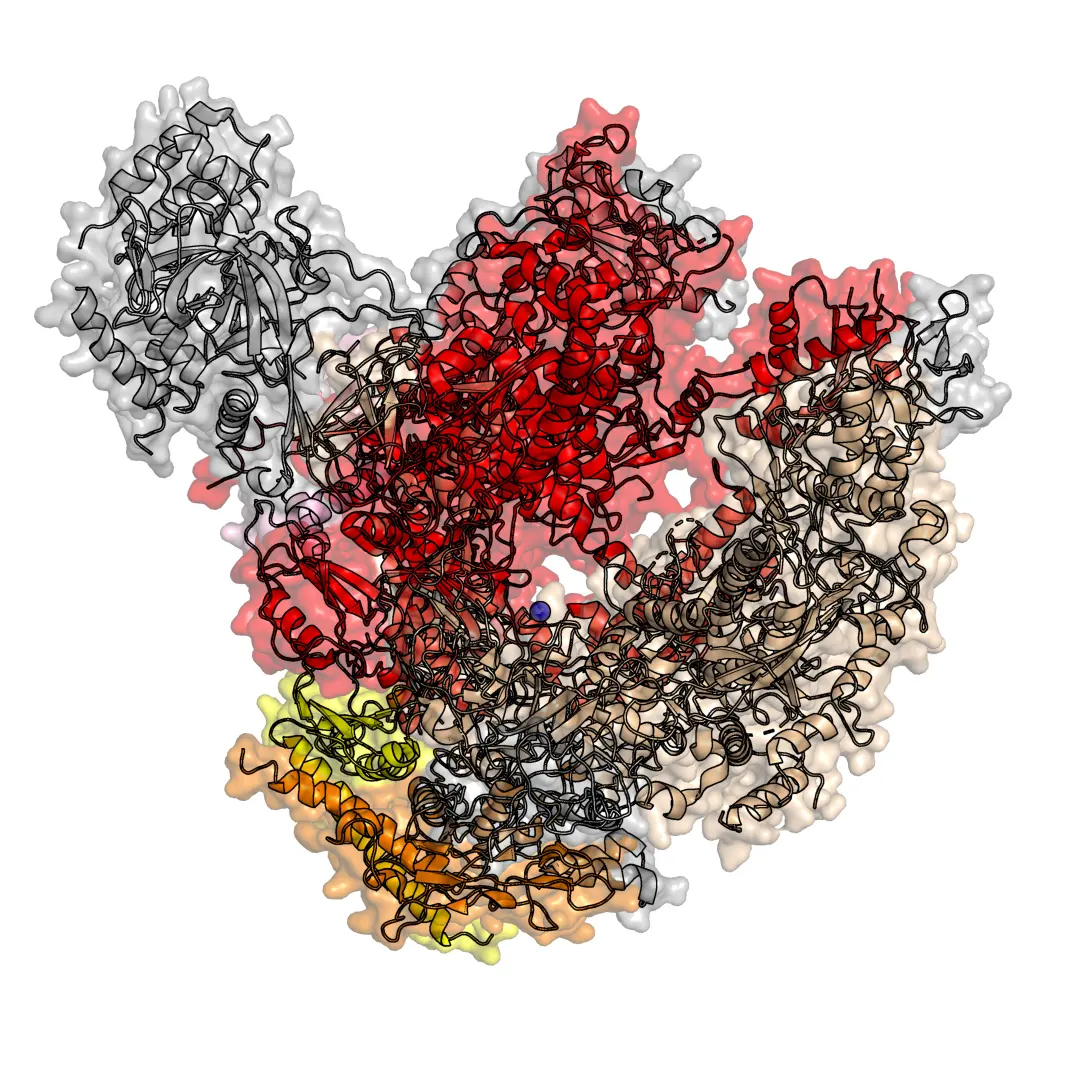
- 2001, the picture. Kornberg’s team, with Patrick Cramer and David Bushnell, published the structure of RNA polymerase II, detailed enough to place individual atoms.
- 2001, caught in the act. To freeze the machine in the middle of its work, Kornberg gave it DNA and RNA building blocks but left one kind of building block out. The polymerase copied happily until it needed the missing letter, and then it stopped and stayed stuck there, holding its DNA and the half-made RNA. Millions of identical stopped machines could then be crystallized and photographed with X-rays.
What the pictures show
Kornberg’s pictures turned transcription from a list of steps into a machine you can see.
- A clamp. Part of the polymerase swings shut over the DNA like a clamp, so that once it starts on a gene it doesn’t fall off. Some genes are more than a million letters long.
- A slot that only fits the right piece. The newest DNA letter sits beside a small pocket. A building block that pairs correctly fits into it; a wrong one doesn’t, the way a wrong piece won’t go into a half-finished jigsaw puzzle. That is how the copy stays so accurate.
- A ratchet. After each letter is added, a small spring-like part of the enzyme, called the bridge helix, flips and moves the DNA forward by one step.
- The poison. The death cap’s poison, α-amanitin (alpha-amanitin), sticks right next to the bridge helix and stops it moving. The polymerase can no longer step along, so no new mRNA is made, and the cells of the liver, which take up the poison, slowly die.
In your life today
- Medicines. Many medicines and many diseases work through transcription. Rifampicin, one of the main medicines for tuberculosis in Nepal, kills TB bacteria by blocking their RNA polymerase. Ours is shaped differently, so the medicine leaves it alone.
- Cancer and other diseases. Mistakes in the control of transcription play a part in cancer, heart disease and inflammation. Knowing the shape of the machinery helps scientists understand what goes wrong.
- One body, many kinds of cell. Every cell in your body has the same genes. What makes a cell a nerve cell, a muscle cell or a liver cell is which genes it transcribes (Genes switched on and off). Stem cells become different kinds of cell by changing which genes they read.
Rifampicin blocks the RNA polymerase of TB bacteria. Why doesn’t it harm the patient’s own cells in the same way?
Pick an answer to see why.
What came next
- The whole machine. RNA polymerase II never works alone: to start on a gene it gathers several other protein groups, called general transcription factors, and Mediator. Kornberg’s team and others went on to picture these too. A newer method, cryo-electron microscopy, which photographs frozen molecules without needing crystals, now shows the whole giant assembly. (It won its own Nobel Prize in Chemistry, in 2017.)
- The open question. We can now see the machine, but we still cannot predict, just by reading the DNA, which genes a liver cell or a nerve cell will switch on, and how strongly. How thousands of switches, activators and Mediator work together to make that choice is one of the big unsolved problems of biology.
In your science books
- Grade 8: the nucleus and ribosomes.
- Grade 9: edible and poisonous mushrooms and the kingdom Fungi, where yeast belongs.
- Grade 10: DNA, RNA and chromosomes.
- Going further: How does a gene make a protein? and How does one cell become a whole person?
Learn more
- The Nobel Prize’s own explanation: Central to life (nobelprize.org).
- Roger Kornberg’s Nobel lecture.
The official reason
The prize was given “for his studies of the molecular basis of eukaryotic transcription.”