
On a January night in Jumla the air can fall to −6 °C. On a June afternoon in the far west of the Terai it can pass 44 °C; Nepal’s record, 46.4 °C, was set at Dhangadhi in 1995. That is a difference of more than 50 degrees. Yet put a thermometer under the tongue of a farmer in Jumla and of a rickshaw driver in Dhangadhi, and both will read about 37 °C, within a degree or so.
Your inside hardly notices the weather. And when it does change by just two degrees, you feel it at once: at 39 °C you are in bed with a fever. How does the body hold its temperature so steady, through winter and summer, sleep and football? The answer is a kind of control that runs almost everything in a living body, and many machines too: the feedback loop.
Steady inside, changing outside
The cells of your body live in a liquid: the blood and the fluid around the cells. They need that liquid kept just right. Not too hot or too cold, with enough sugar and oxygen, not too much carbon dioxide, not too salty or too watery. Outside, the conditions change all the time; inside, they must not.
Keeping the conditions inside the body steady while the outside changes is called homeostasis (homeo = alike, stasis = standing still). You already know two examples:
- Mammals and birds keep their body temperature steady whatever the weather: they are warm-blooded (homeothermic), from Grade 10: Vertebrata.
- Insulin and glucagon keep your blood sugar steady, from Grade 9: Pancreas.
There are many more:
| What is kept steady | Normal level (roughly) | What happens if it goes wrong |
|---|---|---|
| core body temperature | 36.5–37.5 °C | below 35 °C: hypothermia; above 40 °C: heatstroke |
| blood sugar (glucose), fasting | 70–100 mg/dL | too low: shaky, faint; too high for long: diabetes |
| water in the body | about 50–60% of an adult’s mass | dehydration; too much water dilutes the blood’s salts |
| carbon dioxide in the blood | kept within narrow limits | the blood turns too acid or too alkaline |
| blood pressure | about 120/80 mm Hg at rest | fainting, or high blood pressure |
“Steady” doesn’t mean perfectly fixed. Your temperature is about half a degree lower early in the morning than in the late afternoon, and it rises a degree or more in hard exercise. Homeostasis keeps each condition within a range, and brings it back when it strays.
Which of these is an example of homeostasis?
Pick an answer to see why.
The feedback loop
Many homes in Nepal have an electric water heater, a geyser. Inside it is a thermostat: a switch that measures the water’s temperature. When the water is colder than the temperature it is set to, the thermostat switches the heater on; when the water reaches that temperature, it switches the heater off. If someone runs off hot water and cold water flows in, the heater switches on again. Nobody has to watch it.
Your body controls its temperature, and almost everything else in the table, in the same way. Every such loop has the same parts:
- A stimulus: a change away from the normal level (the body gets too warm).
- A sensor (or receptor) that detects the change (nerve endings in the skin; nerve cells in the brain that sense the temperature of the blood).
- A control center that compares what the sensor reports with the level the body is set to, the set point (for temperature, a part of the brain called the hypothalamus, set to about 37 °C).
- Effectors that act (sweat glands, the blood vessels of the skin).
- A response that cancels the change: the body cools back towards 37 °C.
As the response brings the temperature back, the sensor reports less and less of a change, and the effectors do less and less. The output of the loop has been fed back to its start, and it works against the change. That is why it is called negative feedback. Negative doesn’t mean bad: it means the loop pushes the opposite way to the change, whichever way that is.
You have met the first and last words in Grade 9, in the reflex arc: receptor → sensory nerve → spinal cord → motor nerve → effector Grade 9: Reflex action. A reflex is a one-off answer to a stimulus. A feedback loop goes round and round: the effector’s action changes the very thing the sensor measures.
Look at insulin and glucagon again with these words. After a meal the blood sugar rises (stimulus); cells in the pancreas sense it (sensor and control center in one); they send out insulin, which makes the liver and muscles take in sugar (effectors); the sugar falls back (response). When the sugar falls too low, a second loop sends out glucagon and pushes it up again. Many conditions are guarded by two loops that push in opposite directions, like a geyser that has both a heater and a cooler. That is why insulin and glucagon are called antagonistic hormones.
In a room with a heater controlled by a thermostat, which part of the system is the effector?
Pick an answer to see why.
Why is it called negative feedback?
Pick an answer to see why.
Your thermostat
The control center for temperature is the hypothalamus, a part of the brain about the size of an almond, just above the pituitary gland Grade 9: Pituitary gland. It gets two kinds of report: from temperature sensors in the skin, which warn early that the outside is hot or cold, and from its own nerve cells, which feel the temperature of the blood flowing through it, the body’s core. It answers through nerves, mostly the autonomic nerves you met in Grade 9 Grade 9: Autonomic nervous system.
When you are too hot:
- Sweating. Sweat glands pour water onto the skin. As it evaporates it takes heat from the skin. This is the body’s most powerful way to lose heat, and in hot weather the only one: once the air is hotter than your skin, the air heats you instead of cooling you.
- Widening the blood vessels of the skin (vasodilation). More warm blood flows close to the surface, where it loses heat to the air. That is why a hot face turns red.
- Behavior. You look for shade, take off a layer, fan yourself, drink water, slow down.
When you are too cold:
- Narrowing the blood vessels of the skin (vasoconstriction). Less warm blood flows near the surface, so less heat escapes, and the skin of your fingers and toes turns pale and cold. The skin becomes a blanket wrapped round the warm core.
- Shivering. Muscles twitch rapidly, many times a second. They do no useful work, so the energy they use becomes heat. Hard shivering can make several times as much heat as your body makes at rest.
- Goosebumps. Tiny muscles pull the hairs upright. In a furry animal, like a yak or a cat, this traps a thicker layer of still air; in us, with so little hair, it does almost nothing. It is a leftover from our hairier ancestors.
- Behavior. You put on a jacket, curl up, sit by the fire, stamp your feet.
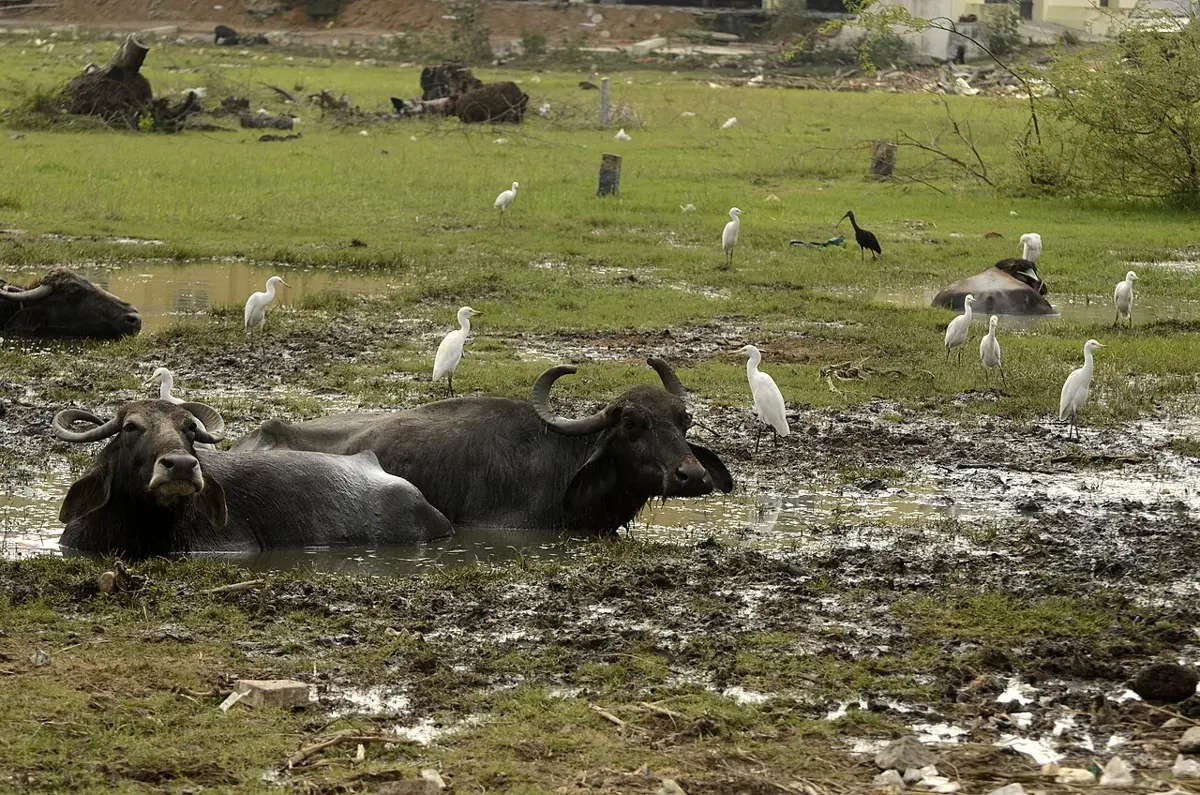
Behavior is part of homeostasis too, and for many animals it is the main part. A lizard has no sweat and no shivering: it keeps warm by lying in the sun in the morning and hiding in the shade at noon. A water buffalo has far fewer sweat glands than a cow, so on a hot day it lies in a pond or a mud wallow. A dog sweats only a little, through its paws, and cools itself mainly by panting: air moved fast over its wet tongue and mouth evaporates water there.
How much heat does sweat carry?
Your body is always making heat, because the chemistry in every cell gives out energy. Sitting still, an adult makes about 90 W of heat, a little less than an old 100 W light bulb. Walking, about 300 W; running hard, about 800 W. All of it has to leave the body, or you get hotter.
To evaporate 1 gram of sweat takes about 2,400 J of heat, taken from your skin. That is a lot: nearly six times what it takes to warm the same gram of water from 0 °C to 100 °C. You know from Grade 10 how to work out the heat needed to warm something, Q = mcΔθ Grade 10: Calculating heat. The human body is mostly water, and its specific heat capacity is about 3,500 J/(kg °C).
Now try being the hypothalamus’s patient. The model in the widget is simplified, but it follows the real physics: heat made by the body, heat gained or lost through the skin, and sweat that cools only as fast as the air lets it evaporate.
On a hot, humid day, which change would cool a sweating person most?
Pick an answer to see why.
A fever: the thermostat turned up
When you catch an infection, such as flu, typhoid or dengue, the body’s defenses send chemical messages to the hypothalamus that raise its set point, from 37 °C to, say, 39 °C. Nothing is wrong with the thermostat: it has been turned up on purpose, and many germs grow less well at the higher temperature.
Now think about what the loop does. The blood is still at 37 °C, but the set point is 39 °C, so the hypothalamus “thinks” the body is too cold. It narrows the skin’s blood vessels and makes you shiver, and you feel cold and pull the blanket up, even though your temperature is rising. This is the chill at the start of a fever.
When the infection is beaten, or you take a medicine for fever like paracetamol, the set point comes back down to 37 °C. Now a body at 39 °C is too hot for the thermostat: you sweat, your face flushes, you throw off the blanket. The fever has “broken”.
At the start of a fever, a child’s temperature is 38 °C, rising, yet she is shivering under a blanket. Why?
Pick an answer to see why.
When the loop is overwhelmed
Negative feedback works only within limits. The sweat glands can make only so much sweat, and the muscles can shiver only so hard. Push the body past them and the loop loses control.
Hypothermia. On a mountain in wind and wet clothes, a body can lose heat faster than shivering can make it. Below 35 °C the person shivers hard, fumbles and stumbles; below about 32 °C shivering may stop, the person becomes confused and sleepy and may not realize they are in danger. Call for medical help, and meanwhile get the person out of the wind and wet, take off wet clothes, and wrap them in dry blankets or a sleeping bag with the head covered. Give a warm, sweet drink only if they are fully awake, never alcohol. Don’t rub their arms and legs or put them in a hot bath: warm them gently.
Heat exhaustion and heatstroke. In hard work in hot, humid weather, the body can make and gain heat faster than sweat can remove it, and it loses water and salt with every liter of sweat. Heat exhaustion comes first: heavy sweating, weakness, headache, dizziness, feeling sick. Rest in a cool, shaded place, loosened clothes, cool water sprayed or sponged on the skin with fanning, and plenty of water or Jeevan Jal usually bring a person back within half an hour; if not, treat it as heatstroke. If the core passes about 40 °C, the brain itself begins to fail: the person becomes confused, may stop sweating, may collapse. This is heatstroke, a medical emergency. Call for help and cool the person at once: wrap them in a cool, wet sheet or sponge them with cold water, and fan them. If they faint, lay them in the recovery position and check their breathing.
Heatstroke is dangerous because the loop flips. Normally, a hotter body sweats more and cools down. But when a hot brain stops controlling the sweat, a hotter body loses heat less well, so it gets hotter still. A change that makes itself bigger is the opposite of negative feedback.
Positive feedback
There is a second kind of feedback loop. In positive feedback, the response makes the change bigger, not smaller, and the change grows faster and faster until something ends it. That is no use for keeping anything steady, but it is just right when the body needs something to happen completely and quickly:
- Childbirth. When a baby’s head presses on the opening of the womb, nerves signal the brain, and the pituitary releases a hormone, oxytocin, that makes the womb squeeze. The squeezing pushes the head harder, which releases more oxytocin, which makes the squeezing stronger. The loop stops when the baby is born and the pressing ends.
- Blood clotting. At a cut, the first platelets that stick to the wound release chemicals that make more platelets stick, and more clotting chemicals form. The clot builds up fast until the hole is closed.
| Negative feedback | Positive feedback |
|---|---|
| The response works against the change. | The response makes the change bigger. |
| Brings a condition back to its set point. | Pushes it further and faster from where it started. |
| Keeps things steady: homeostasis. | Gets a job done completely and quickly. |
| Runs all the time. | Needs an end (the birth, the closed cut). |
| Body temperature, blood sugar, water, CO₂ | Childbirth, blood clotting |
Which of these is positive feedback?
Pick an answer to see why.
Water, breath and heartbeat
The same idea runs other loops you can feel.
Water. When you lose water, by sweating or on a long walk without a drink, your blood becomes a little more concentrated. Sensors in the hypothalamus detect it. You feel thirsty (behavior), and the pituitary releases a hormone (ADH, the antidiuretic hormone) that makes the kidneys take water back from the urine they are making. Less water leaves, and your urine turns dark yellow. Drink a lot, and the opposite happens: plenty of pale urine. The color of your urine is a simple sign of this loop at work.
Breathing. Your muscles make carbon dioxide as they work. Sensors in the brainstem and in the big arteries of the neck detect when the CO₂ in the blood rises, and the brainstem makes you breathe faster and deeper, which removes it. Hold your breath, and after a while the urge to breathe becomes too strong to resist: it is driven mostly by the rising CO₂, not by the lack of oxygen.
Heart rate. You know from Grade 10 that your heart rate rises in exercise and falls back in rest Grade 10: Heartbeat, pulse rate or heart rate. Your heart rate isn’t kept steady for its own sake; the heart is an effector. What the body keeps steady is the oxygen and carbon dioxide in the blood and the blood pressure. When you start to run, your brain speeds up the heart through the sympathetic nerves at once, and sensors in the working muscles and blood vessels report how hard they are working, so the heart pumps faster and harder, bringing more oxygen and taking away more CO₂. When you stop, the parasympathetic nerves slow the heart, and the rate falls back to its resting level Grade 9: Nerves and hormones work together.
Heart rate is easy to measure, with nothing but your fingers and a clock. That makes it the best way to see homeostasis at work: a change (exercise), a response, and a return to rest when the change stops.
Investigate it: heart rate and exercise
A good investigation starts with a question you can answer by measuring. For example: How does your heart rate change during and after exercise, and how long does it take to get back to its resting rate?
Then plan it before you start:
- Make a prediction, with a reason. “My heart rate will rise during skipping, because the muscles need more oxygen, and fall back to its resting rate within a few minutes after I stop, because a feedback loop slows it when the need is gone.”
- Decide on the variables. What you change on purpose is the independent variable: here, the time after exercise (or, in another investigation, how hard or how long you exercise). What you measure is the dependent variable: the heart rate. Everything else must stay the same, the controlled variables: the same exercise for the same time (say 1 minute of skipping), the same person, measured sitting down, the same way of counting, at the same time of day, not just after a meal or tea.
- Decide how to measure, and how precisely. Counting the pulse for 15 seconds and multiplying by 4 is quick, which matters, because the rate starts falling as soon as you stop. But it gives only multiples of 4, so each reading may be up to about 4 beats a minute out. Counting for 30 seconds (× 2) is more precise but slower.
- Repeat. Do the whole thing three times, resting fully between trials, and take the mean (average) at each time. One trial could be upset by a miscounted beat; three agreeing trials are evidence.
- Keep it safe. Gentle exercise only, stop if you feel dizzy or unwell, and anyone with a heart or breathing problem should only do the counting.
- Record it in a table, then plot it: time across, heart rate up.
Plants keep steady too
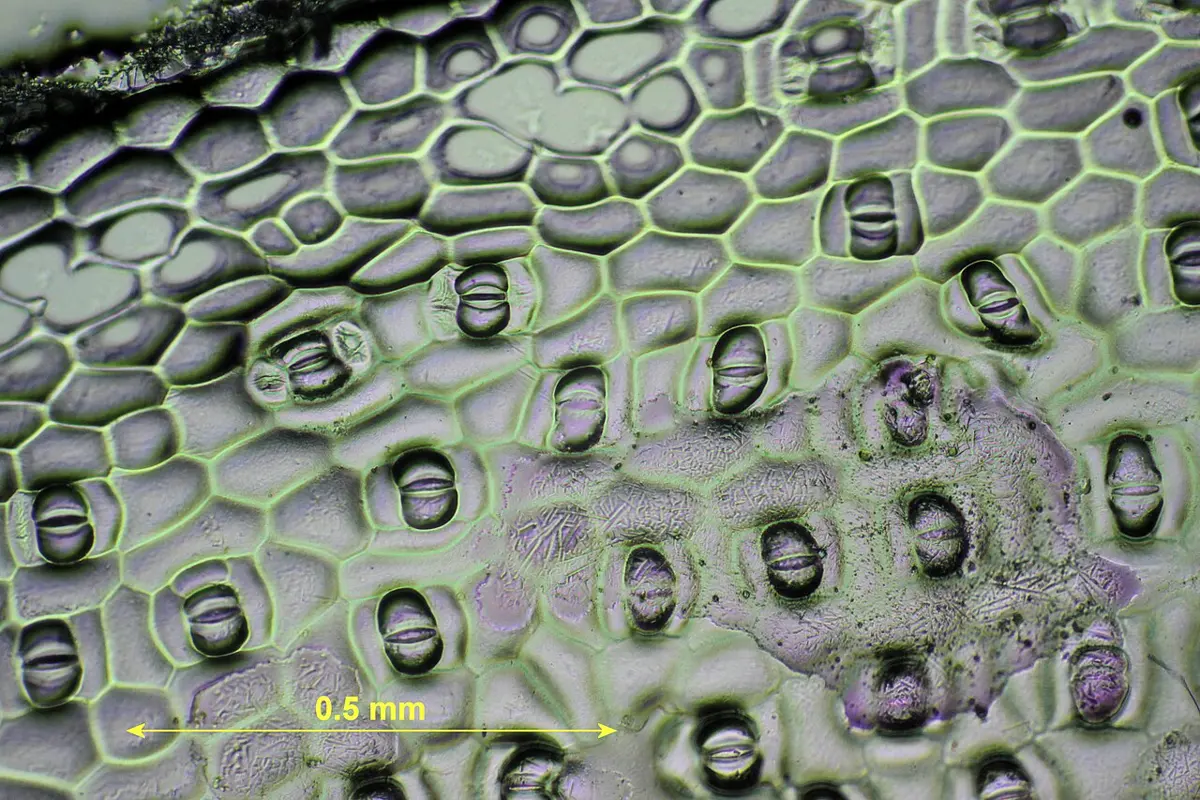
A plant can’t look for shade or drink when it is thirsty, but it has feedback loops of its own. On the underside of most leaves are thousands of tiny pores, the stomata (one is a stoma, Greek for “mouth”). Through them the leaf takes in the carbon dioxide it needs for photosynthesis, and through them it loses water vapor, which pulls water up from the roots.
Each stoma lies between two curved guard cells. When the plant has plenty of water, the guard cells are swollen with it, and they bow apart and open the pore. When the plant is short of water, the guard cells go limp, and they close the pore. So when the soil dries or the air is very dry and hot, the stomata close and the leaf loses much less water: a response that works against the change, negative feedback again. (A plant hormone, abscisic acid, carries the message from dry roots to the guard cells; Grade 9 mentions it among the plant hormones.) The cost is that with its stomata closed, the plant takes in little carbon dioxide, so it grows little until the water comes back.
Plants respond to water in slower ways too. Roots grow more towards wet soil, and a plant grown in dry soil puts more of its growth into roots and less into leaves. These changes take days or weeks rather than minutes.
Questions
After a long walk without a drink, your urine is dark yellow. Which part of a feedback loop is the kidney here?
Pick an answer to see why.
Which of these will not help a body that is too cold?
Pick an answer to see why.
Use the words stimulus, sensor, control center, effector and response to explain how the body brings its blood sugar back to normal after a plate of sel roti.
Answer
The stimulus is the rise in blood sugar as the sugar from the sel roti is absorbed. The sensor and control center are the islet cells of the pancreas, which detect that the sugar is above its normal level (about 70–100 mg/dL fasting) and release insulin into the blood. The effectors are the liver, muscles and fat, which take in sugar from the blood and store it. The response is that the blood sugar falls back to normal, and as it does, less insulin is released. Because the response cancels the change that started it, this is negative feedback.
Explain why a person feels hotter on a humid day at 35 °C in the Terai than on a dry day at 35 °C in a desert.
Answer
At 35 °C the air is about as hot as the skin, so the body can lose almost no heat to the air; nearly all of it must go by evaporating sweat. Sweat cools only when it evaporates, taking about 2,400 J per gram from the skin. In humid air, the air already holds a lot of water vapor, so sweat evaporates slowly: it drips off instead, carrying little heat away, and the body warms up. In dry air sweat evaporates quickly, so it cools well and the person feels much more comfortable.
A porter weighs 62.0 kg before a three-hour climb and 60.5 kg after it. He drank 0.5 liters of water on the way and did not pass urine.
- i.How much sweat did he lose?
- ii.If it all evaporated, how much heat did it carry away?
- iii.What average power is that?
Answer
- i.He lost 62.0 − 60.5 = 1.5 kg of mass, and he also drank 0.5 kg of water that he must have lost too, so his sweat was about 1.5 + 0.5 = 2.0 kg, about 2 liters. (A little of the mass loss is water and carbon dioxide breathed out, so this is a slight overestimate.)
- ii.Heat = 2,000 g × 2,400 J/g = 4,800,000 J = 4.8 MJ.
- iii.Power = energy ÷ time = 4,800,000 J ÷ (3 × 3,600 s) = 4,800,000 ÷ 10,800 = about 440 W.
A student wants to find out whether plants close their stomata in dry air. Plan an investigation. Say what you would change, what you would measure, what you would keep the same, and how you would make your result trustworthy.
Answer
A good plan: use at least six potted plants of the same kind, size and age, all well watered the day before. Put half in dry air (an open, warm room) and half in humid air (each under a large clear plastic cover with a dish of water inside), in the same light and temperature; the humidity is the independent variable. After two hours, measure how open the stomata are: paint clear nail varnish on the underside of one leaf from each plant, let it dry, peel it off with clear tape, and under a school microscope count the open and the closed stomata in the same number of fields of view; the fraction open is the dependent variable. Keep the same: kind, size and age of plant, watering beforehand, light, temperature, time, the position of the leaf sampled. Take the mean of each group, and repeat on another day. (Weighing each pot before and after, with the soil covered, adds a second measurement: the water lost.)
Expected result: in very dry air more of the stomata are closed than in humid air, and as they close the water loss slows. If the plants in dry air began with their stomata open and closed them as they lost water, the response worked against the change that caused it: negative feedback.
A girl’s heart rate was 70 at rest, 150 straight after a run, and 110, 90, 78 and 72 at 1, 2, 3 and 4 minutes after.
- i.Sketch the graph.
- ii.Describe the pattern.
- iii.Explain how this is evidence that a negative feedback mechanism controls the heart rate.
Answer
- i.Time after the run (minutes) across, heart rate (beats a minute) up: a dashed line at 70 for rest; the points start at 150 and curve down to 72, steeply at first, then leveling out just above the dashed line.
- ii.The rate falls back towards the resting rate: by 40 in the first minute, then by 20, 12 and 6. The fall gets smaller as the rate gets closer to rest.
- iii.When exercise stopped, nothing outside made the heart slow down: the body did it, and it stopped at the resting level instead of going on falling. The size of the response depended on how far the rate was from rest, biggest when it was furthest away. That is what a negative feedback loop does: it works against a change, more strongly the bigger the change, and brings the condition back to its normal level.
In a fever, why does a patient shiver as their temperature rises, and sweat as the fever ends? Use the idea of a set point.
Answer
The infection makes the hypothalamus raise its set point, say from 37 °C to 39 °C. While the body is below the new set point, the loop acts as it does when the body is too cold: the skin’s vessels narrow and the muscles shiver, making heat, so the temperature rises and the patient feels cold. When the infection is over or a medicine lowers the set point back to 37 °C, the body at 39 °C is now above it: the loop acts as for a hot body, widening the skin’s vessels and sweating, until the temperature comes back to 37 °C.
Give one example of positive feedback in the body. Why must every positive feedback loop have an end?
Answer
In childbirth, the baby’s head pressing on the opening of the womb makes the pituitary release oxytocin, which makes the womb contract harder, which presses the head harder, which releases more oxytocin. (Blood clotting is another example.) In positive feedback the response makes the change bigger, so the change grows faster and faster. If nothing stopped it, it would run out of control. The loop has a natural end: when the baby is born, the pressure stops and so does the release of oxytocin; when the cut is sealed, clotting stops.
Where to go next
- How Does Food Become Energy, and Become You? Where the heat your body makes comes from: the chemistry that releases energy from food inside every cell.
- How Does a Gene Make a Protein? Insulin, ADH and oxytocin are proteins. How a cell reads its DNA to build them.
- How Does One Cell Become a Whole Person? How the cells of sweat glands, muscles and the brain all came from one, and became so different.