
Building proteins link by link on a bead
Nobel Prize in Chemistry, 1984: Bruce Merrifield
-
Bruce Merrifield
1921–2006, born in the United States
As a boy he went to nine primary schools and two high schools, and ground the mirror for his own telescope. He worked at the same institute in New York for more than fifty years.
Think of a mala, a string of beads. To make one, you thread the beads one at a time, in the order you want. Now imagine that every bead is so small you can't see it, that each one must be joined by a chemical reaction, and that after each bead you must find your string again in a bottle full of loose beads and leftovers.
That was the problem facing chemists who wanted to make proteins and their smaller cousins, peptides. These are chains of small molecules called amino acids, joined end to end. Your body makes thousands of them every second. In the laboratory, making even a short chain took months.
In 1984 the Nobel Prize in Chemistry went to the American chemist Bruce Merrifield, who found a simple trick. He tied the first link of the chain to a tiny plastic bead. Then the chain could never get lost, and the leftovers could simply be washed away.
The problem: chains that are hard to make
Proteins do most of the work in a living thing. Enzymes are proteins that speed up the chemical reactions in your cells; the enzymes in your saliva and gut break down the rice and dal you eat. Many hormones, the body's chemical messengers, are peptides: insulin, which controls the sugar in your blood, is a chain of 51 amino acids, and oxytocin, which makes the womb squeeze during childbirth, is a chain of just nine.
Living things use about 20 kinds of amino acid. Every amino acid has two ends that can join: an amino group at one end and an acid group (a carboxylic acid group) at the other. When the acid end of one amino acid joins the amino end of the next, they make a peptide bond, and a molecule of water is given off. Repeat this many times and you have a chain (Proteins do the work).
The order of the amino acids is everything. Change one link and the chain may fold into a different shape and stop working. So a chemist who wants to make a peptide must join the right amino acids in exactly the right order.
Caps on the ends
The German chemist Emil Fischer, who won the Nobel Prize in Chemistry in 1902 for other work, made the first small peptides around 1901 and gave them their name. He also saw the main difficulty. If you mix two amino acids, A and B, they don't just make A–B. They also make B–A, A–A, B–B and longer muddles, because each one has two ends that can react.
The answer is to put a protecting group, a chemical "cap", on every end that must not react. Cap the amino end of A and the acid end of B, and only one join is possible: A–B. Then take one cap off, add a third capped amino acid, and so on, one link at a time. Fischer's own student Max Bergmann, with Leonidas Zervas, found the first really useful cap in 1932.
Why does a chemist put a "cap" on some ends of the amino acids?
Pick an answer to see why.
Why it was so hard
The plan with caps works, but it is painfully slow. After every join, the new chain is mixed up in the same liquid as the leftover amino acids, the used chemicals and the by-products. Before the next step, the chemist must separate it out and clean it, often by making it crystallize. That takes days, and every time some of the chain is lost.
In 1953 the American chemist Vincent du Vigneaud made oxytocin, nine amino acids long, the first peptide hormone ever made in a laboratory. It was such a feat that he won the Nobel Prize in Chemistry in 1955. A chain of a hundred links looked almost impossible.
The losses are the real killer, because they multiply. Suppose each step keeps 90 per cent of the chain, which is a very good result. After two steps you have 90 % of 90 %, which is 81 %. After seven steps you have less than half. After a hundred steps you have 0.9 multiplied by itself a hundred times: about 0.003 per cent. Start with a whole kilogram of the first amino acid and you end with about 30 milligrams, a few grains, and that is before any other problems (Figure 1).
At the prize ceremony, the Swedish chemist Bengt Lindberg compared the old way with climbing a peak in the Himalaya. It begins with a large expedition carrying a great deal of equipment, and ends, if all goes well, with a few climbers carrying very little reaching the top.
Each step of a synthesis keeps 90 % of the chain. About how much is left after three steps?
Pick an answer to see why.
What he did, step by step
Bruce Merrifield: tie the chain down
- 1949: New York. Merrifield finished his studies in chemistry in California on 19 June 1949. The next day he married Elizabeth (Libby) Furlong, and the day after that they left for New York, where he joined the Rockefeller Institute (later Rockefeller University). He worked there for the rest of his life.
- The need. His boss, D. W. Woolley, studied small peptides that make bacteria grow. To test them, the laboratory needed to make many peptides, and every one took months.
- 1959: the idea. Merrifield thought: what if the chain were fixed at one end to something solid, which can't dissolve? Then, after each step, he could pour off the liquid with all its leftovers, wash the solid, and the chain would still be there, clean and ready for the next link. No crystallizing, no losses from moving things between bottles, and every step in one vessel.
- Finding the right solid. He tried many solids. The one that worked was a polymer, a plastic made of long chains: tiny beads of polystyrene (the plastic of foam cups), lightly cross-linked so that they can't dissolve. Each bead is about 0.05 mm across, smaller than a grain of fine sand. In the liquids he used, the beads swell to five or six times their size, like dry rice soaking up water, so the chemicals can reach the chains inside them and not only those on the surface.
- 1963: the first chain. After four years of work, he published a paper, under his name alone, describing how he made a chain of four amino acids on the beads. He called the method solid-phase peptide synthesis: the chain is held in the solid, the chemicals come in the liquid.
- Using a big excess. Because the leftovers wash away, he could pour in far more of each new amino acid than was needed. That pushes every join almost to the end, so that each step kept 99.5 % of the chains or more. After a hundred steps, 61 % is left, not 0.003 %.
- 1965: a machine. All the steps were the same, over and over: pour in, shake, drain, wash. So, with John Stewart and Nils Jernberg, Merrifield built a machine that did them by itself, controlled by a turning drum and timers.
- The mid-1960s: real hormones. His laboratory made bradykinin (a peptide nine amino acids long that widens blood vessels), angiotensin and oxytocin, and then insulin, with its two chains.
1969: an enzyme made by a machine
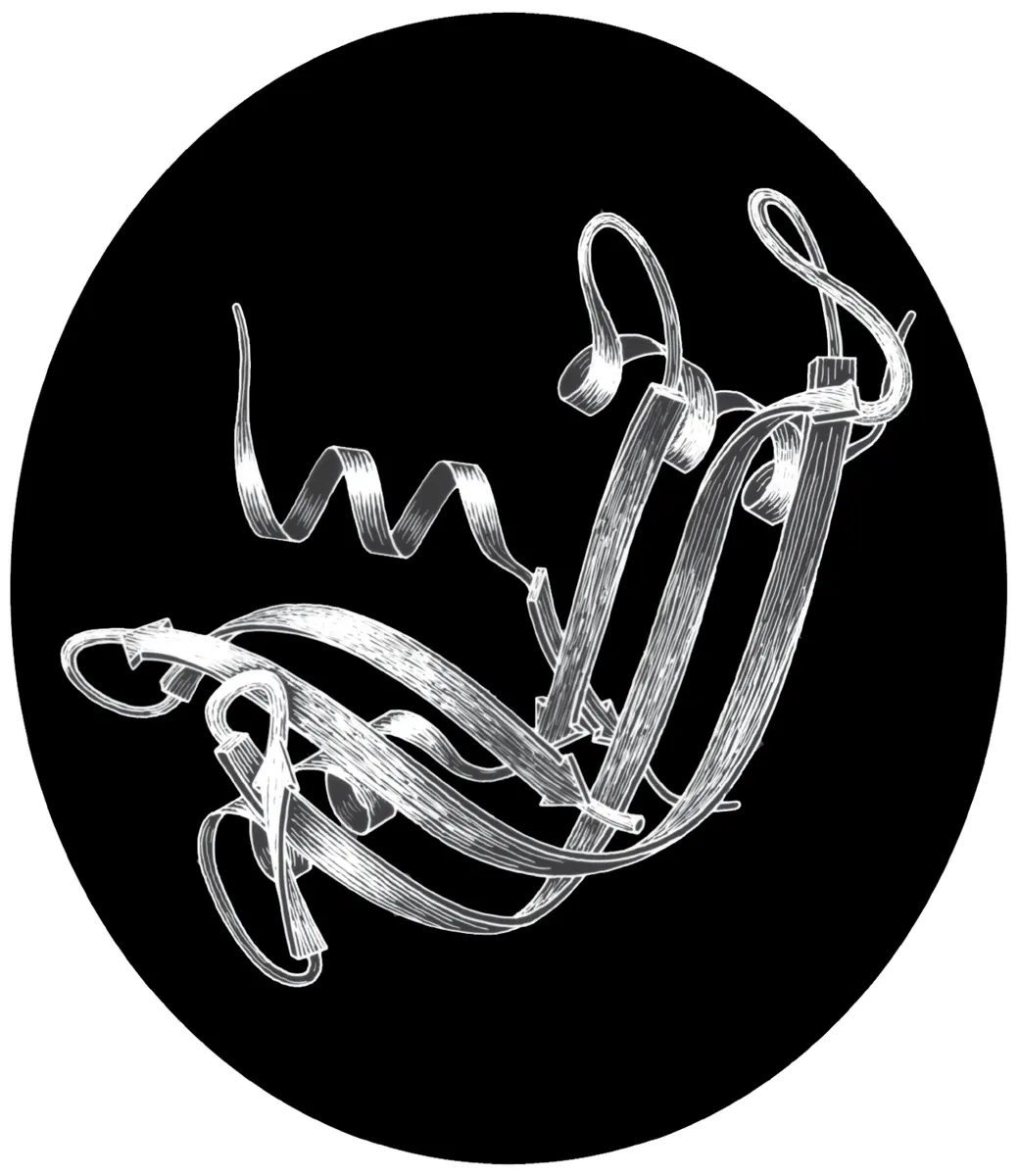
Hormones are short chains. Could the method make a real enzyme, a long chain that folds into a working shape? Merrifield and Bernd Gutte chose ribonuclease A, an enzyme from the pancreas of cows that cuts up RNA. It is a chain of 124 amino acids.
The machine added the amino acids one by one, all 124 of them. Then the chain was cut free, and it folded up by itself. The finished enzyme worked: it cut up RNA, just like the natural one, and it chose the same kinds of RNA to cut. In January 1969 the Rockefeller team and a team at the drug company Merck, which had made the same enzyme a different way, announced their success together.
This showed something important about life. The only thing the chemists put in was the order of the amino acids. Nobody told the chain how to fold. So the order alone must decide the shape, and the shape decides the job.
How it works now
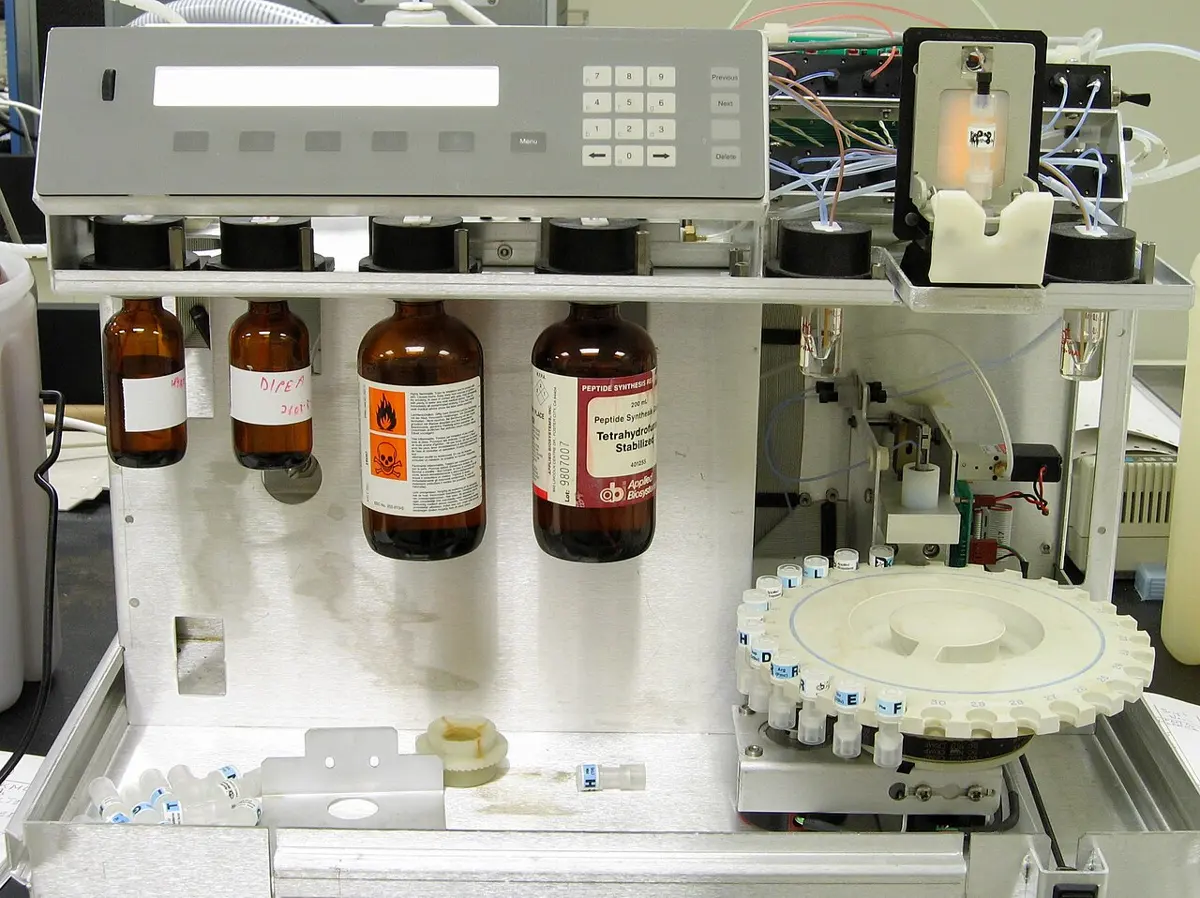
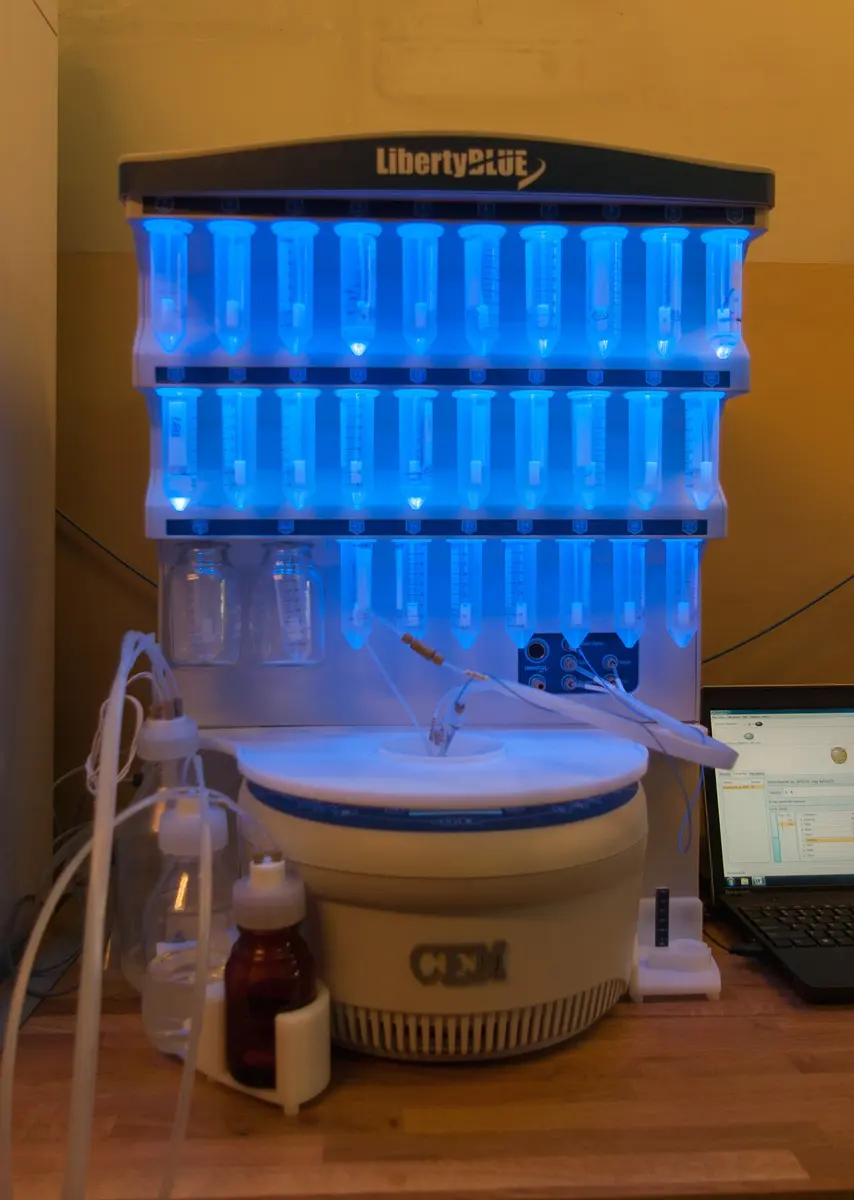
Today the work is done by machines called peptide synthesizers, about the size of a printer. A chemist types in the order of the amino acids. The machine pumps in each capped amino acid in turn, then the chemicals to take off its cap, then washing liquid, and drains it all away through a filter under the beads, cycle after cycle.
Some things have changed since the 1960s:
- Gentler caps. Merrifield's cap (called Boc) was taken off with acid, and the finished chain was cut off the bead with a very strong, dangerous acid. Most laboratories now use a cap called Fmoc, introduced in the 1970s, which comes off with a mild base, and the chain is released with a milder acid.
- Speed. Some machines warm the beads with microwaves, which makes each join faster. A chain of 30 amino acids can now be made in a day.
- How long. One link at a time works best for chains of up to about 50 amino acids. Longer proteins are made in pieces, and the pieces are joined.
The same trick for DNA
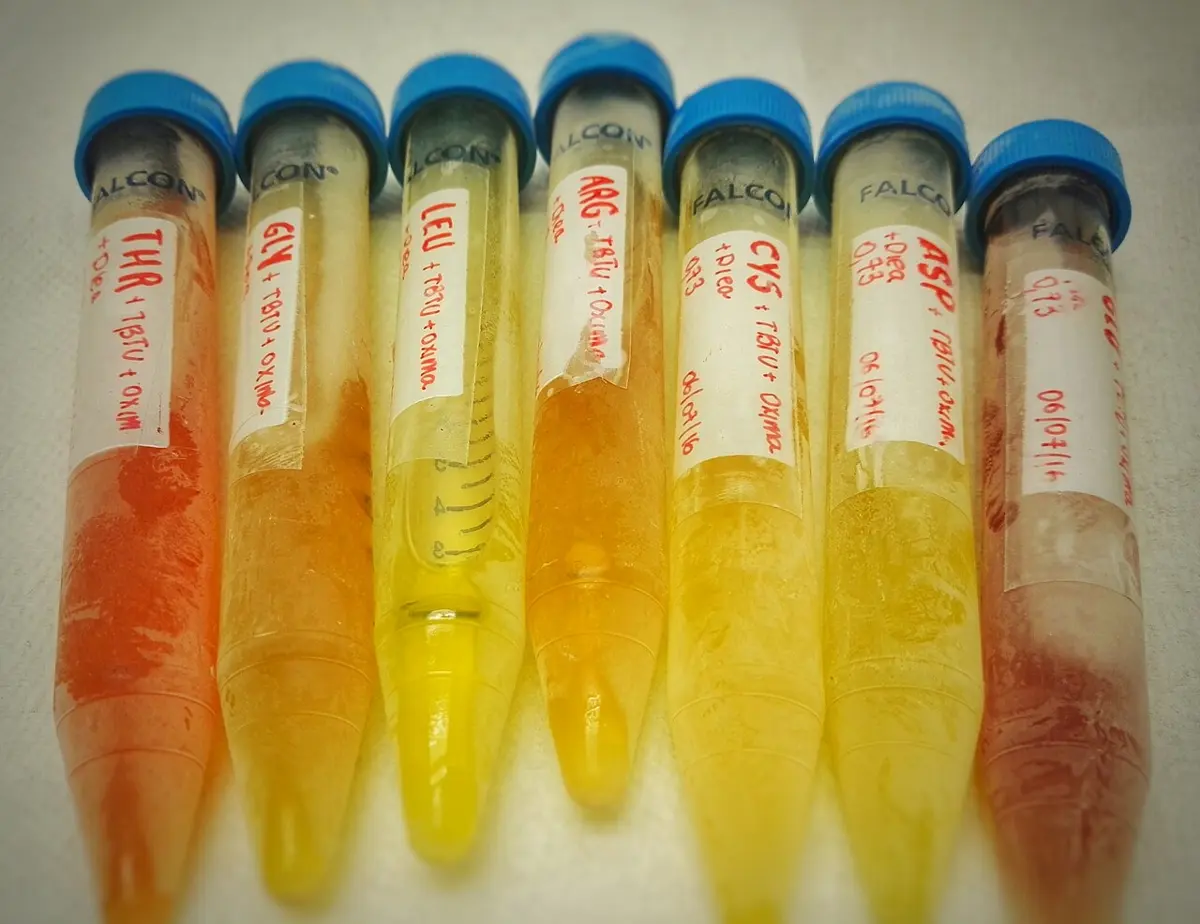
Merrifield's idea was not only for proteins. DNA is also a chain, made of four kinds of link called nucleotides Grade 10: DNA. From 1965 other chemists built DNA chains on solids in the same way: fix the first link, add one capped link at a time, wash, repeat. By the early 1980s machines could make short pieces of DNA of any order. The Nobel committee called this the most important use of his idea, though Merrifield never worked on DNA himself.
What was the key advantage of fixing the chain to a solid bead?
Pick an answer to see why.
In your life today
- Tests for diseases. A PCR test, like the tests for COVID-19 done in Nepal's laboratories, needs short pieces of DNA called primers, about 20 links long, that find and copy the virus's genes. Primers are made by machines that build DNA on a solid, link by link, the way Merrifield built peptides.
- Medicines. Many medicines are peptides: hormones such as oxytocin, which hospitals give to help in childbirth, and newer medicines for diabetes. The oxytocin in those injections is made by chemists, not taken from animals.
- Research. Scientists order peptides to study how proteins work, to find which part of a virus the body's antibodies recognize, and to test new vaccines. A short peptide can now be ordered from a company and arrive within days.
What came next
- Joining pieces. In 1994 the chemist Stephen Kent and his team found a way to join two unprotected peptide chains, each made on beads, into one longer chain. Proteins of a few hundred amino acids can now be made by chemists alone.
- Living factories. Long proteins such as the insulin used by people with diabetes are now mostly made by bacteria or yeast that have been given the human gene. Chemical synthesis is used where it can do things cells can't, such as building a chain from amino acids that living things don't use.
- Mirror-image proteins. Every amino acid in living things is "left-handed". Chemists can build a protein entirely from the "right-handed" mirror form, which no living thing can make, and it folds into the exact mirror image of the natural one. Germs' enzymes can't break such proteins down.
- An open question. Could chemists one day make any protein, of any length, as quickly and cheaply as a printer prints a page? And could they then build a whole mirror-image living cell? Many scientists now warn that such "mirror life" should never be made, because nothing on Earth could fight it.
In your science books
- Grade 8: atoms and molecules and chemical reactions.
- Grade 9: organic compounds, and the pancreas and its hormone insulin.
- Grade 10: DNA, and catalysts.
- Going Further (9–12): proteins do the work and a chain that folds; twenty amino acids.
- Going Further (6–8): plastics are made of chains; food is made of big molecules.
Learn more
- The Royal Swedish Academy of Sciences’ press release, the presentation speech and the speed read (nobelprize.org).
- Merrifield’s Nobel lecture, Solid phase synthesis.
The official reason
The prize was given “for his development of methodology for chemical synthesis on a solid matrix.”