
Look around your home. The black water tank on the roof. The bucket and lota in the bathroom. A plastic chair, a toothbrush, a raincoat, the milk pouch, the pipe that brings the water, the cover of your phone. Maybe even your school sweater. A hundred years ago, almost none of these existed.
Most of this plastic was made from oil and natural gas, pumped up from deep under the ground. But Nepal produces no oil, and oil is a black, sticky, smelly liquid. A water bottle is clear, light and hard. How does one become the other? Chemists change natural things into completely new materials. This topic shows how they do it, and what it costs us and the planet.
Natural and synthetic materials
In Grade 6 you learned that some useful chemicals come straight from nature and some are made by people. Let’s make that idea sharper.
A natural resource is anything from nature that people use: wood, cotton, stone, salt, water, air, oil, natural gas, plants and animals.
Some things we use are made from a natural resource just by changing its shape. A carpenter saws a tree into planks. A spinner twists cotton into thread. A mason cuts stone into blocks. The wood is still wood, and the cotton is still cotton. These are physical changes: no new substance is made.
Other things are made by a chemical change, a chemical reaction. The atoms of the starting materials are rearranged into new substances, with new properties. A material made like this is a synthetic material. Plastic, soap, glass, cement, nylon, most medicines and chemical fertilizers are all synthetic.
So the test is: is there a new substance, with different properties?
You have already met one synthetic material in the kitchen. Soap is made by heating a fat or an oil with caustic soda (sodium hydroxide). They react to make soap and glycerol. Oil is greasy and won’t mix with water; soap cleans grease off your hands. That is a new substance. (If you want to see how it works, it is in Grade 10: Soap.)
| Natural resource | The chemical change | Synthetic material |
|---|---|---|
| crude oil and natural gas | molecules cracked, then joined into long chains | plastics, nylon and polyester cloth |
| fat or vegetable oil, and caustic soda | heated together | soap |
| natural gas and air | hydrogen from the gas joined to nitrogen from the air, then to carbon dioxide | urea fertilizer |
| vegetable oil and hydrogen | hydrogen added, with nickel to speed it up | vanaspati ghee |
| sand, soda ash and limestone | melted together at about 1,500 °C | glass |
| limestone and clay | heated in a kiln at about 1,450 °C | cement |
| sugarcane molasses | fermented by yeast | ethanol (spirit, a fuel) |
| cow dung | broken down by bacteria, without air | biogas (methane) |
Which of these is a synthetic material?
Pick an answer to see why.
Ghee is heated with caustic soda and becomes soap. Why do chemists call soap a synthetic material, but not a cotton shirt?
Pick an answer to see why.
Oil is made of chains
Oil and natural gas formed over millions of years from the remains of tiny sea creatures, buried under the sea floor, squeezed and heated. You can read how in Grade 9: Fossil fuels.
Crude oil is a mixture of thousands of different substances. Most of them are hydrocarbons: compounds made of only two elements, carbon and hydrogen (Hydrocarbons, in Grade 10). A carbon atom has four “hands”: it always makes four bonds (How many hands?). So carbon atoms can hold hands with each other in a long chain, with hydrogen atoms holding on to the spare hands all along it (Grade 9 calls this catenation).
Here is the surprising part. The gas in your LPG cylinder, the petrol in a motorbike, a candle and a plastic bucket are all made of these same chains. The only big difference is how long the chains are.
Why does a longer chain make a solid? Molecules pull on each other a little, wherever they touch. A short molecule touches its neighbors only a little, so they fly apart easily: a gas. A long molecule lies alongside its neighbors over its whole length, so the pull adds up, and it takes a lot more heat to pull them apart. Polythene’s chains are so long that they also tangle, like noodles in a bowl. Pull one and the others hold it back. That is why a plastic bag stretches but doesn’t fall apart.
Butane (4 carbon atoms) is a gas at room temperature. Candle wax (about 25 carbon atoms) is a solid. Why?
Pick an answer to see why.
From oil to a plastic bucket
The chains in crude oil are of every length, all mixed up. To make plastic, chemists first take them apart, then build new, much longer chains. It happens in four big steps.
1. Pumping. Crude oil and natural gas are pumped up from rocks deep underground, often a few kilometers down.
2. Separating. In a refinery, the oil is heated. Short chains boil at low temperatures and long chains at high ones, so in a tall tower they separate into parts: gases, petrol, kerosene, diesel, wax and tar. Most of it is sold as fuel.
3. Cracking. Some of the parts, and the ethane gas that comes with natural gas, go to a cracker. There they are heated to about 850 °C, with steam, for less than a second. The chains shake so hard that they snap into small pieces. One of the most useful pieces is ethene (also called ethylene), C₂H₄: two carbon atoms joined by a double bond, holding hands with two hands each.
4. Joining. Now the trick. In a reactor, with a little help from a catalyst or a pinch of oxygen, one of the two bonds of each double bond opens. That frees a hand on each carbon, and it grabs the next ethene molecule, whose double bond opens too, and so on. Thousands of ethene molecules join end to end into one enormous chain: polythene (polyethylene).
A small molecule that can join with others of its kind is a monomer (“one part”). The long chain they make is a polymer (“many parts”), and the joining is called polymerization. Ethene is the monomer; polythene is the polymer.
The new polythene is cooled, cut into small beads called granules, packed in sacks and shipped. Nepal’s plastic factories buy them from abroad, much of it from India. They melt the granules and blow them into thin film for bags, squeeze them through a shaped hole to make pipes, or press them into molds to make buckets, chairs and jerrycans.
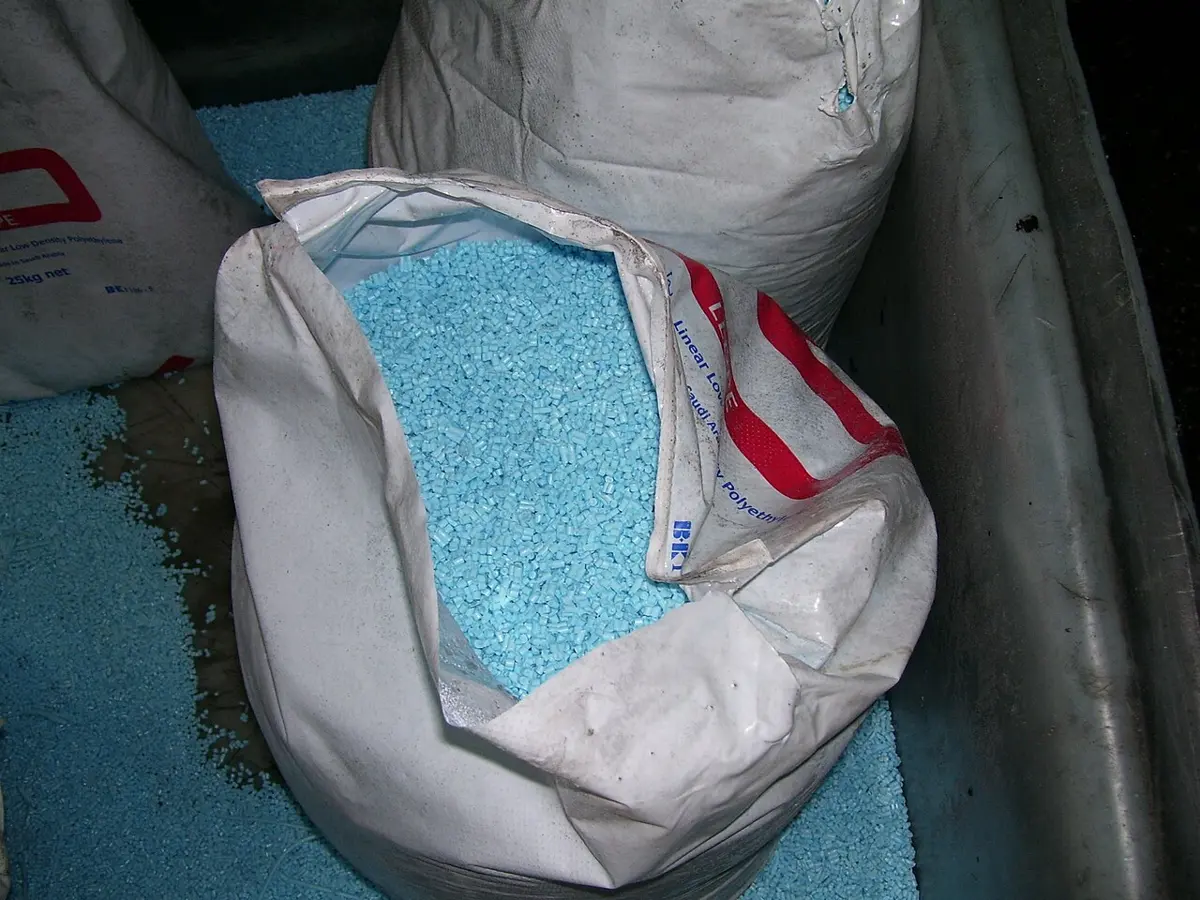
Different monomers make different plastics, with different properties. You can often find out which plastic a thing is made of from the number in a small triangle on it Grade 10: Read the number on a plastic.
| Monomer (from oil or gas) | Polymer | Where you find it |
|---|---|---|
| ethene | polythene (PE) | carry bags, milk pouches, jerrycans, water tanks |
| propene | polypropylene (PP) | chairs, buckets, bottle caps, food boxes |
| vinyl chloride (ethene with one hydrogen swapped for chlorine) | PVC | water pipes, raincoats, electric wire covers |
| styrene | polystyrene (PS) | thermocol plates, cups and packing |
| two monomers, ethylene glycol and terephthalic acid | PET, or polyester | water bottles; polyester cloth |
Which is the monomer, and which the polymer?
Pick an answer to see why.
More things chemists make from nature
Plastic is only one kind of synthetic material. The same idea, a natural resource changed by a chemical reaction into something new, gives us our clothes, medicines, fuels, foods and the fertilizer that grows our rice.
Clothes
Look at the label inside your clothes. Polyester is made from oil, like PET bottles. Nylon was the first fiber made entirely from chemicals, in 1935, in the laboratory of the American chemist Wallace Carothers. Nylon stockings went on sale in 1939 and 1940, and millions of pairs sold within days. Today more than half of all the fiber made in the world is polyester (57 % in 2023).
Rayon (viscose) is in between. It is made from wood: the cellulose in wood pulp is dissolved in chemicals, then squeezed through tiny holes into an acid bath, where it comes out as long, shiny threads. The starting material is natural, but the process is chemical, and rayon is very different from wood.
Medicines
For thousands of years, people in many lands chewed the bark of willow trees to ease pain and fever. In the 1800s, chemists found the substance in the bark that works, and made a stronger form of it, but it hurt the stomach. In 1897 Felix Hoffmann, a chemist at the Bayer company in Germany, changed it with a chemical reaction into a gentler medicine: aspirin. Today aspirin isn’t made from willow at all, but from chemicals that come from oil. Nature gave the idea; chemistry made the medicine cheap, pure and plentiful.
Fuels
Over 400,000 homes in Nepal have a biogas plant (as of 2021): cow dung and kitchen waste go into a closed tank, and bacteria, without air, turn them into methane gas for the stove. Sugar mills ferment their leftover molasses with yeast to make ethanol, a fuel that can be mixed into petrol. These are alternative fuels: they come from plants and animals that grow again, not from oil.
Food and farming
Vanaspati ghee is a new food made by a chemical change: hydrogen is added to vegetable oil, which turns it from a liquid into a solid fat Grade 10: Hydrogenation.
Urea, the fertilizer on Nepal’s rice and maize fields, is made from natural gas and air. The gas gives hydrogen, the air gives nitrogen, and in huge factories they are pressed together into ammonia, which is then joined with carbon dioxide to make urea Grade 9: Inorganic fertilizer. Nepal has no urea factory (as of 2026), so it buys all its urea from abroad. Fertilizer made in this way grows the food for about half the people in the world.
A sugar mill ferments molasses with yeast to make ethanol, a fuel. Which statement is right?
Pick an answer to see why.
What plastic gives, and what it costs
Plastic has changed how we live, much of it for the better:
- It is light, strong and cheap. A plastic tank or pipe brings water to a village at a fraction of the cost of metal.
- It doesn’t rust or rot, and water can’t get through it.
- It keeps food clean and fresh for longer, so less is wasted.
- In hospitals, single-use syringes, gloves, drips and blood bags stop infections spreading.
- It doesn’t carry electricity, so it covers every electric wire in your home.
- Light plastic parts make buses and aircraft lighter, so they burn less fuel.
But every one of these comes with a cost.
It is made from oil and gas. These took millions of years to form and will run out. Getting them, cracking them and making plastic all burn fuel too, which adds carbon dioxide to the air and warms the climate.
It lasts and lasts. Most plastics don’t rot, because almost no microbe can feed on them. Nobody knows exactly how long a plastic bucket lasts in the ground: hundreds of years, probably. Sunlight and rubbing slowly break it into smaller and smaller pieces. Pieces under 5 mm across are called microplastics. They are now found in rivers, seas, fish, salt, drinking water, and the air.
Very little is recycled. Of all the plastic thrown away in the world in 2019, only 9 parts in 100 were recycled.
Plastic in Nepal
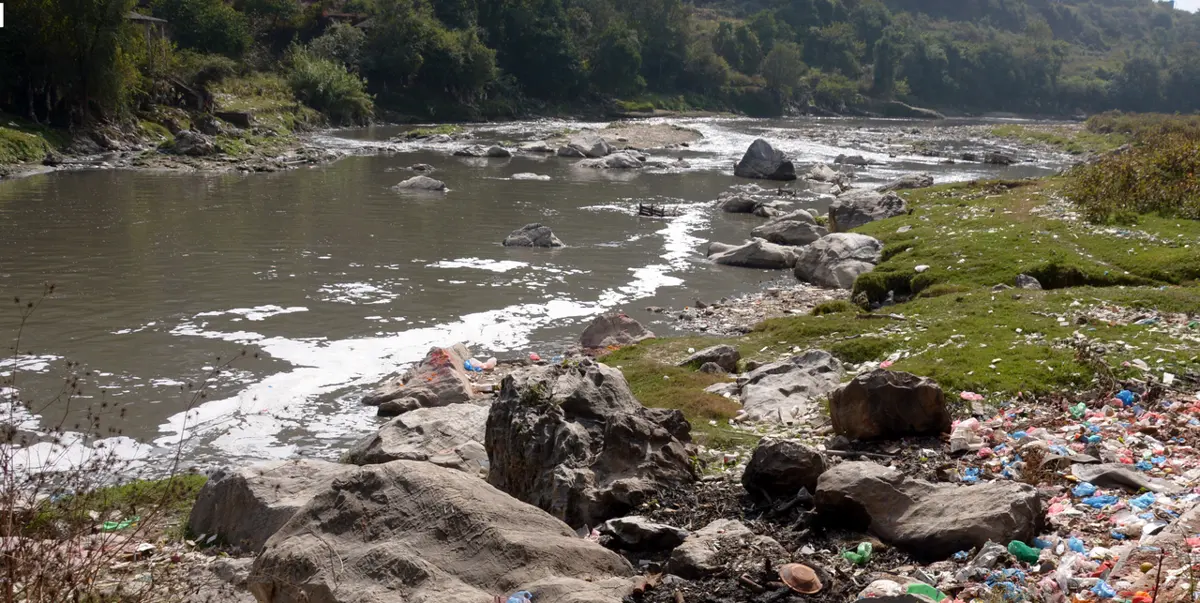
In the Kathmandu Valley, about a fifth of the rubbish people throw away is plastic (in a 2013 survey). Thin bags blow into drains and rivers, block them, and make floods worse in the monsoon. Stray cows eat bags at rubbish heaps and can die from them. Plastic burned in the open, in heaps by the road or in a kitchen fire, gives off poisonous smoke; burning PVC is the worst. Since May 2013, volunteers have gathered on Saturday mornings to clear rubbish, much of it plastic, from the Bagmati river in Kathmandu; in its first months, thousands came on some Saturdays.
In 2015 the government banned plastic bags thinner than 40 micrometers (40 thousandths of a millimeter) in the Kathmandu Valley, because thicker bags are easier to collect and recycle. The ban has been hard to enforce: thin bags are still everywhere.
Paper, plastic or cloth?
So should we stop using plastic bags? It is not as simple as it sounds. A bag made of paper, cotton or thick plastic costs more materials and energy to make than a thin plastic bag. It only does less harm if you use it many times.
In 2011, the Environment Agency in the United Kingdom measured how much each kind of shopping bag warms the climate, counting everything from growing or drilling the raw material to throwing the bag away, and comparing bags that carry the same amount of shopping. Here is what it found.
A cotton bag has to be used 131 times before it warms the climate less than thin bags used once and thrown away (if each thin bag is used again, say as a bin bag, the cotton bag needs even more trips). Cotton needs a lot of land, water and fertilizer to grow. But the study counted only the climate. It didn’t count the litter: a cotton bag that is lost rots away in a few months; a thin plastic bag blocks a drain or ends up in a cow’s stomach. Choosing well means weighing all the costs, and the best bag is almost always the one you already have, used again and again.
Investigate it yourself
Questions
Which of these is made by a chemical change?
Pick an answer to see why.
Ethene is a gas, but polythene is a solid. Why?
Pick an answer to see why.
Name the natural resource each of these synthetic materials is made from, and say in a few words what the chemical change is: a. soap, b. polythene, c. urea, d. biogas.
Answer
- a.Soap: fat or vegetable oil (and caustic soda); heated together, they react to make soap and glycerol.
- b.Polythene: crude oil or natural gas; long molecules are cracked into ethene, then ethene molecules are joined into long chains (polymerization).
- c.Urea: natural gas and air; hydrogen from the gas and nitrogen from the air are joined into ammonia, which is joined with carbon dioxide to make urea.
- d.Biogas: cow dung and kitchen waste; bacteria break them down without air into methane gas.
Rina says, “Cotton cloth and polyester cloth are both synthetic, because both are made in factories.” Is she right? Explain.
Answer
Only partly. Polyester is synthetic: it is made from chemicals that come from oil, by chemical reactions that make a new substance found nowhere in nature. Cotton is a natural material: the fiber is the same cellulose that the cotton plant made, and spinning and weaving it are only physical changes, even when they are done in a factory. What makes a material synthetic is a chemical change, not where it is made.
Use Figure 2.4. a. About how much plastic did the world make in 1990, and in 2019? b. How many times as much is that? c. Describe how the graph changes over time.
Answer
- a.About 120 million tonnes in 1990 and 460 million tonnes in 2019.
- b.460 ÷ 120 ≈ 3.8: nearly four times as much.
- c.The amount made has risen every decade since 1950, and it rises faster and faster: the graph gets steeper. Between 1950 and 1960 it rose by only 6 million tonnes, but between 2010 and 2019 by about 150 million tonnes.
Some plastics, such as PLA, are made from maize starch or sugarcane instead of oil. A shop says its PLA cups are “green”. What questions would you ask before believing it?
Answer
Good questions to ask:
- Is the material really made from plants, and how much of it? (Some “bio” plastics are only partly plant-based.)
- How much land, water, fertilizer and energy did growing the crop and making the plastic use? Could that land have grown food?
- What happens to the cup after use? PLA rots only in a hot industrial composting plant, at about 60 °C. In a rubbish heap, a river or the sea it lasts for years, like ordinary plastic. Is there such a plant near here?
- Can it be recycled with other plastics, or does it spoil them?
- Would a cup washed and used again be better than any throwaway cup?
Being made from plants, not oil, saves fossil fuel, but it doesn’t make a throwaway cup harmless.
A school canteen in Bhaktapur gives out tea in thin plastic cups and throws away about 300 a day. Suggest two ways to cut this waste. For each, say one benefit and one cost.
Answer
Any two well-argued answers, for example:
- Steel cups, washed and reused. Benefit: no cups thrown away; they last for years. Cost: they cost more to buy, need water and soap and someone’s time to wash them, and some go missing.
- Clay cups (kulhad). Benefit: made from a natural material, and a broken one turns back into soil. Cost: making them needs clay and fuel for the kiln, and they break easily, so they are usually used only once.
- Each student brings a cup from home. Benefit: no cost to the school and nothing to wash at the canteen. Cost: students forget, and someone has to make a rule and check it.
Explain why only 9 % of the world’s plastic is recycled, even though most plastic can be melted and molded again.
Answer
Recycling needs plastic to be collected, cleaned and sorted by type, because different plastics don’t mix well when melted. Most plastic waste is mixed, dirty or made of several layers stuck together (like crisp packets), so it is hard and costly to separate. Thin bags and wrappers weigh so little that collecting them doesn’t pay. Every time a plastic is melted, its chains break a little and it gets weaker, so it can be recycled only a few times. And new plastic made from oil is often cheaper than recycled plastic. So most plastic is buried, burned or dumped instead.
Where to go next
- What does a molecule look like? Build molecules from atoms, see their shapes, and find out why carbon makes four bonds. What Does a Molecule Look Like?
- Can you make a hand warmer? Some chemical changes give out heat, others take it in. Use one to design a pack that warms your hands. Can You Make a Hand Warmer?
- Why is there oil in some places but not others? Where oil, gas and other natural resources are found, how they formed, and why we use them far faster than they form.