
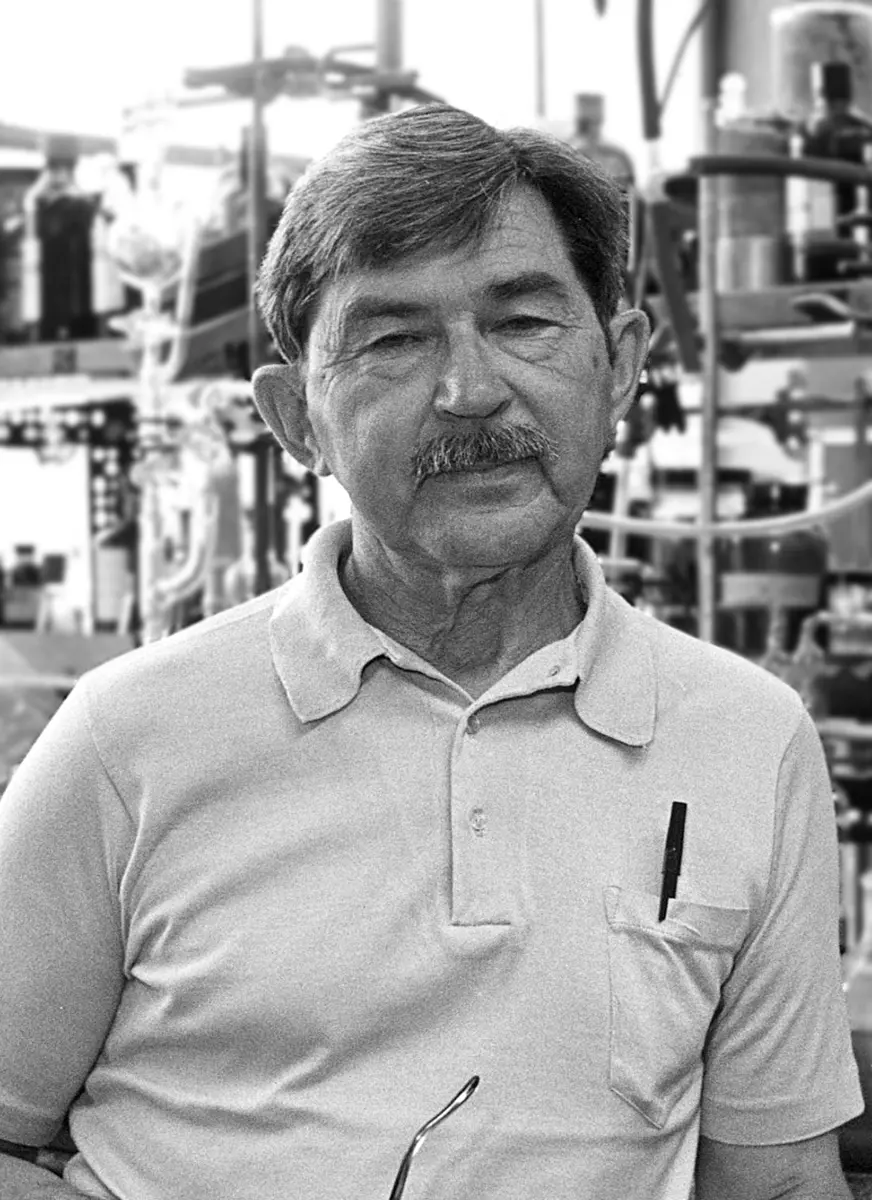
Henry Taube
1915–2005, born in Canada
He grew up on a farm in Saskatchewan, speaking Low German at home. He worked in the United States all his life, mostly at the universities of Chicago and Stanford.
Photo: ENERGY.GOV, CC0
Right now, inside every cell of your body, electrons are jumping from one metal atom to another. In the tiny power stations of your cells, the mitochondria, a chain of proteins with iron and copper atoms in them passes electrons from your food, one by one, to the oxygen you breathe in. Each jump releases a little energy, and your cells catch it. The same kind of jump happens when an iron roof rusts, and when a battery is charged.
How does an electron get from one metal atom to another? It sounds like a small question, but for a long time nobody knew the answer. The 1983 Nobel Prize in Chemistry went to Henry Taube, who found out.
The problem: chemists knew the start and the end, but not the middle
You know from your science books that a metal atom can lose electrons and become a positive ion Grade 9: positive ions. Some metals can do this in more than one way. Iron, for example, can be Fe²⁺ (it has lost two electrons) or Fe³⁺ (it has lost three). This is why some metals have more than one valency Grade 9: variable valency.
Losing electrons is called oxidation. Gaining electrons is called reduction. The two always happen together: if one ion gives an electron away, another must take it. Chemists call these redox reactions (from reduction and oxidation).
Here is the reaction this story is about. Mix a solution of cobalt ions with a charge of 3+ (Co³⁺) and a solution of chromium ions with a charge of 2+ (Cr²⁺). In a moment, the cobalt becomes Co²⁺ and the chromium becomes Cr³⁺:
Co³⁺ + Cr²⁺ → Co²⁺ + Cr³⁺
One electron has moved from the chromium to the cobalt. By the 1940s, chemists could write equations like this, and they could measure how fast such reactions went. But nobody knew how the electron made the journey. Did the two ions have to touch? Did the electron jump across a gap? Was something else carried across with it?
In the reaction Co³⁺ + Cr²⁺ → Co²⁺ + Cr³⁺, which ion is oxidized?
Pick an answer to see why.
Metal ions in water wear a coat
To follow Taube's answer, you need one more idea. A metal ion in water is never alone. Water molecules crowd round it and stick to it, usually six of them, one above, one below and four around its middle. The ion and its six partners together are called a complex, and the partners are called ligands. The Swiss chemist Alfred Werner worked this out in the 1890s (Nobel Prize in Chemistry, 1913).
You have seen complexes. The blue color of copper sulphate solution comes from copper ions with water molecules around them. Add a little ammonia and the solution turns a much deeper blue, because ammonia molecules take the place of some of the water molecules around each copper ion.
The partners don't always stay. Some metal ions hold on to them very loosely and swap them for others from the water all the time. Others grip them so tightly that a partner can stay for days.
So here was the puzzle in a clearer form. A Co³⁺ ion and a Cr²⁺ ion each wear a coat of six partners. The electron must somehow get from inside one coat to inside the other.
Why it was hard
Nobody could watch. The ions are far too small to see, even with the best microscope, and the electron's jump is over in a tiny fraction of a second. Chemists could only look at what was in the flask before the reaction and after it.
So the question became: could you design a reaction so that the products themselves would show what had happened in the middle? That needed a deep understanding of which partners stay and which go. Taube had that understanding, because he had worked it out himself.
What Taube did, step by step
Tight grips and loose grips
- A course with no textbook. Taube grew up on a farm in Saskatchewan, Canada, studied there and at the University of California, Berkeley, and moved to the University of Chicago in 1946. There he was asked to teach a course on inorganic chemistry, and he found that the books said very little about how complexes react. So he began to work it out himself.
- 1952: sorting the metal ions. In a famous article, Taube sorted metal ions into two groups. In some, the partners swap in and out within a minute or much less: chemists call these complexes labile (changeable). In others, they stay for hours, days or longer: these are inert (slow to change). And he showed that which group an ion belongs to depends on how the electrons are arranged inside it. Chromium is a striking example. Cr²⁺ swaps its water molecules in far less than a millionth of a second; Cr³⁺ holds on to each one for days.
The bridge, 1953
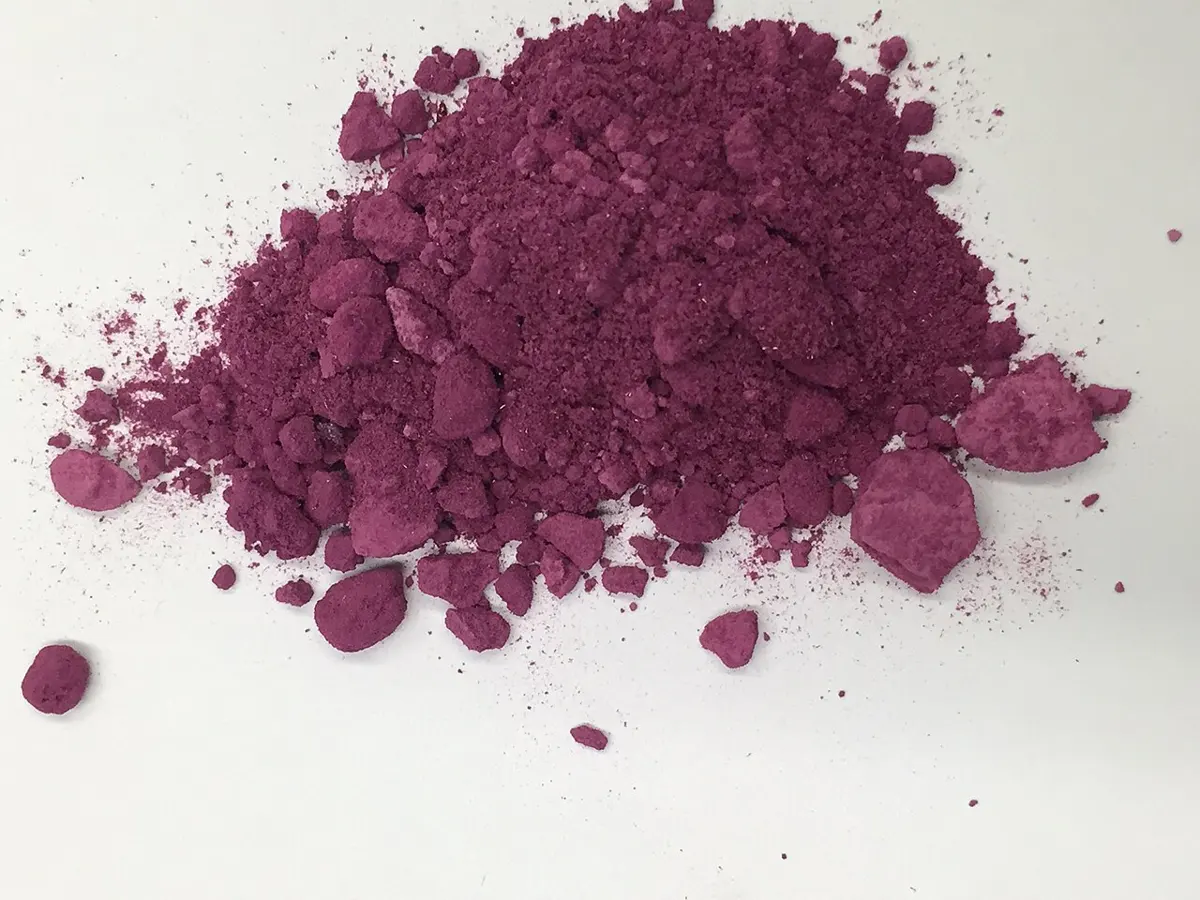
- Choosing the partners. With his co-workers Howard Myers and Ronald Rich, Taube chose the cobalt and chromium reaction above, with one change. The cobalt ion's coat was made of five ammonia molecules and one chloride ion (Cl⁻). This purple compound sticks together well: Co³⁺ grips all six partners tightly. The Cr²⁺ wore its usual coat of six water molecules, held loosely. And when it became Cr³⁺, it would grip whatever it was holding at that moment, and keep it.
- The clever part. So the product would be a record of the moment of the jump. Whatever was attached to the chromium when it lost its electron would still be attached afterwards. When they ran the reaction, every Cr³⁺ ion came out holding exactly one chloride. The chloride had moved from the cobalt to the chromium, in the opposite direction to the electron.
- Checking with radioactive chloride. Perhaps the chloride had simply fallen off the cobalt into the water first, and the chromium had picked it up later? To test this, they added radioactive chloride ions to the water. Radioactive atoms behave chemically just like ordinary ones, but a detector can count them. If the chromium had picked its chloride out of the water, most would have been radioactive. Fewer than 1 in 200 were (Figure 1). The chloride had gone straight from the cobalt to the chromium.
Taube's explanation was this. First the Cr²⁺ lets go of one of its loosely held water molecules. The chloride on the cobalt slips into the empty place, so that for a moment it is holding both metals: a bridge. The electron crosses the bridge, from the chromium to the cobalt. Then the bridge breaks, and the chloride stays with the chromium (Figure 2).
Why was it so important that Cr³⁺ grips its partners tightly?
Pick an answer to see why.
Longer bridges
- 1950s–60s: distant attack. Taube and his students tried many other bridges: other ions, then whole molecules with a place at each end where a metal can hold on. They found that an electron can travel right through a long bridge molecule, from a metal at one end to a metal at the other. Taube called this “distant attack”.
- Timing the crossing. Later his group built molecules with a metal already attached at each end of a bridge. Then they could measure how long the electron takes to cross the bridge itself, without waiting for two ions to meet.
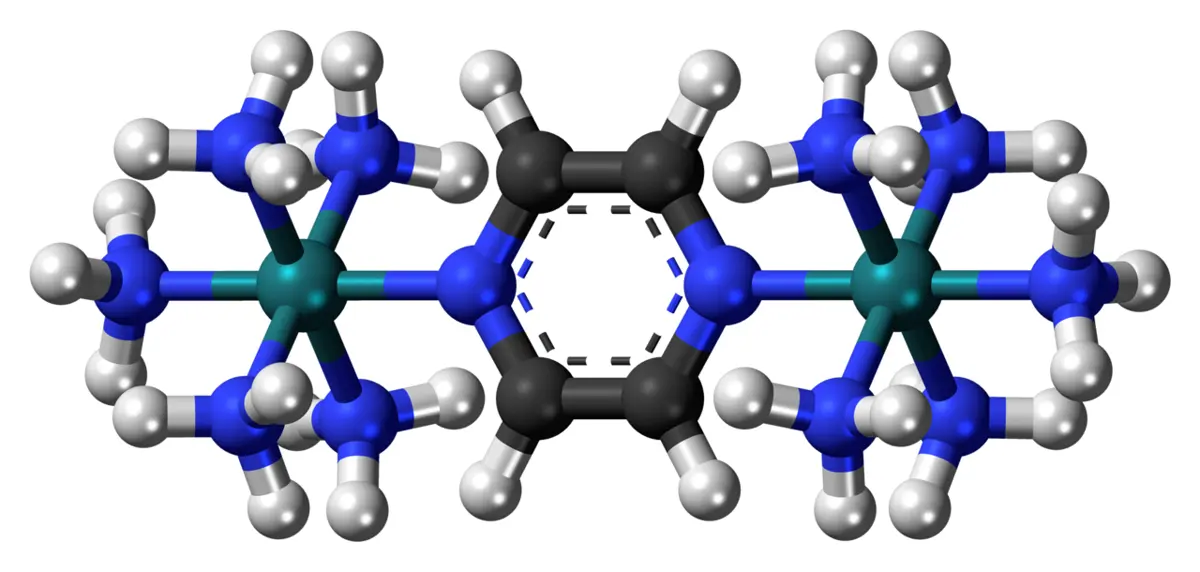
- 1969: sharing an electron. With his student Carol Creutz, Taube made a molecule in which two ruthenium atoms are joined by a ring-shaped bridge, with one ruthenium 2+ and the other 3+. Does the extra electron sit on one atom, or is it shared by both? The Creutz–Taube ion started a long argument. Today most chemists agree that the electron is shared equally between the two.
How it works now: two ways to cross
Chemists now know two main routes for an electron between metal complexes.
- Through a bridge (chemists say inner sphere). One partner is shared by both metals for a moment, and the electron crosses through it, as in Taube's experiment. This needs a partner that can hold two metals at once, such as a chloride ion, and a free place on the other metal.
- Through the coats (chemists say outer sphere). The two complexes come close, coat against coat, and the electron jumps across without any partner being shared. This is what happens when both complexes grip all their partners tightly, so no bridge can form.
Which route a reaction takes changes how fast it goes, often by millions of times. The theory of how fast electrons jump through the coats was worked out by Rudolph Marcus, who won the Nobel Prize in Chemistry in 1992.
In your life today
- Breathing. Each of your mitochondria passes electrons from food along a chain of proteins to oxygen. The iron atoms in proteins called cytochromes switch between Fe²⁺ and Fe³⁺ as each electron passes. Here the metals are buried inside large proteins, so they can't touch. The electrons travel through the protein itself, a kind of “distant attack” over long distances (where the energy in food comes from).
- Green leaves. Photosynthesis uses the same kind of chain. Light knocks an electron loose, and metal atoms pass it along until its energy is stored in sugar.
- Rust. When iron rusts, iron atoms lose electrons to oxygen and become Fe²⁺ and then Fe³⁺. Water and salt make it faster, which is why iron is painted or coated with zinc.
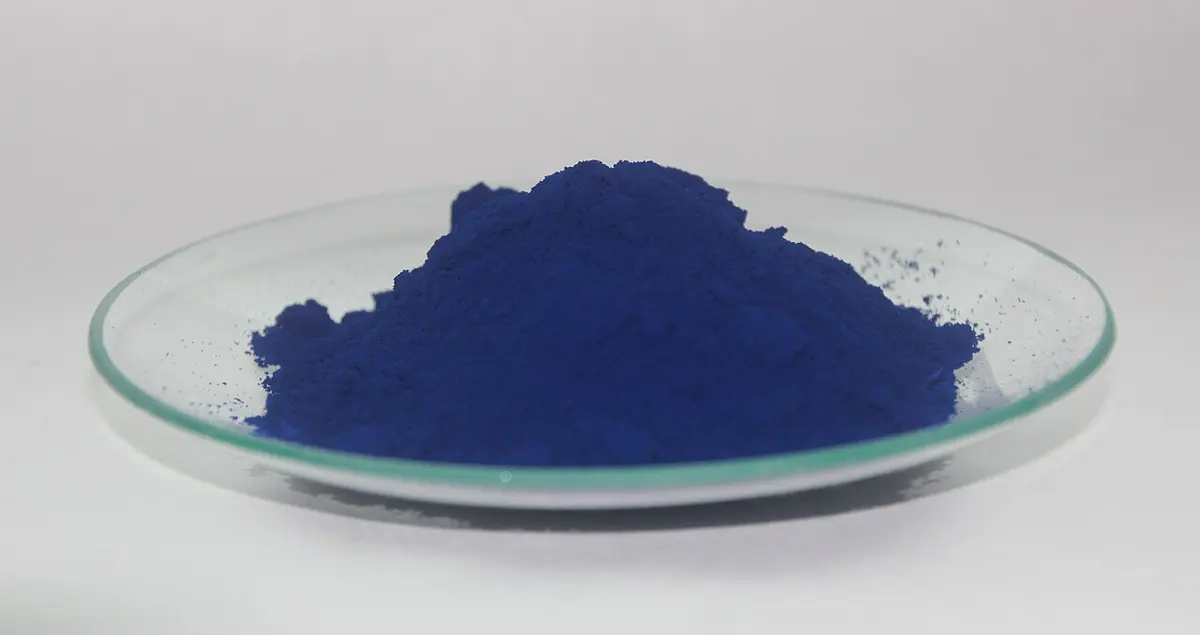
- Colors. Many strong colors come from electrons that move between, or are shared by, two metal atoms. In the paint Prussian blue, electrons move between iron atoms of two different charges.
- New materials. Chemists who design solar cells, batteries and catalysts (substances that speed up reactions, catalysts) choose their metals and partners using ideas that began with Taube.
What came next
- Measuring the journey. In the 1980s chemists, among them Harry Gray in California, attached metal atoms to proteins at known places and timed how fast an electron could cross the protein between them. Speeds fall off quickly with distance, which shows why the chain in your mitochondria keeps its metal atoms only a few atoms apart.
- Molecules as wires. Chemists now build molecules that carry an electron from one end to the other, and measure the current through a single molecule. Taube's long bridges were the first steps.
- An open question. Inside proteins, an electron sometimes seems to hop in short steps from one stopping place to the next, and sometimes to “tunnel” the whole way at once (a strange effect of quantum physics, by which a particle can pass through a barrier it doesn't have the energy to climb). Working out which happens when, and how living things tune it, is still an active question. It matters for artificial photosynthesis: making fuel from sunlight the way leaves do.
In your mitochondria, the iron atoms of the electron-carrying proteins can't touch each other. How do the electrons get from one to the next?
Pick an answer to see why.
In your science books
- Grade 9: positive ions, variable valency (Fe²⁺ and Fe³⁺) and electrovalent bonds, where electrons pass from one atom to another.
- Grade 10: displacement reactions, reduction in metallurgy, and why reactions happen at all.
- Going Further (9–12): how food becomes energy and what makes a reaction go faster.
Learn more
- The Royal Swedish Academy of Sciences’ press release and the presentation speech (nobelprize.org).
- Taube's Nobel lecture, “Electron transfer between metal complexes: retrospective”.
The official reason
The prize was given “for his work on the mechanisms of electron transfer reactions, especially in metal complexes.”