
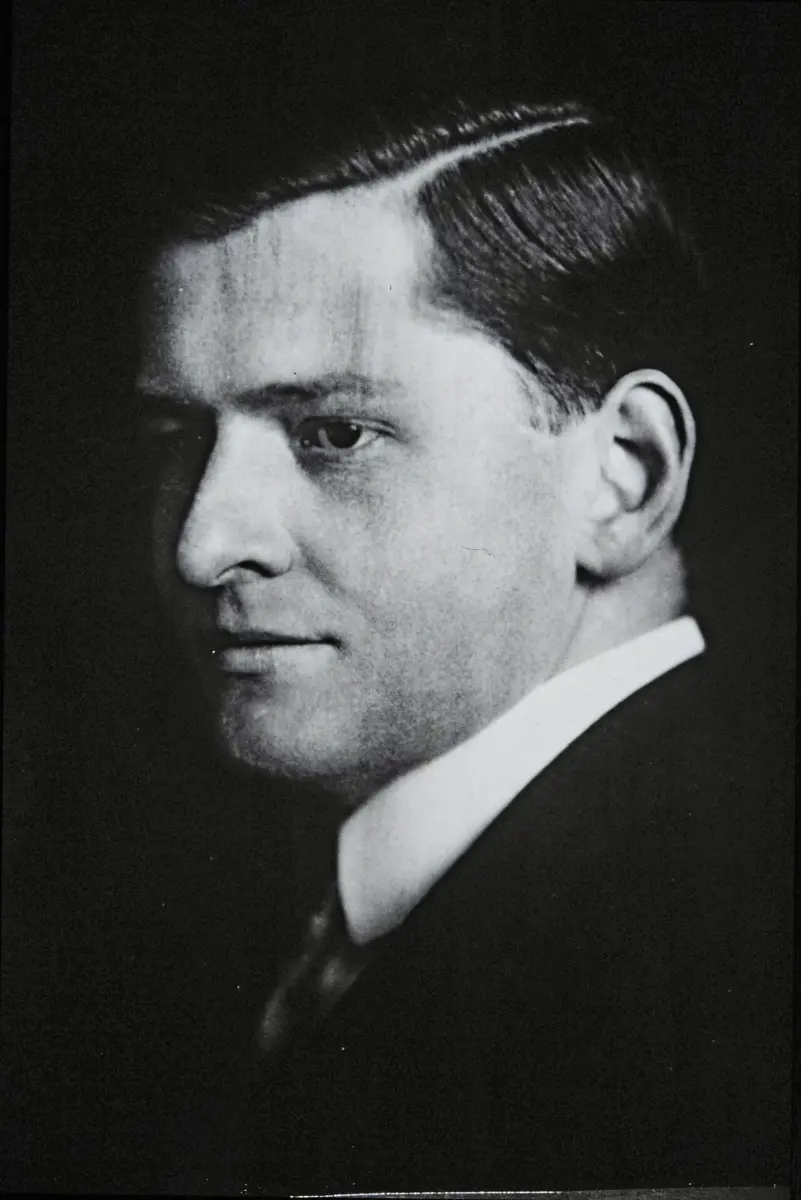
Richard Kuhn
1900–1967, born in Vienna, Austria
A chemist who could work out a molecule from a pinch of colored powder. His government forced him to turn the prize down.
Photo: ETH Library, Zurich, Public domain
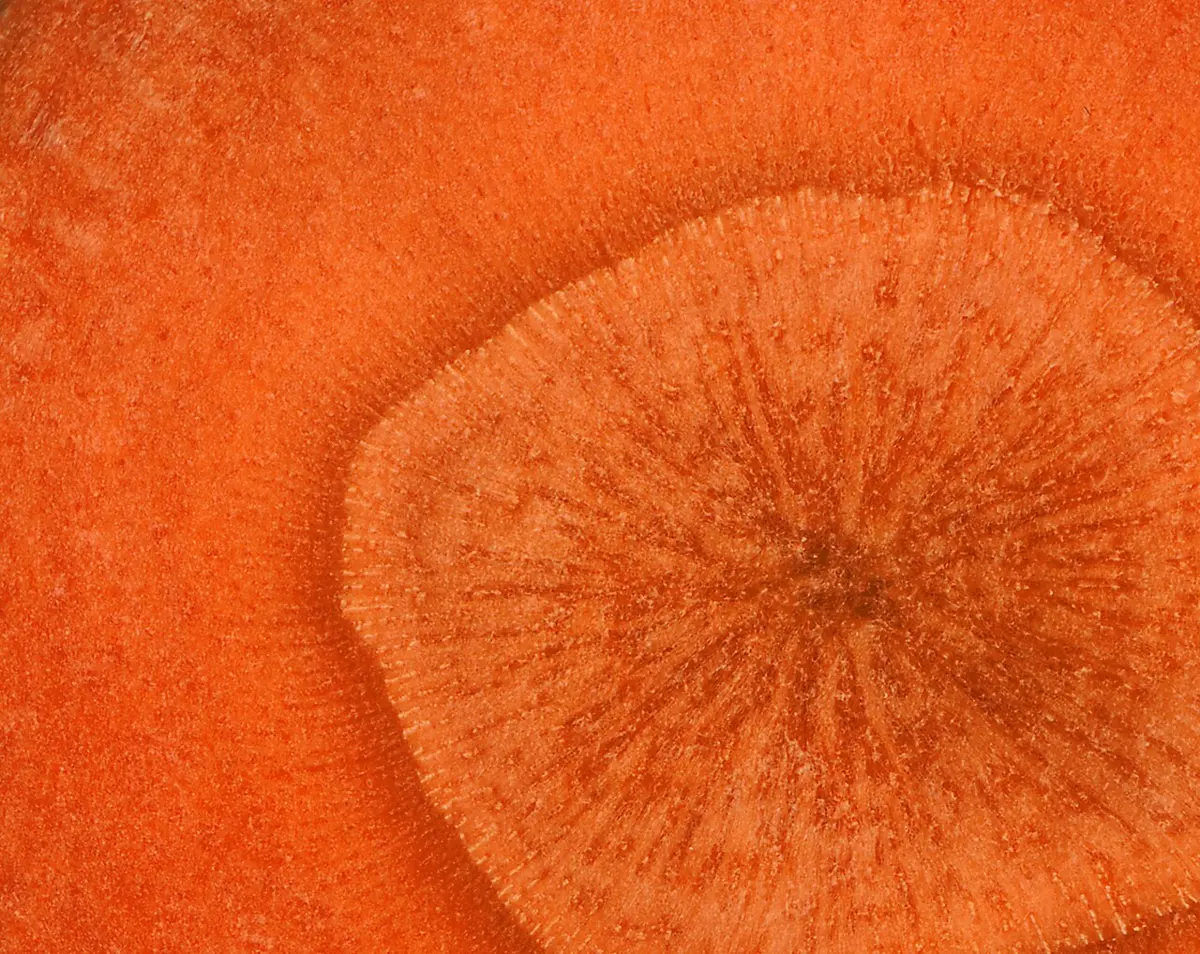
Cut a carrot, a ripe papaya or a pumpkin. The orange is so strong that it stains your fingers and the chopping board. A tomato starts green and ends red. Even a prawn changes color: gray when raw, pink-orange when cooked.
All these colors come from one family of molecules, the carotenoids. In the 1930s an Austrian chemist working in Germany, Richard Kuhn, found out how they are built, why they have color at all, and how one of them becomes vitamin A in your body. He also pulled a yellow vitamin out of thousands of liters of milk. For this work he was given the Nobel Prize in Chemistry for 1938, a prize his government would not let him accept.
The problem: colors and vitamins nobody had in pure form
By the 1920s doctors knew that food holds tiny amounts of substances the body cannot do without, the vitamins. A young rat fed on pure starch, fat and protein stopped growing; a little milk made it grow again. But a vitamin was known only by what it did. Nobody had seen one as a pure substance, so nobody knew what it was made of.
The colors of plants were a puzzle too. The orange of carrots was a substance called carotene, and the German chemist Richard Willstätter had found that it is made of 40 carbon atoms and 56 hydrogen atoms, C₄₀H₅₆. But was it one substance or several?
And there was a deeper question: why are some molecules colored at all? Sugar, salt and water have no color. Carotene, made of only carbon and hydrogen, like the colorless gases in a cooking-gas cylinder, is bright orange.
How a molecule gets its color
White sunlight is a mixture of all colors, from violet to red Grade 10: Dispersion of light. A colored thing absorbs some of those colors and sends the rest to your eye. A carrot absorbs blue and blue-green light; what is left, mostly yellow, orange and red, is what you see.
What decides which color a molecule absorbs? Kuhn spent years on this question. He made more than 300 new substances, chains of carbon atoms joined by double bonds and single bonds taking turns: double, single, double, single. (A double bond is two shared pairs of electrons between two atoms instead of one Grade 10: Alkenes.) Such a chain of alternating bonds is called a conjugated chain.
He found a simple rule: the longer the chain of alternating bonds, the longer the wavelength of light it absorbs. A short chain absorbs only ultraviolet light, which our eyes can't see, so it looks colorless. Make it longer and it starts to absorb violet, and looks yellow. Longer still, it absorbs blue and looks orange, then blue-green, and looks red. Plants show the rule beautifully. On the way to making the red of a tomato, a plant makes a series of molecules, each from the one before, by taking away hydrogen atoms so the chain of alternating bonds grows by one double bond at each step.
Beta-carotene, the main orange of carrots, has 11 double bonds in a row, and two rings at its ends (Figure 4).
A molecule with a short chain of alternating double and single bonds is colorless. What happens if a plant makes the chain longer?
Pick an answer to see why.
Why it was so hard
- Tiny amounts. To get one gram of a vitamin, Kuhn needed thousands of liters of milk.
- Twins. A carrot holds several carotenes whose molecules are almost the same: the same atoms, in nearly the same arrangement. Ordinary ways of purifying, such as making crystals, couldn't tell them apart.
- Fragile molecules. Long chains of alternating bonds are easily broken by the oxygen in air, by light and by heat, which is why old dried chillies fade.
- A forgotten tool. The best method for the job had been invented 25 years earlier and then dropped, because the famous chemists who tried it couldn't make it work.
What Kuhn did, step by step
1. Chains of color (Zurich, 1926–1929)
Kuhn grew up in Vienna, where for eight years he sat in the same school as Wolfgang Pauli, who later won the Nobel Prize in Physics. He studied chemistry under Willstätter in Munich, and in 1926, at only 25, became a professor in Zurich, Switzerland. There he began making his chains of alternating bonds, one length after another, and measuring the light each one absorbed. In 1929 he moved to a new research institute in Heidelberg, Germany, where he stayed for the rest of his life.
2. Bringing back a forgotten method (1930–1931)
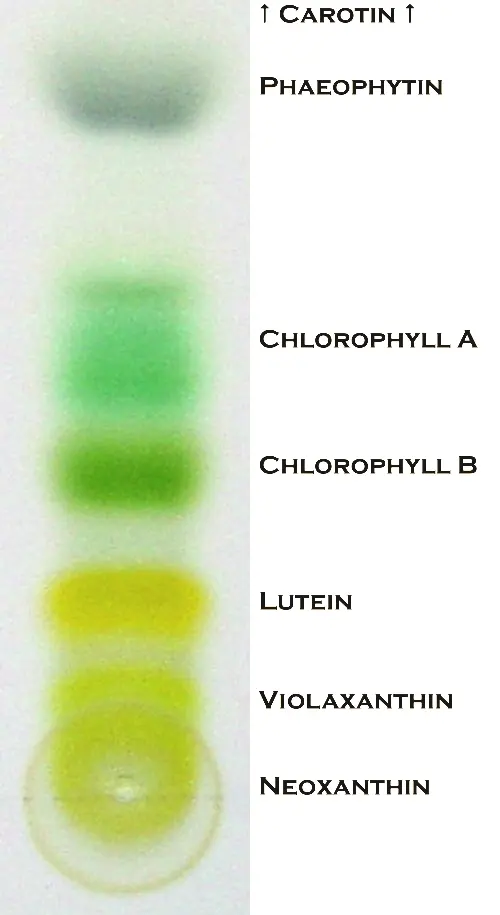
In 1903 a Russian botanist, Mikhail Tsvet, found a way to separate the colored substances in a leaf. He filled a glass tube with fine white chalk powder, poured a leaf extract on top, and then washed it through with a clear liquid (a solvent). Each pigment sticks to the chalk by a different amount. The ones that stick least are carried down fastest, so the green mixture spread out into separate colored bands down the tube. Tsvet called it chromatography, “color writing”. (By chance, tsvet is the Russian word for color.)
Willstätter, Kuhn’s own teacher, tried the method, could not make it work for collecting real amounts of pigment, and dismissed it. So it was almost forgotten. In December 1930, a young chemist in Kuhn’s laboratory, Edgar Lederer, packed a column exactly as Tsvet had described. It worked. From the yolks of 100 eggs he separated two yellow pigments that nobody had managed to part before. In 1931 Kuhn’s group used a column to show that the carotene of carrots is really two substances, alpha-carotene and beta-carotene. (Paul Karrer in Zurich and Otto Rosenheim in London found the same, separately, that year.) In 1933 Kuhn found a third, gamma-carotene.
3. From carrot to vitamin A
With pure carotenes in hand, chemists could ask what they do in the body. Others had found that animals make vitamin A from carotene, and Karrer worked out the full structure of beta-carotene in 1930–1931. Kuhn showed that more than one of the carotenes can be turned into the vitamin. Beta-carotene is the best: its molecule is two vitamin A molecules joined head to head. Our body has an enzyme (a protein that speeds up one particular reaction) that cuts beta-carotene in the middle, giving two molecules of vitamin A. Alpha-carotene, with a slightly different ring at one end, gives only one.
4. A yellow vitamin from milk (1933)
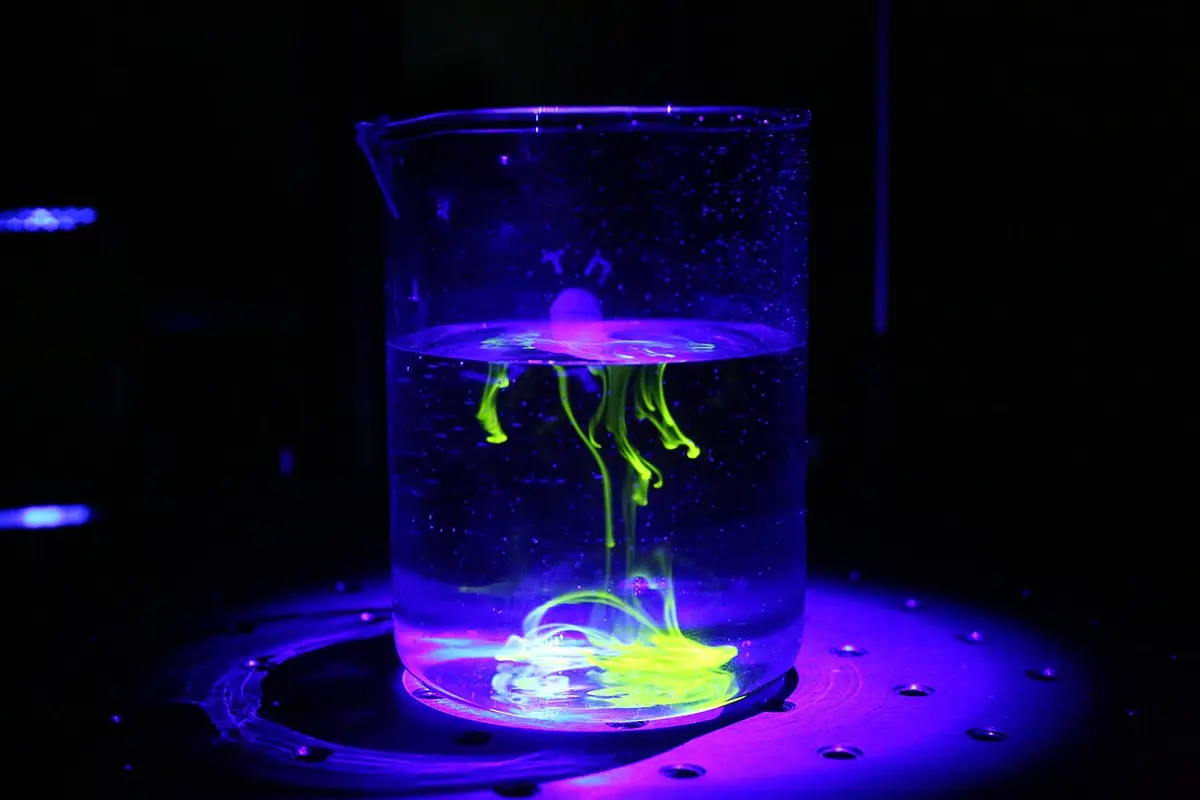
Kuhn then turned to the vitamin B group. Working with the doctor Paul György and Theodor Wagner-Jauregg, he noticed that the substance which made young rats grow glowed yellow-green under ultraviolet light, and that the stronger the glow of an extract, the better it worked. The glow became a quick test. In 1933, from 5,300 liters of skimmed milk, they purified about 1 gram of a yellow substance they named lactoflavin (lac is Latin for milk, flavus for yellow). It was vitamin B₂, now called riboflavin. Kuhn worked out its structure, C₁₇H₂₀N₄O₆, and within two years both his team and Karrer’s had made it from simpler chemicals.
5. Vitamin B₆ (1938)
Around 1938–1939, as several other laboratories did at the same time, Kuhn’s team purified vitamin B₆, which rats need for healthy skin, and quickly worked out its structure.
Why did Kuhn’s team watch for a yellow-green glow while purifying vitamin B₂ from milk?
Pick an answer to see why.
The prize he was not allowed to take
There is a darker side to the story. Kuhn was not a victim of the Nazis. Historians have found that he worked closely with the government, reported three Jewish co-workers to the authorities in 1936, and, during the war, did research for the army in which his team discovered soman, one of the deadliest nerve gases, in 1944. Edgar Lederer, the young chemist who revived chromatography in his laboratory, had to flee Germany in 1933 because he was Jewish and opposed the Nazis. In 2005 the Society of German Chemists stopped giving its Richard Kuhn Medal, saying that, for all his science, he was no role model.
In your life today
Vitamin A in Nepal. Without enough vitamin A, the rod cells of the eye can’t make their light-sensitive pigment, and a child can’t see in dim light: night blindness Grade 10: Night blindness. Worse, the child’s body fights infections such as measles and diarrhea badly. In 1989–1991 a famous study in Sarlahi district gave 28,630 young children either a large dose of vitamin A every four months or a capsule with almost none. Among the children who got vitamin A, about 30% fewer died. Since 1993, Nepal’s National Vitamin A Programme has given a capsule every six months to every child from 6 months to 5 years old, handed out by female community health volunteers, and it is thought to have saved tens of thousands of children’s lives.
In your food. You can get vitamin A from milk, eggs and liver, or make it yourself from the beta-carotene in carrots, pumpkin, sweet potato, mango, papaya and dark green saag. In plants, carotenoids sit in colored plastids called chromoplasts Grade 8: Plastids; in green leaves the green chlorophyll hides them until a leaf turns yellow in autumn. Mushrooms are a good source of riboflavin Grade 9: Mushrooms and vitamins.
Yellow tablets. Riboflavin is why vitamin B tablets are yellow, and why your urine turns bright yellow after taking one: the body passes out what it doesn’t need.
Chromatography everywhere. Laboratories use it to measure medicines in blood, find pesticides in vegetables and catch athletes taking banned drugs.
A child in a village often bumps into things after dark and has frequent illnesses. Which food would help most?
Pick an answer to see why.
What came next
- More prizes for vitamins. Kuhn’s was the third prize in two years for vitamins, after Karrer and Norman Haworth (Chemistry, 1937) and Albert Szent-Györgyi (Medicine, 1937).
- Better chromatography. In 1952 Archer Martin and Richard Synge won the chemistry prize for a new kind of chromatography that could separate colorless substances too, such as the building blocks of proteins.
- Golden Rice. Rice grains have no beta-carotene. Scientists have added the genes for the plant’s carotene-making steps to rice, giving yellow Golden Rice (Golden Rice), to fight vitamin A deficiency in places where people eat mostly rice.
- The open question: the World Health Organization estimates that that around 190 million children under five worldwide get too little vitamin A (its latest global estimate, from 2009). Is the answer capsules, better diets, or crops like Golden Rice, and who should decide?
In your science books
- Grade 8: plastids, including the chromoplasts that hold carotene.
- Grade 9: mushrooms as a source of vitamins, including riboflavin; organic compounds.
- Grade 10: dispersion of light, the colors in white light; night blindness and vitamin A; alkenes, molecules with double bonds.
- Going further: colored glass, on how a color filter takes colors away from white light; Golden Rice.
Learn more
- The prize at nobelprize.org: The Nobel Prize in Chemistry 1938, with the presentation speech and a short speed read. Kuhn gave no Nobel lecture.
The official reason
The prize was given “for his work on carotenoids and vitamins.”