
A sealed bottle of soda on a shop shelf looks perfectly still: no bubbles, nothing happening. Open the cap and it fizzes at once. The gas was there all along, dissolved in the drink, held in by the pressure of the gas above it.
In a fertilizer factory, nitrogen and hydrogen are pumped over hot iron to make ammonia. You might expect them to keep reacting until one of them runs out. They don’t. At 450 °C and 200 times the pressure of the air, the gas stops changing when only a little over a quarter of it is ammonia, and it stays that way however long you wait. The reaction seems to stop halfway, with plenty of nitrogen and hydrogen left.
You met the Haber process in Grade 9 as one use of hydrogen Grade 9: Uses of hydrogen gas, and ammonia, its uses and the story of Fritz Haber in Grade 10 Grade 10: Ammonia gas. You also know that heat, pressure, concentration and a catalyst change how fast a reaction goes Grade 10: Factors affecting the rate. This topic is about something different: not how fast a reaction goes, but how far. Why some reactions stop part of the way, what is really going on when they do, and how chemists change the conditions to get more of what they want.
Reactions that go both ways
Heat blue copper sulphate crystals in a test tube, and they turn into a white powder as water is driven off as steam. Add a few drops of water to the white powder and it turns blue again, and warms up:
Heat white ammonium chloride at the bottom of a test tube, and it breaks into two gases, ammonia and hydrogen chloride. They rise up the tube, and where the glass is cool they join again, and a white ring of ammonium chloride forms near the top:
A reaction that can go in either direction is a reversible reaction, written with a double arrow, ⇌. The reaction from left to right is the forward reaction; from right to left, the backward reaction (or reverse reaction). Most of the reactions in your Grade 10 book seem to go one way only, like burning magnesium: the backward reaction is possible in principle, but so slight that you can never see it.
Here is the reversible reaction this topic will use most. Nitrogen dioxide, NO₂, is a reddish-brown gas: the brown haze over a city in traffic is partly NO₂. Two NO₂ molecules can join into one molecule of dinitrogen tetroxide, N₂O₄, which is colorless. And an N₂O₄ molecule can split back into two NO₂:
Seal some of the gas in a glass tube, and its color tells you how much of it is NO₂ at any moment.
Which of these shows a reversible reaction?
Pick an answer to see why.
Two-way traffic: dynamic equilibrium
Seal some colorless N₂O₄ in a flask at room temperature. At first there is no NO₂ at all, so only one thing can happen: N₂O₄ molecules split, and the gas turns pale brown. But as soon as there is some NO₂, its molecules bump into each other, and now and then two join back into N₂O₄. The more NO₂ there is, the more often that happens.
So the splitting starts fast and slows down, because there is less and less N₂O₄ left to split. The joining starts at zero and speeds up, because there is more and more NO₂. Soon the two are going at the same rate: every second, as many N₂O₄ molecules split as are made. From then on, the amounts of both stay the same, and so does the color. Nothing seems to happen. But both reactions are still going, as fast as ever.
This state is a dynamic equilibrium: a reversible reaction in a closed container, with the forward and backward reactions going at the same rate, so that the amounts of everything stay constant. “Dynamic” means moving: the balance is kept by two-way traffic, not by everything stopping. Think of the courtyard of a temple in Bhaktapur on a festival day: if as many people walk in through the gate each minute as walk out, the crowd inside stays the same size, though nobody in it stands still.
You have met this before, without the name: in a closed jar, water molecules escape from the liquid and return to it at the same rate, and the vapor above it stays at its vapor pressure (Evaporation and vapor pressure). The soda bottle on the shelf is the same: carbon dioxide leaves the drink and dissolves back into it at the same rate, until you open the cap.
The widget shows two things worth remembering:
- You reach the same balance whether you start from the left (only N₂O₄) or the right (only NO₂). The balance depends on the conditions, not on where you started.
- At equilibrium the counts still jiggle a little, and the joining and splitting never stop. In a real flask there are about 10²² molecules, not 40, so the jiggles are far too small to measure, and the color is perfectly steady.
How much of each there is at equilibrium depends on how fast each reaction goes. Here is a simple case you can work out.
A flask of brown gas has kept exactly the same color for an hour. What is happening inside it?
Pick an answer to see why.
Pushing the balance: Le Chatelier’s principle
If equilibrium is a balance between two rates, then anything that changes one rate more than the other will shift it. In 1884 the French chemist Henry Le Chatelier put the result in one rule, now called Le Chatelier’s principle:
If you change the conditions of a system at equilibrium, the equilibrium shifts in the direction that partly undoes the change.
Add more of a substance, and the balance shifts to use some of it up. Heat it, and the balance shifts in the direction that takes in heat. Squeeze a gas, and it shifts to the side with fewer molecules, which lowers the pressure. The change is only partly undone: the new balance is somewhere new.
Change one thing at a time, and look each time at what the molecules are doing.
Adding or removing a substance
Add more of a reactant, and its molecules are more crowded, so they collide and react more often: the forward reaction speeds up. The backward reaction doesn’t, at first. So more products are made, until there are enough of them for the backward reaction to catch up, and a new balance is reached, with more products than before.
Take a product away as it is made, and the backward reaction slows down, because its molecules are scarcer. The forward reaction keeps going, and goes on making more. Keep removing the product, and the reaction can go almost to the end. That is why a lime kiln has a chimney: heating limestone gives quicklime and carbon dioxide, and in a sealed pot the two would reach a balance, but the carbon dioxide goes up the chimney, so the limestone keeps breaking down.
The soda bottle again: opening the cap lets the carbon dioxide above the drink escape. With so few CO₂ molecules left above the drink, few dissolve back in, while those in the drink keep escaping. So the balance shifts towards gas, and the drink fizzes.
Squeezing a gas: pressure
Seal a mixture of NO₂ and N₂O₄ in a gas syringe and push the plunger in, to half the volume. Every molecule is crowded into half the space, so there are twice as many brown molecules in each milliliter, and the gas looks darker at once. Then, within moments, the color fades a little. Some of the NO₂ has joined into N₂O₄.
Here is why, molecule by molecule. For two NO₂ to join, two molecules have to meet. Crowd them into half the space and each NO₂ meets other NO₂ twice as often, and there are twice as many of them per milliliter: the joining goes four times as fast in each milliliter. An N₂O₄ splitting needs no meeting at all: it just falls apart, so in each milliliter the splitting goes only twice as fast, because there are twice as many N₂O₄ there. Joining has sped up more than splitting, so the balance shifts towards N₂O₄, until the two rates are equal again.
That is the rule for gases. Raising the pressure shifts an equilibrium towards the side with fewer gas molecules; lowering it shifts it to the side with more. Fewer molecules press less on the walls, so the shift partly undoes the rise in pressure. If both sides have the same number of gas molecules, pressure makes no difference to the balance.
Heating and cooling: temperature
A reversible reaction that gives out heat one way takes in exactly the same heat the other way (Energy diagrams). Splitting N₂O₄ into NO₂ takes in 57 kJ for every mole of N₂O₄ that splits; joining NO₂ into N₂O₄ gives the same 57 kJ out.
Heating an equilibrium shifts it in the endothermic direction (the one that takes in heat), using up some of the heat added. Cooling shifts it in the exothermic direction. So hot NO₂ gas is darker brown, and cold gas is paler, as the photo shows.
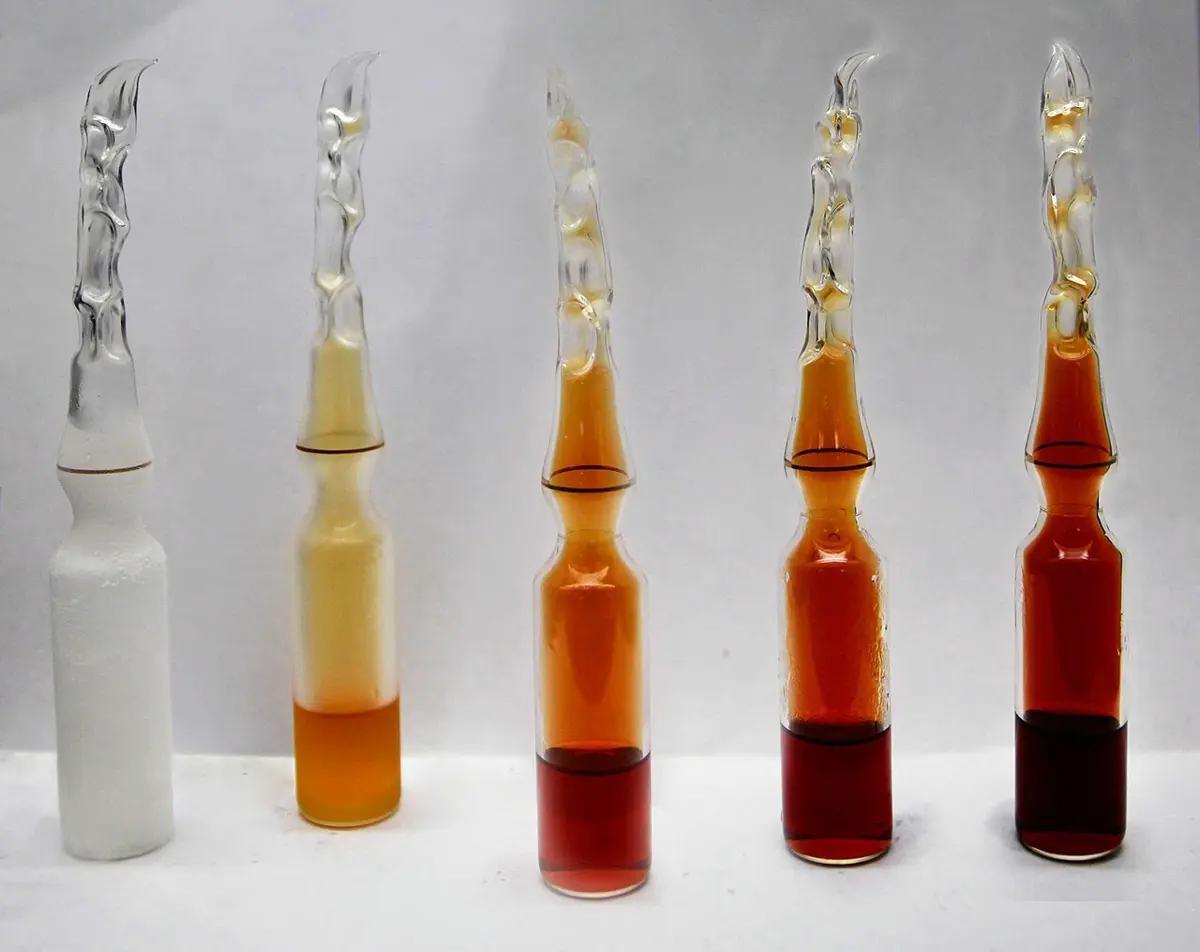
Molecule by molecule: both reactions speed up when it is warmer, because more collisions have enough energy to get over the hill (Heat: why a little warmer is a lot faster). But the two directions have different hills. The endothermic direction starts lower down and has a taller hill to climb, so it is the one that depends most on how many molecules have a lot of energy. Warming speeds up the endothermic direction more than the exothermic one, and the balance shifts its way.
What a catalyst does, and doesn’t do
A catalyst gives a reaction a path with a lower hill (Lowering the hill: catalysts). It lowers the hill for the backward reaction by exactly the same amount, because it is the same hill climbed from the other side. So a catalyst speeds up both directions by the same factor. A catalyst doesn’t change where the balance lies; it only gets there sooner.
A catalyst is added to a mixture at equilibrium. What happens?
Pick an answer to see why.
Designing a factory: making ammonia
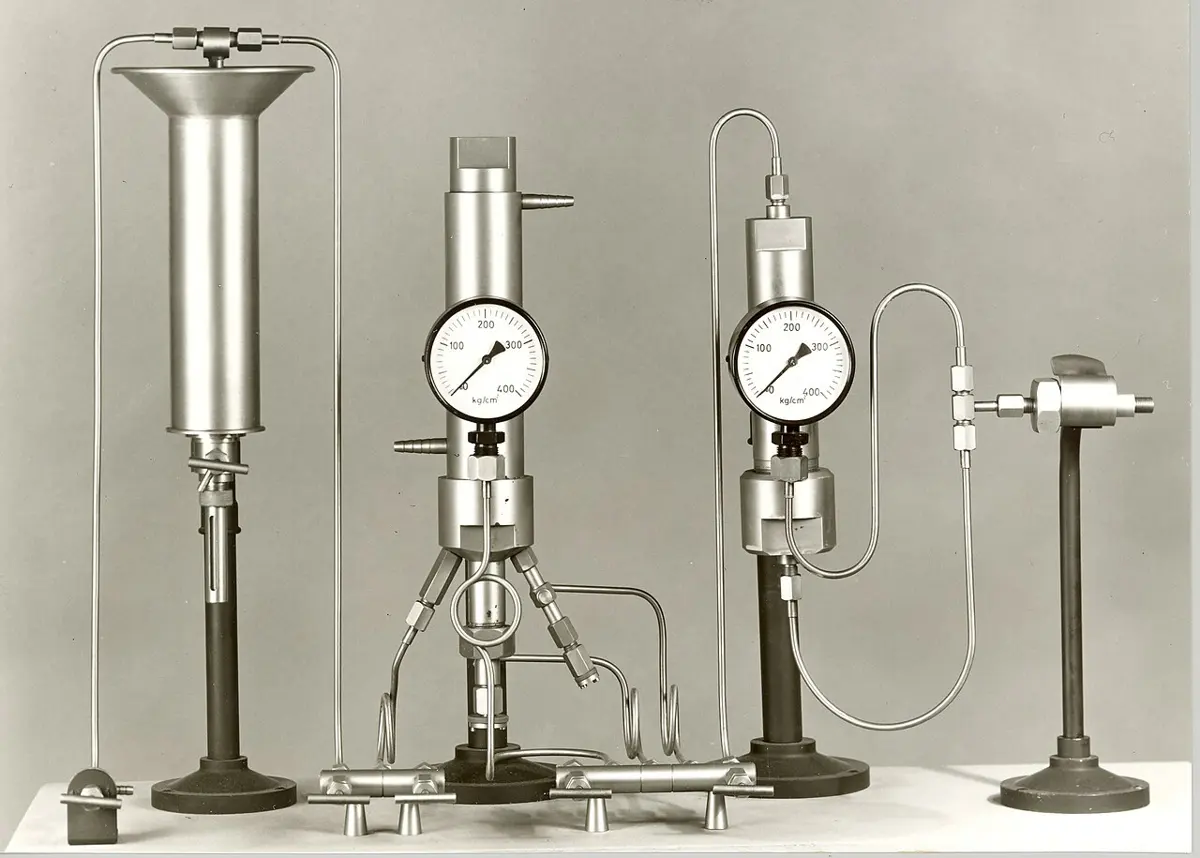
Now put yourself in Carl Bosch’s place at the chemical company BASF in 1909: Haber has made ammonia drip, and you must make millions of tonnes of it, cheaply. The reaction is
The nitrogen comes from the air, and the hydrogen, today, mostly from natural gas. Each condition is a choice, and Le Chatelier’s principle tells you which way each one pushes.
- Pressure. Four gas molecules on the left, two on the right. High pressure shifts the balance towards ammonia, and also makes the reaction faster. But squeezing gas takes a great deal of energy, and the pipes and vessels must have thick steel walls. Plants use about 200 times the pressure of the air (newer plants less), not 1,000.
- Temperature. The forward reaction is exothermic, so low temperature shifts the balance towards ammonia. But at low temperature the reaction is far too slow, even with a catalyst: you would have a high yield at equilibrium and wait for ever to reach it. So plants run at 400–500 °C: a compromise between how much ammonia there is at equilibrium and how fast it is made.
- Catalyst. Iron, with small amounts of other oxides added. It doesn’t change the balance, but without it the reaction would be uselessly slow at any temperature where the yield is worth having.
- Remove the product. The gas leaving the catalyst is cooled, and the ammonia turns to liquid and is drained off. The nitrogen and hydrogen that didn’t react are pumped back round to the catalyst, again and again.
The numbers in the widget are worked out from measurements of this equilibrium made in the 1920s. They show the compromise. At 300 °C and 200 atm, ammonia would be about two-thirds of the gas at equilibrium, but the gas leaves the catalyst long before it gets there. At 600 °C it gets to equilibrium quickly, but equilibrium is only about 9% ammonia. In between, around 450–500 °C, the most ammonia leaves the converter in each pass.
Why do ammonia plants run at 400–500 °C, when a lower temperature would give more ammonia at equilibrium?
Pick an answer to see why.
Questions
For the reaction 2SO₂(g) + O₂(g) ⇌ 2SO₃(g), which change shifts the equilibrium towards SO₃?
Pick an answer to see why.
In a flask at equilibrium, the brown color of NO₂ deepens when the flask is put in hot water. What does that tell you about N₂O₄ ⇌ 2NO₂?
Pick an answer to see why.
A student says: “When a reaction reaches equilibrium, it stops.” Explain what is right and what is wrong in this.
Answer
Right: the amounts of reactants and products stop changing, so to the eye nothing happens. Wrong: the reaction hasn’t stopped. The forward and backward reactions are both still going, at the same rate, so every second as much product is made as is used up. That is why it is called a dynamic equilibrium. (Evidence: with molecules made of a heavier form of an atom, chemists can watch atoms keep moving between reactants and products at equilibrium.)
Methanol, used as a fuel and to make plastics, is made from carbon monoxide and hydrogen over a catalyst:
CO(g) + 2H₂(g) ⇌ CH₃OH(g), with 91 kJ given out.
- a.Name one change of conditions, other than adding a catalyst, that would increase the amount of methanol at equilibrium, and explain your choice using Le Chatelier’s principle.
- b.Explain, in terms of what the molecules do, why your change works.
Answer
Any one of these, with its reasons:
- Raise the pressure. a. There are 3 gas molecules on the left and 1 on the right, so higher pressure shifts the balance to the right, towards fewer molecules, partly undoing the rise. b. Crowding the gas makes molecules meet more often; the forward reaction needs three molecules to come together, so it speeds up more than the backward one, in which a single methanol molecule breaks up. More methanol forms until the rates are equal again.
- Lower the temperature. a. The forward reaction is exothermic, so cooling shifts the balance towards methanol. b. The backward (endothermic) reaction has the taller hill to climb, so cooling slows it down more than the forward one. (But it also makes the reaction slower, so a factory uses a compromise temperature, about 250 °C.)
- Add more hydrogen (or carbon monoxide), or remove methanol as it forms by cooling it to a liquid. a. Adding a reactant or removing a product shifts the balance towards the products. b. More reactant molecules collide more often, speeding up the forward reaction; fewer methanol molecules make the backward reaction slower.
The table gives the percentage of ammonia in the gas at equilibrium, from a 1 : 3 mix of nitrogen and hydrogen, worked out from measurements made up to 500 °C (the 550 °C row goes a little beyond them).
| 100 atm | 200 atm | 400 atm | |
|---|---|---|---|
| 350 °C | 38% | 52% | 66% |
| 450 °C | 17% | 28% | 42% |
| 550 °C | 7% | 13% | 24% |
- a.Describe the two patterns in the table.
- b.Explain each pattern using Le Chatelier’s principle and the equation N₂ + 3H₂ ⇌ 2NH₃ (92 kJ given out).
- c.A plant runs at 450 °C and 200 atm. Its manager wants more ammonia at equilibrium but can change only one thing, by one step in the table. Which change gives more: raising the pressure to 400 atm or lowering the temperature to 350 °C? What is the catch with each?
Answer
- a.At each temperature, the percentage of ammonia rises with pressure. At each pressure, it falls as the temperature rises.
- b.Pressure: 4 gas molecules on the left, 2 on the right, so higher pressure shifts the balance to the right, towards fewer molecules. Temperature: the forward reaction is exothermic, so heating shifts the balance backwards, in the endothermic direction, breaking up ammonia.
- c.400 atm gives 42%; 350 °C gives 52%, so lowering the temperature gives more at equilibrium. The catch with 350 °C: the reaction is much slower, so in the time the gas spends on the catalyst it gets nowhere near 52%, and less ammonia may be made per hour. The catch with 400 atm: compressing the gas costs much more energy, and the plant needs stronger, costlier vessels.
A test tube of white ammonium chloride is heated at the bottom. A white ring of solid forms near the cool top of the tube, but if the same solid is heated in a sealed tube for a long time, some solid stays at the bottom. Explain both.
Answer
NH₄Cl(s) ⇌ NH₃(g) + HCl(g); the forward reaction takes in heat. At the hot bottom, the balance lies to the right: the solid breaks into the two gases. They rise to the cool top, where the balance lies to the left, so they join again into solid ammonium chloride, the white ring. In a sealed tube kept hot all over, the gases can’t escape or be removed; their amount builds up until the backward reaction is as fast as the forward one, and a dynamic equilibrium is reached with some solid left.
A bottle of soda goes flat faster if it is left open in the sun than in a fridge. Dissolving carbon dioxide in water gives out a little heat: CO₂(g) ⇌ CO₂(aq). Explain both facts: why an open bottle goes flat at all, and why warmth makes it faster.
Answer
Open: the carbon dioxide above the drink escapes into the air, so it is removed. Few CO₂ molecules are left to dissolve back in, while those in the drink keep escaping: the balance shifts towards gas, and the drink loses its CO₂. Warm: dissolving gives out heat, so the reverse, gas leaving the drink, takes in heat; warming shifts the balance in that endothermic direction, so less CO₂ stays dissolved. Warmth also makes the escape faster.
Without the catalyst, an ammonia plant would make almost no ammonia, yet the catalyst doesn’t change the percentage of ammonia at equilibrium. How can both be true?
Answer
The catalyst changes how fast equilibrium is reached, not where it lies. Without it, the reaction at 450 °C is so slow that in the few seconds the gas spends in the converter almost nothing reacts, nowhere near equilibrium. With it, both the forward and backward reactions are much faster, so the gas gets close to equilibrium (about 28% ammonia at 200 atm) in seconds. The balance point is the same; only the time to get there changes.
Where to go next
- What makes a reaction go faster? How fast a reaction goes, why crowding and heat speed it up, and how a catalyst lowers the hill: the rates that balance at equilibrium.
- Why do some reactions get hot? Where the 92 kJ comes from: breaking and making bonds, and the energy diagram of a reaction.
- How do you count atoms by weighing them? The mole, and how to work out how many grams a reaction makes from the grams you start with.