
Comb your hair on a dry winter morning in Kathmandu and hold the comb over a few scraps of paper. The scraps jump up to it before it touches them. Put a compass on your desk, and its needle swings round to point north, though nothing touches it either. Hold a magnet near the compass and the needle swings again, toward the magnet, from several centimeters away.
In each case something pushes or pulls across empty space. Physicists say the comb, the magnet and the Earth each fill the space around them with a field: a region where a charge, or a magnet, feels a force. This unit is about two kinds of field. The first half is about the electric field of charges: how to draw it, how strong the force between two charges is (Coulomb’s law), and the capacitor, a device that stores charge. The second half is about magnetic fields: the lines of force round a bar magnet, which you will plot yourself with a compass, the Earth’s own field, and the two angles that say which way it points in Nepal.
14.1 Electric field and lines of force
Rub a plastic ruler with a woolen cloth, or a balloon on your hair. Electrons move from one to the other, and both become charged: the one that gains electrons is negatively charged, the one that loses them positively charged. You learned in Grade 7 that charges of the same kind repel each other and charges of opposite kinds attract.
The surprising part is that the force acts across a gap. The ruler doesn’t have to touch the paper. We explain this by saying that every charge sets up an electric field in the space around it. Another charge placed in that field feels a force, pushed or pulled by the field where it is.
The electric field of a charge is the region around it in which another charge experiences an electrostatic force.
The field is strongest close to the charge and weakens with distance. In principle it reaches out for ever; in practice, a few meters from a charged comb it is far too weak to notice.
Testing a field with a test charge
How can we find out whether there is a field at a place, and how strong it is? Put a small positive charge there and see what force it feels. Such a charge is called a test charge (). It must be small, so that it doesn’t push the charges making the field out of place. By agreement, a test charge is always positive.
The force on the test charge depends on how big the test charge is: double it and the force doubles. So to describe the field itself, we divide the force by the test charge. This is the electric field intensity (or electric field strength), E:
Electric field intensity at a point is the force experienced by a unit positive charge placed at that point. Its SI unit is the newton per coulomb (N/C). It is a vector: its direction is the direction of the force on a positive charge.
A field of 500 N/C at a point means a charge of 1 C there would feel a force of 500 N, a charge of 2 C a force of 1,000 N, and so on: . A negative charge in the same field feels a force of the same size in the opposite direction.
The field of a point charge
A point charge is a charge on a body so small, compared with the distances involved, that we can treat it as sitting at one point: a charged speck of dust, or a charged ball seen from far away. Using Coulomb’s law (below), the field intensity at a distance r from a point charge Q comes out as
where k = 9 × 10⁹ N m²/C² is Coulomb’s constant. Twice as far from the charge, the field is a quarter as strong; three times as far, a ninth.
Electric lines of force
A field can’t be seen, but it can be drawn. In the 1830s, Michael Faraday, working in London, pictured the space round a charge as filled with lines, which he called lines of force. We still draw them today.
An electric line of force is the path along which a free, small positive charge would tend to move in an electric field. The tangent to a line of force at any point gives the direction of the field there.
Lines of force follow a few simple rules:
- They start on positive charges and end on negative charges (or go off to very far away, if there is no negative charge nearby).
- The direction of the line at any point is the direction of the force on a positive test charge there; an arrow on each line shows it.
- They never cross. If two lines crossed, the field at the crossing would point two ways at once, which is impossible.
- Where the lines are close together the field is strong; where they are spread out, it is weak.
- They leave or enter the surface of a conductor at right angles to it.
Field patterns round point charges
Round a single positive point charge, the lines spread straight out in every direction, like the spokes of a wheel. Round a negative point charge they are the same shape, but they point inward. A positive test charge placed near the positive charge is pushed away, along a line; near the negative charge it is pulled in.
The picture is flat, but the real field is in three dimensions: the lines spread out in all directions, like the spines of a hedgehog. The farther from the charge, the farther apart the lines are, which is the picture’s way of saying the field gets weaker.
Which way do the lines of force point round a negative point charge?
Pick an answer to see why.
Like and unlike charges
When two charges are near each other, their fields add, and the lines bend. Between a positive and a negative charge (unlike charges), many lines run straight from one to the other, and the rest curve round to join them: the lines seem to pull the two together, and the charges attract.
Between two positive charges (like charges), no line joins them. The lines from each bend away from the other, as if squeezed apart: the charges repel. Exactly halfway between two equal like charges, the two fields are equal and opposite and cancel. A test charge there would feel no force at all. Such a point, where the field is zero, is a neutral point.
So the direction of the electrostatic force follows from the kinds of charge: like charges repel and unlike charges attract. The force on each charge lies along the line joining them: away from the other charge for like charges, toward it for unlike ones.
Coulomb’s law
How big is the force between two charges? In 1785 the French engineer Charles-Augustin de Coulomb measured it with a torsion balance: a light rod hanging from a thin wire, with a small charged ball at one end. A second charged ball pushed the first, the rod turned, and the wire twisted. How far it twisted told him the size of the force, and he could change the charges and the distance between the balls.
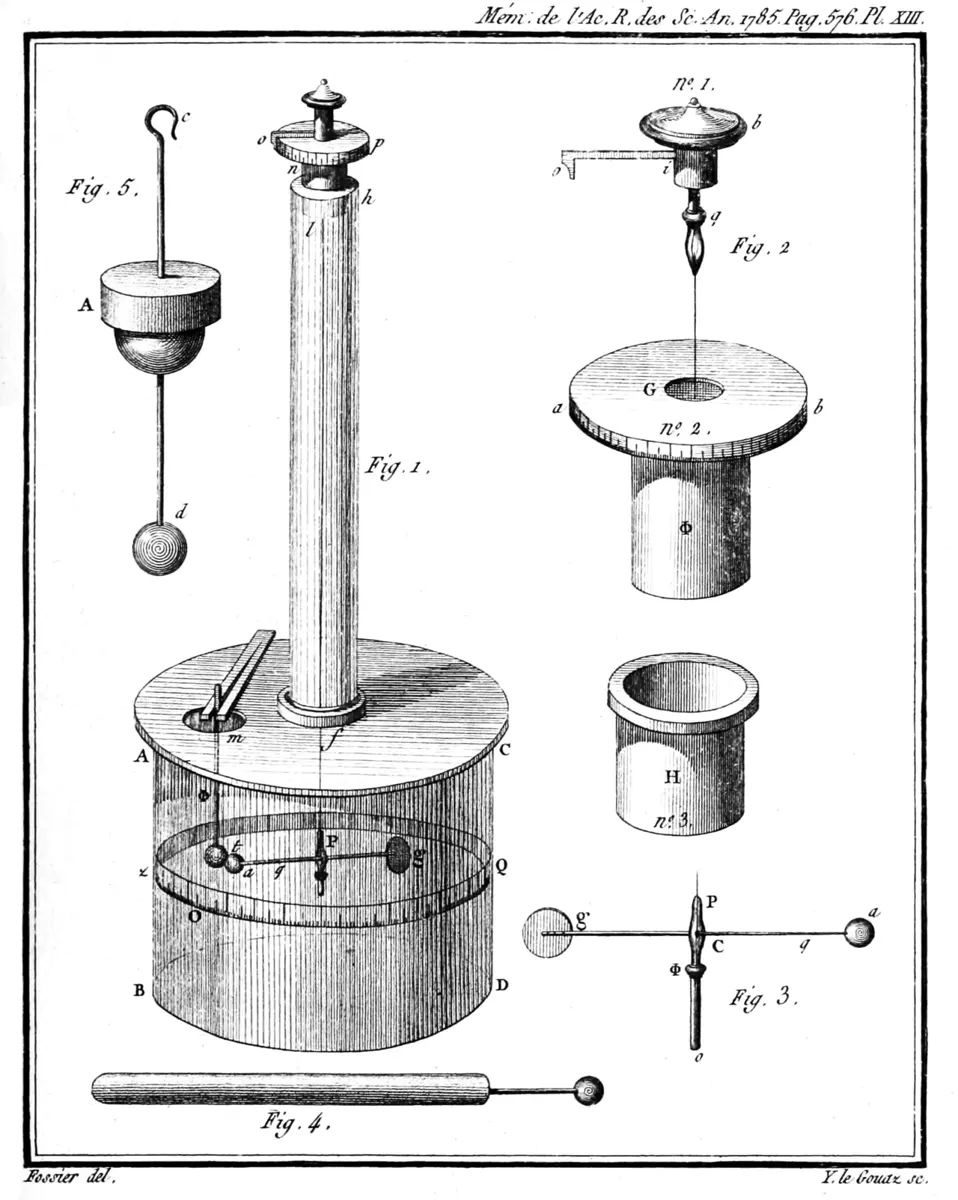
He found two things:
- The force is directly proportional to the product of the charges: . Double one charge and the force doubles; double both and it becomes four times as big.
- The force is inversely proportional to the square of the distance between them: . Double the distance and the force falls to a quarter.
Together these make Coulomb’s law:
The force of attraction or repulsion between two point charges is directly proportional to the product of the charges and inversely proportional to the square of the distance between them, and it acts along the line joining them.
Here and are the charges in coulombs, r the distance between them in meters, F the force in newtons, and k is Coulomb’s constant. In air or a vacuum,
(more precisely, 8.99 × 10⁹; the rounded value is used in every calculation in this book). It is often written as , where = 8.85 × 10⁻¹² C²/(N m²) is a constant called the permittivity of free space.
The value of k tells us what one coulomb means. Put q₁ = q₂ = 1 C and r = 1 m into the law: F = 9 × 10⁹ N. So:
One coulomb is the charge which, placed 1 m from an equal charge in a vacuum, repels it with a force of 9 × 10⁹ N.
That is the weight of about 900,000 tonnes, more than ninety thousand loaded trucks. A coulomb is a huge charge for static electricity: a rubbed comb carries a few nanocoulombs at most. Yet a coulomb flows through a torch bulb every few seconds, because the electrons in a current come with an equal positive charge in the metal around them, so they make no field outside the wire. One coulomb is the charge of about 6.25 × 10¹⁸ electrons; one electron carries 1.6 × 10⁻¹⁹ C.
The widget shows two more facts of the law. The forces on the two balls are always equal in size and opposite in direction, even when one charge is much bigger: this is Newton’s third law. And the force depends only on the product of the charges: +1 µC and +4 µC push each other exactly as hard as +2 µC and +2 µC.
From Coulomb’s law to the field of a point charge
Now you can see where comes from. Put a test charge at a distance r from a charge Q. Coulomb’s law gives the force on it, and dividing by gives the field:
The test charge cancels out, as it should: the field belongs to Q, not to whatever we use to test it.
Electricity and gravity
Coulomb’s law looks just like Newton’s law of gravitation, , which you met in Grade 9 Science. Both forces fall off as the square of the distance. But they differ in important ways.
| Gravitational force | Electrostatic force |
|---|---|
| Acts between masses. | Acts between charges. |
| Always attracts. | Attracts or repels, depending on the kinds of charge. |
| G = 6.67 × 10⁻¹¹ N m²/kg²: very weak. | k = 9 × 10⁹ N m²/C²: very strong. |
| Doesn’t depend on what lies between the bodies. | Weaker when an insulator such as water or glass lies between the charges. |
| Holds planets, stars and galaxies together. | Holds atoms, molecules and solid bodies together. |
Between two protons, the electrostatic push is about 10³⁶ times as strong as the gravitational pull. Gravity rules the sky only because big bodies have almost exactly as much positive charge as negative, so their electric forces cancel, while their masses always add. Why gravity is so weak, and the fields of both forces side by side, are in Going Further: Why is gravity so weak?.
The force between two charges is F. If both charges are doubled and the distance between them is also doubled, the force becomes:
Pick an answer to see why.
What is the SI unit of electric field intensity?
Pick an answer to see why.
14.2 Capacitor
A camera’s flash fires in a thousandth of a second, brighter than anything a small battery could light directly. The battery charges a component inside it for a few seconds, and that component lets all its charge go at once into the flash tube. The component is a capacitor.
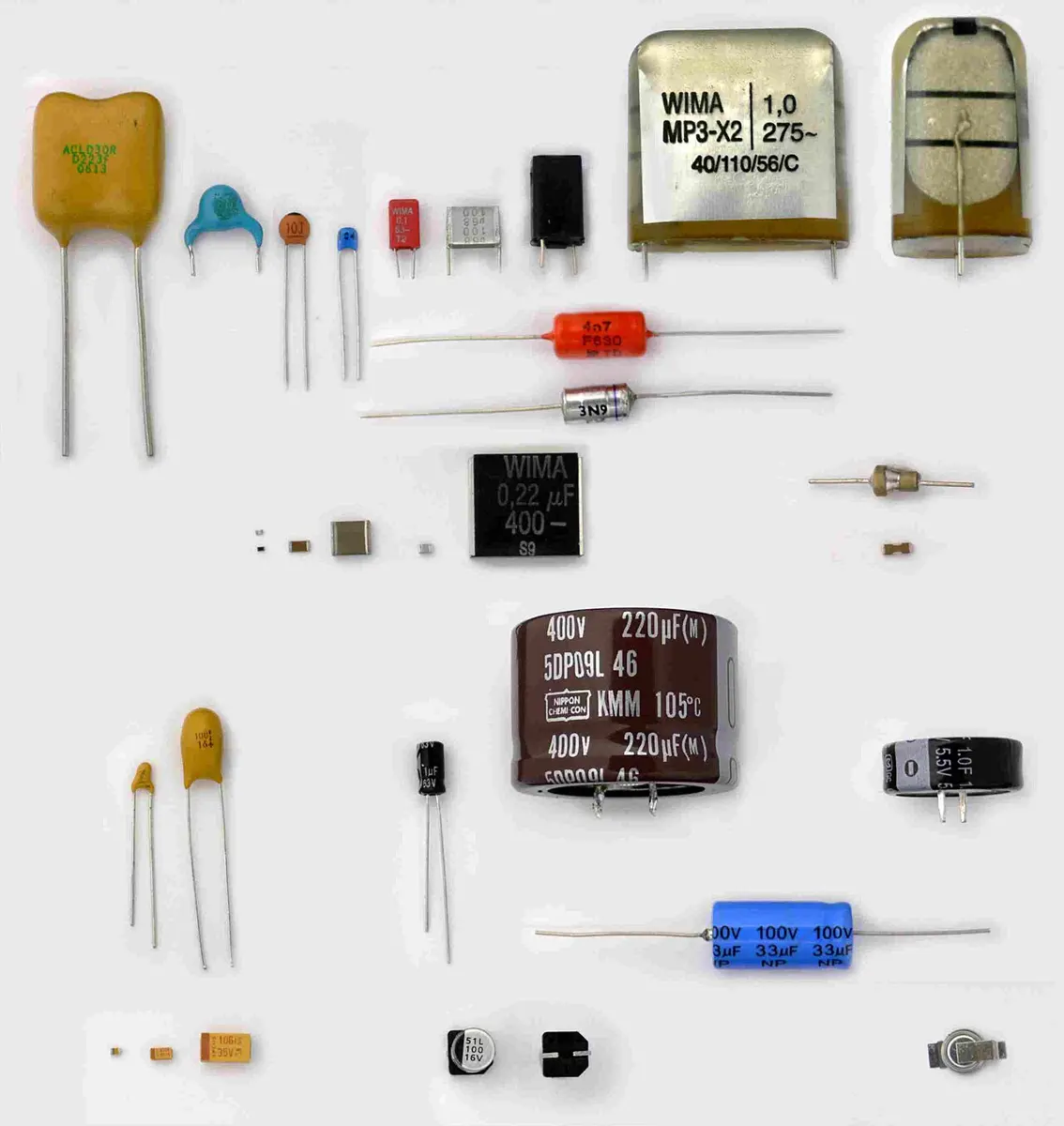
A capacitor is a device that stores electric charge. It is made of two conductors, usually metal plates or foils, close together but separated by an insulator.
The insulator between the plates is called the dielectric: air, paper, plastic, mica, ceramic or a thin layer of oxide. In the circuit symbol, the two plates are two short parallel lines.
Charging and discharging
Connect the two plates to a battery. The battery pulls electrons off the plate joined to its positive terminal and pushes them round the circuit onto the other plate. No electrons cross the gap; the dielectric stops them. So one plate becomes positive, the other equally negative. As the charges build up, the plates push back against the battery more and more, and the flow slows down. When the voltage across the capacitor equals the battery’s voltage, the flow stops: the capacitor is charged.
Disconnect the battery, and the charges stay where they are, held by their attraction across the gap. The capacitor is storing charge. Now join its plates through a bulb: the extra electrons on the negative plate flow round to the positive plate, the bulb glows for a moment, and the capacitor discharges.
Notice that a charged capacitor’s plates hold equal and opposite charges, +Q and −Q. When we say a capacitor “stores a charge Q”, we mean the charge on either plate, not the total, which is zero.
Capacitance
The widget shows that the charge a capacitor stores depends on two things: the voltage across it, and the capacitor itself. For any one capacitor, the charge is directly proportional to the voltage: double the voltage and it stores twice the charge. So the ratio of charge to voltage is fixed for each capacitor. That ratio is its capacitance, C:
The capacitance of a capacitor is the ratio of the charge on either plate to the potential difference between the plates. It tells how much charge the capacitor stores for each volt across it.
The unit of capacitance
The SI unit of capacitance is the farad (F), named after Michael Faraday. One farad is one coulomb per volt:
A capacitor has a capacitance of one farad if a potential difference of one volt across it puts a charge of one coulomb on its plates.
A farad is enormous. A capacitor of 1 F made of two flat plates 1 mm apart in air would need plates of about 113 km² each: nearly 16,000 football fields. So capacitances are usually given in smaller units:
| Unit | Symbol | Value |
|---|---|---|
| microfarad | µF | 10⁻⁶ F |
| nanofarad | nF | 10⁻⁹ F |
| picofarad | pF | 10⁻¹² F |
A capacitor’s capacitance and the highest voltage it can safely take are printed on it, such as “470 µF 25 V”. Above that voltage, the dielectric can break down and let charge spark across.
What makes the capacitance bigger
A capacitor holds more charge for each volt when:
- its plates are bigger: there is more room for the charges to spread out;
- its plates are closer together: the attraction across the gap holds more charge;
- a better dielectric lies between them: an insulator such as mica or ceramic weakens the field between the plates (as water weakens the force between ions), so more charge is needed to reach the same voltage.
So a real capacitor is often two long strips of metal foil with a thin plastic film between them, rolled up into a small cylinder. The biggest capacitances, thousands of farads, are in supercapacitors, whose “plates” are porous carbon with an enormous surface, and whose gap is only a few molecules wide.
A capacitor is not a cell
A capacitor and a cell both give out charge, but they work in very different ways.
| Capacitor | Cell |
|---|---|
| Stores charge, as + and − charges on two plates. | Makes charge flow by chemical reactions inside it. |
| Its voltage falls steadily as it discharges. | Its voltage stays nearly steady until it is almost used up. |
| Can charge and discharge in a fraction of a second. | Takes minutes or hours to charge (if it can be recharged at all). |
| Stores little energy for its size. | Stores much more energy for its size. |
Uses of capacitors in daily life
Almost every electrical device has capacitors in it. Some of their uses:
- Camera flash. A capacitor of a few hundred microfarads is charged to about 300 V over a few seconds, then empties through the flash tube in about a thousandth of a second.
- Ceiling fans and water pumps. Under a ceiling fan’s cover, wired to its motor, is a small capacitor, usually of a few microfarads, that helps the motor start turning and run smoothly. When a fan hums but won’t turn, or turns slowly, a worn-out capacitor is often the cause, and it is cheap to replace. Pumps, washing machines and fridges use bigger ones.
- Phone chargers and power supplies. A charger turns the mains’ alternating current into direct current, which comes out in bumps. Large capacitors fill up at each bump and give charge back between them, smoothing the bumps into a steady voltage.
- Radio and television tuning. A capacitor and a coil together pick out one station’s frequency; changing the capacitance changes the station.
- Touchscreens. A phone’s screen has a grid of transparent conductors. Your finger, which conducts, changes the capacitance where it touches, and the phone works out where from those changes. This is why a touchscreen doesn’t respond to a plastic pen or a gloved finger.
- Computer memory. Each bit in a computer’s main memory (DRAM) is a tiny capacitor, charged for 1 and empty for 0. They leak, so the computer tops them all up every 64 milliseconds.
- Defibrillators. A defibrillator charges a capacitor to well over a thousand volts and then empties it through the chest of a person whose heart has stopped beating properly, to make it beat in time again.
- Keeping electronics safe. Small capacitors soak up sudden spikes of voltage that would harm a circuit, and they keep a clock or memory alive for a moment when the power flickers.
What is the job of the insulator between the plates of a capacitor?
Pick an answer to see why.
1 µF is equal to:
Pick an answer to see why.
The energy a charged capacitor stores, and why it is half of what the battery gave it, is in Going Further: How do magnets push without touching? Grade 10 Optional Science goes on to the cells that store energy by chemistry, the secondary cells.
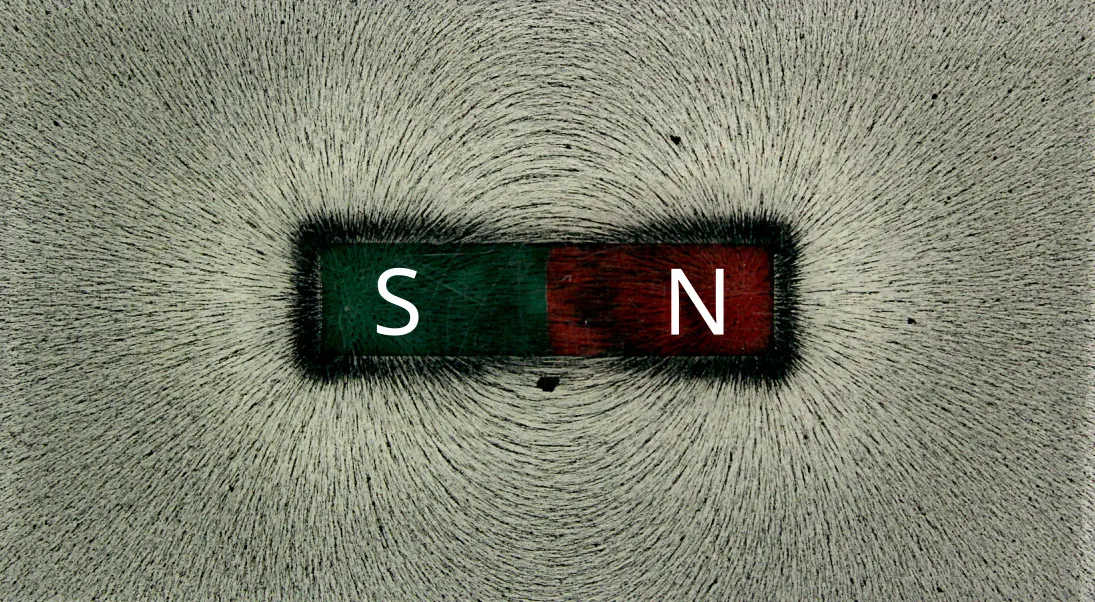
14.3 Magnetic lines of force around a bar magnet
A magnet, too, fills the space around it with a field. A magnetic field is the region around a magnet in which another magnet, or a piece of iron, experiences a magnetic force. A compass needle is a small magnet free to turn, so it lines up with the field wherever it is placed: its north-seeking end, the N pole, points the way the field points.
Just as for electric fields, a magnetic field is drawn with magnetic lines of force (also called magnetic field lines).
A magnetic line of force is the path along which a free, isolated north pole would tend to move in a magnetic field. The tangent to it at any point gives the direction of the magnetic field there, which is the direction the N pole of a compass needle points.
No real north pole exists on its own (cut a magnet in two and each half has its own N and S), but a small compass is close enough: its N end is pushed along the line, its S end the other way, and the needle settles along the line.
Properties of magnetic lines of force
- Outside a magnet, they go from the N pole to the S pole. Inside the magnet, they go from S to N, so every line is a closed loop. (This is one difference from electric lines of force, which start and end on charges.)
- The tangent at any point gives the direction of the field there.
- They never cross each other: the field at a point can point only one way.
- They are crowded together where the field is strong, near the poles, and spread out where it is weak.
- In a uniform field, such as the Earth’s field over a small table far from any magnet, they are straight, parallel and evenly spaced.
- They tend to shorten, like stretched rubber bands, which is why unlike poles pull together, and they push sideways on each other, which is why like poles push apart.
Plotting the lines with a compass
You can draw the lines round a magnet for yourself with a small plotting compass, a compass about 1–2 cm across. The idea is simple: a compass needle always lies along a line of force, so if you mark where its two ends are, then move the compass on so its tail sits where its head was, the marks follow the line step by step.
Neutral points
On the table, the compass feels two fields at once: the magnet’s, and the Earth’s, which is weak but the same everywhere on the table and points north. Close to the magnet, the magnet’s field is far stronger, and the lines curve round from N to S. Far away, the Earth’s field wins, and the lines run north. In between, at a few points, the magnet’s field is exactly as strong as the Earth’s and points exactly the opposite way. There the two cancel.
A neutral point is a point in a magnetic field where the resultant field is zero: the field of the magnet is equal and opposite to the Earth’s horizontal field. A compass placed there doesn’t point in any particular direction.
Where are they? Wherever the magnet’s field points south, opposite to the Earth’s.
- N pole pointing north: to either side of the magnet’s middle, its field runs from the N end back to the S end, which is southward. So the two neutral points lie east and west of the magnet, on the line through its center at right angles to it. For the magnet in the widget, about 12.5 cm from the center.
- N pole pointing south: beyond each end, along the magnet’s axis, its field points south (away from the N pole, beyond the N end; toward the S pole, beyond the S end). So the two neutral points lie on the axis, beyond both poles, north and south of the magnet. For the same magnet, about 16.5 cm from the center.
A compass is placed at a neutral point near a bar magnet. Its needle:
Pick an answer to see why.
A bar magnet lies on a table with its N pole pointing north. Where are its neutral points?
Pick an answer to see why.
14.4 Magnetic field pattern of the Earth
A compass points north because the Earth itself is a magnet, as you learned in Grade 8. In 1600 the English doctor William Gilbert showed it with a terrella, a ball of lodestone, a naturally magnetic rock: a small compass needle moved over its surface behaved just as a compass does on the Earth, pointing toward its poles and tilting down near them. He concluded that the Earth is one great magnet.
Today we know the field comes from slow currents of molten iron in the Earth’s outer core, about 2,900 km below us. These currents work like a dynamo, and the field they make looks, outside the Earth, very nearly like the field of a huge bar magnet placed at the Earth’s center.
The pattern has these features:
- The lines of force come out of the Earth in the southern hemisphere and go back in, in the northern hemisphere. Outside the Earth they run from the geographic south to the geographic north. This is why a compass’s N end points north: it points along the lines.
- So the pole of the Earth’s magnet in the far north, which attracts the N pole of every compass, is magnetically a south pole, and the one in the far south a north pole.
- The magnetic axis doesn’t line up with the geographic axis. The two make an angle of about 10°, so the Earth’s magnetic poles are not at its geographic poles.
- Near the magnetic equator, the lines run parallel to the ground. Near the magnetic poles, they plunge steeply into the ground (in the north) or rise steeply out of it (in the south). In between, as in Nepal, they slope.
- The field at the Earth’s surface is weak: from about 25 µT (microteslas) near the magnetic equator to about 65 µT near the magnetic poles. In Kathmandu it is about 49 µT. A fridge magnet is about a hundred times stronger, close up.

The field helps living things too. Pigeons, migrating birds, sea turtles and salmon sense the Earth’s field and use it to find their way, sometimes across thousands of kilometers.
Which statement about the Earth’s magnetic field is correct?
Pick an answer to see why.
14.5 Angle of dip and angle of declination
A compass tells you which way is north, roughly. But the Earth’s field at a place points in a particular direction in space, and two angles are needed to describe it: one says how far it is turned from true north, and the other how steeply it slopes into the ground. They are two of the elements of the Earth’s magnetism, which you met in Grade 8.
Two meridians
Imagine a vertical plane at a place, passing through the Earth’s geographic North and South Poles. It is the geographic meridian (or true meridian) of the place. The line where it meets the ground runs true north–south, the direction a map’s grid lines and the Pole Star show.
Now imagine the vertical plane that a freely hanging compass needle settles in, the plane containing the Earth’s field at that place. It is the magnetic meridian. Its line on the ground is the direction a compass needle points.
The two are not usually the same, because the Earth’s magnetic poles are not at its geographic poles.
Angle of declination
The angle of declination (or magnetic declination) at a place is the angle between the geographic meridian and the magnetic meridian there. It is the angle by which a compass needle points away from true north.
It is called east declination if the compass points east of true north, and west if it points west of it. It changes from place to place, and slowly, from year to year. Near the magnetic poles it can be tens of degrees; in some places it is zero, and there a compass points exactly to true north.
In Nepal the declination is small. Computed from the international model of the Earth’s field, IGRF-14 (not measured in a survey), in 2026 it is about 0.1° E at Biratnagar, 0.4° E at Kathmandu, 0.6° E at Pokhara and 1.1° E at Mahendranagar: a compass anywhere in Nepal points less than a degree and a half east of true north. In Kathmandu, the tip of a compass needle 10 cm long sits less than half a millimeter from where it would be if it pointed to true north.
Angle of dip
A compass needle turns only in a horizontal plane, so it shows only the direction of the field along the ground. But the Earth’s field also slopes. Hang a magnetized needle so that it can turn freely in a vertical plane, set in the magnetic meridian, and it doesn’t rest level: in Nepal, its N end dips down by more than 40°.
The angle of dip (or angle of inclination) at a place is the angle that the Earth’s magnetic field there makes with the horizontal, in the magnetic meridian. It is the angle by which a freely suspended magnetic needle, turning in the magnetic meridian, dips below the horizontal.
It changes with latitude, roughly as the lines of force in the figure slope:
| Where | Angle of dip |
|---|---|
| At the magnetic equator | 0°: the needle rests level |
| Between the magnetic equator and the magnetic north pole (Nepal, India, Europe) | the N end dips down, more the farther north |
| At the magnetic north pole | 90°: the needle stands straight up and down, N end down |
| South of the magnetic equator (Australia, South Africa) | the S end dips down |
In 2026, computed from the same model (IGRF-14), the angle of dip is about 42° at Biratnagar, 44° at Kathmandu, 45° at Pokhara, 46° at Mahendranagar and 47° at Jumla. The magnetic equator passes just south of India’s southern tip, across Sri Lanka.
Because the dip grows steadily from the magnetic equator toward the poles, it gives a rough idea of how far north or south one is, a fact sailors once used when they couldn’t see the stars. A navigator with a dip needle could tell, on a cloudy night, roughly how far north of the magnetic equator the ship was.
Uses of the angle of declination and the angle of dip
- Using a compass with a map. Maps are drawn to true north, compasses point to magnetic north. Walkers, surveyors and soldiers add or subtract the declination to turn a compass bearing into a true one. In Nepal the correction is under 1.5°, often small enough to ignore over short distances, but near the magnetic poles it can be tens of degrees.
- Ships and aircraft. Compasses and navigation systems correct for the declination at every place along the route. Airport runways are numbered by their magnetic direction, rounded to the nearest 10° and divided by 10: Kathmandu’s Tribhuvan International Airport’s single runway points about 21° and 201° from magnetic north, so its two ends are numbered 02 and 20. When the declination drifts, runways somewhere in the world have to be renumbered and their signs repainted.
- Phones. A phone has a tiny magnetic sensor. Its map app works out the declination for where the phone is, from a model of the Earth’s field, and turns the magnetic reading into true north.
- Finding latitude. The angle of dip changes steadily with distance from the magnetic equator, so it was once used to estimate latitude.
- Searching for minerals. Iron ore and some other rocks change the field above them a little, changing the dip and declination there. Geologists map these small changes to find buried ore and to study the rocks below.
- Studying the Earth. Observatories record the declination and dip continuously, to follow the slow changes in the Earth’s field, to warn of magnetic storms from the Sun, and to keep the world’s model of the field up to date, which is renewed every five years.
Finding the angle of declination
To find the declination at a place, you need two directions: true north and magnetic north. A compass gives magnetic north directly. True north can be found from the Sun, using a vertical stick.
At an observatory, the declination is measured much more precisely, with an instrument called a declinometer: a magnetometer that finds the magnetic meridian, mounted on a telescope that finds true north from the stars or the Sun.
Finding the angle of dip
The angle of dip is measured with a dip circle (or dip needle). It is a magnetic needle on a horizontal axle through its center, so that it can turn up and down in a vertical plane, in front of a vertical circular scale marked 0° at the horizontal and 90° straight up and down. The circle and needle stand on a base that turns on a horizontal scale, so the whole plane of the needle can be turned to face any direction, and a spirit level and leveling screws keep the base level.
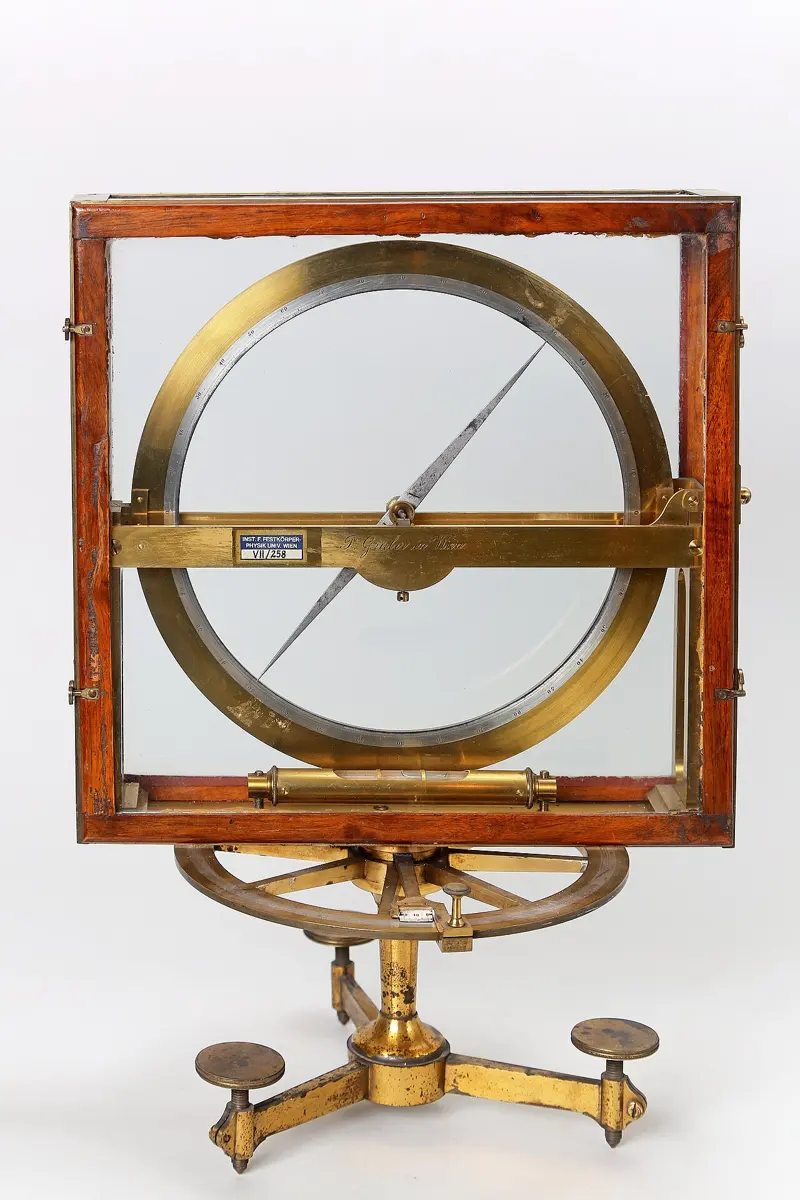
It is used like this:
- Level the base, using the leveling screws and the spirit level, so that the vertical scale is truly vertical.
- Set the circle in the magnetic meridian. Turn the circle on the horizontal scale until the needle stands straight up and down (reads 90°). The needle’s plane is then at right angles to the magnetic meridian: in that direction the needle feels only the field’s vertical part. Note the reading on the horizontal scale, then turn the circle through exactly 90°. Now the needle swings in the magnetic meridian.
- Read the angle of dip at both ends of the needle and take their mean. To cancel small errors of the instrument, turn the circle through 180° and read both ends again, and average all the readings.
Why does step 2 matter? In any other vertical plane, the needle feels only part of the field’s horizontal part, but all of its vertical part, so it dips more steeply than the true angle of dip. In a plane at right angles to the meridian it would stand straight up and down, reading 90° anywhere off the magnetic equator. Only in the magnetic meridian does the needle show the true dip. So the reading is never smaller than the true dip; the smallest reading, when the circle is turned slowly round, is the angle of dip.
At the magnetic equator, the angle of dip is:
Pick an answer to see why.
Why is a dip circle set in the magnetic meridian before the angle of dip is read?
Pick an answer to see why.
In Nepal, a compass points:
Pick an answer to see why.
Exercise
1. Choose the correct option
a. Electric lines of force round an isolated positive point charge:
Pick an answer to see why.
b. If the distance between two point charges is made three times as large, the force between them becomes:
Pick an answer to see why.
c. The value of Coulomb’s constant k in air is:
Pick an answer to see why.
d. Two charges of +2 µC and +3 µC are placed 1 m apart. The force between them is:
Pick an answer to see why.
e. A capacitor is a device used to:
Pick an answer to see why.
f. A 10 µF capacitor is connected to a 6 V battery. The charge on each plate is:
Pick an answer to see why.
g. Outside a bar magnet, magnetic lines of force go:
Pick an answer to see why.
h. With a bar magnet’s N pole pointing geographic south, the neutral points lie:
Pick an answer to see why.
i. The pole of the Earth’s magnet that lies near the geographic North Pole is:
Pick an answer to see why.
j. The angle between the geographic meridian and the magnetic meridian at a place is called the:
Pick an answer to see why.
k. The angle of dip at a place is measured with a:
Pick an answer to see why.
2. Give reasons
A small positive charge is used as a test charge.
Hint
Answer
Electric lines of force never intersect each other.
Hint
Answer
Salt dissolves easily in water, though its ions attract each other strongly in a crystal.
Hint
Answer
A capacitor can store charge, but it doesn’t let a steady direct current flow through it.
Hint
Answer
It is dangerous to open a television or a microwave oven even after it has been unplugged.
Hint
Answer
Magnetic lines of force are crowded near the poles of a bar magnet.
Hint
Answer
A compass placed at a neutral point doesn’t point in any particular direction.
Hint
Answer
The N pole of a compass needle points toward the geographic north.
Hint
Answer
A dip needle rests horizontal at the magnetic equator but vertical at the magnetic poles.
Hint
Answer
A dip circle must be set in the magnetic meridian to measure the angle of dip.
Hint
Answer
3. Differentiate between
Electric field and electric field intensity
Hint
Answer
Electric lines of force and magnetic lines of force
Hint
Answer
Gravitational force and electrostatic force
Hint
Answer
Capacitor and cell
Hint
Answer
Geographic meridian and magnetic meridian
Hint
Answer
Angle of declination and angle of dip
Hint
Answer
4. Answer the following questions
What is an electric field? Define electric field intensity and write its SI unit.
Hint
Answer
What is a line of force? Write any four properties of electric lines of force.
Hint
Answer
Draw the electric lines of force round (i) an isolated positive point charge, (ii) an isolated negative point charge.
Hint
Answer
Draw the lines of force between (i) two equal unlike charges, (ii) two equal like charges. Mark the neutral point in (ii).
Hint
Answer
State Coulomb’s law and write its formula. What is the value of Coulomb’s constant in air?
Hint
Answer
Define one coulomb using Coulomb’s law.
Hint
Answer
How does the force between two charges change if (i) one charge is doubled, (ii) both charges are halved, (iii) the distance between them is halved?
Hint
Answer
What is a capacitor? Define capacitance and write its SI unit.
Hint
Answer
Define one farad. Why are capacitances usually given in microfarads, nanofarads or picofarads?
Hint
Answer
Explain how a capacitor is charged by a battery and how it is discharged.
Hint
Answer
Write any four uses of capacitors in daily life.
Hint
Answer
What is a magnetic line of force? Write any four properties of magnetic lines of force.
Hint
Answer
Describe how you would plot the magnetic lines of force round a bar magnet using a plotting compass.
Hint
Answer
What is a neutral point? Draw the lines of force of a bar magnet placed with its N pole pointing (i) north, (ii) south, and mark the neutral points.
Hint
Answer
Describe the Earth’s magnetic field pattern, with a labeled diagram.
Hint
Answer
Define the angle of declination and the angle of dip. Write the values of each at Kathmandu.
Hint
Answer
Write any three uses of the angle of declination and the angle of dip.
Hint
Answer
Describe how the angle of dip is measured with a dip circle.
Hint
Answer
Think: A student sets up a dip circle in Pokhara and reads 70°. She is sure the instrument is level. What has she most probably done wrong, and how can she check?
Hint
Answer
5. Numerical problems
Find the electric field intensity at a point 20 cm from a point charge of +8 µC.
Hint
Answer
A charge of 4 µC placed in an electric field experiences a force of 0.02 N. Find the electric field intensity there. What force would a charge of −10 µC feel at the same point?
Hint
Answer
Two point charges of +5 µC and −4 µC are 30 cm apart in air. Find the force between them.
Hint
Answer
Two equal charges repel each other with a force of 3.6 N when they are 5 cm apart in air. Find each charge.
Hint
Answer
How far apart must two charges of 1 µC each be placed in air so that the force between them is 0.1 N?
Hint
Answer
Two charges are 6 cm apart and attract each other with a force of 16 N. At what distance would the force be 4 N?
Hint
Answer
Two small balls, each of mass 0.9 g and each carrying a charge of 0.1 µC, are 3 cm apart. Compare the electrostatic force between them with the weight of one ball (g = 10 m/s²).
Hint
Answer
A capacitor of 220 µF is charged by a 9 V battery. Find the charge stored on it.
Hint
Answer
A capacitor stores a charge of 0.6 mC when it is connected to a 12 V supply. Find its capacitance in microfarads.
Hint
Answer
A camera flash has a capacitor of 150 µF, charged to 300 V. (i) How much charge does it store? (ii) If the flash empties it in 1 ms, what is the average current through the flash tube?
Hint
Answer
A ceiling fan’s capacitor of 2.5 µF is connected to the mains, whose voltage reaches 325 V at its peak. Find the largest charge on the capacitor.
Hint
Answer
Think: At a place, the horizontal part of the Earth’s field is 30 µT and the vertical part 30√3 µT (about 52 µT). Find the angle of dip there. Is the place nearer the magnetic equator or a magnetic pole than Kathmandu?
Hint
Answer
Printable PDFs
- The unit as a book (A5) 37 pages Answers as an A4 booklet, 10 sheets
- Study notes 3 pages
- Worksheet 5 pages Answer key
- Harder practice questions 3 pages Answer key
Practice every question in the book, and keep track of the ones you miss →
Found a mistake? Please tell us.