
Stand on the shore of Rara Lake on a still morning and look down. The water is so clear that you can see fish gliding over the stones, and the stones look close enough to touch. Wade in, though, and the water comes up much higher on your legs than you expected. The bottom was deeper than it looked. A fisherman with a spear learns the same lesson: aim straight at the fish you see and you miss, because the fish is not quite where it seems to be.
Light is playing a trick here. It travels in straight lines, but where it passes from water into air it bends, and your eyes and brain don’t know that it bent. The same bending lets a doctor look inside your stomach through a thin cable, carries the internet into Nepal through glass threads thinner than a hair, and makes a diamond flash with colored fire. This unit is about how much light bends, a rule that lets you work it out with a calculator, and what happens when light can’t get out at all.

You already know from Grade 7 that light travels in straight lines and that a mirror reflects it by the law of reflection: the angle of reflection equals the angle of incidence Grade 7: Laws of reflection of light. When light meets the surface of a transparent material such as water or glass, most of it doesn’t bounce back. It goes on into the new material, and something changes: its speed.
In empty space, and almost exactly in air, light travels at about 3 × 10⁸ m/s, three hundred thousand kilometers every second. In water it travels at only about three-quarters of that speed, in glass about two-thirds, and in diamond well under half. A material in which light travels more slowly is called optically denser; one in which it travels faster is optically rarer. Glass is optically denser than water, and water is optically denser than air.
13.1 Refraction
What refraction is
Put a pencil in a glass of water at a slant: it looks broken at the surface. Shine a laser pointer into a tank of water from above at a slant and look from the side: the beam changes direction as it enters the water. This change of direction is refraction.
Refraction of light is the change in the direction of light when it passes at a slant from one transparent medium into another, because its speed changes.
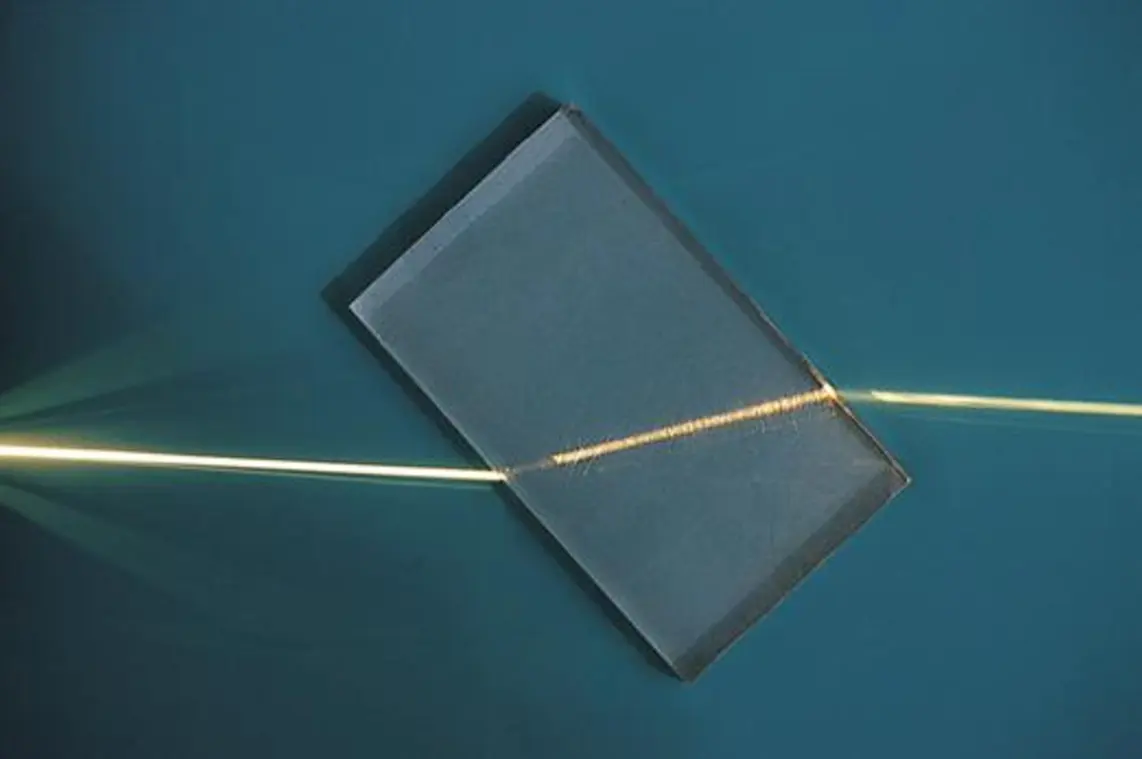
To describe refraction, we need a few words, shown in Figure 13.3.
- The incident ray is the light coming toward the surface.
- The point of incidence (O) is where it meets the surface.
- The normal is a line drawn at right angles to the surface at the point of incidence. It is an imaginary line, drawn dashed.
- The refracted ray is the light that goes on into the second medium.
- The angle of incidence () is the angle between the incident ray and the normal.
- The angle of refraction () is the angle between the refracted ray and the normal.
Both angles are always measured from the normal, never from the surface. A ray that strikes the surface at 30° to the surface makes an angle of incidence of 60°.
The rule for the direction is simple:
- Light going from a rarer into a denser medium (air into water, water into glass) bends toward the normal: .
- Light going from a denser into a rarer medium (glass into air, water into air) bends away from the normal: .
- Light that meets the surface along the normal () goes straight on without bending, although it still slows down or speeds up.
Why a change of speed bends light
Imagine a line of students marching side by side across the school ground, arms linked, and coming at a slant to a patch of soft sand where everyone walks more slowly. The student at one end reaches the sand first and slows down, while the others keep their speed for a moment longer. The line swings round, and by the time all of them are on the sand it is marching in a new direction, turned toward the line square to the edge of the sand. Coming out of the sand at a slant, the first to reach firm ground speeds up first, and the line swings back the other way.
A beam of light behaves in the same way. Its front edge is like the marching line: the side that enters the slower medium first is slowed first, so the whole front turns. If the line hits the edge of the sand square on, everyone slows at the same moment, and the line goes straight on. That is why light along the normal doesn’t bend.
A ray of light passes from water into air at an angle of incidence of 30°. Which is true of the angle of refraction?
Pick an answer to see why.
The laws of refraction
People had seen light bend in water since ancient times, but finding the exact rule took more than a thousand years. Measurements of and for many angles give two laws.
- The incident ray, the refracted ray and the normal at the point of incidence all lie in the same plane.
- For a given pair of media and a given color of light, the ratio of the sine of the angle of incidence to the sine of the angle of refraction is a constant:
The second law is Snell’s law. The constant is called the refractive index of the second medium with respect to the first. In this book it is written μ (the Greek letter mu); many books write n. Both mean the same thing.
The first law says that refraction never bends light up out of the page or down into it: if the incident ray and the normal are drawn on paper, the refracted ray is on the same paper. The second law is the one you calculate with.
Notice that it is the sines of the angles that keep a fixed ratio, not the angles themselves. For light going from air into glass, = 30° gives = 19.5°, but = 60° gives = 35.3°, not 39°. The angles are not in a fixed ratio; their sines are: sin 30° ÷ sin 19.5° and sin 60° ÷ sin 35.3° are both 1.5.
Refractive index
The refractive index of a medium tells how much it slows light down, and so how strongly it bends light. When light passes from a vacuum (or air) into a medium, the refractive index of the medium is the ratio of the speed of light in a vacuum, , to its speed in the medium, :
This is the absolute refractive index of the medium. Since it is one speed divided by another, it has no unit. Air’s refractive index is 1.0003, so close to 1 that we take it as 1, and the refractive index “with respect to air” is the same as the absolute one.
| Medium | Refractive index (μ) | Speed of light (m/s) |
|---|---|---|
| air | 1.0003 (take 1) | 3.0 × 10⁸ |
| ice | 1.31 | 2.29 × 10⁸ |
| water | 1.33 | 2.26 × 10⁸ |
| kerosene | about 1.44 | 2.08 × 10⁸ |
| glycerine | 1.47 | 2.04 × 10⁸ |
| ordinary glass | 1.5 | 2.0 × 10⁸ |
| diamond | 2.42 | 1.24 × 10⁸ |
A higher refractive index means slower light and more bending. The refractive index of a material also changes slightly with the color of the light: violet light is slowed a little more than red, which is why a prism splits white light into colors. The values in tables like this one are for yellow light. Kerosene is a mixture whose make-up varies, so its refractive index varies a little too, from about 1.43 to 1.45; problems use 1.44.
Relative refractive index
Light does not always start in air. When it goes from medium 1 (water, say) into medium 2 (glass), Snell’s law still holds, and the constant is the relative refractive index of medium 2 with respect to medium 1, written :
Since and , the ’s cancel:
So the refractive index of glass with respect to water is . A relative refractive index can be less than 1: that just means the light is going into a faster medium, as from glass into water ().
Multiplying both sides of out gives Snell’s law in a form that works for any two media at once:
This is often the quickest way to solve a problem: put the refractive index of each medium beside the sine of the angle in it.
The principle of reversibility
If a ray of light is sent back along the path it came, it retraces that path exactly. A ray going from air into glass at 50° is refracted at 30.7°; send light back along that refracted ray from inside the glass at 30.7°, and it comes out into the air at exactly 50°. This is the principle of reversibility of light.
Applied to Snell’s law, it says that the refractive index from medium 2 to medium 1 is the reciprocal of the one from 1 to 2:
Worked examples
The refractive index of a liquid is 1.25. What is the speed of light in it? (c = 3 × 10⁸ m/s)
Pick an answer to see why.
13.2 Total internal reflection of light
From a denser into a rarer medium
When light goes from glass into air, it bends away from the normal, so the angle of refraction is always bigger than the angle of incidence. Make bigger, and grows faster still. But can’t be more than 90°: at 90°, the refracted ray skims along the surface. What happens then?
Go back to the widget above and choose Block into air. Move the angle of incidence up slowly from 0° and watch three things: the refracted ray swinging toward the surface, the reflected ray getting stronger, and the moment the refracted ray disappears.
The critical angle
The critical angle () is the angle of incidence in the denser medium for which the angle of refraction in the rarer medium is 90°.
For glass in air, it is 41.8°. Below it, light gets out, bent away from the normal. Exactly at it, the refracted ray skims along the surface. Beyond it, no light gets out at all (Figure 13.4).
The critical angle and the refractive index
Snell’s law gives the critical angle at once. For light going from a medium of refractive index μ into air, becomes, at the critical angle (, ):
The bigger the refractive index, the smaller the critical angle.
| Medium (in air) | μ | Critical angle |
|---|---|---|
| water | 1.33 | 48.8° |
| kerosene | about 1.44 | about 44° |
| glycerine | 1.47 | 42.9° |
| glass | 1.5 | 41.8° |
| diamond | 2.42 | 24.4° |
Between two media that aren’t air, the same reasoning gives , where is the denser medium’s index and the rarer one’s. Light in glass meeting water has a critical angle of = 62.5°.
Total internal reflection
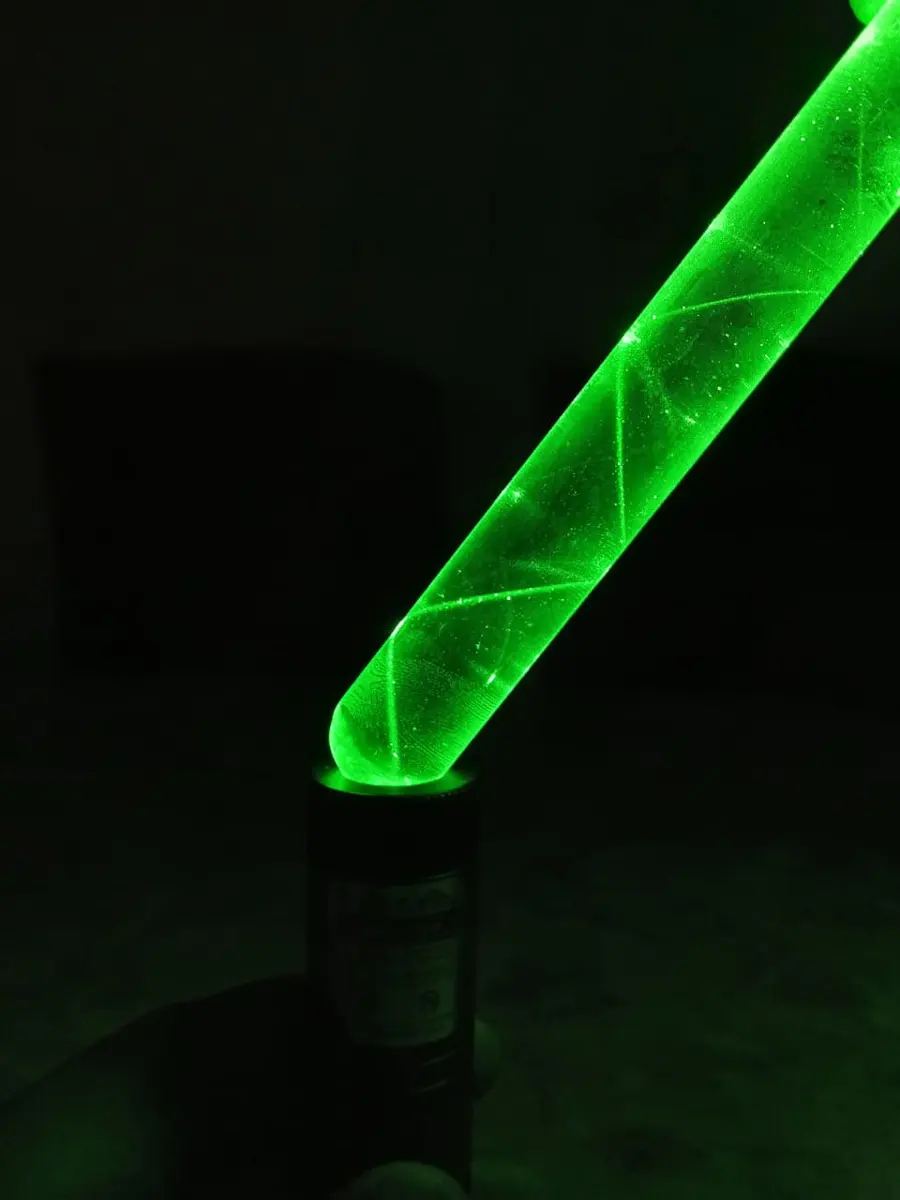
When light in a denser medium meets the surface of a rarer medium at an angle of incidence greater than the critical angle, none of it is refracted: all of it is reflected back into the denser medium, obeying the laws of reflection. This is total internal reflection. It is “internal” because the light stays inside the denser medium, and “total” because all of it is reflected.
Two conditions are needed for total internal reflection:
- The light must be going from an optically denser medium into an optically rarer one.
- The angle of incidence must be greater than the critical angle for the pair of media.
Ordinary reflection from a mirror is never total: even a good silvered mirror absorbs a few percent of the light and slowly tarnishes. Total internal reflection reflects all the light, every time, so it makes the best mirror there is.
Worked examples
Total internal reflection can happen when light goes from:
Pick an answer to see why.
The refractive index of a material is 2. What is its critical angle?
Pick an answer to see why.
Total internal reflection around us
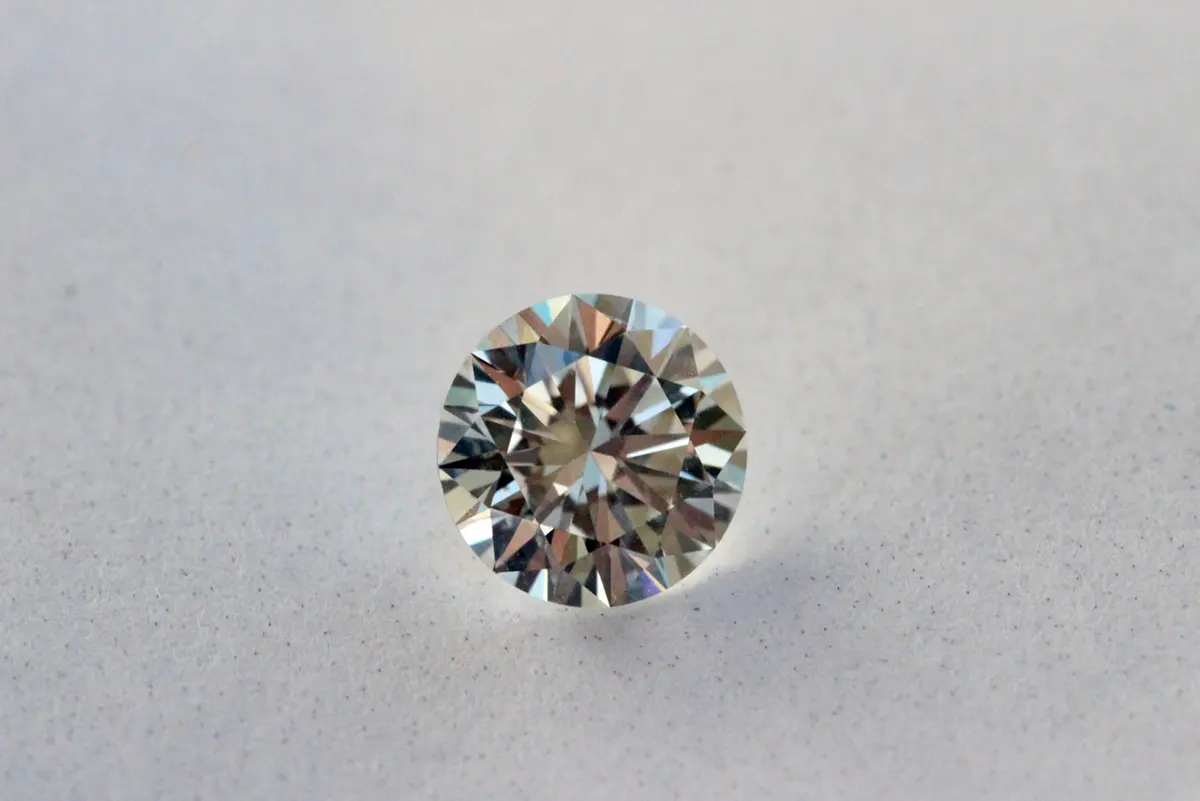
The sparkle of a diamond. A diamond’s critical angle is only 24.4°, so light that enters it is very likely to meet its next face at more than that and be trapped. A diamond cutter cuts the stone with dozens of flat faces, angled so that light entering the top bounces from face to face inside and comes out of the top again, toward the viewer, instead of leaking out of the back. Glass, with a critical angle of 41.8°, lets far more light leak out at the back, so a glass copy cut the same way looks dull beside it. Diamond also splits white light into colors strongly, so the light comes out as flashes of color, the stone’s “fire”.
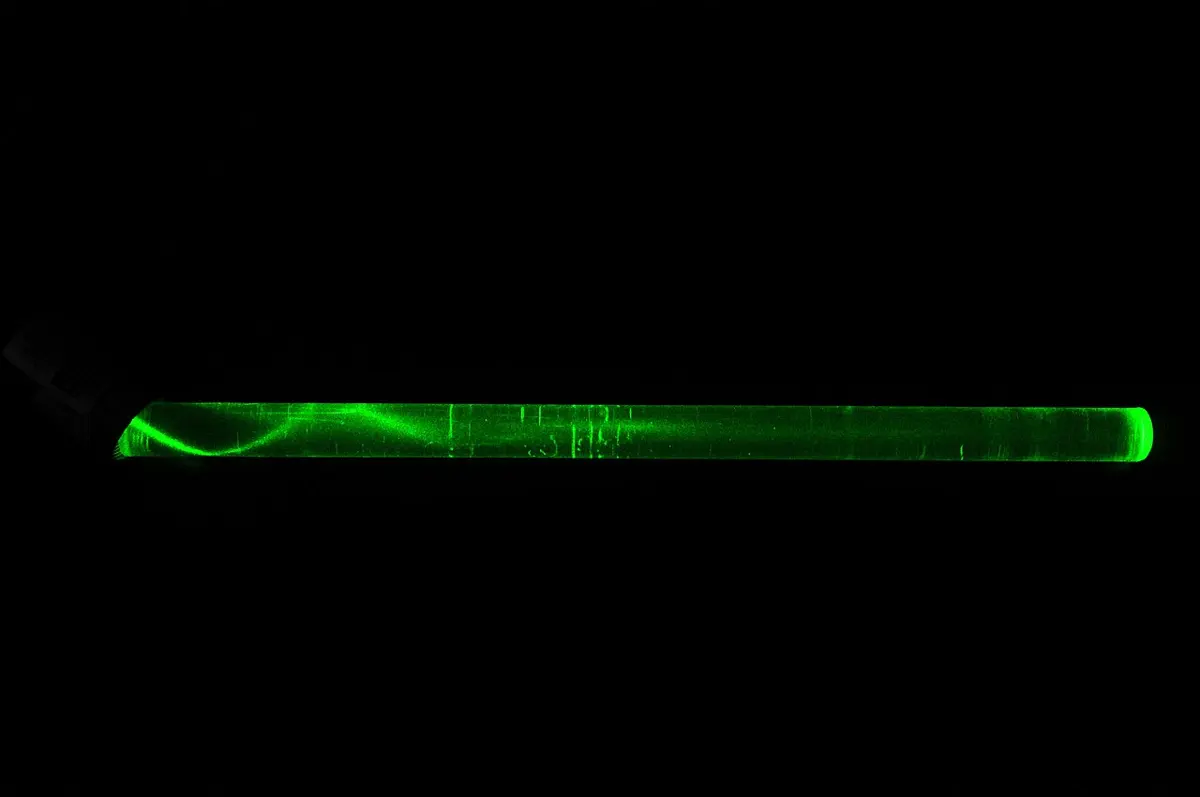
Optical fibers. An optical fiber is a glass thread about as thick as a human hair. Its middle, the core, has a slightly higher refractive index than the glass around it, the cladding (for example 1.48 and 1.46). Light sent into one end meets the core’s edge at a big angle of incidence, more than the critical angle (here 80.6°), so it is totally reflected, again and again, thousands of times a meter, and follows the fiber round bends for many kilometers with very little loss. Fibers carry telephone calls and the internet as flashes of light. Most of Nepal’s internet reaches the world through fiber cables across the border with India, at Birgunj, Bhairahawa and Biratnagar among other places, and since 12 January 2018 also through a cable from China at Rasuwagadhi.
Endoscopes. A doctor’s endoscope is a bundle of thousands of optical fibers in a flexible tube. Some carry light down into the stomach or the knee; others, laid in exactly the same order at both ends, carry the picture back, each fiber one dot of it. It lets doctors see inside the body without large cuts.
Prisms that turn light. A glass prism with angles of 90°, 45° and 45° turns light through 90° or 180°: the light meets the long face at 45°, more than glass’s 41.8°, and is totally reflected. Periscopes and binoculars use such prisms instead of mirrors, since they reflect all the light and never tarnish.
Mirages. On a hot day, the road ahead seems to shine like water. Air near the hot road is hotter and optically rarer than the air above it. Light from the sky coming down at a shallow slant is bent more and more away from the normal as it passes through warmer and warmer layers, until, close to the road, it is turned back upward. Your eye sees the sky’s light coming up from the road and takes it for a pool of water. (Strictly, the light is bent gradually all the way round, with no single surface where it reflects; textbooks describe the last turn as total internal reflection.)
13.3 Determination of refractive index of glass
The refractive index of a glass slab can be found in the laboratory by tracing a ray through it with pins. The pins mark the ray’s path on paper: when you look through the glass and see two pins, one behind the other, in a straight line, the light from them reaches your eye along the line you are looking.
Getting a good result. Stand the pins upright and well apart (pins close together give a line whose direction is uncertain). Keep the angle of incidence between about 30° and 60°: at very small angles the angles are tiny and hard to read to the same accuracy, and at very large ones the light reflected from AB makes the pins hard to see. Use a sharp pencil and a fine line, and look at the feet of the pins.
The emergent ray is parallel to the incident ray
At face AB, light goes from air into glass: . At face DC it goes from glass into air, with angle of incidence (the two normals are parallel, so the angle inside is the same at both faces) and angle of emergence : . Multiplying the two,
The light leaves going in the same direction it came in. It is only shifted sideways, by the lateral shift (or lateral displacement), the perpendicular distance between the emergent ray and the incident ray produced. A thicker slab, a bigger angle of incidence or a higher refractive index gives a bigger shift. This is why a line seen through a thick glass slab at a slant looks broken where the glass begins, but still points the same way.
Other ways to find a refractive index
The pin method is not the only one. With a semicircular block, as in the widget in 13.1, the light leaving through the curved side meets it along a radius and isn’t bent there, so both angles can be read straight off a protractor; and sending the beam in through the curved side gives the critical angle, and so . A third way uses real and apparent depth, the subject of the next section: , measured with a traveling microscope.
In the glass slab experiment, the emergent ray is:
Pick an answer to see why.
13.4 Real and apparent depth
Meaning
Drop a coin into a bucket of water and look down at it. It seems to lie higher than it does, as if the bucket had a shallower bottom. The distance from the surface down to where the object really is, is its real depth. The distance down to where it seems to be, its image, is its apparent depth. For anything under water seen from above, the apparent depth is less than the real depth.
The reason is refraction at the surface. Light from the coin travels up through the water and bends away from the normal as it passes into the air. Your eye can’t tell that the light bent. It traces the light straight back, and sees the coin where the bent light seems to come from, higher up.
Real depth ÷ apparent depth = μ
In Figure 13.10, a coin O lies on the bottom of the water, and A is the point on the surface straight above it. Light from O that goes straight up, along OA, meets the surface along the normal and isn’t bent. Light from O that goes along OB meets the surface at B, at an angle of incidence , and leaves bent away from the normal at angle . Traced back, the ray from B meets the line OA at I. That is where the eye sees the coin: AO is the real depth and AI the apparent depth.
The angle at O between OA and OB equals , and the angle at I between IA and IB equals (each is the same as the angle at B, since OA and the normal at B are parallel). In the right-angled triangles OAB and IAB,
For light going from water into air, Snell’s law gives , the refractive index of water. When we look straight down, only rays very close to the normal reach the eye, so and are very small, and for small angles the sine and tangent of an angle are almost equal. Then
Looking straight down into water, things appear at , about three-quarters, of their real depth. The amount by which the object seems to rise is the apparent shift (or normal shift):
Real and apparent depth around us
Pools, ponds and rivers look shallower than they are. A pool 2 m deep looks only 1.5 m deep from straight above, and less from the side. Every monsoon, people drown in Nepal’s rivers and ponds, and water that looks shallower than it is adds to the danger. Never jump or wade into water whose depth you haven’t checked with a stick.
The fisherman’s aim. A fish seen from the bank appears higher, and nearer, than it is. A spear aimed straight at the fish’s image passes above it; fishermen learn to aim below where the fish appears.
Seen from under water. The light works the other way too. To a swimmer under water looking up, a person standing at the pool’s edge looks taller and farther up than they are, because light from the air bends toward the normal as it enters the water.
A thick glass slab. Print seen through a thick glass block laid on a page looks raised, closer to the top of the block: for a 6 cm glass block (μ = 1.5) the print appears 4 cm below the top, raised by 2 cm.
Worked examples
A coin lies at the bottom of a beaker of water 16 cm deep (μ = 4/3). Looking straight down, how far does it seem to be raised?
Pick an answer to see why.
Exercise
1. Choose the correct option
a. When light passes from air into glass at a slant, it:
Pick an answer to see why.
b. The unit of refractive index is:
Pick an answer to see why.
c. The angle of incidence in a denser medium for which the angle of refraction in a rarer medium is 90° is called:
Pick an answer to see why.
d. The critical angle of glass is 42°. Light inside glass meets the glass–air surface at 50°. It will be:
Pick an answer to see why.
e. Which relation is correct for a medium of refractive index μ in air, with critical angle c?
Pick an answer to see why.
f. The refractive index of water is 4/3. A coin at the bottom of a tank of water 2 m deep appears, from straight above, to be at a depth of:
Pick an answer to see why.
g. Optical fibers carry light by:
Pick an answer to see why.
h. In the glass slab experiment, the angle of emergence is:
Pick an answer to see why.
2. Give reasons
A pond looks shallower than it really is.
Hint
Answer
A diamond sparkles much more than a glass copy of the same shape.
Hint
Answer
Light passing along the normal from air into glass does not bend.
Hint
Answer
Total internal reflection cannot happen when light goes from air into water.
Hint
Answer
An empty test tube held at a slant in a beaker of water looks silvery from above, but not once it is filled with water.
Hint
Answer
3. Differentiate between
Angle of incidence and critical angle
Hint
Answer
Ordinary reflection (from a mirror) and total internal reflection
Hint
Answer
Real depth and apparent depth
Hint
Answer
4. Answer the following questions
Define refraction of light, and state the two laws of refraction.
Hint
Answer
What is the absolute refractive index of a medium? How is it related to the speed of light in the medium?
Hint
Answer
What is total internal reflection? Write its two conditions. Describe a simple experiment to demonstrate it.
Hint
Answer
Derive the relation between the critical angle and the refractive index of a medium.
Hint
Answer
Describe how you would find the refractive index of a glass slab in the laboratory. Draw a labeled diagram.
Hint
Answer
Show that real depth ÷ apparent depth = μ for an object under water seen from straight above.
Hint
Answer
Write two uses of total internal reflection, and explain how one of them works.
Hint
Answer
5. Numerical problems
A ray of light passes from air into a block of glass. The angle of incidence is 45° and the angle of refraction is 28°. Find the refractive index of the glass.
Hint
Answer
Light travels at 2.25 × 10⁸ m/s in a liquid. Find the refractive index of the liquid and its critical angle. (c = 3 × 10⁸ m/s)
Hint
Answer
A ray in air strikes the surface of glycerine (μ = 1.47) at an angle of incidence of 60°. Find the angle of refraction.
Hint
Answer
The critical angle of a transparent material is 35°. Find its refractive index and the speed of light in it.
Hint
Answer
Rizwan looks straight down into a water tank 1.2 m deep. How deep does the tank look to him? (μ = 4/3)
Hint
Answer
A mark on paper, seen through a glass slab 3.6 cm thick laid on it, seems to be raised by 1.2 cm. Find the refractive index of the glass.
Hint
Answer
Anisha uses a traveling microscope to find the refractive index of a liquid. Focused on a scratch on the bottom of an empty beaker, it reads 1.12 cm. With liquid poured in, it must be raised to 2.08 cm to see the scratch clearly. Focused on a little powder floating on the liquid’s surface, it reads 4.90 cm. Find the refractive index of the liquid.
Hint
Answer
Light travels at 2 × 10⁸ m/s in glass and 2.25 × 10⁸ m/s in water. Find the refractive index of water with respect to glass. Can total internal reflection happen for light going from glass into water? If so, find the critical angle.
Hint
Answer
Think: A small lamp lies on the bottom of a swimming pool 2 m deep (μ of water = 1.33). Light from it gets out of the water only through a circle on the surface. Explain why, and find the circle’s radius.
Hint
Answer
Printable PDFs
- The unit as a book (A5) 32 pages Answers as an A4 booklet, 8 sheets
- Study notes 2 pages
- Worksheet 6 pages Answer key
- Harder practice questions 3 pages Answer key
Practice every question in the book, and keep track of the ones you miss →
Found a mistake? Please tell us.