
On a dry winter morning in Kathmandu, comb your hair fast with a plastic comb. Then hold the comb just above some tiny bits of paper. The bits jump up and cling to the comb before it touches them. Now try a magnet: hold it a finger’s width above a steel pin, and the pin leaps up to meet it.
Every push and pull you make with your hands needs touching. You push a door with your hand; a rope pulls a bucket up a well. But the comb and the magnet push and pull across an empty gap. How can something push without touching? In this topic you will find out what makes these pushes stronger or weaker, map the invisible field that carries them, and plan an experiment to show that the field is really there.
Pushes that reach across a gap
You learned in Why Does a Rolling Ball Stop? that a force is a push or a pull, with a size and a direction. Most of the forces you meet every day need two things to touch: your foot kicking a football, friction between a tyre and the road, the floor holding you up. These are contact forces.
A few forces act across a gap, with nothing touching. They are non-contact forces, and there are three you can feel:
- Gravity pulls a falling mango down to the ground, though nothing holds it.
- A magnetic force pulls a pin up to a magnet, or pushes two magnets apart.
- An electric force pulls bits of paper up to a rubbed comb.
Non-contact forces still follow the rule you met in Pushes come in pairs. The magnet pulls the pin, and the pin pulls the magnet just as hard. Hang a magnet on a thread and bring a big iron nail near it: the magnet swings towards the nail.
Which of these is a non-contact force?
Pick an answer to see why.
In this topic we look at the electric and magnetic forces. (Gravity is far weaker; you need a whole planet to feel it.)
Two kinds of charge
You learned in Grade 7 that rubbing two things together can move tiny particles called electrons from one to the other. Electrons carry a negative charge. The thing that gains electrons is left with a negative charge; the thing that loses them is left with a positive charge. When you rub a balloon on your hair, the balloon takes electrons from your hair. The balloon becomes negative, and your hair positive.
Here is the rule for charged things:
- Like charges repel: two positive things push each other apart, and so do two negative things.
- Unlike charges attract: a positive and a negative thing pull each other together.
You can see both, with nothing but a roll of sticky tape.
Why is the strip pulled towards your finger, or a comb towards bits of paper that have no charge? Paper is made of atoms, and every atom has electrons in it. When a negative comb comes near, it pushes the electrons in the paper a tiny distance away, to the far side of each atom. The near side of the paper is left a little positive, and the far side a little negative. The near side is closer, so its pull wins: the paper is pulled towards the comb. A charged thing attracts uncharged things in this way, whatever its own charge.
A rubbed balloon pulls a small piece of paper towards it. A rubbed plastic ruler pushes the same balloon away. What can you say for certain?
Pick an answer to see why.
What makes an electric push stronger?
You know that a comb rubbed harder picks up more paper, and that it must be brought close. Scientists turn hunches like these into questions they can test: questions about how one thing changes another.
- “Does a bigger charge make the force stronger?”
- “How does the force change as the charged things get farther apart?”
To answer a question like this, you change one thing (the charge, or the distance) and keep everything else the same, just as you did in Plan an investigation. Then you measure what happens. But how do you measure a push that you can hardly feel?
One way is with a very sensitive balance, the kind used in a laboratory, which reads to a ten-thousandth of a gram. Put a small charged ball on a plastic rod on the balance, and set the reading to zero. Then hold a second charged ball above it. If the top ball pushes the bottom one down, the balance reads more. If it pulls it up, the balance reads less. The change in the reading tells you how strong the push or pull is.
If you change one thing at a time, you find two patterns.
More charge, more force. At 4 cm apart, ×1 charge on the top ball gives 0.0103 g; ×2 gives 0.0206 g; ×4 gives 0.0413 g. Twice the charge, twice the force. The force is proportional to the charge. (The same is true of the bottom ball’s charge: double either one, and the force doubles.)
Farther apart, much less force. With ×1 charge, at 3 cm the reading is 0.0183 g, and at 6 cm it is 0.0046 g. Twice as far, and the force is not a half but a quarter. Three times as far, a ninth. The force gets weaker very quickly as the distance grows.
| Distance | 1 time as far | 2 times as far | 3 times as far | 4 times as far |
|---|---|---|---|---|
| Force | 1 | ¼ | ⅑ | 1⁄16 |
The French engineer Charles-Augustin de Coulomb found this pattern in 1785, measuring the tiny twist of a thin wire. That is why the unit of charge, which you will meet in Grade 9, is called the coulomb. The charges in the widget are made up, but of a real size: a few billionths of a coulomb, less than a rubbed balloon carries.
Two charged balls attract each other. You move them three times as far apart. What happens to the pull?
Pick an answer to see why.
What makes a magnetic push stronger?
You found in Grade 6 that an electromagnet gets stronger with more turns of wire, and with more cells pushing a bigger current through it. You met it again in Grade 8.
A permanent magnet has no turns or cells to change. So what makes its push stronger? You can find out with the same kind of balance: a kitchen scale is sensitive enough for magnets. Tape one small magnet on top of an upturned plastic cup on the scale, and set the scale to zero. Hold a stack of magnets above it, north pole facing north pole, so that they push the bottom magnet down.
These are powerful little magnets, so the readings are much bigger than for the charged balls. Look at what the table shows.
The gap matters most of all. One magnet above one magnet: at a 10 mm gap the scale reads 120.2 g; at 20 mm, only 19.3 g. Twice the gap, and the push is about a sixth. That is even faster than for charges. Close up, the push is huge: at a 5 mm gap it reads 427.9 g.
A stronger magnet pushes harder, but stacking isn’t simple. At a 10 mm gap, a stack of two magnets reads 164.2 g and a stack of three 183.5 g. More magnets give a bigger push, but two magnets don’t push twice as hard as one. The second magnet in the stack is farther from the bottom magnet, and you have just seen how quickly the push weakens with distance.
The numbers in this widget were worked out from the laws of magnetism for real magnets: small neodymium discs (the strongest kind of magnet sold), 10 mm across and 5 mm thick. Your own measurements with other magnets will be different, but the pattern will be the same.
The same factors make electric motors stronger. A motor turns because its magnets push on the current in its coil (you will learn how in Grade 10: The electric motor). A bigger current, more turns in the coil, or stronger magnets give a bigger turning push, so the motor can turn a heavier load.
You make an electromagnet with 40 turns of wire round a nail and one cell. Which change would you expect to make it pick up more pins?
Pick an answer to see why.
Fields: the space that pushes
How does a magnet “know” that a pin is there, across empty space? Scientists explain it like this. A magnet changes the space around it, even when nothing else is there. The space round a magnet, where a magnetic thing would feel a force, is its magnetic field. You met this name in Grade 8. When a pin is put in the field, the field pushes or pulls on it.
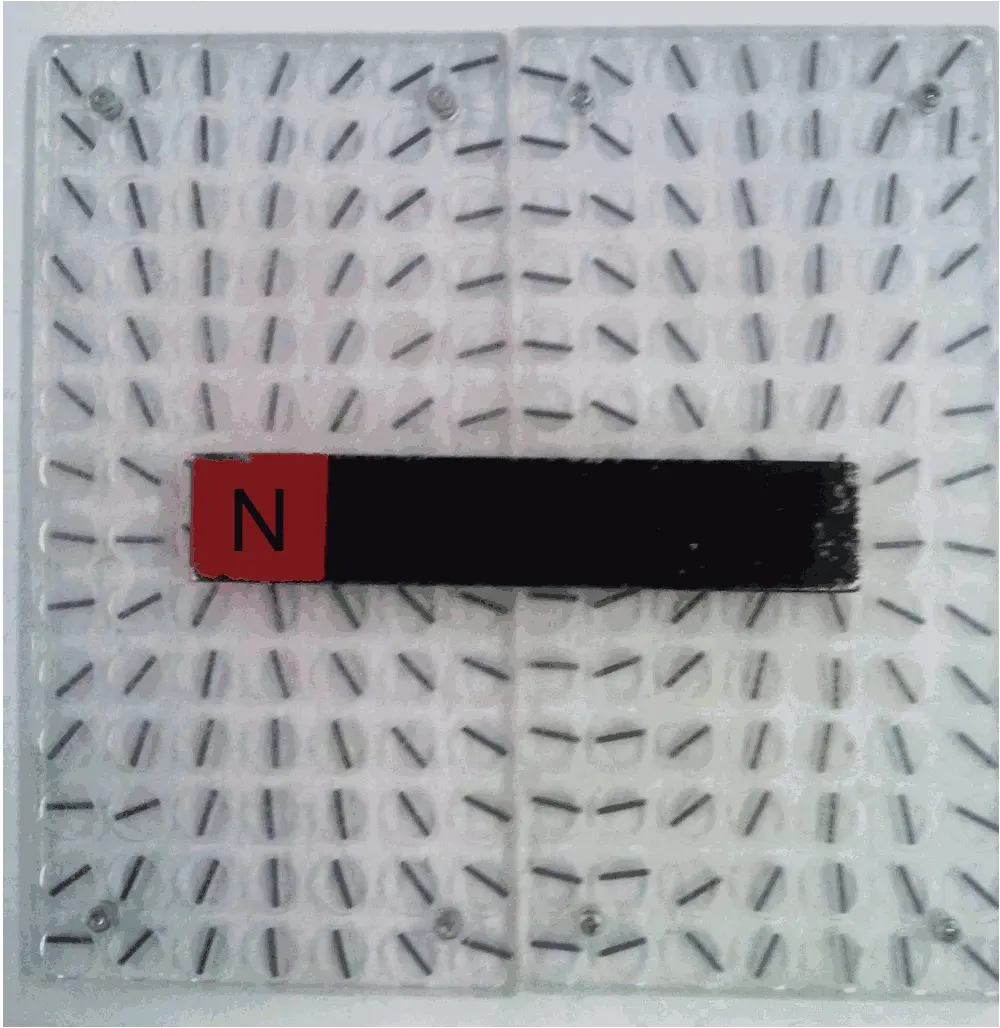
How can you find out where a field is, and which way it points, if you can’t see it? Use a test object: a small thing that feels the force, and shows it. For a magnetic field, the test object is a small compass. Its needle is a tiny magnet, so it turns to line up with the field wherever you put it. Move it to a new place, and the needle shows the field there. Carry it all round a magnet, marking the direction each time, and you have a map of the field.
Here is what a map like this shows.
- Close to the magnet, the needle follows the magnet’s field. The arrows curve out from the N pole and round into the S pole.
- Far from the magnet, the needle swings back towards north. The Earth is a giant magnet too Grade 8: Geomagnetism, and its field is everywhere. Far away, the magnet’s field is weaker than the Earth’s.
- With two magnets, N facing S, the arrows run straight across the gap. With N facing N, they turn away from the gap.
- Now search the top half of the sheet, up and to one side of the magnet (or near the top corners, with N facing N). Somewhere there, the magnet’s field points south, and is exactly as strong as the Earth’s field pointing north. The two cancel completely, and the needle has no direction to point at all: a neutral point Grade 8: Evidence that the Earth is a magnet. Can you find one?
An electric field
A charged thing changes the space round it too. The space round a charged object, where another charge would feel a force, is its electric field. To map it, the test object is a tiny charged thing: scientists use a tiny positive charge, and draw the direction it would be pushed.
Around a positively charged ball, a tiny positive test charge is pushed straight outwards (like charges repel), in every direction. Around a negative ball, it is pulled straight inwards. Join up the directions, and you get field lines. Where the lines are crowded together, the field is strong.
Gilbert’s versorium was a test object for electric fields too. The field pushes the electrons in its metal needle a little towards one end, so the needle lines up along the field, just as a compass needle lines up in a magnetic field. (It can’t show which way along the line the field points: for that you need a charged test object.)
You put a small compass at different places round a magnet. Why does the needle point in different directions in different places?
Pick an answer to see why.
How could you map the electric field around a charged balloon?
Pick an answer to see why.
Is the field really there?
Maybe the field is only an idea, a way of drawing pictures. How could you test whether there really is something in the space between a magnet and a pin? Here is an experiment you can do at home.
This experiment gives evidence that a field exists in the gap. The clip feels a force where nothing touches it, and the force is still there when the space is filled with paper or plastic. But a good scientist also asks: is the experiment fair, and could anything else explain the result? This is called evaluating an experiment.
- Is it really the magnet? Take the magnet away, and the clip falls. This is a control: the same set-up without the thing you are testing.
- Could the thread be holding it up? No. The thread can only pull down, towards the table. Something else pulls up.
- Could it be air pushing? Try it inside a box with no draughts: it still works. And magnets work just as well with the air pumped out. The Earth’s magnetic field reaches far out into space, where there is no air at all, and turns aside the charged particles that stream out from the Sun.
- Could the materials have been tested unfairly? Each sheet should go into the same gap, at the same place, without touching or moving the clip. Thicker things fill more of the gap, so a test with a thick book and a test with thin paper aren’t quite the same. And one try isn’t enough: repeat each test, to make sure the result happens every time.
Questions
A student hangs a rubbed plastic straw on a thread. A rubbed balloon pulls it towards itself. What does this show?
Pick an answer to see why.
Two magnets are 20 mm apart. Which change would make the push between them weaker?
Pick an answer to see why.
Two charged balls 5 cm apart push each other with a force that reads 0.0066 g on a balance. What will the balance read if: (i) the charge on one ball is doubled; (ii) the balls are moved to 10 cm apart, with their first charges; (iii) both balls’ charges are doubled, at 5 cm?
Answer
- i.The force is proportional to each charge, so doubling one charge doubles the force: 0.0066 g × 2 = 0.0132 g.
- ii.10 cm is twice as far, so the force is a quarter: 0.0066 g ÷ 4 = 0.00165 g, about 0.0017 g.
- iii.Doubling one charge doubles the force, and doubling the other doubles it again: 0.0066 g × 2 × 2 = 0.0264 g.
A class tested how many paperclips an electromagnet could hold, using a nail and one cell. Here are their results. (These results are made up, of the kind a class might get.)
| Turns of wire | 20 | 40 | 60 | 80 |
|---|---|---|---|---|
| Paperclips held | 4 | 8 | 11 | 13 |
a. What pattern does the data show? b. A student says, “With 160 turns it would hold 26 clips.” Does the data support this? c. Write one new question this class could test next, and say what they should keep the same.
Answer
- a.More turns of wire make a stronger electromagnet that holds more paperclips. At first the number goes up in proportion (20 turns, 4 clips; 40 turns, 8 clips), but then it grows more slowly (60 turns, 11; 80 turns, 13).
- b.No. The student has assumed the number of clips stays proportional to the turns, but the data shows it growing more slowly at more turns. The data gives no measurement beyond 80 turns, so the only way to know is to test it. (Real electromagnets do level off: the iron can only become so strongly magnetized. A long coil also has more resistance, so the cell drives a smaller current through it.)
- c.For example: “Does a bigger current (two cells instead of one) make the electromagnet hold more paperclips?” Keep the same nail, the same number of turns, the same kind of wire and the same paperclips, and change only the number of cells. Another good question: “Does the material inside the coil matter?” (iron nail, steel bolt, wooden pencil, nothing).
A group made a simple motor (a coil of wire spinning on two bent paperclips above a magnet) and counted its turns in one minute, with one magnet and with two magnets stacked. (These results are made up.)
| Magnets | 1 | 1 | 1 | 2 | 2 | 2 |
|---|---|---|---|---|---|---|
| Turns per minute | 410 | 395 | 420 | 610 | 590 | 625 |
a. Why did they repeat each test three times? b. What does the data show? c. What else should they have kept the same during the tests?
Answer
- a.Each measurement varies a little (counting is never perfect, and the motor runs a little differently each time). Repeating shows how much the results vary, and makes sure a difference between one magnet and two is real and not chance. Here the three results for one magnet (395–420) don’t overlap with the three for two magnets (590–625), so the difference is real.
- b.With two magnets the motor spins faster: about 408 turns per minute on average with one magnet, about 608 with two. A stronger magnetic field gives a bigger push on the coil, so this motor, held back by the friction of its paperclips, turns faster. (The data shows this for this motor only. In a well-made motor running freely, stronger magnets give more turning push but can even make it spin more slowly: another reason to measure rather than guess.)
- c.The same cell (a fresh one, since a cell running down gives less current), the same coil, the same motor and the same way of counting, with nothing else changed but the number of magnets.
Draw, or describe, how you would use a small compass to map the magnetic field around a bar magnet on a sheet of paper. Why does the compass point north when it is far from the magnet?
Answer
Put the magnet in the middle of a large sheet of paper and draw round it. Put the compass near the N pole and mark a dot at each end of its needle. Move the compass so that its tail is on the dot at the needle’s head, and mark the new head. Go on until you reach the magnet again or the edge of the paper; join the dots into a line with an arrow from N to S. Start again from other places near the N pole, to draw more lines. The lines show the direction of the field everywhere around the magnet.
Far from the magnet, the magnet’s field is very weak. The Earth is also a magnet, and its field is everywhere. Where the Earth’s field is stronger than the magnet’s, the compass lines up with the Earth’s field, and points north.
In the floating paperclip experiment, the clip stays in the air when paper, plastic or aluminium foil is slid into the gap, but falls when the lid of a steel tin is. a. What is the evidence that a field exists in the gap? b. Why did the clip fall when steel was slid in? c. Give two ways to make the experiment fairer.
Answer
- a.The clip is pulled up although nothing touches it, and the pull goes on even when the space is filled with paper or plastic. Something in the space between the magnet and the clip is pulling on it: the magnet’s field. When the magnet is taken away (the control), the clip falls, so it is the magnet’s field that holds it.
- b.Steel is a magnetic material. The magnet’s field goes into the steel lid and runs through it, instead of reaching across the gap to the clip. (The magnet also pulls on the lid itself.) So the field at the clip becomes too weak to hold it up. (With a very strong magnet, a thin lid can carry only part of the field, and the clip may only sag.)
- c.Any two of: keep the gap the same for every material; use sheets of the same thickness; slide each sheet in at the same place without touching the clip; repeat each test several times; include a control with nothing in the gap and one with no magnet.
Compare electric and magnetic forces. Write two ways they are alike and one way they are different.
Answer
Alike: both act across a gap without touching (non-contact forces); both can attract or repel (like charges or like poles repel, unlike ones attract); both get weaker quickly with distance; both are carried by a field that can be mapped with a test object; and both come in equal and opposite pairs.
Different: an electric force acts on charged things (and pulls on almost any light uncharged thing), while a magnetic force acts only on magnets and magnetic materials like iron, steel, nickel and cobalt. You map an electric field with a tiny charge, and a magnetic field with a compass. (A magnet always has two poles together, while a charge can be on its own.)
Where to go next
- Who Feels the Bigger Push in a Crash? A magnet and a pin pull on each other equally, like every pair of forces. See what equal pushes do to things of different mass.
- Why Does a Rolling Ball Stop? What any push, touching or not, does to the motion of the thing it pushes: balanced and unbalanced forces.
- Where Does a Lifted Stone Keep Its Energy? Pull two magnets apart and you store energy in their field, as you do when you lift a stone.
- Going further still, in Grades 9–12: How Do Magnets Push Without Touching? The energy stored in magnetic and electric fields, and where it is.