
Pilgrims at Muktinath, 3,800 m up, find that rice takes forever to cook in an open pot. A steel needle laid gently on water floats, though steel is eight times denser than water. Honey poured on a cold morning creeps; warm, it runs. And an airplane weighing 70 tonnes climbs out of Kathmandu held up by nothing but air pushing a little harder under its wings than over them.
All of these are fluid mechanics: the physics of liquids and gases. A fluid is anything that flows: it has no shape of its own and takes the shape of its container, because its layers slide over one another under the smallest sideways force. The unit has two halves. Fluid statics studies fluids at rest: pressure, upthrust and floating (Archimedes), and the stretched “skin” of a liquid’s surface (surface tension). Fluid dynamics studies fluids in motion: the internal friction called viscosity, the flow through a narrow tube, the fall of a small ball through oil, and the two great rules of steady flow, the equation of continuity and Bernoulli’s equation.
3.1 Introduction
Fluid statics is the study of fluids at rest and the forces they exert. Two ideas carry most of it: Archimedes’ principle, which explains why things float or sink, and surface tension, which explains why small things can rest on a water surface.
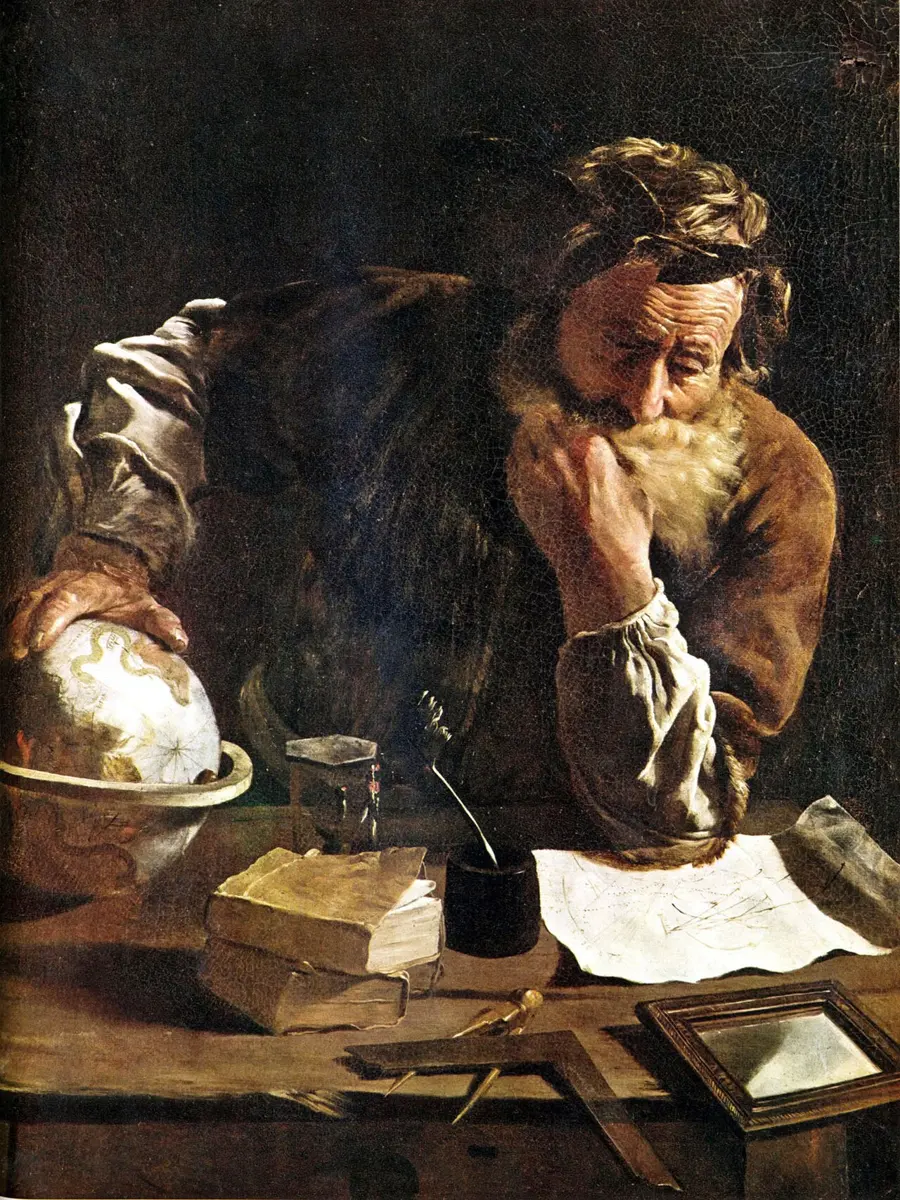
Some everyday observations this unit explains:
- Under water you feel the same pressure on your ears whichever way you turn your head.
- Rice is hard to cook in an open pot at Muktinath, and the air there is so dry that nosebleeds are common.
- At sea level the air presses on everything with about 101,325 Pa (1 atmosphere), yet we don’t feel it; the pressure falls as you climb.
- Press on a liquid shut in a container and the pressure spreads equally everywhere in it: that is how a hydraulic lift and a car’s brakes work.
- A bucket of water feels light while it is still under water, and suddenly heavy when it comes out.
- A water strider walks on a pond; a steel needle laid gently on water floats; bits of camphor dart about on water; a wet paintbrush’s hairs cling together; a loop of thread on a soap film snaps into a circle when the film inside it is broken; water on a waxy leaf forms beads instead of spreading.
Pressure exerted by a fluid column
Pressure is the force acting normally (at right angles) on a surface, per unit area:
Its SI unit is the newton per square meter, N/m², called the pascal (Pa). A fluid at rest pushes at right angles on every surface it touches, so fluid pressure is the force the fluid exerts per unit area of any surface in it or around it.
Take a column of liquid of height and density ρ standing in a cylinder of cross-sectional area (Figure 3.2). The liquid’s weight presses on the bottom.
The volume of the column is , so its mass is .
Its weight is , acting on the area .
The pressure this weight makes at the bottom is
The area cancels: the pressure at a depth doesn’t depend on the shape or width of the vessel, only on the depth and the liquid. So the pressure due to a liquid column is
- directly proportional to the depth, , and
- directly proportional to the density of the liquid, .
The air above the surface pushes on it too, with the atmospheric pressure , and a liquid passes that on downwards. So the total (absolute) pressure at a depth is
The part alone, the pressure above atmospheric, is the gauge pressure: it is what a tire gauge or a blood-pressure cuff reads.
Some consequences:
- Water comes out faster from a lower tap on a tank than from a higher one: the pressure behind it is greater.
- Mercury is 13.6 times as dense as water, so 1 cm of mercury presses as hard as 13.6 cm of water.
- The air is a fluid too. Atmospheric pressure is the weight of the air above you, per square meter: greatest at sea level, less as you climb, because there is less air above you. In Bhaktapur, at about 1,400 m, it is about 86 kPa; at Muktinath, about 63 kPa.
Three vessels with the same base area are filled with water to the same height: a narrow tube, a wide jar and a cone that widens upwards. The pressure on the base is:
Pick an answer to see why.
Pascal’s law
Squeeze a water-filled polythene bag pricked with pinholes all over, and water spurts from every hole, not only from those opposite your hand. The push you give at one place reaches every part of the water.
Pascal’s law: a pressure applied to an enclosed fluid (one shut in a container) is transmitted undiminished to every part of the fluid and to the walls of the container.
Two things follow. A fluid at rest presses equally in all directions at any point (you feel the same pressure on your ear however you turn your head). And the force it exerts on a surface is always normal to the surface, so the jets leave the bag (or the ball in Figure 3.4) at right angles to its skin.
The hydraulic lift uses this law to multiply a force. A small force on a small piston of area makes a pressure , which reaches the large piston of area undiminished and pushes it with
A piston 100 times larger in area pushes 100 times harder (moving 100 times less far, so no energy is created). Hydraulic jacks, car brakes, the arms of an excavator and the press that bales cotton all work this way.
Specific gravity
The specific gravity (or relative density) of a substance compares its density with that of water:
Water is densest at 4 °C, 1000 kg/m³ (1 g/cm³). So the specific gravity is just the density in g/cm³ without its unit: iron, 7.9; ice, 0.92; mercury, 13.6. Being a ratio of two quantities of the same kind, specific gravity has no unit and no dimensions.
The density of a liquid is measured with a hydrometer, a weighted glass float with a scale on its stem: it sinks deeper in a less dense liquid. A lactometer is a hydrometer made for milk: milk with water added is less dense, so the lactometer sinks deeper.
Upthrust
Lift a bucket of water while it is still under water and it feels light; the moment it comes out it feels heavy. The water was pushing up on it. The upward force a fluid exerts on a body in it is the upthrust or buoyant force. Weigh a body in air and then in water: the apparent loss of weight is the upthrust.
Where does it come from? Pressure grows with depth.
Hold a cylinder of end area upright in a liquid of density σ, its top at depth and its bottom at depth (Figure 3.5).
The liquid presses down on the top with a force , and up on the bottom with . The pushes on the curved side are equal all round and cancel.
The net upward force is
where is the volume of the cylinder, which is the volume of liquid it pushes aside (displaces). And is the weight of the displaced liquid.
Any shape can be built from thin upright cylinders, so the result holds for every body:
The upthrust depends only on the volume of fluid displaced (the volume of the part of the body that is under the surface) and on the density of the fluid. It doesn’t depend on what the body is made of, whether it is solid or hollow, or how deep it is (once it is fully under). A denser liquid gives more upthrust: an iron ball sinks in water but floats in mercury.
Archimedes’ principle
Archimedes’ principle: when a body is wholly or partly immersed in a fluid, it experiences an upthrust equal to the weight of the fluid it displaces.
It holds in gases too: a hydrogen balloon rises because the weight of the air it displaces is more than its own weight.
Floating and sinking
A body in a liquid has two forces on it: its weight , down, and the upthrust , up.
- If when it is fully under, it sinks. For a solid body this happens when its density is greater than the liquid’s.
- If when it is fully under, it rises, breaks the surface and comes to rest with only part of it under: it floats.
- If when it is fully under, it stays wherever it is put, neither rising nor sinking (a fish or a submarine does this by adjusting its density).
Law of flotation: a floating body displaces a weight of liquid equal to its own weight. If a body of volume and density ρ floats in a liquid of density σ with a volume under the surface, then , so
The fraction of a floating body that is under the surface equals the ratio of its density to the liquid’s. Wood of density 600 kg/m³ floats in water with 60 % of it under; ice (920 kg/m³) floats in sea water (1030 kg/m³) with under, which is where “the tip of the iceberg” comes from.
A boat floating on a pond is carrying a heavy stone. The stone is thrown overboard and sinks. The water level of the pond:
Pick an answer to see why.
Equilibrium of a floating body
A floating body is balanced by two equal forces along one vertical line, but it can still tip over. Whether it does depends on two points (Figure 3.7):
- the center of gravity G, through which its weight acts downwards;
- the center of buoyancy B, the center of gravity of the liquid it displaces, through which the upthrust acts upwards.
For a body floating at rest, , and G and B lie on the same vertical line.
When the body tilts, the shape of the liquid it displaces changes: more of one side goes under. So the center of buoyancy moves, to a new point B′ on the side that went deeper; where exactly depends on the new shape of the displaced liquid. The upthrust now acts up through B′, and the weight still down through G, so they no longer act along one line: they form a couple that turns the body.
The point where the vertical line through the new center of buoyancy B′ meets the body’s center line (the line through G and B when it was upright) is the metacenter M. The distance GM is the metacentric height.
- M above G: stable equilibrium. The couple turns the body back upright (Figure 3.7 b).
- M below G: unstable equilibrium. The couple turns it further over, and it capsizes (Figure 3.7 c).
- M at G: neutral equilibrium. There is no couple, and the body stays tilted at its new angle.
It is the metacenter, not the center of buoyancy, that has to be above G: in a stable ship B is usually below G.
This is why the bottom of a ship is made heavy, with heavy engines and ballast placed low: lowering G keeps it well below M. It is also why passengers in a small boat on Phewa Lake are asked to sit down rather than stand: standing raises G. A round log can roll over at the slightest push because its metacenter is at its center and so, for a uniform log, at its center of gravity: it is in neutral equilibrium.
3.2 Surface tension
The surface behaves like a stretched skin
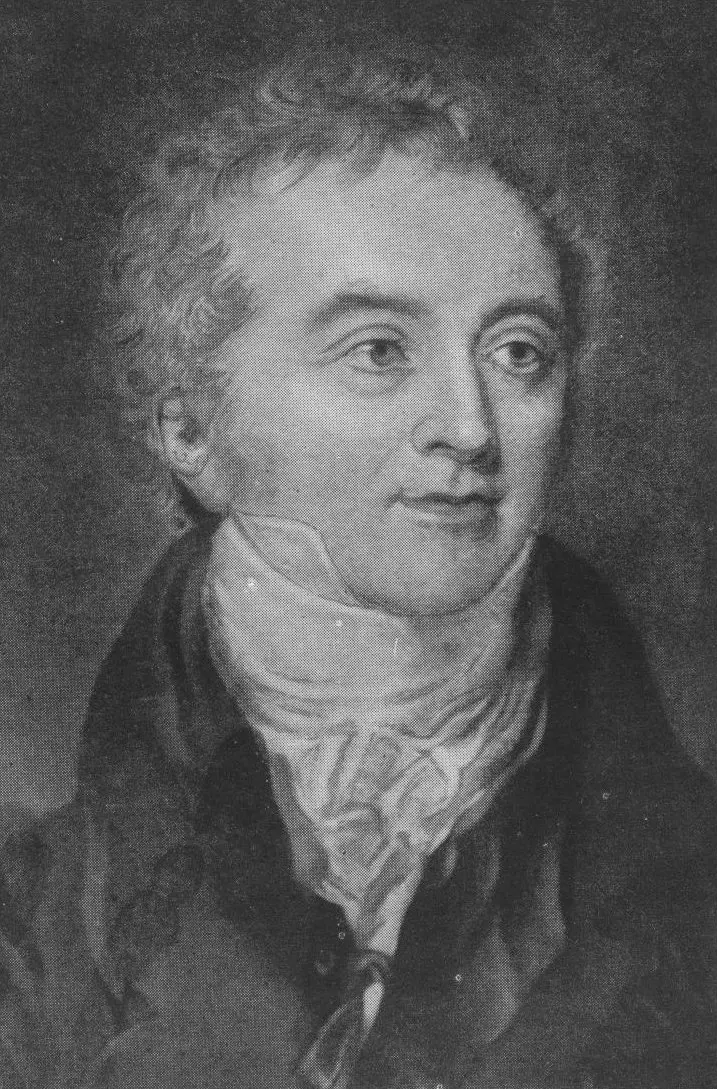
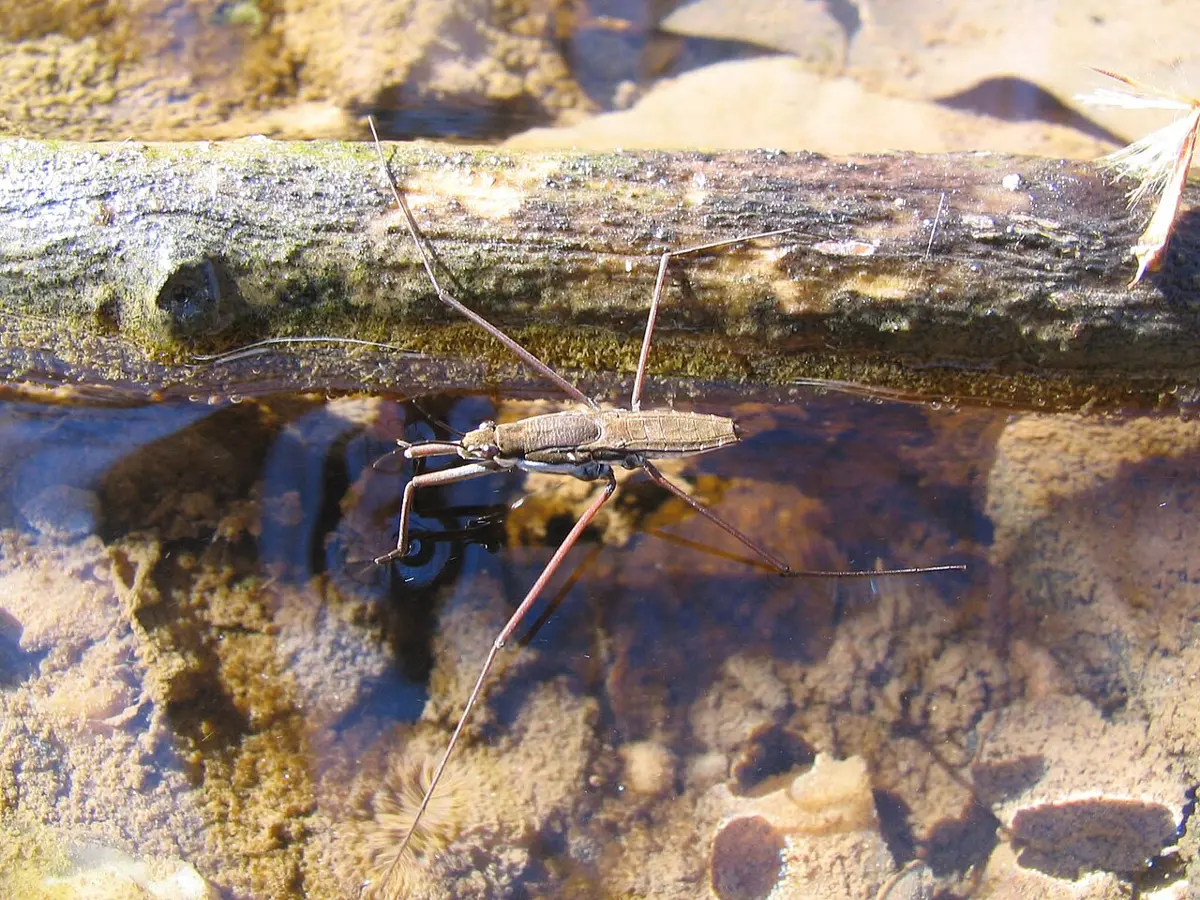
A water strider stands on a pond, its feet making small dimples in the surface as if it were standing on a trampoline. A drop of water hanging from a tap is pulled into a rounded bag. Small drops of rain and dew are nearly perfect spheres.
The free surface of a liquid behaves like a stretched elastic membrane, always trying to shrink to the smallest possible area. (Picture someone curling up into a ball to make as little of themselves as possible exposed.) This property is surface tension.
To give it a number, imagine a line of length drawn on the surface. The surface on one side pulls on the surface on the other side, along the surface and at right angles to the line. The surface tension of a liquid is this force per unit length of a line drawn in its surface:
Its SI unit is the newton per meter, N/m (equivalently J/m², Section 3.3), and its dimensional formula is .
| Liquid (at 20 °C, in air) | Surface tension (N/m) |
|---|---|
| Mercury | 0.485 |
| Water | 0.0728 |
| Olive oil | 0.032 |
| Ethanol (alcohol) | 0.022 |
| Soap solution | about 0.025 |
Surface tension is a property of a liquid’s surface where it meets air or another substance it doesn’t mix with. A gas has no free surface of its own (it spreads to fill its container), so a gas has no surface tension. It lets a body denser than the liquid, like a needle, rest on the surface, as long as the body doesn’t break through.
Surface tension decreases as the temperature rises, and it is lowered by many impurities dissolved in the liquid, such as soap and detergents. (Some dissolved substances, like common salt, raise it slightly.) This explains:
- Antiseptic lotions have low surface tension, so they spread easily into every part of a cut or wound.
- Soap and detergents lower the surface tension of water, so it spreads into the fibers of cloth and under grease instead of sitting in drops on it.
- Camphor “dances” on water. As camphor dissolves, it lowers the surface tension around it, more on one side than the other where the piece is uneven; the stronger pull of the clean water on the other side drags it along.
- Hot soup tastes better than cold soup: its surface tension is lower, so it spreads over more of the tongue (and more of its flavors evaporate up into the nose).
The needle presses a shallow groove into the surface (Figure 3.10). Along each side of the groove, the surface pulls on the needle along itself, a force for a needle of length , tilted at an angle θ to the vertical. The sideways parts of the two pulls cancel; the vertical parts add up to , which holds up the needle’s weight:
Soap lowers so much that the surface can no longer hold the weight, and the needle sinks.
More examples of surface tension:
- A wet paintbrush. Under water, a brush’s hairs spread out freely. Lift it out and they cling together in a point: now there is a water surface around the hairs, and by pulling the hairs together the water’s surface makes its area smaller.
- A loop of thread on a soap film. Lay a loop of thread gently on a soap film stretched across a wire ring: the loop lies in any odd shape. Break the film inside the loop with a hot pin and the loop springs into a perfect circle (Figure 3.11). The film outside pulls the thread outwards equally all round to make its own area as small as possible, which means making the hole as large as possible, and of all shapes with a given perimeter the circle encloses the largest area.
Molecular theory of surface tension
The molecules of a liquid attract each other. The attraction between molecules of the same substance is cohesion. It acts only over a tiny distance, about 10⁻⁹ m (a few molecules’ widths), called the range of molecular attraction; imagine a small sphere of that radius round each molecule, its sphere of influence.
- A molecule deep inside the liquid (A in Figure 3.12) is surrounded by molecules on all sides. They pull it equally in every direction: the net force is zero.
- A molecule near the surface (B), less than a molecular range from it, has part of its sphere of influence sticking out into the air, where there are hardly any molecules. It is pulled down more than up: a net force into the liquid.
- A molecule on the surface (C) has liquid only below it. It feels the largest net pull inwards.
So every molecule in the surface layer is pulled into the liquid. To bring a molecule from inside up to the surface, work must be done against this pull: surface molecules have more potential energy than those inside. A system settles where its potential energy is least, so the liquid keeps as few molecules as possible in its surface: it makes its surface area as small as it can. The surface behaves as though it were under tension, like a stretched membrane.
That is why a small drop is a sphere: of all shapes holding a given volume, a sphere has the smallest surface area. (A large drop is flattened by its weight, which matters more for large drops; in space, where things are weightless, even a large blob of water floats as a sphere.)
A molecule in the surface of a liquid has, compared with a molecule deep inside:
Pick an answer to see why.
3.3 Surface energy
To make a liquid’s surface larger, molecules must be brought from inside to the surface against the inward pull, and that takes work. The extra potential energy of the molecules in the surface is the surface energy. The surface energy per unit area is the work needed to increase the surface area by one unit (at constant temperature). A liquid always tends to lower its surface energy by making its surface area smaller, which is why drops form.
Relation between surface energy and surface tension
Take a rectangular wire frame with one side, PQ, a wire that can slide (Figure 3.13). Dip it in soap solution, so that a film forms on it. A film has two surfaces, front and back, each pulling on PQ with a force per unit length.
If PQ has length , the total inward force on it is
(Left alone, PQ slides in and the film shrinks.)
Pull PQ outwards slowly, with a force just equal to , through a small distance Δx, to P′Q′. The work done is
Each surface has grown by an area , so the total increase in area is
Dividing, , so
The work done is stored as surface energy (when the temperature is kept constant). So the surface energy per unit area is numerically equal to the surface tension, and the surface energy of an area ΔA is . Surface tension can be written in J/m² as well as N/m: the two units are the same, since 1 J/m² = 1 N m/m² = 1 N/m.
A drop of water is sprayed into many tiny droplets. Compared with the drop, the droplets together have:
Pick an answer to see why.
3.4 Angle of contact
Why does water spread into a thin film on clean glass, while mercury on glass gathers into round, shiny beads? Why do raindrops roll off a lotus or rhododendron leaf instead of wetting it?
Two kinds of attraction compete:
- Cohesion: the attraction between molecules of the same substance (water to water). It holds a liquid together and pulls it into drops.
- Adhesion: the attraction between molecules of different substances (water to glass). It makes a liquid stick to a solid and spread over it.
Where a liquid’s surface meets a solid, it is curved: this curve is the meniscus. The angle of contact θ is the angle between the tangent to the liquid surface at the point of contact and the solid surface, measured inside the liquid (Figure 3.14).
- If adhesion is stronger than cohesion, the liquid spreads over the solid and climbs it: the meniscus is concave (curving up at the edges) and θ is less than 90°. The liquid wets the solid. Water on clean glass has θ close to 0°; kerosene on glass, about 26°.
- If cohesion is stronger than adhesion, the liquid gathers itself up and pulls away from the solid: the meniscus is convex (curving down at the edges) and θ is more than 90°. The liquid doesn’t wet the solid. Mercury on glass has θ ≈ 140°; water on wax or on a waxy leaf, more than 100°.
- θ = 90° exactly gives a flat surface right up to the wall (pure water on silver is close to this).
The angle of contact depends on:
- the nature of the solid and the liquid (water–glass differs from mercury–glass);
- the cleanliness of the surfaces (a trace of grease on glass makes water bead up);
- the medium above the liquid’s free surface (air or another gas or liquid);
- the temperature of the liquid;
- impurities dissolved in the liquid (a detergent lowers θ, making water wet better).
A liquid whose cohesion is weaker than its adhesion to a solid has, on that solid:
Pick an answer to see why.
3.5 Capillarity
Dip a narrow glass tube (a capillary tube, from the Latin capillus, a hair) into water: the water climbs up inside it, higher than the water outside, and the narrower the tube, the higher it goes. Dip it into mercury and the mercury inside stands lower than outside.
Capillarity (capillary action) is the rise or fall of a liquid in a narrow tube or in the fine pores of a material, caused by surface tension and the adhesion between the liquid and the material. A liquid that wets the tube (θ < 90°) rises; one that doesn’t wet it (θ > 90°) is pushed down.
Capillarity at work:
- The split in a fountain-pen nib is a narrow slit. Ink wets the metal, and capillarity draws it along the slit to the tip, steadily, whichever way the pen is held.
- A towel is a mass of fine fibers with narrow gaps between them, each like a capillary tube. Water wets the cotton and is drawn from your skin into the gaps.
- The wick of an oil lamp (a diyo’s cotton wick) is full of tiny gaps between its fibers. Oil wets the cotton and creeps up the wick to the flame.
- Soil and plants. Water rises through the fine pores of soil by capillarity, which keeps the soil near the roots moist. In plants, capillarity helps water into the fine walls of cells and up the narrow tubes of the xylem, but only a little way: the main lift in a tall tree is the pull of water evaporating from the leaves (transpiration), which draws a continuous column of water up the xylem.
- Blotting paper, a sponge, a sugar cube dipped in tea: all soak liquid up through their pores.
- Damp walls. Water climbs from wet ground up into a brick wall through its pores; a waterproof layer (a damp-proof course) near the bottom of the wall stops it.
Capillary rise: the formula
A capillary tube of radius stands in a liquid of density ρ and surface tension , which wets it with an angle of contact θ (Figure 3.15). The liquid rises to a height above the level outside.
The liquid surface meets the glass all round a circle of circumference . There, the liquid’s surface pulls on the glass with a force per unit length, along the surface’s tangent, down and away from the wall. By Newton’s third law, the glass pulls the liquid with an equal and opposite force: up, at an angle θ to the vertical wall.
The horizontal parts of these forces cancel all the way round. The vertical part is
This holds up the weight of the column of liquid raised above the outside level. Its volume is (ignoring the small amount in the meniscus itself), so its weight is
In equilibrium, :
What it says:
- : a tube half as wide makes the liquid rise twice as high (Jurin’s law). So is the same for any tube with a given liquid: .
- : on the Moon, where is a sixth of Earth’s, the same tube would hold a column six times as tall.
- For θ < 90°, is positive and is positive: the liquid rises. For θ > 90° (mercury in glass), is negative: is negative, a fall (capillary depression). For θ = 90°, no rise or fall.
- For water in clean glass, θ ≈ 0° and : .
In a capillary tube of radius 1 mm, water rises 1.5 cm. In a tube of radius 0.5 mm of the same glass, it rises:
Pick an answer to see why.
3.6 Viscosity
Now the fluids start to move. Fluid dynamics studies fluids in motion, and its first idea is that a moving fluid has internal friction.
Three things you have seen:
- Stir water in a bowl and stop: the swirl slows down and dies away.
- In a river, the water at the surface flows fastest, and slower and slower towards the bed.
- In a pipe, water moves fastest along the middle and slowest near the walls.
When you stop stirring, every layer of water rubs against the layers next to it. The faster layer is dragged back by the slower one beside it (and the slower one is dragged forward). Near the walls, the water touching the bowl doesn’t move at all, and it holds back the layer next to it. This internal friction between layers turns the swirl’s kinetic energy into heat, until the water is still.
In a river the same thing happens from the bottom up (Figure 3.18). The water touching the bed is held still by it (a fluid in contact with a solid moves with the solid: the no-slip condition). The layer just above slides over that still layer and is held back by it; the layer above that slides over a slow layer and is held back a little less; and so on. Each layer is dragged back by the slower layer below it and dragged forward by the faster one above, so the speed grows steadily from zero at the bed to its greatest at the surface, where nothing above holds it back.
In a pipe, the water touching the wall is still, and the speed rises to its greatest along the axis: the water flows in thin cylindrical sheets, one inside another, called laminae (Figure 3.19). The change of speed from layer to layer is the velocity gradient.
Viscosity is the property of a fluid by which it opposes the relative motion between its layers. The opposing force between layers is the viscous drag (viscous force). It is like friction between solid surfaces, but it acts inside the fluid, between one layer and the next. The more viscous a liquid, the more it resists flowing: honey is far more viscous than water.
Temperature:
- The viscosity of a liquid decreases as it warms, quickly: honey runs when warm, and water’s viscosity halves between 20 °C and 60 °C. The molecules move faster and pull away from one another more easily. This is why machines are hard to start on a cold winter morning: the oil and grease in them thicken, and the moving parts drag.
- The viscosity of a gas increases as it warms. A gas’s “friction” comes from its molecules flying from one layer to the next carrying their momentum with them, and faster molecules carry more.
Engine oil for a motorbike in Jumla’s winter should be:
Pick an answer to see why.
Streamline, laminar and turbulent flow
Streamline (steady) flow. Watch a fluid at one point, A. If every particle that passes A has the same velocity there (the same speed in the same direction) as the ones before it, and the same is true at every point, the flow is steady, or streamline flow. Each particle then follows the same path as the one before it through A, B and C, with the velocity at A, at B and at C each time. That path is a streamline: a line whose tangent at any point is the direction of the fluid’s velocity there (Figure 3.20).
Two streamlines can never cross: if they did, a particle at the crossing point would have two directions to go in at once.
Laminar flow. If a liquid flows steadily in layers sliding over one another with different speeds, without mixing, the flow is laminar flow. It is streamline flow seen as layers (the river and the pipe above).
Turbulent flow. Turn a tap on slowly and the stream is clear and smooth, like a glass rod. Open it wide and it breaks into a rough, churning, white rope. Above a certain speed, the critical velocity, the flow becomes turbulent: the particles move in eddies and whirls, and the speed and direction at any point keep changing irregularly from moment to moment. The water of the Bhote Koshi tumbling over its boulders, smoke rising from an incense stick that is smooth for a few centimeters and then breaks into swirls, the air behind a fast bus: all are turbulent.
| Laminar (streamline) flow | Turbulent flow |
|---|---|
| Below the critical velocity | Above the critical velocity |
| Smooth layers that don’t mix | Eddies that mix the fluid |
| The velocity at a point stays the same | The velocity at a point keeps changing |
| Viscous drag on a moving body grows in proportion to its speed | Drag grows roughly as the square of the speed |
| Blood in small vessels, honey poured slowly, oil in a bearing | A fast river, a jet from a hose, the air behind a truck |
Reynolds number
What decides whether a flow is laminar or turbulent? In 1883 the British engineer Osborne Reynolds let a thin stream of dye into water flowing through a glass pipe. At low speed the dye stayed a sharp thread; at higher speed it suddenly broke up and filled the pipe. He found that the change depends not on the speed alone, but on one number made from four quantities, now called the Reynolds number:
where ρ is the fluid’s density, its average speed, the diameter of the pipe and η the fluid’s viscosity (Section 3.7). It has no unit: it compares the fluid’s tendency to keep moving (its inertia, ρv) with the viscous drag that tames it (η/D). For flow in a straight pipe:
- below about 2000: laminar flow;
- above about 3000: turbulent flow;
- in between: unsteady, changing from one to the other.
Setting = 2000 gives the critical velocity, : a viscous fluid in a narrow pipe stays laminar up to a high speed, while water in a wide pipe turns turbulent at a crawl.
3.7 Newton’s formula for viscosity; coefficient of viscosity
Take two neighboring layers of a liquid in laminar flow, each of area , at heights and above a fixed surface (the river bed, where the liquid is at rest), moving with velocities and (Figure 3.22). The change of velocity per unit distance across the flow, , is the velocity gradient between them.
Newton found that the viscous force between the layers is
- directly proportional to the area of the layers, , and
- directly proportional to the velocity gradient, .
Together, , or
This is Newton’s formula (law) for viscosity. The constant of proportionality, η (eta), is the coefficient of viscosity of the fluid: a property of the fluid itself (and its temperature). The minus sign says that the viscous force on a layer acts against its motion relative to the layer next to it. When only its size is needed, .
If = 1 m² and = 1 s⁻¹, then (in size). So the coefficient of viscosity of a fluid is the tangential viscous force needed to keep a unit velocity gradient between two layers, per unit area of the layers.
Unit: , so its SI unit is N s/m² = Pa s (pascal second), also called the poiseuille (Pl) or decapoise. In the CGS system the unit is the dyne s/cm², the poise (P), after Poiseuille:
So 1 Pa s = 10 poise (1 decapoise), and water at 20 °C, at 1.0 × 10⁻³ Pa s, is 1 centipoise.
Dimensions:
| Fluid (20 °C) | η (Pa s) |
|---|---|
| Air | 1.8 × 10⁻⁵ |
| Water | 1.0 × 10⁻³ |
| Blood (37 °C) | about 3–4 × 10⁻³ |
| Olive oil | about 0.08 |
| Glycerine | 1.4 |
| Honey | about 2–10 |
The force per unit area, , is the shear stress between the layers. So Newton’s law says: shear stress = η × velocity gradient. Compare a solid, where shear stress = modulus of rigidity × shear strain (Grade 11, 8.4 Moduli of elasticity): a solid resists being twisted, a fluid only resists being twisted quickly.
3.8 Poiseuille’s formula
How much liquid flows each second through a narrow tube, a drip line, a hypodermic needle, a small blood vessel? The French doctor Jean Léonard Marie Poiseuille (1797–1869), who wanted to understand blood flow, measured the flow of water through glass capillaries in the 1830s and 1840s; the German engineer Gotthilf Hagen found the same rule at about the same time. The volume of liquid flowing per second, , through a tube of radius and length , with a pressure difference between its ends, for a liquid of viscosity η, is
This is Poiseuille’s formula. Its assumptions:
- The flow is steady and laminar, the streamlines parallel to the axis of the tube.
- The pressure is the same all over any cross-section (there is no flow across the tube, only along it).
- The liquid touching the wall is at rest (the no-slip condition).
(It also assumes the tube is straight, rigid and uniform, and the liquid incompressible and Newtonian.)
Where the r⁴ comes from: dimensions
Poiseuille’s full derivation needs calculus, but the shape of the formula can be found by dimensional analysis (Grade 11, 1.6 Dimensions of a physical quantity). Suppose depends on η, and the pressure gradient (the pressure drop per unit length):
with a number. Writing in dimensions, , , , :
- Powers of M:
- Powers of T:
- Powers of L:
From 1, ; then 2 gives , so and . Then 3 gives , so . Hence
The full theory (or experiment) gives .
The fourth power of the radius is the striking part. Doubling the pressure doubles the flow, but doubling the radius multiplies it by 16: a tube twice as wide has four times the area to flow through, and its middle is farther from the walls that hold the liquid back, so the liquid there moves four times as fast on average.
Applications
- Blood flow. The body controls blood flow mainly by narrowing and widening the small arteries (arterioles): narrowing one by only 16 % halves the flow through it. A fatty deposit narrowing an artery cuts the flow sharply, and the heart must raise the pressure to make up for it; that is part of why narrowed arteries go with high blood pressure.
- Drips and syringes. The flow from an IV drip is set by the narrow tube and needle and by the height of the bag (the pressure); a needle of half the radius delivers a sixteenth as much at the same pressure. Thick (viscous) medicines need wider needles.
- Lubrication. Engineers use it to make sure oil reaches every bearing through narrow passages.
- The laboratory. It is used to measure viscosity (by timing a liquid through a capillary viscometer) and to design narrow tubes in instruments.
Limitations
- It holds only for laminar flow, not turbulent flow.
- It assumes a straight, narrow, cylindrical tube, not a curved or irregular one.
- It is for incompressible Newtonian fluids, whose viscosity doesn’t change with the flow.
- It assumes no slip at the walls.
- It is for steady flow, so it is only a first guide for blood, which flows in pulses with each heartbeat (and isn’t quite Newtonian).
A blockage halves the radius of a blood vessel. If the pressure difference stays the same, the flow through it becomes:
Pick an answer to see why.
3.9 Stokes’ law
Some things you may have wondered about:
- Clouds float in the sky, though they are made of water droplets, which are heavier than air.
- A parachutist lands safely after jumping from a plane.
- Hailstones falling from a great height don’t hit as hard as a stone dropped from that height would without air.
Each is a body falling through a fluid whose resistance grows with its speed, until it stops speeding up.
The law
In 1851 the Irish-born physicist George Gabriel Stokes worked out the viscous drag on a small sphere moving slowly through a fluid. The drag is directly proportional to the radius of the sphere, the coefficient of viscosity η of the fluid, and the velocity of the sphere:
This is Stokes’ law. It holds for a small, smooth, rigid sphere moving slowly through a fluid that stretches far around it, so that the flow around it stays laminar (for a Reynolds number well below 1). A falling raindrop, a parachute or a cricket ball is too big and too fast: their drag grows more like .
The form of Stokes’ law can be found by dimensions too: if , then . M gives ; T gives , so ; L gives , so . Then , and Stokes’ theory gives .
Terminal velocity
Drop a small steel ball into a tall jar of glycerine. Three forces act on it (Figure 3.25):
- its weight , downwards;
- the upthrust of the liquid, upwards (Archimedes);
- the viscous drag , upwards, against its motion, growing as the ball speeds up.
At first the ball is slow and the drag small, so it speeds up. As its speed grows, so does the drag, and its acceleration gets less and less. Soon the drag and upthrust together balance its weight: the net force is zero and the ball falls on at a steady speed, its terminal velocity (or settling velocity).
Derivation. Let the sphere have radius and density ρ, and the liquid density σ and viscosity η.
Weight:
Upthrust (the weight of liquid displaced):
Viscous drag at the terminal velocity :
At the terminal velocity the net force is zero: , so
Dividing by :
What it says:
- : a sphere twice the radius falls four times as fast. A graph of against is a straight line through the origin (Figure 3.26).
- If ρ > σ the sphere falls; if ρ < σ, is negative: it rises (an air bubble in a fizzy drink, a drop of oil in water).
- A more viscous liquid gives a slower fall.
Applications
Measuring the viscosity of a liquid (the falling-sphere method). Time a small ball of known radius and density over a marked distance in a tall jar of the liquid, once it has reached its terminal velocity. Rearranging,
Settling and sedimentation. How fast mud settles in a water-treatment tank, or silt in a reservoir behind a dam, depends on the particles’ size: fine clay takes days, sand seconds.
ESR in medicine. The erythrocyte sedimentation rate is how many millimeters red blood cells settle in an hour in a tube of blood. Some illnesses make the cells clump into larger groups, which settle faster, so a high ESR tells the doctor to look further.
Paints, emulsions and cosmetics are made with small particles and a viscous liquid so that they settle slowly and stay mixed.
Cleaning the air. Settling chambers and cyclones, which remove dust from factory smoke, are designed from settling speeds.
Soil and geology. Shake soil in water and let it settle: the sand settles first, then silt, then clay. Timing it gives the soil’s particle sizes (its texture).
Millikan’s oil drop experiment used Stokes’ law to find the size of tiny charged oil drops from how fast they fell, and so measured the charge of the electron.
Two steel balls, of radii 1 mm and 2 mm, fall through the same glycerine. The ratio of their terminal velocities (small : large) is:
Pick an answer to see why.
3.10 Equation of continuity and its applications
Put your thumb partly over the end of a garden hose and the water shoots out much faster and farther. The same water has to get through a smaller opening each second, so it must move faster.
The equation of continuity is the law of conservation of mass for a flowing fluid. For an incompressible fluid in steady flow, the volume of fluid entering a pipe each second equals the volume leaving it each second, so
where , are the cross-sectional areas at two places along the pipe (or a tube of flow) and , the fluid’s speeds there. Where the pipe narrows, the fluid speeds up; where it widens, the fluid slows down.
Derivation
The fluid is taken as incompressible (its density ρ is the same everywhere), the flow as steady (at any point the velocity doesn’t change with time), and, for simplicity, the fluid as non-viscous, so that it moves with one speed across each section.
Take a narrow tube of flow (a bundle of streamlines, which fluid never crosses) with cross-sections and at its two ends, where the fluid moves with speeds and (Figure 3.27).
In a short time Δt, the fluid entering at the first end moves a distance , so the volume entering is and its mass .
In the same time the volume leaving at the other end is , of mass .
Fluid can’t pile up in the tube or appear from nowhere in steady flow (and it can’t be squeezed, since it is incompressible), so the mass entering equals the mass leaving:
So Av is the same all along the tube:
The product is the volume of fluid passing any cross-section per second, the volume rate of flow (rate of flow, rate of discharge, or volume flux), in m³/s. The speed of the fluid at any section is inversely proportional to the area of the section there.
(For a compressible fluid, such as a gas at high speed, it is the mass per second, , that stays the same.)
Applications
- Water pipes and hoses. It tells how the speed changes where a pipe narrows (faster) or widens (slower), and lets an engineer size a pipe for a given flow. A hose’s nozzle makes a fast jet.
- Blood flow. Blood speeds up where an artery is narrowed by a deposit. And the other way: the aorta is about 2.5 cm across and its blood moves at about 30 cm/s, but the body’s billions of capillaries together have a cross-section hundreds of times larger, so blood creeps through them at under a millimeter a second, slowly enough to exchange oxygen and food with the cells.
- Ventilation. Air ducts are sized so that air moves at a steady, quiet speed when the duct changes size.
- Jet engines and rocket nozzles. A narrowing nozzle speeds up the hot gas rushing out of a jet engine. (Gases at very high speed are compressible, so engineers use the mass flow ρAv; a rocket nozzle, where the gas is faster than sound, widens again after its throat.)
- Pumps, turbines and hydropower. The water entering a turbine is sped up through a narrowing nozzle or guide vanes before it strikes the blades.
- Rivers and wind. A river runs fastest through a narrow gorge and slows where its valley widens (the Kali Gandaki at its narrowest is fierce). Wind speeds up through a mountain pass or between tall buildings.
Water flows at 3 m/s through a pipe 4 cm across, which then narrows to 2 cm across. Its speed in the narrow part is:
Pick an answer to see why.
Energy of a flowing fluid
A fluid in steady flow can have three kinds of energy:
- Kinetic energy, because it moves: for a mass moving at , . Per unit mass: . A unit volume has a mass ρ, so per unit volume: .
- Potential energy, because of its height above a reference level: . Per unit mass: ; per unit volume: .
- Pressure energy, because it is under pressure: the work that was done to push it into place against the pressure of the fluid already there.
Pressure energy. Take a tube of uniform cross-section holding an incompressible, non-viscous fluid at a pressure . Push a small extra mass Δm of fluid into it slowly (so that it gains no kinetic energy). It fills a length Δl of the tube, so . The force needed is , through a distance Δl, so the work done is . This work is stored as the pressure energy of the mass Δm. Per unit mass:
and per unit volume, . So pressure is the pressure energy per unit volume: 1 Pa = 1 N/m² = 1 J/m³.
Altogether, the total energy of a flowing fluid is
3.11 Bernoulli’s equation and its applications

Bernoulli’s theorem: for an incompressible, non-viscous fluid in steady (streamline) flow, the total energy per unit volume (the sum of the pressure, the kinetic energy per unit volume and the potential energy per unit volume) is the same at every point along a streamline:
or, per unit mass, constant.
Derivation
Take a tube of flow of changing cross-section through which an incompressible, non-viscous fluid flows steadily (Figure 3.29). At end 1 the pressure is , the area , the height above a reference level and the speed ; at end 2 they are , , and .
In a short time Δt, the fluid at end 1 moves a distance and at end 2 a distance . The fluid is incompressible, so the volume entering equals the volume leaving:
The fluid behind end 1 pushes the fluid in the tube forward with a force , through : work done on the fluid, .
At end 2 the fluid ahead pushes back with , while the fluid moves forward : work done by the fluid, so the work done on it is .
The net work done on the fluid by the pressure:
The overall effect is that a slice of volume ΔV and mass has been moved from end 1 to end 2 (the fluid in between is the same as before, in steady flow). Its kinetic energy has changed by and its potential energy by .
With no viscosity, no energy is lost to friction, so by the work–energy theorem the work done equals the gain in energy:
Cancel ΔV and gather each end’s terms on its own side:
Ends 1 and 2 were any two points, so
which is Bernoulli’s equation.
For a horizontal tube, , and
So if , then : where the speed of a fluid is greater, its pressure is lower, and the other way round. This is Bernoulli’s principle. It isn’t that low pressure is a cause and speed an effect, or the reverse: a fluid speeds up only if something pushes it from behind harder than from in front, so a fluid that has sped up has necessarily come from higher pressure into lower.
Water flows steadily along a horizontal pipe that narrows in the middle. Compared with the wide part, in the narrow part the water’s:
Pick an answer to see why.
Torricelli’s theorem: water from a hole in a tank
A tank is filled with water to a height above a small hole in its side (or bottom). How fast does the water come out?
Apply Bernoulli’s equation between point 1 on the water surface and point 2 just outside the hole:
- Both are open to the air: , the atmospheric pressure.
- The tank is wide and the hole small, so the surface sinks very slowly: .
- Take the hole as the reference level: , .
Torricelli’s theorem (Evangelista Torricelli, 1643, a century before Bernoulli): the speed of efflux from a hole a depth below the surface is the speed a body gains falling freely through . The volume per second coming out of a hole of area is . (A real jet comes out a little slower, and narrows just past the hole, because of viscosity.) The tank must be open at the top (or the air above the water at atmospheric pressure): in a sealed bottle, the air above the water thins as water leaves, and the flow soon stops, which is why a sealed oil tin needs a second hole to pour well.
Applications of Bernoulli’s principle
1. The lift on an airplane’s wing. A wing (an airfoil, or aerofoil) is curved and tilted slightly upwards to the oncoming air. The air flowing over its top surface is made to follow the curve and moves faster than the air below. By Bernoulli’s principle, the pressure above the wing is lower than below it. The pressure difference, acting on the large area of the wing, gives an upward force, the lift, which lets the aircraft take off, climb and stay up.
2. Helicopters. A helicopter’s rotor blades are wings that go round instead of forwards. Each blade, cutting through the air, has faster air and lower pressure above it, which lifts the helicopter, and it turns the air downwards in a strong downdraft. Because it needs no forward speed to make lift, a helicopter can hover, rise straight up and land on a small pad, which is why helicopters carry out rescues from high in the Himalaya.
3. Sprayers and atomizers. In a perfume spray, a paint sprayer or the old carburetor of a motorbike, a jet of air is blown fast across the top of a narrow tube whose bottom dips into the liquid. The fast air has low pressure, so the atmospheric pressure on the liquid in the container pushes it up the tube; at the top the air jet breaks it into a fine mist of droplets.
4. Swing of a spinning ball: the Magnus effect. A spinning ball drags a thin layer of air round with it. On the side where the ball’s surface moves the same way as the air streaming past it, the air is helped along and moves faster; on the other side, where the surface moves against the air, the air is slowed. The pressure is lower on the faster side, and the ball is pushed sideways towards it: its path curves. This is the Magnus effect. It makes a football kicked with sidespin bend round a wall of defenders, a table-tennis ball with topspin dip sharply, and a baseball pitcher’s curveball curve. (The swing of a cricket ball is a different effect. The bowler keeps the seam upright but angled to one side; the seam makes the air on that side turbulent, and turbulent air clings to the ball longer before breaking away. The air leaving the ball is thrown towards the other side, so the ball swings towards the side the seam points to.)
5. The Venturi effect and the venturimeter. Where a pipe narrows (a venturi), the fluid speeds up and its pressure drops. A venturimeter measures the rate of flow in a pipe from that pressure drop: vertical tubes (or a pressure gauge) at the wide part and at the throat show the difference (Figure 3.34).
If the water levels in the two tubes differ by , the pressure difference is . Continuity gives , and Bernoulli for a horizontal pipe gives . Putting them together,
Medical devices use the same effect: a Venturi mask gives a patient oxygen mixed with air in an exact proportion, the fast oxygen jet drawing in room air through side openings, and a nebulizer turns a medicine into a mist to breathe in, just as an atomizer does.
More everyday Bernoulli:
- Roofs in a storm. Fast wind over a roof lowers the pressure above it while the air inside stays at the ordinary pressure: light tin roofs are lifted off in a storm, which is why they are tied down.
- Standing near a train or a fast bus. The air between you and the fast vehicle is dragged along fast, its pressure drops, and you feel pulled towards it: stand back from the platform’s edge.
- A chimney draws better in wind: wind over the top lowers the pressure there.
Exercise
Choose the correct option
- Which of these liquids is likely to have the highest surface tension?
Pick an answer to see why.
- Which of these is not caused by surface tension?
Pick an answer to see why.
- Which part of a liquid shows surface tension?
Pick an answer to see why.
- A liquid rises to a height in a capillary tube on Earth. In the same tube on the Moon’s surface (where is a sixth of Earth’s), it would rise to:
Pick an answer to see why.
- A liquid rises 7.5 cm in a capillary of radius 2 mm. How high does it rise in a capillary of radius 1 mm?
Pick an answer to see why.
- A body floats on water in a beaker, and the whole system is falling freely under gravity. The upthrust on the body is:
Pick an answer to see why.
- A tank holds water 5 m deep above a hole 1 cm² in area in its bottom. The water first flows out at a rate of about (g = 10 m/s²):
Pick an answer to see why.
- Two solids float in water, one with of its volume under water and the other with . The ratio of their densities is:
Pick an answer to see why.
- Water flows at 4 m/s through a horizontal pipe. Where the pipe’s diameter doubles, its speed is:
Pick an answer to see why.
- Water flows at 2 m/s from a hole 1 mm² in area in the bottom of a beaker. How high is the water in the beaker at that moment? (Torricelli: ; g = 10 m/s²)
Pick an answer to see why.
- According to Poiseuille’s law, which changes the volume of liquid flowing through a pipe most?
Pick an answer to see why.
- Which best explains the lift on an aircraft’s wing?
Pick an answer to see why.
Answer these questions
A container open at the top is filled with water, and a small hole is made in its side.
- a.Define pressure in a fluid. How does it vary with depth?
- b.Derive the expression for the pressure at a depth below the surface of a liquid.
- c.The hole is 20 cm below the surface of the water. Calculate the speed of the water coming out of it. (g = 9.8 m/s²)
Hint
Answer
- a.Why is the bottom of a ship made heavy?
- b.Does Archimedes’ principle apply in a satellite moving in a circular orbit round the Earth? Explain.
- c.A string holds a solid iron object of mass 200 g totally under a liquid of density 900 kg/m³. If the density of iron is 8000 kg/m³, calculate the tension in the string. (g = 10 m/s²)
Hint
Answer
A wooden block floats in water, partly under it.
- a.State Archimedes’ principle.
- b.Explain the conditions for a body to float or sink in a liquid.
- c.A block of volume 0.02 m³ floats in water with 75 % of its volume under the surface. Find its density.
Answer
- a.How does Archimedes’ principle apply in an artificial satellite?
- b.The specific gravity of sea water is 1.03 and that of ice 0.92. What fraction of an iceberg is above the surface of the water?
- c.A block of ice 25 cm thick floating on fresh water can just support an 80 kg man standing on it. What is the smallest area the block can have? (Specific gravity of ice = 0.917)
Hint
Answer
- a.Define surface energy.
- b.Derive the relation between surface energy and surface tension.
- c.A rectangular plate 6 cm × 4 cm × 2 mm rests with its largest face on the surface of water. Calculate the downward force on it due to surface tension, taking the angle of contact as zero. Then find the downward force if the plate is held vertically with only its longest edge just touching the water. (Surface tension of water = 7 × 10⁻² N/m)
Hint
Answer
A clean glass capillary tube is dipped vertically into water.
- a.Define surface tension. What is its SI unit?
- b.What is capillarity? Derive the expression for the capillary rise.
- c.A capillary tube of radius 0.25 mm is dipped in water. If the surface tension is 0.072 N/m and the angle of contact zero, calculate the height to which the water rises. (g = 9.8 m/s², ρ = 1000 kg/m³)
Answer
- a.What is the angle of contact? Explain how it affects capillary action.
- b.Derive the relation between surface tension, capillary rise and the radius of the tube.
- c.Two small drops of mercury, each of radius , join to form a single larger drop. Calculate the ratio of the total surface energies before and after.
Hint
Answer
Oil flows through a narrow tube under pressure.
- a.Define viscosity and give its SI unit.
- b.State and explain Newton’s law of viscosity.
- c.A fluid of viscosity 0.01 N s/m² flows through a tube of radius 2 mm. If the velocity gradient is 400 s⁻¹, find the shear stress.
Answer
- a.Explain why small drops of liquid are spherical.
- b.Discuss how adhesive and cohesive forces affect the shape of drops.
Answer
- a.i. Define surface energy.
- ii.Derive an expression for surface energy in terms of surface tension and area.
- b.Calculate the work done in breaking a drop of water 2 mm across into a million droplets of the same size. (Surface tension of water = 72 × 10⁻³ N/m)
Hint
Answer
- a.Define viscosity and the coefficient of viscosity.
- b.Derive an expression for the force needed to move one layer of fluid over another.
- c.A plate of area 0.2 m² moves at 0.1 m/s over a thin layer of liquid 0.5 mm thick. If the viscosity of the liquid is 0.5 N s/m², find the force needed to keep the plate moving.
Answer
- a.State and explain Stokes’ law.
- b.Derive an expression for the terminal velocity of a sphere falling through a viscous fluid.
- c.A ball of radius 0.002 m falls through oil of viscosity 0.1 N s/m². If the density of the ball is 900 kg/m³ and that of the oil 700 kg/m³, calculate its terminal velocity. (g = 9.8 m/s²)
Answer
- a.State Poiseuille’s formula for the flow of a liquid through a capillary tube.
- b.Explain the importance of Poiseuille’s equation in fluid dynamics.
- c.A liquid of viscosity 0.6 N s/m² flows through a tube of radius 2 mm. If the pressure difference across 10 cm of the tube is 500 Pa, calculate the volume flow rate.
Answer
- a.What causes surface tension? Why does hot soup taste better than cold soup?
- b.In the figure, water flows through a horizontal pipe with = 0.02 m², = 0.01 m², = 4 × 10⁴ Pa and = 2 m/s. Calculate i. the speed at , ii. the pressure at .
Answer
Water flows from a narrow pipe into a wider one.
- a.State Bernoulli’s theorem.
- b.Give two applications of Bernoulli’s principle in real life.
- c.Water flows at 0.5 m/s through a horizontal pipe of radius 0.02 m and length 1 m. The viscosity of water is 0.001 N s/m², and the pressure difference across the pipe is 500 Pa. Calculate the power lost to viscosity along the pipe.
Hint
Answer
- a.To what kind of fluid does Bernoulli’s principle apply?
- b.Derive Bernoulli’s equation for the streamline flow of an incompressible, non-viscous fluid.
- c.Water flows through a horizontal pipe. At one point its speed is 2 m/s and its pressure is 3000 Pa above atmospheric. At another point its speed has risen to 4 m/s. Find the pressure at the second point, assuming steady flow.
Answer
A horizontal pipe has a varying cross-section, and water flows steadily through it.
- a.State and derive the equation of continuity for incompressible flow.
- b.State Bernoulli’s principle and write its mathematical form.
- c.Why is the pressure of a fluid lower where its speed is higher?
- d.The pipe tapers from a diameter of 10 cm to 5 cm. Water flows at 2 m/s in the wider part. Find i. its speed in the narrow part, ii. the pressure difference between the two ends. (ρ = 1000 kg/m³)
Answer
Printable PDFs
- The unit as a book (A5) 37 pages Answers as an A4 booklet, 10 sheets
- Study notes 3 pages
- Worksheet 4 pages Answer key
- Harder practice questions 2 pages Answer key
Quiz yourself: Force, Motion and Machines, Grades 5–12 →
Practice every question in the book, and keep track of the ones you miss →
A companion to your textbook, not a replacement for it: study from the book your school uses, and where the two differ, follow your teacher. Found a mistake? Please tell us.