
Pump up a bicycle tyre and feel the end of the pump: it gets warm. Press the button of a can of spray deodorant for a few seconds and the can turns cold in your hand. Leave a pressure cooker on the stove with its weight in place and the pressure inside climbs, though nothing is pushed into it but heat. In each case heat, work and the energy stored inside a gas are trading places.
This unit keeps the accounts of that trade. Its main rule, the first law of thermodynamics, is the law of conservation of energy written for heat engines: the heat you give a gas either stays inside it or comes out as work. With it you will see why squeezing a gas fast heats it, why a gas has two specific heat capacities, how to find the work a gas does from the area under a graph, and why the curve of a fast expansion is steeper than that of a slow one. The next unit asks the question this one can’t answer: why can no engine turn all its heat into work?
4.1 Introduction
Thermodynamics is the branch of physics that deals with heat, work and the energy stored in matter, and with how they turn into one another. The word joins two Greek words: thermē, heat, and dynamis, power. It was born in the 1800s from a very practical question: how much work can a steam engine get from a tonne of coal?
The idea that work and heat are two forms of the same thing, energy, and can be changed into each other at a fixed rate, was proved by measurement in the 1840s, above all by the English brewer and physicist James Prescott Joule (Section 4.8). Thermodynamics has four laws:
- the zeroth law: two bodies each in thermal equilibrium with a third are in thermal equilibrium with each other. It makes temperature something that can be measured (Grade 11, Unit 9);
- the first law, this unit: energy is conserved, with heat counted as a form of energy;
- the second law, Unit 5: heat flows by itself only from hot to cold, and no engine can turn all its heat into work;
- the third law: absolute zero can be approached but never reached.
The first law says that the total energy of an isolated system stays constant. It brings in the three ideas of this unit, heat, work and internal energy, and it is the starting point for the study of gases, heat engines, refrigerators and many chemical and biological processes, down to what your body does with the dal bhat you eat.
4.2 Thermodynamic system
To keep accounts of energy you first have to say whose energy you are counting. A thermodynamic system is the particular part of matter or region of space we choose to study, separated from everything else by a boundary, real or imagined. Everything outside the boundary is the surroundings. The system together with its surroundings is sometimes called the universe.
A system is described by its large-scale (macroscopic) properties: its pressure, volume and temperature. It can interact with its surroundings in two ways: by exchanging energy (as heat or as work), and by exchanging matter. That gives three types of system (Figure 4.2):
- Open system: exchanges both matter and energy with its surroundings. Example: water boiling in an open pot. Heat comes in from the flame, and steam (matter) leaves.
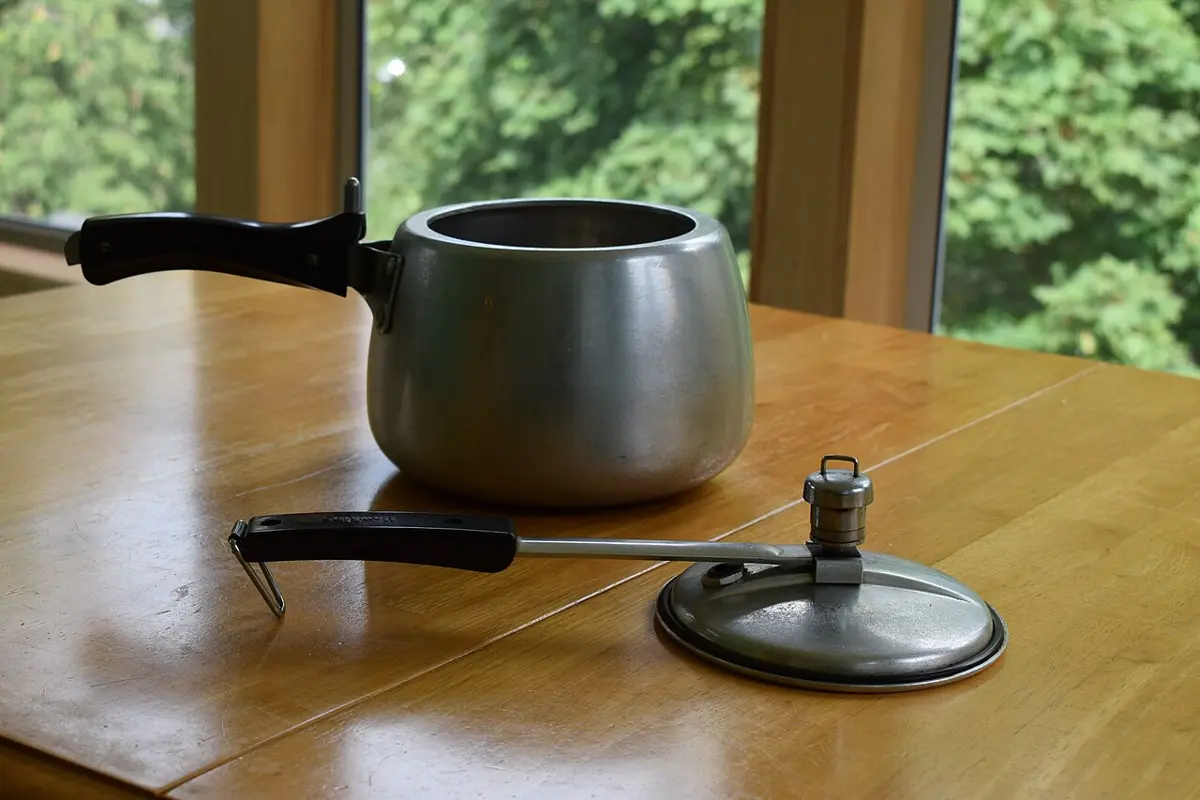
- Closed system: exchanges energy but not matter. Example: a gas shut in a cylinder with a conducting wall and a movable piston. Heat can pass through the wall and the gas can do work on the piston, but no gas gets in or out. A pressure cooker with its weight in place is closed too, until the weight lifts and lets steam out.
- Isolated system: exchanges neither energy nor matter. Example: hot water in a closed, insulated vacuum flask. No real system is perfectly isolated (a flask’s tea does cool overnight), but a good flask comes close for a few hours.
A sealed bottle of cold cold-drink is left on a table on a hot day. As a thermodynamic system, it is:
Pick an answer to see why.
4.3 Thermodynamic variables (thermodynamic coordinates)
When a system has settled down, so that nothing in it changes any more with time, it is in thermodynamic equilibrium: the same temperature everywhere (thermal equilibrium), no unbalanced forces, so the same pressure everywhere (mechanical equilibrium), and no chemical change going on. Its state can then be described by a few measurable quantities, the thermodynamic variables (or coordinates). They let us describe the system, and predict how it will behave.
They are of two kinds:
- State variables (state functions) have a definite value in each equilibrium state, whatever happened to the system before: pressure, volume, temperature, internal energy, entropy (Unit 5) and enthalpy (chemistry’s heat content, ). A change in a state variable depends only on the starting and ending states.
- Process variables describe something that happens during a change, and have no value in a state: work and heat. How much work is done or heat given depends on the path taken between the states.
An everyday picture: the height of the summit of Phulchoki above the Godavari road head is a state variable; it is the same whichever trail you take. The distance you walk and the sweat you lose are process variables: they depend on the trail. A gas “contains” internal energy, but it doesn’t “contain” heat or work, any more than a hiker contains the trail.
Which of these is not a state variable?
Pick an answer to see why.
4.4 Work done
In mechanics, a force does work when its point of application moves: (Grade 11, Unit 5). In thermodynamics, the force usually comes from a pressure, and the movement is a change of volume: a gas pushing a piston out, or the air pushing a balloon’s skin in. Work done is energy transferred because a force acts on a system and the system’s boundary moves.
Work in thermodynamics is a path function: how much is done depends on the path the system takes from its first state to its last, not just on those two states (Section 4.7 shows why).
4.5 Positive and negative work
The work that matters is the work done by the system on its surroundings, and its sign is chosen so:
- Positive work (work done by the system): the system pushes its surroundings back. Example: a gas expanding and pushing a piston out, or the air in a bursting balloon pushing the room’s air away. The gas gives energy to the surroundings.
- Negative work (work done on the system): the surroundings push the system in. Example: a gas being compressed by a piston, as in a bicycle pump. The surroundings give energy to the gas.
For a gas: expansion, , work done by the gas positive; compression, , work done by the gas negative.
4.6 Work done during the expansion of a gas
Take a gas in a cylinder closed by a piston of cross-sectional area , which is light and moves without friction (Figure 4.3). The gas, at pressure , pushes on the piston with a force
Let the gas expand from its first state to its last . Over a very small part of the expansion the piston moves out a tiny distance , so little that the pressure stays during it.
- The small work done by the gas is force × distance: .
- The piston sweeps out a volume , which is the gas’s increase in volume: .
- So
- The total work done by the gas in the whole expansion is the sum of all these small pieces:
To do the sum, you must know how changes with along the way, and that depends on the process: the pressure might stay the same, fall slowly (gas kept warm) or fall fast (gas cooling). Only if the pressure stays constant is it simply .
4.7 Indicator diagram
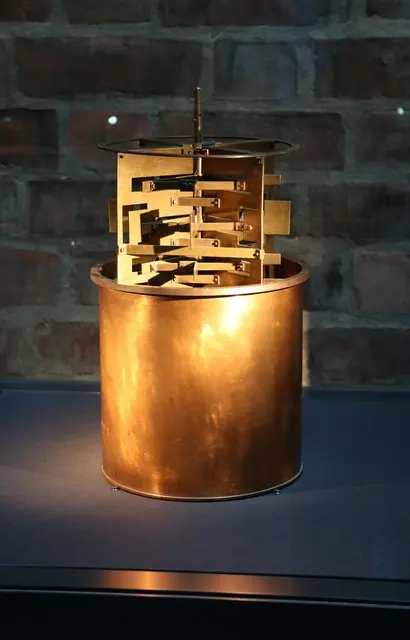
An indicator diagram is a graph of the pressure of the working gas against its volume (a P–V diagram) as it expands or is compressed. The name comes from the steam age: in the 1790s James Watt’s assistant John Southern made an “indicator”, a pencil moved up and down by the pressure in an engine’s cylinder while a card moved sideways with the piston, so that the engine drew its own P–V diagram as it ran. Engineers still use such diagrams to see how well an engine or a refrigerator works, and to find faults.
Features of an indicator diagram:
- i.Volume is plotted across (the x-axis) and pressure up (the y-axis).
- ii.The shape of the curve shows the kind of process (isothermal, adiabatic, isobaric, isochoric: Sections 4.11–4.13).
- iii.The area under the curve is the work done in that process; for a cycle, a closed loop, the area enclosed by the loop is the net work done in one cycle.
Why the area? Let a gas expand from to along the curve AB (Figure 4.4). Cut the process into many tiny steps, like EF, in which the volume grows from to while the pressure stays about .
- The strip under EF is (very nearly) a rectangle EFGH, with height and width .
- Its area is , which is the work done in going from to .
- Adding all the strips from A to B, the total work done is the total area:
Work depends on the path. Two different curves between the same points A and B have different areas under them, so the gas does different amounts of work. That is what we meant by saying work is a path function. The widget shows it.
Two things to notice in the widget. The work is different for each path, but the change in internal energy, , is always the same: it depends only on A and B. The heat taken in is the work plus (the first law, Section 4.9), so it depends on the path too.
Cycles. If the gas goes round a closed loop and returns to its first state, it does work on the parts of the loop where it expands (the area under the upper curve, positive) and has work done on it where it is compressed (the area under the lower curve, negative). What is left is the area enclosed by the loop. Going round clockwise on a P–V diagram, the expansion happens at the higher pressure, so the net work done by the gas is positive: this is what an engine does. Going round anticlockwise, the net work is negative: work is done on the gas, as in a refrigerator.
A gas is taken round a cycle that appears as a loop traced anticlockwise on a P–V diagram. Over one cycle, the net work done by the gas is:
Pick an answer to see why.
4.8 Internal energy and latent heat
The molecules of every body are in constant random motion, so they have kinetic energy. In a gas, their average kinetic energy depends only on the temperature: (Grade 11, Unit 13). The molecules also attract one another, so they have potential energy, which depends on how far apart they are, and so on the volume.
The internal energy of a system is the sum of the kinetic and potential energies of all its molecules, measured in the system’s own frame (the motion of the whole body, like a gas in a moving bus, doesn’t count). It depends on the temperature (through the kinetic energy) and the volume (through the potential energy): .
Internal energy is a state function: it has one value in each state, whatever path the system took to get there. So when a system goes round a cycle and returns to its first state, its change in internal energy is zero.
Internal energy and latent heat
Internal energy can’t be read off an instrument, as a speed or a height can: we can only measure how it changes. In that sense it is hidden, latent, energy. That is where latent heat goes. When ice melts at 0 °C, or water boils at 100 °C, heat goes in but the temperature doesn’t rise: the molecules’ kinetic energy doesn’t change. The heat does work against the molecules’ attraction, pulling them apart, and so raises their potential energy. The internal energy of a substance is therefore least in its solid state and greatest as a gas, at the same temperature.
The internal energy of a system changes in two ways: when heat flows in or out, and when work is done by or on it. Of the heat given to a system, part raises its internal energy and the rest is used to do work on the surroundings:
If the process happens without any exchange of heat (), then
The work is done at the expense of the internal energy: a gas that expands without being heated cools, and a gas compressed without losing heat warms up. The bicycle pump’s warm end and the deodorant can’s cold one are both this equation.
Internal energy of an ideal gas
In an ideal gas the molecules don’t attract one another, so their potential energy is zero, and the internal energy is the kinetic energy alone. That depends only on the temperature, so the internal energy of an ideal gas depends on its temperature only, not on its volume or pressure. For moles of a monatomic ideal gas, whose molecules only move from place to place,
(Section 4.10 shows what changes for molecules that can also spin.)
Internal energy of a real gas
In a real gas the molecules do attract one another (weakly, but not negligibly), so its internal energy is kinetic plus potential energy. The kinetic part depends on the temperature, the potential part on the volume (how far apart the molecules are), so the internal energy of a real gas depends on both its temperature and its volume.
The mechanical equivalent of heat
Rub your palms together hard and they warm up: work becomes heat. Before Joule, heat was measured in calories (the heat that warms 1 g of water by 1 °C) and work in joules, as if they were different things. If work is completely turned into heat , then , so
where is Joule’s mechanical equivalent of heat, the work that makes one unit of heat: J/cal ≈ 4.2 J/cal (today the calorie is defined as exactly 4.184 J). It holds only when all the work becomes heat, or all the heat becomes work. Since heat is energy, it is now measured in joules like any other energy, and then : the equation simply says .
4.9 First law of thermodynamics
The first law of thermodynamics is the law of conservation of energy for processes that involve heat. When an amount of heat is given to a system, it can raise the system’s internal energy (), or let the system do external work (), or both, and nothing is lost:
For a gas whose only work is pushing its boundary out, :
For a whole process, . The signs are the key:
| Quantity | Positive when | Negative when |
|---|---|---|
| heat flows into the system | heat flows out | |
| internal energy rises (an ideal gas warms up) | it falls (an ideal gas cools) | |
| the system does work (it expands) | work is done on it (it is compressed) |
In words: heat in = rise in stored energy + work out. The first law is the bookkeeping used for heat engines, refrigerators, the weather, chemical reactions and living bodies.
A gas absorbs 500 J of heat and does 200 J of work on its surroundings. Its internal energy:
Pick an answer to see why.
Limitations of the first law
The first law only says that energy is conserved. It is silent on several things we see every day:
- i.It doesn’t say which way heat flows. By the first law alone, heat could just as well flow from a cold body to a hot one, if the energies balanced; it never does.
- ii.It doesn’t give the conditions under which heat can be turned into work.
- iii.It treats heat and work as freely exchangeable, but they are not equally so: work can be turned completely into heat (the hands rubbed together), while heat can never be turned completely into work by an engine running in a cycle.
- iv.It doesn’t say how much of the heat an engine takes in can become work: the limit to the efficiency of a heat engine.
The second law of thermodynamics (Unit 5) was brought in to answer these.
4.10 Specific heat capacity of a gas
For solids and liquids (Grade 11, Unit 11) the heat needed to warm 1 kg by 1 K is a fixed number for each substance. For a gas it isn’t: it depends on how the gas is heated, whether it is allowed to expand, because a gas that expands does work. For gases we usually count the amount of gas in moles, and use molar specific heat capacities instead of the specific heat capacity per unit mass (the principal specific heat capacity).
The molar specific heat capacity of a gas is the heat needed to raise the temperature of one mole of it by one degree Celsius (one kelvin):
where is the heat supplied to moles and the rise in temperature. Its SI unit is J/(mol K).
A gas can be heated in many ways, and each gives a different heat capacity. Two are standard:
- Molar specific heat capacity at constant volume, : the heat needed to raise the temperature of one mole of gas by 1 K at constant volume.
The gas is heated in a closed rigid container. It can’t expand, so it does no work: all the heat goes into its internal energy.
- Molar specific heat capacity at constant pressure, : the heat needed to raise the temperature of one mole of gas by 1 K at constant pressure.
The gas is heated in a cylinder with a free piston, so it expands as it warms, keeping its pressure the same. Its internal energy rises by the same amount as before, and it does work pushing the piston out, so it needs more heat.
Mayer’s relation:
- At constant volume no work is done (), so for one mole the first law gives , that is,
The internal energy of an ideal gas depends only on its temperature, so any process that changes its temperature by changes its internal energy by this same , however it happens.
- At constant pressure, heating one mole by :
- For one mole of ideal gas . At constant , a change in temperature makes a change in volume with
- Putting this into step 2: . Dividing by :
This is Mayer’s relation (also spelled Meyer’s). The extra heat needed at constant pressure, per mole per kelvin, is exactly the work the gas does as it expands, = 8.31 J. So is always greater than .
For the principal specific heat capacities (per unit mass), divide by the molar mass : and , so
where is the gas constant per unit mass (for air, = 8.31 ÷ 0.029 = 287 J/(kg K)).
Why is greater than ?
When a gas is heated at constant volume, all the heat raises its internal energy, and so its temperature. When it is heated at constant pressure, it expands and does work on its surroundings, which takes extra energy. So more heat is needed for the same rise in temperature at constant pressure than at constant volume.
Degrees of freedom, specific heat capacity and γ
The degrees of freedom of a body are the number of independent coordinates needed to describe its motion completely. In thermodynamics, they are the number of independent ways in which a molecule can store energy. There are three kinds (Figure 4.8):
- Translational: moving from place to place, along x, y and z. Every molecule has these 3.
- Rotational: spinning. A linear molecule (all its atoms in a line, like N₂, O₂, CO₂) has 2: it can spin about the two axes across it, but spinning about its own length stores almost no energy. A non-linear molecule (like H₂O or CH₄) has 3. A single atom has none that count.
- Vibrational: the atoms moving towards and away from one another, as if joined by springs. Each way of vibrating (each mode) counts 2, one for its kinetic energy and one for its potential energy. They come into play only at high temperatures.
The law of equipartition of energy (from the kinetic theory) says that in thermal equilibrium the energy is shared equally among all the degrees of freedom: each gets, on average, per molecule, or per mole. (The of Grade 11’s kinetic theory is , the three translational degrees of freedom.) For a gas whose molecules have degrees of freedom:
- Internal energy of one mole: .
- .
- .
- The ratio of the molar heat capacities (the adiabatic index), :
| Gas | Example | ||||
|---|---|---|---|---|---|
| monatomic | He, Ne, Ar | 3 | = 12.5 J/(mol K) | = 20.8 J/(mol K) | = 1.67 |
| diatomic (translation and rotation) | H₂, N₂, O₂, air | 5 | = 20.8 J/(mol K) | = 29.1 J/(mol K) | = 1.40 |
| non-linear polyatomic | H₂O vapor, CH₄ | 6 | = 24.9 J/(mol K) | = 33.3 J/(mol K) | = 1.33 |
So the more degrees of freedom, the smaller γ, always between 1 and 5/3. Measured values agree well: helium and argon 1.67, nitrogen, oxygen and air 1.40, steam about 1.33. Carbon dioxide (linear, from translation and rotation) measures about 1.29 at room temperature, lower than 1.40, because some of its vibrations have already begun to take up energy.
For a diatomic ideal gas at room temperature, γ is:
Pick an answer to see why.
4.11 Thermodynamic processes
A thermodynamic process is any change of a system from one equilibrium state to another, in which energy is exchanged with the surroundings as heat, work or both, so that its state variables (pressure, volume, temperature, internal energy) take new values.
A process is like a journey. Where you start and where you finish don’t fix how much fuel you use: a short steep road and a long gentle one use different amounts. In the same way, the heat and work exchanged depend on how the system gets from one state to the other. The study of these processes is what explains how heat engines and refrigerators work.
To draw a process as a line on a P–V diagram, every point along it must be an equilibrium state, with one pressure and one temperature throughout the gas. Such a process, slow enough to pass through equilibrium states all the way, is called quasi-static. The four standard processes below are each named for the quantity they hold constant.
Isothermal process (constant temperature)
An isothermal process is one in which the temperature of the system stays constant throughout, while it expands or is compressed and heat flows in or out to keep the temperature steady. For that the gas must be in a container with thin, well-conducting walls, in contact with a large body at a steady temperature (a heat reservoir), and the change must be slow, so that heat has time to flow. Examples: the slow expansion or compression of a gas in a metal cylinder standing in a large water bath; melting and boiling, which also happen at a steady temperature.
Let moles of an ideal gas change isothermally from to . By the first law,
The internal energy doesn’t change (it depends only on ), so all the heat given to the gas comes out as work. In an isothermal expansion the gas takes in heat equal to the work it does; in an isothermal compression it gives out heat equal to the work done on it.
From the equation of state, . With constant, is constant, so
which is Boyle’s law. This is the equation of state for an isothermal process. Each temperature gives its own curve, a rectangular hyperbola, called an isotherm; a hotter isotherm lies farther from the axes (Figure 4.9).
Work done during an isothermal expansion
Let moles of ideal gas expand isothermally at temperature from to (Figure 4.10).
- In a small expansion , the pressure stays about : .
- The total work is
- From , , and is constant, so it comes out of the integral:
- So
where ln is the natural logarithm (to base e). For one mole, .
- Since , , so also
With common logarithms, : .
4.12 Adiabatic process
An adiabatic process is one in which no heat is exchanged between the system and its surroundings, while its pressure, volume and temperature change because work is done by or on it. (Adiabatic is Greek for “not passable”.) It needs either a perfectly insulated container, or a change so fast that heat has no time to flow. Examples: the sudden bursting of a vehicle’s tyre or of a balloon; the expansion of the hot gases in a petrol engine’s cylinder; the squeezing and stretching of air as sound passes through it; air rising and sinking over mountains.
By the first law, with :
The work is done at the expense of the internal energy. Over the whole process, :
- In an adiabatic expansion (), : the gas cools.
- In an adiabatic compression (), : the gas heats up.
Equation of state for an adiabatic process
Let moles of ideal gas expand adiabatically from to . Take a small step in which the volume and temperature change by and , at nearly constant pressure .
- First law, with :
- Differentiate the ideal gas equation : , so
- Put (4.7) into (4.6):
- Multiply by and collect the terms:
- By Mayer’s relation :
- Divide by and write :
- Integrate both sides:
- So
This is the equation of state for an adiabatic process. Using , it can also be written with the temperature:
and, using ,
Work done during an adiabatic process
Let moles of ideal gas with ratio expand adiabatically from to .
- The work done is .
- Along the adiabat (a constant), so :
- Change the sign of both factors:
- Put in the first term and in the second (they are equal): , and likewise for state 2. So
- With and :
The work done in an adiabatic process depends only on the first and last temperatures. A quicker way to the same result: , and from and , .
The adiabat is steeper than the isotherm
At any point, the slope of an adiabatic curve is γ times the slope of the isothermal curve through the same point, so the adiabat is the steeper of the two (γ > 1) (Figure 4.11).
- Isothermal: constant. Differentiate: , so the slope is
- Adiabatic: constant. Differentiate: . Divide by : , so
- So
Physically: in an adiabatic expansion the pressure falls for two reasons, the gas spreading out (as in the isothermal case) and the gas cooling, so it falls faster. In a compression it rises faster, because the gas also heats up.
An ideal gas is compressed adiabatically to half its volume. Its temperature:
Pick an answer to see why.
4.13 Isobaric and isochoric processes
Isobaric process (constant pressure)
An isobaric process is one in which the pressure of the system stays constant throughout, while heat is given to it or taken from it; its volume, temperature and internal energy change. Examples: heating or cooling a gas in a cylinder with a freely moving piston (the piston’s weight and the air above keep the pressure steady); boiling water in an open pot, or melting ice, at atmospheric pressure; much of what happens in the atmosphere.
It is carried out in a container that can expand. By the first law, : part of the heat raises the internal energy (and the temperature), and the rest is used to do external work.
For moles of ideal gas going from to at pressure :
and (Charles’s law). On a P–V diagram it is a horizontal line, and the work is the rectangle under it (Figure 4.12).
Isochoric process (constant volume)
An isochoric (or isometric) process is one in which the volume stays constant throughout, while the pressure, temperature and internal energy change. Examples: heating a gas in a closed rigid container; the burning of a fuel–air mixture in a sealed chamber, as in a petrol engine at the instant of the spark (Unit 5); a pressure cooker heating up with its weight in place, until the weight lifts.
It is carried out in a container that can’t expand. With no change of volume, the system does no work, and all the heat supplied goes into its internal energy:
On a P–V diagram it is a vertical line, with no area under it (Figure 4.13).
The four processes compared
| Process | Constant | Equation of state | Work done by the gas, | Heat in, | |
|---|---|---|---|---|---|
| isothermal | constant | 0 | |||
| adiabatic | no heat flow | constant | 0 | ||
| isobaric | constant | ||||
| isochoric | constant | 0 |
4.14 Reversible process
A reversible process is one that can be run backwards so that the system and its surroundings both return exactly to their first states, leaving no change anywhere. At every step, a tiny change in the conditions (pressure a whisker higher instead of lower) would send it the other way. It is an idealization: no real process is perfectly reversible, but some come close. Examples: a very slow, frictionless expansion or compression of a gas; the slow isothermal and adiabatic changes of Section 4.11–4.12; the swing of a pendulum with no friction or air resistance (motion under conservative forces only).
Conditions for a reversible process:
- It must be carried out infinitely slowly (quasi-statically).
- No energy may be dissipated (turned into waste heat) during it.
- The system and its surroundings must be in thermodynamic equilibrium with each other at every step: the same temperature where heat flows, the same pressure where the boundary moves.
- There must be no dissipative forces: no friction, viscosity, electrical resistance or the like.
4.15 Irreversible process
An irreversible process is one that can’t be retraced: once it has happened, the system and its surroundings can’t both be returned to their first states. It brings a permanent change, with energy dissipated as waste heat and an increase in entropy (Unit 5). Examples: the rusting of iron; the decay of dead leaves; heat produced by friction; heat flowing from a hot cup of tea to the air; gas rushing out of a burst tyre; mixing milk into tea. Almost all processes in nature are irreversible.
During a fast, irreversible change the gas is not in equilibrium: it swirls, one part is hotter or at a higher pressure than another, so it has no single pressure or temperature. Only its first and last states can be marked on a P–V diagram, and the change between them can’t be drawn as a curve (Figure 4.16).
Which of these processes is closest to reversible?
Pick an answer to see why.
Exercise
Choose the correct option
- Which of the following is not a type of thermodynamic system?
Pick an answer to see why.
- The first law of thermodynamics is a statement of the conservation of:
Pick an answer to see why.
- If a gas expands adiabatically, which of these statements is true?
Pick an answer to see why.
- In an isothermal process, which of the following remains constant?
The textbook’s fourth option, “internal energy”, also stays constant in an isothermal process of an ideal gas, so the question had two right answers; it is replaced below.
Pick an answer to see why.
- Which of these correctly relates the molar heat capacities at constant pressure and at constant volume?
Pick an answer to see why.
- A gas undergoes an isochoric (constant volume) process. The work done during it is:
Pick an answer to see why.
- A gas expands isothermally at 300 K from 2 L to 6 L. If the work done is , the work done is:
Pick an answer to see why.
- A gas undergoes an adiabatic compression. What happens to its temperature?
Pick an answer to see why.
- A gas at 27 °C, kept at that temperature, expands from 1 L to 4 L against a constant external pressure of 2 atm. The work done by the gas is closest to:
The textbook’s options (1384 J, 1725 J, 1845 J, 2100 J) don’t include the answer, 608 J, so the book’s numbers don’t work; the options below are corrected.
Pick an answer to see why.
- 2 moles of an ideal gas (γ = 1.4) are compressed adiabatically from 5 L to 1 L. If the first temperature is 300 K, the final temperature is:
None of the textbook’s options (750 K, 820 K, 900 K, 1050 K) is right: the answer is 571 K, so the book’s numbers don’t work. The options below are corrected.
Pick an answer to see why.
- A gas expands so that constant. Its first pressure and volume are 2 atm and 3 L. The final pressure when its volume becomes 6 L is:
The textbook’s nearest option is 0.78 atm, but the answer is 0.76 atm; the option is corrected below.
Pick an answer to see why.
Answer these questions
- a.Define a thermodynamic system. Give one example of each type, and differentiate between open, closed and isolated systems with examples.
- b.How does work done on the system differ from work done by the system?
- c.A gas at a pressure of Pa and a volume of 0.01 m³ expands isobarically to 0.03 m³. Find the work done.
- d.Define an indicator diagram and explain how the work done by an expanding gas can be found from it.
Hint
Answer
- a.Explain the concept of internal energy and its relation with heat and work. What does the equation signify? How does the internal energy of a real gas differ from that of an ideal gas?
- b.Calculate the change in internal energy of 2 moles of a monatomic ideal gas whose temperature changes from 300 K to 500 K. ()
Answer
- a.State and explain the first law of thermodynamics. Discuss its significance.
- b.Does it follow the law of conservation of energy?
- c.A gas absorbs 600 J of heat and does 150 J of work. Find the change in its internal energy.
- d.List the limitations of the first law of thermodynamics.
Answer
- a.Why does a gas have two specific heat capacities?
- b.Derive Mayer’s relation, .
- c.Why is always greater than ?
- d.If J/(mol K) and J/(mol K), find the gas constant and γ.
Answer
- a.Explain the isothermal, adiabatic, isobaric and isochoric processes with the help of P–V diagrams.
- b.Differentiate between the types of thermodynamic process, and compare their P–V diagrams.
Answer
- a.Define an adiabatic process. Derive the equation constant.
- b.In an adiabatic expansion, a gas does 1200 J of work. Find the change in its internal energy.
- c.Find the final temperature and the work done when 1 mole of ideal gas expands adiabatically from 1 L to 5 L. Take γ = 1.4, K, J/(mol K).
Hint
Answer
- a.Derive expressions for the work done in isothermal and adiabatic processes.
- b.A gas expands isothermally from 2 L to 8 L at a temperature of 300 K. Calculate the work done. ( J/(mol K), mol)
Answer
- a.Define the heat capacity ratio (γ).
- b.How does γ vary with the atomicity of a gas? Explain using degrees of freedom.
- c.Differentiate between reversible and irreversible processes.
Answer
Printable PDFs
- The unit as a book (A5) 27 pages Answers as an A4 booklet, 7 sheets
- Study notes 3 pages
- Worksheet 4 pages Answer key
- Harder practice questions 2 pages Answer key
Quiz yourself: Energy, Heat, Light and Sound, Grades 5–12 →
Practice every question in the book, and keep track of the ones you miss →
A companion to your textbook, not a replacement for it: study from the book your school uses, and where the two differ, follow your teacher. Found a mistake? Please tell us.