
Push a child on a swing and let go: it swings out, back, out again, each swing taking the same time. A guitar string hums at one pitch, a wall clock’s pendulum ticks off the seconds, the needle of a sewing machine goes up and down, your heart beats, and the Earth goes round the Sun once a year. Motions that repeat themselves are everywhere.
The simplest and most important of them is simple harmonic motion, the motion of a mass on a spring or a pendulum making small swings. It is worth learning well: waves, sound, alternating current, light and even the vibrations of atoms in a solid are all built from it. This unit describes it with one equation, finds its energy, works out the periods of a spring, a pendulum and a twisting disc, and ends with what happens when friction slows an oscillation down, or a push keeps it going: damping and resonance.
2.1 Introduction
Periodic motion is a motion that repeats itself at regular intervals of time. The time for one repeat is its period. The swing of a pendulum, the ticking of a clock, the vibration of a guitar string, the turning of a fan and the Moon going round the Earth are all periodic.
A periodic motion in which a body moves back and forth about a fixed point, along the same path, is an oscillation (or vibration). Every oscillation is periodic, but not every periodic motion is an oscillation: a fan’s blade goes round, not back and forth.
Three questions to keep in mind:
- Why does a swinging pendulum always come back? (Section 2.2: a restoring force.)
- How do musical instruments make their notes? (Natural frequencies and resonance, Section 2.7.)
- Can a motion repeat forever without stopping? (Damping, Section 2.7.)
2.2 Simple harmonic motion
A mass on a spring, a pendulum making small swings, the prong of a tuning fork and a child on a swing all oscillate about a position of rest, the mean position (or equilibrium position). Pull any of them aside and a force pulls it back: a restoring force. In each, the restoring force grows in step with how far the body is from the mean position: twice as far, twice the pull. Motion of this kind is simple harmonic motion (SHM).
Simple harmonic motion is a periodic motion in which the restoring force is directly proportional to the displacement from the mean position and is always directed towards the mean position.
where is the displacement from the mean position and is a constant (for a spring, its spring constant). The minus sign says that the force points the opposite way to the displacement: towards the mean position.
By Newton’s second law, , so
is a positive constant; it is written (Section 2.2.1 shows why), so
So SHM can also be defined by its acceleration: SHM is an oscillation in which the acceleration is directly proportional to the displacement from the mean position and is always directed towards the mean position. Whenever we find that a system obeys , or , we know at once that it moves in SHM, and its is the square root of that constant.
Which of these is simple harmonic motion?
Pick an answer to see why.
2.2.1 The equation of SHM and its terms
There is a neat link between SHM and steady circular motion. Let a point P go round a circle of radius , centered at O, with a steady angular velocity , and watch its shadow on a vertical diameter (its projection, N). As P goes round, N moves up and down the diameter, between and , and its motion is exactly SHM. The circle is called the reference circle.
Let P start at X, on the horizontal line through O, at , and go round anticlockwise (to Y, X′, Y′ and back to X). After a time it has turned through an angle .
(i) Displacement. The displacement of the oscillating particle is its distance from the mean position at any instant. N is at height above O, so
where is the displacement at time , the amplitude and the angular frequency. The displacement follows a sine curve in time.
(ii) Velocity. Differentiating,
Since (taking the size),
- At the mean position, : , the greatest (maximum) speed.
- At an extreme position, : . The particle stops for an instant and turns back.
(iii) Acceleration. Differentiating again,
So the acceleration is directly proportional to the displacement and directed towards the mean position: the motion of N is SHM, with the same as P’s angular velocity. (It is also the vertical part of P’s centripetal acceleration, , which points to the center.)
- At the mean position, : .
- At an extreme position, : , the greatest size of acceleration, .
The speed is greatest where the acceleration is zero, and the acceleration greatest where the particle stops.
(iv) Amplitude. The amplitude is the greatest displacement from the mean position. Since is at most 1, : the amplitude is the radius of the reference circle. (It is sometimes called the displacement amplitude.)
(v) Period. The period, , is the time for one complete oscillation: P goes once round its circle, through radians, so and
From , taking sizes, , so
This is a general recipe: for any SHM, find the acceleration at a displacement, and the period follows. It works because the ratio of the two is the same everywhere in an SHM.
(vi) Frequency. The frequency, , is the number of complete oscillations in one second, the reciprocal of the period:
Its unit is the hertz (Hz), one oscillation per second. The angular frequency is in rad/s.
(vii) Phase. The phase of an oscillating particle tells where it is in its cycle, and which way it is moving, at an instant. If the particle is at the mean position at , its displacement is ; in general
and the angle is its phase. is the phase at , the initial phase or epoch: it says where in the cycle the particle starts. With , it starts at the mean position, moving up; with (90°), at its upper extreme, so then . The phase changes steadily with time; the epoch stays the same.
Phase difference
Two oscillations of the same frequency can be at different points of their cycles. The phase difference between them is the difference of their phases, in degrees or radians: how far one is ahead of (leads) or behind (lags) the other.
- In phase (phase difference 0, or , …): they reach their extremes together and pass the mean position together, moving the same way.
- In antiphase (completely out of phase, phase difference π or 180°): when one is at its upper extreme, the other is at its lower extreme. Two waves of the same amplitude meeting in antiphase cancel each other; in phase, they add.
Phase differences matter wherever oscillations are combined: waves interfering, the voltage and current in an AC circuit, or signals in communication.
A particle in SHM is at its greatest displacement. At that instant:
Pick an answer to see why.
2.3 Energy in SHM
As a particle oscillates, its energy keeps changing from kinetic to potential and back. With no friction, the total stays the same.
Potential energy. Let a particle of mass be at displacement . Its acceleration is , so the restoring force is
the form of Hooke’s law. To move the particle a further small step away from the mean position, we must push against this force with an equal and opposite force , doing work . The work done to take it from the mean position to is stored as potential energy:
Kinetic energy. From Equation 2.2, , so
Total energy.
with . The has canceled: the total energy is the same at every point of the motion. It is proportional to the square of the amplitude (and of the frequency): double the amplitude and the energy is four times as much.
- At the mean position (): , and the kinetic energy is greatest, . All the energy is kinetic.
- At an extreme (): and . All the energy is potential.
At what displacement are the kinetic and potential energies of a particle in SHM equal?
Pick an answer to see why.
2.4 Applications of SHM
Simple harmonic motion is everywhere in engineering. A car’s springs and shock absorbers, a building’s sway, the quartz crystal in a watch, a guitar string and the balance wheel of a mechanical watch all oscillate in, or close to, SHM, and engineers design them from its equations. Here is one of the most useful: a mass hanging from a spring, as in a vehicle’s suspension.
2.4.1 Vertical oscillations of a spring–mass system
A light spring of spring constant hangs from a fixed support, and a mass is hung from it.
- Equilibrium. The mass stretches the spring by and comes to rest. The spring pulls up with (Hooke’s law) and the weight pulls down with ; at rest the net force is zero, so
- Displaced. Pull the mass down a further distance and let go. The spring is now stretched by , so it pulls up with , while the weight still pulls down with . Taking downward as positive, the net force on the mass is
since . The same holds above the equilibrium position ( negative).
- SHM. By Newton’s second law, , so
The acceleration is proportional to the displacement from the equilibrium position and points towards it: the mass moves in SHM about the equilibrium position (not the unstretched length).
- Period.
So the period of a mass on a spring depends only on the mass hung from it and the spring constant, not on the amplitude and not on . Gravity only moves the point it oscillates about, down by ; the same mass and spring would oscillate with the same period on the Moon, or lying on a smooth table. (We have taken the spring’s own mass to be negligible.) A heavier mass oscillates more slowly; a stiffer spring, faster.
Since , the period can also be found from the stretch alone: .
Springs joined together
Two springs, of spring constants and , can hold a mass together in two ways (Figure 2.4).
- In parallel (side by side, sharing the load): pulled down by , both stretch by , and their pulls add: . So . The pair is stiffer than either.
- In series (one below the other): the same force passes through both, so they stretch by and , and the total stretch is . So . The pair is softer than either: two equal springs in series have .
A mass on one spring oscillates with period T. The same mass is hung from two such springs in parallel. Its period is now:
Pick an answer to see why.
2.5 Simple pendulum
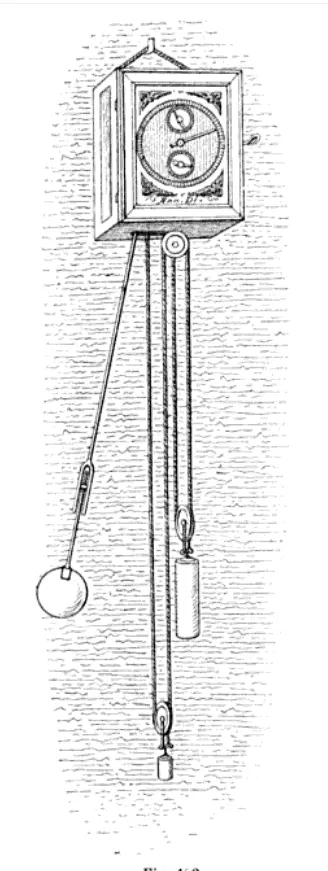
The first recorded study of the pendulum was by Galileo Galilei, at the end of the 1500s. The story goes that, as a young man in the cathedral of Pisa, he watched a lamp swinging on its long chain and timed its swings against his pulse: as the swings grew smaller, each still seemed to take the same time. That a pendulum’s period hardly depends on its amplitude (for small swings) is called isochronism. In 1656–57 the Dutch scientist Christiaan Huygens used it to build the first pendulum clock, which kept time to within about a minute a day, against about a quarter of an hour for the best clocks before it.
A simple pendulum is a small, heavy bob hung from a fixed point by a light, inextensible string, swinging to and fro in a vertical plane under gravity. For small swings its motion is SHM.
- The point of suspension is the fixed point from which the pendulum hangs.
- The point of oscillation is the bob’s center of gravity.
- The effective length, , is the distance from the point of suspension to the point of oscillation: the length of the string plus the radius of the bob.
The ideal simple pendulum assumes a point-sized bob, a massless string that doesn’t stretch, no friction or air resistance, and small swings.
The period of a simple pendulum
Let the bob, of mass , be pulled aside and let go. At some instant it is at B, at an angle θ to the vertical OA, a distance along the arc from its mean position A.
The forces. Two forces act on the bob: its weight , straight down, and the tension in the string, along the string towards O. Split the weight into two parts:
- along the string, , away from O. The tension balances it (and, since the bob moves on a circle, the tension is a little larger, to give the centripetal force);
- along the arc (perpendicular to the string), , towards A. Nothing balances it: it is the restoring force.
The restoring force acts opposite to the displacement, so
- Small angles. For a small angle, in radians, (at 5°, they differ by only 0.1 %), and the arc gives . So
- SHM. With ,
The acceleration is proportional to the displacement and directed towards the mean position: for small swings, the pendulum moves in SHM.
- Period.
The – graph and measuring g
Squaring Equation 2.7,
This has the form : a graph of against is a straight line through the origin, with slope . Time a pendulum at several lengths, plot against , and measure the slope: then . Using the slope of a best-fit line averages out the errors in single readings, so it gives more reliably than one length alone.
The seconds pendulum
A seconds pendulum is a simple pendulum whose period is 2 s: each swing, one way, takes 1 s, so it “beats seconds”, as in a grandfather clock. Its length, from with s and m/s²:
about 99.3 cm. Where is smaller, it must be shorter.
What the period depends on
From :
- Length. A longer pendulum has a longer period: . Four times the length, twice the period.
- Acceleration due to gravity. Where is weaker, the period is longer: . On the Moon, where is a sixth of the Earth’s, a pendulum swings times as slowly.
- Not the mass of the bob, and, for small swings, not the amplitude. A heavier bob has a larger restoring force, but in exactly the same proportion as its larger mass, so its acceleration is the same.
Why a real pendulum is not quite simple
A point-sized bob and a weightless string can’t be made, and a real pendulum falls short of the ideal in other ways too:
- The formula holds only for small swings, less than about 5°. For larger angles, is less than θ, the restoring force is smaller than the formula assumes, and the period is longer: about 0.4 % longer at 15°, 1.7 % at 30°.
- The period depends on , which changes from place to place (with latitude, height above sea level and the rocks below), so a pendulum clock keeps different time in different places.
- The length must stay fixed, but heat expands the string or rod and a string can stretch; a longer pendulum runs slow. Fine clocks used rods of special alloys, or of two metals arranged so their expansions cancel.
- Air drag and friction at the pivot take energy away: the amplitude dies down and, without a push from the clock’s mechanism, the pendulum stops.
- Vibrations, wind and other outside forces disturb it.
- So a pendulum on its own is no good for timing over a long time; a clock must keep giving it small pushes (its escapement) to replace the energy lost.
A pendulum clock that keeps perfect time in Kathmandu is taken to a hot place at the same height. It will:
Pick an answer to see why.
2.6 Angular simple harmonic motion
A body can also oscillate by turning back and forth about an axis. If the restoring torque is proportional to the angular displacement, the motion is angular simple harmonic motion, the turning form of SHM.
A torsion pendulum is an example: a disc or a bar hung from the middle by a wire. Turn the disc through an angle and the wire twists; the twisted wire tries to untwist, and when let go the disc swings back and forth about the wire as its axis. The springiness here is the wire’s twist, not a spring’s stretch. The balance wheel of a mechanical watch, with its hairspring, works the same way.
- Turn the disc through an angle θ from its rest position. The twisted wire gives a restoring torque proportional to the twist, and opposite to it:
where κ (kappa) is the torsional constant of the wire, in N m/rad.
- With (Unit 1), being the disc’s moment of inertia about the wire:
- This has the form of linear SHM: the angular acceleration is proportional to the angular displacement and directed towards the mean position. So the disc moves in angular SHM, with
A heavier disc, or one with its mass farther out, turns back and forth more slowly; a thicker, stiffer wire, faster. Unlike a pendulum, a torsion pendulum doesn’t need small angles: the wire’s torque stays proportional to the twist even for large turns. (Other books write the torsional constant as or ; the meaning is the same.)
A torsion pendulum’s disc is replaced by one with four times the moment of inertia, on the same wire. The period:
Pick an answer to see why.
2.7 Oscillatory motion: free, damped and forced
An oscillatory motion is a to-and-fro motion about a central point, like a swinging pendulum or a bouncing spring. It is described by its amplitude (how far it moves), its period (the time for one complete movement) and its frequency (how often it moves back and forth). What happens to an oscillation over time depends on what else acts on it.
Free oscillation
When a body is pulled aside and let go, and nothing else acts on it, it oscillates at a frequency set by itself alone: its natural frequency, . A pendulum’s is , a spring’s . This is a free oscillation. An ideal free oscillation, with no friction, would keep the same amplitude forever.
Damped oscillation
Every real oscillation meets friction or air resistance, which takes energy from it. Its amplitude grows smaller and smaller until it stops. This is a damped oscillation, and the loss of energy is damping. The more damping, the faster the oscillation dies away; damping also makes each oscillation take a little longer.
There are three kinds of damping:
- Light damping (underdamping): the body still oscillates, but each swing is smaller than the last, by the same fraction each time. A pendulum in air and a tuning fork are lightly damped.
- Critical damping: just enough damping that the body returns to its mean position in the shortest possible time without overshooting. A car’s shock absorbers and the needle of a good meter are designed to be close to critically damped.
- Heavy damping (overdamping): so much damping that the body doesn’t oscillate at all; it creeps back slowly to the mean position, like a pendulum in thick syrup, or a door with a door closer.
Examples of damped oscillations:
- A pendulum in air: air resistance slowly brings it to rest.
- Car shock absorbers: when a car hits a bump, its springs start to oscillate; the shock absorbers (pistons in oil) damp the motion so the car settles quickly instead of bouncing for a long time.
- A tuning fork: its sound dies away as the vibration loses energy to the air (that energy is the sound) and inside the metal.
- Slow-closing doors: a door closer damps the door’s swing so it closes gently instead of slamming.
- A spring in water: a mass bobbing on a spring under water dies down much faster than in air.
Forced oscillation
If an outside force that varies periodically keeps acting on a body, the body is made to oscillate at the frequency of the force (the driving frequency), whatever its own natural frequency. This is a forced oscillation (forced vibration). After a short settling time, the body oscillates steadily, the force’s push each cycle making up for the energy lost to damping. How large the oscillation is depends on the strength of the force, and very much on how close the driving frequency is to the natural frequency.
Resonance
When the driving frequency equals the natural frequency of a body, the body takes in energy from the force most easily and oscillates with its largest amplitude. This is resonance. Pushing a swing is the everyday example: push once each swing, at the right moment, and even small pushes build a large swing.
With light damping, the amplitude at resonance can be very large; heavier damping keeps it smaller and makes the peak broader.
The phase also changes as the driving frequency passes resonance. Driven slowly, the body moves in step with the force. Driven fast, it moves opposite to the force (half a cycle behind). At resonance, the displacement lags the driving force by a quarter of a cycle, π/2 (90°): the body’s velocity is then in step with the force, so the force pushes the way it moves all the time, putting in energy as fast as it can.
Examples of resonance:
- A swing pushed at the right time: pushes at the swing’s natural frequency make it go higher and higher.
- A tuning fork on a resonance box: a wooden box whose air vibrates at the fork’s frequency makes its sound much louder. The hollow body of a guitar, violin or sarangi does the same for the strings.
- Breaking a glass with sound: a loud note at a wine glass’s natural frequency can set it vibrating so strongly that it shatters. (It takes a very loud, steady note; it has been done with a loudspeaker and, rarely, by a trained voice.)
- Tuning a radio: a radio’s tuning circuit has a natural frequency that you change by turning the knob; when it matches a station’s frequency, that station’s signal makes it resonate, and the radio picks it out from all the others.
- Buildings in an earthquake: the ground shakes most at certain frequencies; a building whose natural frequency matches them sways far more than its neighbors. Engineers design buildings to avoid this, and tall buildings carry tuned mass dampers, huge weights on springs that soak up the sway.
- Marching across a bridge: soldiers are ordered to break step on a bridge, so that their steps don’t drive it at its natural frequency.

Exercise
Choose the correct option
- A particle’s displacement in SHM is , in cm. Its amplitude is:
Pick an answer to see why.
- What is the angle between the instantaneous velocity and the acceleration of a particle in SHM?
Pick an answer to see why.
- A particle in SHM has amplitude r and period T. How long does it take to go from x = r to x = r/2?
Pick an answer to see why.
- What happens to the period of a simple pendulum if its length is tripled?
Pick an answer to see why.
- A pendulum has a period of 2 s on the Earth. What is its period on the Moon, where g is a sixth of the Earth’s?
Pick an answer to see why.
- A girl on a swing swings with period T. Another girl of the same size sits beside her, and they swing together. The period:
Pick an answer to see why.
- The mass on a spring is halved and the spring’s stiffness doubled. Its natural frequency:
Pick an answer to see why.
- What happens to the frequency of a mass–spring system if the mass is doubled?
Pick an answer to see why.
- In the picture above, the natural frequency of system I is f. What is the frequency of system II, the same mass on two similar springs joined end to end?
Pick an answer to see why.
- When does resonance occur in a system that can oscillate?
Pick an answer to see why.
- Where would you see resonance in everyday life?
Pick an answer to see why.
- In an angular simple harmonic oscillator the restoring torque is τ = −kθ, where k is the torsional constant. If I is its moment of inertia, its angular frequency is:
Pick an answer to see why.
Answer these questions
A body moves in simple harmonic motion along a straight line.
- a.Define simple harmonic motion. What are its essential characteristics?
- b.Derive the expression for the acceleration in SHM.
- c.A particle of mass 0.1 kg moves in SHM with a period of 2 s and an amplitude of 0.5 m.
- i.Find its total mechanical energy.
- ii.Find its kinetic energy when its displacement is 0.3 m.
- iii.At what displacement is its speed half its greatest value?
Answer
The figure shows a simple pendulum that swings back and forth between P and Q.
- a.It takes about 0.5 s to swing from P to Q. Estimate the length of the pendulum. (g = 9.8 m/s²)
- b.i. Draw a free-body diagram showing all the forces on the bob.
- ii.Use it to find the frequency of oscillation.
Hint
Answer
Consider a spring–mass system placed vertically.
- a.Define the equilibrium position in vertical SHM.
- b.How does the restoring force act in vertical SHM? Explain using Hooke’s law.
- c.A 5 kg block hung from a vertical spring stretches it by 0.25 m.
- i.Calculate the spring constant.
- ii.The block is pulled down further and set oscillating. Find its period. (g = 9.8 m/s²)
Answer
The diagram shows a mass hung from a helical spring, oscillating up and down. A motion sensor connected to a data logger records its motion.
- a.Name the type of oscillation shown.
- b.Write the expression for the period T of the vertical oscillation in terms of the mass m and the spring constant k.
- c.If the extension of the spring at equilibrium is h, derive a relation between h, g and T.
Answer
A torsion pendulum moves in angular SHM.
- a.What is angular simple harmonic motion? Give one example.
- b.Derive the expression for the period of angular SHM of a torsion pendulum.
- c.A disc of moment of inertia 0.05 kg m² hangs from a wire of torsional constant 0.10 N m/rad. Find the period of its angular oscillation.
Answer
A pendulum in air meets air resistance and slows down over time.
- a.What is damping in an oscillation? Name the types of damping.
- b.Explain what happens to the amplitude when the frequency of a periodic driving force matches the natural frequency of the system.
- c.A metal pendulum bob oscillates in still air. An investigator records its successive peak displacements on the same side of its equilibrium position, one period apart:
| Peak number | 1 | 2 | 3 | 4 |
|---|---|---|---|---|
| Displacement (cm) | 8.0 | 6.0 | 4.5 | 3.4 |
Assume the oscillations are small.
- i.Describe how you would sketch a displacement–time graph for this pendulum from these data. How does the graph show that the bob is damped?
- ii.If the undamped period of the pendulum is 1.6 s, will its actual period in air be exactly 1.6 s, slightly more, or slightly less? Give a reason.
- iii.The pendulum is now made to swing in thin oil instead of air. State two changes you would expect in the displacement–time graph.
Answer
A tuning fork vibrates under an outside periodic force.
- a.What is resonance? Under what condition does it occur?
- b.What is the phase relation between the displacement and the driving force at resonance?
- c.A forced oscillator has a natural (angular) frequency ω₀ = 5 rad/s. When it is driven by an outside force of angular frequency ω = 5 rad/s, its amplitude is greatest. Explain this with a graph, and state the resonance condition with numbers.
Answer
The graph shows how the amplitude of a system varies with the frequency of a periodic force applied to it. Points A, B and C are at the frequencies Fa, Fb and Fc.
- a.Name the physical phenomenon the graph shows.
- b.Identify the frequency Fb, and explain what happens to the amplitude at it.
- c.Compare the amplitudes at A and C, and explain why they are lower than at B.
Answer
A block of mass m attached to a vertical spring moves in SHM.
- a.Define SHM, and derive its equation of motion using Hooke’s law.
- b.What is the total mechanical energy in SHM? Derive the expression, and discuss how the energy varies with time.
- c.Explain why the restoring force in vertical SHM does not depend on gravity.
- d.Two springs, of spring constants k₁ = 200 N/m and k₂ = 300 N/m, are connected in parallel to a mass of 2 kg.
- i.Find the effective spring constant.
- ii.Calculate the period of oscillation.
- iii.If the amplitude is 0.15 m, find the energy of the oscillation (the greatest energy stored in the springs).
Answer
A particle moves in SHM with an amplitude of 0.4 m and a frequency of 5 Hz, starting from the mean position.
- i.Find its angular frequency.
- ii.Find its displacement 0.1 s after it leaves the mean position.
- iii.Find its velocity and acceleration at that instant.
Answer
A system oscillates with a starting amplitude of 0.5 m. Because of damping, its amplitude falls by 5% each cycle.
- i.Find the amplitude after 10 oscillations.
- ii.If its starting energy is 40 J, how much energy is left after 10 oscillations?
Answer
Printable PDFs
- The unit as a book (A5) 18 pages Answers as an A4 booklet, 5 sheets
- Study notes 3 pages
- Worksheet 4 pages Answer key
- Harder practice questions 2 pages Answer key
Quiz yourself: Force, Motion and Machines, Grades 5–12 →
Practice every question in the book, and keep track of the ones you miss →
A companion to your textbook, not a replacement for it: study from the book your school uses, and where the two differ, follow your teacher. Found a mistake? Please tell us.