
Climate models, and order in disorder
Nobel Prize in Physics, 2021: Syukuro Manabe, Klaus Hasselmann, and Giorgio Parisi
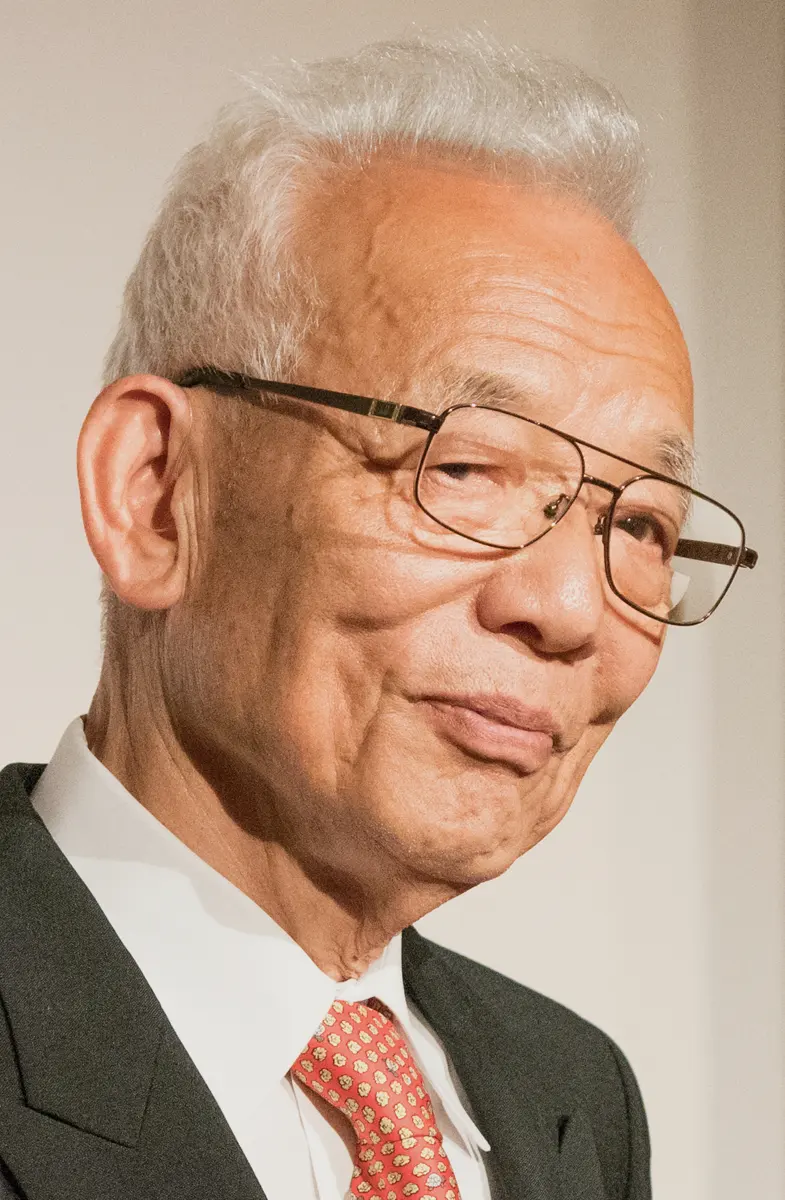
Syukuro Manabe
born 1931 in Japan
A doctor’s son who chose the sky instead. He says the secret of a good model is to leave things out.
-
Klaus Hasselmann
born 1931 in Germany
He grew up in England, studied ocean waves, and sang in a choir with the man who first measured the rise of carbon dioxide.
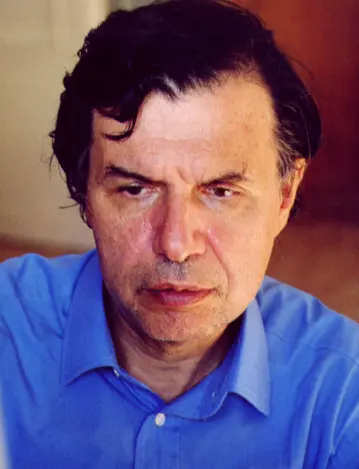
Giorgio Parisi
born 1948 in Italy
A theoretical physicist in Rome who has worked on everything from tiny particles to flocks of birds.
Photo: Lorenza Parisi, CC BY-SA 4.0
Nobody can tell you whether it will rain in Bhaktapur on the first day of Dashain next year. Yet scientists can tell you, with confidence, that the Himalaya will be warmer in fifty years than it is now. How can the far future be easier to predict than next year’s weather?
In 2021 the Nobel Prize in Physics answered that question. Half of it went to Syukuro Manabe and Klaus Hasselmann, who built the physics of Earth’s climate on computers and showed that people are warming it. The other half went to Giorgio Parisi, who found hidden order in systems that look completely random. What joins them is one big idea: a system with millions of jumbled parts can still follow rules you can work out.
The problem: a blanket of gas
The Sun’s light passes through the air and warms the ground. The warm ground then gives off heat of its own, as invisible infrared rays Grade 9: Infrared rays. Some gases in the air soak up these rays and send part of the heat back down. This is the greenhouse effect, and the gases that do it are greenhouse gases: water vapor, carbon dioxide (CO₂), methane and a few others Grade 10: Greenhouse effect.
The greenhouse effect is not bad in itself. Without it, the Earth’s surface would be at about −18 °C, frozen all over. With it, the average is about 15 °C.
Two hundred years ago, in the 1820s, the French scientist Joseph Fourier first understood that the air keeps the Earth warm. In 1896 the Swedish chemist Svante Arrhenius did the first sums. He worked out that if the amount of carbon dioxide in the air doubled, the Earth would warm by 5 to 6 °C.
But Arrhenius had to guess at a lot. Carbon dioxide is only about 0.04% of the air, a few molecules in every ten thousand. Could so little really matter? And the air is not still. Warm air rises, carries water vapor up, and the vapor turns to cloud and rain. Nobody could put all of that together by hand.
Why is the Earth’s average temperature about 15 °C instead of about −18 °C?
Pick an answer to see why.
Weather and climate are not the same
Weather is what the air is doing today: sun, rain, wind, a cold morning. Climate is the pattern of weather over many years: how hot Kathmandu usually is in Jestha, how much rain usually falls in the monsoon Grade 10: Weather and climate.
Weather is very hard to forecast more than about ten days ahead. In the 1960s the American scientist Edward Lorenz showed why. The air is chaotic: a tiny difference today, too small to measure, can grow into a completely different storm two weeks later. This is called the butterfly effect, from the question of whether a butterfly flapping its wings in Brazil could set off a tornado in Texas.
So if weather can’t be forecast for more than a few days, how could anyone hope to forecast the climate for a hundred years? That is the puzzle the two climate laureates solved, one piece each.
What they did, step by step
Manabe: one column of air
Syukuro Manabe studied meteorology, the science of the weather, at the University of Tokyo. Japan had been badly damaged by the Second World War, and in 1958, like several young Japanese scientists, he moved to the United States, to work for the US Weather Bureau. It was one of the first places in the world to use computers to study the air.
- Leaving things out. Computers then were hundreds of thousands of times slower than today’s. So Manabe kept only what mattered most. He did not model the whole planet. He modeled one column of air, standing on the ground and reaching 40 kilometers up, like a tall chimney through the sky. “You must always simplify,” he says. “You cannot compete with the complexity of nature.”
- Two ways to move heat. Earlier sums had looked only at radiation: heat traveling as rays. Manabe added the second way: convection, warm air rising and carrying heat and water vapor up with it Grade 8: Convection. When water vapor turns to cloud high up, it lets go of the heat it took to evaporate it. His model kept the air’s relative humidity fixed, so warmer air held more water vapor, just as it does in real life.
- 1967, the answer. With his colleague Richard Wetherald, Manabe changed the gases in the column one by one and let the computer find the new temperatures. Oxygen and nitrogen made almost no difference. Carbon dioxide did. When they doubled it, the ground warmed by about 2.3 °C.
- A fingerprint. The model found something else. The lower air got warmer, but the high air, 20 to 40 km up, got colder. If a brighter Sun were warming the Earth instead, the whole column would have warmed together. So this pattern was a way to tell the two causes apart, years before anyone could measure it.
- 1975, the whole Earth. Manabe and Wetherald then built one of the first climate models of the whole globe in three dimensions, on a computer with about half a megabyte of memory, less than a single photo on your phone. Doubling carbon dioxide warmed it by about 3 °C.
Hasselmann: weather is the noise, climate is the signal
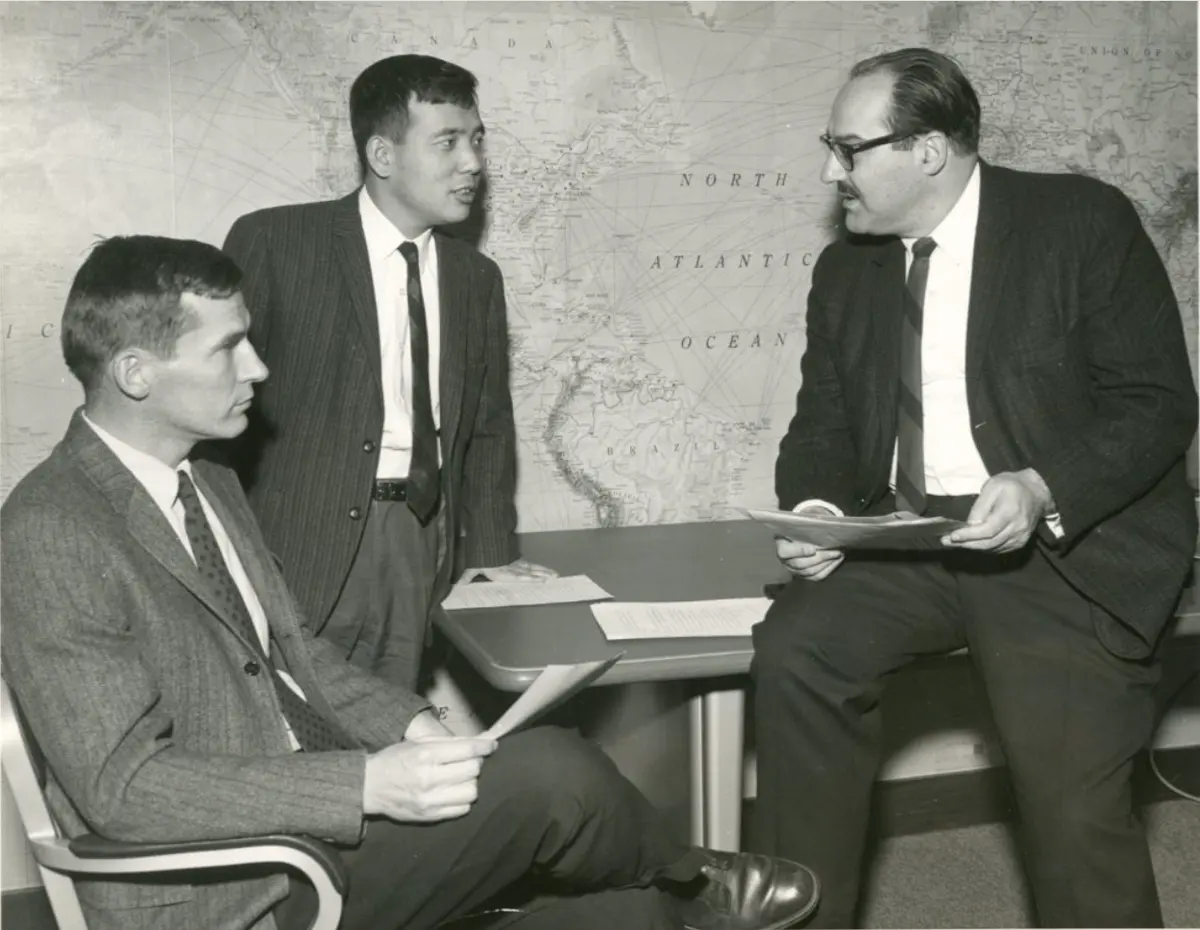
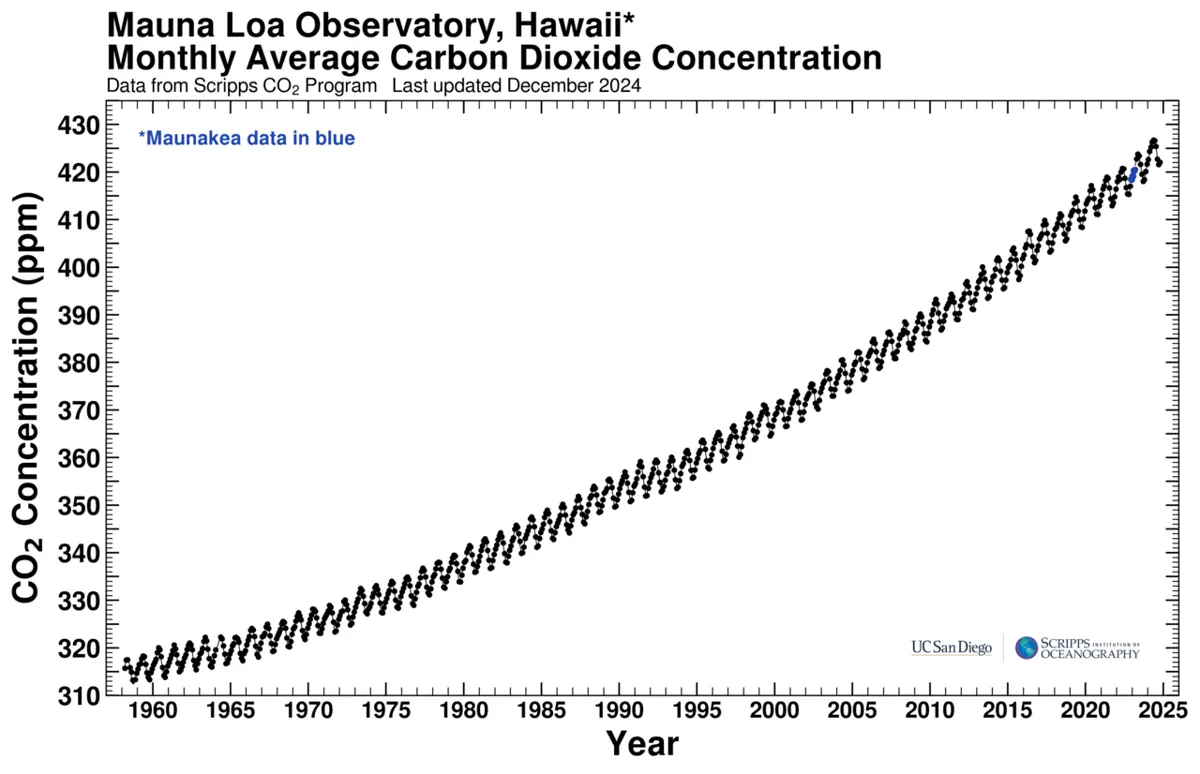
Klaus Hasselmann was born in Hamburg, Germany. When he was two, his family fled the Nazi government to England, where he grew up. He went back to Hamburg to study physics and became an expert on ocean waves. In California he became friends with Charles David Keeling, the scientist who in 1958 began measuring carbon dioxide on the volcano Mauna Loa in Hawaii. Together with their wives they started a madrigal choir, a choir that sings old songs in parts. Later in his life Hasselmann used Keeling’s measurements again and again.
- The dog on a walk. Picture walking a dog that is off its lead. It runs ahead, back, sideways, round your legs. Its path is a mess. But if you look at all its tracks over an hour, you can still tell where you walked, and how fast. The dog is the weather, quick and random. You are the climate, slow and steady.
- 1976, chance inside the model. Hasselmann borrowed an idea from Albert Einstein, who had explained why a grain of pollen in water jiggles about: water molecules, much smaller and faster, hit it from every side at random. In the same way, Hasselmann said, the fast, random weather keeps pushing the slow ocean. Heating the air by one degree can take a few weeks; heating the ocean by one degree can take a thousand years. He built a climate model with chance built in. It showed that the random pushes of weather add up, in the slow ocean, into slow ups and downs lasting years. So the weather’s chaos doesn’t make the climate impossible to predict. It is just noise on top of a signal.
- 1979 to 1997, fingerprints. Next he asked: when the climate changes, what caused it? Each cause leaves its own pattern, a fingerprint, in where and when the Earth warms or cools. A brighter Sun leaves one pattern. Dust from a big volcano leaves another. Greenhouse gases leave a third, like the warm lower air and cold high air of Manabe’s model. Hasselmann worked out mathematical methods to find these fingerprints in the noisy measurements and to say how sure we can be.
In Hasselmann’s picture of walking a dog off its lead, what does the dog stand for?
Pick an answer to see why.
Why the climate laureates’ work matters
Using Hasselmann’s methods and models that grew from Manabe’s, scientists could finally answer the big question. The Nobel committee put it simply. Is the Earth warming? Yes. Is the cause the extra greenhouse gas in the air? Yes. Can it be explained by natural causes alone? No.
In the 1850s the air held about 280 molecules of carbon dioxide in every million. By 2024 it held more than 420, mostly from burning coal, oil and gas. The air now has more carbon dioxide than at any time in hundreds of thousands of years, and the world is about 1.2 °C warmer than in the 1800s.
Parisi: order hidden in a mess
Now for the other half of the prize. It sounds like a different subject, but it is about the same kind of problem: a system with a huge number of parts, pushed about by chance.
A metal that can’t make up its mind
Inside a magnet, each atom of iron behaves like a tiny magnet itself, called a spin. In an ordinary magnet the spins all line up and point the same way Grade 8: Molecular theory of magnetism.
In the 1970s physicists were puzzled by a strange material called a spin glass. A typical one is copper with a few iron atoms scattered through it at random. Each pair of iron spins is pushed by the copper between them. Some pairs want to point the same way, others want to point opposite ways, depending on how far apart they are.
Now take three spins in a triangle, where each pair wants to point opposite ways. Spin 1 points up. Spin 2 points down: that pair is happy. But spin 3 can’t be opposite to both of them. Whatever it does, one pair is unhappy. Physicists call this frustration. Parisi compares it to a play by Shakespeare: try to be friends with two people who hate each other, and someone is always upset.
In a spin glass there are millions of such triangles, all tangled together. So the spins never settle into one neat best arrangement. Instead there is a huge number of almost-equally-good ones. Cool the metal down twice in exactly the same way and the spins freeze into a different pattern each time. Ordinary window glass is similar: its atoms are frozen in a jumble, not in the neat rows of a crystal.
Three spins sit at the corners of a triangle, and every pair wants to point in opposite directions. Each spin can point only up or down. What happens?
Pick an answer to see why.
What Parisi did
- The replica trick. To study a spin glass, physicists used a mathematical trick: imagine many copies (replicas) of the same material and compare them. But in the 1970s the trick gave answers that couldn’t be right, such as an impossible negative amount of disorder at low temperature.
- 1979, the hidden pattern. Parisi found the way out. The copies are not all alike. They group into families, and the families into bigger families, like a family tree. He found a way to describe this pattern with mathematics, and the answers now made sense.
- Proof, much later. Parisi’s solution was so new that it took mathematicians more than twenty years to prove it was right. The French mathematician Michel Talagrand finished the proof in 2006.
Far beyond magnets
Spin glasses are not used in any machine. But Parisi’s ideas turned out to fit many other problems where lots of parts have to find a compromise. One is the traveling salesman’s problem: find the shortest route through many towns, when there are so many routes that no computer can try them all. Another is memory in artificial neural networks, the ideas behind today’s artificial intelligence (Physics Prize 2024). His methods are used in biology, in the study of the brain, and in machine learning.
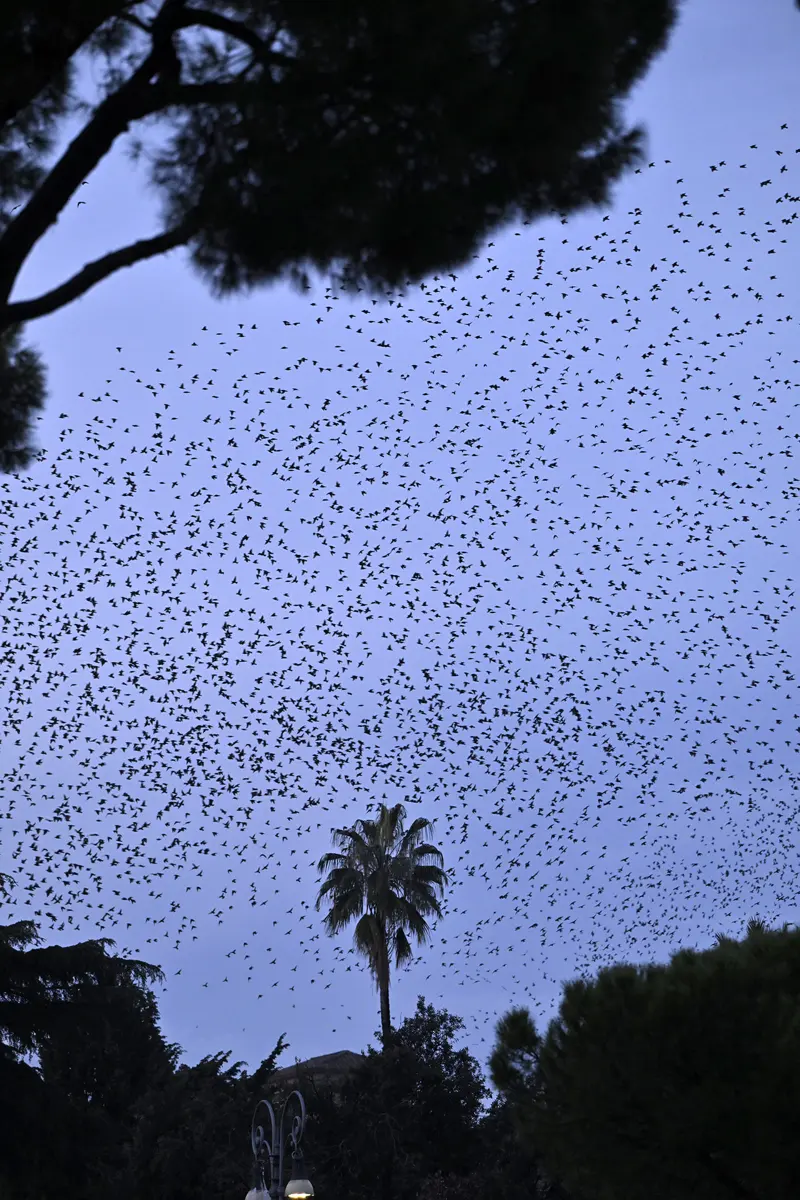
Parisi has studied many other things where chance makes patterns. One is the huge flocks of starlings that swirl over Rome on winter evenings, thousands of birds turning together without a leader. His team filmed the flocks from several cameras at once and followed each bird in three dimensions. Each starling, they found, keeps track of about seven of its nearest neighbors, and that simple rule is enough to turn the whole flock.
In your life today
- Weather forecasts and climate warnings. Your phone’s weather forecast comes from computer models of the air, the family Manabe helped start. Climate models of the same kind tell governments what to plan for: hotter summers, stronger floods, longer droughts.
- Proof in court and at climate talks. Hasselmann’s fingerprint methods are behind the reports of the IPCC, the United Nations’ panel of climate scientists, which in 2021 said it is “unequivocal” (beyond doubt) that people have warmed the air, ocean and land. Every country’s climate promises start from those reports.
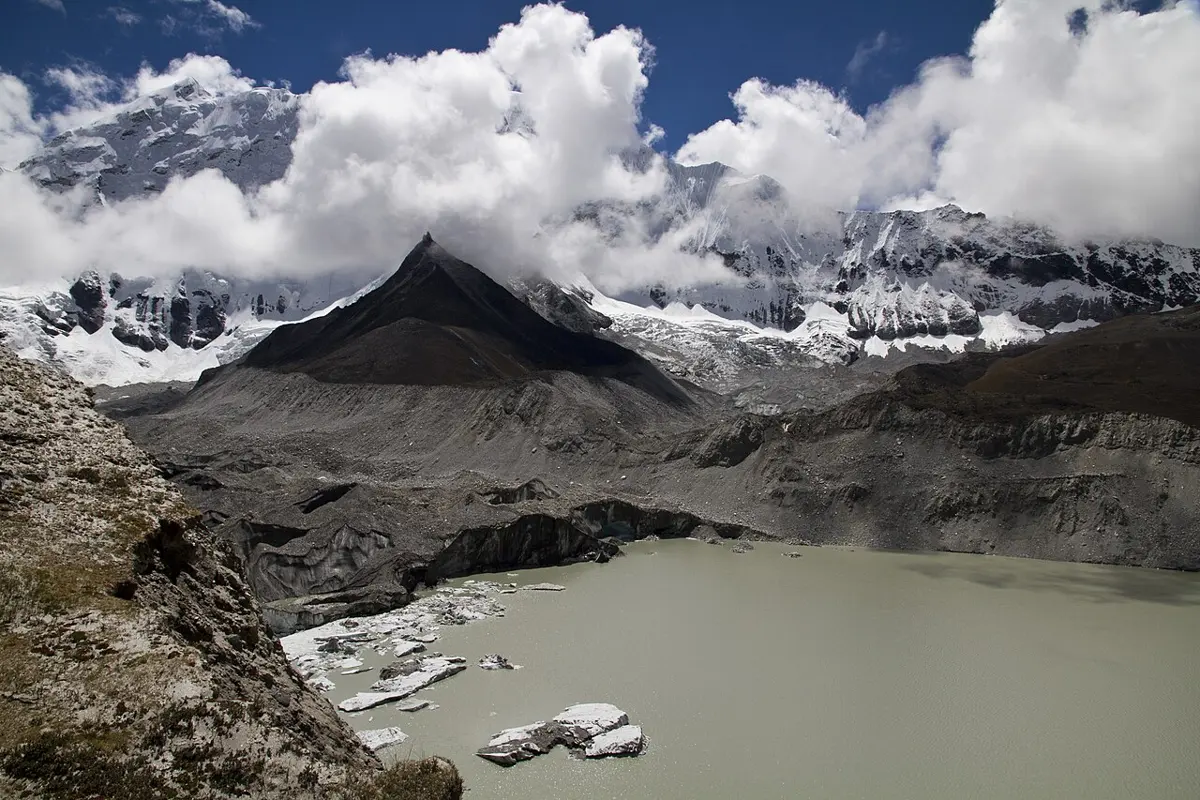
- Nepal’s glaciers. The Himalaya is warming faster than the world as a whole. In 2019 a big study by ICIMOD, the mountain research center in Lalitpur, used climate models to find that at least a third of the glaciers of the Hindu Kush Himalaya would melt by 2100 even if world warming were held to 1.5 °C, and about two thirds if emissions kept rising. As glaciers shrink, the lakes in front of them grow, and some could burst and flood the valleys below Grade 10: Glacial lake outburst floods.
What came next
- Bigger and better models. Today’s climate models divide the whole Earth, its air and its oceans, into millions of boxes, and add ice, clouds, forests and living things (What a climate model is). Yet their answer to Manabe’s question, how much warmer a doubling of carbon dioxide makes the Earth, is still about 2.5 to 4 °C: very close to his.
- Clouds, the big open question. The biggest uncertainty left is clouds. Low clouds cool the Earth by reflecting sunlight; high thin clouds warm it by holding heat in. How clouds will change as the Earth warms is still not fully known.
- Glass itself. Parisi’s work started from spin glasses, but ordinary glass is still a puzzle: why does a liquid, cooled fast, stiffen into a solid without ever forming a crystal? Physicists, Parisi among them, are still working on it.
In your science books
- Grade 8: convection and convection currents and weather, how warm air rises; molecular theory of magnetism, tiny magnets that line up.
- Grade 9: infrared rays and the electromagnetic spectrum.
- Grade 10: climate change, weather and climate, the greenhouse effect and glacial lake outburst floods; the greenhouse effect and carbon dioxide.
- Going Further: Is the Earth really getting warmer? (Manabe’s fingerprint in the high air) and What will the climate be like when you are grown up? (how a climate model works).
Learn more
- The Nobel Prize’s own explanation: They found hidden patterns in the climate and in other complex phenomena (nobelprize.org).
- The three laureates’ Nobel lectures: Manabe, Hasselmann and Parisi.
The official reason
The prize was given “for the physical modelling of Earth’s climate, quantifying variability and reliably predicting global warming.”
The prize was given “for the discovery of the interplay of disorder and fluctuations in physical systems from atomic to planetary scales.”