
Testing Einstein with entangled light
Nobel Prize in Physics, 2022: Alain Aspect, John F. Clauser, and Anton Zeilinger
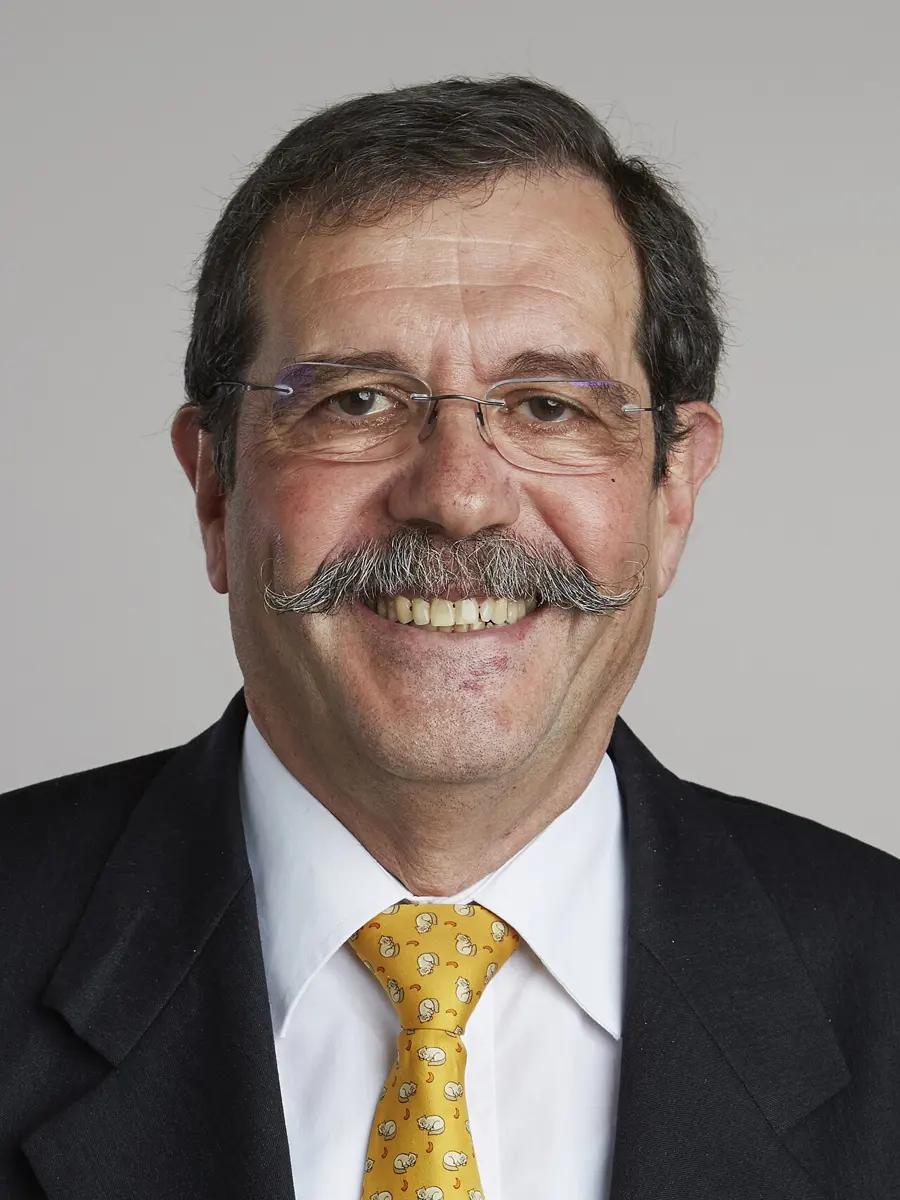
Alain Aspect
born 1947 in France
He did his famous experiment as a young researcher near Paris, for his doctorate, and kept improving it until it left no easy way out.
Photo: The Royal Society, CC BY-SA 4.0
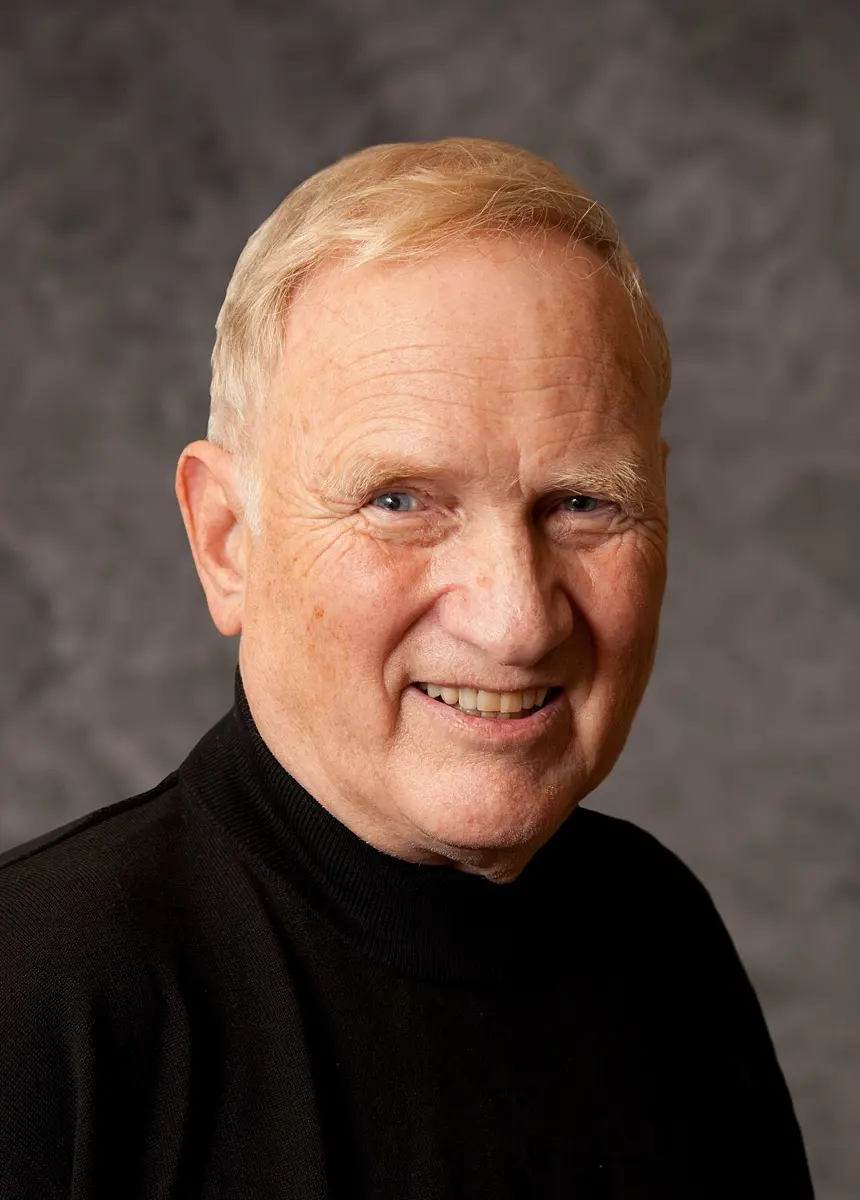
John F. Clauser
born 1942 in the United States
As a young physicist he could not stop thinking about one idea that most others ignored, and built the first experiment to test it.
Photo: Peter Lyons, CC BY-SA 4.0
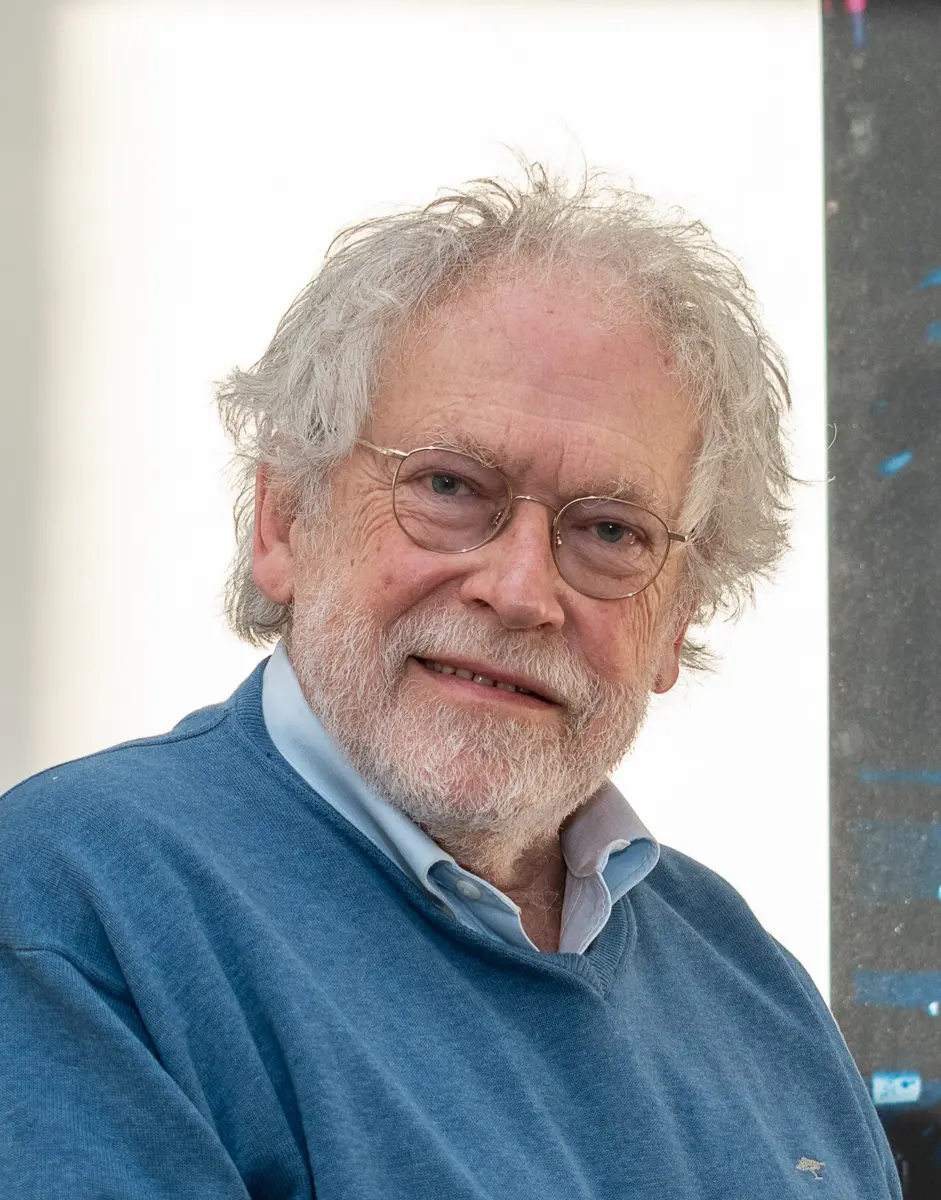
Anton Zeilinger
born 1945 in Austria
A professor in Innsbruck and Vienna who turned a puzzle about reality into tools for sending quantum information.
Photo: Jaqueline Godany, CC BY 4.0
Imagine you have a pair of gloves. Without looking, you put one glove in a box and send it to your cousin in Biratnagar, and keep the other in a box in Bhaktapur. Later you open your box: a left glove. At that instant you know your cousin has the right one, even though nothing traveled between you. There is no mystery: each glove was left or right from the start.
Tiny particles of light can be linked in pairs in a way that looks just like the gloves. But in 1964 a physicist found a way to test whether they really are like the gloves, and the answer was no. Nature does something stranger. The 2022 Nobel Prize in Physics went to the three people whose experiments showed this, and who began to use it.
The problem: does nature decide in advance?
In the 1920s physicists built quantum mechanics, the rules for atoms, electrons and light. It works extremely well: it explains how atoms give out light, how chips in phones work and much more. But it says something odd. Before you measure a particle, many of its properties are not fixed. The theory only gives the chance of each result. Which result you get is decided at the moment of measuring, by pure chance.
Two particles can also be made together so that they share one state, however far apart they fly. This is called entanglement. Measure one, and you know at once what the same measurement on the other will give.
In 1935, Albert Einstein and two colleagues, Boris Podolsky and Nathan Rosen, argued that this could not be the whole story. If measuring one particle tells you about the other one instantly, they said, the answer must have been there all along, like the gloves. The particles must carry hidden instructions that quantum mechanics simply doesn’t know about. Einstein called the other possibility, one particle somehow affecting a distant one, “spooky action at a distance”.
Niels Bohr, the other giant of the time, disagreed: quantum mechanics was complete. But for thirty years nobody could see how an experiment could decide between them. Both ideas predicted the same results for every test anyone could think of.
Light that wiggles one way: polarization
The experiments used a property of light called polarization. Light is a transverse wave: it vibrates at right angles to the direction it travels Grade 9: Transverse waves. Ordinary light from the Sun or a bulb vibrates in every direction across its path. Polarized light vibrates in one direction only, for example up and down.
A polarizing filter lets through only light that vibrates in one direction. Think of shaking a rope that passes through the gap in a fence of upright bars. Shake it up and down and the wave passes between the bars; shake it sideways and the bars stop it.
Put two polarizing filters on top of each other. Turn one until it is at right angles to the other, and almost no light gets through both.
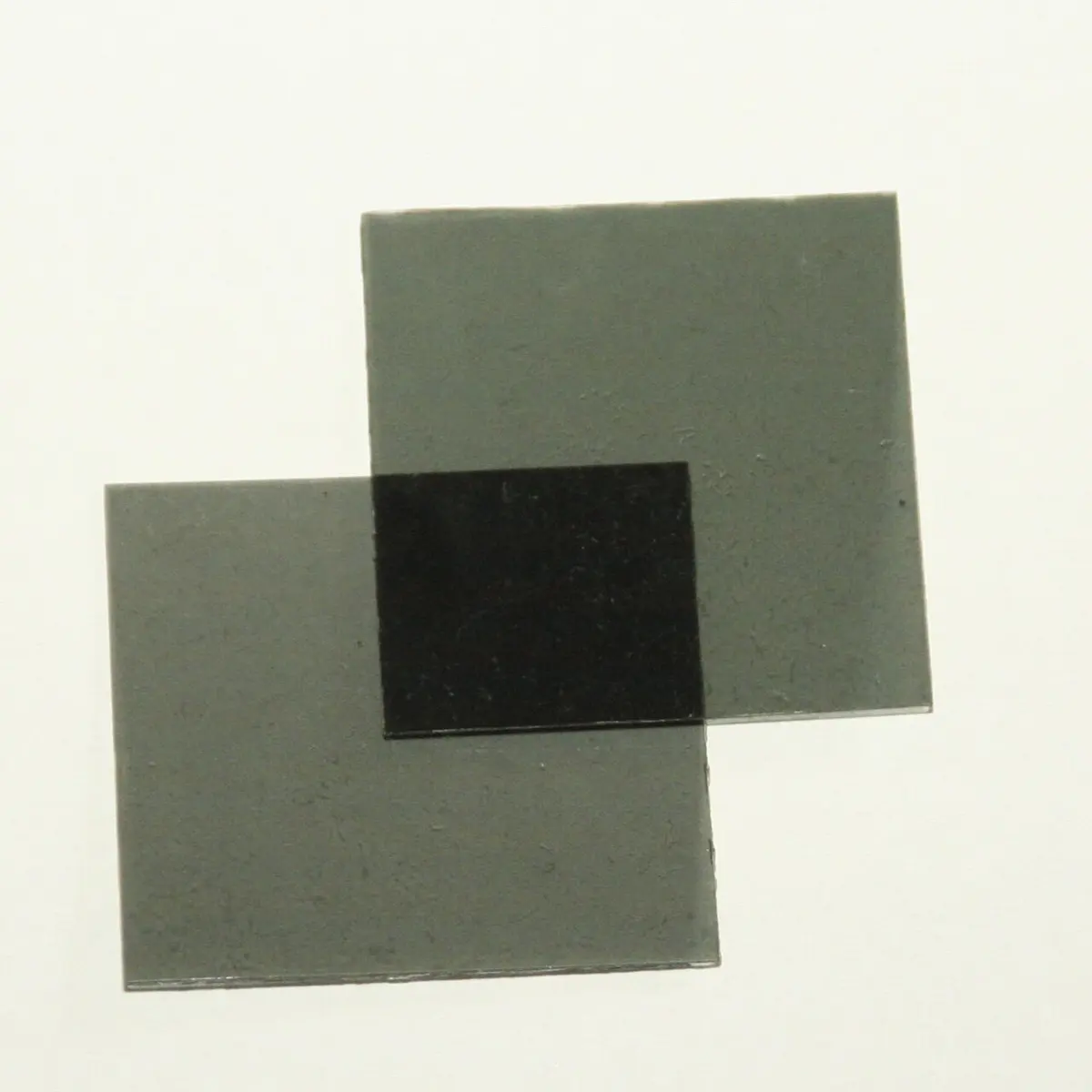
Now the quantum part. Light is made of tiny packets called photons. A single photon cannot be half let through. Send a photon polarized up and down at a filter turned at an angle, and it either passes whole or is stopped whole. The bigger the angle, the smaller the chance it passes. Which one happens is decided only when the photon reaches the filter, by chance.
Two polarizing filters are lined up so that both let through only light that vibrates up and down. What happens if you turn the second filter a quarter turn (90°)?
Pick an answer to see why.
Bell’s idea: a test the hidden instructions must fail
In 1964 John Stewart Bell, a physicist from Northern Ireland working at CERN in Switzerland, found the test that everyone had missed. His result is called Bell’s inequality. Here is a simple version of his idea.
Make pairs of entangled photons and send the two photons of each pair in opposite directions, to two filters far apart. Call the people at the filters Alice and Bob. When their filters point the same way, the two photons always do the same thing: both pass, or both are stopped. So far, this is just like the gloves.
Now Alice and Bob each choose between three angles for their filter: 0°, 30° or 60°. If hidden instructions exist, each pair of photons carries a card with three answers on it, the same card for both photons, for example:
| Filter at | 0° | 30° | 60° |
|---|---|---|---|
| The card says | pass | pass | stop |
Look at the times Alice uses 0° and Bob uses 60° and their results differ. On those cards, the 0° and 60° answers are different. Then the 30° answer must differ from at least one of them. So: the photons can differ at 0° and 60° at most as often as they differ at 0° and 30° plus at 30° and 60° together. That is a Bell inequality, and it follows from nothing more than the idea that the answers were written in advance.
Quantum mechanics predicts something else. With filters 30° apart, the photons differ 25% of the time. With filters 60° apart, they differ 75% of the time. Hidden instructions allow at most 25% + 25% = 50% for the 60° case. Quantum mechanics says 75%. Both cannot be right, and an experiment can tell which.
In this version of Bell’s test, the experiment finds that photons with filters 60° apart give different results about 75% of the time. What does this show?
Pick an answer to see why.
Why it was hard
Bell’s test sounds simple, but in practice it was very hard.
- Single photons. The test needs pairs of photons, one pair at a time, and the pairs had to be really entangled. In the 1960s there was no easy way to make them.
- Detectors that miss. Detectors of the time caught only a small fraction of the photons. Someone could always argue that the photons caught were a special, unfair sample.
- Filters set in advance. If the filters stay at fixed angles, perhaps the source somehow “knows” the settings, or one filter sends a hidden signal to the other. To rule that out, the angles must be chosen after the photons have left, too quickly for any signal, even one traveling at the speed of light, to warn the other side.
Most physicists thought the question was philosophy, not physics, and not worth the effort.
What they did, step by step
Clauser: the first test
John Clauser read Bell’s paper as a young physicist in the 1960s and could not let it go.
- 1969, the plan. With three other researchers, Clauser worked out how Bell’s idea could be tested in a real laboratory, with real filters and detectors that miss many photons.
- 1972, the experiment. At the University of California, Berkeley, with the doctoral student Stuart Freedman, he built the apparatus, much of it from spare parts. They shone light on calcium atoms, which then gave out two photons at once, in opposite directions, with matching polarization. A filter and a detector on each side counted how often both photons came through.
- The result. The measurements broke a Bell inequality clearly and agreed with quantum mechanics.
Aspect: changing the filters in flight
Clauser’s result left loopholes: the filters stayed fixed during each run, and few photons were caught. Alain Aspect, working for his doctorate at the Institut d’Optique near Paris, built a better version.
- Early 1980s, a brighter source. He used lasers to make the calcium atoms give out entangled pairs much faster, so the results were clearer.
- Catching both answers. In one version he counted the photons that passed and the ones that didn’t, instead of only those that got through.
- 1982, the switches. The cleverest step: a switch on each side sent each photon to one of two filters at different angles, changing about every ten billionths of a second. The filters were about 6 m from the source, so light took about 40 billionths of a second to go from one side to the other. The setting was chosen while the photons were already flying, too late for any signal to tell the other side.
Again, quantum mechanics was right. There was no room left for simple hidden instructions.
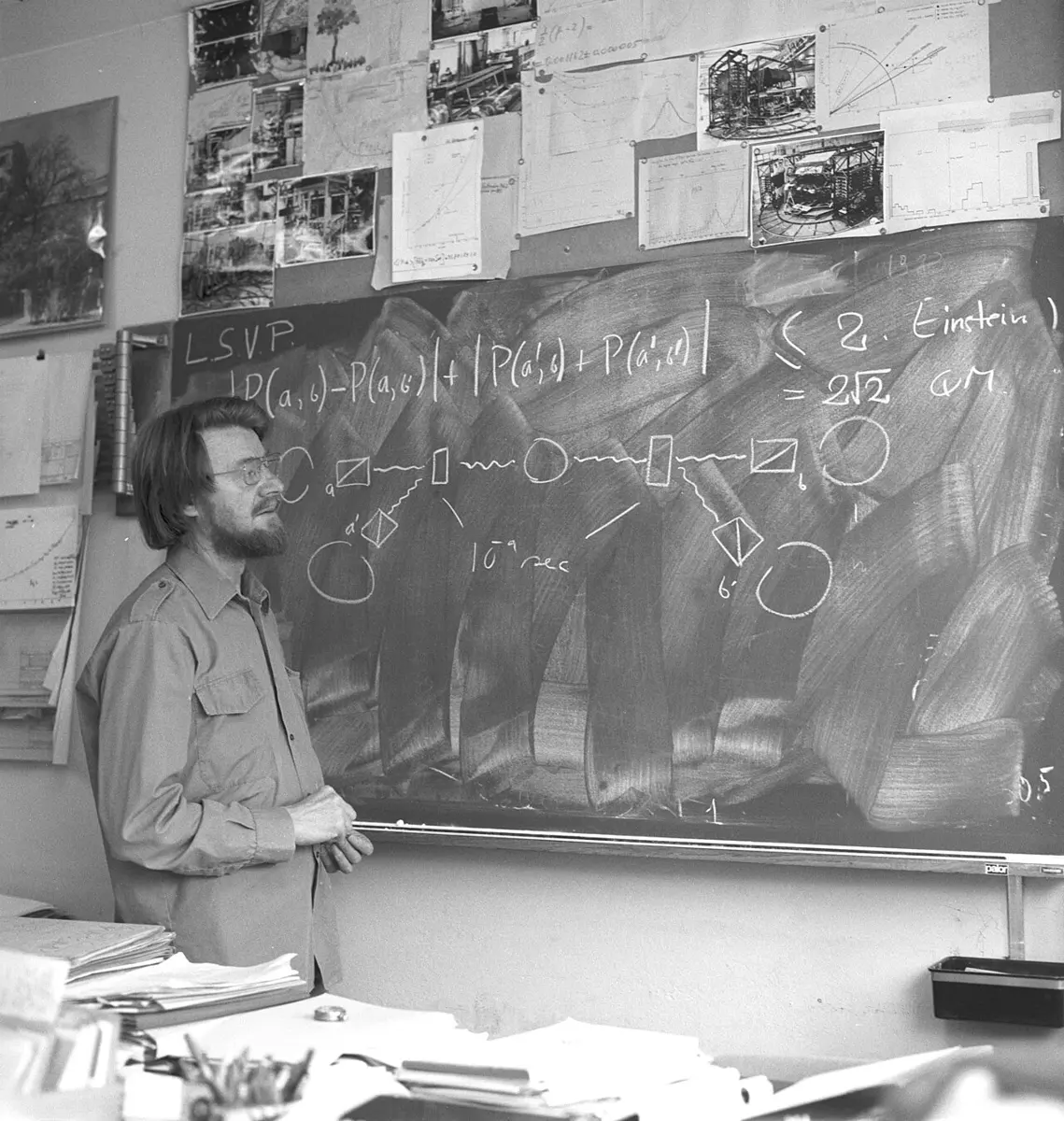
Zeilinger: from a test to a tool
Anton Zeilinger and his teams, in Innsbruck and Vienna, made entangled photons in a new way: by shining a laser into a special crystal, which sometimes splits one photon into an entangled pair. Then they put entanglement to work.
- 1997, quantum teleportation. They passed the polarization of one photon onto another photon some distance away, using an entangled pair and an ordinary message. Nothing traveled except light, and the first photon lost its state in the process. It was the first experiment of its kind.
- 1998, entanglement swapping. They took two separate entangled pairs and measured one photon from each together. The other two photons, which had never met, became entangled with each other.
- More and better Bell tests. His groups closed further loopholes. In one test, in 2018, the filter settings were chosen by the color of light from two very distant galaxies, light that had set out billions of years ago. Nobody on Earth, and nothing in the laboratory, could have arranged those choices.
How it works now: keys that show a spy
The best-known use is to make secret keys. To send a message in code, two people need a shared secret key, a long random string of 0s and 1s. The question is how to share it without anyone copying it on the way.
With entangled photons, Alice and Bob each measure their photons and write down the results, 1 for pass and 0 for stopped. Because the photons are entangled, their lists match, and because each result is decided by chance, nobody could have known them in advance. That gives both of them the same random key.
The clever part is spying. A spy who catches a photon must measure it, and a measurement changes a quantum state. So Alice and Bob check a sample of their results: if the photons still break Bell’s inequality, nobody has been listening. If someone has, the matching gets worse and they throw that key away. The safety comes from the laws of physics, not from a hard sum.
Why can’t a spy secretly copy a key made with entangled photons?
Pick an answer to see why.
In your life today
- Not in your phone yet. The secure messages and online banking you use today are protected by ordinary codes Grade 9: Online security measures, not by entangled photons. Quantum keys are still mostly used in tests, and by some banks and governments.
- From space. In 2017 the Chinese satellite Micius, about 500 km up, sent single photons down to ground stations in China and Austria. The keys made that way protected a video call between Vienna and Beijing, about 7,600 km apart. Zeilinger was on the call, with scientists led by his former student, Pan Jianwei. The same satellite also sent entangled pairs to two stations about 1,200 km apart.
- Quantum computers. Entanglement is one of the things that make quantum computers different from ordinary ones Grade 10: Binary numbers.
What came next
- No loopholes left. In 2015, three teams, in Delft, Vienna (Zeilinger’s group) and Boulder, closed the main loopholes at once, in the same experiments. Quantum mechanics passed again.
- A quantum internet. Engineers are linking laboratories, cities and satellites with entangled photons, using entanglement swapping to reach further than one fiber can carry them.
- The open question. Experiments have shown that the hidden instructions Einstein hoped for, at least the kind that stay inside each particle, don’t exist. But physicists still argue about what is really happening when an entangled pair is measured. Nobody has a picture that everyone accepts.
In your science books
- Grade 9: transverse waves, the kind of wave that can be polarized; the electromagnetic spectrum; artificial satellites; online security.
- Grade 10: optical fibers, which carry quantum keys between cities; binary numbers.
- Going further: Einstein’s packets of light, the photons used in these experiments; wave or particle?
Learn more
- The Nobel Prize’s own explanation: How entanglement has become a powerful tool (nobelprize.org), with the press release.
- The laureates’ Nobel lectures: Aspect, Clauser and Zeilinger.
The official reason
The prize was given “for experiments with entangled photons, establishing the violation of Bell inequalities and pioneering quantum information science.”