
Black holes, on paper and in our galaxy
Nobel Prize in Physics, 2020: Roger Penrose, Reinhard Genzel, and Andrea Ghez
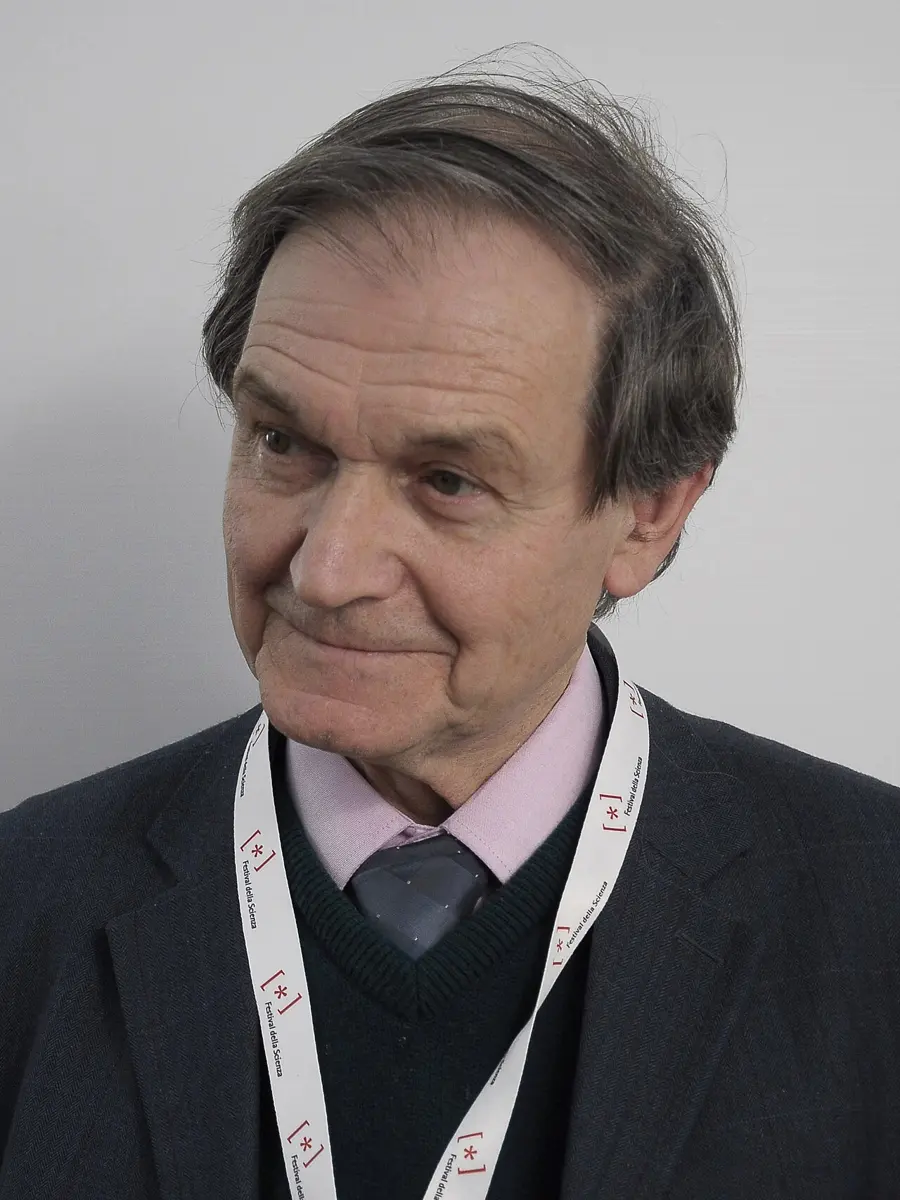
Roger Penrose
born 1931 in the United Kingdom
A mathematician who thinks in pictures. The idea behind his prize came to him while crossing a street in London.
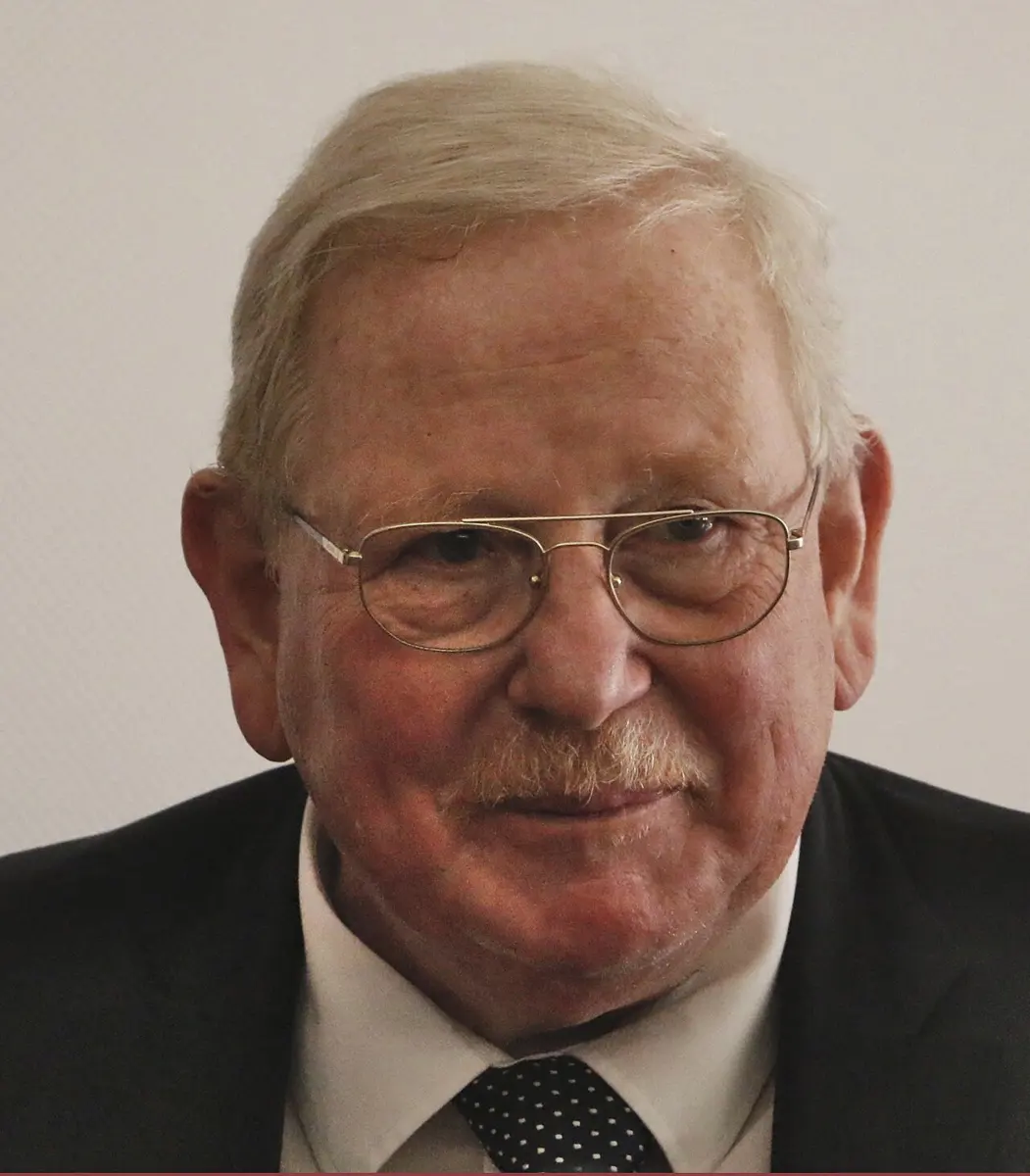
Reinhard Genzel
born 1952 in Germany
As a teenager he was one of Germany’s best young javelin throwers. He has followed the same few stars for thirty years.
Photo: Pavel Hrdlička (Czech Wikipedia user Packa ), CC BY-SA 4.0

Andrea Ghez
born 1965 in the United States
At four, watching the Moon landings, she told her mother she would be the first woman on the Moon. She became the fourth woman to win the Nobel Prize in Physics.
Photo: BorderlineRebel, CC BY-SA 4.0
Throw a stone straight up. It slows down, stops and falls back. Throw it faster and it goes higher before it falls. If you could throw it at 11.2 km/s, it would never come back: it would escape the Earth’s pull for ever. That speed is the Earth’s escape velocity Grade 10: Escape velocity.
Now imagine squeezing the whole Earth into a ball the size of a marble, about 2 cm across. Its gravity at the surface would be so strong that the escape velocity would be greater than the speed of light, 300,000 km/s. Nothing could ever get out, not even light. That is a black hole.
For most of the 20th century, many scientists thought black holes were just a strange answer in a mathematician’s notebook. In 2020 the Nobel Prize in Physics went to one person who proved they must really form, and to two who found a giant one at the center of our own galaxy.
The problem: a strange answer nobody trusted
The idea is old. In the 1780s and 1790s, the English thinker John Michell and the French scientist Pierre-Simon Laplace each wondered whether a star could be so heavy and so dense that light could not escape it. They called such things “dark stars”.
In 1915 Albert Einstein gave a new picture of gravity, his general theory of relativity. In it, a mass bends space and time around it, a little like a heavy ball makes a dip in a stretched rubber sheet. Only weeks later, a German astronomer, Karl Schwarzschild, found an exact answer to Einstein’s equations for a single round mass. Hidden in it was a black hole: if the mass were squeezed small enough, there would be a boundary around it from which nothing could return.
But most physicists, Einstein among them, did not believe that real stars would ever do this. Schwarzschild’s answer was for a perfectly round star that does not spin. A real star is lumpy, it turns, and the gas in it swirls about. Perhaps, people thought, a real collapsing star would never squeeze all the way. Its parts might miss the center and fly out again, the way water swirling down a drain doesn’t all hit one point.
Then, in 1963, astronomers found quasars: points of light so far away that their light has been traveling for more than a billion years, yet so bright that each must give out more light than hundreds of galaxies. Nothing but matter falling into an enormous black hole could explain that much energy from such a small place. The question became urgent: can black holes really form?
How a black hole works
You need three ideas to follow the story.
- The event horizon. Around a black hole is an invisible boundary, the event horizon. Outside it, light (and a rocket fast enough) can still escape. Inside it, nothing can: every path, even the path of light, leads further in. The horizon is not a surface you could stand on. It is a point of no return.
- Size. The heavier a black hole, the bigger its horizon. To make a black hole, the Earth would have to be squeezed into a ball about 2 cm across, and the Sun into a ball about 6 km across. (Its real diameter is 1.4 million km.)
- The singularity. At the center, Einstein’s theory says, everything that falls in is crushed to infinite density. This is called a singularity, a place where space and time come to an end and the known laws of physics stop working.
You can’t see a black hole, because it gives out no light Grade 9: Why can’t we see a black hole?. You can only see what it does to things near it.
Why can nothing escape from inside a black hole’s event horizon?
Pick an answer to see why.
What they did, step by step
Roger Penrose: a proof on paper (1964–1965)
Roger Penrose was a mathematician, a professor at Birkbeck College in London. He was not trying to make a model of a perfect star. He wanted to know what must happen to any collapsing star, however lumpy.
- Autumn 1964, crossing a street. Penrose was walking and talking with a colleague, Ivor Robinson. They fell silent for a moment to cross a side road, and an idea came to him. He forgot it at once in the conversation, and only that afternoon, puzzled by a strange feeling of happiness, did he search his memory and find it again.
- The idea: a trapped surface. Imagine a sphere in space, and a flash of light given out all over its surface at the same instant. Normally, the light that goes outwards spreads over a bigger sphere, and the light that goes inwards over a smaller one. But where gravity is strong enough, even the light going outwards is dragged in, and ends up on a smaller sphere. Penrose called such a sphere a trapped surface. Its shape doesn’t matter; it needn’t be round at all.
- The proof. Using new mathematics about the shapes of space and time, Penrose showed that once a trapped surface has formed, nothing can stop the collapse. Whatever the star’s shape, however it spins, there must be a singularity inside. Black holes are not a special case of perfect stars. They are what gravity does.
- January 1965. His article was published in the journal Physical Review Letters. The Nobel committee calls it the most important work on the general theory of relativity since Einstein.
Reinhard Genzel and Andrea Ghez: watching the stars at the center (1990s–2020)
If black holes form, the biggest might be at the centers of galaxies. Our own galaxy, the Milky Way, is a flat disc of a few hundred billion stars, about 100,000 light-years across Grade 10: Our galaxy, the Milky Way. The Sun is about 26,000 light-years from its center, which lies in the direction of the constellation Sagittarius. By the 1970s, astronomers had found a small, strong source of radio waves there, named Sagittarius A* (say “Sagittarius A star”).
Two teams set out to see what was there, each with a telescope as big as they could get.
- Reinhard Genzel’s team, from the Max Planck Institute for Extraterrestrial Physics in Germany, began in the early 1990s with the New Technology Telescope in Chile and moved in the 2000s to the Very Large Telescope (VLT) on Paranal mountain, also in Chile: four telescopes, each with a mirror more than 8 meters across.
- Andrea Ghez’s team, at the University of California, Los Angeles, began in 1995 with the two Keck telescopes on Mauna Kea in Hawaii. Each mirror is almost 10 meters across and made of 36 six-sided pieces.
They had two problems to beat.
- Dust. Between us and the center lie huge clouds of gas and dust, which block almost all visible light. But longer waves, infrared rays, get through Grade 9: Infrared rays, so both teams used cameras that see infrared.
- Twinkling. We live at the bottom of an ocean of air about 100 km deep. Warm and cool pockets of air keep bending starlight a little this way and that: that is why stars twinkle Grade 10: Refraction in the atmosphere. In a telescope, it blurs a crowd of stars into a smudge. At first both teams took thousands of very short pictures, each too quick for the air to move much, and combined them. Later they used adaptive optics: a thin, bendable mirror in the telescope that changes its shape many hundreds of times a second to undo the air’s bending. To know how to bend, it watches a bright star nearby, or an artificial “star” made by shining a laser into the sky.
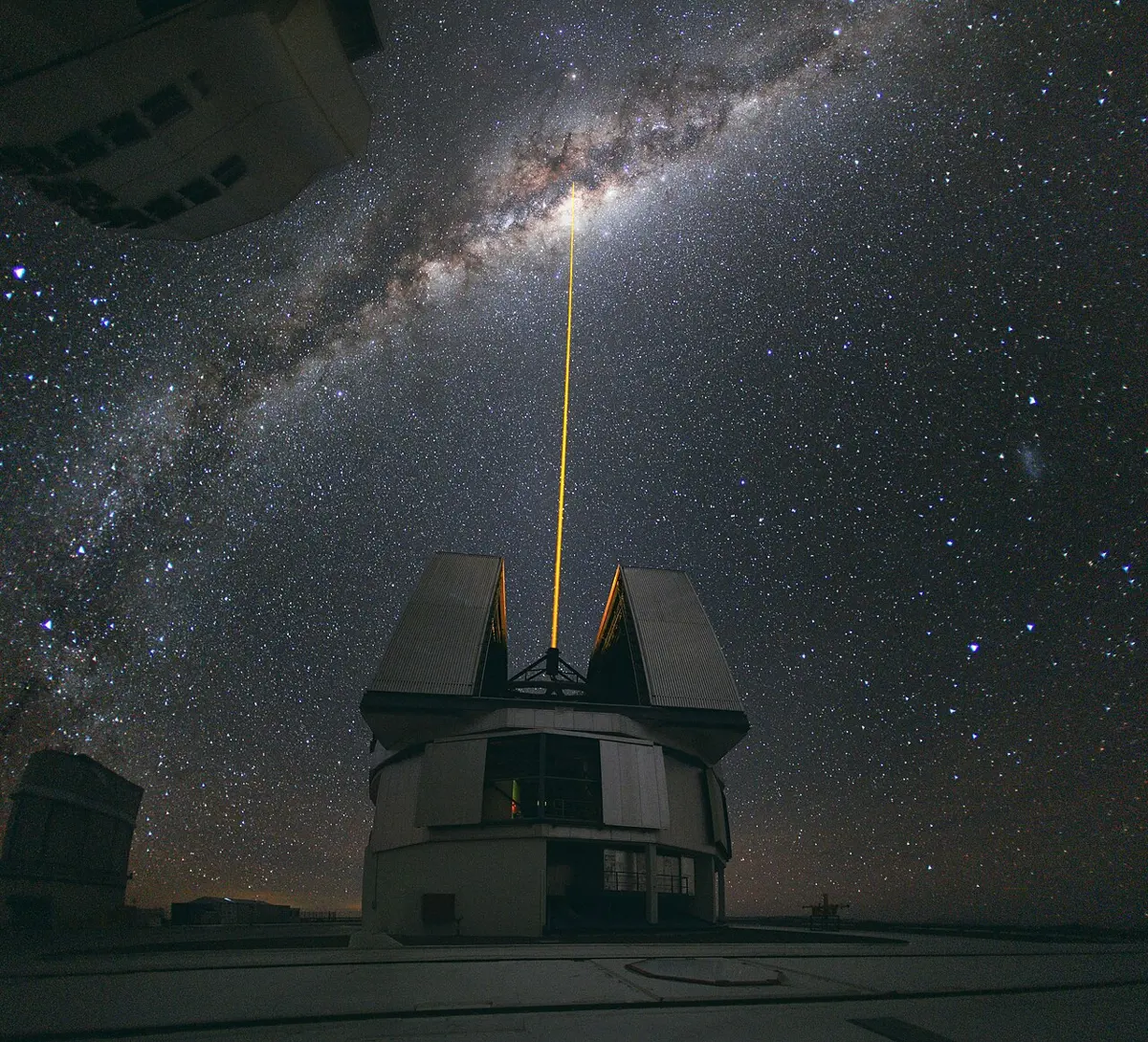
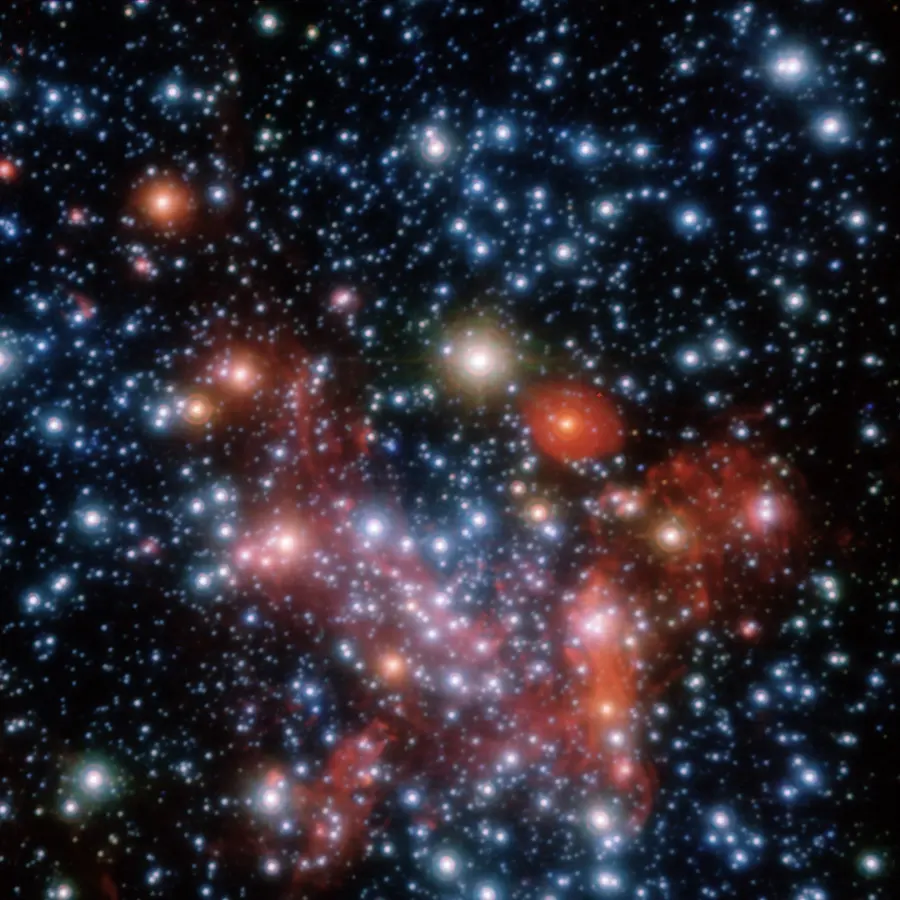
With these, both teams could pick out single stars less than a light-month from the center, and they measured where each one was, year after year. The stars were moving, in curved paths, very fast. They were going round something.
One star, called S2 (Ghez’s team calls it S0-2), goes round in about 16 years, so the teams could follow a whole orbit. Its path is a long, thin ellipse. In 2002, and again in 2018, it swung past the center at about 120 times the distance from the Earth to the Sun, only four times further than Neptune is from the Sun. At its closest, it moves at about 7,700 km/s: fast enough to go from Kathmandu to Pokhara in a fiftieth of a second.
Weighing the invisible
How do you weigh something you can’t see? By the way things orbit it. You may know Kepler’s third law (Kepler’s third law): the further a planet is from the Sun, the longer its year, and the heavier the thing at the center, the faster things go round it.
Four million Suns, inside S2’s closest approach, a space not much bigger than our solar system. Yet nothing there shines like a star. The two teams, working separately with different telescopes, got results that agreed very well. In today’s physics there is only one thing so heavy, so small and so dark: a supermassive black hole.
How did Genzel and Ghez find the mass of the black hole at the center of the Milky Way?
Pick an answer to see why.
How it works now
The two teams keep watching. Genzel’s team now joins the light of all four VLT telescopes with an instrument called GRAVITY, which sees detail as if through one telescope 130 meters wide.
- 2018. When S2 swung close again, both teams saw its light shifted to redder colors, as Einstein’s theory predicts for light climbing out of strong gravity.
- 2020. Genzel’s team found that S2’s ellipse slowly turns round after each orbit, again by just the amount Einstein’s theory predicts and Newton’s does not.
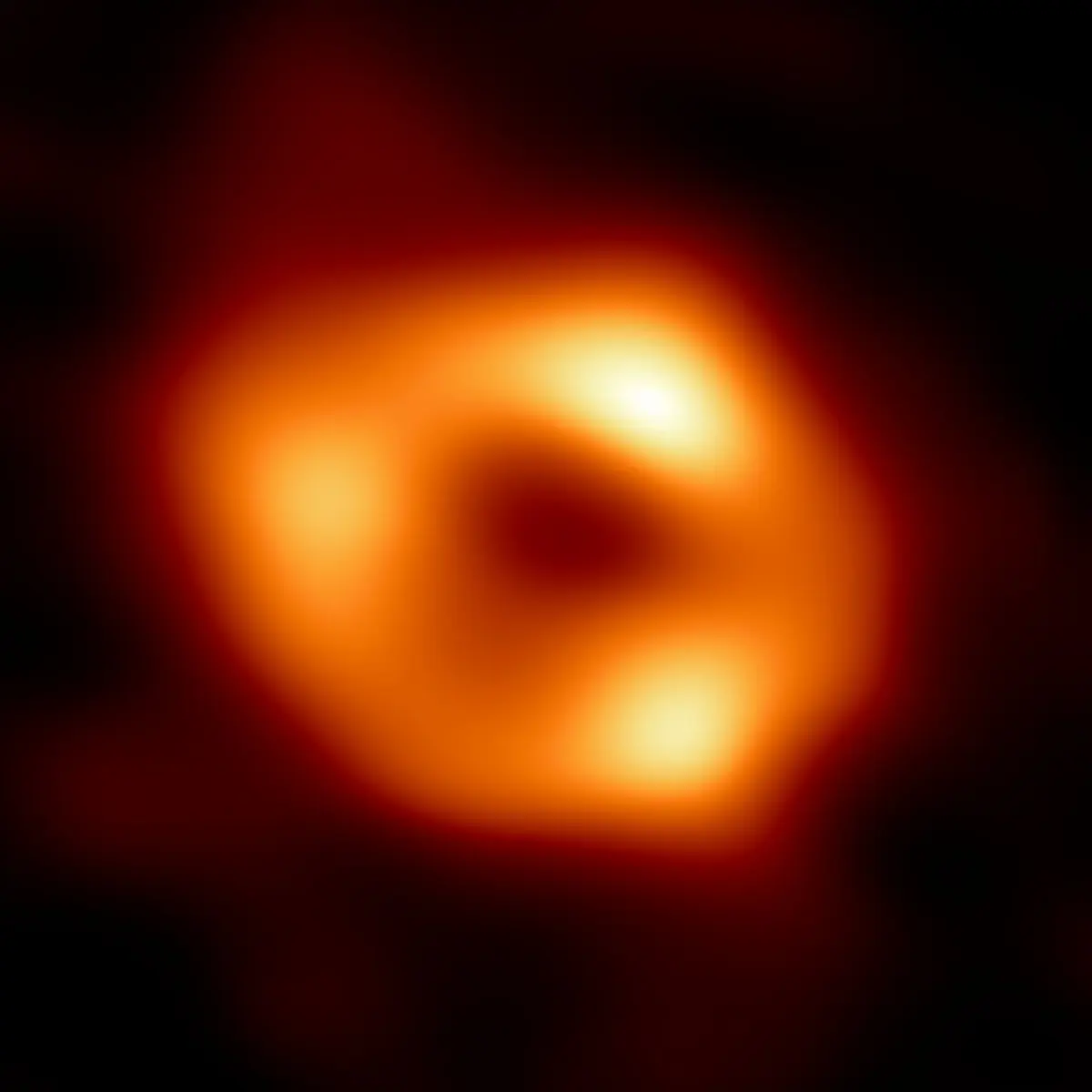
In May 2022, the Event Horizon Telescope, radio telescopes all over the world working together as one the size of the Earth, released the first picture of Sagittarius A* itself: a ring of glowing gas around a dark center. Its mass, worked out from the size of the ring, agreed with the stars’.
In your life today
Black holes don’t power anything in your home. What they give is understanding: the stars of the Milky Way, our Sun among them, all go round something we now know is a black hole.
- Einstein in your phone. The same theory is used every day. The clocks in GPS satellites run slightly fast, because gravity is weaker up there, and the system corrects for it. Without that, the map on your phone would drift by kilometers a day.
- Adaptive optics in the eye clinic. The trick of undoing twinkling is now used in research instruments that look into the human eye, past the wobbles of the eye’s own lens, to see single cells of the retina.
- The center of the galaxy, from Nepal. On a clear, dark evening from July to September, look south. The Milky Way is brightest and widest low in the south, in Sagittarius, whose brightest stars look like a teapot. The black hole is in that direction, hidden behind the dust.
What came next
- Black holes everywhere. Astronomers now think almost every large galaxy has a supermassive black hole at its center. In 2019 the Event Horizon Telescope pictured one in the galaxy M87, more than a thousand times heavier than ours.
- Black holes that crash. Since 2015, LIGO has caught gravitational waves from smaller black holes crashing together (the Nobel Prize in Physics, 2017).
- Too big, too early? The James Webb Space Telescope has found big black holes in galaxies seen as they were less than a billion years after the Big Bang. How they grew so heavy so quickly is an open question.
The biggest open question is inside. At the singularity, Einstein’s theory says the density becomes infinite, and so the theory itself stops making sense there. To understand what really happens, physicists need a new theory that joins general relativity with quantum physics, the physics of atoms. Nobody has found it yet.
In your science books
- Grade 8: galaxies, and the black hole at the center of the Milky Way.
- Grade 9: the death of a star and what is left after a supernova, the light-year and infrared rays.
- Grade 10: Newton’s law of gravitation, the Milky Way, escape velocity and why stars twinkle.
- Going Further: Kepler’s three laws and weighing the Earth, the Sun and Jupiter, the same method the two teams used.
Learn more
- The Nobel Prize’s own explanation: Black holes and the Milky Way’s darkest secret (nobelprize.org).
- The three laureates’ Nobel lectures: Penrose, Genzel and Ghez.
The official reason
The prize was given “for the discovery that black hole formation is a robust prediction of the general theory of relativity.”
The prize was given “for the discovery of a supermassive compact object at the centre of our galaxy.”