
Telomeres: the caps on our chromosomes
Nobel Prize in Physiology or Medicine, 2009: Elizabeth H. Blackburn, Carol W. Greider, and Jack W. Szostak
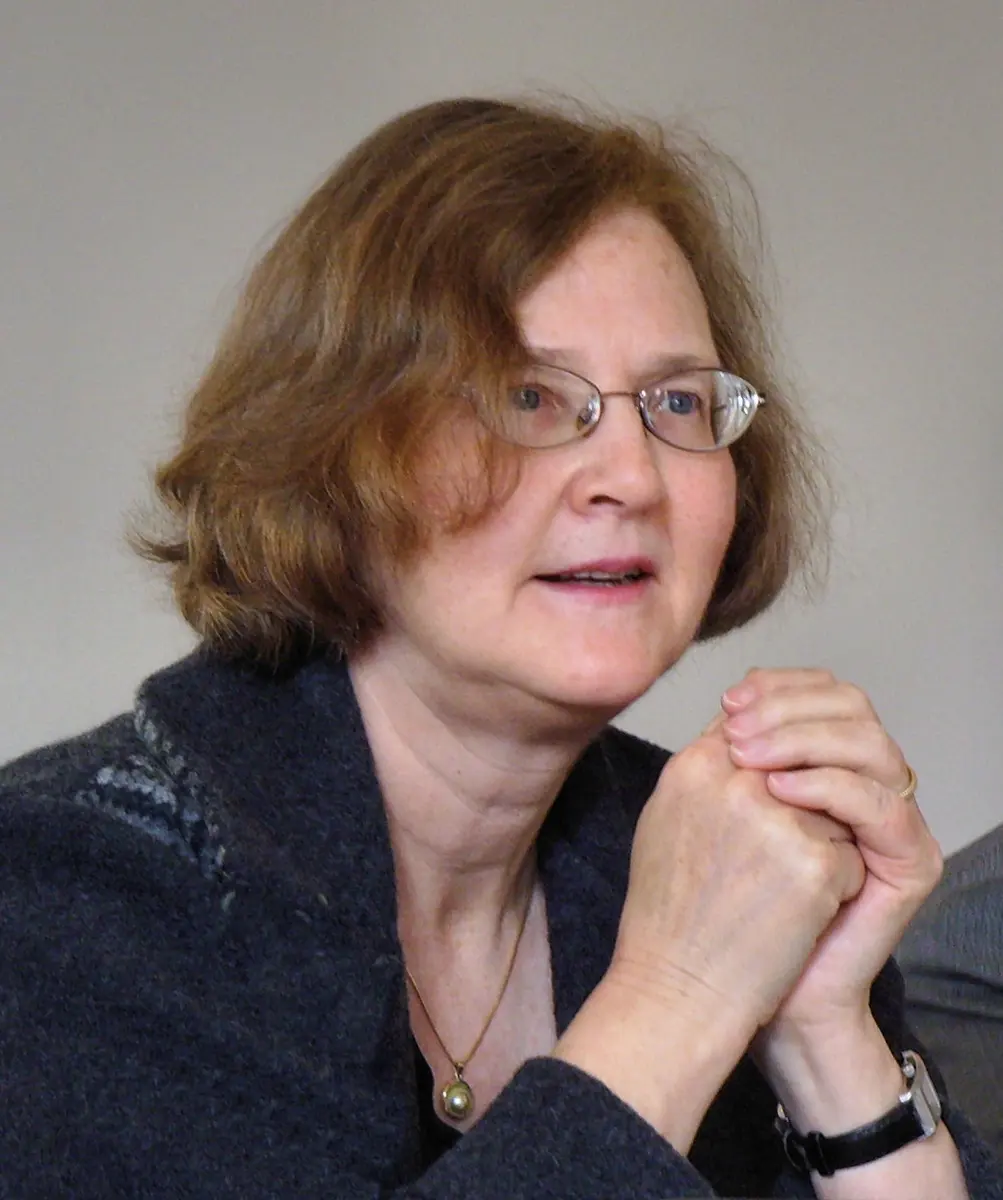
Elizabeth H. Blackburn
born 1948 in Tasmania, Australia
A doctors’ daughter who kept tadpoles in jars and grew up with rabbits, guinea pigs, chickens and canaries. Her girls’ school taught no physics, so she went to evening classes at another school to learn it.
Photo: Gerbil, CC BY-SA 3.0
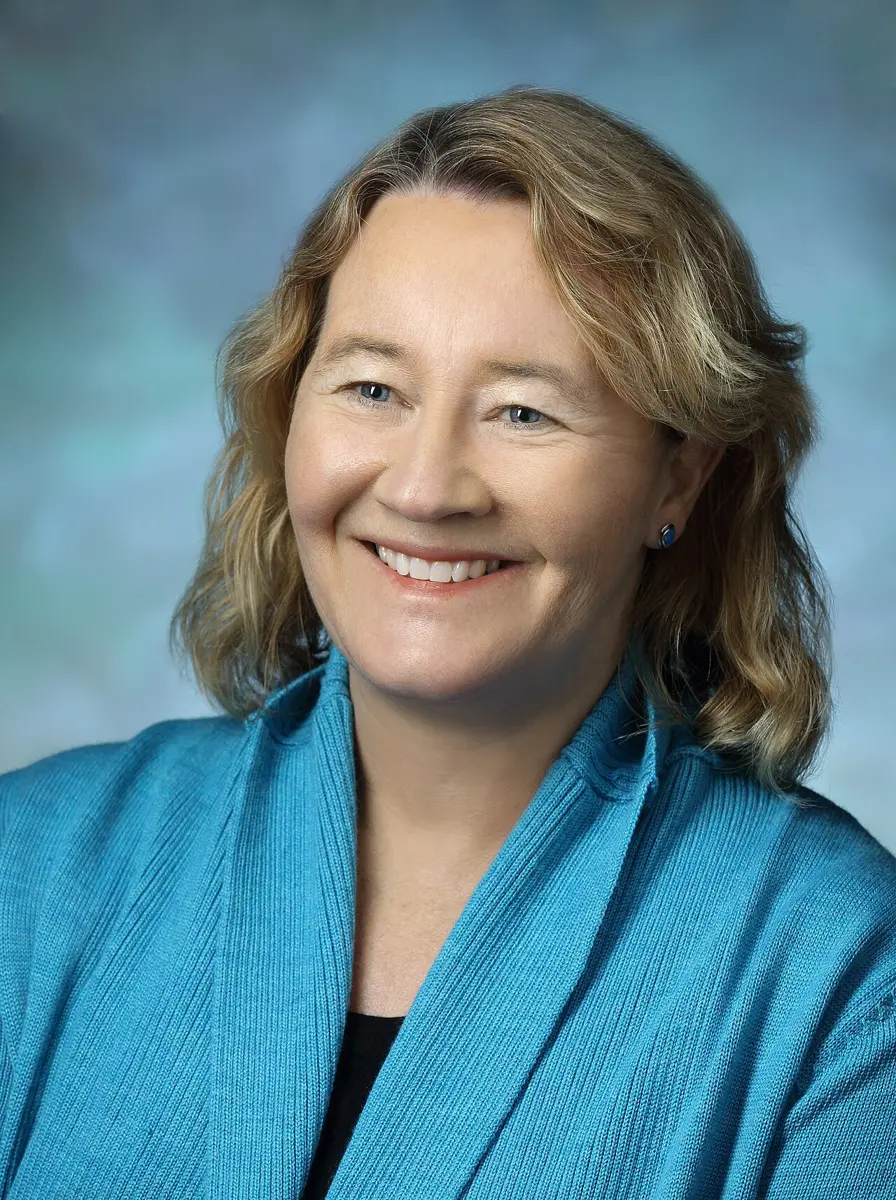
Carol W. Greider
born 1961 in the United States
As a child she was sent out of class for extra spelling lessons and thought she was “stupid”. Only much later did she learn that she is dyslexic. She found telomerase at 23, as Blackburn’s student.
Photo: Keith Weller, CC BY-SA 4.0
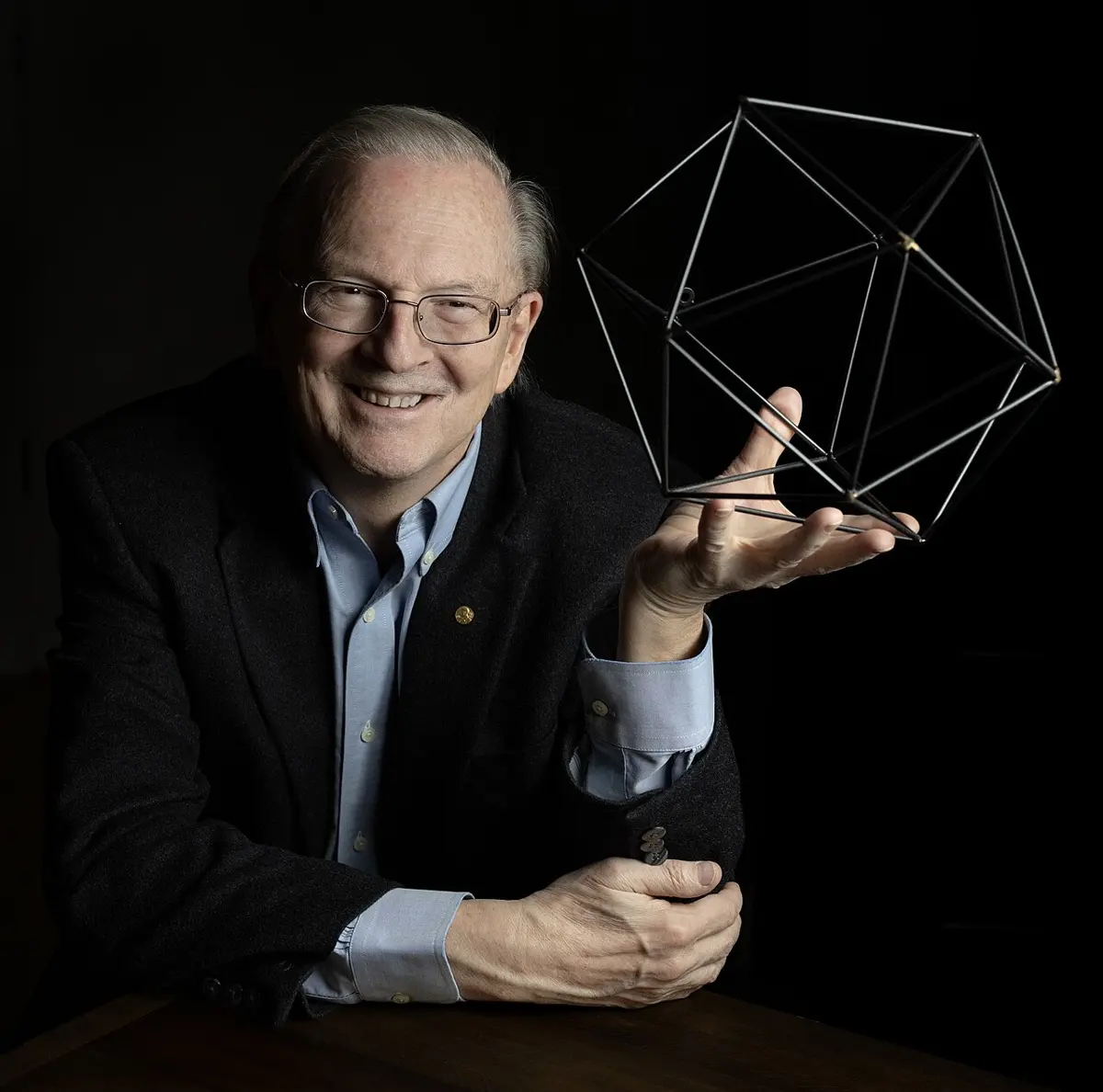
Jack W. Szostak
born 1952 in London
Born in London’s deadly smog of 1952 and raised in Canada, he went on from telomeres to a new question: how did the first living cells begin?
Photo: Christopher Michel, CC BY-SA 4.0
Look at the end of a shoelace. It has a small plastic tip, so that the threads don’t fray and come apart. Your chromosomes, the long threads of DNA that carry your genes, have something like that too. Their tips are called telomeres.
Every time one of your cells divides, all 46 of its chromosomes must be copied, letter by letter, so that each new cell gets a full set Grade 10: Mitosis. The 2009 Nobel Prize in Physiology or Medicine went to three scientists who found out how the ends of the chromosomes are protected and kept whole: Elizabeth Blackburn, Carol Greider and Jack Szostak.
The problem: two puzzles at the ends
Bacteria keep their DNA in a closed circle, which has no ends. Plants, animals and people keep theirs in long straight threads, the chromosomes Grade 10: Chromosome. Straight threads have ends, and ends caused two puzzles.
Puzzle 1: ends that look broken
In the 1930s two scientists, Barbara McClintock and Hermann Muller, studied chromosomes that had been broken, in maize and in fruit flies. They noticed that a broken end was “sticky”: it stuck to other broken ends, and the chromosomes became tangled and damaged. But the natural ends of chromosomes never did this. Muller gave them a name, telomere, from the Greek telos (end) and meros (part). Something about a natural end protected it, but nobody knew what.
Puzzle 2: ends that should get shorter
Before a cell divides, its DNA is copied by an enzyme (a protein that does a chemical job in the cell) called DNA polymerase. In the early 1970s James Watson pointed out a problem. The way DNA polymerase works, it can’t start on its own. It needs a short starter piece to begin each stretch. The starter is removed afterwards and the gap filled from the stretch behind it. But at the very end of a thread, there is nothing behind it, so the last little bit is never copied.
So every time a cell divided, its chromosomes should get a little shorter. After enough divisions, the genes near the ends would be cut away. Yet most cells, and above all the cells that make eggs and sperm, pass on their chromosomes whole, generation after generation. How?
In the early 1970s a Russian scientist, Alexei Olovnikov, linked this to something odd about human cells grown in dishes: they can divide only a limited number of times, and then they stop. Perhaps, he suggested, the chromosomes get a little shorter at each division, and the cell stops when they have become too short. It was a clever guess, but nobody could test it until the ends of chromosomes were understood.
Why don’t bacteria have the problem of chromosomes getting shorter each time they divide?
Pick an answer to see why.
Why it was hard
- Ends are tiny. A telomere is a minute part of a chromosome. To study its letters you need a lot of pure telomere DNA, and in the 1970s there was no way to get it from human cells.
- Reading DNA was new. The first methods to read the order of the letters in DNA were only invented in the mid-1970s, and were slow.
- No known enzyme could do the job. Every enzyme that made DNA did it by copying another strand. If something was adding DNA to the ends, it had to be a kind of enzyme nobody had ever seen.
What they did, step by step
Blackburn: reading the end of a chromosome
Elizabeth Blackburn grew up in Tasmania, an island state of Australia, studied in Melbourne, and learned the brand-new methods of reading DNA in Cambridge, England, in the laboratory of Frederick Sanger, who invented them.
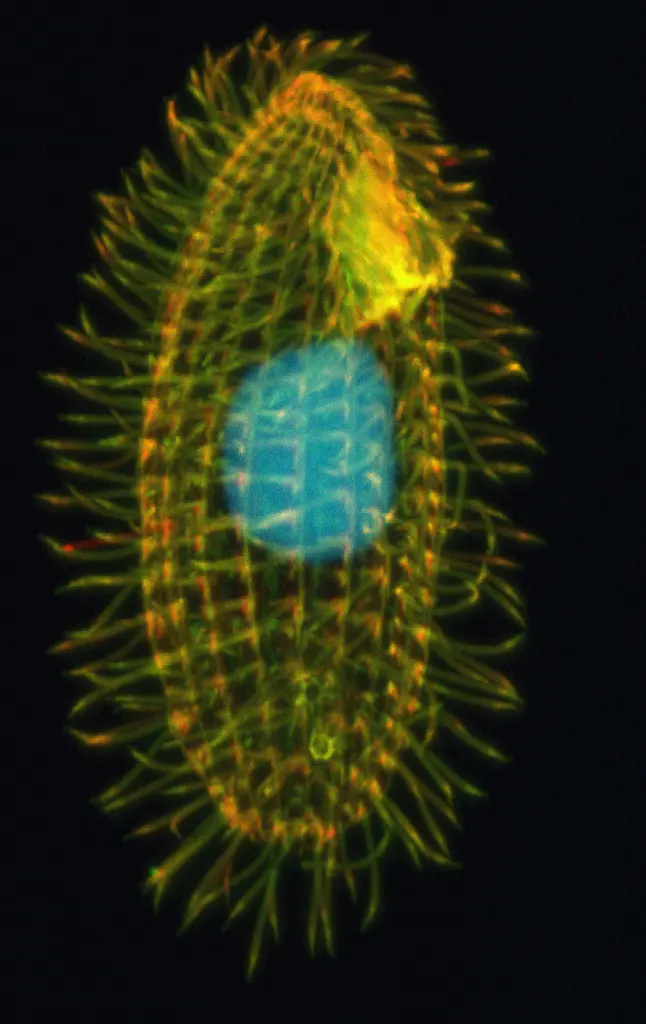
- 1975, the right creature. At Yale University in the United States she studied Tetrahymena, a tiny one-celled creature from ponds, a cousin of the Paramecium in your science book Grade 9: Kingdom Protista. Tetrahymena is useful because its nucleus holds thousands of tiny chromosomes, with more than 40,000 telomeres in one cell. That meant plenty of chromosome ends to study.
- The repeated letters. She found that the ends of its chromosomes carry a short, simple sequence of six letters, CCCCAA (TTGGGG on the other strand), repeated 20 to 70 times. Stranger still, the number of repeats differed from one chromosome to another, as if they were added after copying rather than copied.
Blackburn and Szostak: a test across two kingdoms
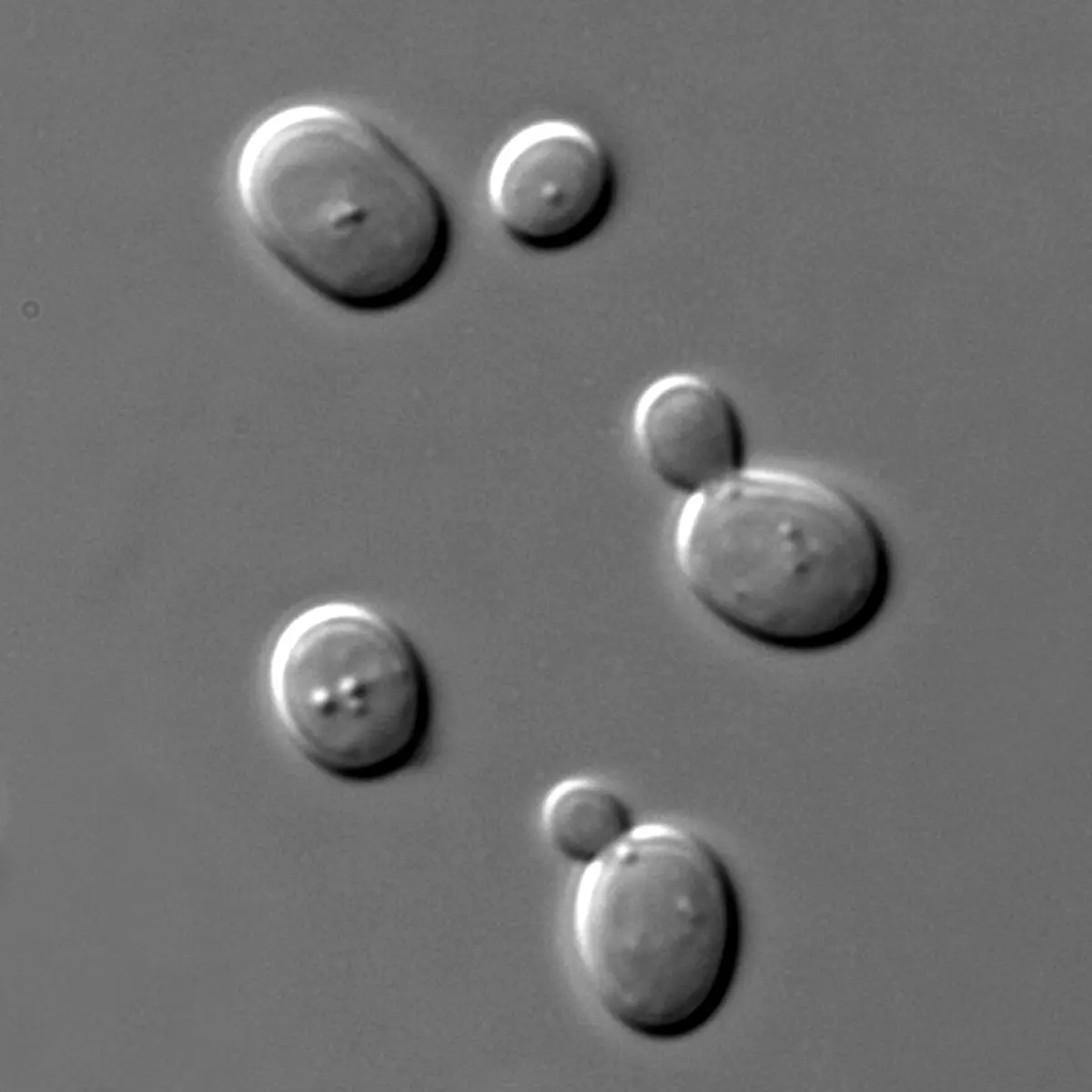
- 1980, a conference. Blackburn described her repeated letters at a scientific meeting. In the audience was Jack Szostak, of Harvard Medical School. He had a problem of his own: he was putting small, man-made straight chromosomes into yeast cells (the yeast that makes bread rise), and the yeast quickly chopped them up.
- The bold idea. Szostak suggested an experiment. Could the ends from Tetrahymena protect his chromosomes inside yeast? Tetrahymena and yeast are only very distant relatives: one is a protist, the other a fungus.
- 1982, it worked. Blackburn sent the telomere DNA; Szostak joined it to the ends of his man-made chromosomes and put them into yeast. Now the chromosomes survived. The six-letter repeats were the protection. Soon Szostak found yeast’s own telomeres, made of a very similar repeat.
- The ends grew. When they looked at these chromosomes again after a while in the yeast, their ends had grown longer. Something in the cell was adding new letters to the ends.
In 1982, what did the experiment with Tetrahymena’s telomeres in yeast show?
Pick an answer to see why.
Greider and Blackburn: Christmas Day, 1984
Carol Greider came to Blackburn’s laboratory at the University of California, Berkeley, as a student working towards her PhD. Together they set out to find the unknown enzyme.
- The test. They ground up Tetrahymena cells into a soup, the extract, and added short pieces of telomere DNA and DNA letters that were made slightly radioactive, so that wherever they were added they would show up on X-ray film. If an enzyme was adding letters to the ends, the pieces would grow, and they would grow in steps of six.
- 25 December 1984. Greider was in the laboratory on Christmas Day and developed the film. It showed a neat ladder: pieces that had all started the same length now came in a series of longer lengths, one six-letter step apart. A new enzyme had been found. They named it telomerase.
- 1989, the built-in pattern. Most enzymes are made only of protein. Greider and Blackburn found that telomerase also carries a short piece of RNA, and that this RNA holds the pattern of the telomere: the letters to be copied. Telomerase carries its own blueprint.
- 1990, the proof. Blackburn’s team changed a few letters in telomerase’s RNA. The telomeres that Tetrahymena then built carried the same changed letters. The RNA really was the pattern.
How it works in your body
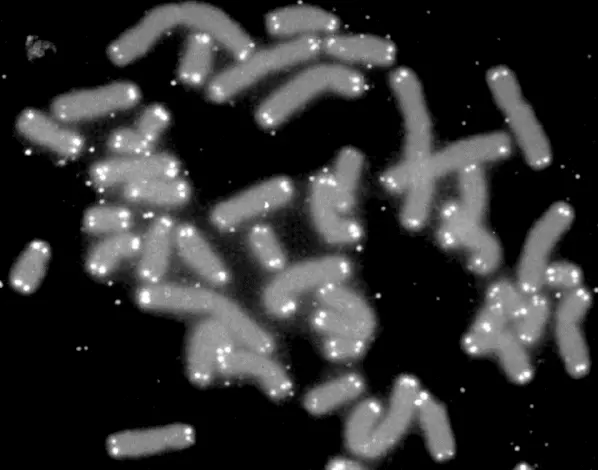
In 1988 scientists found the human telomere: TTAGGG, repeated a thousand times or more, several thousand letters long at each end of each chromosome. Proteins sit on these repeats and fold the end into a protective cap, so the cell doesn’t mistake it for a broken piece of DNA.
- Most of your cells have little or no telomerase. Each time one of them divides, its telomeres lose a little, roughly 50 to 100 letters in cells grown in a dish.
- Cells that must divide many times keep telomerase switched on: the stem cells that make new blood and skin, and the cells that make eggs and sperm. That is why a baby is born with long telomeres, even if its parents are old.
In your life today
- Aging cells. Skin cells from a newborn baby, grown in a dish, can divide about 80 to 90 times; cells from a 70-year-old only 20 to 30 times. Shrinking telomeres are one reason. Some people hoped that telomeres were the clock of human aging, but aging turned out to have many causes, and telomeres are only one of them.
- Cancer. A cancer cell divides again and again, without stopping. To do that, it must stop its telomeres running out. In about 80 to 90 out of 100 cancers, the cells have switched telomerase back on. The shortening of telomeres in normal cells is probably one of the body’s brakes against cancer.
- Rare diseases. Some children are born with a faulty telomerase. Their bone marrow can’t make enough new blood cells, and some develop diseases of the skin or lungs.
Why might a medicine that blocks telomerase help to treat cancer?
Pick an answer to see why.
What came next
- The first telomerase medicine. In June 2024 the United States approved the first medicine that blocks telomerase, imetelstat, for a kind of bone marrow cancer. As expected, it also lowers the numbers of some healthy blood cells.
- A new question for Szostak. After telomeres, Szostak turned to one of the biggest questions in science: how did the very first cells begin, on the young Earth? His team builds simple “protocells” from fatty bubbles and RNA, to see what might have happened.
- An open question. We now know that telomeres shorten with age and that stress, smoking and illness may speed this up. But does the shortening cause aging, or is it just a sign of it, like gray hair? Scientists are still trying to find out.
In your science books
- Grade 8: budding in yeast.
- Grade 9: kingdom Protista, where Tetrahymena’s cousin Paramecium belongs, and kingdom Fungi, where yeast belongs.
- Grade 10: mitosis, DNA and chromosomes.
- Going Further (Grades 9–12): stem cells and keeping a body going, where cells divide all life long.
Learn more
- The Nobel Prize’s own explanation: popular information on the 2009 prize (nobelprize.org).
- The laureates’ Nobel lectures: Blackburn, Greider and Szostak.
The official reason
The prize was given “for the discovery of how chromosomes are protected by telomeres and the enzyme telomerase.”