
Prions: proteins that spread disease
Nobel Prize in Physiology or Medicine, 1997: Stanley Prusiner
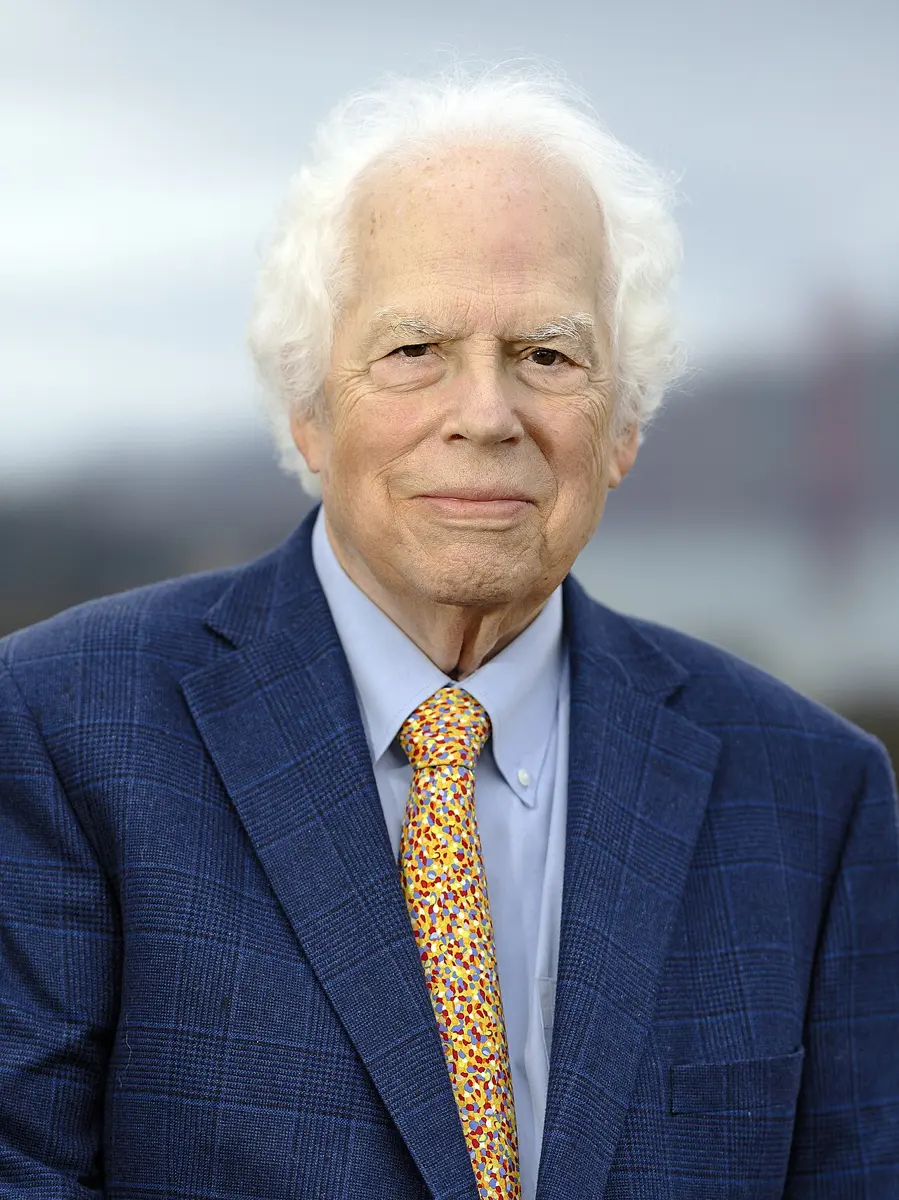
Stanley Prusiner
born 1942 in the United States
A doctor who watched one patient die of a rare brain disease, and spent the next ten years hunting for its cause, while many scientists told him he was wrong.
Photo: Christopher Michel, CC BY 4.0
Crack an egg into a hot pan. The clear, runny egg white turns solid and white within seconds, and however long you wait, it never turns clear again. Nothing has been added and nothing taken away. The proteins in the egg white have simply changed their shape.
A protein’s shape matters more than you might think. In 1997 the Nobel Prize in Physiology or Medicine went to Stanley Prusiner, who found that a protein in our own brain can fold into a wrong shape, and that the wrong shape can spread from one protein to the next, from one animal to another, and even from cows to people. He called these infectious proteins prions (say PREE-ons).
The problem: brain diseases with no germ
Every disease that spreads from one living thing to another was known to be caused by a germ: a bacterium, a virus, a fungus or a parasite Grade 8: microorganisms. Every germ, however small, carries its own instructions for making copies of itself, written in DNA or its cousin RNA Grade 10: DNA. Without those instructions, a germ cannot multiply.
But a few strange diseases did not fit.
- Scrapie is a disease of sheep, known to farmers in Europe for nearly 300 years. A sick sheep becomes nervous, trembles, and scrapes its wool off against fences.
- Creutzfeldt–Jakob disease (CJD), described by two German doctors in the 1920s, affects about one person in a million. The person loses their memory and control of their body, and dies, usually within a year.
- Kuru struck the Fore people in the mountains of Papua New Guinea. Its victims trembled and lost their balance. In the 1950s and 1960s the American doctor Carleton Gajdusek showed that kuru spread through a funeral custom in which families ate parts of their dead relatives, including the brain. When the custom stopped around 1960, kuru slowly died out. Gajdusek won the 1976 Nobel Prize in Physiology or Medicine.
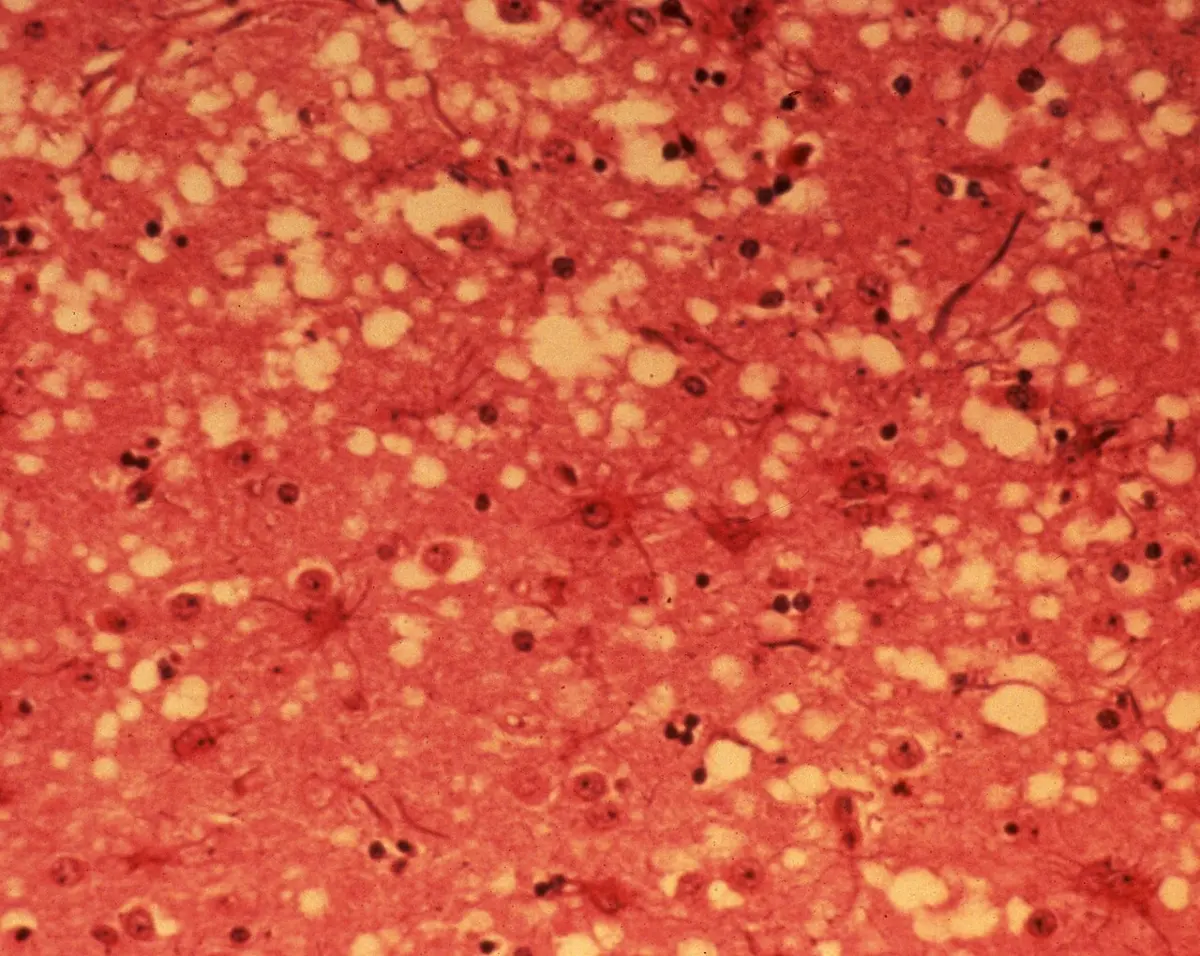
All these diseases had the same signs. They took years to appear after infection, they always ended in death, and under a microscope the brain was full of tiny holes, like a sponge. Scientists showed that a bit of a sick brain, put into a healthy animal’s brain, gave it the disease. So something infectious was there. They called it a slow virus, but nobody could find it.
How proteins work
To understand prions, you need to know a little about proteins. Proteins do most of the work in your body: they carry oxygen in your blood, digest your food, build your hair and muscles, and pass messages between cells.
A protein is a long chain of small building blocks called amino acids, joined one after another like beads on a string. There are 20 kinds of amino acid. Your genes, written in DNA, give the order of the beads for each protein (how a gene makes a protein).
Once the chain is made, it folds up into a particular shape, the way a long piece of string can be folded into a knot. The shape decides the job. A protein that has folded wrongly usually cannot do its job, and the cell breaks it down.
This is what happens to egg white in the pan. Heat makes its proteins unfold and tangle together into a new shape. The chain of amino acids is the same; only the folding has changed.
Why it was hard
- Each test took months. To find out whether a sample still held the infectious agent, the scientists had to inject it into the brains of mice and wait. The mice took about 200 days to fall ill. One answer could take most of a year.
- The agent was very hard to kill. Heat that kills bacteria and viruses, even above 100 °C, did not destroy it. In 1967 the British scientist Tikvah Alper found that it survived doses of radiation that wreck DNA and RNA. Perhaps it had no DNA or RNA at all? A few scientists, such as the British biophysicist John Griffith, guessed that it might be a protein. But nobody knew how a protein could make copies of itself.
- The body did not fight it. A virus or bacterium makes the body’s defenses attack it. In these diseases, there was no fever and no attack. The body seemed not to notice the germ at all.
What made scientists suspect that the agent of scrapie had no DNA or RNA?
Pick an answer to see why.
What Prusiner did, step by step
Choosing the problem (1972–1974)
- One patient (1972). In 1972 Stanley Prusiner was a young doctor training in neurology, the study of the brain and nerves, in San Francisco. Two months into his training he cared for a woman who was losing her memory. She was dying of CJD. Prusiner learned that nobody knew what caused it.
- A laboratory (1974). He read everything he could find about CJD, kuru and scrapie, and in 1974 he set up his own laboratory to find the agent. He chose scrapie, because it could be passed to laboratory animals.
Purifying the agent (1974–1982)
- Faster animals. Prusiner’s team moved from mice to hamsters, which fall ill from scrapie much sooner. That made each test quicker.
- Separating the parts. Starting from sick hamster brains, they separated the material into parts again and again, testing at each step which part was still infectious. After about ten years of work they had a sample that was almost pure infectious agent.
- Testing what it was made of. They treated this sample in two ways. Treatments that destroy DNA and RNA left it just as infectious. Treatments that destroy proteins made it much less infectious. The agent seemed to be a protein, with no DNA or RNA.
- A new name (1982). In 1982 Prusiner published his results and named the agent a prion, from the words proteinaceous infectious particle: an infectious particle made of protein.
Many scientists were angry. Every germ ever found had DNA or RNA, and the virus experts were sure that a tiny virus was hiding in his samples. One of the organizations paying for his research stopped supporting him, and for a while his university would not give him a permanent job (it changed its mind). The speech at the prize ceremony said that he fought “an uneven battle against overwhelming opposition” for more than ten years.
The protein is our own (1984)
- Reading the protein. Prusiner’s team found the protein in their samples and named it prion protein, PrP. In 1984, with other scientists, they worked out part of its order of amino acids. From that, they could search for the gene that carries its instructions.
- A shock. The gene was not in a virus. It was in the animals’ own DNA: in hamsters, in mice, and in every animal tested, including humans. Healthy brains made the prion protein too, in the same amounts as sick ones.
This seemed to prove Prusiner wrong. How could a protein that every healthy brain makes be the cause of a deadly disease?
Two shapes of one protein
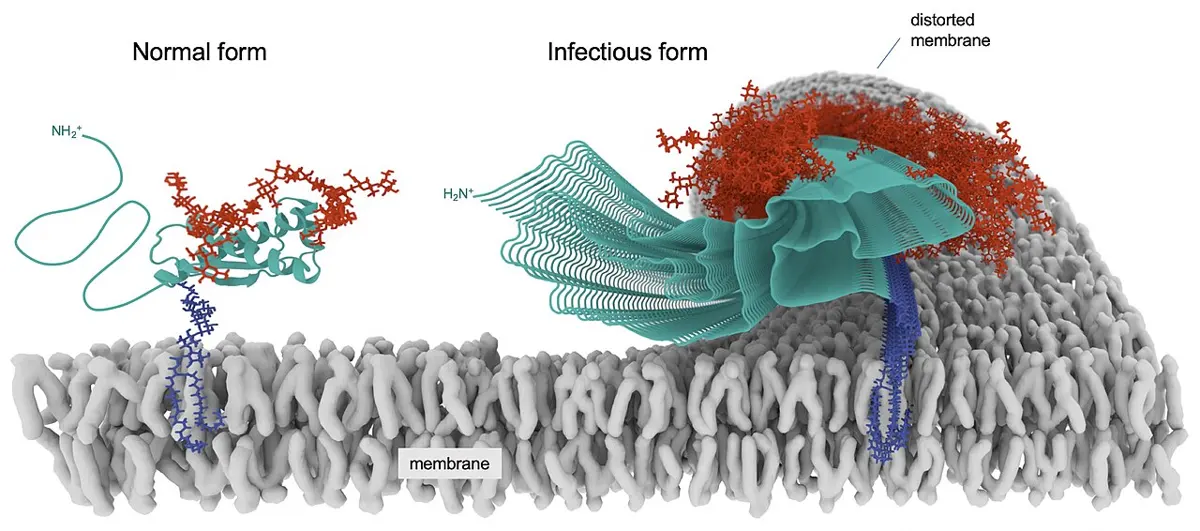
- The difference was the shape. The protein from sick brains had exactly the same chain of amino acids as the healthy one, but it was folded differently. The normal form is mostly coiled. The disease form has many flat, sheet-like parts instead.
- A tougher form. The two forms behave very differently. The normal form is easily broken down by the enzymes that digest proteins. The disease form resists them, and also resists heat and many chemicals. Inside the brain, it isn’t cleared away. It piles up.
- Copying without DNA. Prusiner proposed how a prion multiplies: when a misfolded prion protein meets a normal one, it makes the normal one refold into the wrong shape. Now there are two misfolded proteins, then four, then eight. It is a chain reaction, and it needs no DNA, because the instructions are the shape itself.
The prize committee compared the two forms to Dr Jekyll and Mr Hyde, the man in an old story who turns from a kind doctor into a monster: the same thing in two forms, one harmless and one deadly.
What is the difference between a normal prion protein and a disease-causing prion?
Pick an answer to see why.
The final proof: mice without the gene (1992–1993)
- If prions spread by converting the body’s own prion protein, then an animal without that protein should not catch the disease. In 1992 a team in Zurich, Switzerland, led by Charles Weissmann, who worked with Prusiner, bred mice whose prion gene had been removed. These knock-out mice grew up healthy.
- When the knock-out mice were given prions, they did not fall ill. Normal mice given the same prions did. When the gene was put back into knock-out mice, they could catch the disease again. The infection needed the body’s own protein to work on.
How it works now
Prion diseases can start in three ways, which is unusual for a disease.
- By chance. Once in a while, a prion protein in someone’s brain folds wrongly by itself and starts the chain reaction. Between 85 and 90 per cent of CJD cases start like this, mostly in older people.
- Through the genes. About 10 to 15 per cent of CJD cases run in families. A small change, a mutation, in the prion gene makes the protein much more likely to misfold (one wrong letter). Prusiner’s team put such a changed gene into mice, and the mice fell ill.
- By infection. Rarely, prions get in from outside: from eating infected brain (kuru), or, in the past, from medical treatment with material taken from people who had the disease.
Where in the brain the prions pile up decides what goes wrong. In kuru, the damage is worst in the cerebellum, which controls balance, so people trembled and staggered Grade 9: cerebellum. In CJD, the cerebrum, where we think and remember, is badly hit Grade 9: cerebrum.
Mad cow disease
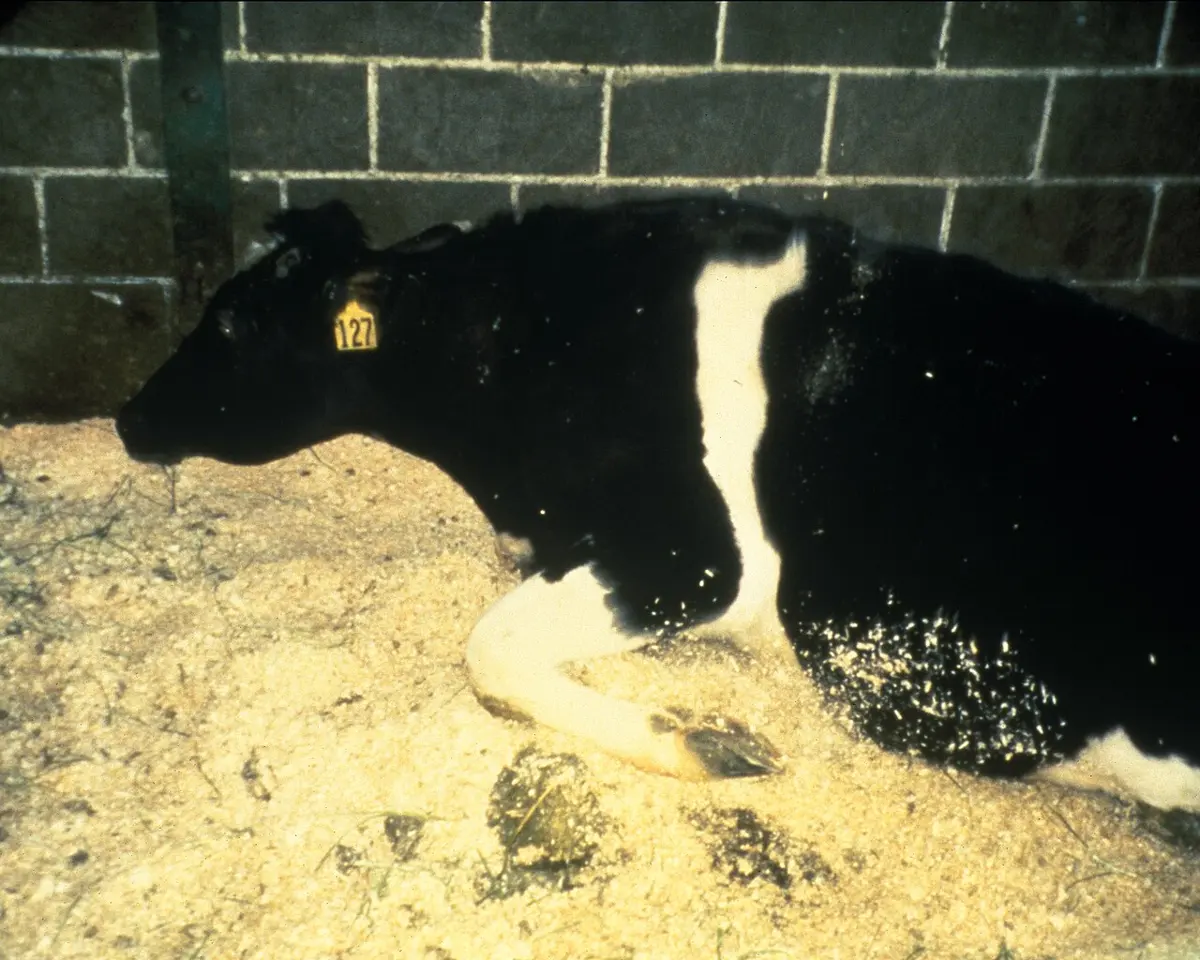
In the mid-1980s, cattle in Britain began to fall ill. They became nervous, stumbled and could not stand. Their brains were full of holes, like the brains of sheep with scrapie. The disease was named bovine spongiform encephalopathy (BSE), and the newspapers called it mad cow disease.
The cause was the cattle’s feed. To make them grow faster, cows had been fed meat-and-bone meal, a powder made from the remains of dead farm animals. If any of those animals carried prions, the prions went into the feed and on into thousands of cows. Whether the first prions came from sheep with scrapie or from a cow that fell ill by chance is still not known.
Britain banned feeding this meal to cattle in 1988, but because the disease takes years to appear, cases kept rising into the early 1990s. More than 184,000 cattle were found with BSE in Britain between 1986 and 2015.
Then, in March 1996, British scientists reported a new form of CJD in young people. It was named variant CJD, and it most likely came from eating beef products containing infected brain or nerve tissue. About 230 people have died of it worldwide, 178 of them in Britain.
In your life today
- Safe cattle feed. Because of BSE, many countries now forbid feeding cattle with meat-and-bone meal made from animals like them, and test sick cattle. Mad cow disease has almost disappeared.
- Safe operations. Prions stick to steel and survive normal cleaning. Hospitals that operate on the brain clean their instruments with strong chemicals, such as sodium hydroxide, and then heat them with steam under pressure for a long time. Even the steam in a pressure cooker, at about 120 °C, is not enough on its own.
- Safe medicines. Some children who need growth hormone were once treated with hormone taken from the brains of people who had died, and a few caught CJD from it. Since the 1980s, growth hormone has been made by bacteria with a human gene instead, which cannot carry prions.
What came next
- Other brain diseases. In Alzheimer’s disease and Parkinson’s disease, other proteins fold wrongly, clump together and spread through the brain in a way much like prions. These diseases are not caught from other people in everyday life, but Prusiner’s idea has changed how scientists study them.
- A natural protection. In 2009, scientists found that some Fore people carry a small change in their prion gene that protects them from kuru. It seems to have spread during the kuru epidemic, because those who carried it survived.
- A disease in deer. Chronic wasting disease, a prion disease of deer, elk and moose, is spreading in North America and has been found in Scandinavia. It hasn’t been found in people, and scientists watch it closely.
- What is the normal prion protein for? Mice without it live almost normal lives. Every mammal makes it, so it must do something, but after decades of research its job is still not clear.
In your science books
- Grade 8: microorganisms: viruses and bacteria, the germs that do carry DNA or RNA.
- Grade 9: the brain, its cerebrum and cerebellum, and nerve cells.
- Grade 10: DNA and RNA.
- Going further: How does a gene make a protein?, with a chain that folds and one wrong letter.
Learn more
- The prize at nobelprize.org: The Nobel Prize in Physiology or Medicine 1997, with the press release and the presentation speech.
- Prusiner’s Nobel lecture, Prions, and his own story of his life.
The official reason
The prize was given “for his discovery of Prions - a new biological principle of infection.”