
How a cell feels a message from outside
Nobel Prize in Chemistry, 2012: Robert J. Lefkowitz and Brian K. Kobilka
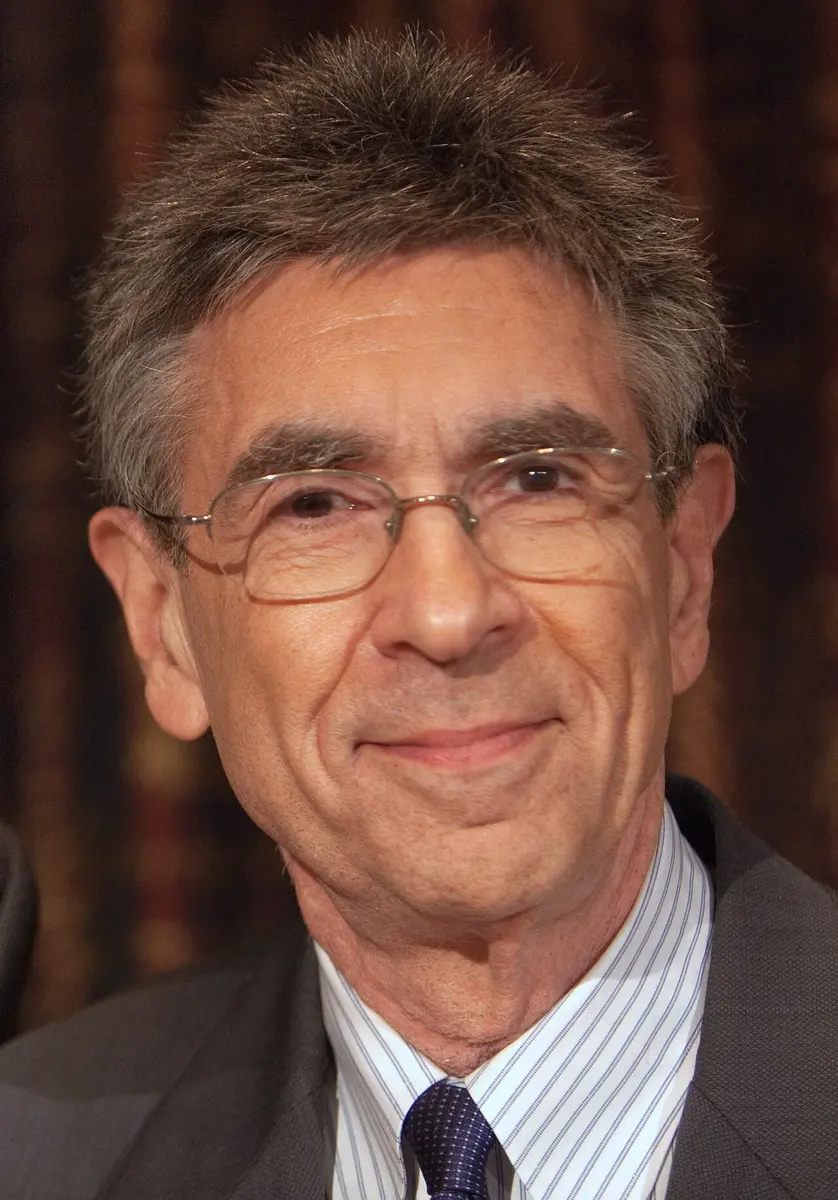
Robert J. Lefkowitz
born 1943 in the United States
He wanted to be a heart doctor and was not keen on research at first. His first year in a laboratory went so badly that he nearly gave up.
Photo: Bengt Nyman, CC BY 2.0

Brian K. Kobilka
born 1955 in the United States
The son of a baker in a small town in Minnesota, he worked in his father’s bakery from the age of 13. As a young doctor in intensive care he saw how one injection of adrenaline could save a life.
Photo: Bengt Nyman, CC BY 2.0
You are walking home through a dark lane. A dog barks behind you, close. Before you have even decided to run, your heart is pounding, you are breathing fast, and your legs feel ready to fly. A gland on top of each kidney has poured the hormone adrenaline into your blood, and within seconds cells all over your body have changed what they are doing.
But a cell is wrapped in a thin skin, and adrenaline never goes inside. So how does a heart cell know that adrenaline has arrived? The same question goes for the smell of momos, the taste of sugar, and the light reaching your eyes at dusk. In 2012 the Nobel Prize in Chemistry went to Robert Lefkowitz and Brian Kobilka, who found the answer: a family of molecules called G-protein-coupled receptors.
The problem: a message that can’t get in
Every cell is surrounded by a cell membrane, a thin, oily skin that keeps the inside in and the outside out Grade 8: The covering of the cell. Hormones such as adrenaline are carried by the blood to every cell Grade 9: Endocrine glands, but adrenaline can’t pass through that oily skin.
At the end of the 1800s, scientists found that adrenaline makes the heart beat faster and raises blood pressure. They guessed that cells must carry some kind of receptor: a molecule on the surface that picks up a particular chemical, like a lock that only one key fits. In the 1940s an American scientist, Raymond Ahlquist, showed that there must be at least two kinds of adrenaline receptor, which he called alpha and beta. Soon medicines called beta blockers were made to block the beta kind and slow the heart. They are still among the most used heart medicines in the world.
Yet nobody had ever seen a receptor. Ahlquist himself began to wonder whether they were real, or just an idea to explain the results. Doctors were using medicines that worked on receptors without knowing what a receptor was.
Why did scientists think cells must have receptors on their surface?
Pick an answer to see why.
How a receptor passes the message on
Here is what we now know, thanks largely to the two laureates. Keep this picture in mind as you read their story.
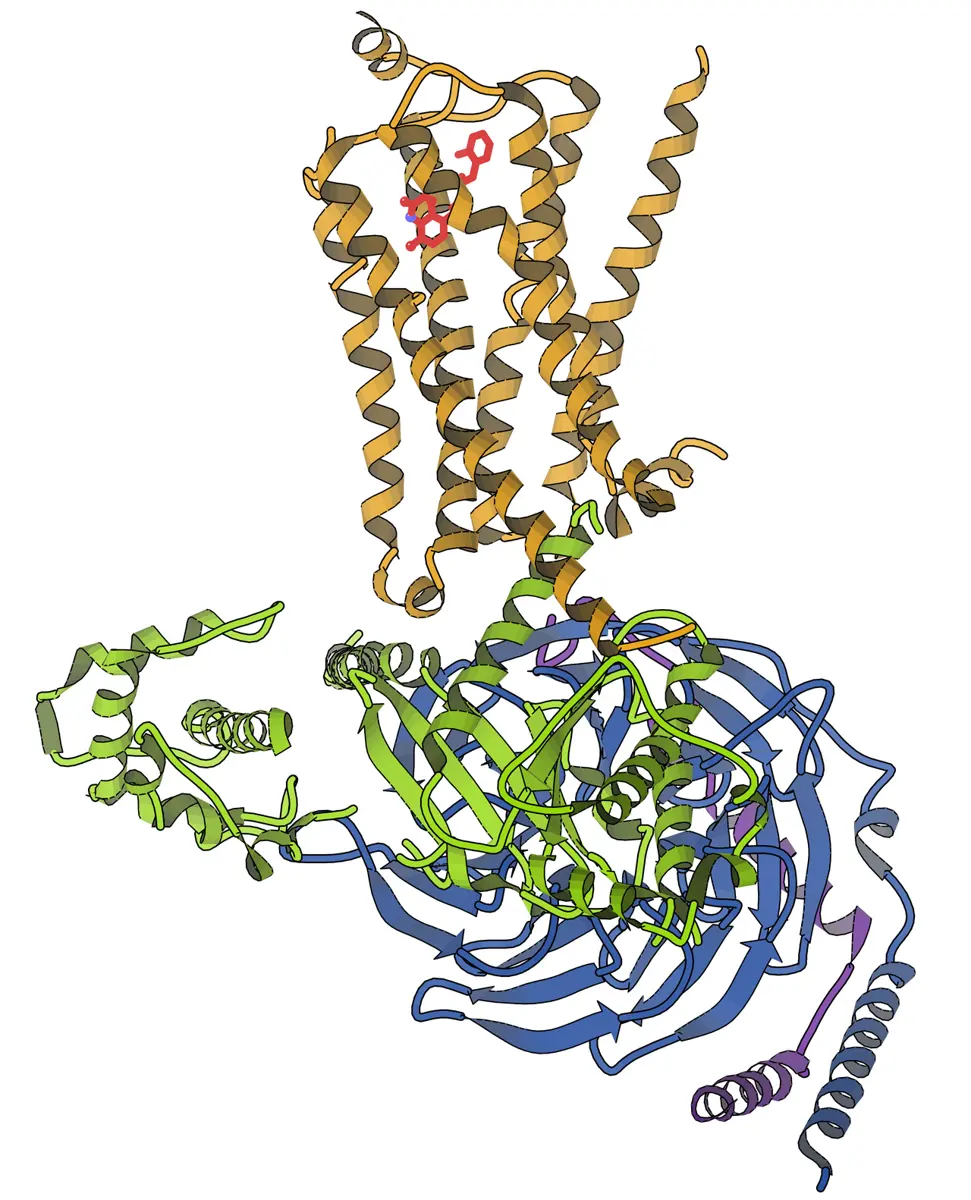
A G-protein-coupled receptor (GPCR for short) is a protein, a long chain of building blocks called amino acids, folded into a shape (A chain that folds). The chain weaves in and out through the cell membrane seven times, like a thread sewn through cloth. Its outer end sticks out of the cell; its inner end sits inside.
- The key arrives. A molecule of adrenaline fits into a pocket in the part of the receptor facing outside.
- The receptor changes shape. The coiled pieces shift a little at the top, and much more at the bottom: inside the cell, the receptor opens up a gap.
- The G protein switches on. A helper molecule waiting inside the membrane, the G protein, fits into that gap and is switched on. (G proteins won the 1994 Nobel Prize in Physiology or Medicine.)
- The message spreads. The G protein switches on other molecules, which make many small “messenger” molecules inside the cell. One receptor can switch on many G proteins, one after another, so a few molecules of adrenaline outside become a flood of signals inside. In a heart cell the result is a faster, stronger beat.
A few molecules of adrenaline can change a whole heart cell. Why?
Pick an answer to see why.
Why it was so hard
The receptors were hard to study for three reasons.
- There are very few of them. A cell has only a small number of adrenaline receptors, among a huge number of other molecules.
- They hide in the membrane. Most of the receptor is buried in the oily skin of the cell. Take it out into water, and it falls apart or clumps up, like oil in water.
- They move. A receptor works by changing shape. That makes it very hard to catch in one shape long enough to take its picture.
What they did, step by step
Lefkowitz: a radioactive label
Robert Lefkowitz trained as a doctor and wanted to become a heart specialist. In 1968, during the Vietnam War, he took a research post at the National Institutes of Health near Washington instead of joining the army. His supervisor gave him a task: find a hormone receptor.
- 1968–1970, the label. The plan was to attach radioactive iodine to a hormone. The radiation shows where the hormone sticks, so it can lead you to the receptor. For more than a year nothing worked. Lefkowitz was so unhappy that he planned to go back to treating patients. Then, in 1970, it worked: he found a receptor and showed that the hormone sticking to it really switched on a process inside the cell. He found he loved research.
- 1973 onwards, adrenaline receptors. At Duke University in North Carolina he started his own laboratory and turned to the adrenaline receptors, which matter so much for the heart. Using radioactive labels, including on beta blockers, his team learned how to coax the receptors out of the membrane and purify them.
Kobilka joins: the gene, and a surprise
- 1984, a young doctor. Brian Kobilka joined the laboratory. His team set out to find the gene for the beta receptor: the stretch of DNA that holds the instructions for building it. In the 1980s, finding one gene among all of a person’s DNA was like looking for a needle in a haystack. Kobilka had a clever idea for building the collection of DNA pieces in which to search, and after almost two years of frustration they found it.
- 1986, the eureka moment. Reading the gene told them the order of the receptor’s amino acids. It showed seven long oily stretches: the chain must cross the membrane seven times. That was exactly like rhodopsin, the molecule in the eye that catches light, which works through a G protein too. Lefkowitz knew of about 30 other receptors that worked through G proteins. Could they all be built the same way? They could. This was one big family of receptors.
Kobilka: a picture of the receptor at work
- 1989, a long goal. Kobilka moved to Stanford University in California and set himself a goal that most scientists thought impossible: to take a picture of the receptor, atom by atom.
- The method. Molecules are far too small to see in a microscope. Scientists use X-ray crystallography: they pack millions of copies of a molecule into a tiny crystal, shine X-rays through it, and work out the shape from the way the X-rays are scattered. But a floppy, oily receptor will not form a crystal. For years every try failed.
- 2007, the first picture. Kobilka’s team replaced the receptor’s floppiest loop with a small, sturdy protein that forms crystals easily, and grew crystals in a fatty jelly that is like the membrane. They got the first detailed picture of a hormone receptor of this family.
- 2011, caught in the act. Finally they pictured the receptor at the very moment it passes on the signal: with a hormone-like molecule in its pocket outside, and a G protein fitted into the gap inside. To hold it still they used a tiny antibody of a kind made only by camels and their relatives. The picture showed the gap opening at the bottom, just as in Figure 2.
How it works now: one design, hundreds of jobs
We now know that people have about 800 kinds of GPCRs (the committee counted close to a thousand genes in 2012). About half of them are for smell. Others let you see (rhodopsin and the color receptors of the eye), taste sweet, bitter and the savoury taste of meat and soup, and respond to hormones and to the chemicals that nerve cells use to talk to each other, such as dopamine, serotonin and histamine. In 2012 more than a hundred of them still had no known job.
Adrenaline alone has at least nine different receptors in the body. That is why the same hormone can do different things in different places: it speeds up the heart, opens the airways of the lungs, and sends more blood to the muscles and less to the stomach.
In your life today
Somewhere between a third and a half of all medicines work by fitting into a GPCR, either to switch it on or to block it. Counts differ: the Nobel committee said about half in 2012; a careful count of medicines approved in the United States in 2017 found about a third. You probably know some of them.
- Asthma inhalers. The common blue inhaler contains salbutamol, which switches on the beta-2 adrenaline receptor (the very receptor in Kobilka’s picture) in the muscles around the airways. The muscles relax, and the airways open.
- Heart medicines. Beta blockers block the adrenaline receptors of the heart, so it beats more slowly and gently. They are used for high blood pressure and after heart attacks Grade 10: High blood pressure.
- Allergy tablets. Antihistamines such as cetirizine block a receptor for histamine, the chemical that makes your nose run and your eyes itch.
- Strong painkillers. Morphine works on the GPCRs for the body’s own painkilling chemicals.
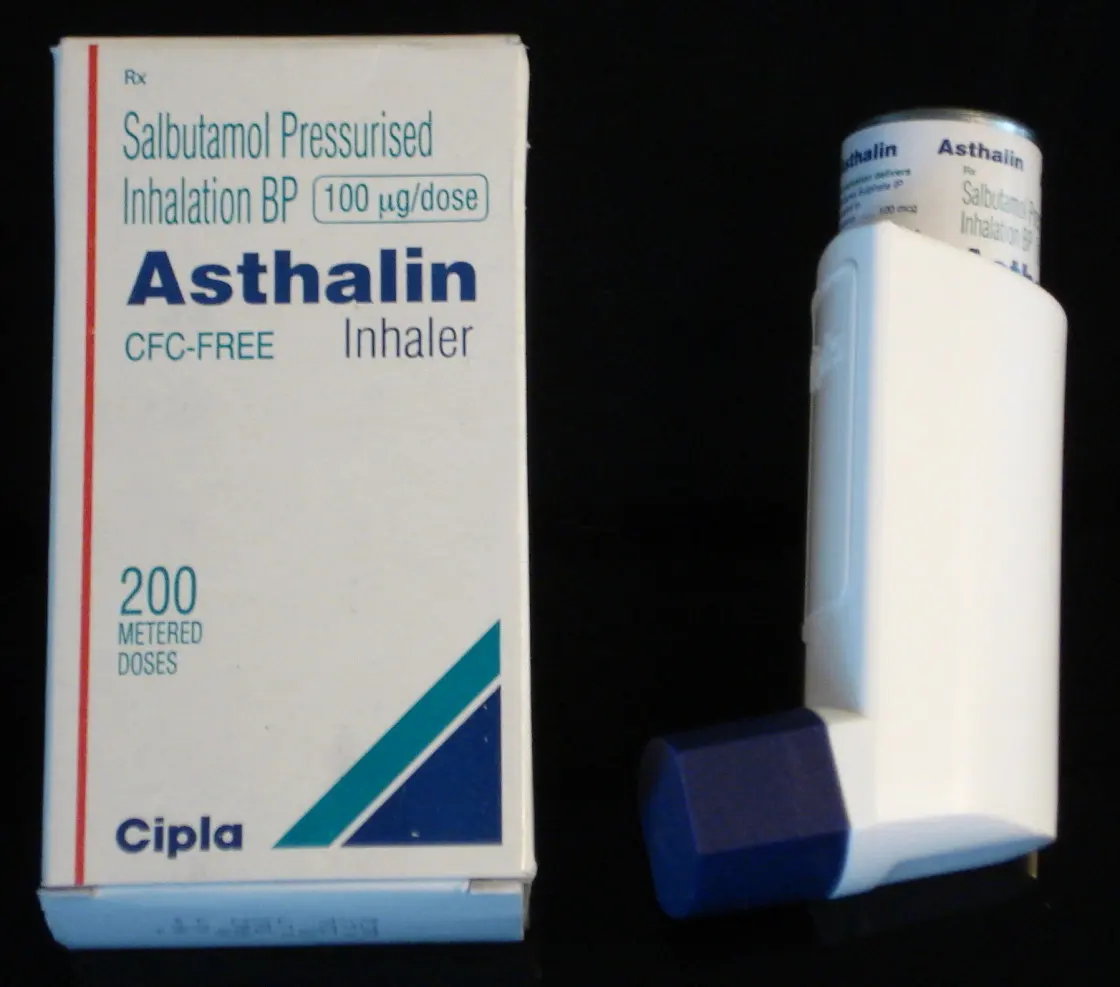
A patient with asthma uses a salbutamol inhaler. What does the drug do?
Pick an answer to see why.
What came next
- Medicines with fewer side effects. Once you know the exact shape of a receptor’s pocket, you can design a drug to fit it more exactly, so it doesn’t also fit other receptors and cause side effects. Since 2011 the structures of hundreds of GPCRs have been worked out, and many new medicines have been designed with their help.
- More than one message. Lefkowitz’s team found that a receptor can also pass messages through other helper molecules called arrestins, not only through G proteins. A drug might be able to switch on only the helpful message and not the harmful one.
In your science books
- Grade 8: the covering of the cell, the cell membrane.
- Grade 9: endocrine glands and the functions of hormones, and how nerves and hormones work together.
- Grade 10: the heart and high blood pressure.
- Going Further: your body’s detectors (Grades 6–8), and how a gene makes a protein (Grades 9–12).
Learn more
- The Nobel Prize’s own explanation: Cells and sensibility (nobelprize.org).
- The laureates’ Nobel lectures: Lefkowitz and Kobilka.
The official reason
The prize was given “for studies of G-protein-coupled receptors.”