
The genes that lay out a body, head to tail
Nobel Prize in Physiology or Medicine, 1995: Edward B. Lewis, Christiane Nüsslein-Volhard, and Eric F. Wieschaus
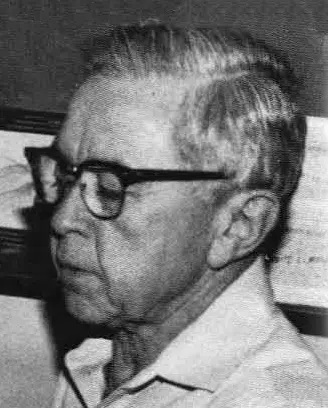
Edward B. Lewis
1918–2004, born in Wilkes-Barre, Pennsylvania, USA
A weather forecaster in the Second World War, he then spent more than forty years on one small group of fruit fly genes at Caltech.
Photo: The Big T (Caltech yearbook), 1986, Public domain
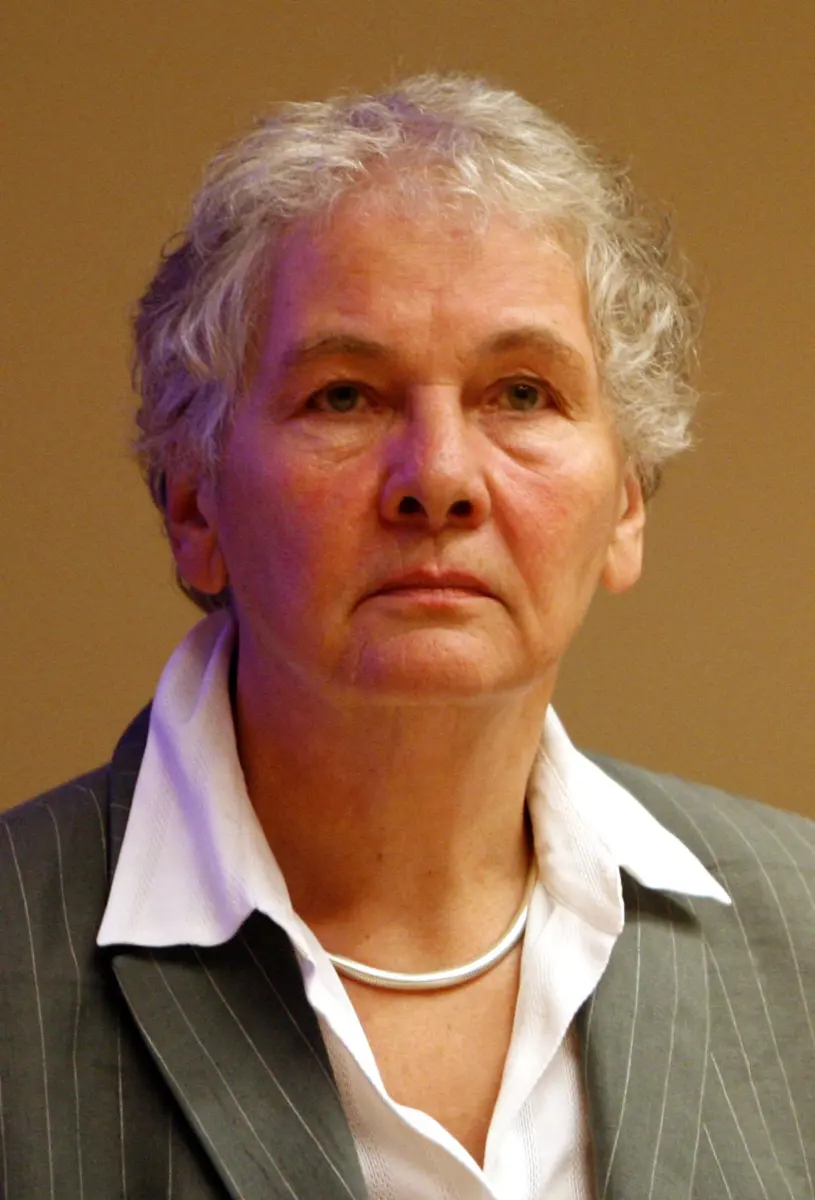
Christiane Nüsslein-Volhard
born 1942 in Magdeburg, Germany
The first woman from Germany to win the Nobel Prize in Physiology or Medicine. She later set up a foundation that helps young women scientists with children pay for help at home, so they can keep doing research.
Photo: Rama, CC BY-SA 2.0 fr
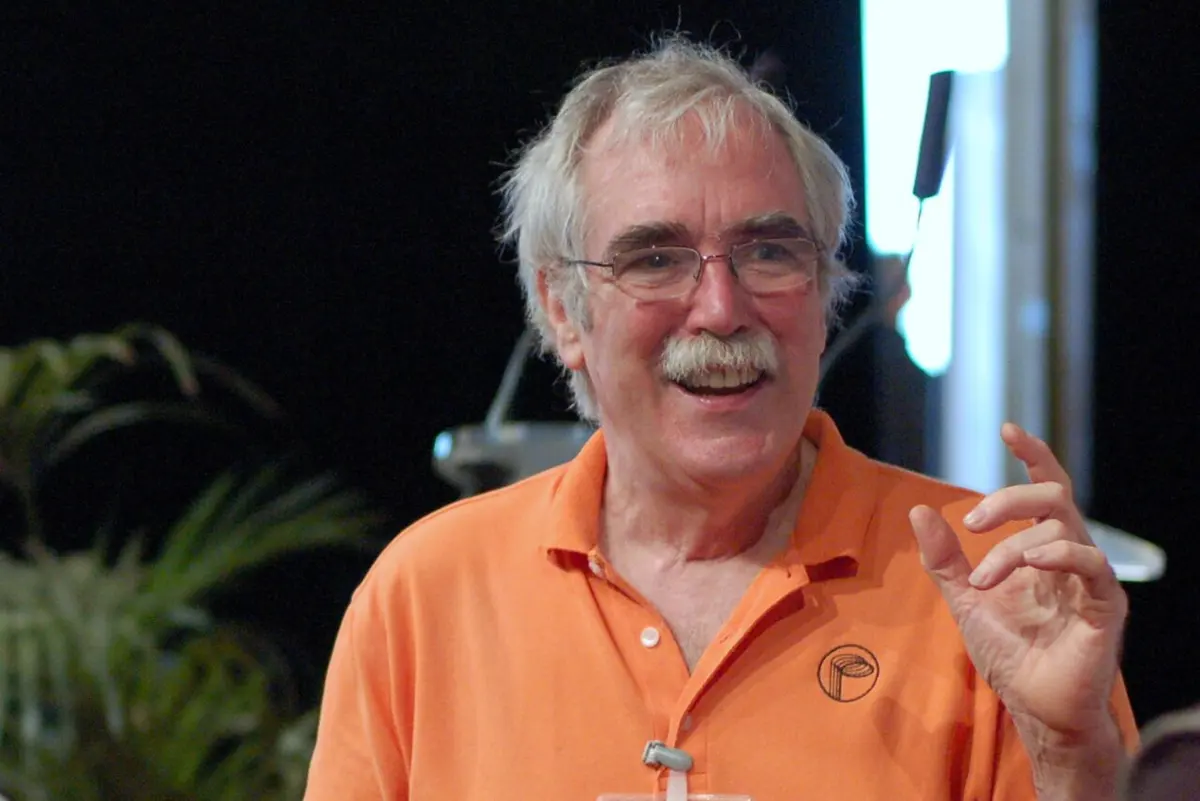
Eric F. Wieschaus
born 1947 in South Bend, Indiana, USA
As a boy in Alabama he wanted to be an artist. His first job in science, as a student, was mixing food for fruit flies.
Photo: Matthias Kubisch, CC0
You began as one cell, smaller than the full stop at the end of this sentence. That cell divided into two, then four, then eight, and at first all the cells were alike. Yet within weeks some of them had become your head and others your feet, your back and your front, in the right places and in the right order. Nobody told them where to go. How did they know?
The answer came from an unlikely animal: the tiny fruit fly that hovers over ripe bananas and mangoes in your kitchen. In 1995 the Nobel Prize in Physiology or Medicine went to three scientists who found, in fruit flies, the genes that lay out an animal’s body from head to tail.
The problem: one cell, and a whole body to build
Every cell of your body carries the same set of genes, the instructions written in its DNA Grade 10: DNA. A cell in your eye and a cell in your toe have exactly the same instructions. What makes them different is which genes are switched on in each one (Genes switched on and off).
So, as an embryo grows, something has to switch the right genes on in the right places. Cells near one end must learn that they are the head end; cells along the back must learn they are the back. In the 1970s nobody knew which genes did this, or even how many there were. There might be thousands, each doing a tiny part. Many biologists thought the problem was simply too big to solve.
Why the fruit fly?
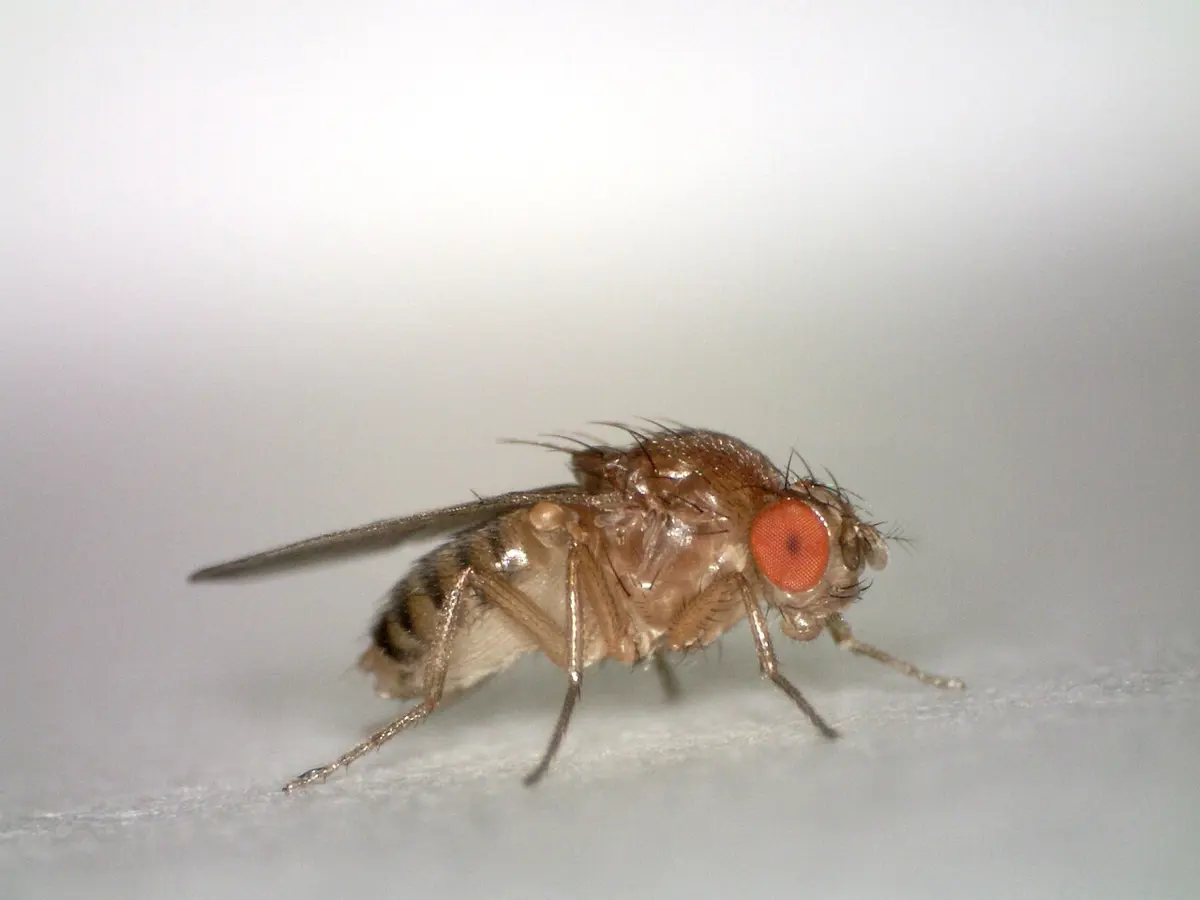
Biologists have studied the fruit fly, Drosophila melanogaster, since the early 1900s. It is ideal for studying genes:
- It is small (about 3 mm long) and cheap to keep: thousands live in a few milk bottles of food.
- It grows fast: from egg to adult fly in about ten days.
- A female lays hundreds of eggs, so you can study many offspring of every cross.
A fly’s body is built in segments, like the rings of an earthworm. You can see them on a caterpillar or on a wasp’s striped tail. A fruit fly larva (the grub that hatches from the egg) has 14 segments. When it grows into an adult, each segment makes its own parts: some form the head, the middle three form the thorax, which carries the legs and wings, and the rest form the abdomen.
Every cell in your body has the same genes. So why is a skin cell different from a nerve cell?
Pick an answer to see why.
What they did, step by step
Lewis: the fly with four wings
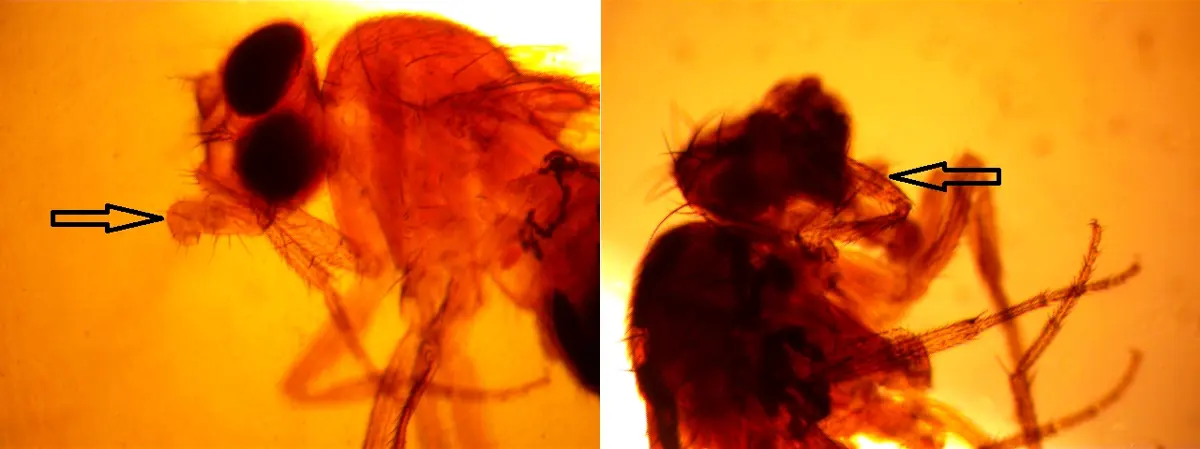
A normal fly has two wings. On the segment behind them, the third segment of the thorax, it has two tiny knobs called halteres, which it uses to keep its balance as it flies. In 1915 the American geneticist Calvin Bridges found a strange mutant fly (one with a changed gene) in which part of that third segment had grown like the segment in front of it: a mutation called bithorax, “two thoraxes”.
Edward Lewis, at the California Institute of Technology (Caltech), spent decades from the 1940s studying such flies.
- Collecting mutants. He bred and crossed thousands of flies, finding more and more mutations in the same small stretch of one chromosome. Each one made a segment of the fly grow like a different segment.
- The four-winged fly. By putting several of these mutations together in one fly, he made the third segment of the thorax grow exactly like the second, with a second pair of full-sized wings instead of the halteres.
- The genes’ order. He found that the genes in this stretch, the bithorax complex, lie on the chromosome in the same order as the segments they control: genes at one end work in the front segments, genes at the other end in the segments near the tail.
- 1978: the summary. In a famous review, Lewis brought decades of work together and explained how these genes give each segment its identity.
Genes like this, which decide what a part of the body becomes, are called homeotic genes, and today Hox genes.
Nüsslein-Volhard and Wieschaus: the great hunt
In 1978 two young scientists, Christiane Nüsslein-Volhard from Germany and Eric Wieschaus from the USA, got their first independent jobs at the European Molecular Biology Laboratory in Heidelberg, Germany. They shared a small laboratory and a big, risky idea: to find every gene needed to divide the fly embryo into segments.
- Making mutants on purpose. They fed male flies a chemical that causes random mutations in their sperm Grade 9: Mutation, damaging genes at random. Then they bred the flies for several generations, so that each family carried a different broken gene.
- Looking at dead embryos. A gene needed to build the body is so important that an embryo without it dies before hatching. So they looked at the dead embryos. Each embryo’s skin carries rows of tiny hooks, one band on every segment, which show the segment pattern clearly under a microscope.
- Side by side, for months. In autumn 1979 they sat on either side of a microscope with two eyepieces, looking at the same embryo at the same time and discussing each strange one. They examined the embryos of 4,200 fly families for the second chromosome alone in about three months.
- 1980: 15 genes. In October 1980 they published the result in the journal Nature. Out of the many thousands of fly genes, only 15 were needed to make the segments, and they fell into three groups.
The three groups work one after another, each dividing the embryo more finely:
- Gap genes switch on in a few broad regions. Lose one, and a whole block of neighboring segments is missing, leaving a gap.
- Pair-rule genes switch on in seven stripes, one for every second segment. Lose one, and the embryo has only half its segments. They spotted this strange pattern early in the hunt.
- Segment-polarity genes switch on in fourteen narrow stripes, one in each segment, and give each segment a front and a back.
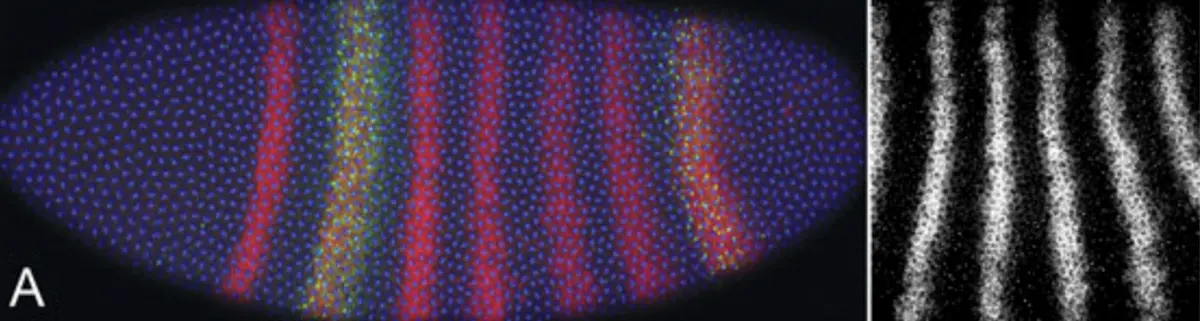
A fly embryo has a broken pair-rule gene. What would you expect to see?
Pick an answer to see why.
How it works: switches that switch on switches
The genes the laureates found are mostly master switches. Each one makes a protein that sticks to DNA and switches other genes on or off. So the steps run like a chain:
- Even before the egg is fertilized, the mother places different substances at the head end and the tail end of the egg.
- These tell the gap genes where to switch on.
- The gap genes, together, tell the pair-rule genes where to make their seven stripes.
- The pair-rule genes tell the segment-polarity genes where to make their fourteen.
- Meanwhile the Hox genes read the same signals and give each segment its identity: “you are the third segment of the thorax; make halteres.”
In your life today
- The same genes in you. In 1984, scientists found that every Hox gene contains the same short stretch of DNA, called the homeobox. Searching for it, they found Hox genes in frogs, mice and humans. Humans have 39 Hox genes in four clusters on four chromosomes, and in each cluster they lie in the same head-to-tail order as in the fly. A human Hox gene put into a mutant fly can do part of the work of the missing fly gene. These genes have been passed down, little changed, for more than 500 million years, from the common ancestor of flies and people.
- Babies born with differences. Some babies are born with a birth defect, a difference in how a part of the body formed, and for many the cause is not known. Changes in genes like these explain some of them: a change in a human gene related to the fly gene paired, for example, causes a rare condition with deafness and patches of white hair.
- Vitamin A in pregnancy. Very large doses of vitamin A in early pregnancy upset the Hox genes and can cause serious birth defects. That is why doctors warn pregnant women against high-dose vitamin A pills and some acne medicines made from vitamin A, while normal food is safe and needed.
- Your backbone. Your spine is made of repeated vertebrae, a kind of segmentation, and Hox genes decide which vertebrae carry ribs (in your chest) and which don’t (in your neck and lower back).
What came next
- The mother’s signal. In 1988 Nüsslein-Volhard’s team showed how the head end is marked: the mother leaves a substance (from a gene called bicoid) at the front of the egg. It spreads backwards, strong at the head and weak towards the tail, and the gap genes read how strong it is.
- Fish and people. Nüsslein-Volhard then began a giant hunt like the fly one in the zebrafish, a small fish whose see-through embryos grow outside the mother. It found hundreds of genes that build animals with backbones.
- New animals. Hox genes help explain how animal bodies change in evolution. A snake’s long body with ribs nearly all the way along, and an insect’s six legs where its centipede-like ancestors had many, both come partly from changes in where Hox genes work Grade 9: Evolution.
How a few switches, a few chemical signals and the physics of growing cells together build a shape as exact as a hand is still being worked out. Scientists can now grow small, simple “organs” from stem cells in a dish, but nobody yet knows enough to build a whole organ, like a kidney, to order.
In your science books
- Grade 8: the cell and its nucleus, and fertilization in animals.
- Grade 9: mutation, and evidence for evolution from embryos.
- Grade 10: cell division, DNA and chromosomes.
- Going Further (Grades 9–12): how one cell becomes a whole person, genes switched on and off, and how a gene makes a protein.
Learn more
- The Nobel Prize’s own explanation: the press release, with pictures of the gene groups and the four-winged fly (nobelprize.org).
- The laureates’ Nobel lectures: Lewis, Nüsslein-Volhard and Wieschaus.
The official reason
The prize was given “for their discoveries concerning the genetic control of early embryonic development.”