
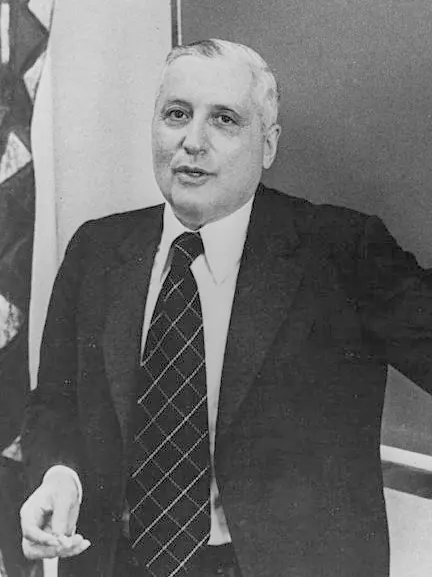
Ilya Prigogine
1917–2003, born in Moscow, Russia
His family fled Russia when he was four and settled in Belgium. His mother said he could read music before he could read words, and he played the piano all his life.
Photo: Unknown (Keystone - US), Public domain
Put a drop of ink in a glass of water and wait. The ink spreads until the whole glass is evenly pale. It never gathers itself back into a drop. A cup of hot tea cools down to the temperature of the room; it never warms itself up again. Left alone, things run down, mix and even out.
And yet, all around us, things build themselves into patterns. A seed grows into a rhododendron, with its leaves and flowers in their right places. Clouds line up in rows. When rice boils in a pan, the bubbling water can arrange itself into neat cells. How can order appear by itself, if nature always tends to mix and run down?
The 1977 Nobel Prize in Chemistry went to Ilya Prigogine, a Belgian chemist, for answering that question. Order can appear by itself, he showed, but only in a system that energy keeps flowing through.
The problem: everything runs down
The second law
The study of heat and energy is called thermodynamics. It began in the 1800s with steam engines. Its most famous rule, the second law of thermodynamics, says that heat flows by itself only from hot to cold, never the other way (a rule that energy doesn’t make).
There is another way to say the same thing. Scientists measure how spread out and mixed up energy and matter are with a quantity called entropy. Disorder means high entropy. The second law says: in a closed box, cut off from everything outside, entropy can only go up, or stay the same. The ink spreads; it never unspreads.
A closed box ends in equilibrium: a final, even, unchanging state where nothing more happens. The tea is at room temperature; the ink is evenly mixed. For a hundred years thermodynamics was mainly the science of these final states. The changes on the way there seemed a messy detail.
A glass of hot water and a glass of cold water are poured together and left in a closed box. What happens?
Pick an answer to see why.
But living things build order
A living thing is the opposite of an evenly mixed box. A cell keeps sugar on one side of a membrane and salt on the other, builds long, exact molecules such as DNA and proteins, and keeps all of this going for years. Did life break the second law?
No. A living thing is not a closed box. It is open: it takes in food and oxygen, rich in usable energy, and gives out heat, carbon dioxide and waste. It keeps its own order by making more disorder in its surroundings. Overall, entropy still goes up. But this only showed that life is allowed by the second law. It did not explain how ordered patterns could arise. That is what Prigogine set out to explain.
What Prigogine did, step by step
- 1930s–1941, Brussels. Prigogine first studied law, at his parents’ wish, then switched to chemistry and physics at the Free University of Brussels. His teacher Théophile De Donder was one of the few scientists interested in thermodynamics away from equilibrium, in how fast entropy is made while things are changing.
- 1945, near equilibrium. Prigogine proved a rule for open systems kept a little away from equilibrium, for example a bar held hot at one end and cold at the other. Such a system settles into a steady state: things keep flowing through it, but it doesn’t change, and it makes entropy as slowly as it can. Near equilibrium, however, it is always the plain, even, boring state that wins. No patterns.
- 1947–1967, far from equilibrium. For twenty years Prigogine and his colleagues, above all Paul Glansdorff, asked what happens when an open system is pushed far from equilibrium, with a strong flow of energy or chemicals through it. They found that the plain steady state can become unstable: a tiny chance disturbance, instead of dying away, grows. The system then jumps to a new state with a pattern in space or time.
- 1967, a name. Prigogine called these patterns dissipative structures. “Dissipative” means that they constantly use up energy and give it out again as heat. A dissipative structure exists only as long as energy flows through it. Stop the flow, and it falls back into even, featureless equilibrium.
- 1968, a model chemical clock. With René Lefever, Prigogine made a simple model of chemical reactions, nicknamed the Brusselator after their city. Fed steadily with fresh chemicals, its amounts did not settle down: they went up and down, again and again, on their own.
Two famous examples show what such structures look like.
Cells in a heated liquid
In 1900 the French physicist Henri Bénard heated a thin layer of liquid evenly from below. While the heating was gentle, heat simply passed up through the still liquid, by conduction. But above a certain point, the liquid suddenly began to move. It broke up into neat, regular cells, most of them six-sided, like a honeycomb. In each cell, warm liquid rises in the middle, spreads out at the top, cools, and sinks again at the edges Grade 8: convection.
Nobody arranges the cells. Billions of molecules start moving together, in step, all on their own. And the pattern lasts only as long as heat flows from the hot pan to the cooler air. Turn off the flame, and the cells disappear.
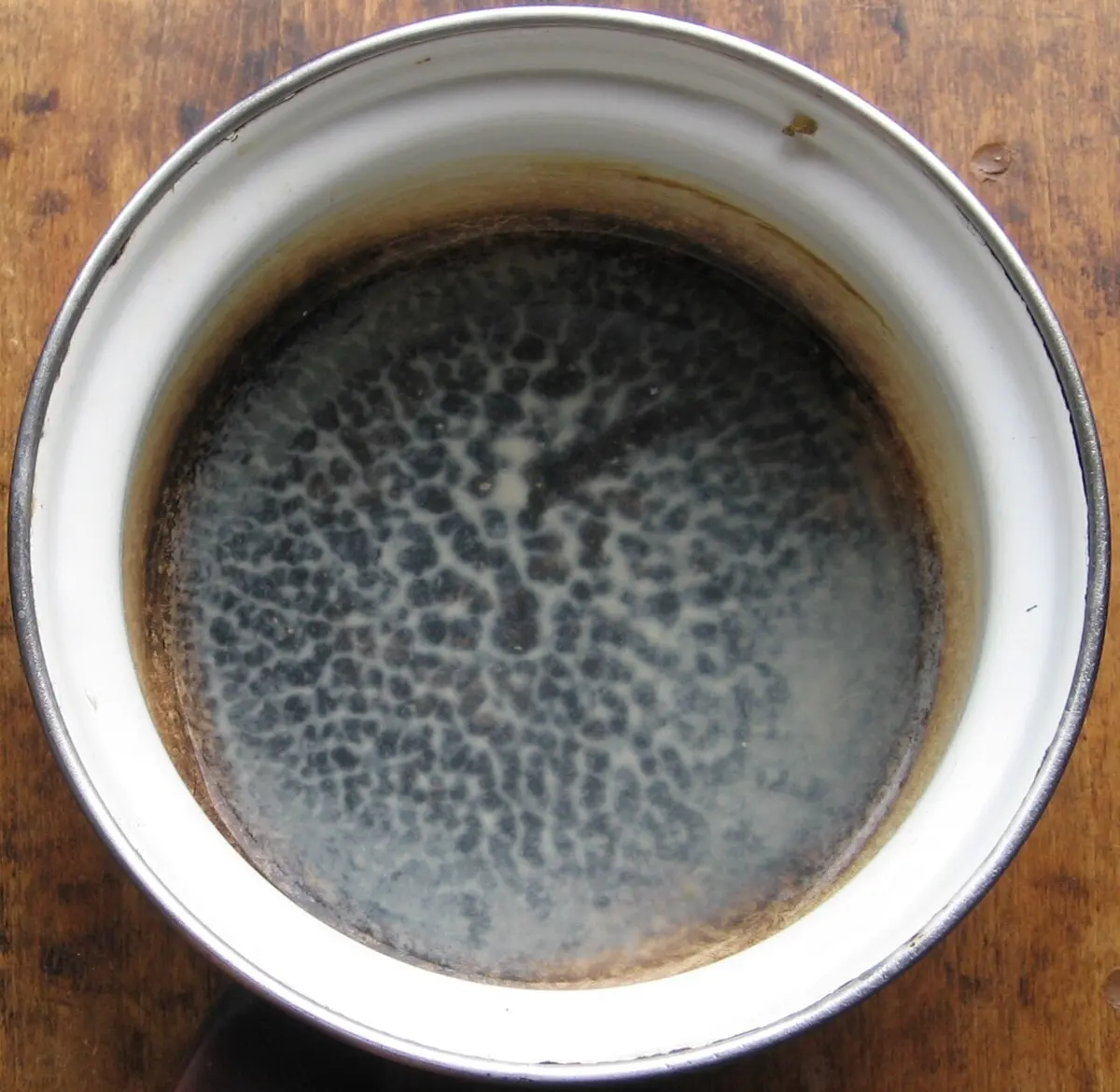
What happens to Bénard cells when the heating is switched off?
Pick an answer to see why.
A chemical clock
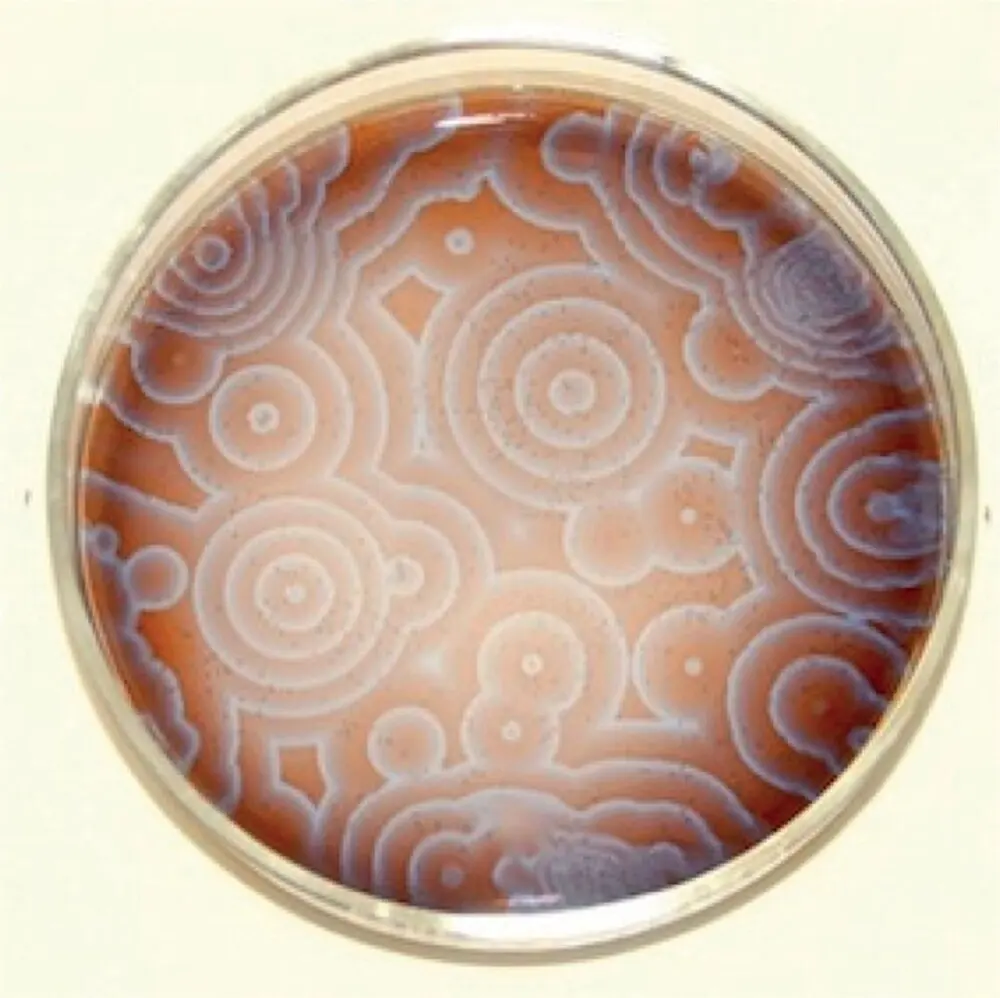
In 1951 a Soviet chemist, Boris Belousov, mixed a few chemicals in acid and saw the solution change color, from colorless to yellow and back, again and again, like a clock. Journal editors refused to publish it: they thought a reaction going backwards and forwards on its own was impossible, against the second law. He published only a short note, in 1959. In the 1960s a young scientist, Anatol Zhabotinsky, took it up and showed it was real. Today it is called the Belousov–Zhabotinsky reaction. With a different color indicator it pulses between red and blue; left unstirred in a flat dish, it draws spreading rings and spirals.
Prigogine’s theory explained why it is no miracle. The reaction is far from equilibrium, and some of its steps speed themselves up: a product helps make more of itself. That kind of feedback is what lets the even state break into a rhythm. The clock is not a perpetual motion machine: it runs down when its starting chemicals are used up, as the second law requires.
Why it was hard
The mathematics of equilibrium is fairly simple. Near equilibrium, causes and effects are in proportion: push twice as hard, get twice the flow. Far from equilibrium they are not, and the equations become non-linear: a small push can have a huge effect, or none. There are usually no neat formulas for the answers. Prigogine had to find general ways to tell whether a steady state was stable, without solving the equations.
There was also resistance. Prigogine remembered a famous scientist telling him in 1946 that he was surprised anyone paid attention to changes, which are only passing, rather than to equilibrium, where everything ends. And many chemists, like Belousov’s editors, simply did not believe that a reaction could oscillate.
How it works now
Prigogine’s ideas gave scientists a way to think about order that is made and kept by a flow of energy, which is how much of the world works.
- Weather. The Sun heats the ground, and the heat flows up and out to space. On the way it drives convection cells in the air, from small puffy clouds to huge storms.
- Living things. A cell is the greatest dissipative structure of all. Its chemical reactions, kept far from equilibrium by food and oxygen, keep time (the cell’s own clocks) and build patterns.
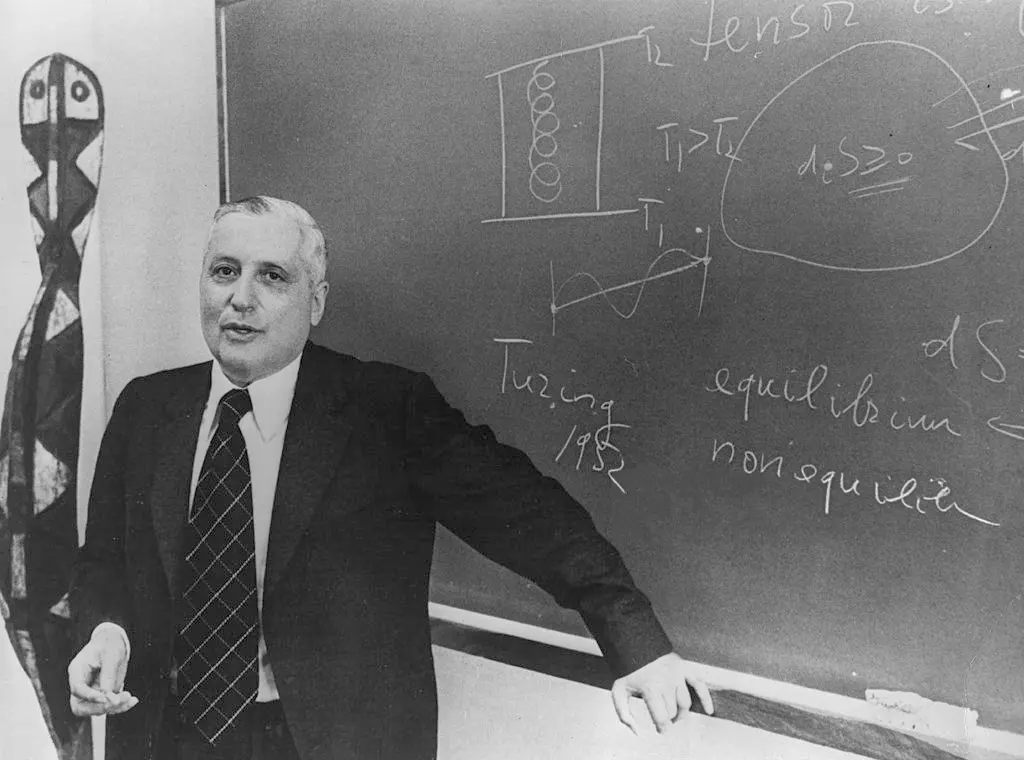
- Patterns in animals. In 1952 the mathematician Alan Turing suggested that two chemicals spreading and reacting in a growing embryo could make spots and stripes by themselves. Prigogine’s theory showed when this could happen. Such patterns have since been found in real chemical reactions, and scientists think some animals’ markings form this way.
In your life today
- Your heartbeat is a natural clock: a small group of cells in your heart fires again and again, on its own, as long as you are fed and breathing.
- Cooking. The cells in a pan of boiling rice or gently simmering dal are convection patterns that last only while the stove is on.
- Your body’s temperature. Your body stays at about 37 °C because energy keeps flowing through it, in food and out as heat (steady inside, changing outside).
What came next
- Self-organization. Prigogine’s ideas spread to biology, to the study of traffic, of termite nests and of cities, under the name self-organization. Some of these uses are careful science; others are stretched further than the evidence allows.
- Chaos. Systems far from equilibrium can also behave in a way that never repeats and can’t be predicted far ahead: chaos, as in the weather.
- Open question. How did the first living cell arise from non-living chemicals? Prigogine hoped that dissipative structures were part of the answer: a flow of energy, on the early Earth, organizing chemicals into ever more complex patterns. Nobody yet knows how it happened.
In your science books
- Grade 8: convection and convection currents and weather.
- Grade 10: thermal energy, heat and temperature.
- Going further: why heat never flows from cold to hot, dynamic equilibrium and how your body stays at 37 °C.
Learn more
- The Nobel Prize’s press release and presentation speech.
- Ilya Prigogine’s Nobel lecture and his own story.
The official reason
The prize was given “for his contributions to non-equilibrium thermodynamics, particularly the theory of dissipative structures.”