
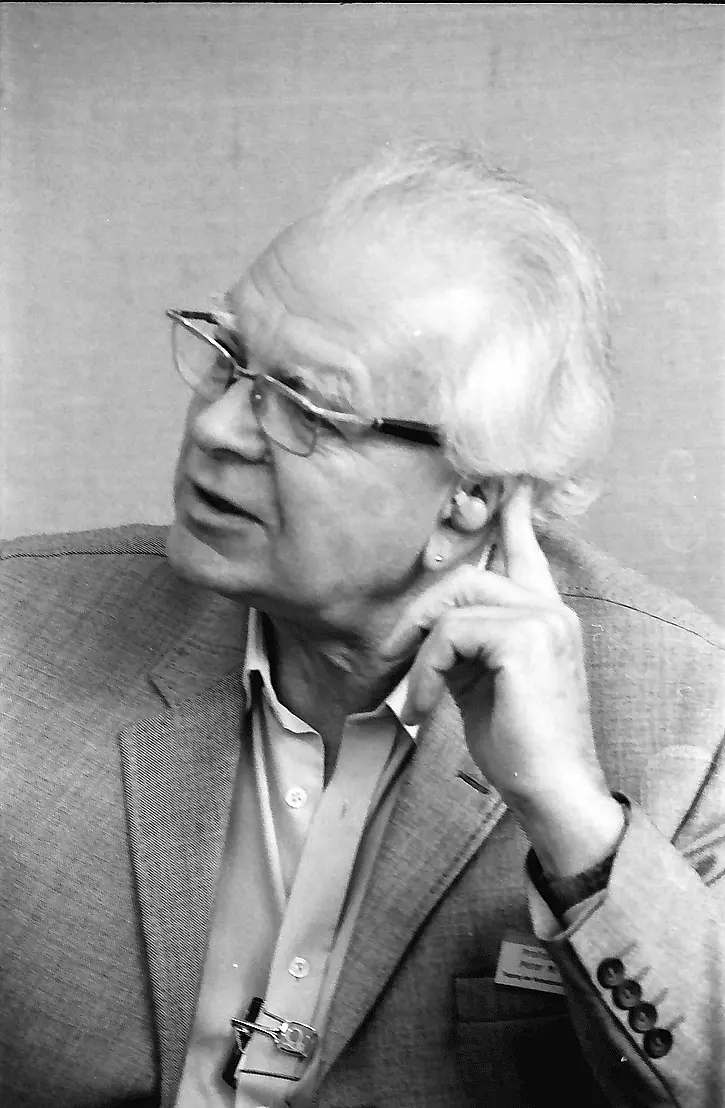
Peter Mitchell
1920–1992, born in Mitcham, near London, England
He left his university job after an illness, repaired an old country house in Cornwall and turned it into his own small laboratory, where he proved his idea right.
Photo: Willy Pragher, CC BY 4.0
You ate dal bhat for lunch. A few hours later you climb the stairs, and your leg muscles are using energy that, a little earlier, was in the rice. Between the plate and the muscle, the energy is passed through one small molecule, ATP. Your body uses so much of it that, each day, you make and use up roughly your own body weight of ATP.
How the cell makes ATP, using the energy of food, was one of the great puzzles of biology. The answer, put forward in 1961 by a British scientist working almost alone, was so unexpected that most experts refused to believe it for years. In 1978 it won Peter Mitchell the Nobel Prize in Chemistry.
The problem: how does food energy get into ATP?
ATP, the energy coins
Your cells burn food with oxygen, in respiration, and get energy, water and carbon dioxide. But the energy isn’t used straight away. It is first stored in ATP (adenosine triphosphate).
Think of ATP as the cell’s coins. Whatever job needs energy, moving a muscle, sending a message along a nerve, building a protein, the cell pays with ATP. Paying turns ATP into ADP (adenosine diphosphate) and a loose phosphate group. To get the coin back, the cell must join ADP and phosphate again, and that takes energy:
Most of this “recharging” happens in the mitochondria, the small bodies in our cells often called the cell’s powerhouses Grade 8: mitochondria. Plants also make ATP in their chloroplasts, using the energy of sunlight.
Why does a cell need to keep making ATP all the time?
Pick an answer to see why.
The missing link
By about 1960, scientists knew half of the story. In the inner skin, or membrane, of a mitochondrion sits a chain of proteins, the respiratory chain. The food is broken down and its electrons (tiny negatively charged particles) are handed along this chain, from one protein to the next, until they reach oxygen. At each step a little energy is set free. They also knew the enzyme that makes ATP: a protein that speeds up the joining of ADP and phosphate.
But how did the energy get from the chain to the ATP-making enzyme? Most scientists believed there must be a high-energy chemical, made by the chain and used by the enzyme, the way a battery is charged and then carried to a torch. For years, laboratories around the world hunted for it. Nobody ever found it.
And there was a second puzzle. ATP was made only when the membrane was whole. Break it, or make a tiny hole in it, and respiration went on, the food was still burnt, but no ATP was made. Why should a membrane matter?
Mitchell’s idea: a dam inside every cell
In 1961 Peter Mitchell proposed something completely different. There is no high-energy chemical, he said. The link is the membrane itself.
- Pumping. As electrons pass along the respiratory chain, the proteins use their energy to pump hydrogen ions (H⁺, also called protons) across the inner membrane, out of the inside of the mitochondrion into the space between its two membranes. You know hydrogen ions: they are what make a liquid acidic Grade 8: acids give hydrogen ions in water.
- Holding. The membrane does not let hydrogen ions back through. So they pile up on one side. That side becomes more acidic and more positively charged than the other. Like water held behind a dam, the crowded ions “want” to flow back.
- Flowing back. The only open way back is through the ATP-making enzyme, now called ATP synthase. As the ions flow through it, their energy is used to join ADP and phosphate into ATP.
Mitchell called the push of the crowded ions the proton-motive force, by comparison with the “electromotive force” of a battery, which pushes electrons round a circuit. He called his idea the chemiosmotic theory: chemistry (making ATP) driven by something passing across a membrane.
It also explained the second puzzle at once. A broken membrane is a broken dam: the ions leak straight back, and there is nothing to drive ATP synthase.
In Mitchell’s theory, what does the membrane do?
Pick an answer to see why.
Why it was hard
Mitchell’s idea was strange to most chemists of the time. They thought of reactions between molecules in a liquid, not of flows across a skin. His papers were long and full of new words, and at first there was little evidence. Many leading scientists in the field argued against it, sometimes fiercely, for more than ten years.
Testing it was hard, too. A mitochondrion is about a thousandth of a millimeter across. Nobody could put a measuring instrument inside one. Every test had to be indirect.
What Mitchell did, step by step
- 1940s–1950s, Cambridge and Edinburgh. Mitchell studied how bacteria take in or push out substances across their membranes. His PhD, in 1951, was on how penicillin works. This gave him the habit of thinking about what happens across a membrane, not only inside a cell.
- 1961, the paper. In the journal Nature he set out the chemiosmotic idea, with little evidence yet.
- 1963, a breakdown and a new start. Ill with stomach ulcers, Mitchell left Edinburgh University. For two years he did no research at all: he restored Glynn House, an old mansion in Cornwall, in the south-west of England, acting as his own architect.
- 1965, a laboratory of three. Glynn House became the Glynn Research Laboratories, paid for with money from Mitchell and his brother. There Mitchell worked with his former colleague Jennifer Moyle and one technician. They never had more than three researchers.
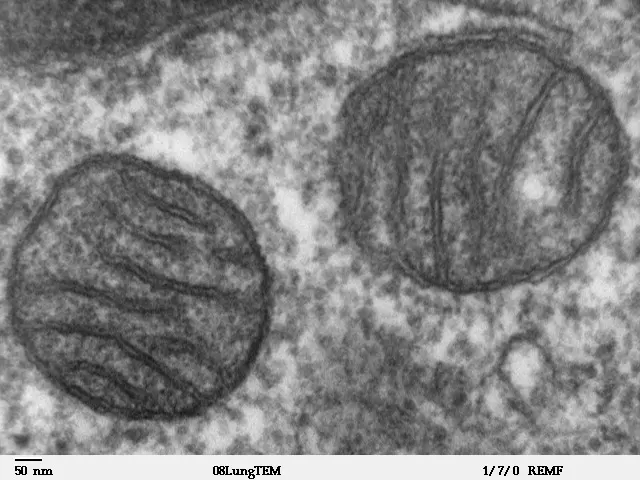
- Late 1960s, measuring the pump. Mitchell and Moyle put mitochondria in a liquid and measured its acidity with a pH meter. When they gave the mitochondria a little oxygen, so that the respiratory chain could run, the liquid outside became more acidic for a moment: hydrogen ions were being pushed out of the mitochondria, just as the theory said. They also measured how many ions were pumped for each oxygen atom used.
Others test the idea
Mitchell’s strongest support came from other laboratories.
- 1966, ATP in the dark. André Jagendorf and Ernest Uribe, in the USA, took chloroplasts from spinach leaves and soaked them in an acid (pH 4), so that hydrogen ions filled the inside of their membranes. Then they quickly moved them into a solution that was basic (pH 8), with ADP and phosphate. In complete darkness, with no light and no respiration, the chloroplasts made ATP. A difference in acidity across a membrane alone was enough.
- 1974, a machine built from parts. Efraim Racker and Walther Stoeckenius, in the USA, made tiny artificial bubbles of membrane. Into them they put two things: a light-driven proton pump from a microbe that lives in very salty water, and ATP synthase from the mitochondria of a cow’s heart. Shine light, and the bubbles made ATP. The two proteins had never met in nature. The only thing that could link them was the flow of hydrogen ions across the membrane.
How it works now
Inside a mitochondrion, food is broken down and its electrons are passed along the respiratory chain to oxygen, which joins with hydrogen ions to make water. Three of the chain’s proteins pump hydrogen ions across the inner membrane as the electrons pass. The ions flow back through ATP synthase, which, we now know, really is a tiny turbine: the flow of ions turns part of it round and round, and each turn makes three ATP (the 1997 prize).
The same trick is used across all of life. In chloroplasts, sunlight drives the pumps, and the flow back makes the ATP that plants use to make sugar (the 1988 prize). Bacteria pump hydrogen ions across their outer membrane and use the flow to take in food and even to spin the long tails, flagella, they swim with.
In your life today
- Every breath. The oxygen you breathe in is used at the end of the respiratory chain. Without it, the pumps stop, the “dam” empties and ATP runs out within minutes. That is why the brain is damaged so quickly when breathing stops.
- Keeping warm. Newborn babies have a special brown fat, whose mitochondria contain a protein that lets hydrogen ions leak back through the membrane on purpose. The energy then comes out as heat, not ATP, and keeps the baby warm.
- Poisons. Cyanide kills by blocking the last protein of the respiratory chain, so the pumps stop.
What came next
- The turbine itself. In the 1990s Paul Boyer and John Walker showed how ATP synthase works, as a turning machine (the 1997 prize).
- Seeing the pumps. Using electron microscopes, scientists have now seen the shapes of the proteins of the respiratory chain, atom by atom.
- Open question. How exactly does each pump push hydrogen ions across, one by one, using the energy of an electron passing through it? Scientists are still working out the details, and faults in these proteins cause rare but serious diseases that we can’t yet cure.
In your science books
- Grade 8: the cell and its parts, mitochondria, and acids, which give hydrogen ions in water.
- Going further: catching the energy: ATP, in “How does food become energy and become you?”
Learn more
- The Nobel Prize’s press release and presentation speech.
- Peter Mitchell’s Nobel lecture.
The official reason
The prize was given “for his contribution to the understanding of biological energy transfer through the formulation of the chemiosmotic theory.”