
Boranes: bonds with too few electrons
Nobel Prize in Chemistry, 1976: William Lipscomb
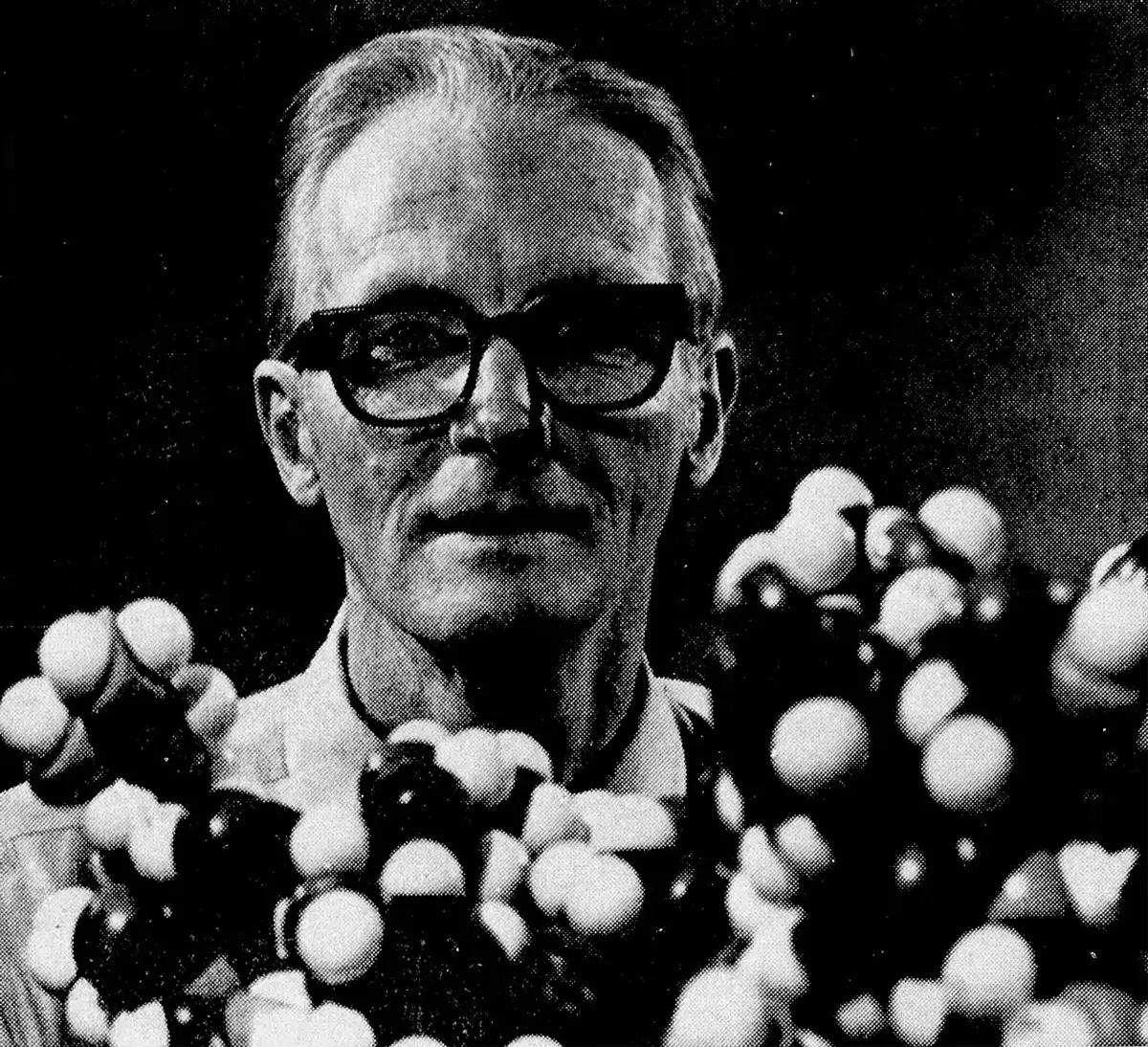
William Lipscomb
1919–2011, born in Cleveland, Ohio, USA
He grew up in Kentucky, where a chemistry set at about the age of twelve started it all. He played the clarinet in chamber music all his life.
Photo: Eddie Adams, Public domain
You have probably met boron without knowing it. The fine white powder sprinkled on a carrom board is often boric acid, a compound of boron. Goldsmiths use borax, another one, when they melt and join gold. The glass of the beakers in a school laboratory often contains boron, which stops it cracking when it is heated.
Boron sits next to carbon in the periodic table. With hydrogen, carbon makes thousands of well-behaved compounds, the hydrocarbons, like the methane in biogas and the propane and butane in a cooking gas cylinder. Boron makes compounds with hydrogen too, called boranes. But for forty years nobody could explain how their atoms held together, because they seemed to have too few electrons to make all their bonds. The 1976 Nobel Prize in Chemistry went to William Lipscomb, who worked out their shapes and explained their strange bonds.
The problem: not enough glue
You know how atoms join in a covalent bond: two atoms share a pair of electrons between them Grade 9: Covalent bond. Each shared pair is one bond, drawn as a line. The electrons that take part are the atom’s valence electrons, those in its outermost shell Grade 9: Valence electrons.
Look at ethane, C₂H₆, a gas found in natural gas. Each carbon has 4 valence electrons and each hydrogen 1, so ethane has
2 × 4 + 6 × 1 = 14 valence electrons.
It has 7 bonds (6 C–H and one C–C), and 7 bonds × 2 electrons = 14. Every electron is used, and every bond has its pair. Everything fits.
Now the simplest stable borane, diborane, B₂H₆. It has the same formula pattern as ethane. But boron has only 3 valence electrons, so diborane has
2 × 3 + 6 × 1 = 12 valence electrons.
If diborane were built like ethane, it would need 7 bonds and 14 electrons. It has only 12. Two electrons short, the molecule should not hold together. Yet it does: diborane is a real, stable gas. For a long time, this made no sense. Chemists called such molecules electron-deficient.
Methane is CH₄. A carbon atom has 4 valence electrons and a hydrogen atom has 1. How many valence electrons does methane have, and how many ordinary bonds can they make?
Pick an answer to see why.
Strange, dangerous compounds
The boranes do not occur in nature. They were first made in the laboratory in the late 1800s, mixed up with other gases. From about 1912, the German chemist Alfred Stock learned to make pure ones. He found several, with formulas such as B₂H₆, B₄H₁₀, B₅H₉ and B₁₀H₁₄. The formulas were odd in themselves: nothing like the neat series of the hydrocarbons.
They were also hard to handle.
- Most are gases or liquids that catch fire by themselves in air, or explode.
- They are poisonous.
- Many fall apart at room temperature, so they had to be made and studied very cold, in sealed glass apparatus with the air pumped out.
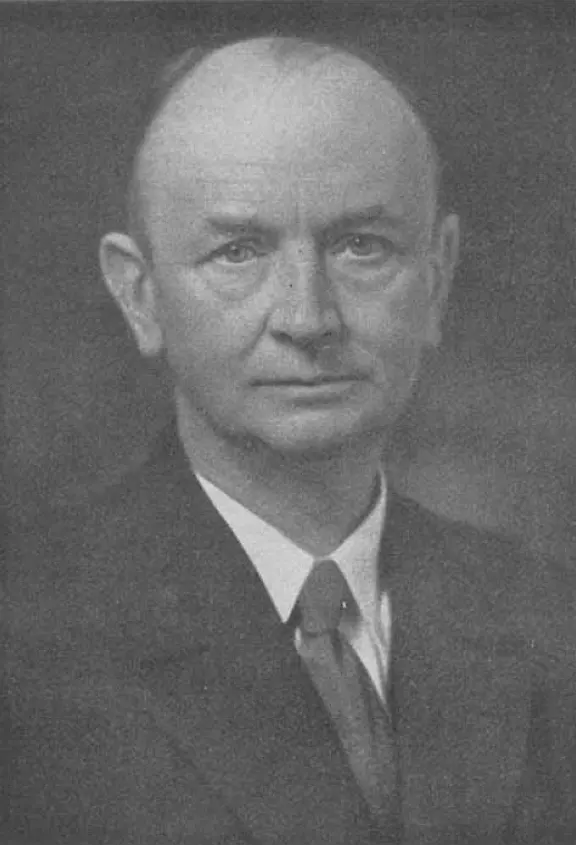
Why it was hard
To explain the bonds, you first have to know the shape: which atom is joined to which. For molecules this small, that means measuring positions of atoms about a ten-millionth of a millimeter apart. And the boranes made that especially difficult.
- They had to be frozen. The best way to find where atoms are is X-ray diffraction: shine X-rays through a crystal and measure the pattern they make. But most boranes are gases or liquids, so a crystal of them exists only far below room temperature, and it must stay that cold the whole time it is measured.
- Hydrogen is almost invisible. X-rays are scattered by electrons, and a hydrogen atom has only one, so in an X-ray picture it is hardly seen.
- The old rules didn’t work. Even with the shape, chemists had no type of bond that fitted. They needed a new idea about bonding itself.
What they did, step by step
First clues
- 1943, two bridges. A young British student, Christopher Longuet-Higgins, with his teacher Ronald Bell, suggested that diborane is not built like ethane. Instead, two of its hydrogens form bridges between the two boron atoms.
- 1949, a new kind of bond. The idea was worked out that in each bridge, one pair of electrons holds three atoms together: boron, hydrogen and boron. (The Nobel committee dates this idea to 1949; Longuet-Higgins had suggested the bridges six years before.)
- 1951, the shape confirmed. Measurements of diborane gas with beams of electrons showed that the bridge structure was right.
But diborane is the simplest borane. The bigger ones, with 4, 5, 10 or more boron atoms, were still a mystery.
William Lipscomb: shapes, rules and predictions
Lipscomb had studied with the great chemist Linus Pauling in California. In 1946 he went to the University of Minnesota, and in 1959 to Harvard.
- Late 1940s–1950s, X-rays in the cold. Lipscomb’s laboratory was one of the first to take X-ray pictures of crystals that exist only at very low temperatures. They grew a crystal of a borane inside a thin, sealed glass tube, kept it cold, and measured how it scattered X-rays. One borane after another, they found where the atoms were.
- The shapes. In the bigger boranes, the boron atoms sit at the corners of triangles, and the triangles fit together into pieces of closed cages, like part of a football. Hydrogens stick out from the corners, and a few form bridges along the open edges.
- 1954, the counting rules. With W. H. Eberhardt and Bryce Crawford, Lipscomb wrote down rules for the boranes. Each borane has a fixed number of electrons; each kind of bond uses a fixed number. There are ordinary two-atom bonds, and three-atom bonds of two kinds: a B–H–B bridge, and a bond between three boron atoms at the corners of a triangle. Like a puzzle, the rules list every way the electrons can be shared out. The arrangements that fit matched the shapes found by X-rays.
- 1950s–1970s, predictions. With some of the first computer calculations of molecules, his group worked out which boranes and borane ions (charged boranes) should be stable, and how they should react. Chemists then made many of them. The presentation speech said it is “rare that a single investigator builds up, almost from the beginning, the knowledge of a large subject field”.
How it works now: two electrons, three atoms
An ordinary covalent bond is like a rope tied between two poles. In the boranes, some ropes are tied around three poles at once.
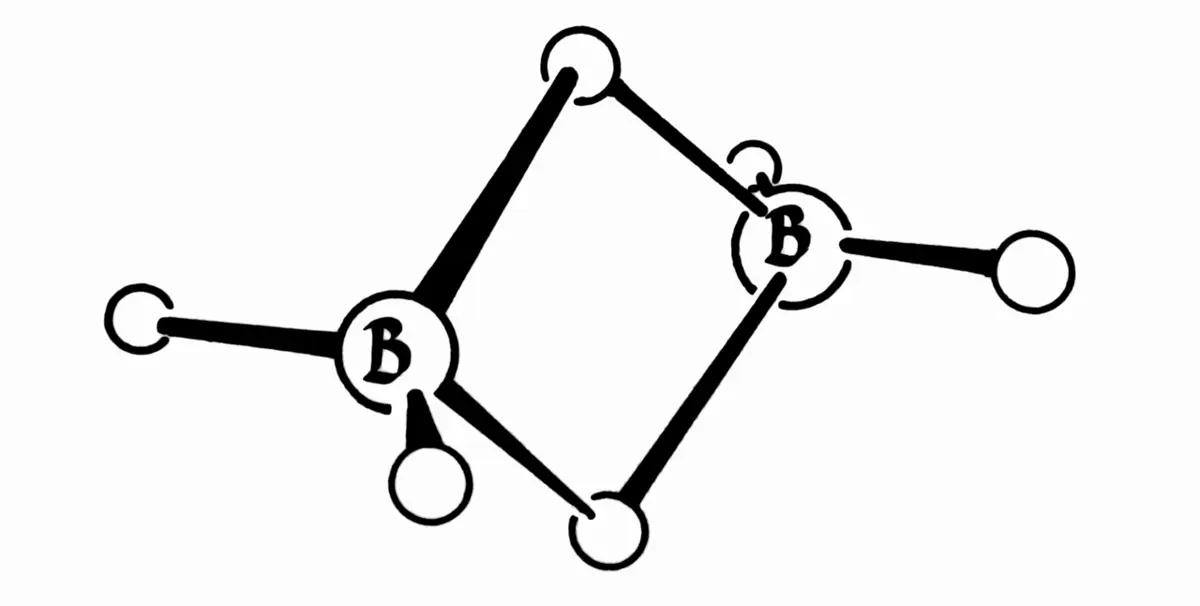
In diborane, each boron makes two ordinary bonds to its own two hydrogens: four bonds in all, using 8 electrons. That leaves 4 electrons. They form two bridges. In each bridge, one pair of electrons spreads over a boron, a hydrogen and the other boron, and holds all three together. This is called a three-center two-electron bond.
Count again: 4 ordinary bonds × 2 electrons + 2 bridges × 2 electrons = 8 + 4 = 12. Exactly the 12 valence electrons diborane has. No electrons are missing; they are just shared in a different way.
A bridge bond is spread over more atoms, so it is a little weaker and longer than an ordinary bond: in diborane, a bridge B–H bond is about 1.33 ten-billionths of a meter long, an ordinary one about 1.19.
Diborane has 12 valence electrons. Four of its hydrogens are held by ordinary bonds. How many electrons are left over for the two bridges?
Pick an answer to see why.
The bigger boranes are built on the same idea, and their shapes come from cages of triangles. The most perfect is the ion B₁₂H₁₂²⁻: twelve boron atoms at the corners of an icosahedron, a shape with 20 triangular faces, like a twenty-sided die, with a hydrogen pointing out from each corner. It had been predicted from bonding theory in 1955 and was made in 1960. It turned out to be unusually stable.
Which of these is true about a three-center two-electron bond?
Pick an answer to see why.
In your life today
- In the fields. Plants need a tiny amount of boron, one of their micronutrients Grade 9: Necessary nutrients for plants. Studies have found that most of Nepal’s farmland has too little. Cauliflower grows hollow, brown stems, and mustard and other crops give less. Farmers add a little fertilizer containing boron.
- Making medicines. Diborane adds to carbon–carbon double bonds in a neat, predictable way. Herbert Brown turned this into a widely used tool for building molecules, including medicines (the 1979 prize).
- Computer chips and solar panels. Diborane gas is used to add tiny amounts of boron to silicon, making the p-type silicon in chips, LEDs and solar cells.
What came next
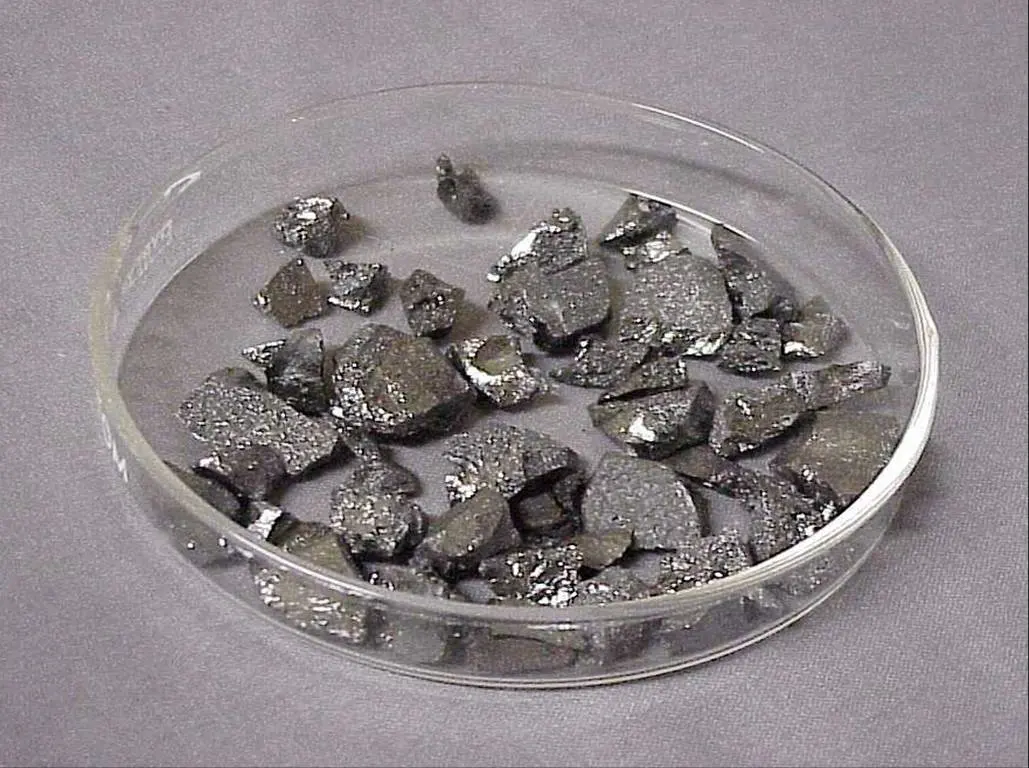
- Cages with carbon. Chemists learned to swap some boron atoms in the cages for carbon, making carboranes. They are very stable and are used in heat-resistant plastics and studied for new medicines.
- Enzymes. From about 1960 Lipscomb also used X-rays to find the shapes of enzymes, the proteins that speed up reactions in living things, and showed how one of them, a digestive enzyme, grips the food molecule it cuts. Two of his students later won Nobel Prizes of their own: Roald Hoffmann for the rules of chemical reactions (the 1981 prize) and Thomas Steitz for the shape of the ribosome (the 2009 prize).
- Boron against cancer. One kind of boron atom, boron-10, readily captures slow neutrons and then breaks apart, damaging only the cell it is in. In boron neutron capture therapy, a boron compound is taken up by a tumor and then the tumor is exposed to neutrons. Japan approved one such treatment in 2020. Whether boron clusters, which carry many boron atoms in one molecule, can be made to collect in tumors well enough to work better is still an open question.
In your science books
- Grade 8: valence shell, valence electrons and valency.
- Grade 9: valence electrons, the covalent bond, the octet rule, X-rays and plant nutrients.
- Grade 10: metalloids in the modern periodic table.
- Going further: molecules have shapes, in “What does a molecule look like?”
Learn more
- The Nobel Prize’s press release and presentation speech.
- William Lipscomb’s Nobel lecture, “The Boranes and Their Relatives”.
The official reason
The prize was given “for his studies on the structure of boranes illuminating problems of chemical bonding.”