
Pour a glass of hot chiya and forget it on the table. Half an hour later it is cold: it has cooled to the temperature of the room. Now imagine the opposite. A glass of cold chiya sits on the table, and slowly it gets hotter and hotter, until steam rises from it, while the room around it gets a tiny bit colder. Nobody has ever seen that happen.
But why not? In the last topic you learned that energy is never created or destroyed (Where Does the Energy Go When a Ball Bounces?). The cold chiya warming itself would break no rule about energy: every joule it gained would come from the room. The room has plenty to spare. Something else must decide which way heat flows. This topic finds out what, and why it means that no engine, however well it is made, can turn all its fuel’s heat into work.
A rule that energy doesn’t make
Film almost anything that happens on its own, then play the film backwards, and you will laugh, because you know at once that it is backwards. A cup falls from the table and smashes; backwards, the pieces jump up from the floor and join into a cup. A drop of ink spreads through a glass of water; backwards, the cloud of ink gathers itself into a drop. A bus brakes to a stop with hot brakes; backwards, the brakes cool down and push the bus off along the road.
In every one of these backward films, energy is still conserved. The pieces of the cup could get the energy to jump from the floor, if the floor’s molecules all happened to push them up together. The bus could get its kinetic energy back from its warm brakes. Energy alone doesn’t forbid any of it. Yet none of it ever happens.
You already know one rule like this from Grade 10. When two things at different temperatures touch, heat flows from the hotter one to the colder one until they reach the same temperature, and never the other way round by itself Grade 10: Heat. In 1854 the German physicist Rudolf Clausius put it in one sentence: heat can never pass from a colder to a warmer body without some other change happening at the same time.
This is one way of saying the second law of thermodynamics. (The first law of thermodynamics is the conservation of energy, the law of the last topic: thermal energy counted in with all the rest.) The first law says how much energy there is. The second law says which way things go.
A glass of cold water at 10 °C stands in a room at 25 °C. Which of these would break the second law, but not the first?
Pick an answer to see why.
Investigate: hot and cold together
The second law makes a prediction you can test. Put a hot thing and a cold thing together, in a container that lets as little heat as possible in or out (a closed system; physicists, strictly, call a system that no energy enters or leaves an isolated system), and the energy should spread out between them until it is shared evenly, with each part at the same temperature. You did the sums for this in Grade 10, mixing hot and cold water, where the heat lost by the hot water equals the heat gained by the cold water Grade 10: Mixing hot and cold. Now check it with your own measurements, and watch the energy spread.
Here are one class’s readings. They are made up for this example, worked out from a simple model of a set-up like the one in Figure 11.1 (200 g of water at 80 °C in the tumbler, 400 g at 20 °C in the pot, in a room at 20 °C), and rounded as a student reading a thermometer would. Yours will be different.
| Time (min) | Hot water (°C) | Cold water (°C) |
|---|---|---|
| 0 | 80.0 | 20.0 |
| 2 | 60.5 | 29.5 |
| 4 | 50.5 | 34.0 |
| 6 | 45.0 | 36.5 |
| 8 | 42.5 | 37.5 |
| 10 | 40.5 | 38.0 |
| 12 | 39.5 | 38.5 |
So far this is Grade 10’s heat lost = heat gained. Now look at the same numbers in a new way: where is the energy?
That is what the second law says happens, every time: when parts at different temperatures are put together, the energy spreads out until it is shared evenly among them. Equal temperatures mean the energy is shared evenly in this sense (for the same material, the same energy per gram). It never gathers itself back into one part.
In the tumbler investigation, the hot water cooled fastest in the first minute. Why?
Pick an answer to see why.
Why energy spreads out
Why should the energy spread out and never gather back? Nothing pushes heat from hot to cold. The answer is chance, and how much more likely some arrangements are than others.
Think about the molecules in the tumbler’s wall where the two waters meet. A fast-moving molecule of hot water hits the steel and gives it a shake; the steel shakes the slower molecules of cold water on the other side. Energy can also pass the other way, when a fast cold-water molecule hits the steel. At the molecular level, energy goes back and forth at random, in both directions. So why does more go one way?
To see why, make a very simple model of two solid blocks touching. In the model, energy comes in small equal packets, and each atom can hold any number of them. (This is roughly how the atoms of a solid really store energy; it is called an Einstein solid, after Albert Einstein, who used it in 1907.) Again and again, a packet jumps at random from one atom to a neighbor. No rule says which way.
Start with the smallest interesting case: two blocks of three atoms each, sharing six packets. Count the ways the six packets could be shared among the six atoms. There are 28 different ways to put all six in the left block (six on one atom; five on one and one on another; and so on). But there are 100 ways to have three in each block. Because each jump is random, and a jump is exactly as likely as the jump back, in the long run every single arrangement turns up as often as any other; so a split that can happen in more ways turns up more often.
With six atoms, the energy can easily find its way back into one block: 28 ways out of 462, about one look in 17. But watch what happens as the blocks get bigger.
With 4 + 4 atoms, the energy keeps spreading out and coming back: you will often see all of it back in the left block. That is heat flowing from cold to hot, all by itself. With 25 + 25 atoms, the chance of finding all the energy back in the left block is about 1 in 3 billion. With 256 + 256 atoms, it is about 1 in 10⁹⁶ (a 1 with 96 zeros).
Now think of a real glass of chiya. 200 g of water has about 6.7 × 10²⁴ molecules (200 g ÷ 18 g per mole × 6.02 × 10²³). The number of ways to share its energy evenly with the room is so much bigger than the number of ways to keep it hot that the chance of the cooled chiya heating itself up again isn’t zero, but you would never see it if you watched every cup of tea in the world from the beginning of the universe until now. That is the second law: energy spreads out because there are vastly more ways for it to be spread out than to be gathered together. It isn’t pushed. It is just overwhelmingly likely.
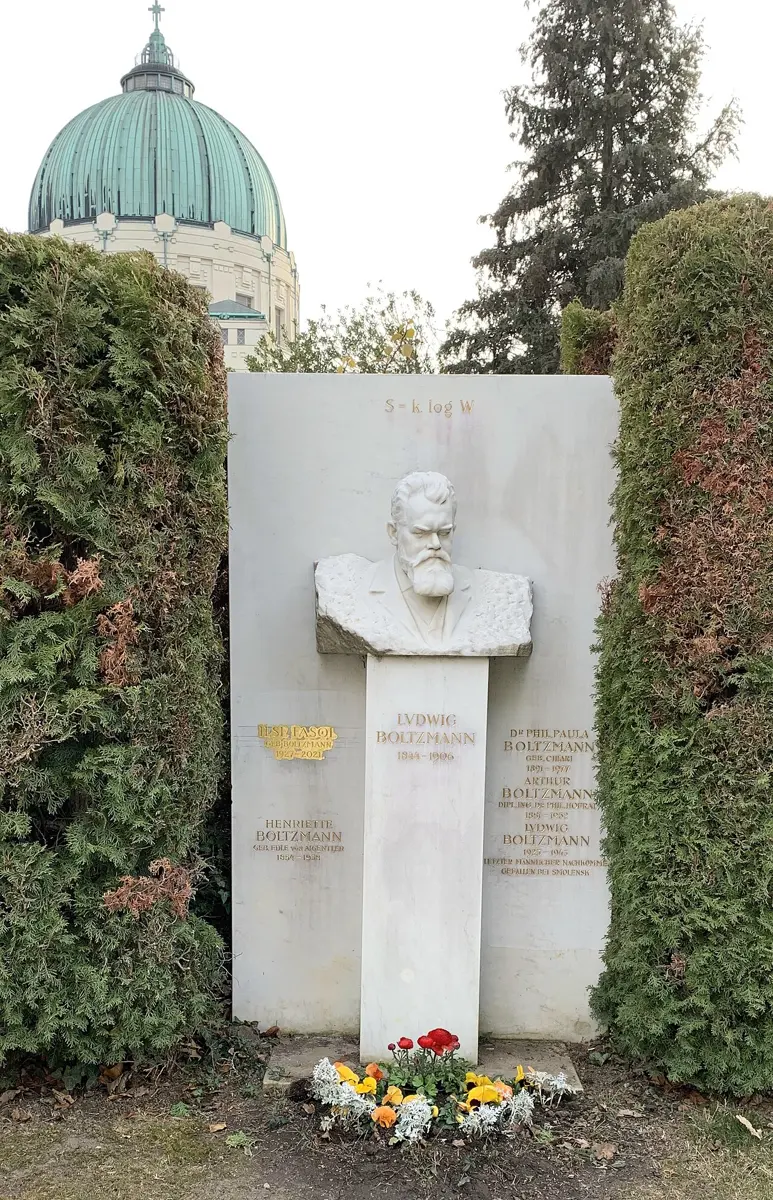
Scientists measure how spread out energy is with a quantity called entropy (Clausius named it in 1865). The more ways there are to arrange the energy among the molecules, the higher the entropy. So the second law can also be said like this: in a closed system, entropy never goes down. The hot and cold water in the investigation had lower entropy at the start than at the end.
At the level of molecules, which is true when a hot block touches a cold one?
Pick an answer to see why.
Why no engine is perfect
In Grade 9 you learned that no machine is 100% efficient, because friction always turns some of the input work into heat Grade 9: Efficiency. A well-oiled pulley can come close to 100%. The second law adds a much bigger limit, which no oiling can remove. It is about engines that run on heat.
A heat engine is any machine that turns heat into work: a steam engine, the petrol engine of a car or motorbike, the diesel engine of a bus, the steam turbines of a coal or nuclear power station. Every one of them works in the same way. It takes heat from something hot (burning fuel, or steam), turns part of it into work, and lets the rest flow out to something cold (the air, or a river). A car engine’s cold side is the air: its radiator and its exhaust pipe throw heat into it. A power station’s cold side is its cooling water.
Why can’t an engine skip the cold side, and turn all the heat into work? Think about what the heat is: the random jiggling of countless molecules, spread out in every direction. Work is orderly: a piston pushed one way, a shaft turned one way. Turning all of the random motion into orderly motion would be like the cooled chiya heating itself back up, gathering the energy instead of letting it spread: against the odds of the second law. An engine can only get work out by letting heat flow from hot to cold, the way it wants to go, and catching part of the flow on the way, like a water wheel catching part of a waterfall’s energy. The rest must flow on to the cold side.
How big a part can it catch? The French engineer Sadi Carnot showed in 1824, using exactly this picture of a waterfall, that the answer depends only on the two temperatures. Once Lord Kelvin had made his absolute temperature scale (1848), Kelvin and Clausius could write the answer as a formula, with the temperatures measured in kelvin (Grade 10: T in K = t in °C + 273). Think of the temperature as the height of the waterfall, measured from absolute zero, the bottom of everything. An engine takes in heat at the hot temperature , but it can only let it fall as far as the cold temperature , not all the way down to 0 K. So the best fraction it can use is the height of the fall, − , out of the whole height :
This is the Carnot efficiency. (The waterfall is only a way to picture it; the proof uses the second law itself.) No heat engine can do better, however well it is made, because to do better it would have to make heat flow from cold to hot on its own somewhere inside it. Real engines do worse, because of friction and because heat leaks away without doing anything.
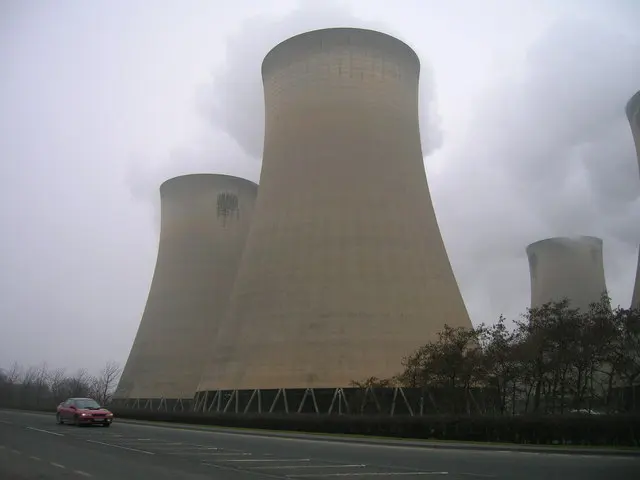
Try it: the engine does better the hotter its hot side and the colder its cold side. That is why power stations use steam as hot as their steel pipes can stand, and why engineers keep looking for metals that stay strong when hotter still. But the cold side can’t be colder than the surroundings, the air or a river, so no engine on Earth can get anywhere near 100%.
A car’s petrol engine turns about a quarter of its fuel’s energy into work. Where does most of the rest go?
Pick an answer to see why.
Pushing heat uphill
Heat never flows from cold to hot by itself. But your fridge moves heat from its cold inside to the warmer kitchen every day. How?
Clausius’s sentence has a way out: “without some other change happening at the same time”. A fridge is a pump for heat. It uses electrical energy to do work, and that work carries heat from the cold inside to the warm outside, the way a water pump carries water uphill. In Grade 8 you met the black grid of pipes at the back of a fridge, which gives off the heat taken from inside Grade 8: Uses of radiation. That heat is more than the heat taken out of the food: it is that heat plus the electrical energy the fridge uses.
The trick is in the compressor. Squeezing a gas makes it hot, which is one reason the end of a bicycle pump gets warm as you pump. Inside the freezer the liquid in the pipes is colder than the food, so heat flows into it, downhill. After the compressor has squeezed it, the gas is hotter than the kitchen, so heat flows out of it, downhill again. Each flow goes from hot to cold, as the second law says. The electrical energy is the “other change” that lets the whole fridge move heat uphill.
Questions
A heat engine takes in heat at 327 °C and gives out heat at 27 °C. What is the best possible efficiency?
Pick an answer to see why.
An inventor says his engine takes 1,000 J of heat from a boiler at 100 °C, gives 100 J to cooling water at 20 °C, and does 900 J of work. What is wrong?
Pick an answer to see why.
Plan an investigation to show that when a hot object is put into cold water in a closed container, energy spreads from the object to the water until they are at the same temperature. Say what you would use, what you would measure, what you would keep the same, how you would reduce heat lost to the surroundings, and how you would use your results to check that the energy was conserved.
Answer
For example: heat some steel nuts (or stones) of known mass, about 200 g, in boiling water so that they are at 100 °C. Weigh about 200 g of cold water into an insulated cup (a polystyrene cup with a lid, or a steel tumbler wrapped in cloth), and measure its temperature. Lift the nuts out quickly with a spoon, shake off the water, drop them into the cup and close the lid. Stir and read the water’s temperature every 30 seconds until it stops rising.
Measure: the masses (with a kitchen scale), the starting temperatures (100 °C for the nuts, the water’s with a thermometer), and the final temperature. Keep the same: the masses and the cup, if you repeat it; repeat it three times and take the average. Reduce losses: lid, insulation, moving the nuts quickly.
Check: the heat gained by the water, m₁s₁Δθ₁, should equal the heat lost by the nuts, m₂s₂Δθ₂ (steel 460 J/(kg °C)); or the measured final temperature should be close to the one this predicts. A little lower is expected, because some heat escapes; say how much and why.
A student mixes 300 g of water at 70 °C with 100 g of water at 10 °C in an insulated flask.
- a.Predict the final temperature.
- b.Taking 10 °C as the zero, how much thermal energy does each part have before mixing, and how much per gram? And after mixing?
- c.Use your answer to b. to explain what “a more even spread of energy” means.
Answer
- a.0.3 × 4200 × (70 − T) = 0.1 × 4200 × (T − 10), so 3(70 − T) = T − 10, 210 − 3T = T − 10, 4T = 220, T = 55 °C.
- b.Before: hot water 0.3 × 4200 × 60 = 75,600 J, which is 252 J per gram; cold water 0 J, 0 J per gram. After, at 55 °C: hot part 0.3 × 4200 × 45 = 56,700 J and cold part 0.1 × 4200 × 45 = 18,900 J, together 75,600 J (none lost), and each gram has 189 J.
- c.Before mixing, all the energy above 10 °C was in three-quarters of the water and none in the rest. After, every gram has the same, 189 J: the energy is shared evenly among all the water, and that is why the temperature is the same everywhere.
Using the idea of molecules and chance, explain why a cup of hot tea cools down to room temperature, but a cup of tea at room temperature never heats up by itself, even though that would not break the law of conservation of energy.
Answer
The tea’s thermal energy is the random motion of its molecules. Where the tea touches the cup and the air, energy passes from molecule to molecule at random, in both directions. But there are vastly more ways to share the energy evenly among the molecules of the tea, the cup and the room than to keep it crowded in the tea, so random passing almost always ends with the energy spread out: the tea cools until it is at the same temperature as the room. For the tea to heat up again, energy from countless molecules of the room would have to gather, by chance, into the few molecules of the tea. That arrangement is possible, and would conserve energy, but it is so overwhelmingly unlikely, with about 10²⁵ molecules in a cup, that it never happens.
A ship’s engineer suggests running a ship on the thermal energy of the sea, which is enormous: the engine would take heat from the sea water, turn it into work, and leave the water slightly colder. Why won’t it work? What would it need, that a ship at sea doesn’t have?
Answer
It would be a heat engine with only a hot side. To turn heat into work, an engine must let heat flow from something hot to something colder and give out part of the heat there (second law). Taking heat from water at one temperature and turning all of it into work would mean energy gathering itself from random motion into orderly motion on its own: like the sea heating one part of itself while cooling another. The ship would need a cold side, something colder than the sea water to give heat to, such as cold water pumped up from the deep (and even then, with a few degrees of difference, the best efficiency would be a few per cent).
An air conditioner takes 1,500 J of heat out of a room every second and uses 500 J of electrical energy every second.
- a.How much heat does it give out of the window every second?
- b.Explain why it must use electrical energy at all, when it only moves heat.
Answer
- a.Heat out = heat taken in + electrical energy = 1,500 + 500 = 2,000 J every second.
- b.It moves heat from the cooler room to the warmer air outside. Heat never flows from colder to hotter by itself (second law), so it can only happen with “some other change”: the work done by the compressor, which uses electrical energy. That energy ends up as heat outside too.
A pulley system is 90% efficient and a car’s petrol engine about 25%. Both lose energy. Explain why oiling the pulley can bring it close to 100%, but no improvement can bring a petrol engine close to 100%.
Answer
The pulley loses energy only through friction, which oiling reduces; nothing in principle stops it reaching nearly 100%. The petrol engine is a heat engine: it starts from heat, the random motion of molecules in the burning gases. The second law says it must give part of that heat to a cold side, the air, and even a perfect engine could turn only 1 − ÷ of it into work. Friction and leaks make the real figure lower still. However good the oil, the second law’s share is lost.
Where to go next
- Where Does the Energy Go When a Ball Bounces? Counting energy in joules: kinetic, gravitational and thermal, and how the total stays the same. The first law, behind this topic’s second.
- How Much Electricity Can a Small Stream Make? Turbines and generators, which aren’t heat engines, and how much of a stream’s energy a small hydropower plant can turn into electricity.
- How Does Your Body Stay at 37 °C? Your body makes heat all the time, and it must flow out, from hot to cold, at just the right rate.