
Boron, phosphorus and building molecules
Nobel Prize in Chemistry, 1979: Herbert C. Brown and Georg Wittig
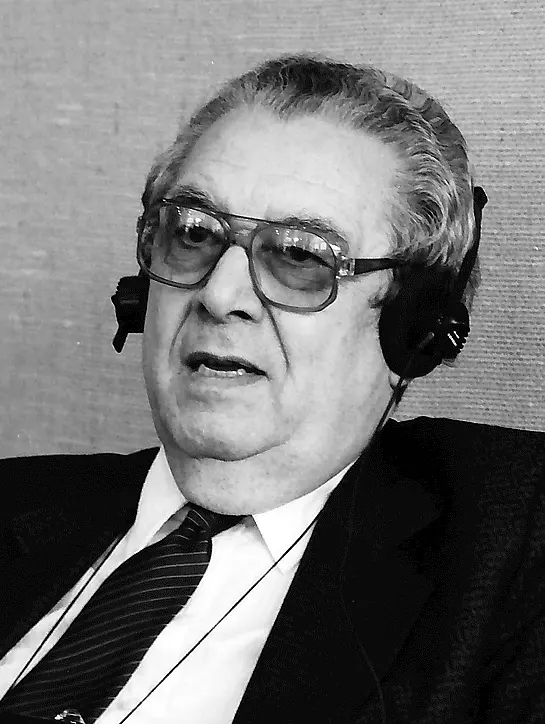
Herbert C. Brown
1912–2004, born in London, England, grew up in Chicago, USA
He left school for a while to run his family’s small shop after his father died. He liked to joke that his initials, H, C and B, are the symbols of hydrogen, carbon and boron, the elements he worked with.
Photo: Willy Pragher, CC BY 3.0 de
-
Georg Wittig
1897–1987, born in Berlin, Germany
A cavalry officer and prisoner of war in the First World War before he studied chemistry. He found his famous reaction in his mid-fifties and won the prize at 82.
Twice a year, in Baisakh and Kartik, health volunteers all over Nepal give small children a vitamin A capsule. Vitamin A keeps the eyes working in dim light and helps the body fight infections Grade 10: night blindness. Carrots, pumpkin and saag contain substances the body turns into vitamin A, but the vitamin in a capsule is made in factories, many tonnes of it a year. One of the world’s biggest makers builds it using a reaction found by a German chemist, Georg Wittig.
Making a molecule like vitamin A is like building with blocks, but the blocks are atoms too small to hold. A chemist needs tools: substances that change one exact part of a molecule and leave the rest alone. In 1979 the Nobel Prize in Chemistry went to two chemists who gave the world some of its most useful tools. Herbert C. Brown made his from boron, and Wittig made his from phosphorus.
The problem: building molecules to order
Carbon atoms can join to each other in long chains and rings, thousands of ways, a property called catenation Grade 9: catenation. The chemistry of carbon compounds is organic chemistry. Medicines, plastics, dyes, perfumes and vitamins are all organic compounds, and by 1979 chemists had made more than two million of them.
The behavior of an organic molecule is decided mostly by a small group of atoms in it, its functional group Grade 10: functional groups. Two matter for this page:
- C=O, a carbon joined to an oxygen by a double bond. Molecules with it are called aldehydes and ketones. Acetone, in nail-polish remover, is a ketone.
- C=C, two carbons joined by a double bond. Hydrocarbons with it are the alkenes, like ethene Grade 10: alkenes.
A chemist building a medicine often needs to do one small, exact job: turn a C=O into an alcohol, or put a C=C in one exact place in a long chain, without disturbing a dozen other groups in the same molecule. In the 1930s the tools for this were few, rough or dangerous.
Which of these is the functional group of an alkene?
Pick an answer to see why.
What they did, step by step
Brown: boron and hydrogen (1936–1960s)
- A cheap present (1936). When Brown finished his first degree at the University of Chicago, his girlfriend, Sarah Baylen, gave him a book: The Hydrides of Boron and Silicon. Boron hydrides are compounds of boron and hydrogen. He read it and decided to study them.
- A gas that turns C=O into alcohol (1938). For his doctorate he studied diborane, B₂H₆, a gas made of boron and hydrogen. He found that it adds hydrogen to the C=O of aldehydes and ketones, quickly and gently, even at very low temperatures, turning them into alcohols Grade 10: alcohols. Adding hydrogen to a molecule like this is called reduction. But in 1939 diborane was very rare: only two laboratories in the world made it, in tiny amounts, so almost nobody paid attention.
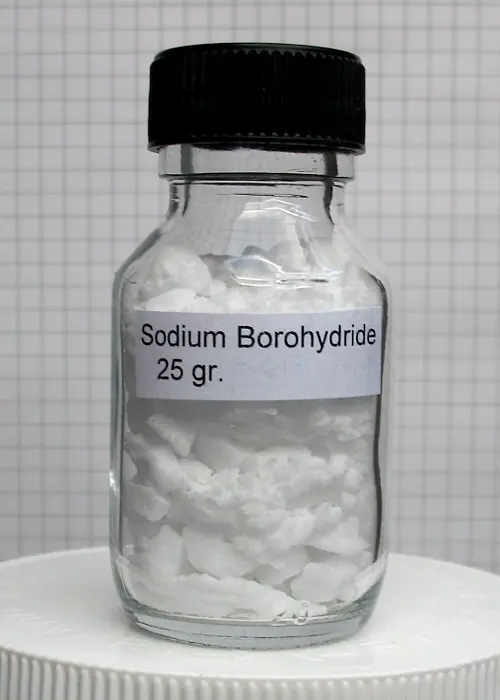
- Wartime work (1940s). During the Second World War, Brown and his professor, Hermann Schlesinger, were asked to make compounds of uranium that turn into gas easily, for the American government. On the way they found how to make sodium borohydride, NaBH₄, a white solid. While trying to separate it from another product with acetone, they noticed that it changed the acetone: it had reduced its C=O to an alcohol.
- The gentle tool. Sodium borohydride is a safe, easy powder. It reduces aldehydes and ketones but leaves many other groups alone, and it can even be used in water or alcohol. After the war, when the secrecy ended, it became one of the most used substances in organic chemistry. Brown then made a whole range of related tools, some gentler and some stronger, so that a chemist could pick exactly the one that changed one group and not another.
- A strange result (1956). At Purdue University, an Indian chemist working with Brown, B. C. Subba Rao, was measuring how much hydrogen different substances took from a borohydride mixture. One fat-like substance took more than it should. The extra went into its C=C double bond: the boron and a hydrogen had added across it. Brown called this hydroboration.
- A new family of compounds. The products, with carbon joined to boron, are called organoboranes. Subba Rao showed that treating them with hydrogen peroxide swaps the boron for an –OH group, giving an alcohol. Brown’s team went on to use organoboranes for dozens of other jobs, including joining carbon atoms together.
Hydroboration is special because of where the –OH ends up. The older way to turn an alkene into an alcohol, with water and an acid, puts the –OH on the middle carbon. Hydroboration puts it on the end carbon. Now a chemist could choose.
A chemist has a molecule with both a C=O group and a C=C group, and wants to turn only the C=O into an alcohol. Which of Brown’s tools fits?
Pick an answer to see why.
Wittig: swapping an oxygen for a carbon (1953–1954)
- A late start. Georg Wittig was born in Berlin in 1897. He began studying chemistry in 1916, but was called up into the army and spent the end of the First World War as a prisoner. He became a professor, mostly at the University of Tübingen and then Heidelberg, and was known for following unusual questions just to see what happened.
- Five arms on a phosphorus atom. In the 1940s and 1950s his group was studying whether a phosphorus atom can hold five groups around it. Along the way they made an odd compound in which a carbon is held to phosphorus by a link that behaves like a double bond: P=CH₂. Compounds like this are called ylides (say ill-ides).
- The surprise (1953). With his student Georg Geissler, Wittig mixed the ylide with a ketone. He expected the two to join into one bigger molecule. Instead, two new molecules came out. The ketone’s oxygen had gone to the phosphorus, and the ylide’s CH₂ had taken its place on the carbon. The C=O had become a C=C.
- A clean, exact swap (1954). With another student, Ulrich Schöllkopf, he showed that it works with many aldehydes and ketones. Its great advantage: the new C=C appears exactly where the C=O was, and nowhere else. Older methods often gave a mixture, with the double bond in the wrong place.
Why does the swap happen? Phosphorus and oxygen hold on to each other very strongly. Making the bond between them gives out a lot of energy, and that pulls the whole reaction forward, like water running downhill.
How chemists use these tools now
- Vitamin A. Vitamin A is a ring and a long chain of carbon atoms with five C=C double bonds. Chemists at the German company BASF, led by Horst Pommer, built it by joining two pieces with Wittig’s reaction, which creates one of those double bonds exactly where it belongs. The method is still used to make vitamin A in factories.
- Medicines. Sodium borohydride is used in making many medicines, including the antibiotic chloramphenicol. Brown’s boron compounds can also make just one of the two “mirror-image” forms of a molecule, which matters because the two forms can act very differently in the body.
- Joining carbon atoms. Two young chemists who worked in Brown’s laboratory, Akira Suzuki and Ei-ichi Negishi, later found ways to join carbon atoms using metals and, in Suzuki’s case, organoboranes. Their reactions are used to make medicines and the materials in phone screens, and they won the 2010 prize (our page on their prize).
In your life today
- Vitamin A for children. Nepal’s national vitamin A program gives a capsule twice a year to every child between 6 months and 5 years old. Started in 1993, it is believed to have saved the lives of tens of thousands of children, because vitamin A also helps the body fight infections such as measles.
- Medicines. Every packet of tablets you buy from a pharmacy began as a molecule built in steps, and reductions and Wittig reactions are among the steps chemists use most.
- Your textbook, too. The Nobel committee noted that Brown’s and Wittig’s reactions went straight into textbooks and student laboratory courses. They are taught to every chemistry student at university today.

What came next
- Waste. The Wittig reaction leaves behind a large, heavy by-product, triphenylphosphine oxide, often much heavier than the bit of the molecule the chemist wanted. Making a few tonnes of a medicine can mean tonnes of this waste. Chemists now try to design reactions that waste fewer atoms, called green chemistry (our page on the 2005 prize).
- Many more reactions with boron. Organoboranes became the starting point for the Suzuki reaction, now one of the most used reactions in the world for joining carbon atoms.
- Open question: can chemists find tools as exact as Brown’s and Wittig’s that need no boron or phosphorus at all, use only a pinch of a catalyst, and leave nothing behind but water?
In your science books
- Grade 9: catenation and organic compounds.
- Grade 10: alkenes, functional groups, alcohols and night blindness (vitamin A).
- Going further: how many hands an atom has (why carbon makes four bonds).
Learn more
- The Nobel Prize’s press release and presentation speech for 1979.
- The laureates’ Nobel lectures: Brown and Wittig.
The official reason
The prize was given “for their development of the use of boron- and phosphorus-containing compounds, respectively, into important reagents in organic synthesis.”