
In 2009, Nepal’s forests held 121 tigers. Thirteen years later they held 355. You can say that in a long paragraph, or you can draw four bars and let the eye do the work in one second. But an exam will not ask you to draw the bars. It will give you the bars and ask you to say them.
This unit is about charts, graphs and tables: how to read them, and how to turn them into good English. You will read how Nepal became the first country to double its tigers, and a short play about a mousetrap that ends badly for everyone except the mouse. You will learn the words that say how fast and how far numbers move (rose steadily, fell slightly, more than doubled), choose between much, many, a few and a little while a couple shop for an apple pie, and sort out the four present tenses. You will describe a bar chart and a flowchart, ask questions about a table, and draw a graph of your own school.
Getting started: what do these charts show?
A table puts facts in rows and columns. A chart or graph turns numbers into a picture, so that you see the pattern before you read a single number. People use the two words almost as one. These are the kinds you will meet in this unit.
| Kind | What it looks like | Best for |
|---|---|---|
| bar graph (bar chart) | bars side by side; the taller the bar, the bigger the number | comparing amounts |
| pictogram | rows of small pictures; each picture stands for a number | simple counts |
| flowchart | boxes joined by arrows | the steps of a process |
| table | rows and columns of facts | exact numbers |
The unit opens with two charts of the same kind of survey: which fruit do people like best?
What do the following charts/graphs represent? Discuss.
A model answer
In the pictogram, how many more votes did the apple get than the grapes?
Pick an answer to see why.
Reading I: Nepal’s tigers
Before you read
The text comes with two charts. Here is the first, drawn from the report’s numbers.
What is the name of the given charts?
A model answer
Is it good to increase the number of tigers? Why?
A model answer
What kind of text it is
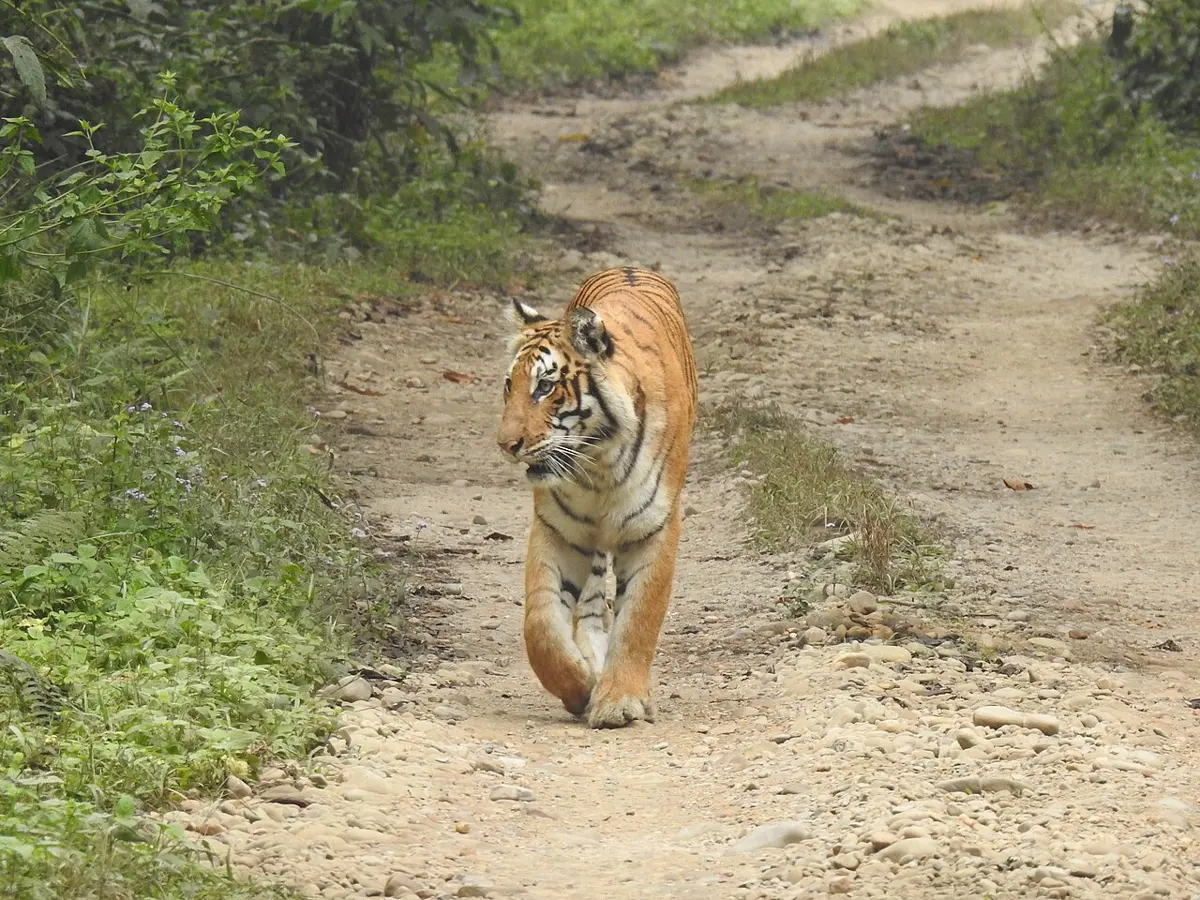
This is a report, adapted from one published by the National Trust for Nature Conservation (NTNC) on 29 July 2022, which is Global Tiger Day. A report gives facts and numbers, says where they come from, and quotes experts. It doesn’t tell a story with characters, and it doesn’t try to make you laugh. Its job is to inform, so look for dates, numbers and names of organizations.
The text, part by part
The surveys. Nepal began its fourth tiger and prey survey (prey are the animals that a hunter eats) in December of the year before the report. Two government departments led it, the Department of National Parks and Wildlife Conservation and the Department of Forests and Soil Conservation, under the Ministry of Forests and Environment. The nationwide surveys (those that cover the whole country) have come about every four years since 2009. The first three, in 2009, 2013 and 2018, found about 121, 198 and 235 tigers.
The big news. An NTNC tiger expert, Dr. Chiranjibi P. Pokharel, says that the new number is close to three times the number of 2009–2010, and he calls that historic. Tigers are apex predators: they stand at the very top of the food chain. Their numbers are intricately linked to the health of forests, which means that the two are joined in many small ways. So this is undoubtedly (certainly) good news for all wildlife.
How bad it had been. A hundred years ago, about 100,000 tigers lived across Asia. By 2010, the number had drastically fallen (fallen in a very big way) by 97%, to about 3,200. The main reasons were the loss of the places where they live and poaching (illegal hunting). So the 13 countries that still have wild tigers, Nepal among them, pledged (made a firm promise) to double their tigers by 2022. They did this by endorsing (officially agreeing to) a declaration signed at St. Petersburg in Russia in 2010. The goal is called TX2: tigers times two.
What Nepal did. Since 2010, Nepal has taken many initiatives (new plans of action). It has made more land safe for tigers and their prey by creating Banke National Park and making Parsa National Park bigger. It has also set up bodies at every level, from the very top to the village.
| Level | Who does what |
|---|---|
| top | the Prime Minister chairs the National Tiger Conservation Committee |
| central to district | Wildlife Crime Control Bureau units see that the law really works (enforcement) |
| community | more than 450 local anti-poaching units |
Money and help came from many stakeholders, the people and groups with an interest in the result, both in Nepal and abroad.
What comes next. The danger isn’t over. Poaching, illegal wildlife trade and climate change still threaten tigers. To manage a growing number sustainably (in a way that can go on for years), Nepal must care for the large animals that tigers eat, such as gaur, swamp deer, sambar, nilgai and wild buffalo. It must deal with conflict between people and tigers, and work with villagers towards coexistence (living side by side). Good science must back (support) every decision, and roads and buildings must be friendly to wildlife. Last of all, corridors, the strips of forest that link one tiger home to the next across the landscape, are needed for the safe dispersal of tigers, as young ones spread out to find homes of their own.
The second chart
The report’s second chart looks closer. For each park and the forests beside it, one bar is the count of 2018 and the other the count of 2022, so each pair shows a change.
Which park’s number changed the least between 2018 and 2022?
Pick an answer to see why.
Why does the report say that a rising tiger number is news for all wildlife?
Pick an answer to see why.
Words from the text
Words linked here open in English Vocabulary, where you can see an example and practice them in the word game. The meanings below are the ones the words have in this text.
| Word | Meaning here |
|---|---|
| prey | animals that are hunted and eaten by another animal |
| nationwide | in all parts of a country |
| apex | the very top; an apex predator has no hunters above it |
| intricately | with many small parts that fit together |
| undoubtedly | certainly, without any doubt |
| drastically | in a very big and serious way |
| poaching | hunting birds and animals illegally |
| pledge | to make a firm promise |
| endorse | to say officially that you agree with something |
| declaration | an official public statement |
| initiative | a new plan to solve a problem |
| enforcement | making people obey a law or rule |
| stakeholder | a person or group with an interest in how something turns out |
| sustainably | in a way that can continue without doing harm |
| coexistence | living together in the same place at the same time |
| back | to support |
| corridor | a strip of land that links two habitats |
| landscape | a large area of land seen as a whole |
| dispersal | spreading out over a wide area |
A. Match the words
Match the words in column A with their meanings given in column B.
| Column A | Column B | ||
|---|---|---|---|
| a. | nationwide | i. | the act of making people obey a particular law or rule |
| b. | intricately | ii. | hunting birds and animals illegally |
| c. | poaching | iii. | the state of being together in the same place at the same time |
| d. | enforcement | iv. | existing in all parts of a particular country |
| e. | coexistence | v. | the process of spreading something over a wide area |
| f. | dispersal | vi. | with a lot of different parts that fit together |
Answer
B. Fill in the blanks
Fill in the blanks with correct information from the text.
- a.The third tiger and prey survey found a total of ……… tigers in Nepal.
- b.Tigers are at the top of the ……… chain.
- c.The national committee related to tiger conservation in Nepal is headed by ……… .
- d.National and international ……… have supported the tiger conservation program.
- e.Development works and construction should be conducted in a ……… way.
Answer
C. Answer the questions
How many tiger surveys have already been conducted?
Answer
What percent of Asia’s tigers were left in 2010?
Answer
When was the St. Petersburg declaration made?
Answer
Mention any one initiative that Nepal has adopted for tiger conservation.
A model answer
What are the threats to tiger conservation?
Answer
D. Building without thinking
In Nepal, some development and construction activities have been conducted without considering nature and its ecosystem. What might be its effects? Discuss.
A model answer
Pronunciation: chart words
You will use these ten words each time you talk about a chart. The loud part of each word is in capitals.
| Word | Say | Watch out for |
|---|---|---|
| constant | CON-stant | the stress is at the front |
| rising | RI-zing | ri as in rice; the s sounds like z |
| trend | trend | one beat; tr with no vowel between |
| ascend | a-SEND | the c is silent |
| descend | di-SEND | the c is silent |
| decrease | DEE-crease (a thing) / dee-CREASE (an action) | the stress moves |
| decline | di-CLINE | cline rhymes with line |
| steadily | STED-i-ly | ea as in bread, not eat |
| rapidly | RAP-id-ly | three beats |
| proportion | pro-POR-shun | -tion is shun |
Writing I: interpreting a bar chart
To interpret a chart is to say in words what it shows. Don’t read out every number. Your reader can see the numbers. Say what they mean.
A good description has three parts.
| Part | What it says | Useful openings |
|---|---|---|
| Introduction | what the chart shows, and for which years | The bar chart shows … / The given chart compares … |
| Overview and details | the main trend first, then the numbers that prove it | Overall, … / According to the chart, … / As given in the chart, … / If we take a closer look, … / On the other hand, … |
| Conclusion | what it all adds up to | To sum up, … / In conclusion, … |
Numbers move in three ways: up, down, or not at all. For each, you can use a verb with an adverb, or an adjective with a noun. They mean the same, so mix them.
| Verb + adverb | Adjective + noun | |
|---|---|---|
| up, a little | rose slightly | a slight rise |
| up, a lot | rose sharply | a sharp rise |
| down, little by little | fell gradually | a gradual fall |
| down, a lot | dropped dramatically | a dramatic drop |
| no change | remained steady at 1,200 | no change |
Numbers also multiply: doubled (× 2), tripled (× 3), nearly tripled, more than doubled, halved (÷ 2). You will find many more words in the Extra bit.
And four small words do careful work with numbers.
| Word | Example | What it tells you |
|---|---|---|
| from … to | rose from 121 to 198 | the start and the end |
| by | rose by 77 | the size of the change |
| at | remained steady at 1,200 | the level |
| of | a rise of 77 | the size, after a noun |
Now it’s your turn. This chart shows men and women studying engineering at a university.
The chart above shows the number of men and women studying engineering in a university. Write an interpretation of the chart.
Hint
A model answer
Which sentence about the chart is not true?
Pick an answer to see why.
Listening: an apple pie for dinner
A man and a woman must make dinner tonight, so they check their kitchen against a recipe. Listen for how much they have, and how much they need. Read the questions in B first.
Words to know: recipe (the instructions for making a dish), flour (powder made from grain; it sounds the same as flower), cinnamon (दालचिनी, a sweet brown spice) and nutmeg (जाइफल, a brown spice), shopping list (a note of things to buy), store (a shop).
A. Before you listen
The picture shows a smiling woman in an apron, holding a freshly baked pie in oven gloves. An older man in a cap stands behind her with his hands on her shoulders.
Where do you think these people are?
A model answer
What do you think they are doing there?
A model answer
B. Complete the sentences
Listen to the audio and complete the sentences with the missing information.
- a.Mike wants to make ……… .
- b.They have ……… apples.
- c.They have to use only ……… apples.
- d.They have only about 200 grams of ……… .
- e.They don’t have any ……… .
- f.They need ……… grams of butter.
- g.All the remaining ingredients will be bought from ……… .
Answer
C. The ingredients
Note down as many ingredients as you can remember from the audio to make an apple pie.
Answer
Grammar I: quantifiers
A quantifier is a word that says how many or how much. You met some, any, many, much, a few and a little in earlier grades. This section puts them all in one place, and they all depend on one question: can you count the thing?
Countable nouns are things you can count one by one, so they have a plural: an apple, six apples. Uncountable nouns are stuff, with no plural: flour, milk, time, money, news. You can’t say two flours. But you can count a container of it: two cups of flour.
A. Six sentences to study
Study these sentences and discuss how the quantifiers in bold have been used.
- a.Most children start school at the age of five.
- b.We ate some bread.
- c.We saw lots of birds.
- d.We have lots of time.
- e.Did you see any friends?
- f.Would you like any food?
What to notice
This table shows which quantifier goes with which kind of noun.
| With countable nouns | With uncountable nouns | With both |
|---|---|---|
| many, (a) few, several, fewer, both | much, (a) little, a bit of, less | all, some, any, no, more, most, enough, a lot of, lots of |
| with a singular noun: each, either, neither |
A few* and few, a little and *little are not the same. With a, the speaker is pleased: there is some. Without a, the speaker is worried: there is hardly any.
| Countable | Uncountable | |
|---|---|---|
| some, and that’s fine | A few friends came, so we had fun. | We have a little time, so let’s eat. |
| almost none, and that’s bad | Few friends came, so we felt lonely. | We have little time, so hurry. |
“There are ……… tigers in Banke than in Chitwan.” Which fits?
Pick an answer to see why.
“Hurry up. We have ……… time before the bus leaves.” Which fits best?
Pick an answer to see why.
B. Choose the quantifier
Choose the correct quantifier to complete the sentences.
- a.I’m sorry, but there’s ……… (any/no) milk. Is black tea OK?
- b.If you want to lose weight, you should eat ……… (less/more) chocolate.
- c.If you want to help me make breakfast, you can peel ……… (any/some) potatoes.
- d.We don’t have ……… (all/enough) tomatoes. Can you bring another five or six, please?
- e.When I was a child, I used to drink ……… (a lot of/most) milk.
- f.I don’t generally like fruits but I eat ……… (no/a lot of) mangoes.
- g.I’m not sure if we can make a cake. Do we have ……… (some/much) eggs?
- h.Sorry, I can’t go with you. I’ve got ……… (any/some) work to do.
Hint
Answer
Reading II: A Mousetrap
Before you read
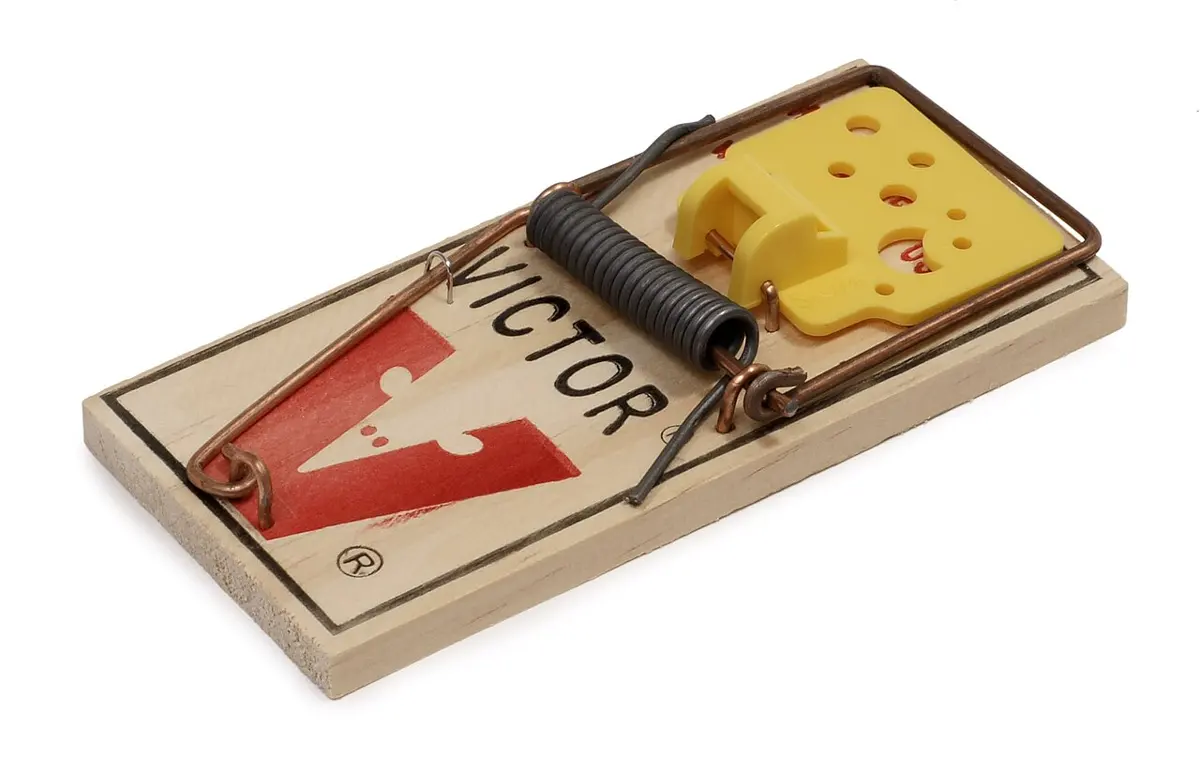
What is the object shown in the picture? What is it used for?
A model answer
How do you react when someone asks you for your help?
A model answer
What kind of text it is
This is a short drama, or play: a story told by what the characters say. The name of the speaker comes first, then the line. The words in brackets, usually in italics, are stage directions: they tell the actors what happens and how to move. A play isn’t written to be read silently, so read it aloud with friends, one character each and one reader for the stage directions.
It is also a fable, a story with animals that teaches a lesson. The drama works by repeating a pattern, as many fables do, three refusals first and then three punishments, each one in the same order.
The drama, part by part
The package. A mouse is peeping through a hole in the wall. A man and a woman are opening a package (a thing wrapped up to be sent or carried). The mouse hopes for food, and then he sees what it really is, and he is horrified (shocked and very afraid). It’s a mousetrap. He rushes outside to warn the others.
Three refusals. The mouse goes to each of the animals on the farm in turn.
| The mouse goes to | What it is doing or saying | What it really means |
|---|---|---|
| the chicken | looking for worms; says it is a big problem for the mouse but it doesn’t bother her (trouble or worry her) | “It’s your problem, not mine.” |
| the lamb | says the trap isn’t for him, and he can only pray for the mouse | polite words, and no help at all |
| the buffalo | asks whether a mousetrap can hurt her at all, and doesn’t think so | “I’m too big to be in danger.” |
The mouse goes back alone, sad and worried.
The noise in the night. That same night, the whole house is quiet when a loud noise rings out. The woman runs to see what has been caught. It’s dark, so she can’t see what is in the trap: it has caught the tail of a deadly snake. The snake bites her. She cries for help and faints (falls down, unconscious).
Three punishments. Now the pattern turns round, and each animal is caught in the order in which it refused.
| What happens | So who pays? |
|---|---|
| The doctor says that chicken soup is good for someone with a fever, so the man goes for the main ingredient (one of the things a dish is made from). | the chicken |
| The woman is still sick, and friends and neighbors come to visit. The man needs a delicious (very tasty) dish to feed them. | the lamb |
| The woman gets well, and the couple want to celebrate (do something special for a happy event) with a big party for their well-wishers (people who hope good things for them). | the buffalo |
The buffalo’s last words are the joke of the play. She says she wasn’t invited to the party, and the man tells her that she was: she is the main dish.
The ending. The final stage direction speaks straight to us. Who was saved? Only the mouse, the one who asked for help. The next time someone asks you for help, remember that we should help others, because we never know when we will be in the same place.
Why does the play repeat the same refusal three times?
Pick an answer to see why.
Which line sounds kind but gives no help at all?
Pick an answer to see why.
A. Look in the dictionary
Look at the dictionary and find the meaning of the following words.
a. package b. worried c. ingredient d. delicious e. celebrate
Answer
B. Put the events in order
Put the following events of the drama in the correct order.
- a.The mouse asked for help with other animals.
- b.None of the animals were ready to help the mouse.
- c.A man and woman brought a mousetrap.
- d.All the animals except the mouse were killed one after another by the man.
- e.A snake bit the woman.
- f.The doctor recommended chicken soup to the woman.
- g.The mouse was afraid that he would get trapped.
Answer
C. Answer the questions
Why was the mouse shocked when he saw a mousetrap?
Answer
Who did the mouse complain to about the mousetrap in the house?
Answer
What did the lamb reply when the mouse asked for help?
Answer
What happened to the woman when she went to see the mousetrap in the dark?
Answer
Why did the couple decide to kill the buffalo?
Answer
D. Do you agree?
“We need to help someone if they ask us for our help because we never know when we will be in the same situation.” Do you agree with the statement? Give reasons.
A model answer
Grammar II: the present tenses
To describe a chart you need the present tenses, so this is a good time to line up all four. All four are about now, but each looks at now from a different side.
| Tense | Form | Use it for | Clue words | Example |
|---|---|---|---|---|
| Present simple | verb, or verb + s | habits, facts, things that are always true | always, usually, every day, never | Tigers hunt at night. |
| Present continuous | am/is/are + verb-ing | an action going on now, or for a time around now | now, at the moment, Look!, Listen! | The ranger is checking the camera. |
| Present perfect | have/has + past participle | a past action whose result matters now; life so far | just, already, yet, ever, never | Someone has moved the camera. |
| Present perfect continuous | have/has been + verb-ing | an action that began in the past and is still going on; how long | for, since, all day | She has been working here for ten years. |
How do you choose between the last two? The present perfect looks at the result, and the present perfect continuous looks at the activity and how long it has lasted.
| Present perfect | Present perfect continuous |
|---|---|
| I have painted the door. (It’s done. Look!) | I have been painting the door. (That’s why my hands are blue.) |
“Anup is out of breath. He ……… .” Which fits best?
Pick an answer to see why.
Which sentence is correct?
Pick an answer to see why.
A. Name the tense
Study the following sentences. Underline the verb forms and identify their tenses. One example has been given.
Example: I need a new pencil. (present simple)
- a.The diagram is a bar graph.
- b.The bar graph shows the population growth in Nepal over the last 20 years.
- c.Look! The dog is running.
- d.I’ve found this pen on the floor.
- e.I’d been studying at this school when you were born.
Answer
B. Choose the verb
Choose the correct options to complete the sentences.
- a.Some teachers always ……… us a lot of homework. (give / are giving / have given / have been giving)
- b.Tim and Dolma ……… good friends. They always walk together. (are / are becoming / has become / has been becoming)
- c.Every morning, I ……… at seven o’clock. (get up / getting up / have got up / have been getting up)
- d.It ……… heavily at the moment. (rains / is raining / has rained / has been raining)
- e.Fred ……… his room. It looks neat now. (cleans / is cleaning / has cleaned / has been cleaning)
- f.Listen! My sister ……… the madal. (plays / is playing / has played / has been playing)
- g.We ……… here for 13 years. I think we’ll live here for three more years. (live / are living / have lived / have been living)
- h.Every day after breakfast, she ……… the newspaper. (reads / is reading / has read / has been reading)
- i.We ……… him very well. (know / are knowing / have known / have been knowing)
- j.I wonder if he ……… my name. (remembers / is remembering / have remembered / have been remembering)
Answer
C. Use the correct form
Use the correct forms of the verbs given in brackets to complete the sentences.
- a.Give me that book. It ……… (belong) to me.
- b.Listen! The head teacher ……… (call) Rama.
- c.They ……… (play) football every Saturday.
- d.She ……… (take) a shower now.
- e.Look! Nima ……… (carry) two bags.
- f.I ……… (lose) my key. Can you help me to look for it?
- g.She ……… (dance) for three hours. She will continue dancing for the next hour.
- h.……… you ……… (hear) the news? The school will be closed tomorrow.
- i.I usually live in Dhading but now I ……… (live) in Kathmandu.
- j.He ……… (teach) here for the last ten years. I think he’ll retire from this school.
Answer
Writing II: describing a flowchart
A flowchart is a chart of a process: a set of steps that always come in the same order. Each box holds a few words, and the arrows show which box comes next. Follow the arrows, not the page: in this one they turn the corner and come back from right to left.
In the boxes, words are left out to save space. Your job is to put them back, in three steps.
- Use the passive. We care about what happens to the oranges, not about who does it, so the thing goes first: Oranges received becomes The oranges are received.
- Use the present simple, because a process happens the same way every time.
- Join the steps with sequence words: first, then, next, after that, once …, finally.
The flowchart above shows the process of making orange juice. Study the chart and write a short description of it.
A model answer
Speaking: asking about a table and a process
A. A table of US states
To ask about a table, use question words that fit the columns: When … ? How big … ? How many people … ? Which … the largest?
| State | Year it became a state | Area (sq km) | Population (in million) |
|---|---|---|---|
| California | 1850 | 423,970 | 34 |
| Florida | 1845 | 170,304 | 16 |
| Michigan | 1837 | 250,487 | 10 |
| New York | 1788 | 141,299 | 19 |
| Texas | 1845 | 695,621 | 21 |
The populations are the census figures for the year 2000. All these states have grown since then. Some books print Michigan’s area as 96,810. That is close to its size in square miles, not square kilometers.
Look at the table above. It gives information about different states of the USA. Take turns to ask and answer the questions using the given information.
A model conversation
B. How tea is made
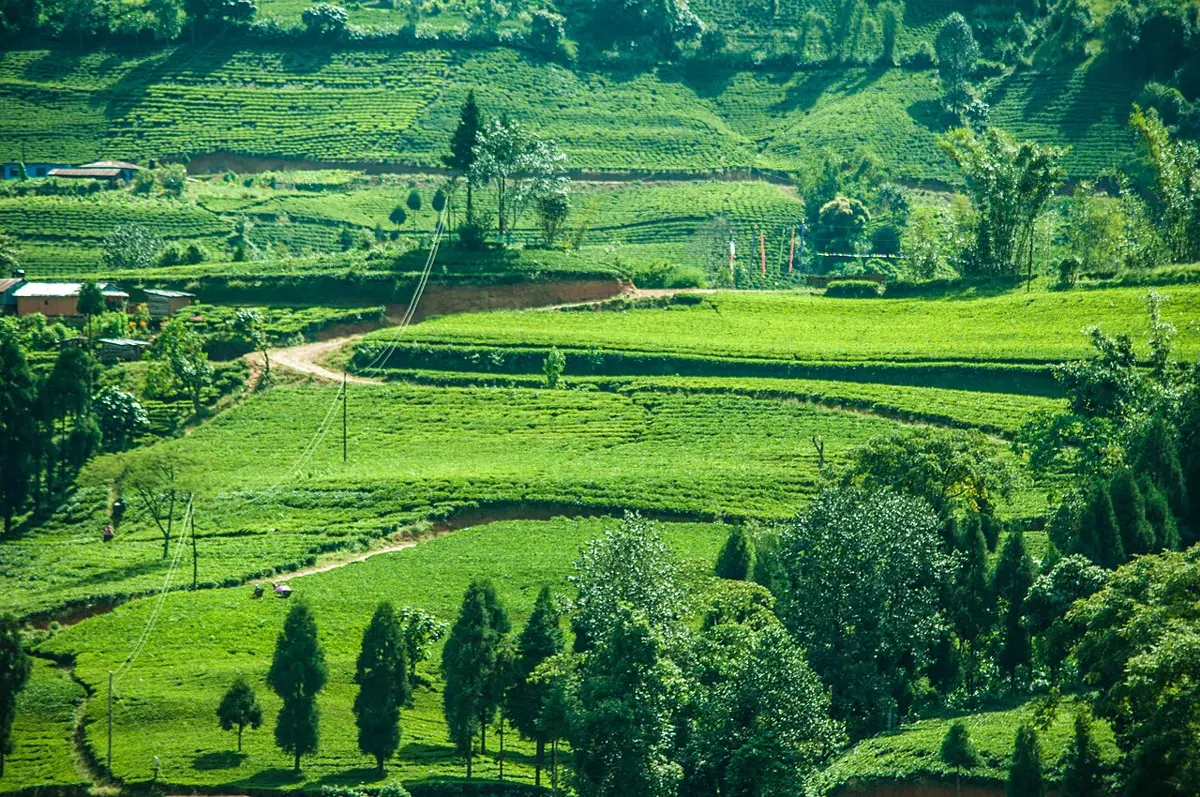
This chart shows a process too, as a row of boxes inside one big arrow: picking → withering → fermenting → drying → sorting → storage and packaging.
| Step | What happens |
|---|---|
| Picking | the bud and the top two leaves are picked |
| Withering | the leaves are spread out and lose water, so they go soft |
| Fermenting | the leaves are left in warm, damp air, and they turn from green to brown |
| Drying | they are dried with heat, which stops the change |
| Sorting | stems are taken out, and the tea is graded by size |
| Storage and packaging | the tea is stored and packed |
Study the steps above, showing the process of manufacturing tea. Take turns to ask and answer the questions about the process.
A model conversation
Project work
Extra bit: words for charts and diagrams
Keep this table beside you whenever you describe a chart. Most words in it come in two forms, a verb and a noun, so you can write rose or a rise.
| What the numbers do | Words to use |
|---|---|
| Upward trend | increase, rise, rocket, climb, lift, grow, go up, jump, surge, shoot up, soar, extend, expand, step up; an increase, growth, an upward (rising, increasing) trend, an improvement, a jump, a surge, a progression |
| Downward trend | decrease, drop, decline, fall, go down, slump, plummet; a fall, a decrease, a decline, a downward (falling, decreasing) trend, a slump |
| Constant trend | remain stable (constant, steady) at, stay at the same level, stabilize, keep stable, hold constant |
| Degree of change | dramatic(ally), vast(ly), huge(ly), a lot, significant(ly), considerable (considerably), moderate(ly), slight(ly), substantial(ly), a little |
| Speed of change | rapid(ly), quick(ly), swift(ly), gradual(ly), gentle (gently), little by little, slow(ly) |
Some of these are stronger than others, so match the word to the bars. Rocket, soar, shoot up and plummet mean a very big, fast change. Save them for when it is true, or your reader will stop believing you. The same goes for dramatically.
The tigers at Banke went from 21 to 25. Which is the best description?
Pick an answer to see why.
Which word pair says the same as “a gradual fall”?
Pick an answer to see why.
Exercise
Practice on this unit in the style of the final exam. Try each one as in the exam, then open the answer.
Read the report on Nepal’s tigers again and write True or False.
- a.The first nationwide survey was held in 2009.
- b.Nepal’s target was to reach 355 tigers.
- c.A century ago, Asia had about 100,000 tigers.
- d.The Prime Minister of Nepal chairs the National Tiger Conservation Committee.
- e.The text says that the danger to tigers is now over.
Answer
Read A Mousetrap again and complete the sentences.
- a.The mouse first went to the ……… .
- b.The lamb said that he could only ……… .
- c.In the dark, the woman didn’t see the ……… .
- d.The doctor said that ……… was good for people with a fever.
- e.At the end, only the ……… was saved.
Answer
Read the table and answer the questions.
Books Borrowed from Deurali School Library (a made-up table, for practice)
| Month | Stories | Science | History |
|---|---|---|---|
| Baishakh | 120 | 40 | 30 |
| Jestha | 150 | 45 | 30 |
| Asar | 90 | 80 | 30 |
- a.How many science books were borrowed in Jestha?
- b.Which kind of book was the most popular in every month?
- c.In which month did the number of story books fall?
- d.Which kind of book stayed the same?
- e.What happened to science books from Jestha to Asar?
Answer
Change the following sentences as indicated in the brackets.
- a.Prakriti reads the news. (into the present continuous)
- b.The rangers are checking the cameras. (into the present perfect)
- c.Siddhanta has cleaned the kitchen. (into the present simple)
- d.Simran teaches in Dolpa. (into the present perfect continuous, adding for six years)
- e.They have planted trees. (into the present continuous)
Answer
Identify ten errors in the given paragraph. Rewrite the paragraph by correcting the errors.
what a chart nepals tigers rose from 121 to 355 but banke rose only a little didnt you see that
Answer
The flowchart shows how momos are made. Write a short description of it.
Dough mixed and rolled → Filling prepared → Momos wrapped → Momos steamed → Served with achar
A plan
Write a short essay of about 100 words on “Why We Should Protect Wild Animals”.
A plan
Printable PDFs
- Study notes 3 pages
- Harder practice questions 2 pages Answer key
Practice every question in the book, and keep track of the ones you miss →
A companion to your textbook, not a replacement for it: study from the book your school uses, and where the two differ, follow your teacher. Found a mistake? Please tell us.