
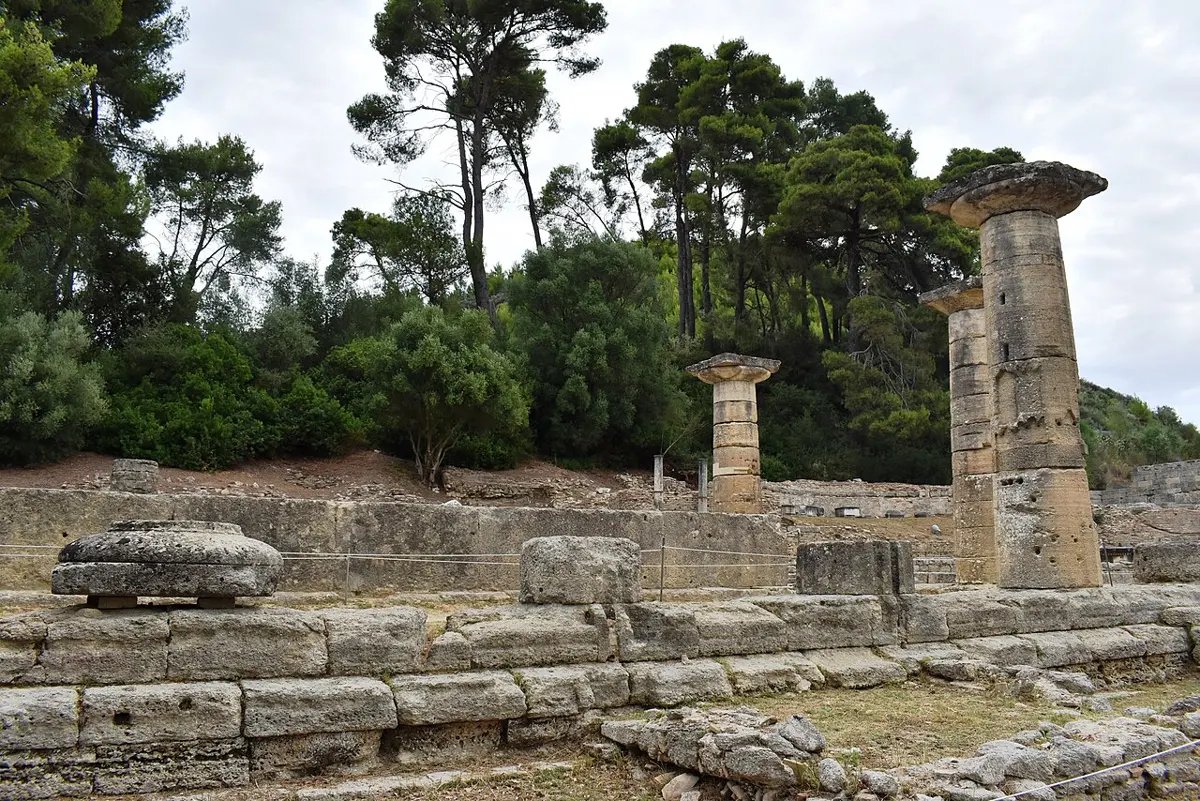
Every four years, a few weeks before the Olympic Games open, a flame is lit from the sun’s rays among old stone ruins in Greece, and carried by hand, torch to torch, all the way to the host city. Why there? An old Greek story says the Games began with a chariot race, a jealous king and a pin made of candle wax.
This unit reads that story, then a short survey of the world’s most popular sports, from football’s four billion fans to golf. Along the way you will learn to say what has happened and what has been going on (the present perfect and its continuous form), to use the passive in every tense, and to write two things: a well-built paragraph and a dialogue.
Getting started
The unit opens with four pictures. Here is what each shows, and why it matters.
| Picture | The activity | Why it is important |
|---|---|---|
| Players leaping at a net to block a ball | volleyball | It needs only a net and a ball, so it is played in villages all over Nepal; it builds teamwork, quick reactions and strong legs. Nepal made it its national game in 2017. |
| Players in red and blue racing for a ball in an indoor hall | basketball | It is fast: running, jumping and passing build fitness and teach players to think and act together. |
| A chessboard in the middle of a game | chess | A game of the mind, not the body: it trains planning, patience and concentration, and can be played at any age. |
| Runners on a red track | running (athletics) | The simplest sport of all: it strengthens the heart and lungs, and a race teaches you to push yourself and to lose well. |
Reading I: The First Olympic Games
Before you read
What objects can you see in the picture beside the story?
Answer
What do they represent?
Answer
What kind of text it is
The text is a myth, a very old story about gods and heroes, told to explain how something began. This one explains how the Olympic Games started. It is adapted from a children’s book by Jean Richards and Kat Thacker, The First Olympic Games: A Gruesome Greek Myth with a Happy Ending. Its last part leaves the myth behind and tells real history: how the old Games were forgotten, found again, and started anew.
Read it as two kinds of writing: the myth (paragraphs 1–4: gods, magic horses, a wax pin) and the history (the last paragraph: earthquakes, archaeologists, a Frenchman).
The story, part by part
1. Tantalus and the terrible dinner
In ancient Greece lived Tantalus, half man and half god, a son of Zeus, king of the gods. Zeus invited him to dinner on Mount Olympus, the gods’ home high above the clouds. Proud of the honor, Tantalus climbed up in his embroidered robes (decorated with patterns sewn in thread) and ate an exquisite meal, beautiful and delicious.
Next morning he decided he must invite the gods back, and serve them the thing he valued most. His idea was horrible: he killed his own son, Pelops, and served him to the gods as a stew. The gods, who see everything, were furious, very angry: they hated human sacrifice. They punished Tantalus by sending him to the underworld, the land of the dead, to stand in water up to his neck forever.
2. A gift of horses
The gods brought Pelops back to life and gave him a chariot pulled by snow-white horses that ran faster than the wind. Zeus told him to go and find a kingdom, because he would become a great ruler. Pelops mounted his chariot (got up into it) and drove down to the plain.
3. The old man’s warning
On the road, an old man in rags told Pelops about the kingdom of Elis, whose king had a beautiful daughter, Hippodamia. Whoever married her would inherit (receive after the king’s death) the kingdom. But there was a catch: a suitor had to race the king in a chariot. Win, and he got the princess and the kingdom; lose, and his head was chopped off. Twelve men had already lost. Pelops was not afraid: his horses were faster than the wind. The old man warned him that the king’s horses ran faster than lightning.
4. At the palace
Pelops came to the palace and told the king he had come to woo his daughter, to ask her to marry him. Hippodamia’s eyes shone when she saw him. The king agreed to the race at sunrise. He had never lost: his horses were magic, a gift from Ares, the god of war.
That evening, Hippodamia wandered near the stables and, not knowing anyone could hear, wished aloud that her father would lose the race, just this once. The stable boy, who had long loved her from a distance, heard her. After she went in, he took out the bronze pins that held the wheels on the king’s chariot and put in pins made of candle wax.
5. The race
At sunrise, crowds gathered on the lush (thick and green) fields of Olympia. The horses raced neck and neck. When the king whipped his horses to pull ahead, the heat had melted the wax pins: his wheels flew off, he was thrown from the chariot, and he died. Pelops had won Hippodamia and the kingdom.
But the young pair were sad. The old king had not really been cruel; he had loved his daughter so much that he could not bear to give her away.
Why did the king lose the race?
Pick an answer to see why.
6. Funeral games, every four years
Before their wedding, Pelops and Hippodamia held a great funeral feast in the king’s honor, and invited heroes from all over Greece to compete in athletic games and races, in memory of his chariot race. Pelops decreed (ordered officially) that such games should be held every four years, forever. Because they took place on the fields of Olympia, they became the Olympic Games.
7. Lost and found again
Now the text turns to history. Pelops and Hippodamia ruled Elis well, and the Games were held every four years at Olympia for many centuries. Then the old Games came to an end, and later earthquakes and floods knocked down the buildings and buried the fields in mud. They lay hidden for well over a thousand years, and people forgot them; many even doubted that the Games had ever existed.
In 1875, archaeologists (scientists who study the past by digging up what people left behind) began digging at Olympia and uncovered the ancient site. There was great rejoicing, and a Frenchman, Baron Pierre de Coubertin, helped start the Games again. Today, every four years, athletes from all over the world meet in a spirit of peace and friendship, in a different country each time, and an Olympic flame, lit from the sun’s rays at Olympia, burns in the stadium until the Games end.
Words from the story
| Word | Meaning here |
|---|---|
| exquisite | extremely beautiful and delicate; of the finest quality |
| inherit | to receive money, property or a title from someone after they die |
| underworld | in myths, the place under the earth where the dead go |
| embroidered | decorated with patterns sewn in colored thread |
| stew | a dish of meat or vegetables cooked slowly in liquid |
| decree | (verb) to order officially; (noun) an official order |
| mount | to get up onto a horse, a bicycle or a chariot |
| rejoicing | great happiness, shown by many people together |
| furious | extremely angry |
| lush | (of grass and plants) thick, green and healthy |
| woo | to try to win someone’s love, in order to marry them |
| caution | (verb) to warn |
| archaeologist | a person who studies the past by digging up old objects and buildings |
A. Complete the sentences
Complete the sentences with these words: exquisite, inherited, underworld, embroidered, stew, decreed, mounted, rejoicing, furious, lush.
- a.We are having ……… for lunch today.
- b.The demon was sent to the ……… for his disobedience to the gods.
- c.The sleeves of his coat were ……… in gold.
- d.Smita was absolutely ……… at having been cheated.
- e.Her wedding dress was absolutely ……… .
- f.The prince ……… the kingship after his father’s death.
- g.There was great ……… when the Nepali football team won the SAFF U-19 Championship.
- h.The king ……… his horse and rode away from the palace.
- i.The government ……… that the following day would be a holiday for Eid.
- j.It was wonderful to spend a week in the ……… green countryside.
Answer
B. True, False or Not Given
Tantalus’s father, Zeus, was also half god and half man.
Pick an answer to see why.
Tantalus wanted to take revenge on the gods.
Pick an answer to see why.
The gods brought Pelops back to life so that he could rule Elis.
Pick an answer to see why.
Princess Hippodamia was attracted to Pelops at first sight.
Pick an answer to see why.
Hippodamia wanted to kill the king so that she could inherit the kingdom.
Pick an answer to see why.
The Olympic Games were not held for about 1,500 years because people were afraid of earthquakes.
Pick an answer to see why.
At every Olympic Games, the flame is brought from Greece.
Pick an answer to see why.
C. Answer the questions
Who was Tantalus?
Answer
Why were the gods angry with him?
Answer
What punishment did the gods give Tantalus?
Answer
What special qualities did the horses of the king and of Pelops have?
Answer
What was the risk of asking to marry Princess Hippodamia?
Answer
How did the stable boy help Pelops win the race?
Answer
How did the king die?
Answer
Why did Pelops and Hippodamia organize a feast?
Answer
How did the events of the feast become the origin of the Olympic Games?
Answer
How is the Olympic flame lit?
Answer
D. The Olympics today
What is the significance of the Olympic Games in the world today? Discuss.
A model answer
Pronunciation: syllables and stress
A syllable is a beat of a word, built round a vowel sound: sport has one, foot·ball two, O·lym·pic three. In a word of two or more syllables, one is stressed: said a little louder, longer and higher. Here the stressed syllable is in capitals.
| Word | Syllables | Stress | Watch out for |
|---|---|---|---|
| invitation | 4 | in·vi·TA·tion | the stress is on ta, not in |
| embroidered | 3 | em·BROI·dered | -ed after r adds no syllable |
| exquisite | 3 | ex·QUI·site (also EX·qui·site) | both are correct |
| furious | 3 | FU·ri·ous | fyoor, not foo |
| inherit | 3 | in·HER·it | |
| princess | 2 | prin·CESS (British), PRIN·cess (American) | both are heard |
| beautiful | 3 | BEAU·ti·ful | beau says byoo |
| carefully | 3 | CARE·ful·ly | |
| marriage | 2 | MAR·riage | -iage is one syllable: rij |
| earthquake | 2 | EARTH·quake | |
| stadium | 3 | STA·di·um | stay, not sta as in stand |
| Olympic | 3 | o·LYM·pic | |
| archaeologists | 5 | ar·chae·OL·o·gists | ch says k; the same stress as ar·chae·OL·o·gy |
Speaking: what people have recently done
To ask and tell about something done recently, with a result that matters now, use the present perfect: have/has + past participle.
- Which place has Kathy recently visited? She has visited London.
- Have you finished your project? Yes, I have just finished it.
Recently, just, already, lately and this week often go with it. If you say when (yesterday, last week), use the past simple instead: She visited London last month.
A. Ask and answer
Work in pairs: one asks what each person has recently done, the other answers from the clues. Example: Kathy / visit / London. A: Which place has Kathy recently visited? B: She has visited London.
- a.Shovan / paint / house
- b.Sarmistha / watch / a movie
- c.Lakpa / scale / Mt. Annapurna
- d.Srijana / plant / potatoes
- e.Swikriti / release / new song
- f.Nandita / take / driving test
- g.Ashok / visit / grandparents
Model questions and answers
B. Your friends’ news
Ask three friends what they have recently done. Keep notes, then tell the class. Example: Krisha has recently visited a library in her community. She has got the membership of the library. She has also borrowed two books for fifteen days.
A model report
Grammar I: Present perfect and present perfect continuous
You met both forms in Grade 9. Here is what each one says, and how to choose between them, which is what the exam tests.
Two ways to link the past with now
The present perfect is have/has + past participle: She has painted the house. It tells about a past action whose result we have now, or counts how many times something has happened up to now.
- I have lost my key. (I don’t have it now.)
- We have visited many places. (a list of what is done)
- You have promised to help me many times. (how many times)
The present perfect continuous is have/has been + -ing: She has been painting the house. It tells about an action that started in the past and is still going on (or has only just stopped), and how long it has gone on.
- It has been raining since morning. (and it is still raining)
- I’m tired. I have been working hard lately. (the work explains how I feel now)
- We have been staying in a hotel since we arrived.
| Present perfect: has done | Present perfect continuous: has been doing |
|---|---|
| the action is finished; the result matters | the action is still going on, or has just stopped |
| how many / how much: She has written three letters. | how long: She has been writing letters all morning. |
| with already, yet, just, ever, never, so far | with since, for, all day, lately, recently, how long |
| Who has eaten my momos? (the plate is empty) | Who has been eating my momos? (some are gone) |
Sitaram is still on the ladder with a brush in his hand. Which sentence fits?
Pick an answer to see why.
Bina ……… three chapters of the book so far.
Pick an answer to see why.
How long ……… for the bus? You look frozen.
Pick an answer to see why.
A. Nirjala’s note from Pokhara
Complete Nirjala’s note with the present perfect or present perfect continuous of the verbs in brackets.
Kaski, Pokhara, 21 August
Hi Nima!
Just a quick note from Pokhara. We (a) ……… (be) here for two days now. We (b) ……… (stay) in a hotel in Lakeside since we arrived. By now, we (c) ……… already (visit) many places of interest here. I feel really excited to be here. We (d) ……… (not be) to Sarangkot yet. We plan to go there too. I (e) ……… always (wish) to go paragliding. I (f) ……… (convince) my parents for this.
How (g) ……… (you / spend) your holidays? I guess you (h) ……… (visit) your grandparents. Please have a great time. We will have great fun back at school.
With love,
Nirjala
Answer
B. Complete the sentences
Complete the sentences with the present perfect or present perfect continuous of the verbs in brackets.
- a.Siddhartha ……… (learn) to drive in just ten days!
- b.It ……… (rain) all summer. There are floods and landslides in many places.
- c.Palden: You must have finished the book. I think you ……… (read) it since last week.
Ricky: No, I ……… (not / finish) it yet. Actually, I started it just yesterday.
- d.What ……… (you / cook) for so long?
- e.You ……… (promise) to help me many times. You really need to help me today.
- f.The children have their exams next week, so they ……… (prepare) a lot.
- g.The film is really wonderful. ……… (you / watch) it yet?
- h.Sitaram ……… (paint) his house all day. He ……… (not / finish) it yet.
- i.Finally they ……… (fix) the leak in their roof.
- j.I am so tired now. I ……… (work) hard lately.
Answer
Writing I: A paragraph
A paragraph is a group of sentences about one main idea. A good one has three parts:
- The topic sentence, usually the first: it says what the whole paragraph is about.
- Supporting sentences: facts, examples and reasons that explain or prove the topic sentence, each one linked to it.
- The concluding sentence: it closes the paragraph, often by saying the main idea again in different words, or adding a final thought.
A. A paragraph about David Beckham
The model paragraph is about David Beckham, the English footballer. It says that he became popular in the late 1990s and was known all over the world by the early 2000s; that he became famous first in England with Manchester United, then in Spain with Real Madrid; that his team valued his dangerous free kicks, long passes and crosses; that he was also a fine leader, who captained England at the 2002 World Cup, where they lost only to Brazil; that he has a huge number of fans around the world; and that he is still loved after his retirement.
Which sentence is the topic sentence of the paragraph?
Answer
Are the other sentences related to the topic sentence?
Answer
Which sentence concludes the paragraph?
Answer
Are the topic and concluding sentences similar or different?
Answer
B. Your favorite player
Write a similar paragraph about your favorite player. Mark the topic, supporting and concluding sentences.
A model paragraph
Reading II: Popularity of Different Sports in the World
Before you read
What kind of text it is
The text is an informative article from WorldAtlas, a website of geography facts. It opens with a short introduction, then gives one paragraph to each sport, from the most popular to the tenth. Each paragraph follows a pattern: the fans, where it is played, how it is played, and sometimes where it began. The numbers are the website’s estimates: nobody can count every fan in the world, and other surveys give different figures and orders.
The article, part by part
Why sports are popular
People play sports to keep healthy, or for recreation (fun in their free time). Even more people love sports as spectators, people who watch. Since time immemorial (for longer than anyone can remember), people have been awed and inspired by those who can perform amazing feats of strength and skill.
The ten sports
| Sport | Fans (estimate) | Where it is most popular | What the article says |
|---|---|---|---|
| Football (soccer in the US and Canada) | 4 billion | Europe, Central and South America, Africa | The modern game began in England in the 19th century; similar games were played 2,000 years ago, first in China. You need only a ball, so anyone, rich or poor, can play. |
| Cricket | 2.5 billion | the UK, India, Pakistan, Australia | Two teams, a bat, a big field and runs, like baseball; but the ball is bowled to a batsman on a long rectangular pitch in the middle, not pitched from a mound to a batter at home plate. |
| Hockey (field and ice) | 2 billion | field: Europe, Africa, Asia, Australia; ice: Canada, the US, northern Europe | Two teams try to put a ball (in ice hockey, a puck) into the other team’s net with a stick. Field hockey usually has no body checking (pushing an opponent with the body). |
| Tennis | 1 billion | worldwide | Players hit a ball with a racket over a net so that the opponent can’t return it. Pros like Roger Federer and Serena Williams are household names. |
| Volleyball | 900 million | North America, Western Europe, Asia, Australia, South America | Two teams volley a ball over a high net onto the other side. Beach volleyball has two players a side on sand; regular volleyball has six. |
| Table tennis (ping-pong) | 875 million | especially Asia | It began in England. |
| Basketball | 825 million | worldwide | Invented by James Naismith, a Canadian teaching in the US, in the late 19th century. Two teams dribble a ball up a court and shoot it into a raised hoop. It needs little equipment, so it is accessible to everyone. |
| Baseball | 500 million | the US, East Asia, Latin America | America’s national pastime, probably descended from the English games rounders and cricket. Batters hit the ball and run round the bases to score runs. |
| Rugby | 475 million | the UK, Australia, New Zealand | Two teams kick, carry or pass an oval ball over the goal line. A contact sport with much tackling, played with very little protection, unlike American football’s pads and helmets. |
| Golf | 450 million | Western Europe, East Asia, North America | Players hit a small ball into a hole in the fewest strokes. The game began in Scotland in the 15th century; the word may come from Dutch kolf, “club”. |
Which two sports does the article say are popular because they need little equipment?
Pick an answer to see why.
Words from the article
| Word | Meaning here |
|---|---|
| cite | to give something as a reason or an example |
| recreational | done for enjoyment in your free time |
| spectator | a person who watches a game or event |
| (time) immemorial | longer ago than anyone can remember |
| awed | filled with respect and wonder, perhaps a little fear |
| feat | an act that needs great skill, strength or courage |
| tremendous | very great |
| pitch | in cricket, the strip of ground in the middle where the ball is bowled |
| mound | a small hill or pile of earth; in baseball, where the pitcher stands |
| elongated | long and thin, longer than usual |
| pro | a professional, paid to play |
| volley | to hit the ball before it touches the ground |
| variant | a slightly different form of something |
| accessible | easy to reach, get or use |
| pastime | something done for pleasure in free time |
| tackle | in rugby or football, to stop a player or take the ball |
A. Crossword
The crossword’s answers, if you are working on paper.
Across: 1. existing for longer than people can remember; very old (10 letters) 5. a British game played by two teams with a bat and a ball (8) 6. long and thin, often in a way that is unusual (9) 7. possible to approach, enter or use (10) 8. a large pile of earth or stones; a small hill (5) 9. a hit of the ball before it touches the ground (6)
Down: 2. connected with activities that people do for pleasure when they are not working (12) 3. a person who works as a professional, especially in a sport (3) 4. showing or feeling respect and slight fear (4)
Answer
B. Name the sports
Write the names of the sports shown in the six pictures: a player running with an oval ball past others in striped shirts; a man swinging a long, thin club at a small ball on the grass; a batter in a helmet hitting a ball with a round bat; a girl bending low with a curved stick to hit a ball; four players on a blue court with rackets; two girls with small round bats at a green table with a low net.
Answer
C. Choose the correct answers
Which two games are popular in the world for their cheap equipment?
Pick an answer to see why.
In which countries is cricket particularly popular?
Pick an answer to see why.
What is the main difference between regular volleyball and beach volleyball?
Pick an answer to see why.
Which of these games are played with a ball and a bat?
Pick an answer to see why.
Which country is thought to have given golf its name?
Pick an answer to see why.
Which of these games have different kinds depending on where they are played?
Pick an answer to see why.
D. Answer the questions
Mention any two reasons behind the popularity of sports in the world.
Answer
What does history say about the origin of football?
Answer
What is the main difference between cricket and baseball?
Answer
How is regular volleyball played?
Answer
Who invented basketball, and when?
Answer
What risk is involved in rugby?
Answer
E. Your ranking
Rank the games in the article in the order of your preference.
A model answer
Listening: a football report
A. Before you listen
- a.Name any two of the most popular sports in Nepal.
- b.Which one of the two do you like the most? Why?
A model answer
The textbook’s listening task is a short sports news report. CDC’s own recording is below: read the questions in B and C first, then listen, as many times as you need. The answers are hidden under the questions; after that, practice with a report of our own that your browser reads aloud.
B and C. The textbook’s audio: answers
Complete the sentences with the words or phrases you hear.
- a.Nepal and Bangladesh are going to play the final of the ……… football tournament.
- b.Nepal had played a ……… match against Bangladesh on Saturday.
- c.Team Nepal managed to reach ……… despite having scored no goal.
- d.The only goal for Bangladesh came through an ……… goal by a Kyrgyz player.
- e.The Nepali team’s coach, ………, is hopeful that Nepal will win the title.
- f.The final is going to be played at ……… at 5:30 p.m.
Answer
Write True, False or Not Given.
- a.The football tournament was organized by Nepal.
- b.Nepal reached the final despite the loss against Kyrgyzstan on Saturday.
- c.Nepal had registered a 1–0 win against Kyrgyzstan in the first match of the tournament.
- d.Bangladesh has not scored a goal of its own in the tournament.
- e.Three countries had taken part in the tournament.
Answer
Practice listening alone
Grammar II: The passive in every tense
In Unit 8 you made the passive in the present simple. The same three steps work in every tense: the object becomes the subject, the doer goes after by (or is left out), and the verb becomes be + past participle, with be in the same tense as the active verb.
| Tense | Active | Passive |
|---|---|---|
| present simple | They clean the ground. | The ground is cleaned. |
| present continuous | They are cleaning the ground. | The ground is being cleaned. |
| present perfect | They have cleaned the ground. | The ground has been cleaned. |
| past simple | They cleaned the ground. | The ground was cleaned. |
| past continuous | They were cleaning the ground. | The ground was being cleaned. |
| past perfect | They had cleaned the ground. | The ground had been cleaned. |
| future simple | They will clean the ground. | The ground will be cleaned. |
| future perfect | They will have cleaned the ground. | The ground will have been cleaned. |
| going to | They are going to clean the ground. | The ground is going to be cleaned. |
| modal | They must / can / should clean the ground. | The ground must / can / should be cleaned. |
| modal, past | They might have cleaned the ground. | The ground might have been cleaned. |
The perfect continuous tenses (have been cleaning) are almost never made passive: they would need has been being cleaned, which sounds clumsy.
Questions, let, and “people believe”
- Yes/no questions keep the question order, the first helping verb first: Has he translated the book? → Has the book been translated by him? Do they sell tickets here? → Are tickets sold here?
- Wh- questions: if the wh-word is the object, it becomes the subject: What are you building? → What is being built? If it is the doer, who becomes by whom: Who broke the window? → By whom was the window broken? (or, in everyday English, Who was the window broken by?)
- Let: Let + object + be + past participle: Let him open the door. → Let the door be opened by him.
- People believe / say / think that… (Unit 8): It is believed that…, or the subject + is believed to: People believe that he is honest. → It is believed that he is honest. / He is believed to be honest.
- After like and mind (Unit 8): being + past participle: I like people praising me. → I like being praised.
The workers are repairing Dasharath Stadium. In the passive:
Pick an answer to see why.
Who scored the winning goal? In the passive:
Pick an answer to see why.
“You must wear a helmet on the motorbike.” In the passive:
Pick an answer to see why.
A. The man who bought an ass
Complete the story with the correct choices from the brackets.
A man who (a) ……… (wanted, is wanted, was wanted) to buy an ass went to the market. Coming across a likely-looking beast, he (b) ……… (was arranged, arranged, had been arranged) with the owner that he should (c) ……… (allowed, be allowed, was allowing) to take him home on trial to see what the beast was like. When the man (d) ……… (reached, was reached, will be reached) home, he put the beast into his stable along with the other asses. The newcomer looked around, and immediately went and chose a place next to the laziest and greediest beast in the stable. When the master (e) ……… (saw, was seen, had been seen) this, he put a halter on him at once, and (f) ……… (led, was lead, was leading) him off and (g) ……… (handed, was handed, will be handed) him over to his owner. The latter (h) ……… (surprised, was surprising, was surprised) to see him back so soon. He asked, “Why, do you mean to say you (i) ……… (have tested, have been tested, was tested) him already?” “I don’t want to put him through any more tests,” replied the other. “I (j) ……… (could see, could be seen, could have seen) what sort of beast he is from the companion he chose for himself.”
Answer
B. Choose the correct answers
Complete the sentences with the correct choices from the brackets.
- a.People always ……… (are admired, admire, are being admired) this picture.
- b.His leg was hurt in the accident. That is to say, he ……… (hurts his leg, is hurt his leg, hurt his leg) in the accident.
- c.Some people dress their children very badly. The passive is: (Their children are very badly dressed. / Their children dress very badly. / They are very badly dressed.)
- d.Two of my dinner plates have been broken. That means ……… (someone broke two of my dinner plates, two of my dinner plates have broken, someone has broken two of my dinner plates).
- e.They will forget this story in a few years. This story ……… (will forget, will be forgotten, will have been forgotten) in a few years.
- f.You must answer all the questions. All the questions ……… (must be answered, must answer, must answered).
- g.The packet of biscuits has been eaten by the boys. That is to say, ……… the packet of biscuits (the boys ate, the boys have eaten, the boys had eaten).
- h.The bridge was built last year. The active voice is: (The bridge built last year. / People built the bridge last year. / The people have built the bridge last year.)
- i.The field is being ploughed by the farmers. The farmers ……… (plough the field, are ploughing the field, will plough the field).
- j.How is a tiger trapped? The active voice is: (How does a tiger trap? / How are people trap a tiger? / How do people trap a tiger?)
- k.“The teacher will help us.” The passive is: (We will be helped. / The teacher will be helped. / We will help the teacher.)
- l.“The tiger should be preserved” is the passive of: (The tiger should preserve. / We should preserve the tiger. / People should be preserved.)
- m.The bird has built a nest. It means ……… by the bird (a nest has built, a nest has been build, a nest has been built).
Answer
C. Change into the passive
Change the sentences into the passive voice.
- a.People could hear the noise of the explosion from a distance.
- b.We ought to break down the building before it collapses.
- c.Has he translated the book into any other language?
- d.I like people driving me to my home.
- e.Can anybody solve this problem?
- f.We had to book the tickets in advance because of the festive season.
- g.Who might have stolen your bicycle?
- h.I didn’t notice that you were recording the class.
- i.Does he always sing songs at parties?
- j.She will draw the picture beautifully.
- k.Let the mechanic repair my bike.
- l.People believe that the Mahabharata war was fought in the 10th century BCE.
- m.What are you instructing them now?
Answer
Writing II: A dialogue
Write a dialogue between you and your friend about the coming Sports Day or Sports Week at your school. Include the time and venue, the kinds of events, the participants and the prize distribution.
Hint
A model dialogue
How to write a dialogue
A dialogue is a conversation written down. In the SEE it is a short writing task, marked for covering every point, natural language and correct layout.
- Write each speaker’s name (or A and B) on the left, followed by a colon, and start a new line for every turn.
- Open with a greeting, and close naturally: a plan, a thank you, a goodbye.
- Cover every point in the task, in a natural order: when and where, what, who, prizes.
- Make it sound spoken: short turns, questions and answers, contractions (I’m, let’s, don’t), and words like Great!, Really?, By the way….
- No quotation marks and no he said: the names do that work.
Project work
Where English words come from
English is the main language of the United States, the United Kingdom, Canada, Australia, Ireland, New Zealand and many Caribbean and Pacific island nations, and an official language of India, the Philippines and many African countries south of the Sahara. It is one of the most widely spoken languages in the world, and the foreign language most often taught.
Its history in short:
- In the 5th and 6th centuries, the Angles, Saxons and Jutes, peoples from what are now northern Germany and Denmark, settled in Britain. Their language, Old English, is the root of English. They had already picked up some Latin words from the Romans before they came (street, wine, cheese, kitchen, mile).
- Christian missionaries in the 6th and 7th centuries brought more Latin, for the church and learning.
- The Norman Conquest of 1066 brought thousands of French words (government, justice, art, painting).
- In the Renaissance, from about 1500 to 1650, some 10,000 more words came in, many of them straight from Latin and Greek (atlas, democracy, academy). Modern English is usually dated from about 1500.
English borrows easily, and makes new words for new technology. It is so widely used that pilots and air traffic controllers on international flights use English on the radio, whatever their own language, as the world’s air authority has recommended since 1951.
| Language | Words English borrowed from it |
|---|---|
| Latin | agriculture, language, justice, science, forum, circus, religion, city |
| French | art, dance, jewel, painting, ballet, government, salon, brigade, infantry |
| Greek | phobia, academy, siren, lexicon, muse, democracy, psyche, atlas, biology, comedy, tragedy |
| German | blitz, kindergarten, poodle, noodle, pretzel, zeppelin |
| Italian | opera, piano, broccoli, spaghetti, pesto, viola, pizza, cappuccino, latte |
| Spanish | canyon, tornado, tortilla, barricade, guitar |
| Dutch | cruise, dock, dyke, yacht, easel, landscape, sketch, cookie |
| Scandinavian languages | ski, saga, sauna, slalom |
| Japanese | kimono, sushi, tsunami |
| Arabic | alcohol, algebra, zero, zenith, giraffe, sultan |
(Some of these came by a longer road: language and city reached English through French, from Latin; algebra and zero through Latin and Italian, from Arabic.) Unit 9 lists more borrowed words, including words from Hindi and Sanskrit.
The word golf, the article says, may come from:
Pick an answer to see why.
Why do so many English words for government and law sound like French?
Pick an answer to see why.
Exercise
SEE-style practice on this unit. Try each one as in the exam, then open the answer.
Put these events of “The First Olympic Games” in the order in which they happen.
- a.The stable boy replaces the bronze pins with wax.
- b.Tantalus is sent to the underworld.
- c.An old man tells Pelops about the princess of Elis.
- d.Pelops decrees that games should be held every four years.
- e.The gods give Pelops a chariot and white horses.
- f.Archaeologists uncover the fields of Olympia.
Answer
Complete the text with the present perfect or present perfect continuous of the verbs in brackets.
Our school team (a) ……… (practice) for the district football tournament since Dashain. We (b) ……… (play) four friendly matches so far, and we (c) ……… (not lose) any of them. Our coach (d) ……… (watch) the other teams for weeks, and he says we (e) ……… (improve) a lot. Unfortunately, our goalkeeper (f) ……… (hurt) his hand, so Bikash (g) ……… (train) as a goalkeeper every evening this week.
Answer
Change into the passive.
- a.The coach is choosing the players.
- b.Someone had stolen the trophy before the final.
- c.They will open the new stadium next month.
- d.You should not waste water.
- e.Did the referee show him a red card?
- f.Let the students clean the ground.
- g.People say that the ground is haunted.
Answer
Read the text and answer the questions.
Bhimsen, a Grade 10 student from Dolakha, has been running since he was ten. Every morning he runs up the hill road to his school, about four kilometers, with his books on his back. Last year he was picked for the district team, and this year he has already won two gold medals in the 1,500 meters. His coach says that he has been training with worn-out shoes, and the school has asked a local business to sponsor a new pair.
- a.How long has Bhimsen been running?
- b.How does he train every morning?
- c.What has he won this year?
- d.What problem does his coach mention?
- e.Find a word in the text that means “to pay for something in return for advertising or support”.
Answer
Write a paragraph of about 120 words on “The importance of games and sports in a student’s life”. Mark the topic sentence and the concluding sentence.
A model paragraph
Practice every question in the book, and keep track of the ones you miss →
A companion to your textbook, not a replacement for it: study from the book your school uses, and where the two differ, follow your teacher. Found a mistake? Please tell us.