
How many times did you pick up a phone today? To check a message, look up a word, pay at a shop, see if it will rain? Gadgets have made our lives easier, but each one needs a little care, and each one comes with instructions. This unit is about the machines we use every day and the instruments that measure the weather, and about two skills that go with them: giving instructions clearly, and reporting what someone said or told you to do.
You will read tips for looking after a smartphone and a description of weather instruments, from the thermometer to the rain gauge. You will learn to give instructions step by step (First… Then… Finally…), to change direct speech into reported speech (She said that she was tired; the doctor advised me to rest), and to tell transitive verbs from intransitive ones. You will write a recipe and a newspaper article, listen to a TV chef baking cookies, and find out how to connect wireless earbuds.
Getting started: making black tea
The unit opens with five small pictures in a row, numbered 1 to 5, that show how to make black tea (tea without milk, called kalo chiya in Nepali):
- A jug pouring water into a kettle, with a packet of tea leaves beside it.
- The kettle on a gas stove, with the flame lit.
- The kettle on the stove with steam rising: the water is boiling.
- The kettle still on the stove, with a little steam: the tea is brewing.
- The tea being poured from the kettle through a strainer into a cup.
Describe the step each picture shows.
Model answer
Instructions like these use the imperative: the base form of the verb with no subject (pour, put, let, add, serve), because they speak directly to the reader. Sequence words (first, then, next, after that, finally) tell the listener the order. You will use both all through this unit.
Reading I: Save your Smartphone
Before you read
The picture shows a girl sitting cross-legged on the floor, busy with her phone, while the phone is plugged into a wall socket to charge.
- a.What do you think the girl is doing?
- b.What is the risk of using a phone this way?
- c.What precautions should you take while using a phone?
Model answers
What kind of text it is
Save your Smartphone is an informative article that gives tips: short pieces of practical advice. After a short introduction, each tip has its own heading (Maintain a cool temperature), and most of its sentences are instructions or advice: You should…, Avoid…, Set a screen lock… Headings like these let a busy reader find the tip they need.
The text, part by part
Introduction: why phones need care
Smartphones are now part of everyday life: we use them to stay in touch with family and friends, to get work done, to keep track of our schedules (plans and timetables), and even to buy groceries or clothes online. In a world run by technology, it is hard to do anything without one, and many of us hold a phone for most of the day. Because they are so essential (extremely important), we should look after them, for two reasons: to prolong (make longer) their lifespan, and to safeguard (protect) the important information stored in them.
Tip 1: A closer look at your charging habits
When we are out, we worry about a fading (weakening) battery, but we rarely think about how long the battery itself will last. The writer’s advice: don’t charge to 100 percent, and don’t let it run down to zero either, since both can damage it. Keep the battery at 50 percent or more most of the time and top it up (charge it a little) when it falls below that, even a few times a day. And use the charger that came with your phone: cheap chargers have been known to catch fire.
Tip 2: Maintain a cool temperature
Heat harms phone batteries. A phone is safest at room temperature. Don’t put it next to other gadgets, such as a laptop, that generate (produce) heat; if your gadgets sit in a pile, spread them out. (Don’t leave a phone in direct sunlight or on a hot car dashboard, either.)
Tip 3: Invest in phone wipes or a cleaning solution
A phone is a breeding ground for germs: a place where they grow and spread. Think of everything you touch before you touch your phone: the toilet, money, food. All of it gunks up the phone (covers it with dirt). The writer reports that studies have found more bacteria on a phone screen than on a toilet seat, so clean your phone regularly: disinfect it with an antimicrobial spray (one that kills germs) and wipe it with a soft cloth.
Tip 4: Protect your phone and data
Set a screen lock (a PIN, a pattern, a fingerprint or face check). It keeps your information safe and renders the phone useless (makes it unusable) to anyone else if it is lost or stolen. A phone with no screen lock, says the writer, is like going out and leaving your front door open for burglars (people who break into houses to steal).
Tip 5: Control app permissions and notifications
A smartphone is useful because of its apps. But the more apps you download, the more notifications (alerts and messages) you get. You can choose which apps may send you prompts (messages that ask for your attention) and how they appear on your home or lock screen: just go to the phone’s settings and set them as you like.
What does the writer advise about charging?
Pick an answer to see why.
Why does the writer compare a phone without a screen lock to an open front door?
Pick an answer to see why.
Words from the text
Words linked here open in English Vocabulary, where you can see an example and practice them in the word game. The meanings below are the ones the words have in this text.
| Word | Meaning here |
|---|---|
| prolong | to make something last longer |
| essential | extremely important; necessary |
| fading | becoming weaker or less bright |
| generate | to produce |
| gunk | (informal) any sticky or dirty substance; to gunk up is to cover with it |
| render | to cause something to be in a particular condition: render it useless |
| notifications | notices: alerts that an app shows you |
| safeguard | to protect |
| breeding ground | a place where something (germs, ideas, trouble) grows and spreads |
| burglar | a person who breaks into a building to steal |
A. Match the words
Match the words in column A with their meanings in column B.
- a.prolong b. essential c. fading d. generate e. gunk f. render g. notifications
- i.being less bright ii. to produce iii. any sticky or dirty substance iv. to cause something to be in a particular condition v. to make something last longer vi. notices vii. extremely important
Answer
B. True or false
Write True for true statements and False for false ones.
- a.It’s a good idea to keep our phones fully charged.
- b.We should keep our phones together with other gadgets.
- c.A phone is likely to hold more bacteria than a toilet seat.
- d.Setting a screen lock on the phone helps us keep the information safe.
- e.Smartphones are very useful even without apps.
Answer
C. Answer the questions
Write any three uses of smartphones in everyday life.
Answer
Why should we care for our phones?
Answer
Why should we not use cheap chargers to charge our phones?
Answer
How can we prevent our phones from getting overheated?
Answer
How can the phone be cleaned?
Answer
D. Your gadgets
What gadgets do you have at your home? How do you take care of them?
A model answer
Pronunciation
Look up these ten words in a dictionary. A learner’s dictionary gives the British pronunciation (left) and the American one; (r) means the r is said in American English, and in British English only when a vowel follows. The mark ˈ comes before the stressed syllable.
| Word | British | American | Watch out for |
|---|---|---|---|
| impossible | /ɪmˈpɒsəbl/ | /ɪmˈpɑːsəbl/ | stress on pos: im-POS-si-ble |
| battery | /ˈbætri/ or /ˈbætəri/ | /ˈbætəri/ | stress on the first syllable, the vowel of cat |
| zero | /ˈzɪərəʊ/ | /ˈzɪroʊ/ | starts with /z/, a buzzing s, not the /dʒ/ of jam |
| either | /ˈaɪðə(r)/ or /ˈiːðə(r)/ | /ˈiːðər/ or /ˈaɪðər/ | both are correct; the th is voiced, as in this |
| temperature | /ˈtemprətʃə(r)/ | /ˈtemprətʃər/ | usually three syllables: TEM-pruh-chuh |
| germ | /dʒɜːm/ | /dʒɜːrm/ | g sounds like j; the vowel of bird |
| cloth | /klɒθ/ | /klɔːθ/ | ends in /θ/, as in thin; clothes is different: /kləʊðz/ |
| burglar | /ˈbɜːɡlə(r)/ | /ˈbɜːrɡlər/ | stress on the first syllable |
| control | /kənˈtrəʊl/ | /kənˈtroʊl/ | stress on the second: con-TROL |
| appear | /əˈpɪə(r)/ | /əˈpɪr/ | stress on the second: ap-PEAR |
Speaking: giving instructions
To ask how to do something, we use polite questions:
- Excuse me, how can I…? / Could you tell me how to…? / Can you show me how to…?
To give instructions, we use the imperative (press, open, tap), one step at a time, joined by sequence words:
- to begin: First, … / To start with, …
- in the middle: Then … / Next, … / After that, … / Second, … / Now …
- to end: Finally, … / Lastly, …
And we check that the listener has understood: Is that clear? Got it?
A. A screenshot on a laptop
In the picture, two students sit at a table: a boy working on paper and a girl at a laptop. The boy asks her how to take a screenshot, and she explains.
Read and act out the conversation between two students.
A: Excuse me, how can I take a screenshot on a laptop?
B: First press the Windows key and the Print Screen key at the same time to capture the entire screen.
The conversation, a little longer
B. Ask and give instructions
Work in pairs, take turns to ask questions and give instructions in the following situations.
a. take a photo b. recharge a phone c. send an email d. print a word document e. replace a light bulb f. send a text
Model conversations
C. Making pizza
Ten pictures show how to make a pizza, and a box gives the steps, jumbled. In the pictures: hands being washed under a tap; a red apron; hands kneading dough; a rolling pin flattening it; a spoon spreading red sauce on the base; cheese being grated over it; toppings being put on; a pizza going into an oven; a pizza cutter slicing a pizza; and a cheerful cook serving it.
Look at the pictures and explain to your friends the steps of making pizza. Use ‘First’, ‘Second’, ‘Then’, etc. Use these clues: cut into slices, put an apron on, serve, grate cheese, knead the dough, roll the dough, put toppings on, bake in the oven, wash hands, spread sauce.
A model answer
Grammar I: reported speech, statements and commands
There are two ways to tell someone what another person said:
- Direct speech gives the speaker’s exact words, inside quotation marks: She said, “I love horror movies.”
- Reported speech (or indirect speech) gives the meaning in the reporter’s own words, with no quotation marks: She said that she loved horror movies.
When we report, the time and place have usually changed, so some words change with them. Grade 8 introduced these changes; Grade 9 practices them together.
Statements
A statement is reported with said (that)…, or told + the listener (that)…. That can be left out.
1. The tense moves one step back when the reporting verb is in the past (said, told):
| Direct | Reported |
|---|---|
| present simple: “I love horror movies.” | past simple: she loved horror movies |
| present continuous: “I am planning to do it.” | past continuous: she was planning to do it |
| present perfect: “I have finished.” | past perfect: he had finished |
| past simple: “I worked as a waiter.” | past perfect: he had worked as a waiter |
| past continuous: “I was waiting.” | past perfect continuous: she had been waiting |
| past perfect: “I had never been there.” | stays past perfect: she had never been there |
| will, can, may, must: “I’ll* phone you.”* | would, could, might, had to: he would phone me |
2. Pronouns change to fit the reporter: “I’ll phone you,” my friend said. → My friend said that he would phone me.
3. Time and place words change when the time or place is no longer the same:
| Direct | Reported |
|---|---|
| today, tonight | that day, that night |
| tomorrow | the next day, the following day |
| yesterday, last night | the day before, the night before (the previous night) |
| now | then |
| ago | before |
| here, this | there, that |
4. No change when the reporting verb is in the present (says, tells): She says that she can’t stay there anymore. And a fact that is always true may keep its present tense: The teacher told us that the Earth revolves round the Sun.
Commands and requests
A command, a request or a piece of advice is reported with a reporting verb + the listener + to + the base verb. For a negative command (Don’t…), use not to:
| Direct | Reported |
|---|---|
| He said to me, “Get me something to drink.” | He told me to get him something to drink. |
| “Don’t make a noise,” said the teacher to the students. | The teacher told the students not to make a noise. |
| The doctor said to the patient, “Quit smoking.” | The doctor advised the patient to quit smoking. |
| The policeman told me, “Don’t park here.” | The policeman forbade me to park there. / The policeman told me not to park there. |
The reporting verb shows what kind of thing was said:
| Verb | Use it for | Example |
|---|---|---|
| told | a plain command | She told me to sit down. |
| asked, requested | a polite request (often with please) | Amrita asked me to help her. |
| advised | advice, for the listener’s good | The doctor advised me to rest. |
| ordered, commanded | an order from someone in charge | The commander ordered the soldiers to march. |
| warned | a warning of danger | The electrician warned me not to touch the wire. |
| forbade (forbid) | a strong “don’t”: forbade + someone + to | Father forbade me to spend so much. |
The imperative’s please, the listener’s name and the exclamation mark are dropped: “Please help me, Dawa!” → She asked Dawa to help her.
“I’ll call you tomorrow,” Kopila said to me. Which is the reported form?
Pick an answer to see why.
“Don’t open the window,” the teacher said to us. Which is correct?
Pick an answer to see why.
B. Report the sentences
Change the following sentences into indirect speech. Use the given sentence starters.
- a.“He works in a bank.” She said …
- b.“We went out last night.” She told me …
- c.“I’m coming!” She said …
- d.“I was waiting for the bus when he arrived.” She told me …
- e.“I’d never been there before.” She said …
- f.“I didn’t go to the party.” She told me …
- g.He said to me, “Help him to do his homework.” He asked me …
- h.The doctor said to the patient, “Take bed rest for a week.” The doctor advised the patient …
- i.The commander said to his soldiers, “March further.” The commander ordered …
Answer
Writing I: a recipe
A recipe tells someone how to cook a dish. It has three parts, the three prompts of the task:
- The name of the dish, often with how many people it serves and how long it takes.
- Ingredients: a list of everything needed, each with its amount (2 cups of rice flour, 1 teaspoon of salt), in the order they are used.
- Method (the cooking procedure): numbered steps in the imperative, one action or two in each, with times and temperatures where they matter (fry for 2 minutes over a medium flame).
Prepare a recipe to cook your favorite dish at home. Use the prompts: name of the food item, ingredients, cooking procedure.
Hint
A model recipe
Reading II: Weather Instruments
Before you read
Six weather symbols, of the kind on weather maps and phone apps, are to be matched with six words.
a. cloudy b. partially cloudy c. snowy d. stormy e. rainy f. sunny
Answer
What kind of text it is
Weather Instruments is a descriptive text: it describes six instruments, one paragraph each, saying what each one measures, how it works or is used, and why it matters. Each paragraph starts with the instrument’s name in capitals, which makes it easy to find. Texts like this use the present simple (A barometer measures…) and the passive (is used for, is placed on).
The text, part by part
1. Before instruments, and now
For a long time, most people judged the weather only with their senses: they saw the wind’s direction in the moving leaves, and guessed when it would rain from the clouds in the sky. Today we have modern instruments and weather stations that help us accumulate (collect) accurate weather data. Each instrument measures one parameter: one thing that can be measured, such as temperature, pressure or wind speed.
2. The thermometer
A thermometer measures temperature. It is used in industry, in meteorology (the science of the weather) and in medicine. It has two important parts:
- a sensor, which senses the change in temperature using some physical property, such as the way a liquid expands (takes up more space) when it gets warmer;
- a converter, which turns that change into a number: in a liquid thermometer, the scale marked on the glass.
At weather stations, mercury thermometers have mostly been used, measuring from about −35 to 40 °C with marks every 0.2 °C. Below about −35 °C they become unreliable, because mercury freezes at about −39 °C. In colder places, alcohol thermometers are used: alcohol freezes at a far lower temperature, and a weather station’s alcohol thermometer can read down to about −65 or −75 °C.
3. The barometer
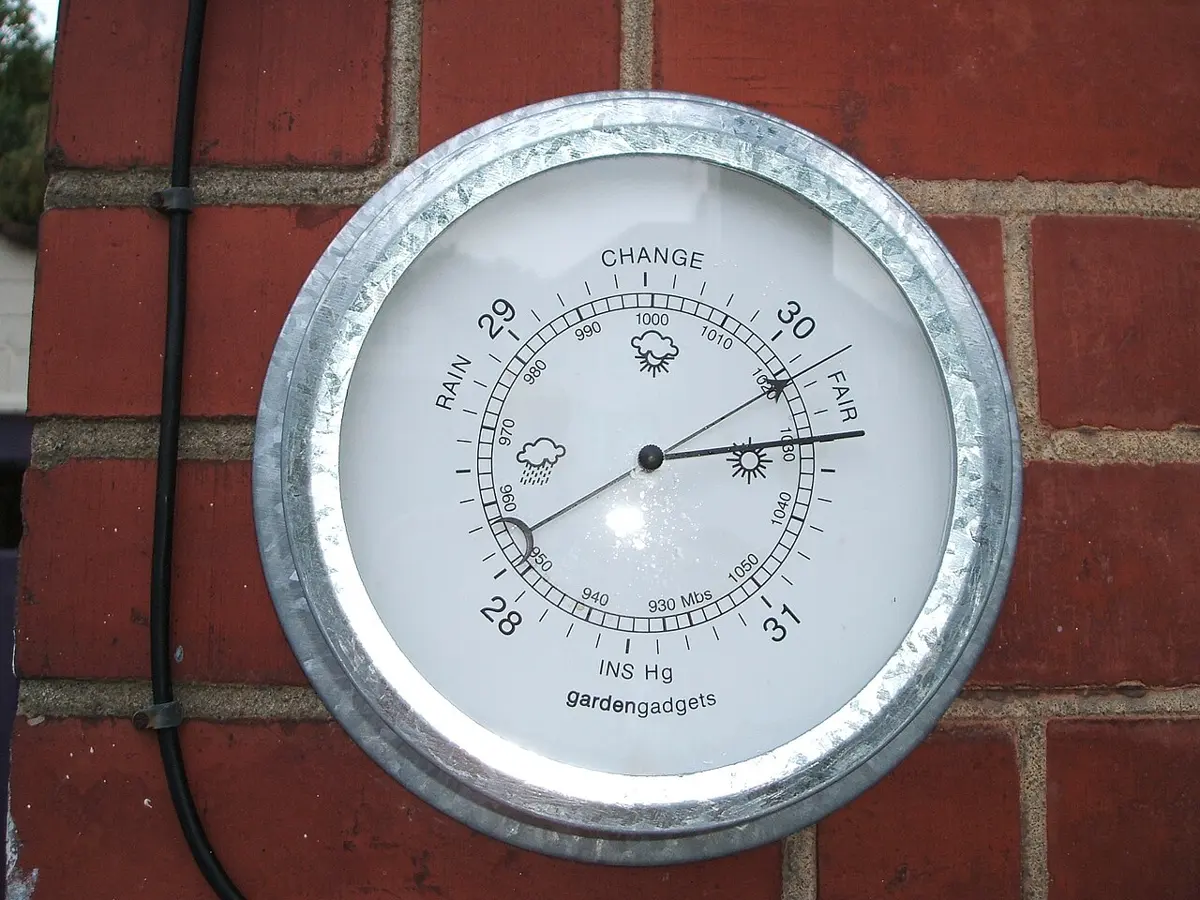
A barometer measures atmospheric pressure, the pressure of the air. The Earth is wrapped in layers of air (the atmosphere), and that air has weight: pulled down by gravity, it presses on everything. Weather stations measure it in hectopascals (hPa), also called millibars (mb): about 1013 hPa at sea level. (One bar is 1000 hPa, and one atmosphere is 1013 hPa.)
Pressure is linked to the weather: low pressure usually brings cloudy, windy or rainy weather, and high pressure brings fair, settled weather. What forecasters watch most is the change: pressure that keeps falling warns that bad weather is coming, and rising pressure that it is clearing.
There are three types of barometer: the mercury barometer, the aneroid barometer (a small sealed metal box that squeezes or swells as the pressure changes, moving a needle on a dial), and the digital barometer, the newest and most accurate, which is also inside many smartphones.
4. The hygrometer
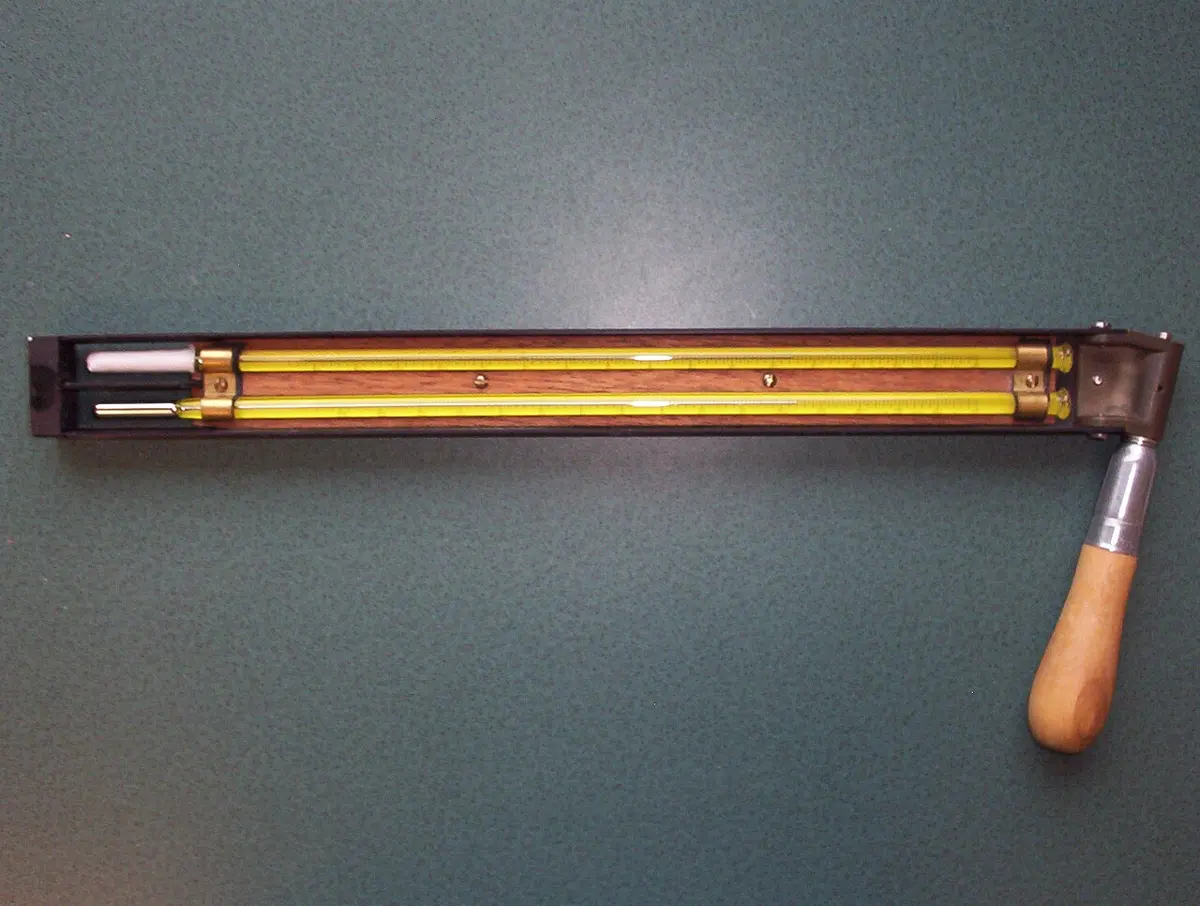
A hygrometer measures humidity: the amount of water vapor (water as an invisible gas) in the air. There are two main types: the dry-and-wet-bulb hygrometer and the mechanical hygrometer.
A dry-and-wet-bulb hygrometer is two thermometers side by side. One bulb is bare; the other is wrapped in a wet cloth. Water evaporates from the cloth and cools that bulb, the more so the drier the air. So when the two read the same, the air is full of water vapor (100% humidity); the bigger the difference, the drier the air. A table turns the difference into humidity. A mechanical hygrometer uses a material, such as a hair, that gets longer in damp air and shorter in dry air, moving a needle.
5. The anemometer
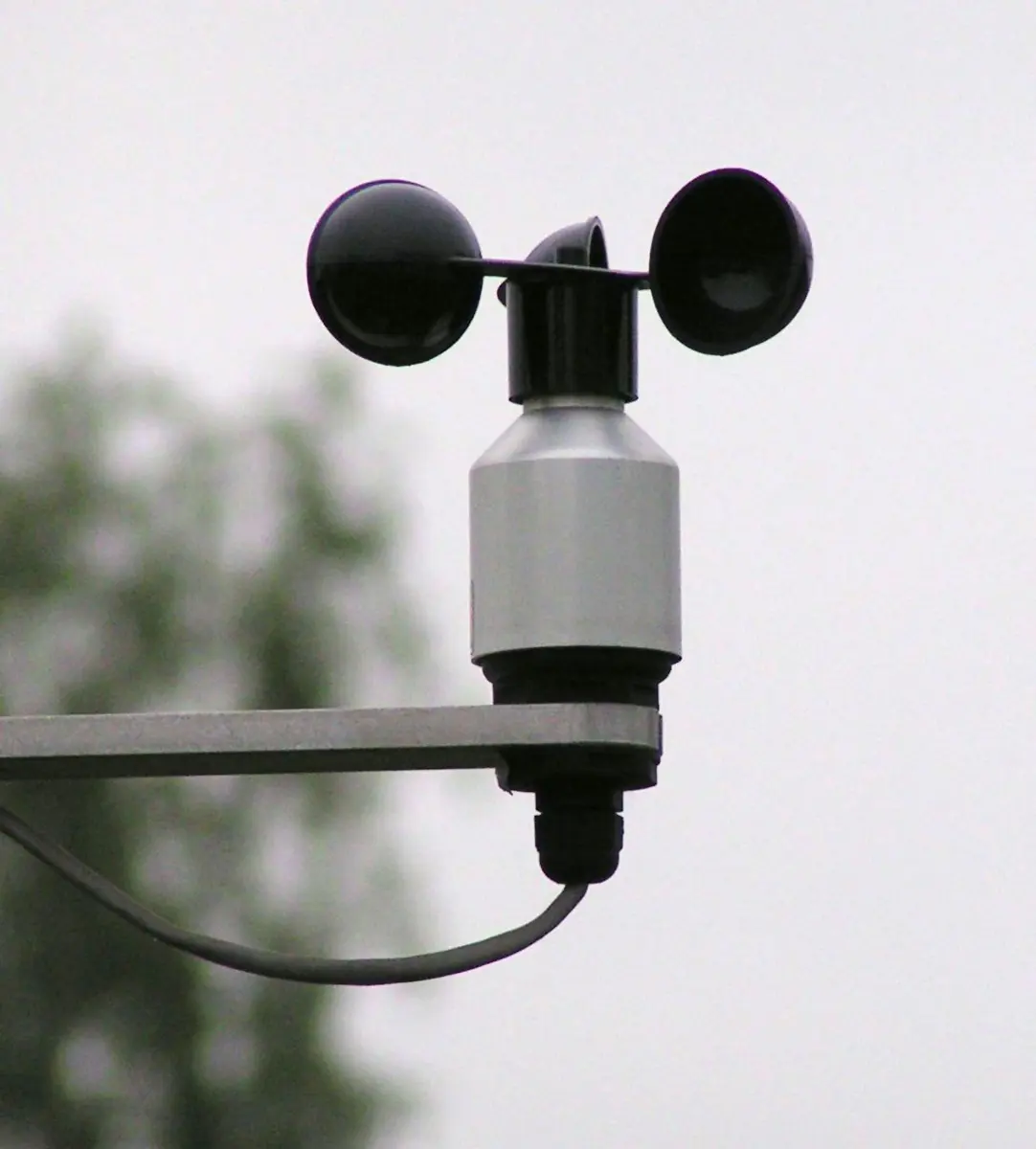
An anemometer measures the speed of the wind. Wind speed says a lot about the weather: a very high wind speed means a storm. Knowing the wind speed helps us protect ourselves from disasters: airports, ships and people in the mountains all need to know it.
6. The wind vane
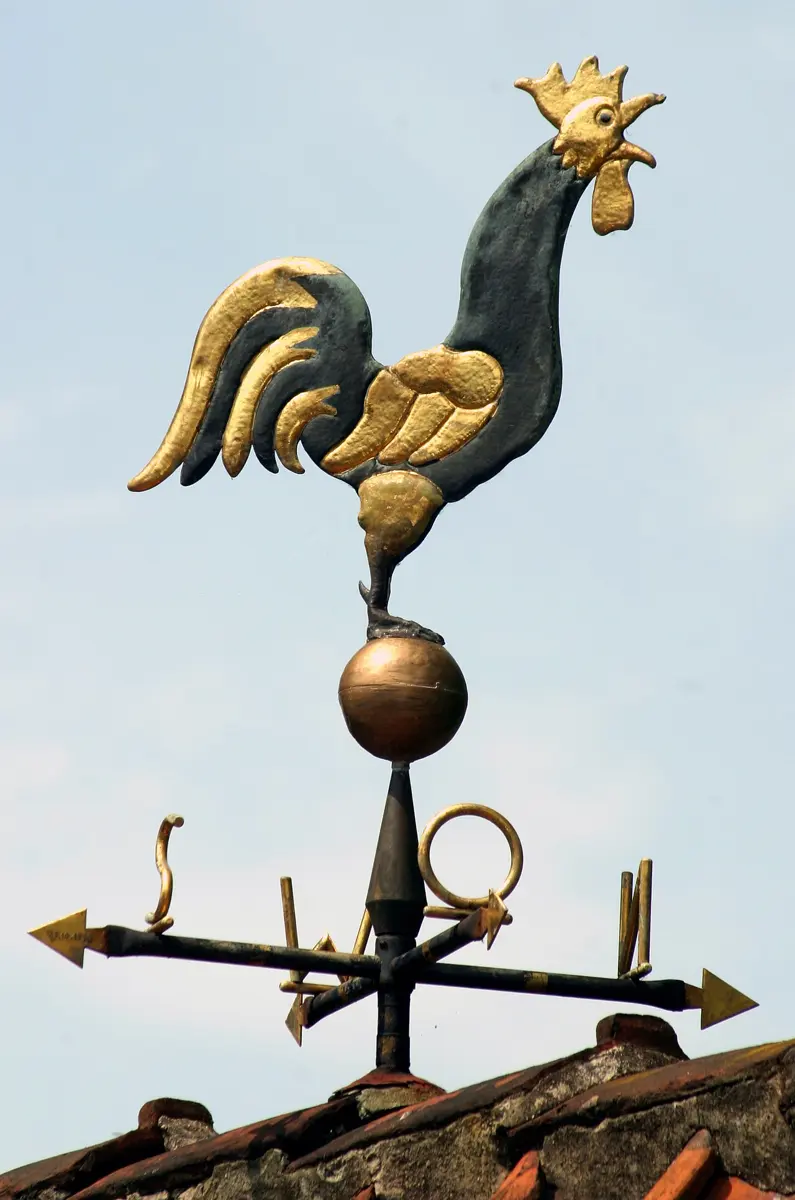
A wind vane (also called a weather vane or a weathercock) shows the direction of the wind. The traditional one has a cockerel (a young rooster) on top, and arms below with the letters of the compass points: N, E, S and W. It stands on top of a weather station, or a building, where the wind reaches it freely. The wind’s direction tells forecasters a lot about the changes coming in the weather.
7. The rain gauge
A rain gauge measures precipitation (rain, snow and hail) over a period of time, usually a day. It is found at almost every weather station. It must stand in an open place, away from trees and buildings, so that nothing stops the rain falling into it or splashes extra water in. It is read by hand (manually) or by an automatic weather station. It has limits: in very strong winds, such as in a hurricane, much of the rain blows past its mouth, so it can’t collect a true amount.
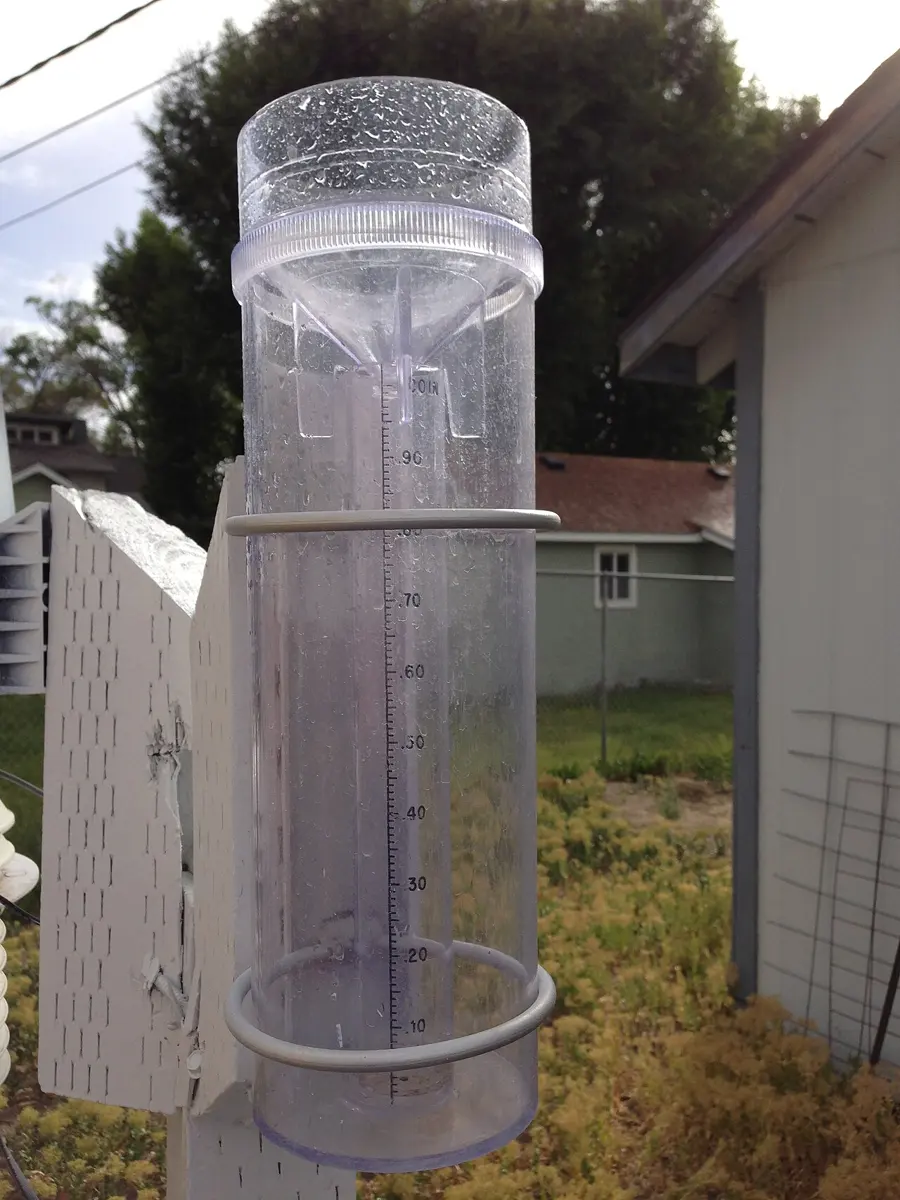
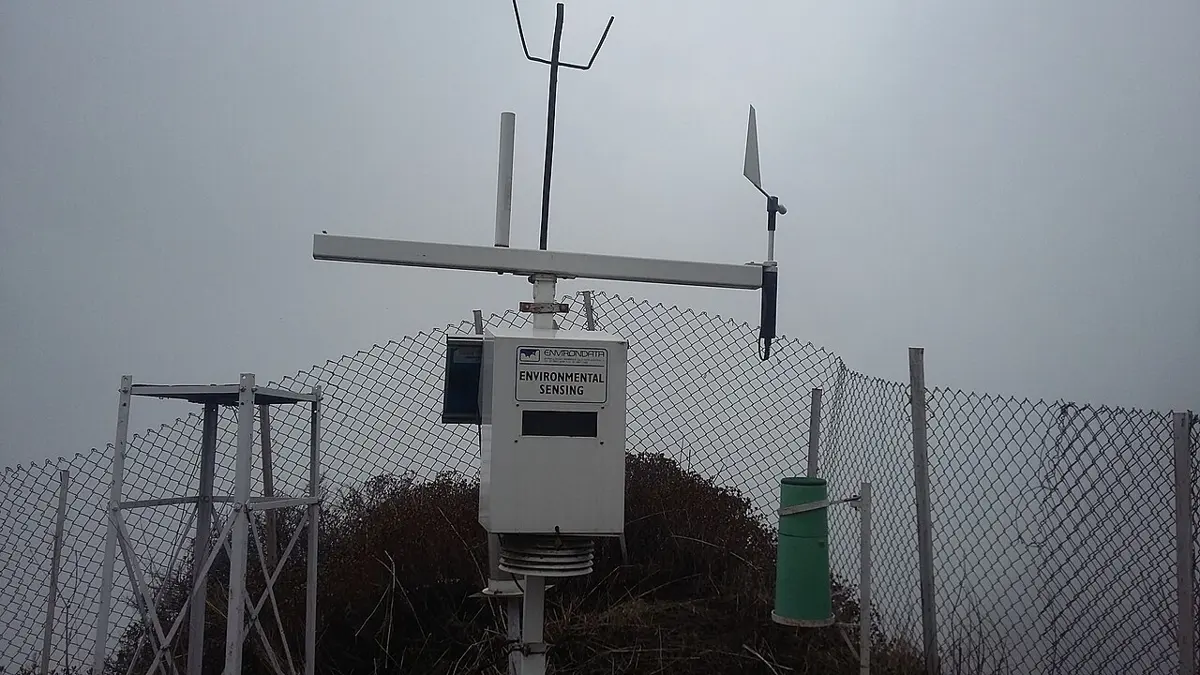
A falling reading on which instrument warns that bad weather may be coming?
Pick an answer to see why.
Why is mercury no good in a thermometer in a very cold place?
Pick an answer to see why.
Words from the text
| Word | Meaning here |
|---|---|
| station | a building or place where a service is based: a weather station, a radio station |
| accumulate | to collect, little by little |
| parameter | a quantity that can be measured, such as temperature or pressure |
| meteorology | the scientific study of the weather; a meteorologist studies it |
| sensor | a part that senses a change (in heat, light, pressure) |
| converter | a part that changes one thing into another, here a change of temperature into a number |
| wrap | to cover all round; wrapped by the atmosphere |
| humidity | the amount of water vapor in the air |
| aneroid | (of a barometer) using no liquid |
| weathercock | a wind vane shaped like a cockerel |
| precipitation | rain, snow or hail that falls to the ground |
| gauge | (said like gage) an instrument that measures an amount |
| blessed | lucky to have something good: blessed with modern technology |
| cockerel | a young rooster (a male chicken) |
A. Complete the sentences
Complete these sentences with the appropriate words from the text above.
- a.Most of the FM ……… broadcast the news at 7:00.
- b.The function of a ……… is to convert the change of temperature into numerical values.
- c.The Earth is ……… by the atmosphere.
- d.The amount of water in the air is called ………
- e.The wind vane is also known as a ………
Answer
B. Choose the correct answer
Choose the correct answer.
- a.How did people get the weather information until the 18th century? i. with weather instruments ii. through their physical senses iii. through their intuitions
- b.Which one of the following barometers is the latest one? i. digital ii. mercury iii. aneroid
- c.What does a barometer measure? i. atmospheric temperature ii. atmospheric humidity iii. atmospheric pressure
- d.Which of the following devices is NOT used to get weather information? i. thermometer ii. galvanometer iii. anemometer
- e.Which of the following devices is used to measure the speed of the wind? i. wind vane ii. anemometer iii. hygrometer
Answer
C. Answer the questions
Where is an alcohol-filled thermometer mostly used?
Answer
What is a barometer used for?
Answer
What are the two kinds of hygrometer?
Answer
Give two examples of how an anemometer gives information about the weather.
Answer
Name the device that is used to measure the changes in weather conditions.
Answer
What precaution should be taken while using a rain gauge?
Answer
D. Talk about it
How do you usually find out what the weather will be like? Talk to your friends.
A model answer
Listening: a cooking show
A. Before you listen
The first picture shows a man in a white chef’s jacket in a TV studio kitchen, with ovens and shelves behind him. The second is a set of small photos: a packet of chocolate chip cookie mix, eggs and butter being mixed, flour, chocolate chips stirred in, balls of dough on a tray, and the baked cookies.
Look at the pictures and answer these questions.
- a.What do you think the profession of the man is?
- b.What does the second picture show?
Model answers
The recording
A TV cook presents his show with his daughter, Ashley, who has had to eat his cooking experiments for years. He shares his favorite chocolate chip cookie recipe. Read the questions in B and C first, then listen, as many times as you need.
B. Tick the correct answer
Listen to the audio and tick the correct answer.
- a.Where did the chef learn to cook? i. at a cooking school ii. at a family member’s home iii. in a friend’s kitchen
- b.What is special about the chef’s cookies? i. He makes them by following a healthy recipe. ii. He prepares them by using cheap ingredients. iii. He sells them at many local stores.
- c.Which ingredient does the chef NOT use to make his cookies? i. baking powder ii. flour iii. sugar
- d.At what temperature should the cookies be baked? i. at 305 degrees ii. at 315 degrees iii. at 350 degrees
- e.What is the topic of the next cooking program? i. Fun Cookies for Teenagers ii. Inexpensive Meals iii. Tips for Cleaning your Kitchen
Answer
C. Complete the sentences
Listen to the audio again and complete the sentences with the correct words from the box: switch, entire, ingredients, preheat, pinch.
- a.Don’t forget to ……… the oven to 375 degrees.
- b.It looks like we don’t have all of the ……… to make dinner. Let’s go to the store and buy them.
- c.If the meat doesn’t taste just right, try adding a ……… of salt.
- d.Please put the ……… mixture in a baking pan.
Answer
D. Cooking shows
Do you watch cooking shows on television? Share your reasons why you do or do not with your classmates.
A model answer
Grammar II: reporting commands and requests
Grammar I gave the pattern; here are the details the exercises test.
- Choose the reporting verb by meaning: told (a plain command), asked or requested (a polite request, a question like Could you…?), advised (advice), ordered (an order from someone in charge), warned (danger), forbade (a strong don’t).
- Name the listener: told me, asked the teacher, advised the patient. If the direct speech doesn’t say who was spoken to, use a sensible listener (him, me, them), or asked without one only before a verb of asking: She asked to see the manager (she wanted to see him herself).
- To + base verb; not to for don’t: He told me not to use his camera.
- Change pronouns, time and place words as for statements: “Finish this job in an hour” → He told me to finish that job in an hour.
- A question that is really a request (Could you…, please?) is reported as a request: “Could you explain number four, please?” said the student. → The student asked the teacher to explain number four.
And two points about statements:
- After a present reporting verb (says, tells), the tense doesn’t move back: She says that she can’t stay there anymore.
- A universal truth (always true) stays in the present: The teacher told us that the Earth revolves round the Sun.
“Please lend me your pen,” said Ishwori to Nirajan. Which report fits best?
Pick an answer to see why.
“Water boils at 100 °C,” the teacher told us. Which report is best?
Pick an answer to see why.
A. Report the commands
Change the following sentences into indirect speech.
- a.He said, “Don’t use my camera.”
- b.The doctor said, “Give up smoking.”
- c.“Don’t touch the wire,” the electrician said to me.
- d.“Could you explain number four, please?” said the student.
- e.“Don’t worry about it, Mrs. Shrestha,” she said.
- f.“Finish this job in an hour,” he said.
- g.Amrita said to me, “Please help me.”
Answer
B. Choose the correct form
Complete the following sentences with the correct alternatives from the brackets.
- a.Anju said that she ……… the accident the day before. (had seen/has seen/was seen)
- b.She says that ……… (she could not stay there anymore/I can’t stay there anymore/she can’t stay there anymore)
- c.The teacher told us that ……… (the Earth revolves round the Sun/the Earth revolved round the Sun/the Earth revolve round the Sun)
- d.Pramesh said that ……… (he had done his homework/I have done my homework/he has done his homework)
- e.The policeman ……… the thief not to move. (requested/told/ordered)
- f.My father forbade me ……… so much money. (to spend/do not spend/not to spend)
- g.The head teacher forbade the students’ parents ……… in the school premises. (not to smoke/to not smoke/to smoke)
Answer
Writing II: a newspaper article
A newspaper article that gives your views on a topic (an opinion article) has:
| Part | What it does |
|---|---|
| Headline | a short, catchy title that tells the topic |
| Byline | By + your name (and sometimes where you are) |
| Introduction | grabs the reader with a fact, a question or a picture from life, and says what the article is about |
| Body | two or three paragraphs, each with one main point: here the positive effects, then the negative ones, with examples from real life |
| Conclusion | your own view, and what we should do |
Use linking words to move between points: first of all, moreover, on the other hand, however, as a result, in conclusion.
In the past 20 years, there have been significant developments in the field of science and technology. These developments have had both a positive and negative impact. Write a newspaper article expressing your views on the impact of science and technology.
A model article
Project work: connecting earbuds
Wireless earbuds connect to a phone, tablet or laptop by Bluetooth, a radio signal that works over a short distance (about 10 meters). Connecting two Bluetooth devices for the first time is called pairing; after that, they usually connect by themselves.
Transitive and intransitive verbs
Ask “what?” or “whom?” right after a verb. If the sentence answers, that answer is the verb’s object: the person or thing that receives the action.
- A transitive verb needs an object to complete its meaning: I admire your courage. (Admire what? Your courage.) ✗ I admire. is incomplete.
- An intransitive verb takes no object: The baby was crying. (Crying what? Nothing.) Words after it may say where, when, how or how long, but they are not objects: We talked for hours. I work for a large firm in Paris.
| Transitive (with an object) | Intransitive (no object) |
|---|---|
| I admire your courage. | The baby was crying. |
| We need to maintain product quality. | I work for a large firm in Paris. |
| I couldn’t face him today. | They laughed uncontrollably. |
| She loves animals. | We talked for hours. |
Many verbs can be both, with a different pattern: Pemba is reading a novel (transitive) / Pemba is reading (intransitive). Dolma charged her phone / The phone charged slowly. A dictionary marks each meaning [T] or [I], or vt and vi.
Which sentence has an intransitive verb?
Pick an answer to see why.
In “The battery died last night”, died is…
Pick an answer to see why.
Exercise
Practice on this unit in the style of the final exam. Try each one as in the exam, then open the answer.
Read the text and write True or False after each statement.
Reshma’s school in Jumla has its own small weather station, run by the Grade 9 science club. Every morning at a quarter to nine, two students read the thermometers inside a white wooden box with slatted sides, which keeps the sun off them but lets the air through. Then they empty the rain gauge in the corner of the playground and write the rainfall in a notebook. In winter they also note the lowest temperature of the night, often below freezing. At the end of each month, Reshma draws a graph of the readings and pins it on the notice board, and last year the club sent its records to a scientist studying how the climate of Karnali is changing.
- a.The weather station is run by the school’s science club.
- b.The thermometers are read in the afternoon.
- c.The white box lets air reach the thermometers.
- d.The rain gauge stands inside a classroom.
- e.The club’s records were used by a scientist.
Answer
Change into reported speech.
- a.“I am charging my phone now,” Rizwan said.
- b.“We visited the weather station yesterday,” the students told me.
- c.“Don’t leave the laptop on the bed,” Mother said to Kushal.
- d.“Please switch off the fan,” Urmila said to her brother.
- e.“You should clean your phone every week,” the doctor said to me.
Answer
Choose the correct word.
- a.The guide (told/said) us to stay together on the trail.
- b.The sign forbids visitors (to feed/not to feed) the monkeys.
- c.Bhim says that he (is/was) busy today.
- d.The teacher said that light (travels/traveled) faster than sound.
Answer
Underline the object, if there is one, and write T (transitive) or I (intransitive).
- a.Abdul fixed the broken radio.
- b.The baby slept peacefully.
- c.Phulmaya grows vegetables on the roof.
- d.The water is boiling.
- e.Mother boiled the eggs for five minutes.
Answer
Write instructions of about 80 words on how to make a cup of black tea, using sequence words.
A model answer
Write a short article of about 150 words for your school magazine on “Gadgets: Friends or Masters?”
A model article
Practice every question in the book, and keep track of the ones you miss →
A companion to your textbook, not a replacement for it: study from the book your school uses, and where the two differ, follow your teacher. Found a mistake? Please tell us.