
Have you ever done something you still tell people about? When you tell the story, listen to your own verbs: I have been to Muktinath. I went there last winter. Why does the first sentence say have been, and the second went?
This unit is about personal experiences: what has happened to you, and how to tell it. You will follow a traveler through Mustang in a memoir, and spend one long day in a Dhading village with a visitor’s diary. You will learn when to use the past simple and when to use the present perfect, write about a day you won’t forget, write a diary entry, hear the diphthongs in night, shower and tour, and sort compound words like post office, airport and check-in.
Getting started: exciting activities
The unit opens with four pictures of people doing something exciting. Here is what each one shows.
| Picture | What it shows |
|---|---|
| 1 | a boy in a helmet and gloves, riding a bicycle |
| 2 | a boy in a harness, on a rope, climbing a wall with colored holds |
| 3 | a girl in a harness, hanging under a parachute high above the clouds |
| 4 | two people in life jackets in a small boat, with a long oar on each side |
Look at the pictures. What exciting activities are the people doing?
Model answers
The answers use is cycling and are rowing, because you are saying what is happening in the picture, now. If you talk about your own life, the verbs change: I have tried wall climbing. I tried it last year. The rest of this unit is about that change.
Reading I: A Visit to Mustang
Before you read
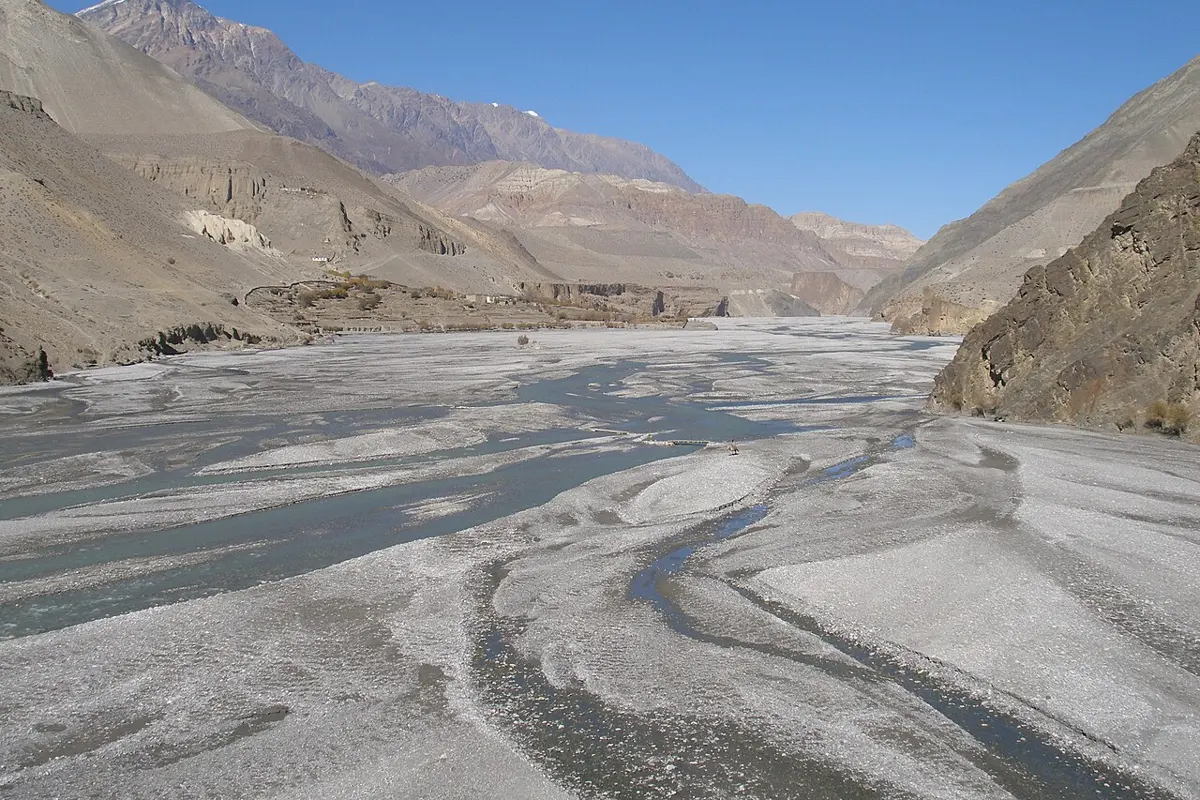
What do you see in the picture given in the text? (The text has two pictures. In the first, a row of small white shrines stands on a stony riverbank, with bare brown hills behind. In the second, three stone shrines hung with colored flags stand in front of a snowy mountain.)
A model answer
Have you visited any new place recently? Share your experiences.
A model answer
What kind of text it is
The text is a memoir: a true story from the writer’s own life, written some time later, as she looks back. It’s told in the first person (I, we). Because it looks back, most of its verbs are in the past simple, and it tells events in the order they happened. It’s also full of what she saw and felt, because a memoir is about her own experience, not just about the place. This one is adapted from a memoir by Phoenix Yu, who traveled to Nepal from Hong Kong.
The memoir is a journey. It’s easier to read if you can see the road first.
The memoir, part by part
1. Why she came
She knew only a little about Mustang when she visited in early 2020. She was curious to see a place untouched by tourists, a place that tourists hadn’t yet changed. That was the opposite of busy Hong Kong. The upper part of Mustang stayed closed to outsiders until 1992, and even now, tourists from other countries need a special travel permit to enter it.
2. The first night: Pokhara
She met her tour group in Pokhara, the town where many Himalayan treks begin. The hotel staff gave her cushions and blankets to ensure (to make sure) that she wouldn’t get cold in the night.
3. A jeep in January
The next morning, her guide, Reena, picked her up early and they set off by jeep. In January, the Himalaya are usually somewhere between 0 °C and −15 °C, and that is why few tourists come in the winter months. She was on her own but not lonely, because they kept picking up local people and dropping them off on the way. Notice the difference: alone means with nobody, and lonely means sad because you are alone.
4. Tatopani
After seven hours, they reached the first stop, Tatopani. Its name is simply Nepali for “hot water”, and here it’s a hot spring: a small but charming (pleasant and attractive) natural pool. As they sat in the warm water, Reena talked about growing up in Nepal, and about the rustic (simple, country-style) way of daily life. The beauty of the place and its loving people, the writer says, couldn’t be replaced anywhere else in the world.
5. Up the Kali Gandaki to Kagbeni
The next day they went on from Tatopani to Kagbeni, along the Kali Gandaki River. She saw the mountain range, cliffs, eroded land (land worn away by wind and water) and canyons (deep, narrow valleys with steep sides).
6. Muktinath
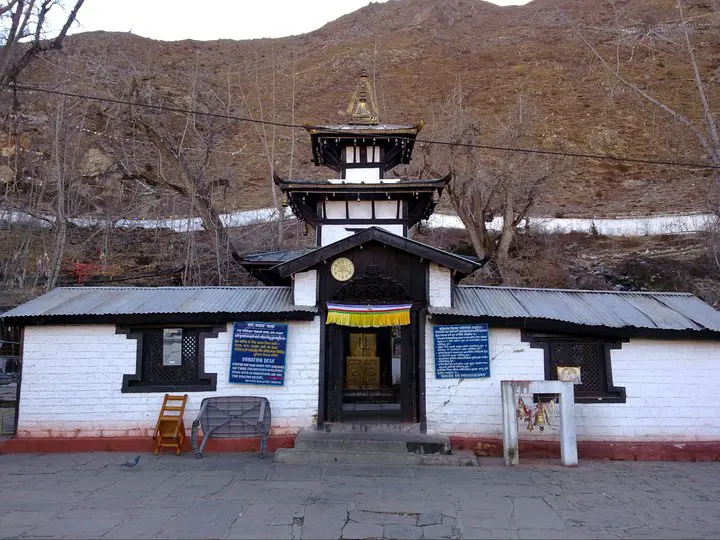
Then they reached Muktinath Temple, about 3,710 meters up in the Annapurna range. It’s sacred to both Hindus and Buddhists, and it draws pilgrims (people who travel to a holy place for religious reasons) of different religions. From this temple, hung with colorful flags, there are panoramic views (wide views in all directions) of the Himalaya.
Buddhists say that this is the only place on Earth that holds all five elements of life, and the elements are symbolized (shown by a sign) by the colors of the flags: blue for sky, white for air, red for fire, green for water and yellow for earth. Together, the five colors stand for balance.
What makes people say that the elements meet here? Water runs from 108 spouts around the temple, and in the temple next to it, Jwala Mai, a small flame burns on natural gas coming out of the ground. So water and fire really are found side by side.
7. A freezing night
They endured (suffered through) a freezing night in a teahouse at Muktinath and woke to a beautiful sunrise. After a quick meal, they got back into the jeep. Two hours later, its wheels bumped (shook over rough ground) into the middle of Marpha.
8. Marpha
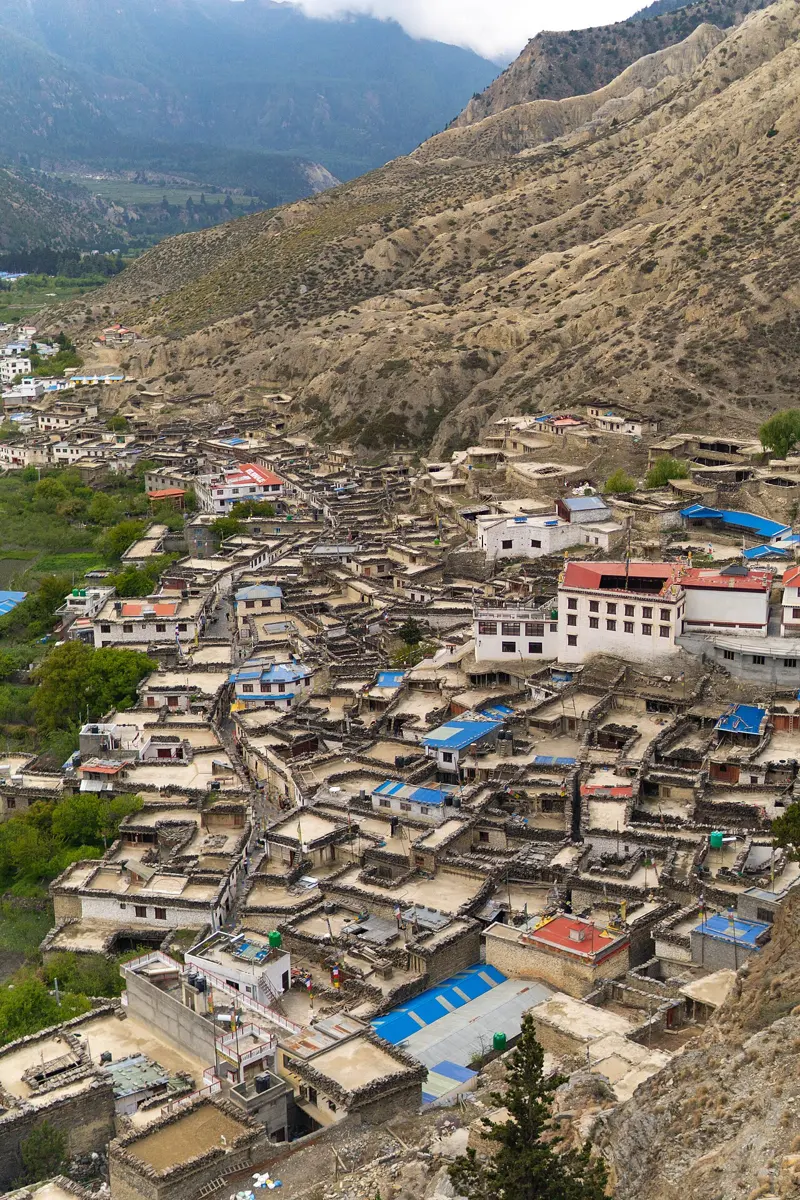
Marpha is known for two things: its apple trees and its unique architecture (the style of its buildings). The houses have flat roofs and stand close together, so the narrow alleyways between them snake on and on. Because the houses are so close (their proximity), people mingle naturally (they meet and talk), and they make a close-knit community, one where everyone knows and helps everyone else.
9. The last morning
She woke up in Marpha feeling refreshed and warm. The night before, she had finally had a hot shower, a luxury (a pleasure you don’t have every day) she had gone without for three days. Her last line sums it all up: her time in Mustang was truly unforgettable.
Why was the writer not lonely on her journey?
Pick an answer to see why.
In the flags, which color stands for water?
Pick an answer to see why.
Words from the memoir
Words linked here open in English Vocabulary, where you can see an example and practice them in the word game. The meanings below are the ones the words have in this memoir.
| Word | Meaning here |
|---|---|
| untouched | not changed or spoiled |
| lonely | unhappy because you are alone |
| charming | very pleasant or attractive |
| rustic | simple, in the style of the countryside |
| eroded | worn away by wind, water or ice |
| canyon | a deep valley with steep sides |
| pilgrim | someone who travels to a holy place |
| panoramic | showing a wide view in all directions |
| symbolize | to stand for something |
| endure | to bear something difficult or painful |
| bump | to move along with sudden shakes |
| architecture | the style of a building or buildings |
| alleyway | a narrow path between buildings |
| proximity | being near to something |
| mingle | to mix with other people and talk |
| close-knit | (of a group) caring about and helping each other |
| luxury | something pleasant that you don’t often have |
A. Complete the sentences
Learn these words and complete the following sentences using them: pilgrims, architecture, charming, alleyways, panoramic.
- a.She studied history of art and ……… at the university.
- b.All the ……… of the city are resurfaced.
- c.Many ……… visit the Muktinath Temple every year.
- d.I found Nepali people ……… and helpful.
- e.One can enjoy the ……… view of the Kathmandu Valley from the top of the Dharahara.
Answer
B. Put the sentences in order
Put these sentences from the text above in the correct order.
- a.It took seven hours for the writer to reach Tatopani.
- b.The tourist guide shared experiences about her life with the writer.
- c.The writer took a hot shower.
- d.The writer appreciated the hotel staff in Pokhara.
- e.The writer, together with other members, visited Marpha village.
- f.The writer spent a night in Pokhara and met her tour group.
Hint
Answer
C. Answer the questions
Is it easy for non-Nepalis to enter Upper Mustang? Why?
Answer
Why was the writer given cushions and blankets at the hotel in Pokhara?
Answer
Why do only a few tourists visit Nepal in January?
Answer
What was the Tatopani spring like?
Answer
Where does Kagbeni lie?
Answer
What, according to the Buddhists, are the five elements of life?
Answer
What is Marpha village known for?
Answer
Was the writer happy with her journey in the end? How do you know?
Answer
Pronunciation: diphthongs
Say the word my very slowly, and feel your mouth. It starts open, on /a/, and it ends nearly closed, on /ɪ/. One sound has glided into another, in a single beat. A vowel sound that glides like this is a diphthong. (The word comes from Greek, and means “two sounds”. It’s said DIF-thong.)
A word’s spelling is no help here: the letters i, o and ou in these words all make sounds that don’t look like them. So listen to the sound, and don’t look at the letters. The words here make three diphthongs.
| Sound | Your mouth goes | Words |
|---|---|---|
| /aɪ/, as in my | from open to a smile | behind /bɪˈhaɪnd/, island /ˈaɪlənd/, night /naɪt/, side /saɪd/, financial /faɪˈnænʃl/ |
| /aʊ/, as in now | from open to round lips | allowance /əˈlaʊəns/, shower /ˈʃaʊə(r)/ |
| /ʊə/, as in sure | from round lips to relaxed | tour /tʊə(r)/, ensure /ɪnˈʃʊə(r)/, manure /məˈnjʊə(r)/, visual /ˈvɪʒuəl/ |
Two of these need a word more. In financial, the first i carries the diphthong. The ending -cial has none: it sounds /ʃl/, and it’s the same in special and social. Many speakers say the first syllable with a short vowel too, /fɪ/ or /fə/. In visual, a careful dictionary writes the u and the a apart, as /uə/, but in quick speech they run together, close to /ʊə/.
Which word has the same diphthong as shower?
Pick an answer to see why.
Grammar I: which tense?
A. Find the verbs in the text
Start with five sentences from the memoir.
Complete these sentences with missing words or phrases from the reading text. Discuss with your friends to identify the tenses.
- a.Mustang ……… open to tourists since 1992.
- b.On the first night, I ……… in Pokhara to meet up with my tour group.
- c.Next day, we ……… our trip from Tatopani to Kagbeni.
- d.They ……… in the colors of flags.
- e.I ……… refreshed and warm.
Answer
Look at the difference. I stayed in Pokhara is about one finished night. Mustang has been open since 1992 began in the past and is still true now. That is the whole point of this unit’s grammar.
Two tenses, two ideas
The past simple and the present perfect both talk about the past. They look at it in different ways.
| Past simple | Present perfect | |
|---|---|---|
| The idea | a finished time: it’s over | a link up to now |
| How to make it | verb + -ed, or the irregular past form | have or has + past participle |
| Statement | She visited Marpha. | She has visited Marpha. |
| Negative | She didn’t visit Marpha. | She hasn’t visited Marpha. |
| Question | Did she visit Marpha? | Has she visited Marpha? |
| Time words | yesterday, last year, two days ago, in 2020, when I was ten | ever, never, already, just, yet, recently, since, for, so far |
So the present perfect is used for three things:
- Experience up to now, when you don’t say when: I have seen the Himalaya.
- A past action with a result now: I have lost my pen. (I can’t write now.)
- Something that began in the past and goes on now, with since and for: We have lived here for ten years.
Use since with the point when it began (since 2019, since Monday), and for with the length of time (for ten years, for two days). For doesn’t always mean the present perfect: if the time is over, use the past simple. We lived there for ten years, and then we moved.
The past participle of a regular verb looks like its past form: visit, visited, visited. Irregular verbs have to be learned. These are the main ones this unit uses.
| Base form | Past simple | Past participle |
|---|---|---|
| be | was, were | been |
| buy | bought | bought |
| drink | drank | drunk |
| eat | ate | eaten |
| forget | forgot | forgotten |
| go | went | gone |
| have | had | had |
| know | knew | known |
| leave | left | left |
| lose | lost | lost |
| rise | rose | risen |
| run | ran | run |
| see | saw | seen |
| set | set | set |
| sing | sang | sung |
| spend | spent | spent |
| win | won | won |
| write | wrote | written |
We ……… in Bhaktapur since 2015.
Pick an answer to see why.
Mingma ……… his grandmother two days ago.
Pick an answer to see why.
B. Underline and name
Read the given paragraph carefully. Underline the verbs in the sentences and identify their tenses.
Have you ever had a frightening experience? I have had one. Some years ago, I was heading to Biratnagar from Kathmandu by plane. It was alright at the beginning but suddenly a problem occurred. The captain of the plane said to us in a very calm voice, “Ladies and gentlemen, we’re having a problem with one of the engines. There’s no need to panic but keep your seatbelts fastened. We are heading back to Tribhuvan International Airport, Kathmandu.” I felt a pain in my chest and people started to cry. After some time, we landed successfully back at the airport. I sighed with relief! Since then, I have decided not to travel in a plane.
Hint
Answer
C. Choose the right form
Fill in the blanks with one of the two alternatives given in the brackets.
- a.The sun ……… (set/has set) at 6 p.m. yesterday.
- b.Get up! The sun ……… (rose/has already risen).
- c.Jackson ……… (has eaten/ate) his lunch. The plate is still on the table.
- d.Jackson ……… (ate/has eaten) his lunch at 11:00 yesterday.
- e.Levi and Simon ……… (were/have been) friends for a long time.
- f.……… (Have you posted/Did you post) the letter last Sunday?
- g.The Smiths ……… (spent/have spent) a week in Paris recently.
- h.Megha ……… (ran/has run) two marathons last year. He could not succeed with either.
- i.I ……… (have lost/lost) my keys yesterday.
- j.Sumina ……… (has lost/lost) her keys this evening. She is at my home.
Hint
Answer
D. Use the box
Complete the given sentences with one of the suitable verb forms from the box: have forgotten, have washed, played, have finished, planted, bought, called, have not visited, haven’t eaten, went.
- a.Richard ……… football yesterday.
- b.They ……… their car again. It looks new.
- c.Last year, some of my friends ……… to Italy.
- d.Juni and Bikram ……… their homework. Now, they can play.
- e.I ……… my parents two days ago.
- f.We ……… another country before.
- g.The Smiths ……… a new house in 2001.
- h.I’m sorry, but I ……… to do my homework.
- i.The girls ……… their lunch yet.
- j.They ……… some trees last week.
Answer
Listening: a volunteer
A woman remembers one summer when she did something for other people. Read the sentences in B first, then listen, as many times as you need. The recording is CDC’s; the answers are hidden under the questions.
Words to know: volunteer (someone who works without being paid, because they want to help), elderly home (a place where old people live and are looked after), achievement (something good that you have done by working hard), gratitude (the feeling of being thankful).
A. Before you listen
Look at the picture and answer these questions. (A long, old brick building with carved windows stands behind a yard, and many people are sitting together there.)
- a.What do you think the place is?
- b.What do you think people do there?
Model answers
B. Complete the sentences
Listen to the audio and complete the sentences. Use one word only.
- a.The speaker remembers the events like holidays abroad and ……… parties.
- b.Beautiful experiences are also gained through everyday ……… .
- c.The speaker worked as a ……… in an elderly home.
- d.Her job was to read the newspapers and ……… to the elderly people.
- e.The elderly people have told her their achievements and ……… stories.
- f.The work at the elderly home was an interesting ……… to the writer.
- g.The speaker gave them feelings of support and ……… .
Hint
Answer
C. Is it good to be a volunteer?
What do you think about the speaker’s work? Is it good to work as a volunteer? Talk to your friends.
A model answer
Practice listening alone
Writing I: a memorable event
A memorable event is one you can’t forget. To write about it, you don’t need a big event. You need a clear one, told in order, that meant something to you.
Plan three short paragraphs that answer the task’s three questions.
| Paragraph | It answers | Useful ways to begin |
|---|---|---|
| 1 | What was the event about, and when did it happen? | I will never forget… It happened last… |
| 2 | What happened, step by step | First… Then… Suddenly… After that… In the end… |
| 3 | What lesson did you learn? | That day I learned… Since then, I have… |
Tell the story in the past simple. Finish in the present perfect if you want to join it to now, as the plane story does: Since then, I have… And put in one small detail that only you could know, like the writer’s hot shower.
You must have had several memorable events in your life. Write two or three paragraphs about one of them. Include the answers to these questions in your paragraphs.
- a.What was the event about?
- b.When did it happen?
- c.What lesson did you learn from it?
A model answer
Speaking: talking about experiences
A. What are they talking about?
Two girls are talking. The first tells how she waited more than an hour for a friend outside her school, for a movie. It started to rain while she was waiting, he came late, he didn’t say sorry, and when they reached the entrance, the film had already begun. So she has never asked him to go anywhere with her again. The second tells how she visited the Central Zoo: they bought tickets at the entrance, she saw many animals and birds, and she really had fun.
Study what these people are saying. What are they talking about?
Answer
Look at how people tell an experience in English. They start with the present perfect, which brings up the topic without a time, and they go on in the past simple as soon as they give details.
I have recently visited the Central Zoo. We bought tickets at the entrance and I saw many animals.
The same thing happens in a conversation. The question is in the present perfect, and the details are in the past simple.
| Step | Example |
|---|---|
| Ask about any time up to now | Have you ever eaten yomari? |
| Answer briefly | Yes, I have. / No, I haven’t. / No, never. |
| Ask for details, in the past simple | When did you eat it? Did you like it? |
| Give details, in the past simple | I ate it last year in Bhaktapur. It was delicious. |
B. Ask and answer
Work in pairs. Take turns to ask these questions and to talk about your experiences.
- a.Have you ever eaten a cake?
- b.Have you read a story book recently?
- c.Have you ever gone on a picnic?
- d.Have you ever had a toothache?
- e.Have you ever gifted anything to your friend?
Model answers
Reading II: A Diary Entry
Before you read
What do you see in the picture below? (An old book lies open, its yellowed pages covered in handwriting, with a dark strap on its cover.)
A model answer
Why do you think people write a diary entry?
A model answer
What kind of text it is
A diary is a private record of your days, and each day’s writing is a diary entry. It looks different from the memoir, though both are true, personal stories.
| Memoir | Diary entry | |
|---|---|---|
| When it’s written | long after the events | on the same day |
| Who it’s for | readers | mostly the writer alone |
| How it opens | as a story | with the date, and often Dear Diary |
| What it sounds like | planned and polished | like talking to a friend |
The writer here is Neil, a visitor from the West, and his day is spent going from Kathmandu to a village in Dhading and back.
The diary, part by part
1. The top
The entry has the day and date (Saturday, 5 March 2022), the time of writing (10:00 p.m.) and a greeting: Dear Diary.
2. How he came to Nepal
Neil grew up in the Western world and was unaware of Nepal (he didn’t know about it). But once he heard of it, he couldn’t stop himself from coming. Fortunately (luckily), the long-awaited day (one he had waited for a long time) came in 2022.
3. The bus out
He was excited, and he set off with his Nepali friend on an old bus, decorated with colorful pictures, at 7 a.m. The road was bumpy (not smooth) and windy, and he nearly fell off his seat a few times. They stopped for coffee at a rest stop (a place on a road where travelers can stop for a while). Then two young boys jumped on with instruments and played Nepali songs. He gave them fifty rupees, because the music made him feel close to the Nepali community, and he would have given more if he had had it.
4. The village
From the main village by the river, they walked up a steep hillside (one that rises quickly) to a smaller village, where his friend’s large extended family lived (a family with grandparents, aunts, uncles and cousins). They were very friendly, and gave him a delicious lunch of rice and curry in a traditional Nepali kitchen. He loved seeing life in a rural village (in the countryside). He met all the families, played football with the youngest child, ate popcorn and daal as a snack, looked at the oxen and goats, and stroked a kid (moved his hand gently over a baby goat). The view from the top of the hill was so charming that he says he can’t describe it. He wanted to stay, but they left at 3:00 p.m., bidding goodbye to everybody (saying goodbye).
5. The way back
The journey back was tiring. Walking down the hill was hard, and there were few vehicles, all full of passengers. They caught a bus on the main road, he found a vacant seat (an empty one), and he slept for ten minutes. A man got on and played an instrument, which was interesting, though Neil couldn’t understand the words. He got off and bought bread and eggs at a supermarket. If he did that again, he says, he would buy a bar of chocolate too, as a treat. He got home in the evening, ate an omelet with bread and went to bed early.
6. Why he writes
He writes a diary every night so that he can remember his adventures. But he is always too tired at night, so he thinks he will start to write during the day too.
7. The end
He sums up: he had a wonderful day, and he will always remember the journey, the village and the family. What he admires most is the friendliness and support of Nepali people: it’s really admirable. He signs his name, Neil.
Why does Neil write I would have given them more money if I had any to spare?
Pick an answer to see why.
What is the main difference between a diary entry and a memoir?
Pick an answer to see why.
Words from the diary
| Word | Meaning here |
|---|---|
| fortunately | luckily |
| long-awaited | waited for over a long time |
| bumpy | (of a surface) not smooth |
| rest stop | a place to stop on a long road journey |
| steep | (of a slope) rising or falling quickly |
| rural | of or like the countryside |
| stroke | to move your hand gently over an animal or a person |
| charming | very pleasant or attractive |
| bid goodbye | to say goodbye |
| tiring | making you feel you need to rest or sleep |
| admirable | deserving respect, excellent |
A. Match the words
Match the words in column A with their meanings in column B.
- a.bumpy
- b.rural
- c.charming
- d.tiring
- e.steep
- f.admirable
- i.very pleasant or attractive
- ii.(of a slope) rising or falling quickly
- iii.(of a surface) uneven/not smooth
- iv.connected with or like the countryside
- v.deserving respect, excellent
- vi.making you feel the need to sleep or rest
Answer
B. True, False or Not Given
Not Given means that the text doesn’t say. Don’t guess from what seems likely. If you can’t point to a line, the answer is NG.
Decide whether these statements are True or False. Write NG if the information is not given.
- a.This was Neil’s first visit to Nepal.
- b.He visited the village together with his friend from England.
- c.Neil did not like the music and the song.
- d.He admires the Nepali people.
- e.Neil never closed his eyes throughout his journey so that he could enjoy the scenery.
- f.Neil is going back to his homeland in the near future.
Answer
C. Answer the questions
When did the writer visit a village in Dhading?
Answer
Why did the writer give some money to the boys on the bus?
Answer
Was the journey to the village comfortable for the writer? Why?
Answer
Why does the writer feel he needs to write diary during the day?
Answer
What did the writer like the most about Nepal?
Answer
D. Find a diary
Surf the internet or search other sources and find an interesting diary entry. Share it with the class.
Where to look
A model of what to share
Grammar II: past simple or present perfect?
You have the idea: a finished time takes the past simple, and a link up to now takes the present perfect. Now for the small words, and where they go.
| Word | Where it goes | Example |
|---|---|---|
| ever | questions, before the participle | Have you ever seen snow? |
| never | before the participle | I have never seen snow. |
| already | before the participle | She has already written ten books. |
| just | before the participle | They have just arrived. |
| yet | end of questions and negatives | Have you finished yet? He hasn’t come yet. |
Has Rohit finished his homework ………?
Pick an answer to see why.
Zeenat ……… in Nepalgunj for six years, and she still lives there.
Pick an answer to see why.
A. Complete the sentences
Complete these sentences with the correct forms of the verbs. Use past simple or present perfect tenses. Use negative forms where necessary.
- a.A: Have you watched the movie “The Queen”? B: No, I haven’t. Actually, I ……… (never/watch) English movies.
- b.Sam ……… (visit) Bali a year ago.
- c.My best friend and I ……… (know) each other for fifteen years. We meet very often.
- d.Sunita is a fantastic writer. She ……… (already write) ten books.
- e.We ……… (go) on a picnic yesterday but my younger brother ……… (do/not).
- f.Ranjita: ……… they ……… (play) chess yesterday? Dawa: No, they didn’t. I did though.
- g.……… you ……… (brush) your teeth yet?
- h.He ……… (arrive) here yet. He must have got stuck in the traffic.
- i.“What’s wrong with you?” “I ……… (lose) my pen.”
Answer
B. Make sentences from clues
Use present perfect or past simple forms of the verbs to make sentences from the given clues, as in the example.
Example: Udit/already sing/many songs → Udit has already sung many songs.
- a.We/know each other/since 2019.
- b.Mohammad/buy a house/in July last year.
- c.The Nepali Cricket Team/already win/several matches.
- d.I/never visit/a museum.
- e.People/grow/a lot of rice last year?
- f.Phurba/sing a song/just now.
- g.Diana/leave for England/last week?
- h.My parents/live/in Stockholm/for several years.
- i.It/rain/a lot last winter?
Hint
Answer
Writing II: a diary entry
A diary entry has a shape, as Neil’s does.
- The day, the date, and if you like the time.
- A greeting, if you like: Dear Diary.
- What you did, in the order it happened, in the past simple.
- How you felt: I was so happy… It was tiring…
- What you would have done differently.
- A closing thought, and your name.
Write a short diary entry about one of your days this week. You can use Reading II as a model. Include the following.
- a.What activities you did
- b.How you felt when you got involved in those activities
- c.What you would have done differently
A model answer
Project work
Extra bit: compound words
A compound word is made of two or more words joined to act as one word. It has a meaning of its own, and that can be quite different from its parts: a heart attack isn’t an attack by a heart, and a role model isn’t a model who plays a role. There are three kinds, by the way they are written.
| Kind | How it’s written | Examples |
|---|---|---|
| Open | with a space between the words | cell phone, dining room, heart attack, French fry, real estate, role model, post office, washing machine, web page |
| Closed | as one word | airport, babysit, barefoot, bedroom, outside, raincoat, nonetheless, mailbox, without, weekend |
| Hyphenated | with a hyphen | check-in, father-in-law, long-term, one-sided, runner-up, up-to-date, well-being, one-dimensional, mind-blowing, deep-fried, twenty-four |
Open compounds can be hard to spot, because they look like two words. They are mostly nouns, and for the plural you add -s only to the last word: post offices, role models, dining rooms.
Closed compounds look like one word, and they can be any part of speech: airport and bedroom are nouns, babysit is a verb, barefoot can be an adjective or an adverb, without is a preposition.
Hyphenated compounds have hyphens between the parts. Many of them are adjectives: a long-term plan, a one-sided match, deep-fried fish.
Which is a closed compound word?
Pick an answer to see why.
Which plural is correct?
Pick an answer to see why.
Exercise
Practice on this unit in the style of the final exam. Try each one as in the exam, then open the answer.
Read A Visit to Mustang again and write True or False after each statement.
- a.The writer visited Mustang in early 2020.
- b.The writer traveled from Pokhara by plane.
- c.Tatopani is a cold river.
- d.Muktinath Temple is sacred for Hindus and Buddhists.
- e.In Marpha the houses stand far apart.
Answer
Read A Diary Entry again and put these events in the correct order.
- a.Neil played football with the youngest child.
- b.Neil stopped for coffee.
- c.Neil bought bread and eggs.
- d.Two boys played songs on the bus.
- e.Neil left the village at 3:00 p.m.
Answer
Read the diary entry and answer the questions.
Wednesday, 3 Poush. Dear Diary, today was the coldest day of my life! Our class walked to Nagarkot to see the sunrise. We left at four in the morning with torches, and Simran’s torch stopped working on the way, so she held my hand in the dark. When the sun came up, Everest was only a tiny white dot, but Langtang stood huge and pink in front of us. Nobody said a word. On the way down I slipped twice, and my new shoes are ruined. I should have worn my old ones. I have never been so tired or so happy. Salim
- a.Where did the class go?
- b.What time did they leave?
- c.Why did Simran hold the writer’s hand?
- d.How many times did the writer slip?
- e.What would the writer have done differently?
Answer
Put the verbs in the brackets in the correct tense: past simple or present perfect.
- a.Rachana ……… (not finish) her book yet.
- b.We ……… (see) a rainbow over Phewa Lake last Sunday.
- c.My uncle ……… (work) in Doha since 2021.
- d.……… you ever ……… (taste) gundruk?
- e.Lochan ……… (write) a letter to his sister two days ago.
Answer
Rewrite the given sentences as indicated in the brackets.
- a.Sandhya has sung at the festival. (Make it negative.)
- b.Jeevan went to Jomsom. (Make it a yes/no question.)
- c.They have reached Marpha. (Make it a yes/no question.)
- d.I visit my aunt every week. (Change to the past simple, with last week in place of every week.)
- e.Sharmila drank tea. (Change to the present perfect, with just.)
Answer
Correct the punctuation and capital letters in this paragraph. There are ten errors.
have you ever been to marpha I went there last year with my uncle the apples were sweet the houses were close together, and the alleyways were narrow id love to go again
Answer
Write an account of a journey you have made, in two or three paragraphs. Say where you went and when, what happened, and what you learned.
A plan
Write a diary entry about the day of your school’s annual function. Say what you did, how you felt, and what you would have done differently.
A model answer
Printable PDFs
- Study notes 2 pages
- Harder practice questions 2 pages Answer key
Practice every question in the book, and keep track of the ones you miss →
A companion to your textbook, not a replacement for it: study from the book your school uses, and where the two differ, follow your teacher. Found a mistake? Please tell us.