
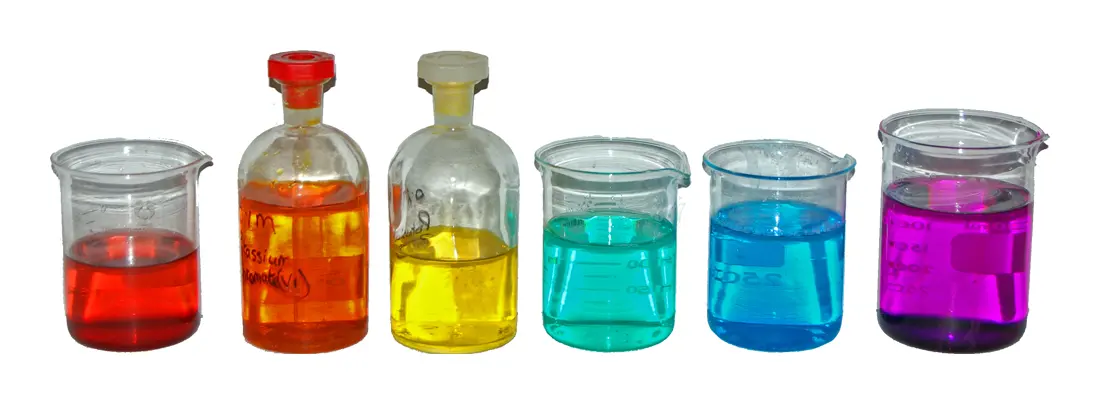
The copper in the wires of every house in Nepal, the iron of a Bhaktapur gate, the brass of a water vessel, the bronze of a Patan statue: the metals people have worked longest are nearly all from one stretch of the periodic table. So are the colors of many things you see in a laboratory, the deep blue of copper sulphate crystals, the orange of potassium dichromate, the purple of potassium permanganate, and the catalysts that make fertilizer, sulphuric acid and vanaspati ghee. These are the transition metals.
This unit asks why one block of the periodic table behaves so differently from the rest. The answer is in their d electrons: how many there are, how close they lie in energy to the outer s electrons, and how the five d orbitals are pushed apart when molecules or ions crowd round the metal. From that one idea come the unit’s topics: variable oxidation states, complex ions and their shapes, crystal field theory, color, magnetism and catalysis.
6.1 Introduction
Look closely at the elements of the d block and you will notice they share certain features. Many are metals used for tools, wires and buildings; many form colorful compounds; several speed up chemical reactions without being used up. They are no ordinary metals.
Transition metals are the elements in the middle of the periodic table, groups 3 to 12. They are called transition metals because their properties lie between those of the s-block and the p-block elements. They are d-block elements, because the electron that is added last enters the (n − 1)d subshell. They are hard, have high melting and boiling points, show variable oxidation states and form colored compounds. Iron, copper, nickel, zinc, chromium and titanium are part of daily life, and the transition metals matter in industry, in medicine and inside our own bodies.
Which of these is not a typical transition element?
Pick an answer to see why.
6.2 Characteristics of transition metals
Transition metals have several properties that set them apart from the other elements. Their general characteristics are:
- Periodic position. They are found in the center of the periodic table, in groups 3 to 12.
- Electronic configuration. Their general valence shell configuration is (n − 1)d¹⁻¹⁰ ns¹⁻², with the (n − 1)d subshell partly filled in the atom or in a common ion.
- Variable oxidation states. They show several oxidation states, because they can lose electrons from both the ns and the (n − 1)d subshells, which are close in energy (6.3).
- Colored compounds. Many of their compounds are colored, because of d–d transitions: electrons jumping between d orbitals of different energy (6.7).
- Conductivity. They are good conductors of heat and electricity: copper and silver are the best conductors of all.
- Density, melting point and boiling point. Their density, melting points and boiling points are high, because of strong metallic bonding in which both the s and the d electrons take part. Tungsten melts at 3,422 °C, the highest of any metal.
- Catalytic property. Many transition metals and their compounds act as catalysts in industry and in living things (6.8).
- Paramagnetism. Many of their compounds are paramagnetic, pulled into a magnetic field, because they have unpaired d electrons. Iron, cobalt and nickel are more than that: ferromagnetic, able to become permanent magnets.
- Complex formation. They readily form complex ions with ligands, because their ions are small and highly charged and have empty d orbitals of low energy to take lone pairs into (6.4).
- Alloy formation. They easily form alloys with one another, because their atoms are of nearly the same size: steel (iron with carbon and often chromium or nickel), brass (copper and zinc), bronze (copper and tin).
- Metallic character. They are typically hard, malleable and ductile, with a metallic luster.

Why do transition metals have high melting points?
Pick an answer to see why.
6.3 Variable oxidation states of transition metals
One of the most remarkable features of the d-block elements is that, with a few exceptions, they show more than one oxidation state in their compounds. There are two reasons.
- The (n − 1)d and ns electrons are close in energy. In a transition metal atom the outer s electrons and the d electrons below them have nearly the same energy, so both can take part in bonding. A metal can lose its two 4s electrons, or those and one or more 3d electrons as well, and each extra electron costs only a little more energy than the last. Which oxidation state a compound ends up in depends on the conditions: what the metal reacts with, and how much energy the new bonds, the crystal or the water around the ion give back.
- Several of those states are stable. Because the energy steps between them are small, several oxidation states can each be stable in suitable compounds. Configurations with an empty, half-filled or full d subshell (d⁰, d⁵, d¹⁰) are especially stable, which is why Mn²⁺ (d⁵), Fe³⁺ (d⁵), Sc³⁺ (d⁰) and Zn²⁺ (d¹⁰) are so common.
An s-block metal is different: sodium loses one electron easily, but the next would come from a full inner shell far lower in energy, so sodium is only ever +1.
| Element | Atomic number | Oxidation states | Electronic configuration |
|---|---|---|---|
| Scandium (Sc) | 21 | +3 (+2 rare) | [Ar] 3d¹ 4s² |
| Titanium (Ti) | 22 | +2, +3, +4 | [Ar] 3d² 4s² |
| Vanadium (V) | 23 | +2, +3, +4, +5 | [Ar] 3d³ 4s² |
| Chromium (Cr) | 24 | +1, +2, +3, +4, +5, +6 | [Ar] 3d⁵ 4s¹ |
| Manganese (Mn) | 25 | +2, +3, +4, +5, +6, +7 | [Ar] 3d⁵ 4s² |
| Iron (Fe) | 26 | +2, +3, +4, +5, +6 | [Ar] 3d⁶ 4s² |
| Cobalt (Co) | 27 | +2, +3, +4 | [Ar] 3d⁷ 4s² |
| Nickel (Ni) | 28 | +2, +3, +4 | [Ar] 3d⁸ 4s² |
| Copper (Cu) | 29 | +1, +2 | [Ar] 3d¹⁰ 4s¹ |
| Zinc (Zn) | 30 | +2 | [Ar] 3d¹⁰ 4s² |
Notice the pattern in Figure 6.4. From scandium to manganese the highest oxidation state equals the total number of 4s and 3d electrons: Sc +3, Ti +4, V +5, Cr +6, Mn +7. After manganese the growing nuclear charge holds the d electrons more tightly, and the highest state falls. The configurations of chromium (3d⁵ 4s¹) and copper (3d¹⁰ 4s¹) break the filling order, because a half-filled or full d subshell is more stable; and when any of these atoms forms an ion, it loses its 4s electrons first. So Fe²⁺ is [Ar] 3d⁶, not [Ar] 3d⁴ 4s².
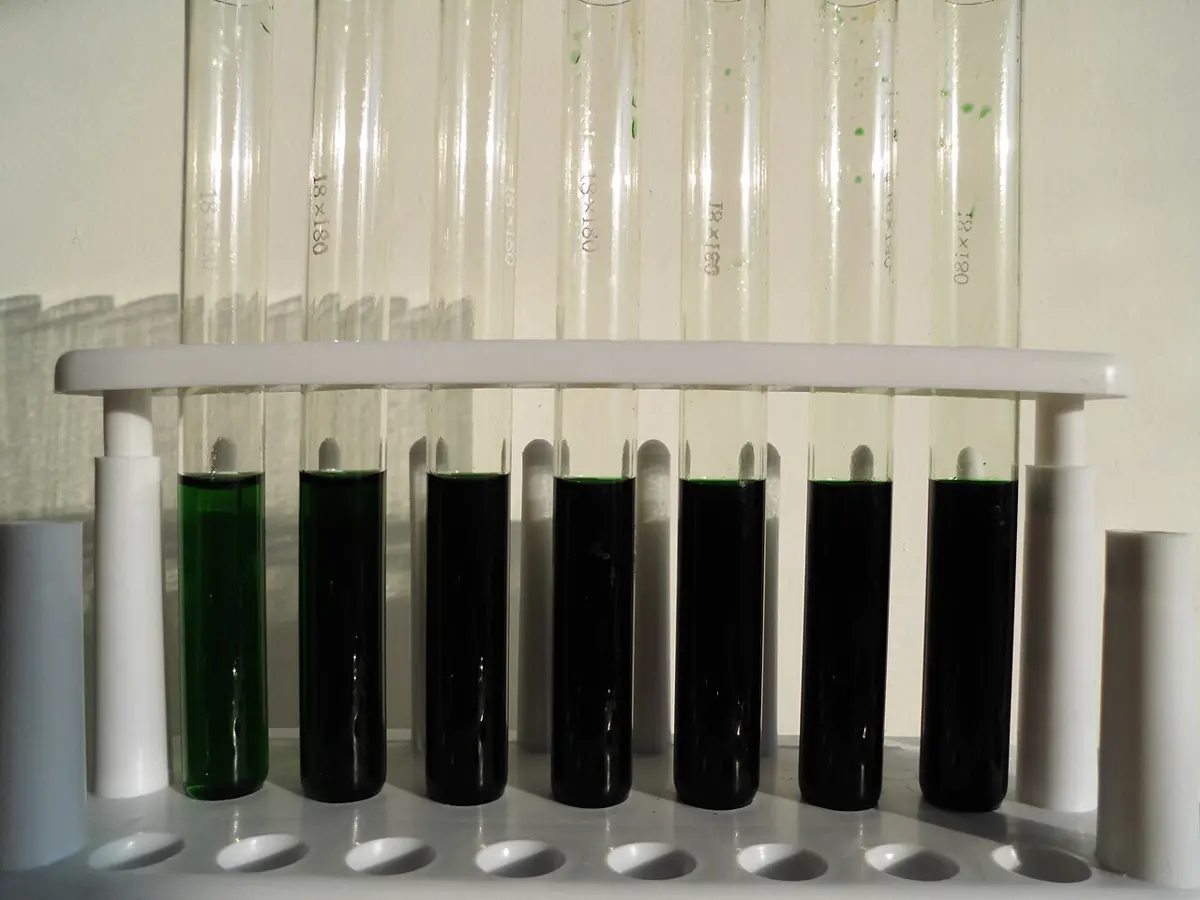
Example: the common oxidation states of chromium. Each has its own color:
| Oxidation state | Example | Color |
|---|---|---|
| +2 | Cr²⁺(aq) | sky blue (quickly oxidized by air) |
| +3 | [Cr(H₂O)₆]³⁺; Cr₂O₃ | violet in solution (green when chloride ions join the complex, as in most chromium(III) chloride solutions); green oxide |
| +6 | CrO₄²⁻, chromate | yellow |
| +6 | Cr₂O₇²⁻, dichromate | orange |

6.4 Complex ions and metal complexes
As the water molecules surround the metal ion, each oxygen atom, which carries two lone pairs, gives one of them to the metal, forming a coordinate bond. As more water molecules bond this way, a stable cluster forms round the central metal ion. The whole assembly, a central metal atom or ion with molecules or ions bonded round it by coordinate bonds, is a metal complex (or coordination complex), and if it carries an overall charge it is a complex ion.
- A ligand is a molecule or ion that gives a lone pair to the central metal. The ligand is a Lewis base and the metal a Lewis acid.
- The atom of the ligand that actually gives the pair is the donor atom: O in H₂O, N in NH₃, C in CN⁻.
- The coordination number is the number of donor atoms bonded to the central metal. If six water molecules attach, it is 6, and they usually take the shape of an octahedron.
- The coordination sphere is the central metal with the ligands bonded directly to it, written in square brackets [ ] in a formula. Ions outside the brackets, such as SO₄²⁻ in [Cu(NH₃)₄]SO₄, are counter ions.
Ligands
Ligands are atoms, ions or neutral molecules that give a lone pair of electrons to a central metal atom or ion to form a coordinate bond in a complex. They are named by how many donor atoms each one can bond with at once (Latin dens, tooth: how many “teeth” it bites with):
a. Monodentate ligands bond through one donor atom: the halide ions X⁻ (F⁻, Cl⁻, Br⁻, I⁻), CN⁻, OH⁻, H₂O, NH₃, CO and NO.
b. Bidentate ligands bond through two donor atoms: ethane-1,2-diamine (ethylenediamine, “en”, H₂N–CH₂–CH₂–NH₂) and the oxalate ion, C₂O₄²⁻. Carbonate, CO₃²⁻, and sulphate, SO₄²⁻, can act as bidentate ligands too, though they are often monodentate.
c. Tridentate ligands bond through three donor atoms: diethylenetriamine, H₂N–CH₂CH₂–NH–CH₂CH₂–NH₂, with three nitrogens.
d. Polydentate ligands bond through more than three. The best known is EDTA (ethylenediaminetetraacetate), which bonds through six donor atoms, two nitrogens and four oxygens: it is hexadentate.
A ligand that bonds through two or more donor atoms holds the metal in a ring, like a crab’s claw: it is a chelating ligand (Greek chele, claw), and the complex a chelate. Chelates are much more stable than complexes of the same metal with the same number of monodentate ligands, because letting go of one donor atom doesn’t let the ligand go.
Some examples of metal complexes, with their names:
| Formula | Name |
|---|---|
| [Cu(NH₃)₄]SO₄ | tetraamminecopper(II) sulphate |
| [Cr(H₂O)₄Cl₂]Cl | tetraaquadichloridochromium(III) chloride |
| K₃[Fe(CN)₆] | potassium hexacyanidoferrate(III) (potassium ferricyanide) |
| K₄[Fe(CN)₆] | potassium hexacyanidoferrate(II) (potassium ferrocyanide) |
| [Cr(H₂O)₆]³⁺ | hexaaquachromium(III) ion |
To read a name: the ligands come first, in alphabetical order, each with a number prefix (di-, tri-, tetra-, hexa-), then the metal with its oxidation state in Roman numerals. Ammine (two m’s) is NH₃ as a ligand, aqua is H₂O, chlorido is Cl⁻ (older books write chloro), cyanido is CN⁻ (older: cyano). In a complex anion, the metal’s name ends in -ate, and some take their Latin names: ferrate for iron, cuprate for copper, argentate for silver.
In [Co(NH₃)₅Cl]Cl₂, what are the coordination number of cobalt and the number of chloride ions that silver nitrate precipitates?
Pick an answer to see why.
6.5 Shapes of complex ions
The shape of a complex ion depends first on the number of ligands round the central metal, its coordination number (C.N.). The commonest coordination numbers of transition metal complexes are 4 and 6. Complexes with C.N. 4 are tetrahedral or square planar, and those with C.N. 6 are octahedral.
| Coordination number | Shape | Examples |
|---|---|---|
| 2 | linear | [Ag(NH₃)₂]⁺, [Ag(CN)₂]⁻ |
| 4 | square planar | [Ni(CN)₄]²⁻, [PtCl₄]²⁻, [Cu(NH₃)₄]²⁺ |
| 4 | tetrahedral | [CoCl₄]²⁻, [CuCl₄]²⁻, Ni(CO)₄, [Zn(NH₃)₄]²⁺, [MnCl₄]²⁻ |
| 6 | octahedral | [Cu(H₂O)₆]²⁺, [Fe(H₂O)₆]³⁺, [Co(NH₃)₆]³⁺, [Fe(CN)₆]³⁻ |
The factors that decide the shape of a complex ion are:
- the coordination number;
- the size of the metal ion (a small ion has room for fewer ligands);
- the kind and size of the ligands (four large Cl⁻ ions fit round a metal more easily than six);
- the electronic configuration and oxidation state of the central metal (d⁸ ions such as Ni²⁺ and Pt²⁺ with strong-field ligands are square planar; d¹⁰ ions such as Zn²⁺ are tetrahedral);
- steric effects: the repulsion between the ligands themselves, which keeps them as far apart as possible.
The shapes of complex ions can be explained with VSEPR theory, which considers the repulsion between electron pairs (Grade 11, Unit 5), and with crystal field theory (6.6), which considers how the d orbitals interact with the ligands. VSEPR alone can’t say why a d⁸ ion with four ligands chooses a square over a tetrahedron; the d electrons decide that.
Which complex is octahedral?
Pick an answer to see why.
6.6 Crystal field theory for octahedral complexes
In 1929 the physicist Hans Bethe worked out how the electric field of the ions round a metal ion in a crystal changes the energies of its electrons, and in the early 1930s John Hasbrouck Van Vleck used it to explain the magnetism of transition metal salts. The idea, called crystal field theory (CFT), was later applied to complexes in solution. It treats the ligands as point negative charges (or the negative ends of dipoles, as in H₂O and NH₃) placed round the central metal ion. Its postulates are:
- The metal ion is surrounded by the electric field created by the ligands.
- The bonding between the metal ion and the ligands is purely electrostatic: the attraction between the positive metal ion and the negative ligands.
- The transition metal is a positive ion with a charge equal to its oxidation state.
- In the absence of ligands, the five d orbitals of the metal ion are degenerate: all five have the same energy.
- In the presence of ligands this degeneracy is lost: the d orbitals split into a lower-energy set, t₂g, and a higher-energy set, eg. In an octahedral complex, the dxy, dyz and dzx orbitals form the lower set t₂g, and the dx²−y² and dz² orbitals the higher set eg.
- How far apart the sets are depends on the kind of ligand and on how the ligands are arranged round the metal ion.
- The difference in energy between the split orbitals gives the crystal field stabilization energy (CFSE), which contributes to the complexes’ stability, color, magnetism and other properties.
- High-spin complexes form with weak-field ligands (such as I⁻, Br⁻, Cl⁻, F⁻, OH⁻ and H₂O): the splitting is small, so electrons spread out over all five orbitals and many stay unpaired.
- Low-spin complexes form with strong-field ligands (such as CN⁻ and CO, and NH₃ with some metals): the splitting is large, so electrons pair up in the lower orbitals first.
Splitting of d orbitals in octahedral complexes
The splitting of a metal’s d orbitals in the presence of ligands is called crystal field splitting. In an octahedral complex the six ligands come in along the three axes, ±x, ±y and ±z. Electrons in the dx²−y² and dz² orbitals, which point along the axes, straight at the ligands, are repelled strongly and raised in energy: these two form the eg set. Electrons in dxy, dyz and dzx, which point between the axes, are repelled less and are lowered: these three form the t₂g set. The energy difference between the two sets is the crystal field splitting energy, Δo (o for octahedral).
The average energy of the five orbitals doesn’t change: the two eg orbitals go up by 0.6 Δo and the three t₂g orbitals go down by 0.4 Δo (2 × 0.6 = 3 × 0.4). So each electron in t₂g lowers the energy by 0.4 Δo and each in eg raises it by 0.6 Δo; their sum is the CFSE.
For example, Cr³⁺ (3d³) in an octahedral field puts its three electrons one in each t₂g orbital, all unpaired, by Hund’s rule:
That large stabilization is one reason chromium(III) complexes are so stable and slow to react.
High spin and low spin
For d¹, d² and d³ there is only one way to fill: one electron in each t₂g orbital. With a fourth electron there is a choice. It can go up into eg, which costs Δo, or pair up with an electron in t₂g, which costs the pairing energy, P, the extra repulsion of two electrons in one orbital.
- If Δo < P (a weak-field ligand), the electron goes up: electrons spread out over all five orbitals before any pair. Many unpaired electrons: a high-spin complex.
- If Δo > P (a strong-field ligand), the electron pairs in t₂g: the three lower orbitals fill before any electron goes up. Few unpaired electrons: a low-spin complex.
The choice exists only for d⁴, d⁵, d⁶ and d⁷. Iron(II), d⁶, shows it best: [Fe(H₂O)₆]²⁺ is high spin, with 4 unpaired electrons, and strongly paramagnetic, while [Fe(CN)₆]⁴⁻ is low spin, with all six electrons paired in t₂g, and diamagnetic.
A low-spin complex pays for its extra pairs: each costs P, so its CFSE is written with them. Low-spin Fe²⁺, with two more pairs than the free ion, has CFSE = 6 × (−0.4 Δo) + 2P = −2.4 Δo + 2P; high-spin Fe²⁺ has −0.4 Δo. Low spin wins only when Δo is bigger than P. Try them, and the other ions, in the widget.
Ligands can be put in order of the splitting they cause, the spectrochemical series, measured from the colors of their complexes:
The magnetism of a complex measures its unpaired electrons, n. The spin-only magnetic moment is
in Bohr magnetons, BM: 1.73 BM for one unpaired electron, 4.90 for four, 5.92 for five.
How many unpaired electrons has the low-spin complex [Co(NH₃)₆]³⁺?
Pick an answer to see why.
6.7 Color of transition metal compounds
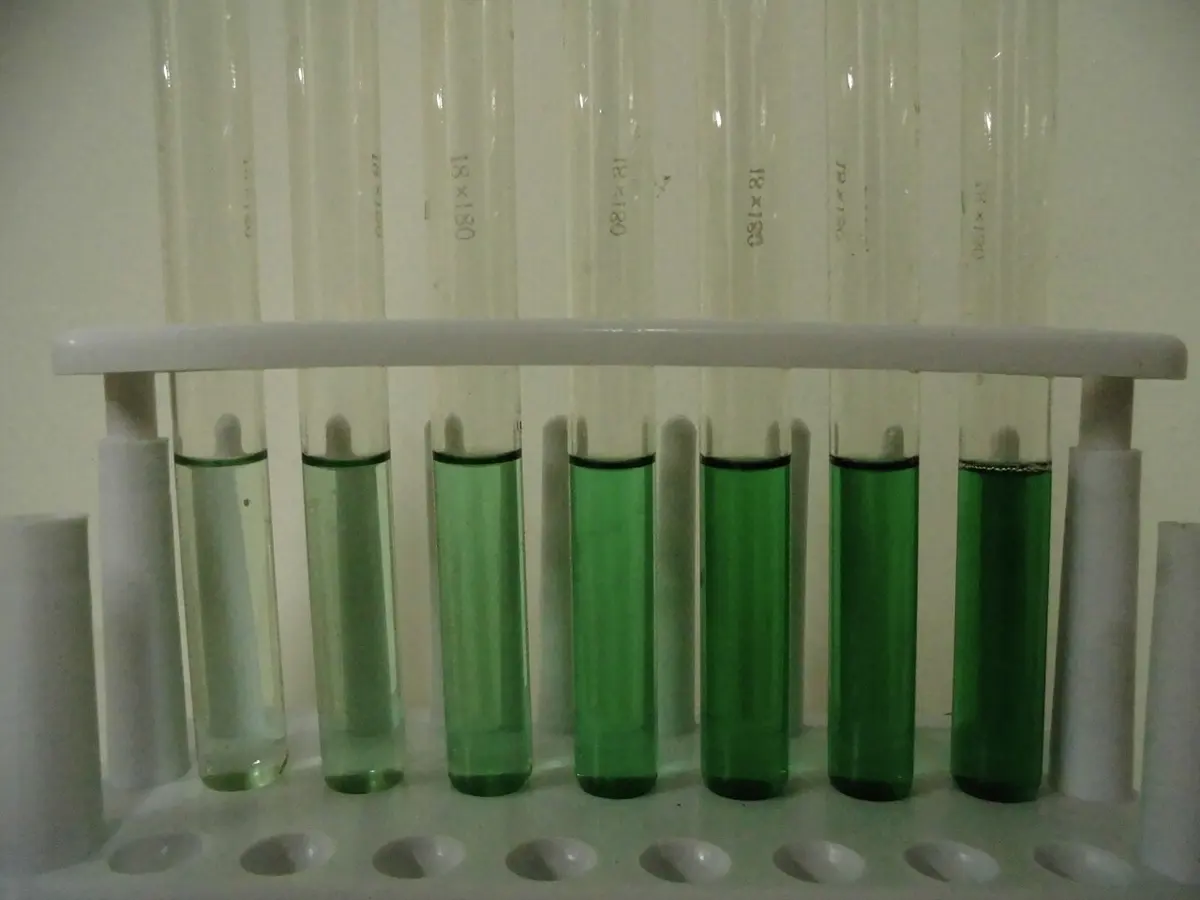
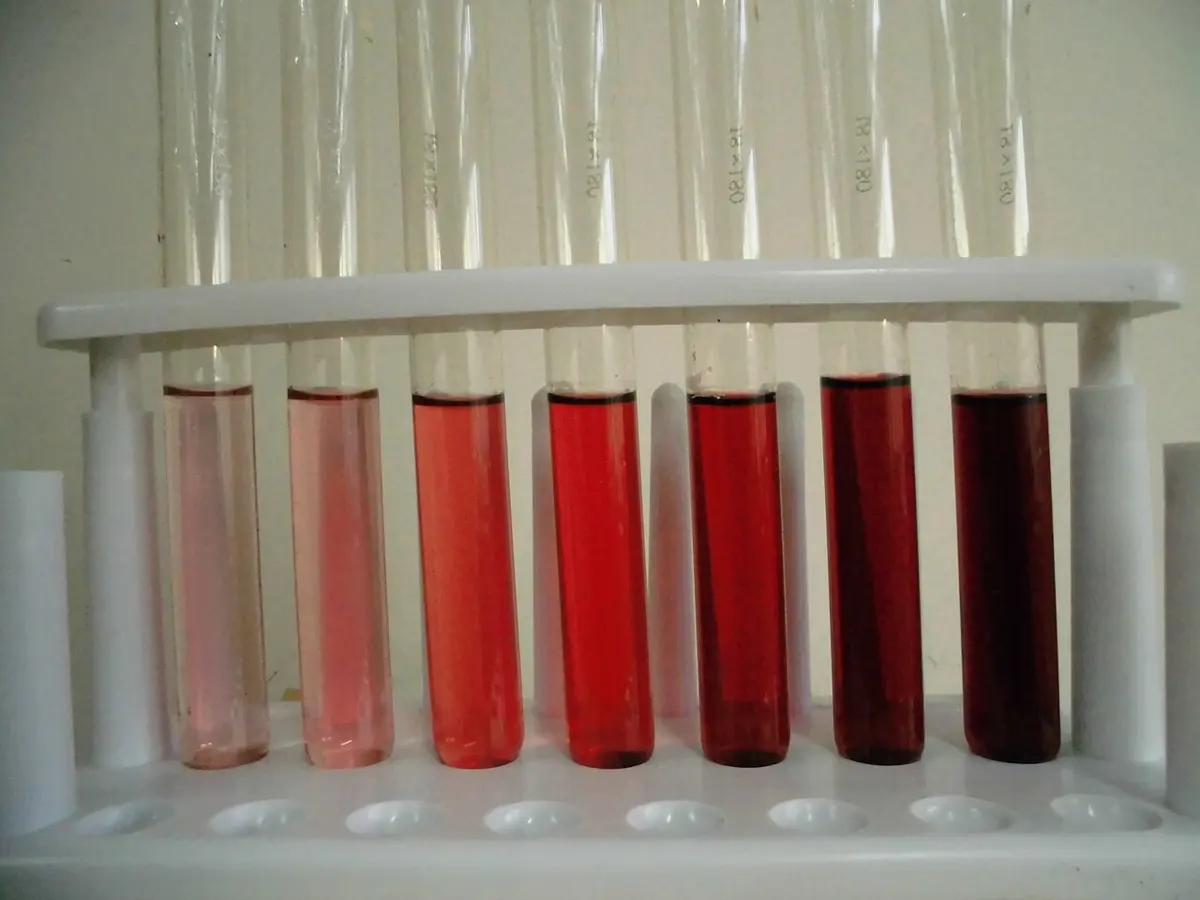
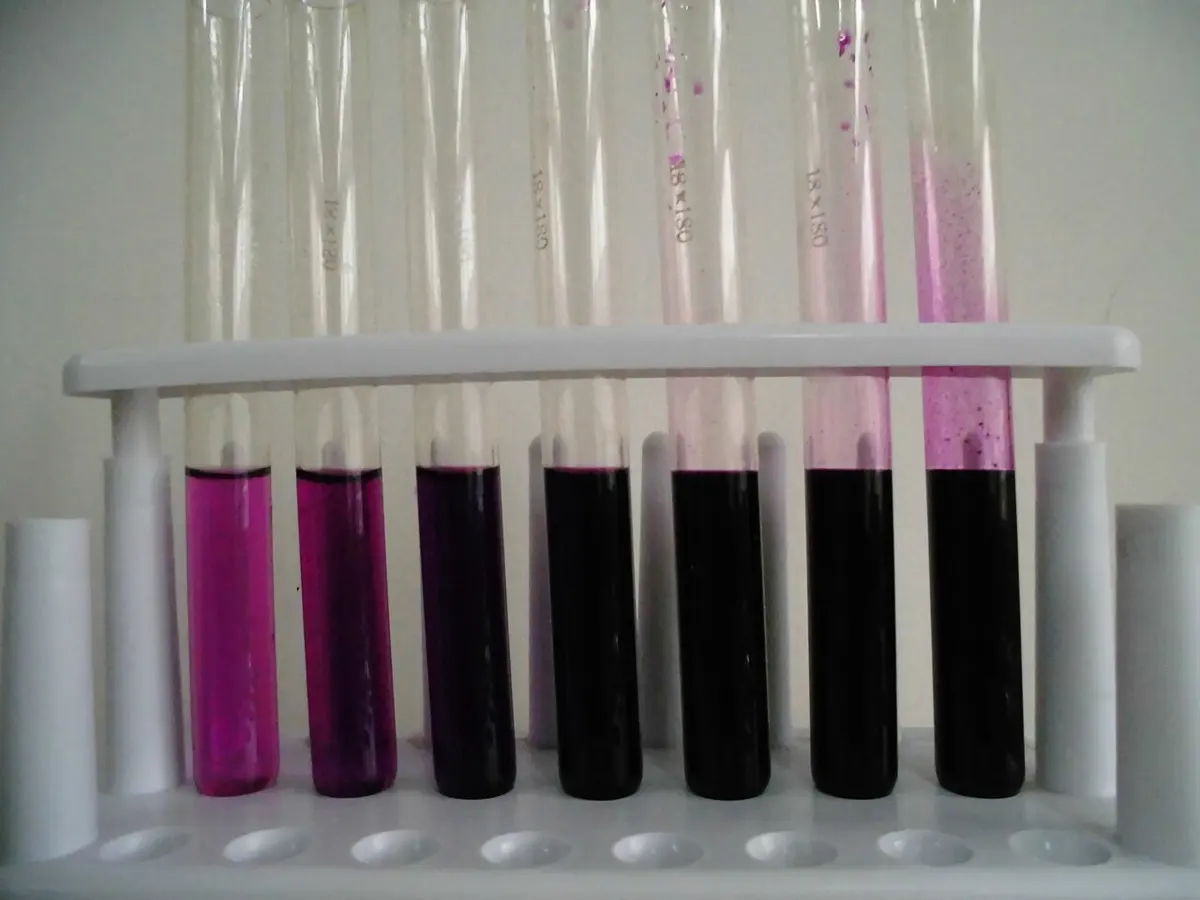
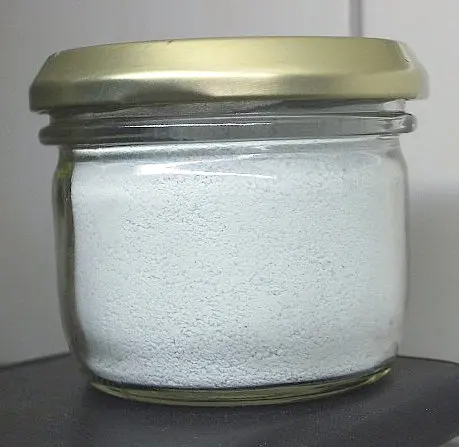
The color of transition metal ions comes from the absorption of particular wavelengths of light, which makes an electron in the metal ion jump from one energy level to another. The color depends on the metal, its oxidation state and the ligands round it. The reasons are these.
- Crystal field splitting. By crystal field theory, the ligands split the metal’s d orbitals into two sets. An electron in the lower set can jump to the higher one by absorbing light whose energy equals Δo, a d–d transition. For most complexes that energy falls in the visible range. The color seen is the complementary color of the light absorbed, and the oxidation state of the metal, the nature of the ligands and the shape of the complex all change it, since all three change Δo.
- Electronic configuration. Ions with an empty (d⁰) or full (d¹⁰) d subshell are usually colorless, because no d–d transition is possible: d⁰ has no electron to jump, d¹⁰ no empty place to jump to. Cu²⁺ (3d⁹) compounds are colored; Zn²⁺ (3d¹⁰) compounds are white.
- Charge transfer. In some compounds the color comes from an electron jumping from a ligand to the metal (or the other way), not between d orbitals. These charge-transfer transitions absorb far more strongly than d–d transitions, so the colors are intense. Permanganate, MnO₄⁻, has manganese +7 with no d electrons, yet it is intensely purple: light moves an electron from an oxide ligand onto the manganese. The yellow of chromate and the orange of dichromate (chromium +6, d⁰) have the same cause.
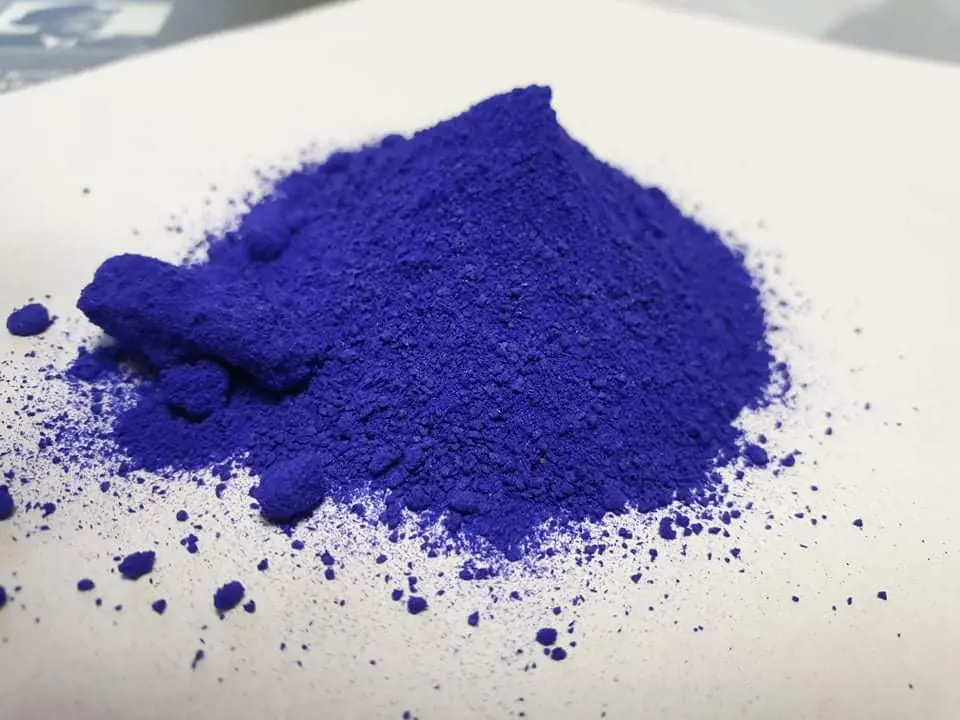
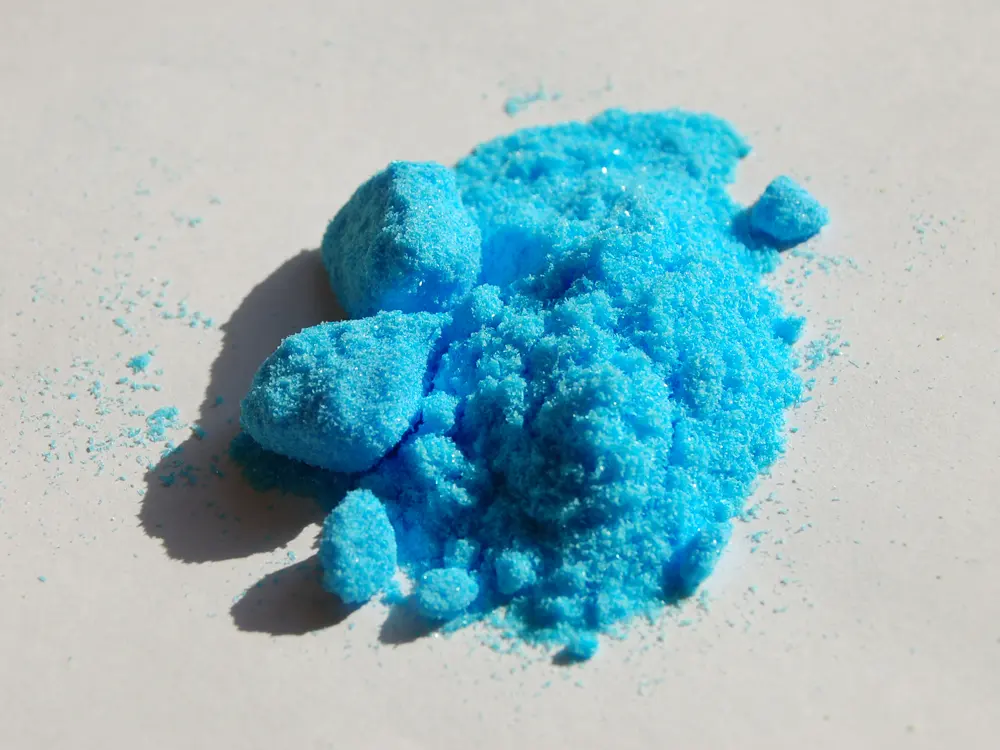
For example, a solution of copper(II) sulphate is blue. In water, Cu²⁺ is surrounded by water ligands, as the hydrated ion [Cu(H₂O)₆]²⁺, and its 3d⁹ orbitals are split. When white light falls on it, it absorbs most strongly at the red-orange end of the spectrum (the absorption peaks near 800 nm and runs into the orange) and lets the blue through. With ammonia, a stronger-field ligand, Δ grows, the absorption moves to shorter wavelengths, into the orange and yellow, and the color deepens to the royal blue of [Cu(NH₃)₄]²⁺.
Which ion is colorless in water?
Pick an answer to see why.
6.8 Catalytic property of transition metals
In the activity, nickel helped hydrogen to add to ethene to give ethane. This is the essence of catalysis: a process in which a substance, the catalyst, changes the rate of a reaction and is left unchanged at the end Grade 12: Unit 3. Transition metals and their compounds are among the most important catalysts there are, for two reasons.
- Variable oxidation states. A transition metal ion can gain or lose electrons for a moment during a reaction, because it can exist in several oxidation states. That lets it take part in a new, easier path, with a lower activation energy, through intermediates it forms and breaks down again. Iron ions, for example, catalyze the reaction of iodide with peroxodisulphate by passing between Fe²⁺ and Fe³⁺: , then .
- Surface adsorption. Transition metals and their compounds offer surfaces where reactant molecules are adsorbed, using the metal atoms’ partly filled d orbitals. Adsorption brings the reactants close together and weakens their bonds, so the intermediate forms easily and quickly turns into the products, which leave the surface. A finely divided catalyst, with more surface, works better.
| Catalyst | Use |
|---|---|
| Iron, with K₂O and Al₂O₃ as promoters (some books name molybdenum as the promoter) | making ammonia by the Haber process |
| Nickel (or palladium) | making vanaspati ghee by hydrogenating vegetable oil |
| MnO₂ | decomposing KClO₃ to oxygen on heating; decomposing H₂O₂ |
| TiCl₄ with triethylaluminium (the Ziegler–Natta catalyst) | making polyethene from ethene |
| Copper | dehydrogenating alcohols to aldehydes and ketones |
| V₂O₅ (or platinum) | making sulphuric acid by the contact process (SO₂ to SO₃) |
Which property of transition metals lets iron ions catalyze a redox reaction by passing between Fe²⁺ and Fe³⁺?
Pick an answer to see why.
Exercise
A. Multiple choice questions
- What is the maximum oxidation state shown by transition elements?
Pick an answer to see why.
- What is the maximum oxidation state shown by the 3d series?
Pick an answer to see why.
- Which of the following does not form colored compounds?
Pick an answer to see why.
- What is the general electronic configuration of transition metals?
Pick an answer to see why.
- Which of the following elements shows the maximum number of oxidation states?
Pick an answer to see why.
- Find the number of unpaired electrons on the iron ion of [Fe(H₂O)₆]²⁺.
Pick an answer to see why.
- What is the coordination number of octahedral complexes?
Pick an answer to see why.
- Which of the following ions has no d electrons?
Pick an answer to see why.
- What do we call the energy difference between the two sets of d orbitals in octahedral field splitting?
Pick an answer to see why.
- Which of the following ligands produces a strong crystal field?
Pick an answer to see why.
B. Short answer questions
Give reasons:
- a.Zinc is a non-typical transition element.
- b.Transition elements show variable oxidation states.
- c.Transition metals are good catalysts.
Answer
Write the characteristics of transition metals.
Answer
What do you mean by crystal field splitting?
Answer
What are transition elements? Why are they called so?
Answer
Define:
- a.ligands
- b.coordination sphere
- c.complex ion
Answer
Which has more unpaired electrons, Fe²⁺ or Cr³⁺?
Answer
What do you mean by degenerate orbitals?
Answer
What is crystal field splitting energy?
Answer
Give any two examples of complex ions.
Answer
Transition metal ions are paramagnetic. Why?
Answer
C. Long answer questions
What is CFT? Write its postulates.
Answer
Explain how CFT accounts for the splitting of d orbitals in octahedral complexes.
Answer
What are transition metals? Write their general characteristics.
Answer
Explain why transition metals and their compounds show catalytic properties.
Answer
Why do most transition metals form colored compounds? What factors affect the color of transition metal compounds?
Answer
Draw the shapes of complex ions having coordination numbers 4 and 6.
Answer
Printable PDFs
- Study notes 3 pages
- Worksheet 4 pages Answer key
Quiz yourself: Materials and Chemicals We Use, Grades 5–12 →
Practice every question in the book, and keep track of the ones you miss →
Project work
A companion to your textbook, not a replacement for it: study from the book your school uses, and where the two differ, follow your teacher. Found a mistake? Please tell us.